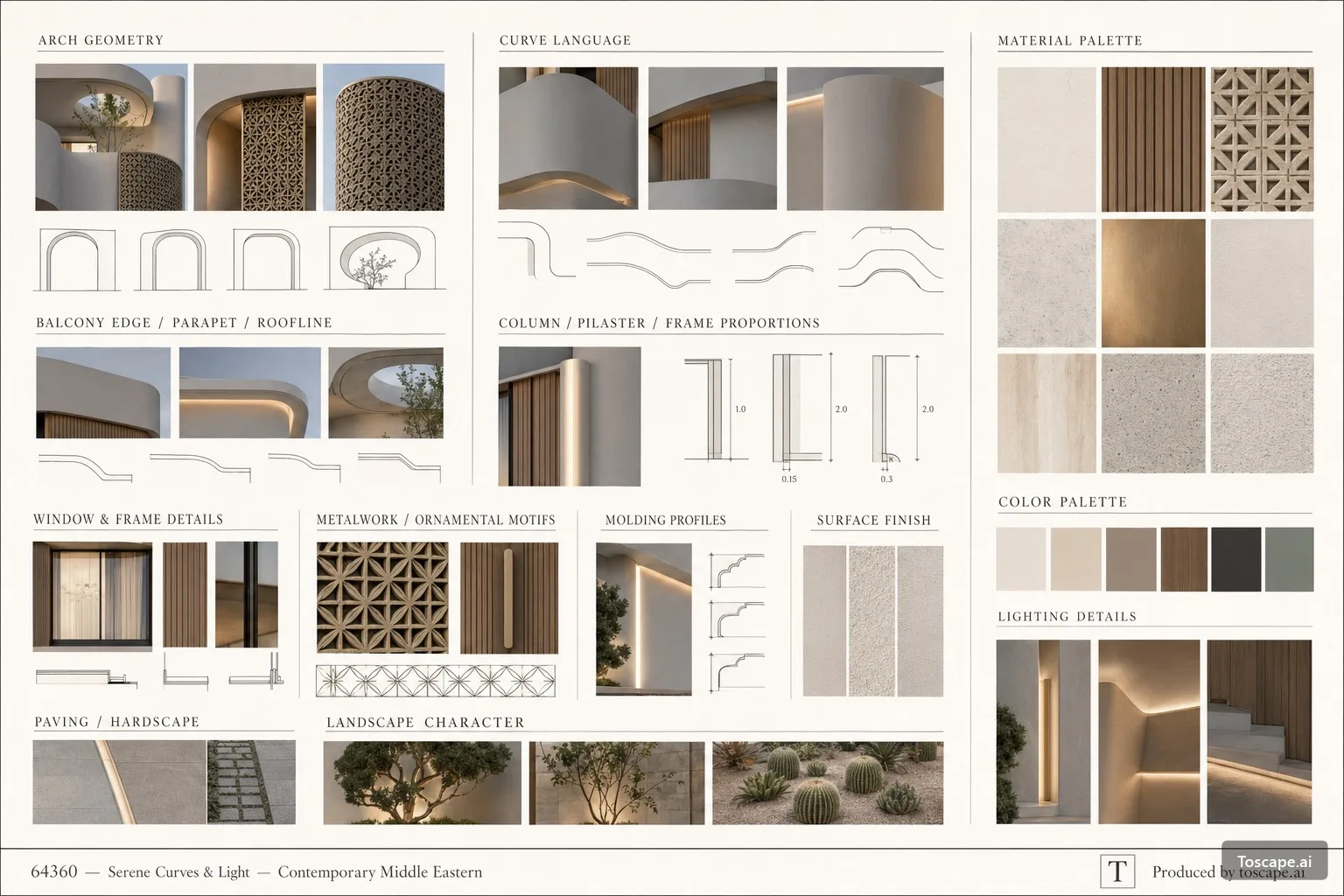
Curved Geometry and Material Palette in Contemporary Design: Contemporary Neo-Islamic, Facade Elements, Arched Openings architectural reference created with Toscape.
Curved Geometry and Material Palette in Contemporary Design
Curved Geometry and Material Palette in Contemporary Design is an architectural gallery study focused on moodboard design, using contemporary neo-islamic, facade elements, arched openings to explain the image as a practical reference for facade, massing, material, and spatial decisions.
The conceptual reading of this design is deeply rooted in spatial fluidity and continuity. The curved language employed in the facade and structural elements suggests a philosophy of seamless spatial transitions, where the boundaries between interior and exterior are softened. This approach not only enhances the experiential quality of the spaces but also fosters a sense of openness and connectivity with the surrounding environment. The spatial sequence is likely designed to guide occupants through a series of unfolding experiences, where each curve and surface finish contributes to the overall narrative of tranquility and elegance.
Massing strategy and formal composition are characterized by a hierarchy that prioritizes horizontal planes, with curves providing a dynamic counterpoint. The massing appears to be carefully articulated to create a sense of balance and proportion, where each element is thoughtfully integrated into the whole. This is evident in the way balconies and parapets are designed to extend the volumetric articulation, creating a dialogue between solid and void that enhances the building's visual permeability.
The envelope logic is defined by a strategic use of fenestration and shading devices that modulate light and privacy. The depth of the facade elements suggests a layered approach to environmental performance, where screens and overhangs are employed to mitigate solar gain while preserving views and natural light. The texture and material stratigraphy of the facade, including the use of warm tones and tactile finishes, contribute to a sense of groundedness and contextual response.
Material interpretation is confident, with a palette that combines natural textures with refined finishes. The use of stone, wood, and metal in the facade and interior elements reflects a commitment to durability and timelessness, while the color palette of earth tones and neutrals reinforces the design's connection to its cultural and environmental context. The lighting strategy further enhances the atmospheric modulation, creating subtle highlights and shadows that animate the spaces throughout the day.
Materials
The material reading is driven by mineral and stone-like tones, using surface depth, shadow, and warm neutral coloration to strengthen the facade's architectural identity.
Style
The style direction reads as contemporary neo-islamic, supported by facade elements and arched openings.
Building Type
Facade Elements
Facade Logic
The facade logic is organized around organic or parametric articulation, where repeated surface movement creates a unified envelope rather than a flat decorative skin.