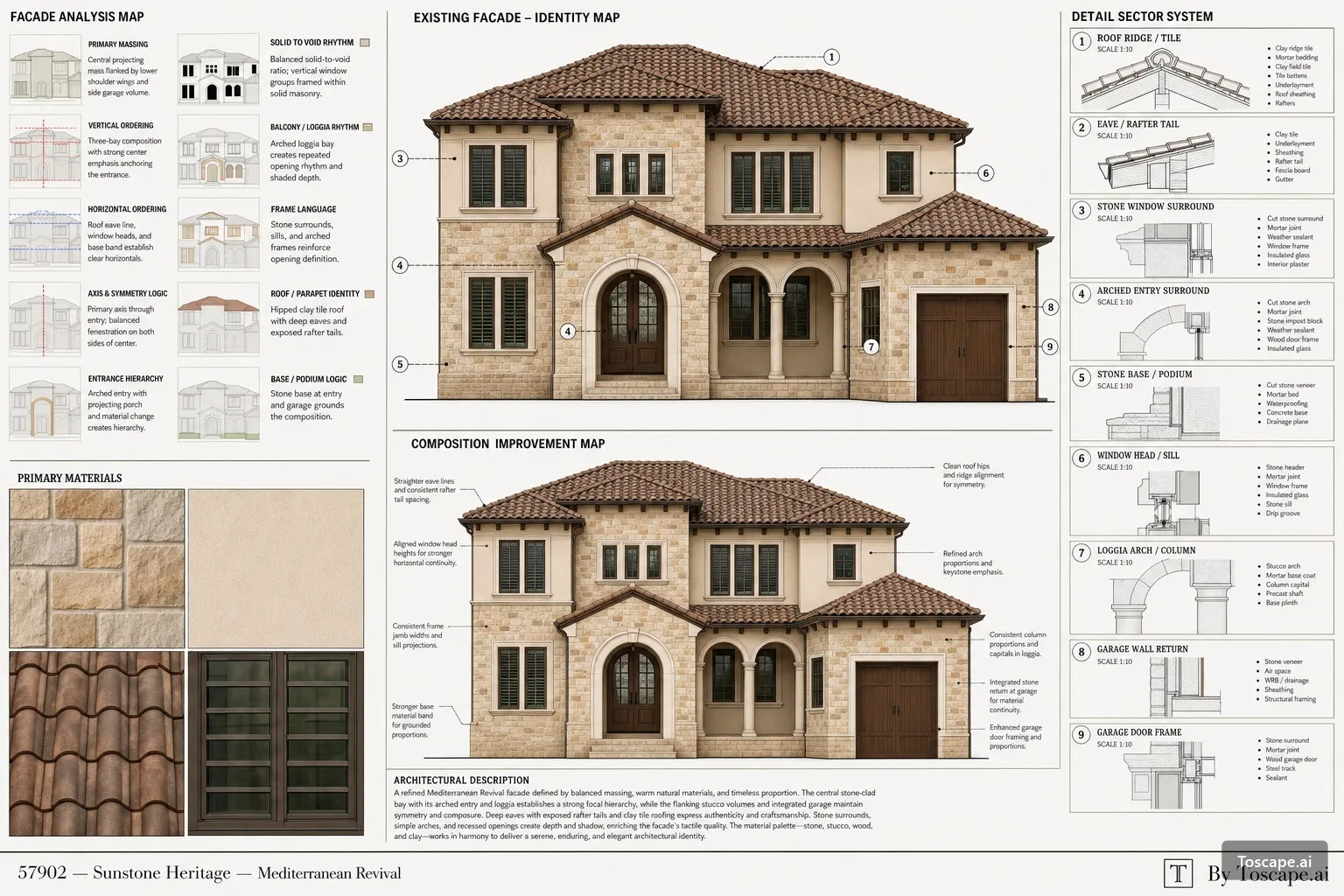
Mediterranean Revival Facade Analysis is an architectural gallery study focused on exterior design, using neo-classical, exterior, symmetrical composition to explain the image as a practical reference for facade, massing, material, and spatial decisions.
The spatial philosophy of the design is rooted in classical principles, where the hierarchy of elements is clearly articulated. The facade improvements focus on refining the visual continuity and symmetry, aligning window head heights and straightening eave lines to enhance horizontal order. The volumetric articulation is achieved through the interplay of solid and void, with deep eaves and projecting stone elements providing depth and shadow.
The massing strategy employs a clear horizontal-vertical interplay, with the roof's hipped clay tiles and deep eaves suggesting a load-bearing logic that is both functional and aesthetic. The facade's envelope performance is enhanced by the use of natural materials such as stone, stucco, and wood, which contribute to the building's thermal regulation and visual texture. The fenestration strategy includes well-proportioned windows with deep sills, offering both visual permeability and shading.
Material interpretation is confident, with a palette that speaks to the Mediterranean aesthetic. The stone cladding, stucco surfaces, and clay tiles work in concert to create a tactile and visually warm facade. The texture of these materials is carefully considered, with the stone providing a rough, natural finish that contrasts with the smoothness of the stucco and the rich, earthy tones of the clay tiles.
Light and shadow play a critical role in the facade's atmospheric modulation, with the deep eaves casting shadows that change throughout the day, adding dynamism to the building's appearance. The landscape interface is subtle yet effective, with the building's base integrating seamlessly with its surroundings, grounding the structure in its context. The skyline relationship is one of understated elegance, with the roofline's gentle slopes complementing the horizon.
Materials
The material reading is driven by mineral and stone-like tones, using surface depth, shadow, and warm neutral coloration to strengthen the facade's architectural identity.
Style
The style direction reads as neo-classical, supported by exterior and symmetrical composition.
Building Type
Villa
Facade Logic
The facade logic uses arches, screens, and layered openings to balance cultural reference, shading depth, and contemporary envelope rhythm.