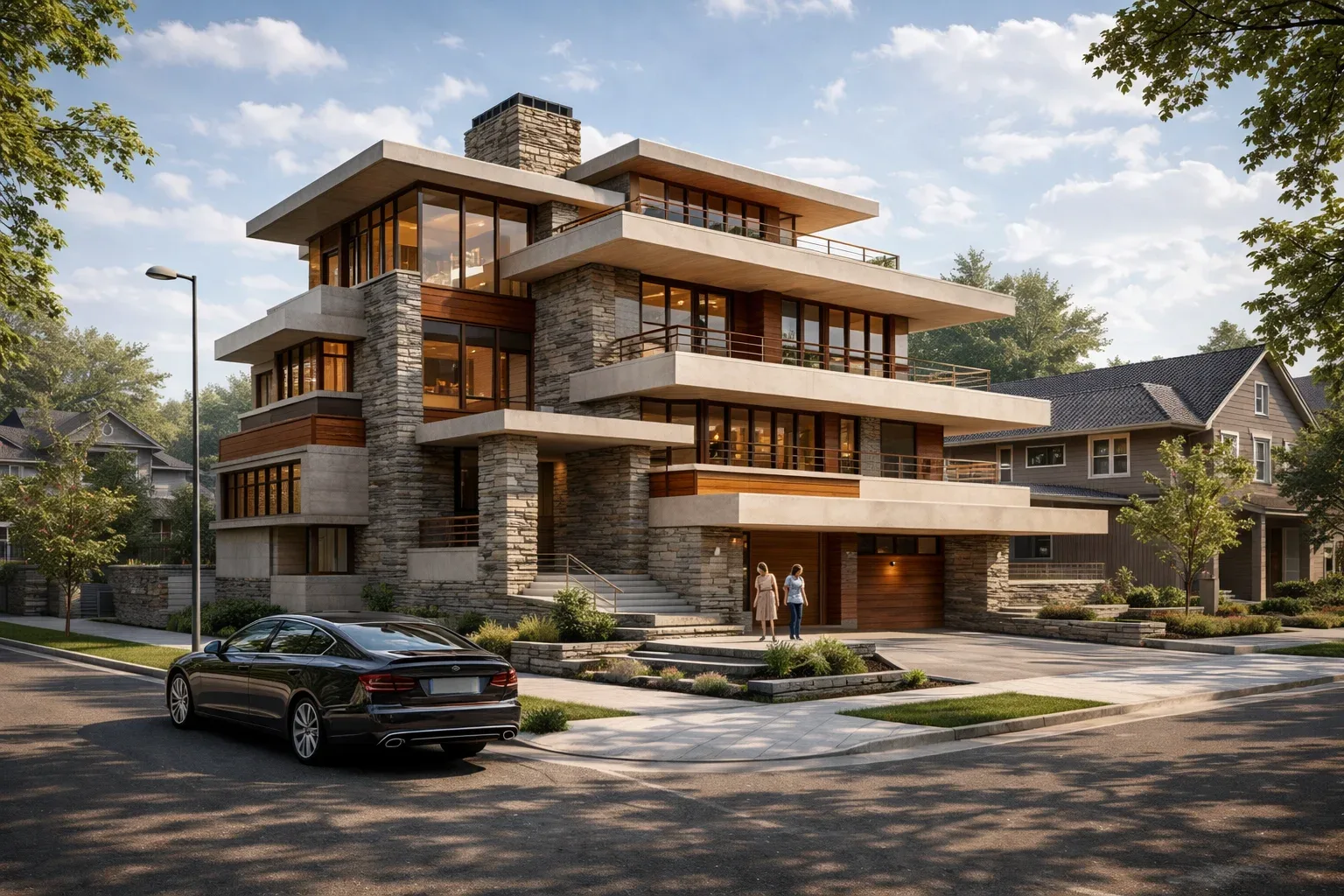
Contemporary Prairie-Style Residential Design is an architectural gallery study focused on exterior design, using nature-integrated contemporary, exterior, organic spatial flow to explain the image as a practical reference for facade, massing, material, and spatial decisions.
Conceptually, the building embraces a spatial philosophy of openness and connection to nature. The extensive use of glass in the fenestration strategy allows for a seamless visual permeability between the interior and exterior spaces, enhancing the dwelling's relationship with its context. The spatial sequence is articulated through a series of terraces and balconies, which provide transitional zones that blur the boundaries between indoor and outdoor living.
The massing strategy is one of layered horizontality, with a clear hierarchy that emphasizes the horizontal axis. This is achieved through the use of strong, linear roof planes that extend outward, creating a sense of shelter and protection. The formal composition is balanced and symmetrical, with a central stone chimney acting as a vertical anchor amidst the horizontal planes.
The facade logic is defined by the interplay of solid and void, with deep overhangs providing shading and textural contrast against the smooth stone and wood surfaces. The openings are carefully proportioned, offering both privacy and openness, while the depth of the facade elements contributes to the building's tectonic expression. The material palette of stone, wood, and glass is both tactile and visually warm, suggesting a high level of craftsmanship and attention to detail.
Light and shadow play a significant role in the building's atmospheric modulation. The broad eaves cast deep shadows that animate the facade throughout the day, while the landscape interface is thoughtfully integrated, with terraced planting beds that echo the building's stepped form. The relationship to the skyline is one of subtlety, with the building's low profile ensuring it sits comfortably within its suburban context.
Materials
The material reading is driven by mineral and stone-like tones, using surface depth, shadow, and warm neutral coloration to strengthen the facade's architectural identity.
Style
The style direction reads as nature-integrated contemporary, supported by exterior and organic spatial flow.
Building Type
Villa
Facade Logic
The facade logic is organized around organic or parametric articulation, where repeated surface movement creates a unified envelope rather than a flat decorative skin.