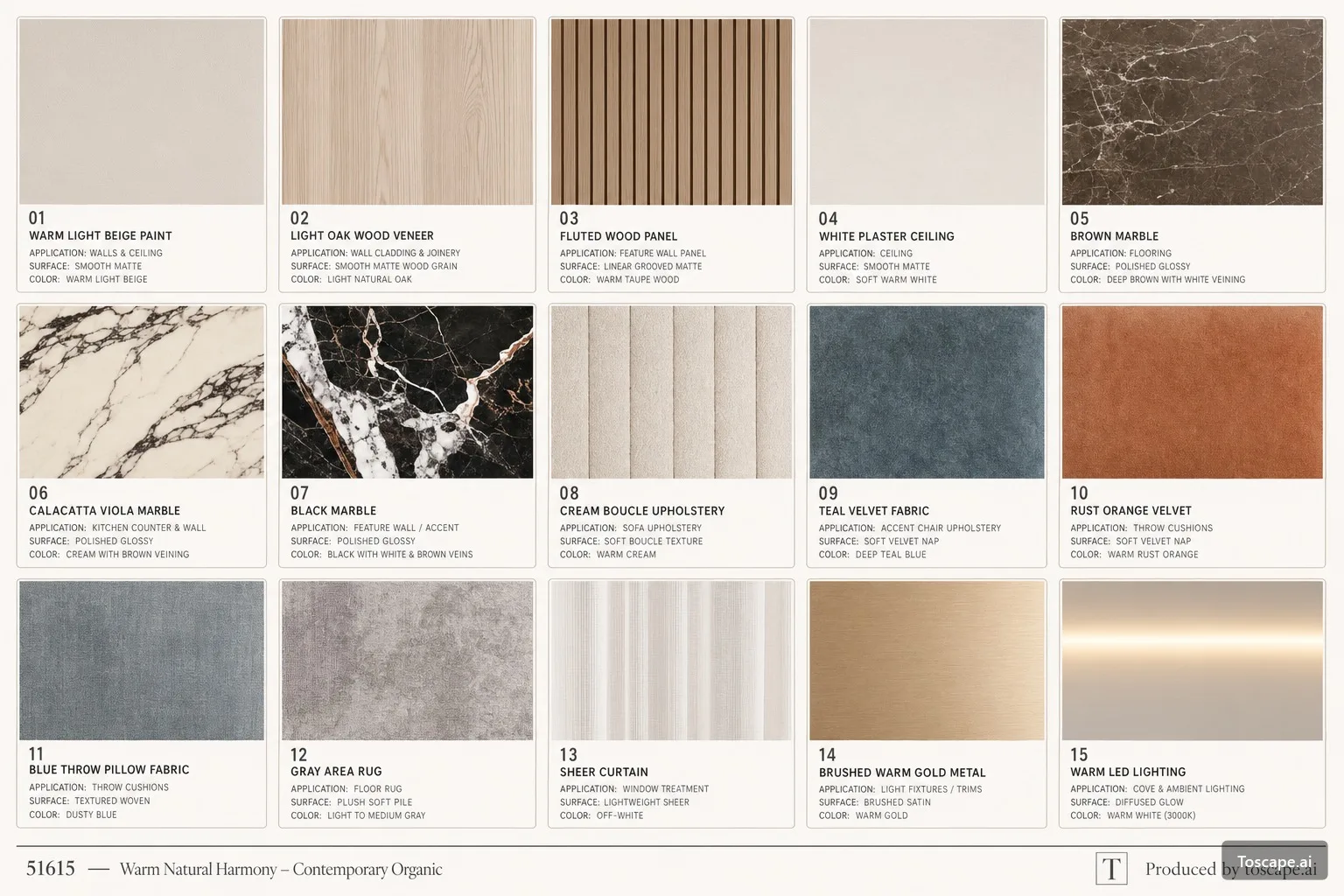
Warm Natural Harmony: Contemporary Organic Palette
Architectural Topic
Warm Natural Harmony: Contemporary Organic Palette is an architectural gallery study focused on texture's design, using nature-integrated contemporary, interior finishes, organic spatial flow to explain the image as a practical reference for facade, massing, material, and spatial decisions.
The design direction is rooted in contemporary organic aesthetics, characterized by a balance between natural elements and refined finishes. The use of light oak wood veneer and fluted wood panels introduces a tectonic dialogue between linearity and natural grain, while the inclusion of plush fabrics like teal velvet and cream boucle upholstery adds a layer of softness and comfort. This stylistic lineage aligns with modern design philosophies that prioritize both form and function, creating spaces that are as comfortable as they are visually appealing.
Conceptually, the palette invites a reading of space as a sensory experience, where the interplay of materials and colors enhances the atmospheric quality of an interior. The spatial philosophy here seems to embrace a holistic approach, where each material contributes to the overall ambience, creating a seamless transition between different areas within a space. This approach is likely to appeal to contemporary sensibilities that value both aesthetic coherence and experiential richness.
The massing strategy implied by this palette would likely involve a careful layering of materials to create depth and interest. The formal composition could be expected to feature a hierarchy of textures, with smoother surfaces acting as a backdrop to more textured elements, such as the fluted wood panel or the plush fabrics. This creates a dynamic yet balanced visual field, where each material has its own role within the larger composition.
In terms of envelope logic, the materials suggest a nuanced approach to facade and interior treatments. The use of brushed warm gold metal and warm LED lighting indicates a focus on subtle illumination and reflective surfaces, enhancing the play of light and shadow across different textures. This not only contributes to the visual permeability of the space but also to its overall envelope performance, ensuring that the interior remains inviting and well-lit.
Materials
The material reading is driven by mineral and stone-like tones, using surface depth, shadow, and warm neutral coloration to strengthen the facade's architectural identity.
Style
The style direction reads as nature-integrated contemporary, supported by interior finishes and organic spatial flow.
Explore Regional & Global StylesBuilding Type
Interior Finishes
Facade Logic
The facade logic is organized around organic or parametric articulation, where repeated surface movement creates a unified envelope rather than a flat decorative skin.
Explore Related Keywords
1536 × 1024 px
Generation Receipt
Deterministic pipeline: the workflow, style direction and output size below are locked at generation time, so the same inputs reproduce the same visual language.
- Workflow
- Mood Board
- Style direction
- Explore Regional & Global Styles
- Output
- 1536 x 1024 px
More from this category


Academy links
Material Swap for Facades and Interiors
Study how material changes alter facade and interior perception.
Re-Render for Concept and Client Review
Learn how to refine existing concepts while protecting studio imagery.
Integrating Toscape into Architectural Production
Connect AI image studies with professional studio workflows.