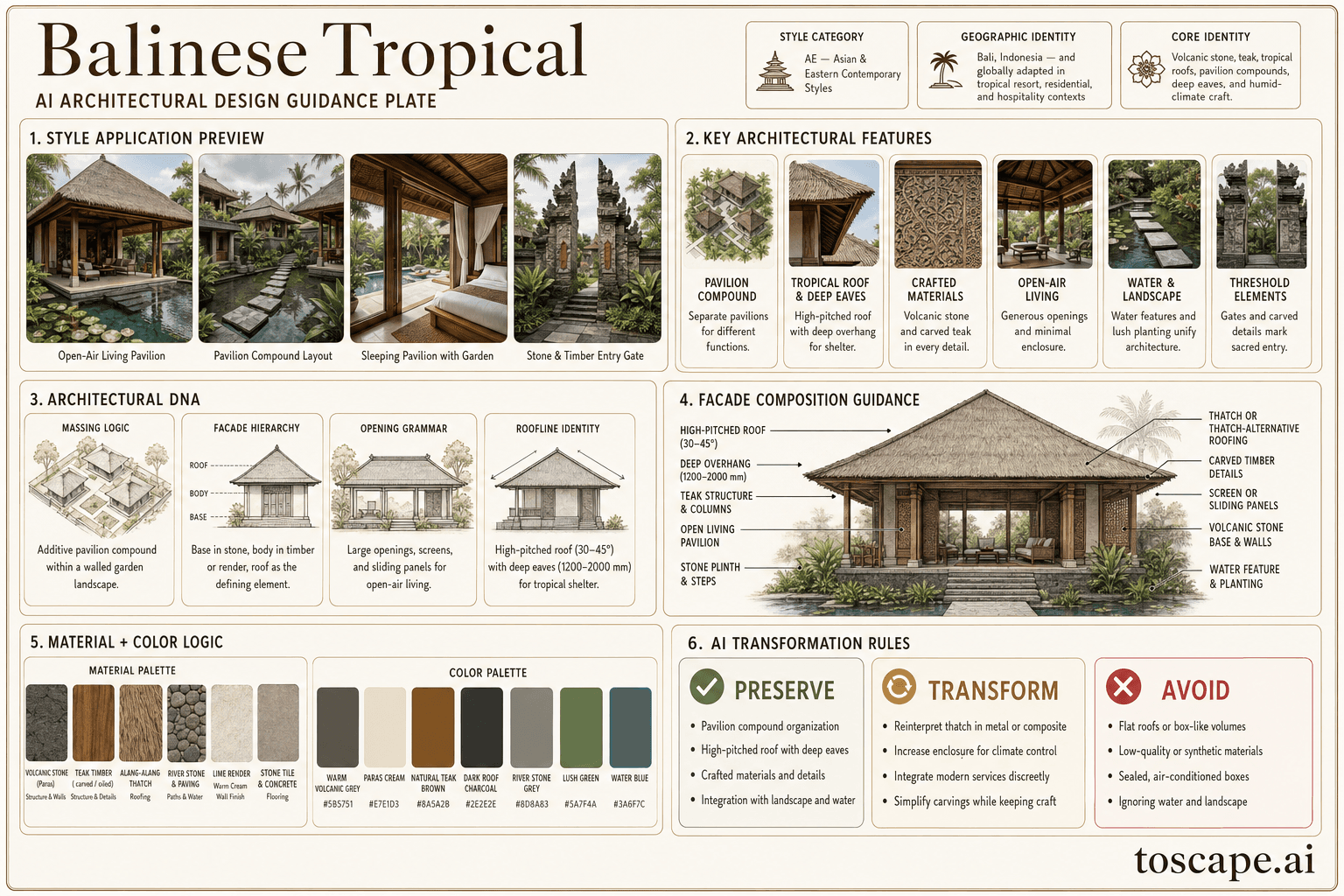
Balinese Tropical
Bali, Indonesia - and globally adapted in tropical resort, residential, and hospitality... / Asian contemporary
Volcanic stone, teak, tropical roofs, pavilion compounds, deep eaves, and humid-climate craft.
Definition
Balinese Tropical is a global architectural style within the asian contemporary. Volcanic stone, teak, tropical roofs, pavilion compounds, deep eaves, and humid-climate craft.
- Family
- Asian contemporary
- Origin
- Bali, Indonesia - and globally adapted in tropical resort, residential, and hospitality.
- Massing
- Massing follows the Balinese compound (pekarangan) logic. Separate pavilion buildings arranged within a walled garden compound.
- Materials
- Walls: paras stone (volcanic tuff), rendered masonry, or timber panels Roofing: alang-alang thatch, composite thatch, dark shingles, or standing-seam metal Timber: teak.
- Palette
- Primary tones: warm volcanic grey, pale paras cream, natural teak brown Roof tones: weathered grey-brown thatch, dark shingle, or charcoal metal Stone tones: dark grey.
- Climate response
- Bali, Indonesia. And globally adapted in tropical resort, residential, and hospitality contexts where Balinese craft traditions, Hindu-influenced spatial culture, and tropical climate response are valued.
Overview
Balinese Tropical is a global architectural style rooted in Bali, Indonesia - and globally adapted in tropical resort, residential, and hospitality contexts where Balinese craft traditions, Hindu-influenced spatial culture, and tropical climate response are valued. Volcanic stone, teak, tropical roofs, pavilion compounds, deep eaves, and humid-climate craft. Serene, crafted, and deeply connected to landscape.
Visual DNA
Massing & Form
Massing follows the Balinese compound (pekarangan) logic. separate pavilion buildings arranged within a walled garden compound.
Facade Language
Facades express the Balinese relationship of base (stone), body (timber and render), and roof (thatch or tile). Stone plinths and bases ground each pavilion.
Materials & Texture
Walls: paras stone (volcanic tuff), rendered masonry, or timber panels Roofing: alang-alang thatch, composite thatch, dark shingles, or standing-seam metal Timber: teak. carved, oiled, or naturally weathered.
Color Palette
Primary tones: warm volcanic grey, pale paras cream, natural teak brown Roof tones: weathered grey-brown thatch, dark shingle, or charcoal metal Stone tones: dark grey, warm brown-grey, soft cream Water and planting provide natural...
Ornament & Detail
Pavilion compound organization. separate buildings for separate functions.
Climate Response
Bali, Indonesia. and globally adapted in tropical resort, residential, and hospitality contexts where Balinese craft traditions, Hindu-influenced spatial culture, and tropical climate response are valued.
Landscape & Ground
Bali, Indonesia. and globally adapted in tropical resort, residential, and hospitality contexts where Balinese craft traditions, Hindu-influenced spatial culture, and tropical climate response are valued.
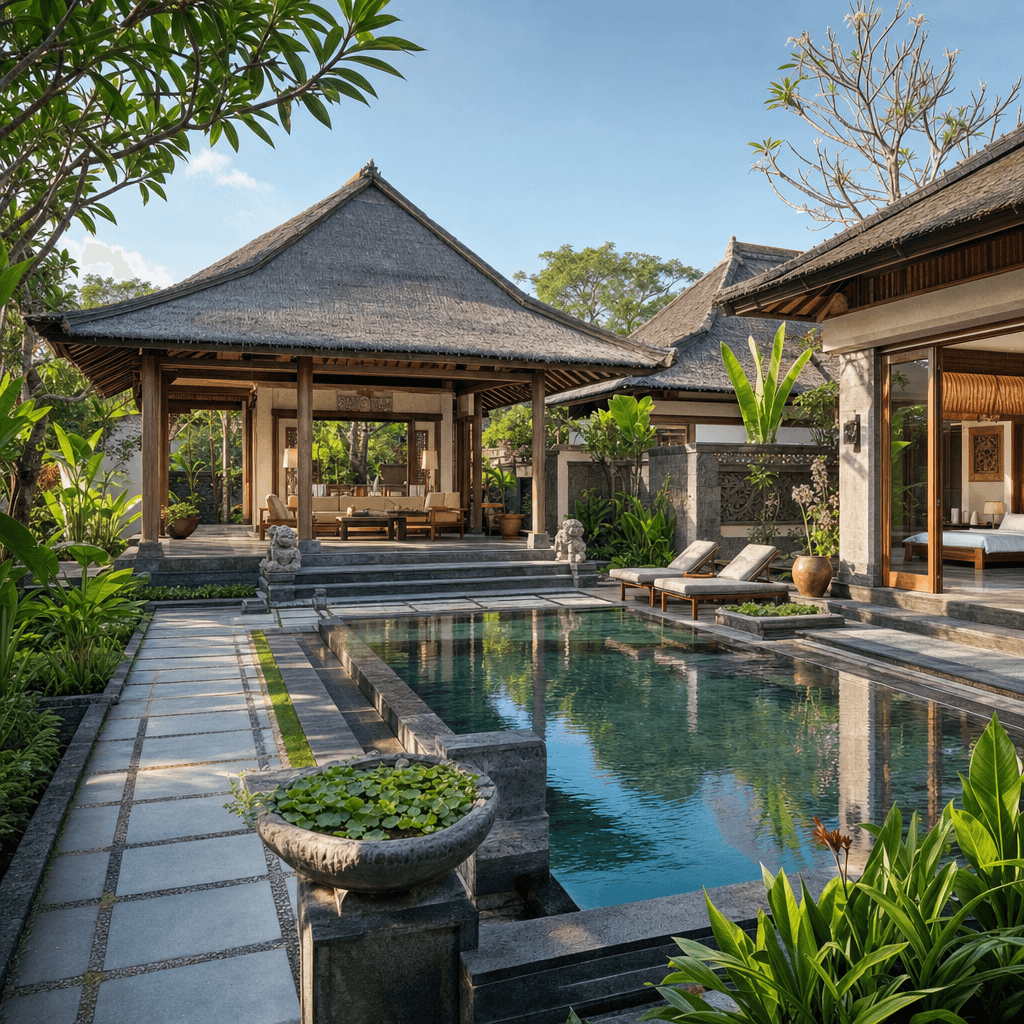
Reference elevation
Balinese Tropical - characteristic facade composition within the asian contemporary.
Context Snapshot
Serene, crafted, and deeply connected to landscape. Massing follows the Balinese compound (pekarangan) logic - separate pavilion buildings arranged within a walled garden compound. Bali, Indonesia - and globally adapted in tropical resort, residential, and hospitality contexts where Balinese craft traditions, Hindu-influenced spatial culture, and tropical climate response are valued.
Contemporary Relevance
Today, Balinese Tropical remains relevant wherever projects need asian contemporary cues without losing performance or contemporary usability. In Toscape it responds best when prompts emphasize massing follows the balinese compound (pekarangan) logic - separate pavilion buildings arranged within a walled garden compound. walls: paras stone (volcanic tuff), rendered masonry, or timber panels roofing: alang-alang thatch, composite thatch, dark shingles, or...
Use this style in Toscape
Explore Balinese Tropical directly inside Toscape using Facade Re-Style and design workflow prompts tuned for global architectural references.
Open Balinese Tropical in the galleryFrequently asked questions
What is Balinese Tropical?
Balinese Tropical is a global architectural style within the asian contemporary. Volcanic stone, teak, tropical roofs, pavilion compounds, deep eaves, and humid-climate craft.
What materials define Balinese Tropical?
Walls: paras stone (volcanic tuff), rendered masonry, or timber panels Roofing: alang-alang thatch, composite thatch, dark shingles, or standing-seam metal Timber: teak. Carved, oiled, or naturally weathered.
What is the Balinese Tropical color palette?
Primary tones: warm volcanic grey, pale paras cream, natural teak brown Roof tones: weathered grey-brown thatch, dark shingle, or charcoal metal Stone tones: dark grey, warm brown-grey, soft cream Water and planting provide natural.
What is the origin of Balinese Tropical?
Serene, crafted, and deeply connected to landscape. Massing follows the Balinese compound (pekarangan) logic - separate pavilion buildings arranged within a walled garden compound. Bali, Indonesia - and globally adapted in tropical resort, residential, and hospitality contexts where Balinese craft traditions, Hindu-influenced spatial culture, and tropical climate response are valued.
When should architects use Balinese Tropical?
Today, Balinese Tropical remains relevant wherever projects need asian contemporary cues without losing performance or contemporary usability. In Toscape it responds best when prompts emphasize massing follows the balinese compound (pekarangan) logic - separate pavilion buildings arranged within a walled garden compound. Walls: paras stone (volcanic tuff), rendered masonry, or timber panels roofing: alang-alang thatch, composite thatch.
How do you render Balinese Tropical in Toscape?
Open Toscape on Windows, load your own photo, elevation, sketch, or CAD view, then apply the Balinese Tropical reference from the built-in style library. The Facade Re-Style and Design Options workflows keep your project geometry and camera while shifting materials, proportion, and detailing toward Balinese Tropical.