Architectural
Styles
Explore architectural style directions across international movements, regional contemporary identities, interior design categories, and material moodboards.
Visual reference guides to regional architectural identities. Each card opens a dedicated style page covering visual DNA, materials, and climate response.
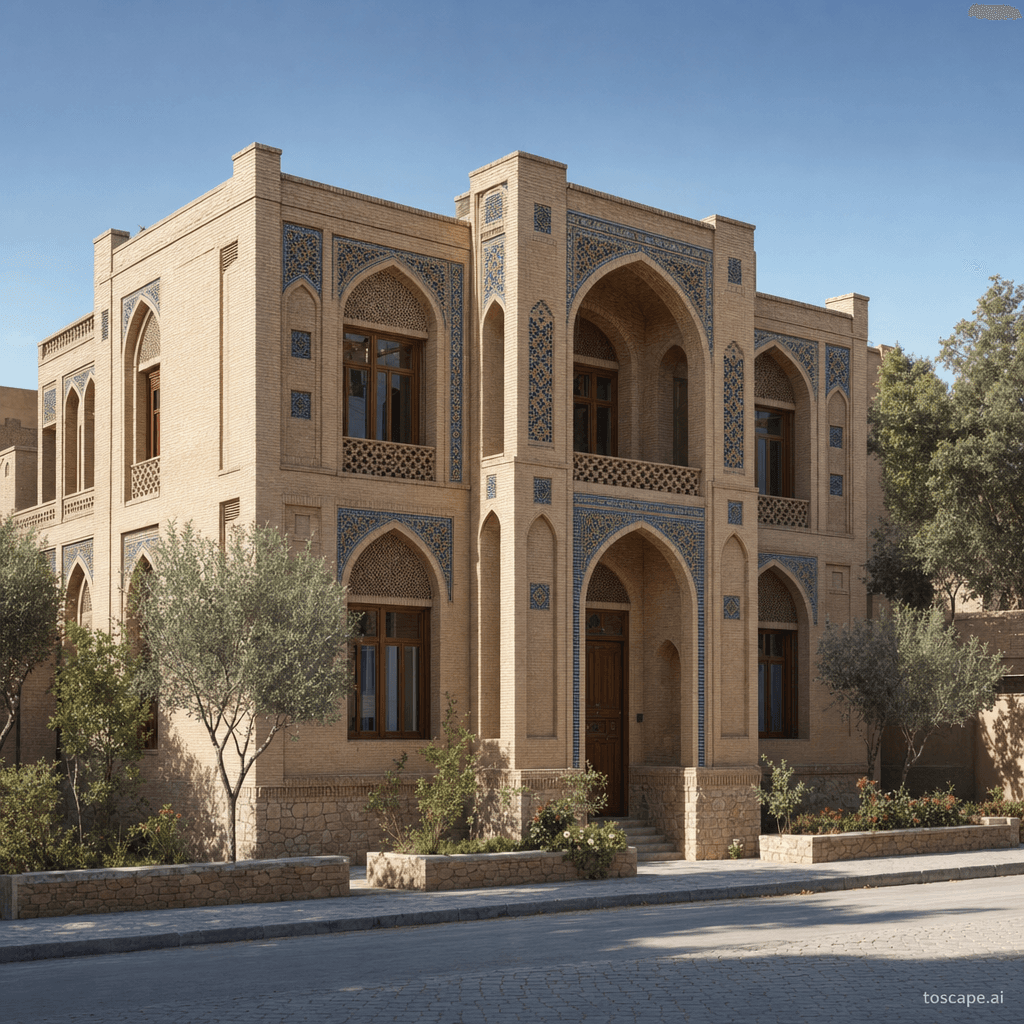
Herat Western Timurid
Afghanistan · architecture of Herat (Harāt)
The Herati domestic house — a single-story courtyard dwelling, typically constructed of fired brick rather than the mud-brick of Kabul, reflecting Herat's hot-arid climate and the availability of good brick clay from the Hari Rud valley — the house is organize...
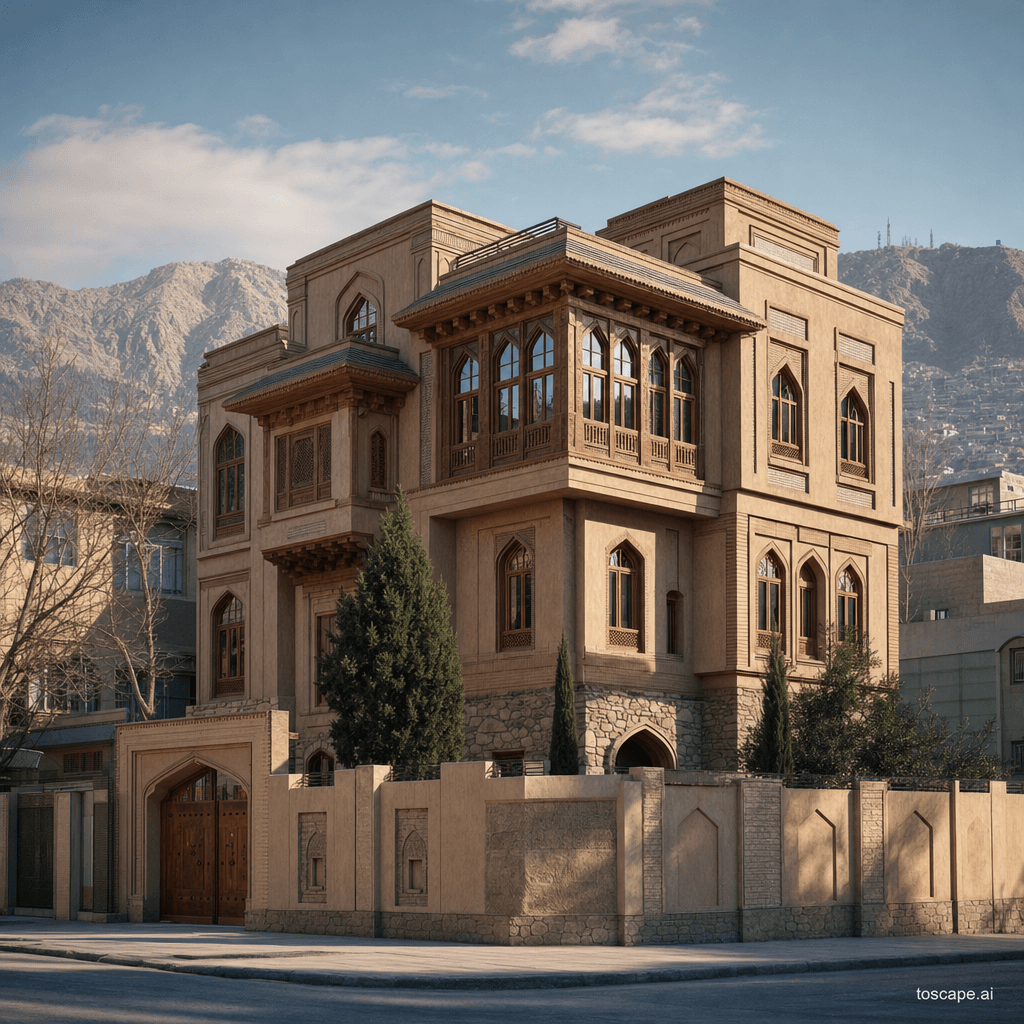
Kabul Central Highland
Afghanistan · traditional architecture of Kabul (Kābul)
The Kabuli courtyard house (khāna) — a one- to two-story dwelling built of mud-brick (khesht-e gel) or fired brick, organized around a rectangular courtyard (ḥayāt) that serves as the spatial and social center — the exterior facing the narrow unpaved lane (kūc...
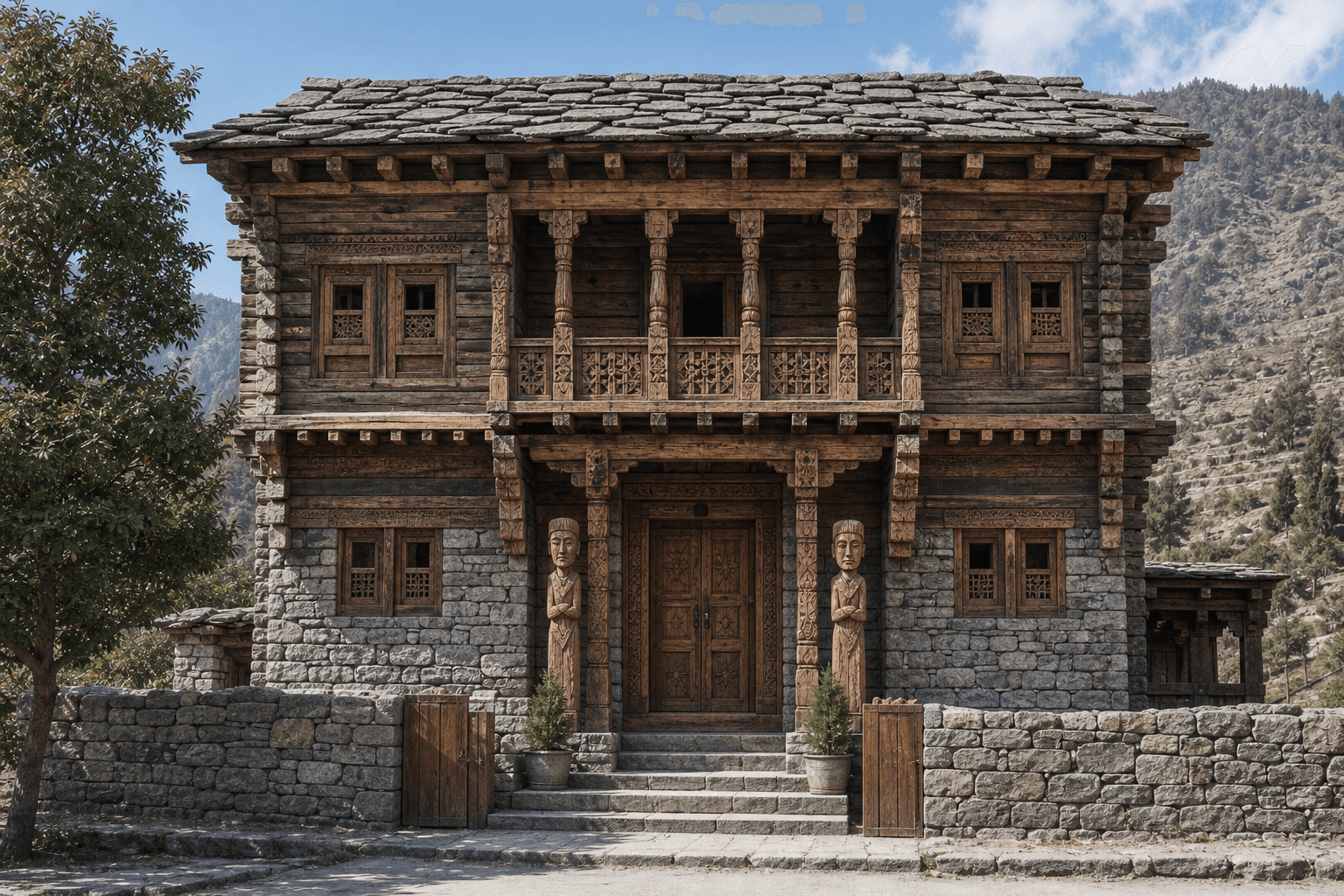
Nuristan Eastern Timber
Afghanistan · vernacular architecture of Nuristan (formerly Kafiristan
The Nuristani house (āmā) — a two- to three-story timber structure built on a stone foundation plinth, sited on the steep terraced slopes of the Nuristan valleys (1,500–3,000 m elevation) — the ground floor (or semi-subterranean lower level) is of dry-stone ma...
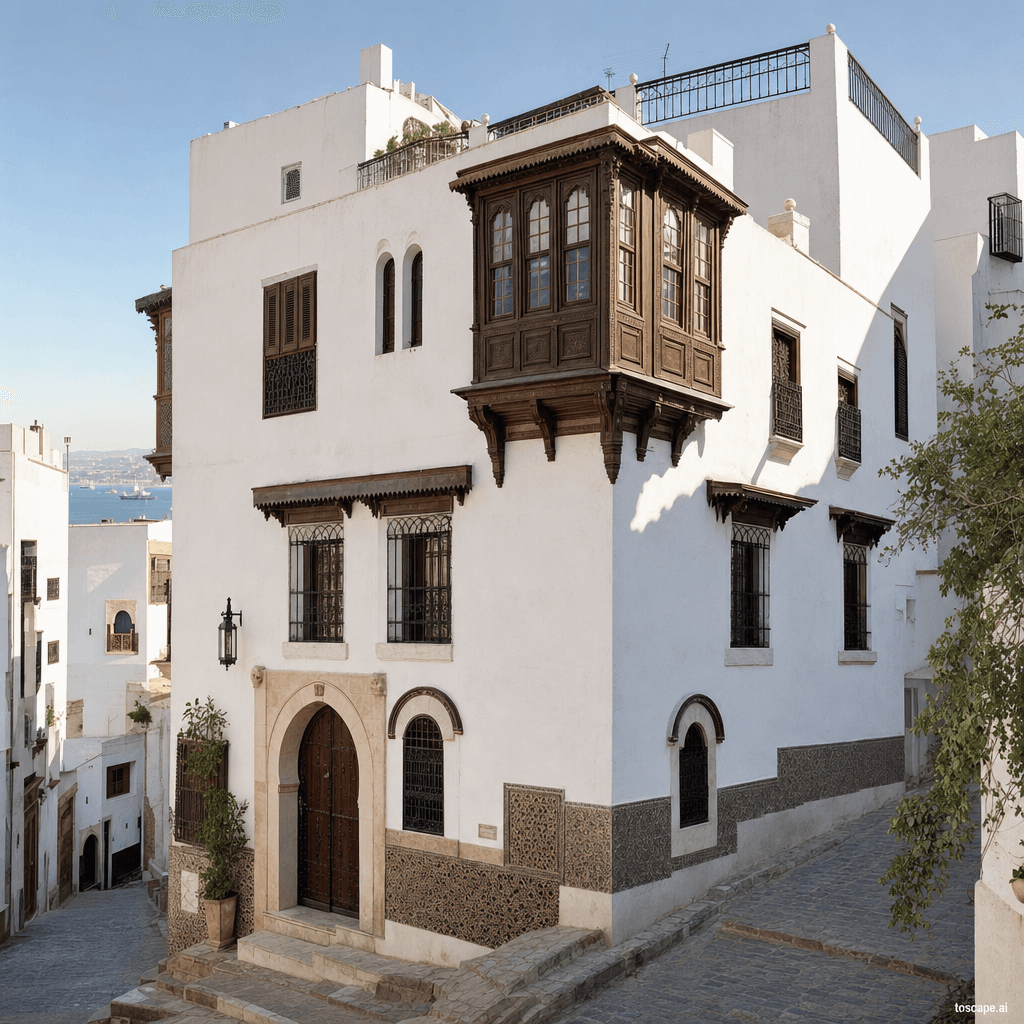
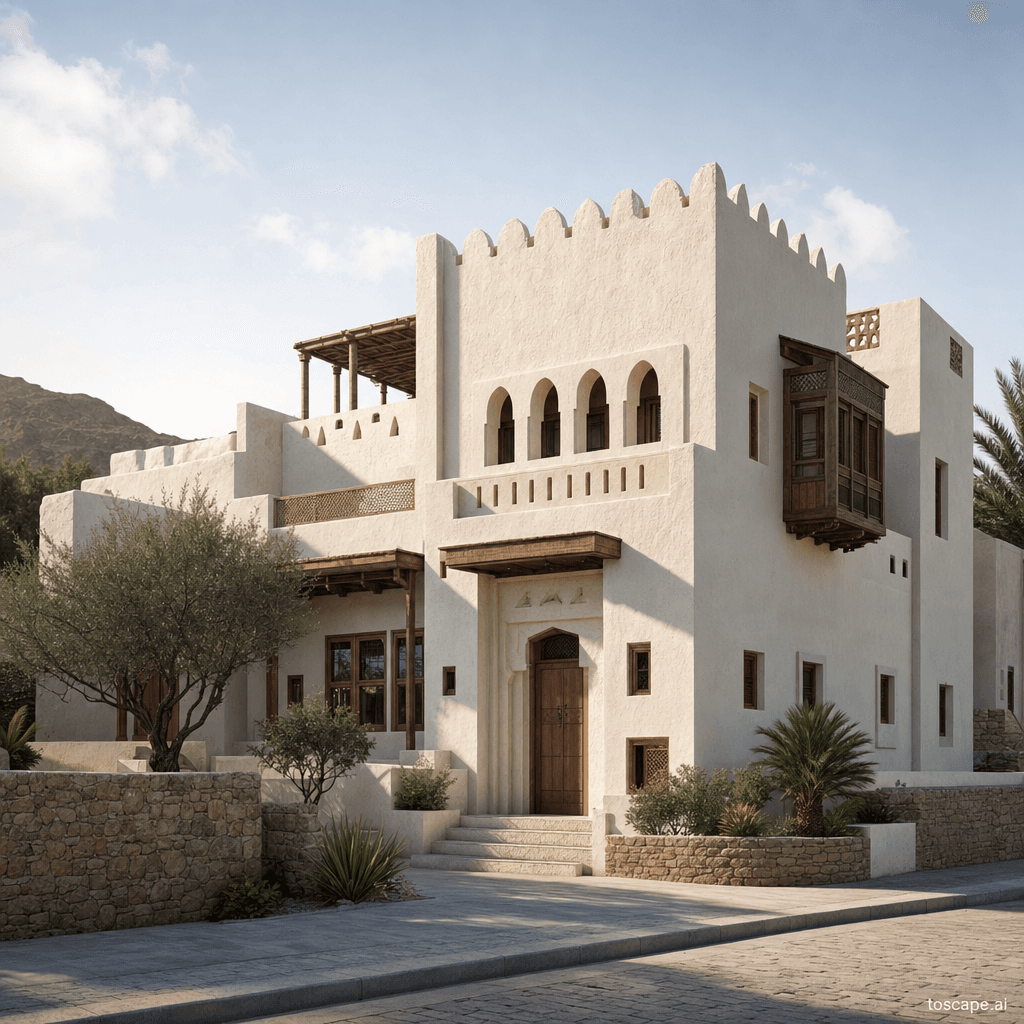
Algiers Casbah
Algeria · Algiers Casbah (Al-Qasaba)
Multi-storey courtyard house (dar) — introverted spatial organization around a central open-air patio (wast al-dar) — white-rendered facades with minimal street openings — blue-painted ironwork (window grilles, balcony railings, door studs) — horseshoe and poi...
Djebel Amour Vernacular
Algeria · vernacular architecture of the Djebel Amour mountain range in the Saharan Atlas...
Stone masonry construction (local limestone) — compact ksar (fortified village) settlement form — flat or slightly pitched roofs — small, minimal openings for thermal protection — earth-toned material palette (warm beige, ochre, pale brown) — vernacular mosque...
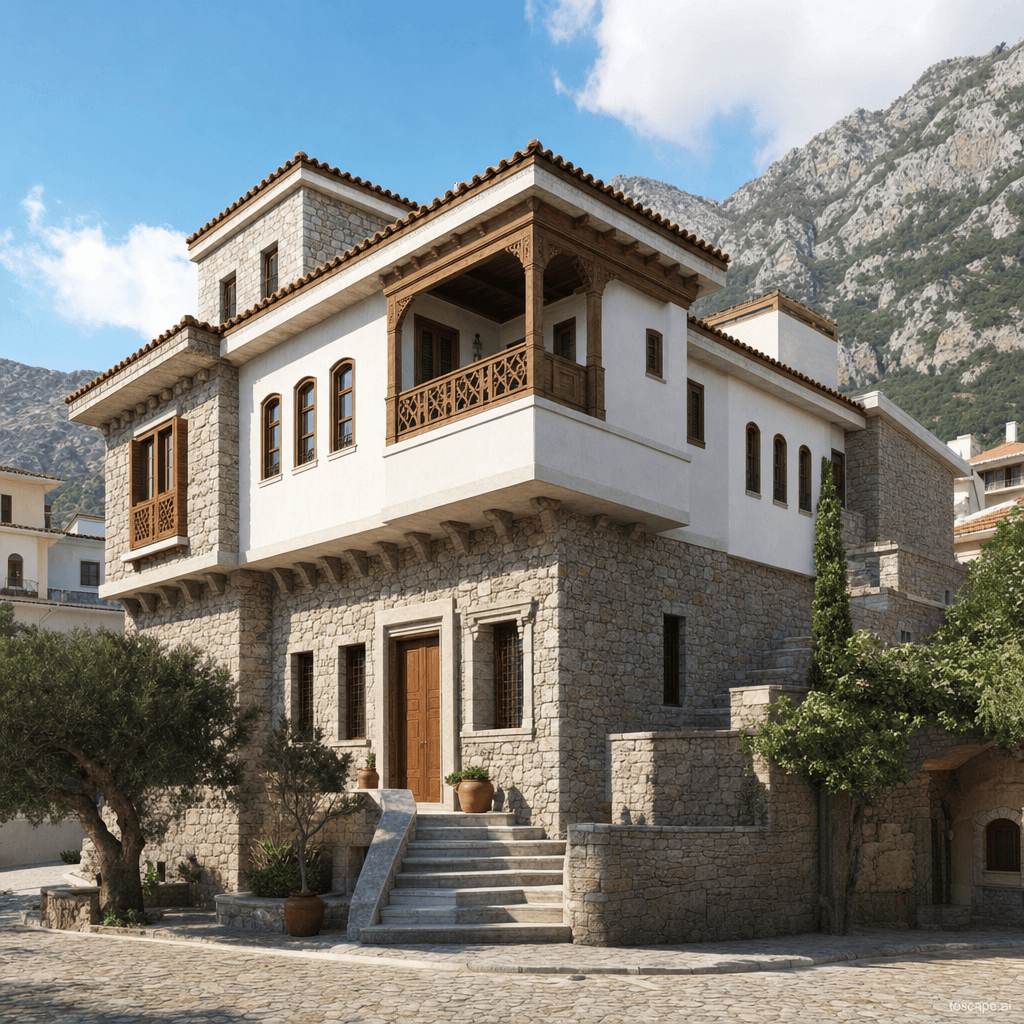
Kabylia Mountain
Algeria · Amazigh (Berber) vernacular architecture of the Kabylia region (Tamurt n Leqbaye...
Stone masonry construction (local limestone and sandstone) — pitched roofs with red terracotta barrel tiles (qarmoud) — compact hillside village organization — houses built into the slope (semi-excavated ground floors) — small rectangular window openings — whi...
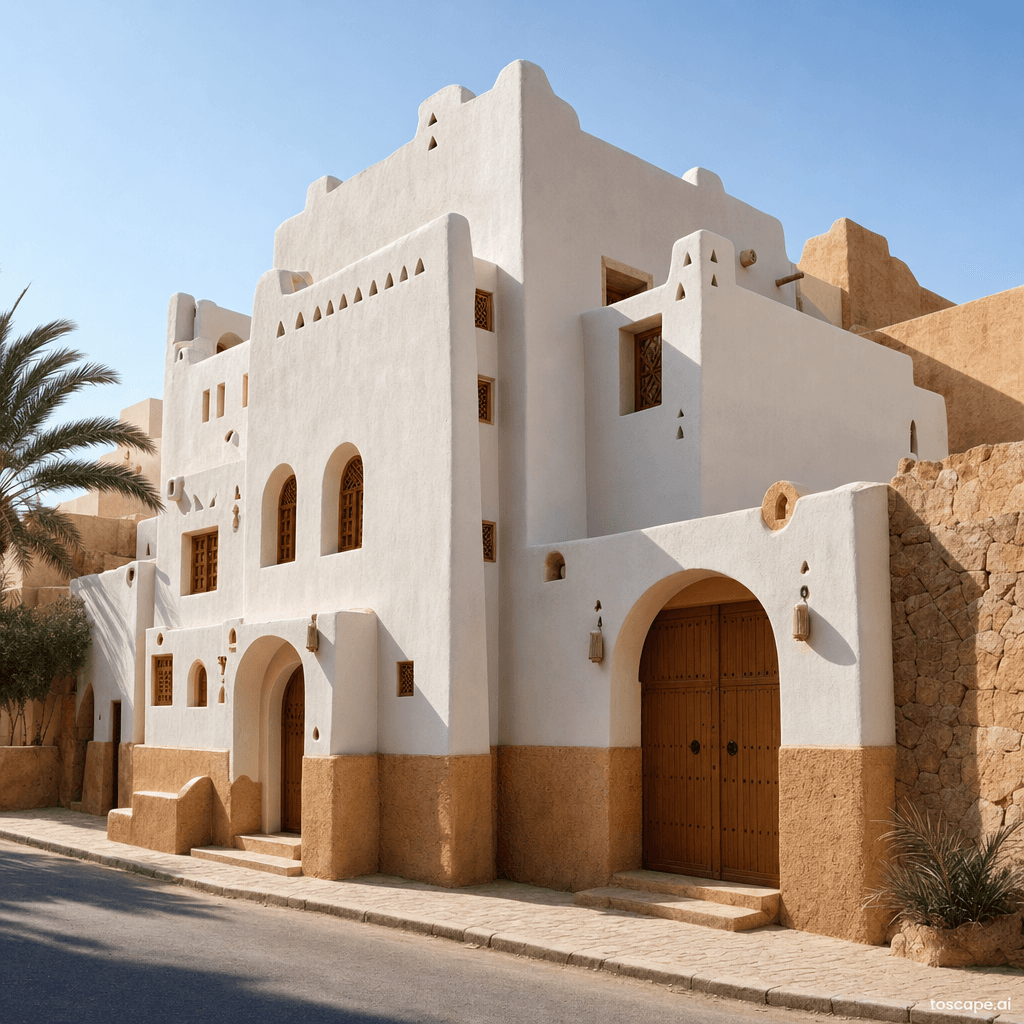
Mzab Valley Pentapolis
Algeria · architectural identity of the M'zab Valley pentapolis (Ghardaïa, Beni Isguen, Me...
Whitewashed cubic volumes — pyramidal mosque minaret as the urban focal point — introverted courtyard houses (dar) — organic, cellular urban fabric on hillside sites — covered alleyways (sabat) for shade — flat roofs — minimal, high-placed window openings — pa...
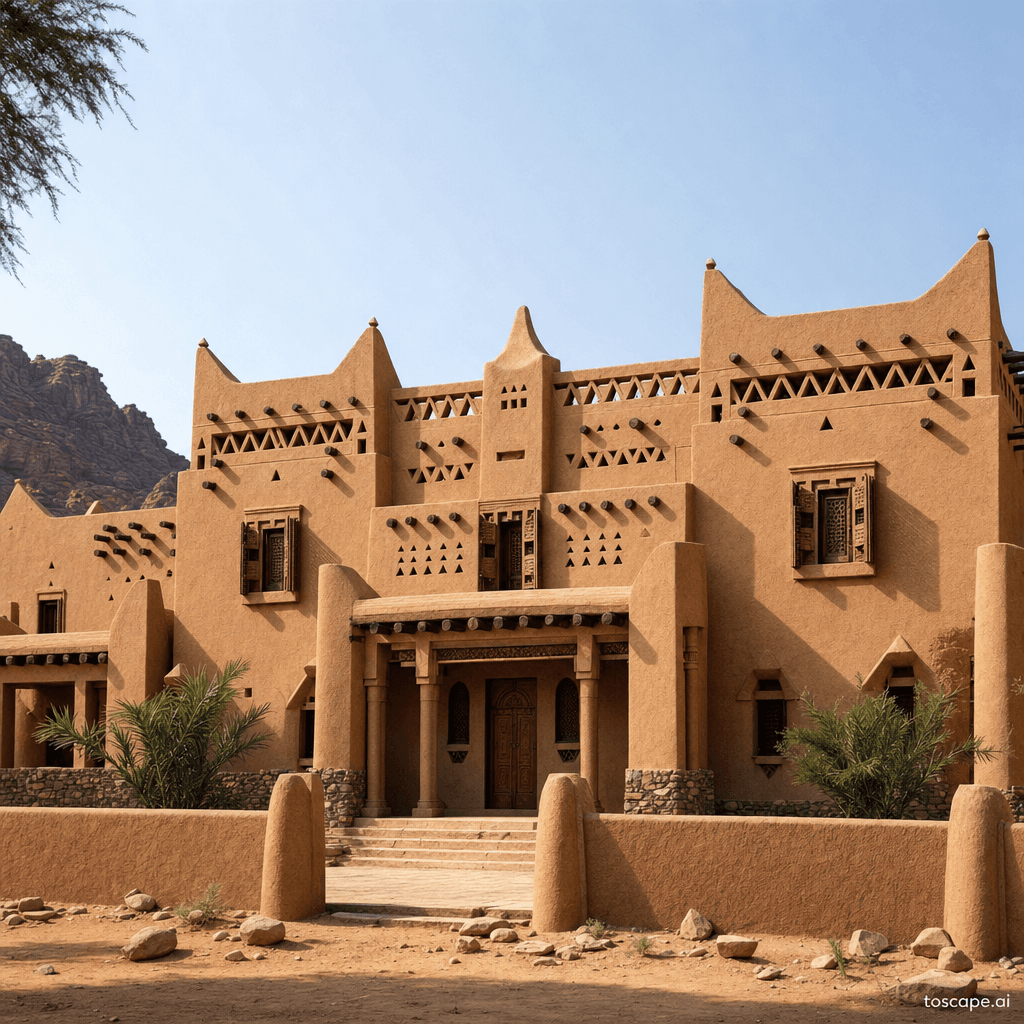
Tassili N'ajjer Tuareg
Algeria · Tuareg (Kel Ajjer) architecture of the Tassili n'Ajjer region in south-eastern A...
The Tuareg leather tent (ehen / akharban) — portable tensile shelter of tanned goatskin stretched over a wooden frame — the nomadic architectural response to the central Sahara — stone-built temporary shelters and enclosures in seasonal camps — the tifinar (ro...
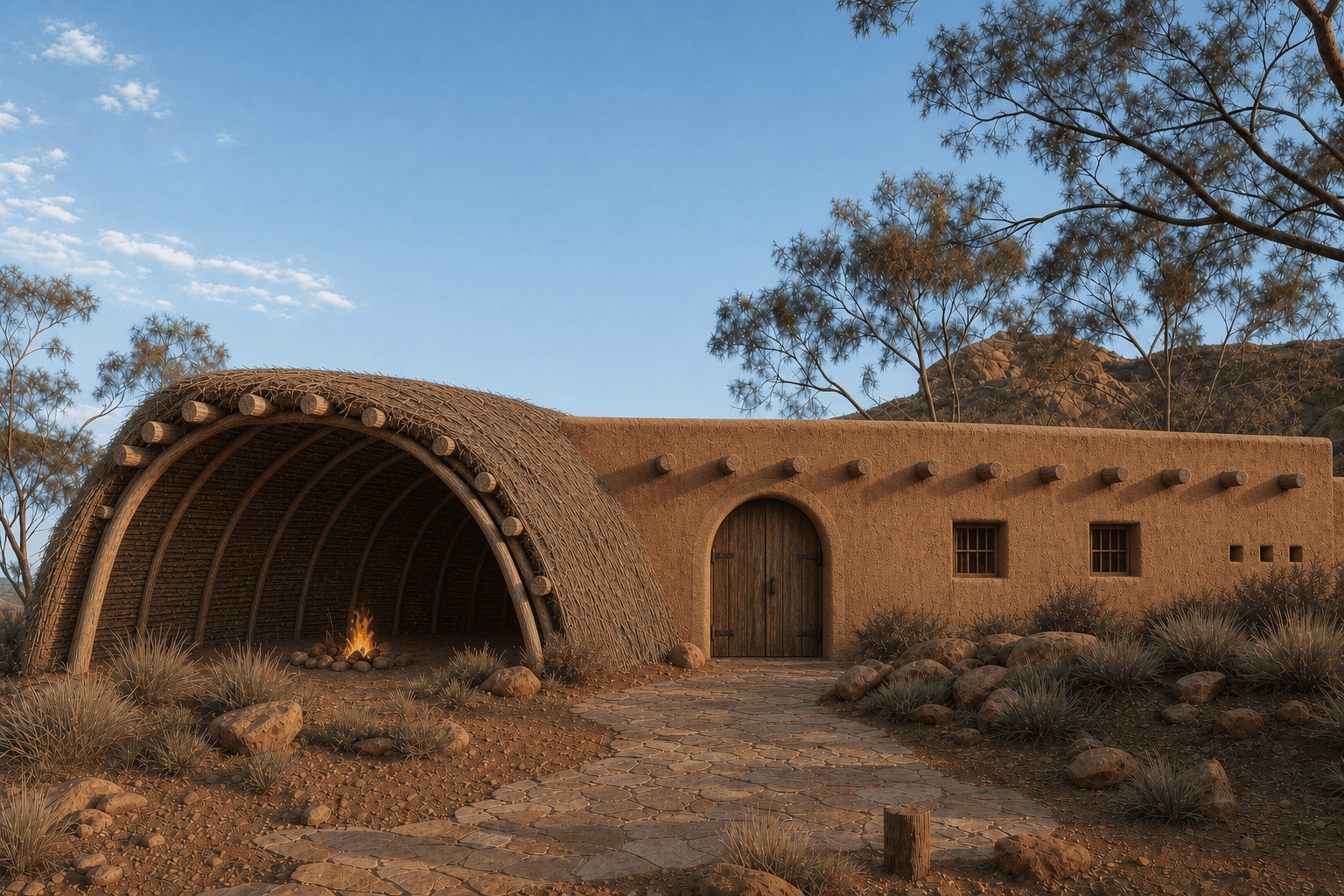
Aboriginal Desert
Australia · traditional and contemporary architectural identity of Aboriginal peoples of the...
The Aboriginal desert shelter — a lightweight, demountable, biogenic structure defined by its relationship to fire and Country — the wiltja is the most iconic form: a semicircular or U-shaped windbreak (2–4 m diameter, 1–2 m high) constructed from mulga branch...
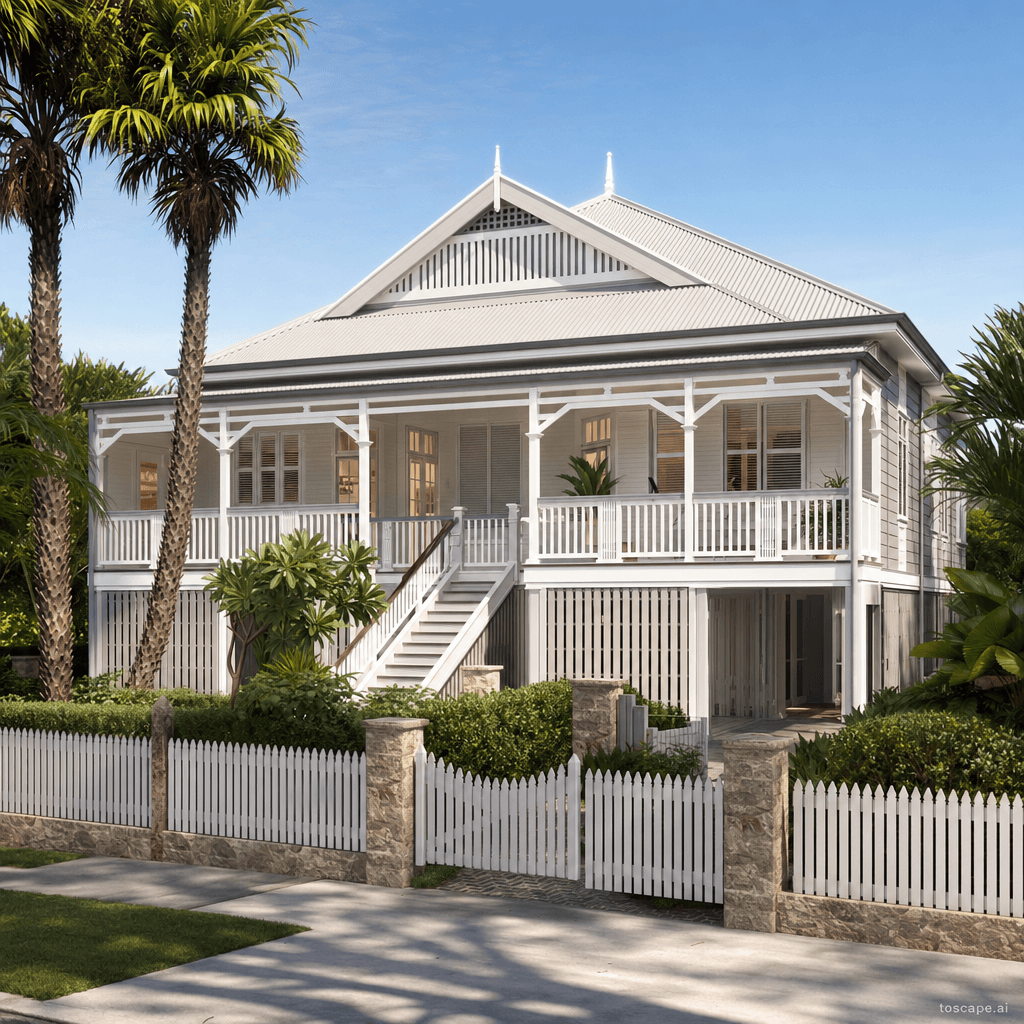
Queenslander & Torres Strait
Australia · Two interconnected but distinct tropical Australian architectural identities: (A...
(A) The Queenslander — a lightweight timber-framed house (pine or hardwood) elevated 2–3 m on concrete or timber stumps, with a hipped corrugated iron roof (20–30° pitch), deep wraparound verandahs (2.5–3.5 m deep) on at least three sides, decorative cast-iron...
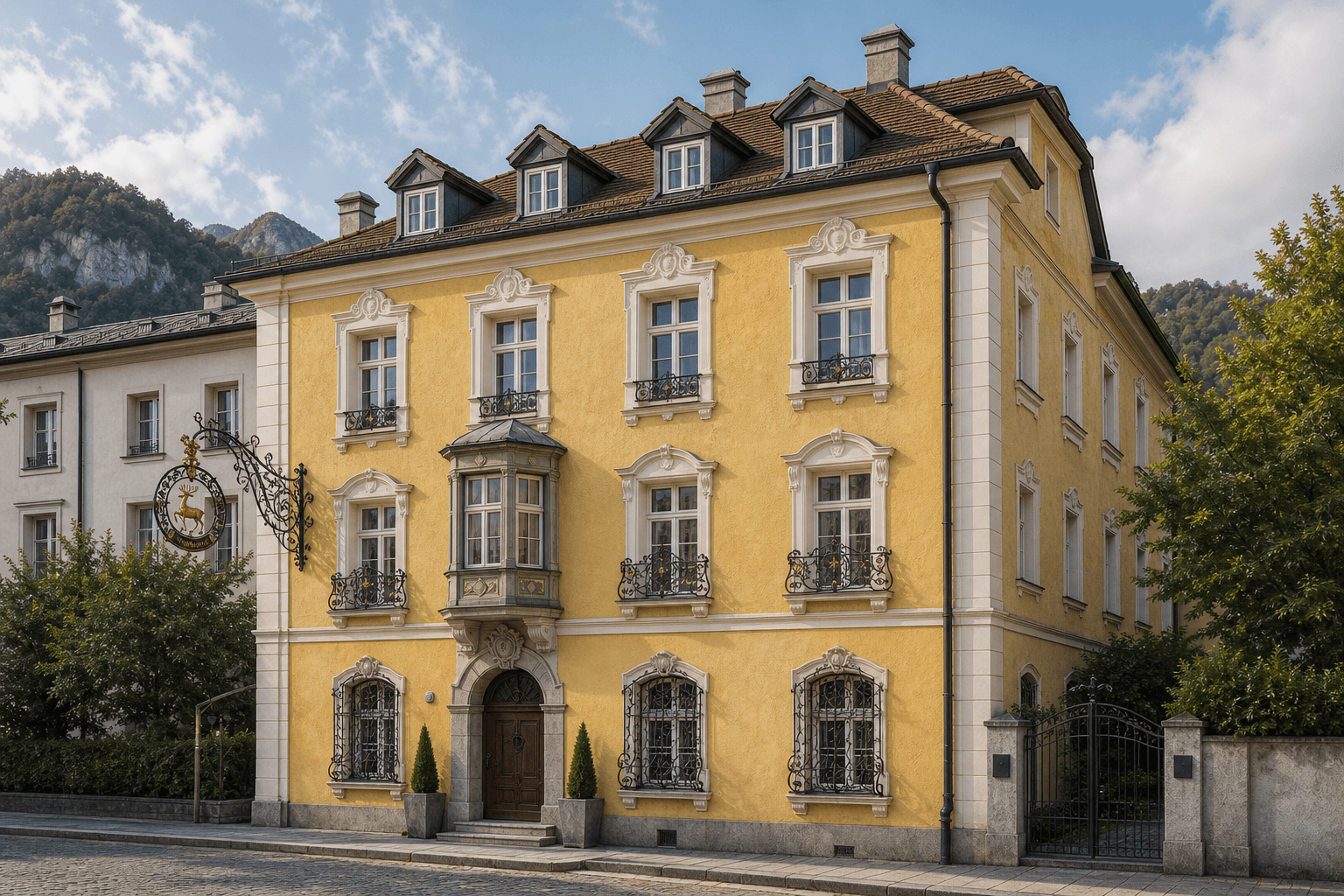
Austrian Salzburg Townhouse
Austria · Salzburg burgher house (Bürgerhaus) of the historic Altstadt (Old Town)
The Salzburg Bürgerhaus — a tall, narrow masonry townhouse (6–12 m wide facade, 3–5 stories, 15–22 m high), rendered in a pastel color (the "Salzburg palette" of yellow, pink, green, or grey) with white or pale grey stone/stucco dressings — the facade is organ...
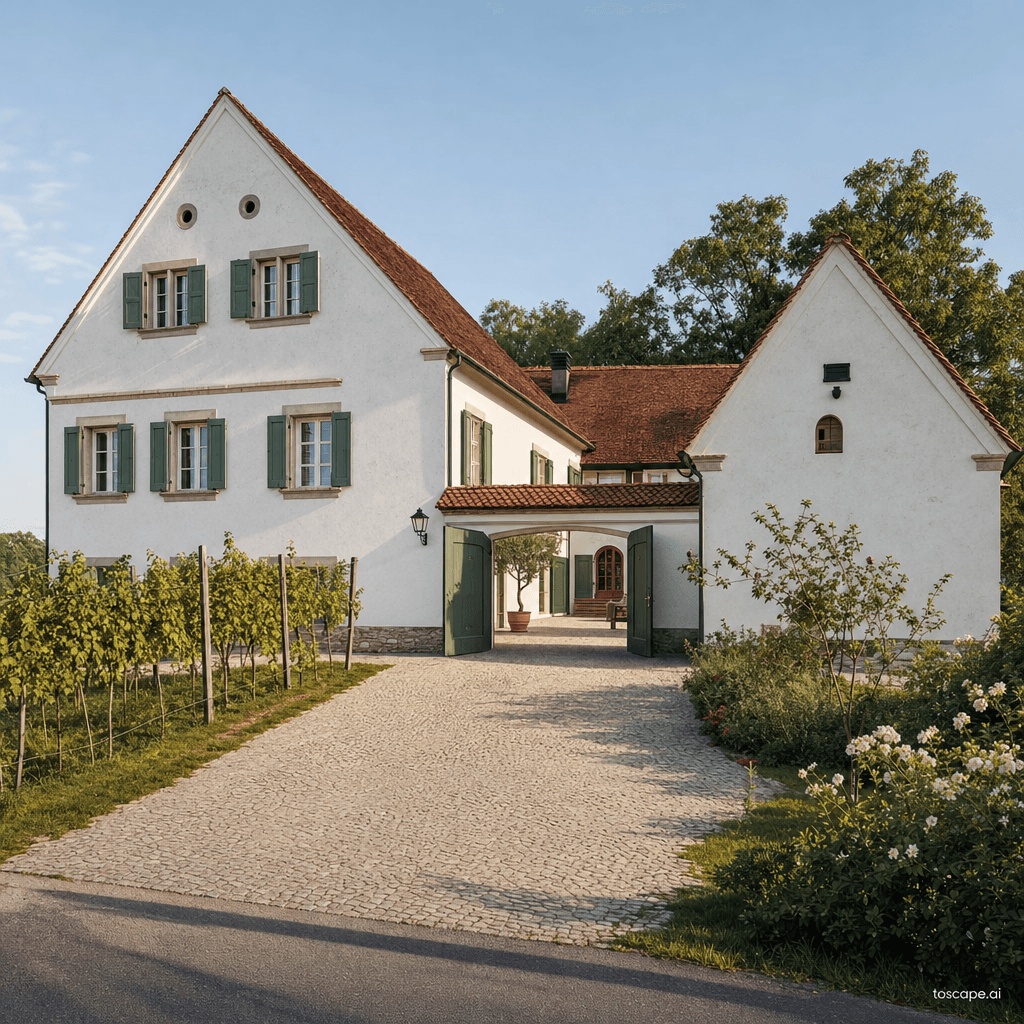
Austrian Styria Wine-Country Courtyard House
Austria · Styrian courtyard farmhouse (Vierseithof / Steirischer Hof) of southeastern Aust...
The Steirischer Vierseithof — a U-shaped or fully closed four-sided courtyard, typically 20–40 m per side, enclosing a central cobbled courtyard (10–18 m square) — the buildings are 2 stories (ground floor: working/storage, upper floor: living), constructed of...
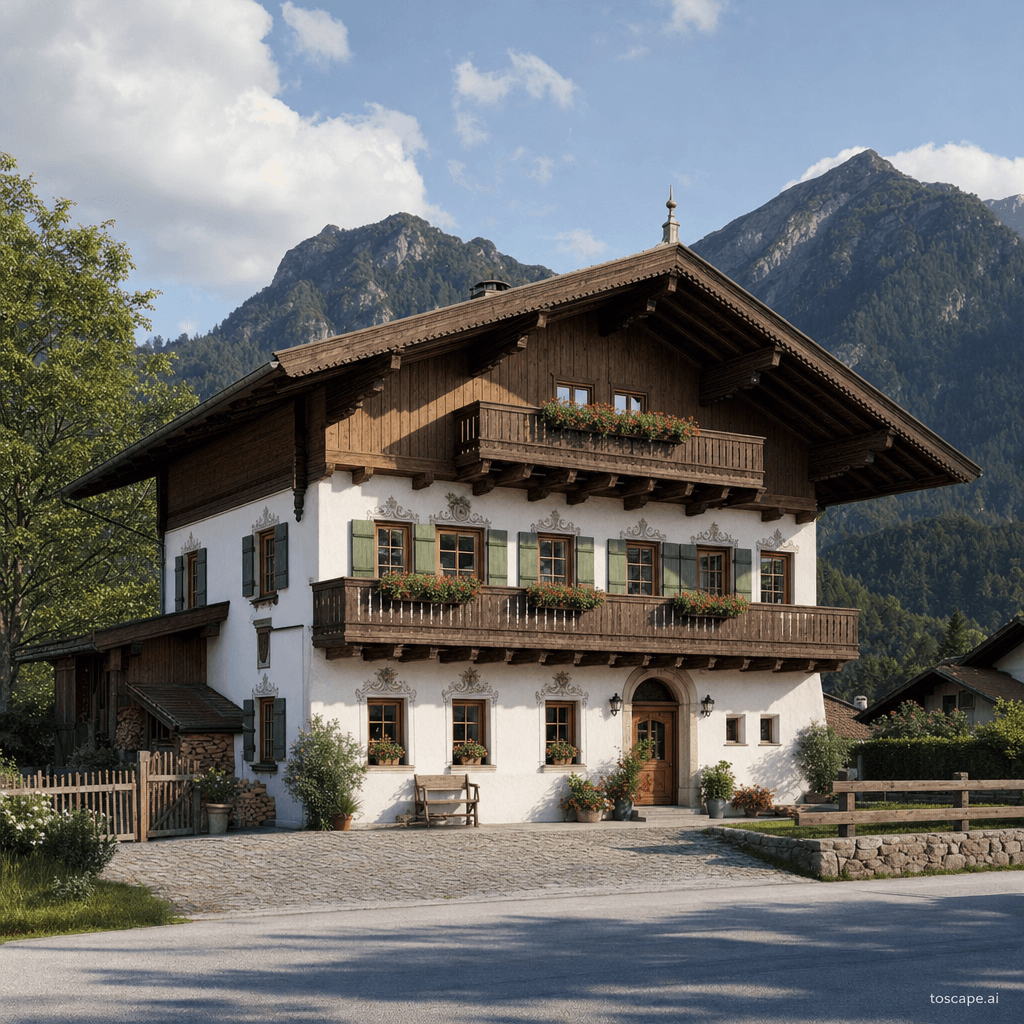
Austrian Tyrol Alpine Farmhouse
Austria · Tyrolean farmhouse (Tiroler Bauernhaus / Maso chiuso) of the Austrian Tyrol
The Tiroler Bauernhaus — a horizontally-dominant rectangular block (10–18 m wide, 8–12 m deep), two stories with an attic, combining white rendered masonry at the base with dark weathered timber above — the architectural sequence is: white masonry ground floor...
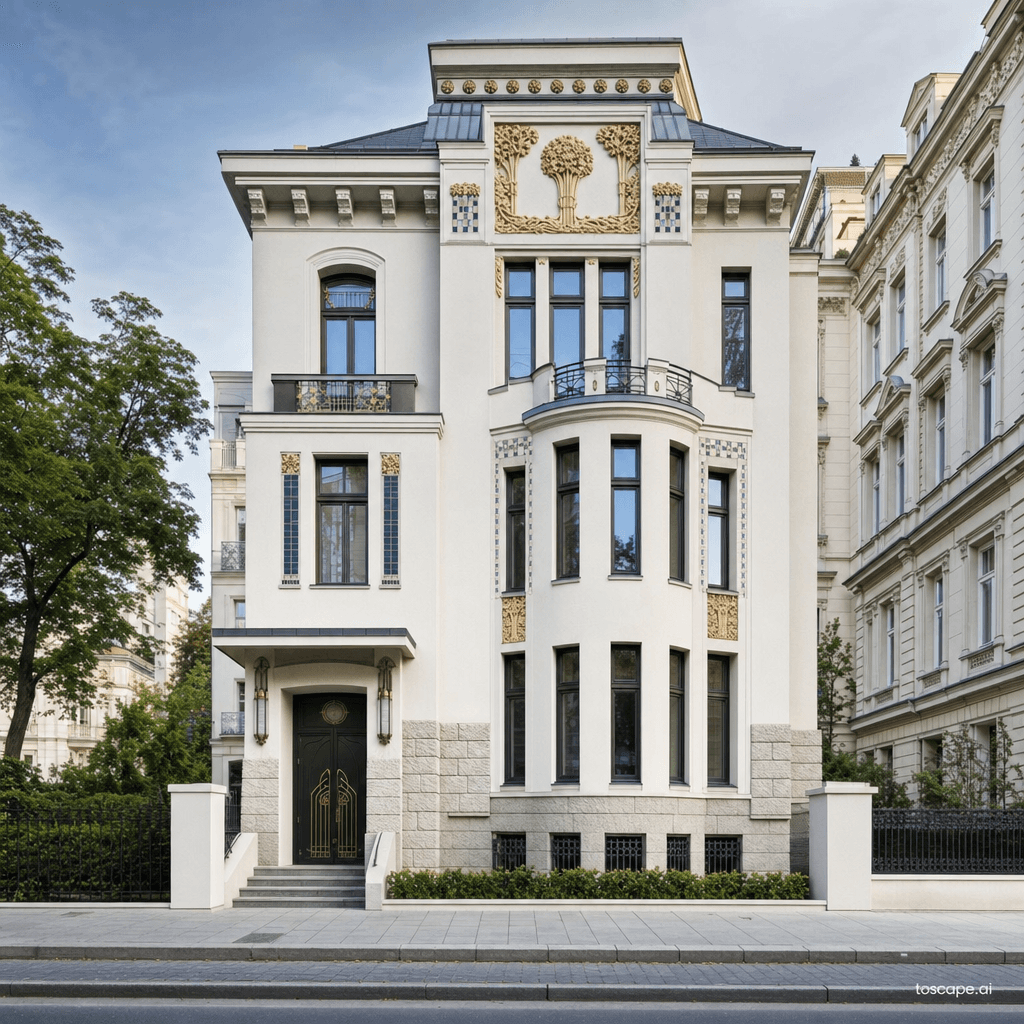
Austrian Vienna Secession Townhouse
Austria · Vienna apartment house (Wiener Zinshaus / Miethaus) of the Secession and Jugends...
The Wiener Secessionist Zinshaus — a tall urban apartment block (4–6 stories, 12–22 m high, 10–18 m wide facade), rendered in pale cream, white, or soft grey, with a surface layer of Secessionist ornament concentrated at key points: the entrance portal, the up...
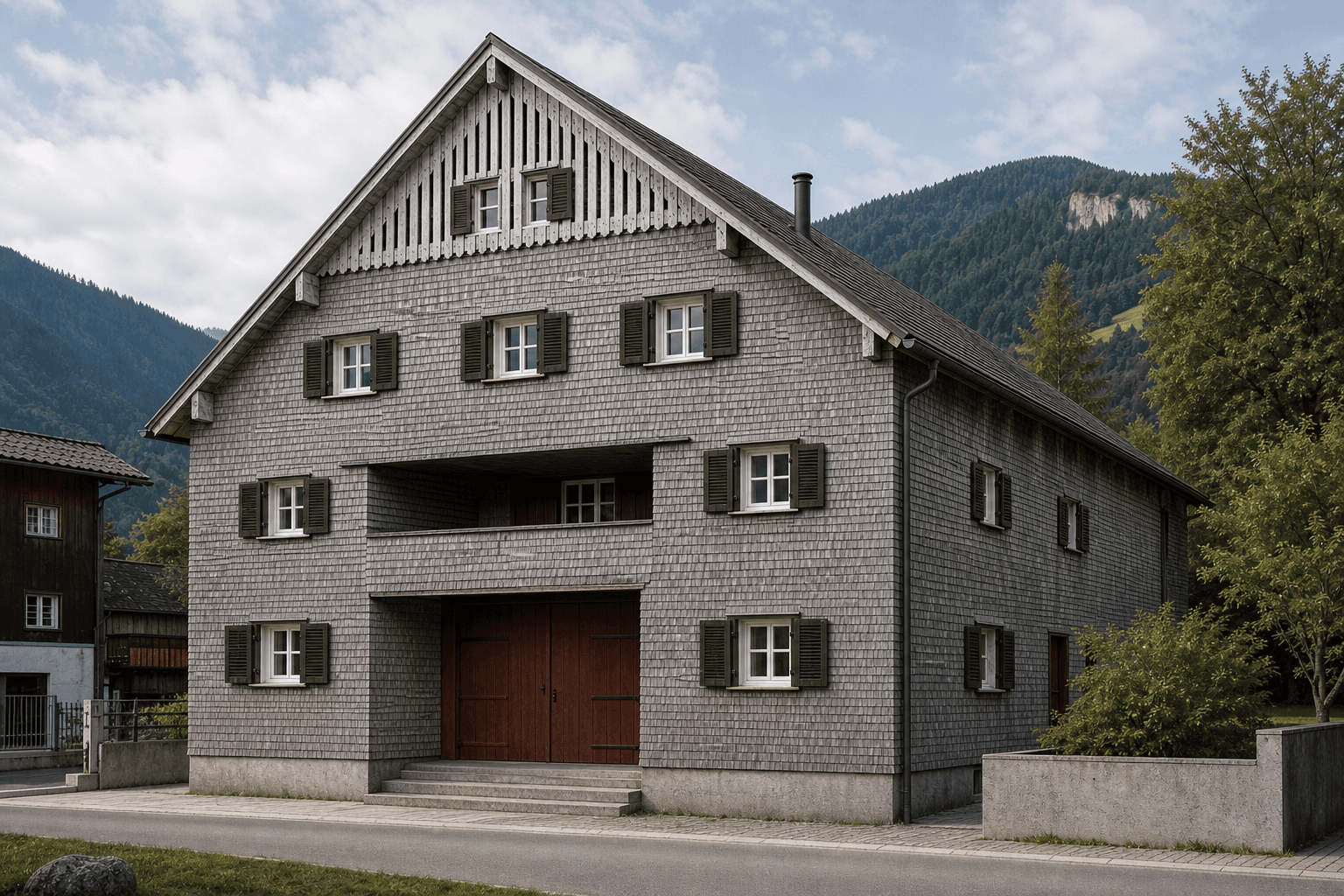
Austrian Vorarlberg Wooden House
Austria · Vorarlberg wooden house (Bregenzerwälderhaus / Wälderhaus) of the Bregenzerwald...
The Bregenzerwälderhaus — a large, elongated wooden farmhouse (Einhof) under a single broad, shallow-pitched shingled roof (18–25° pitch, with deep eaves) — the walls are clad entirely in silver-grey wooden shingles, from ground to gable, giving the house the...
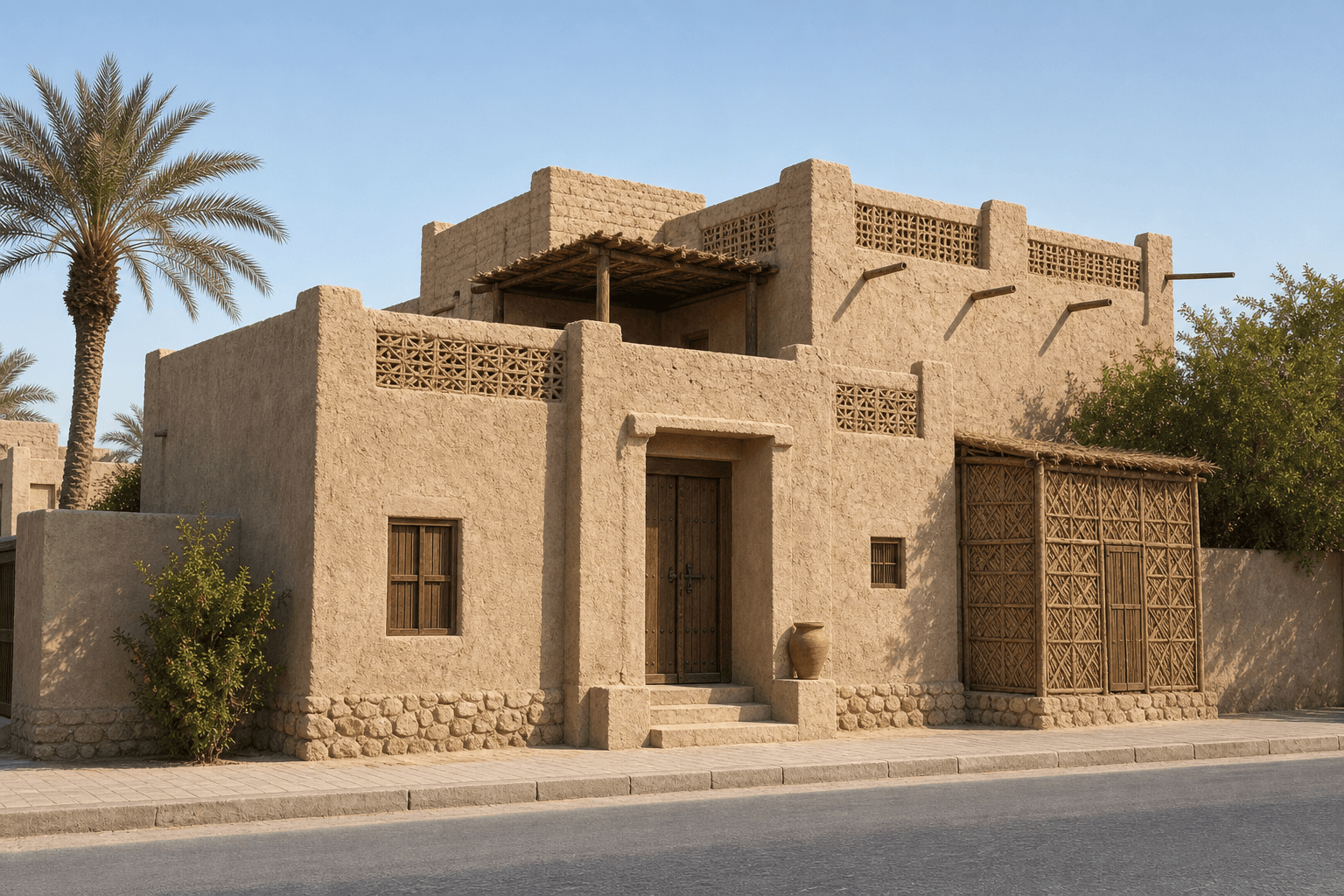
Bahrain Village Heritage
Bahrain · village architecture of Bahrain's northern agricultural belt and coastal fishing...
Date palm grove (bustan / nakheel) as the primary spatial and economic context — freshwater springs (ain / uyun) as settlement catalysts — simplified courtyard houses with coral stone and mud-brick walls — the barasti (palm-frond dwelling) for seasonal and low...
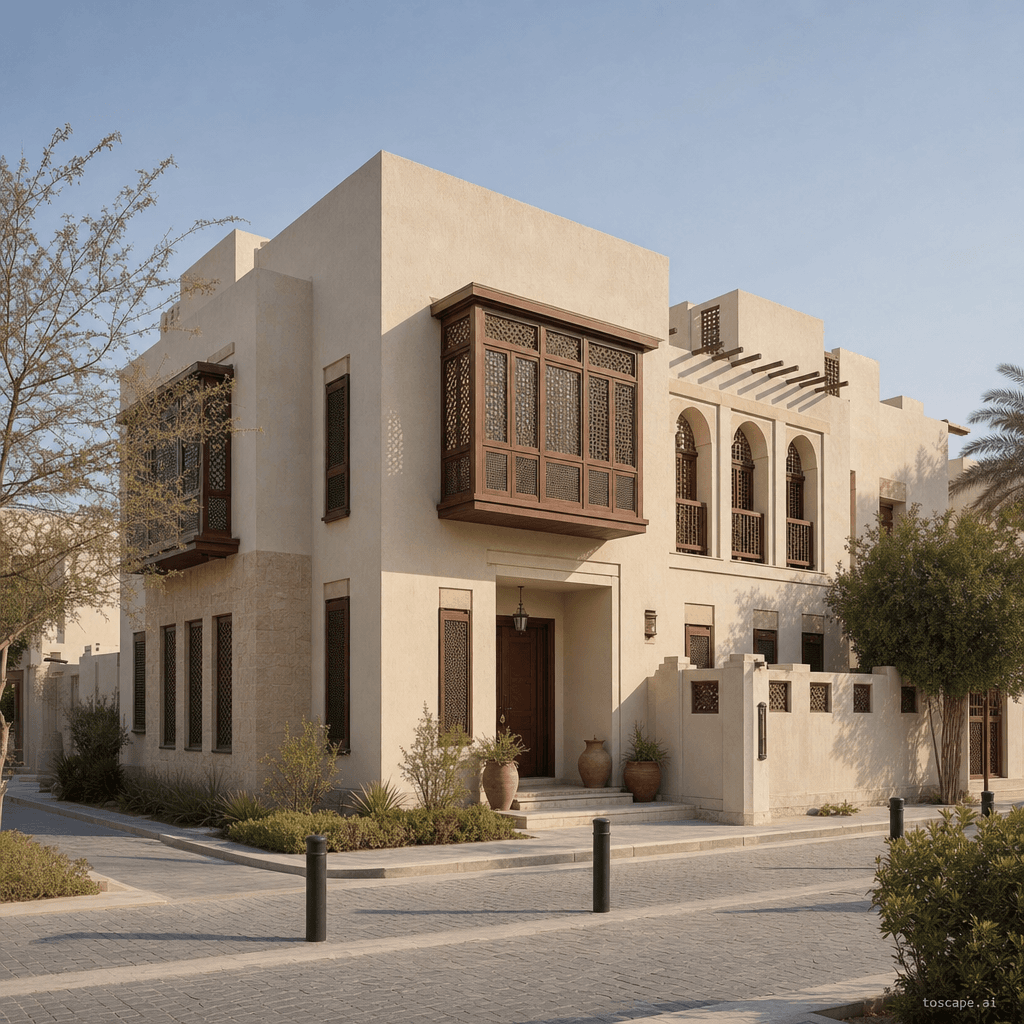
Manama Urban
Bahrain · Manama and Muharraq
The badgir (wind tower) as the primary architectural identity marker — Bahrain has one of the highest concentrations of traditional wind towers in the Gulf — courtyard house (al-bayt al-arabi) with central hosh — coral stone (al-hajar al-manqabi) construction...
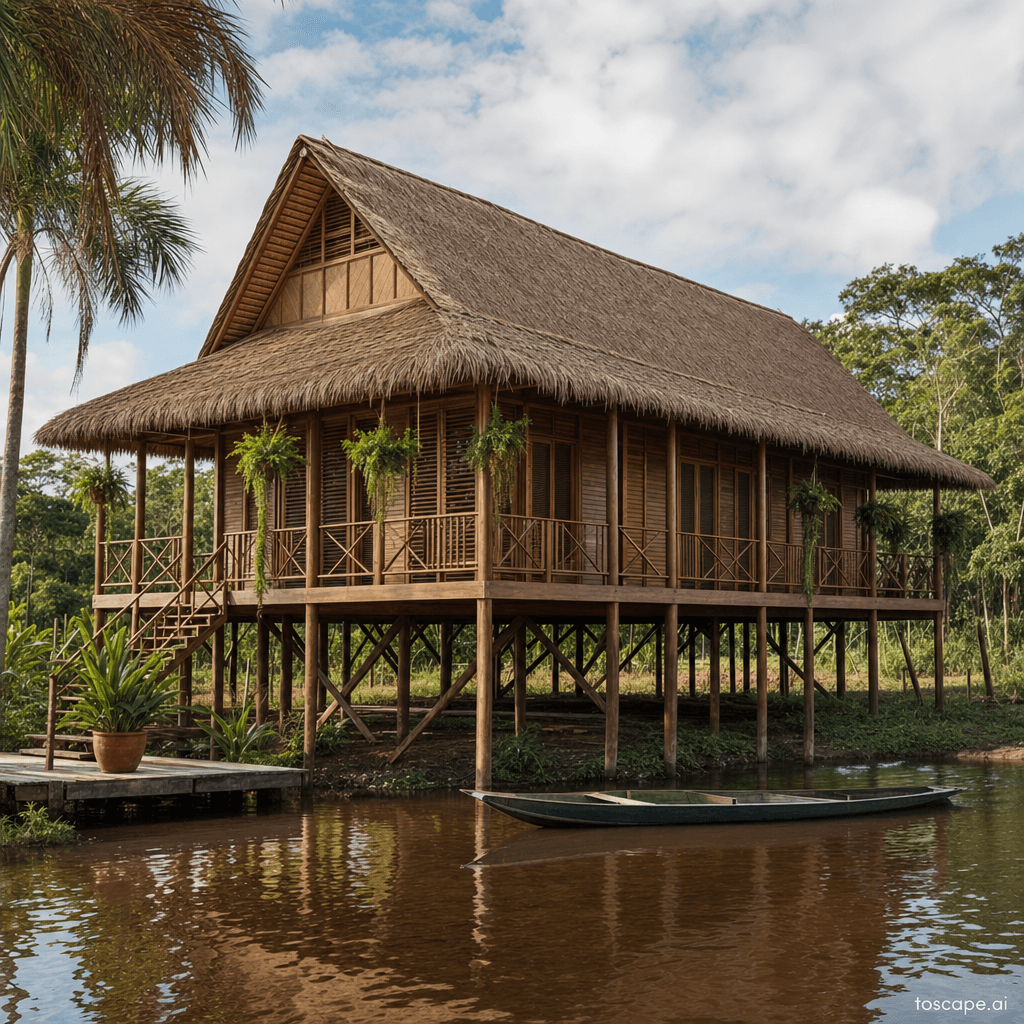
Amazon
Brazil · Amazon region (Amazonas, Pará, Amapá)
Elevated palafita (stilt houses) on hardwood pilotis above seasonal flood levels (2-4m high), open timber frame (gaiola) construction with timber plank or palm-thatch walls, steeply pitched roofs (45-55°) in caranai palm thatch (palha) or terracotta canal tile...
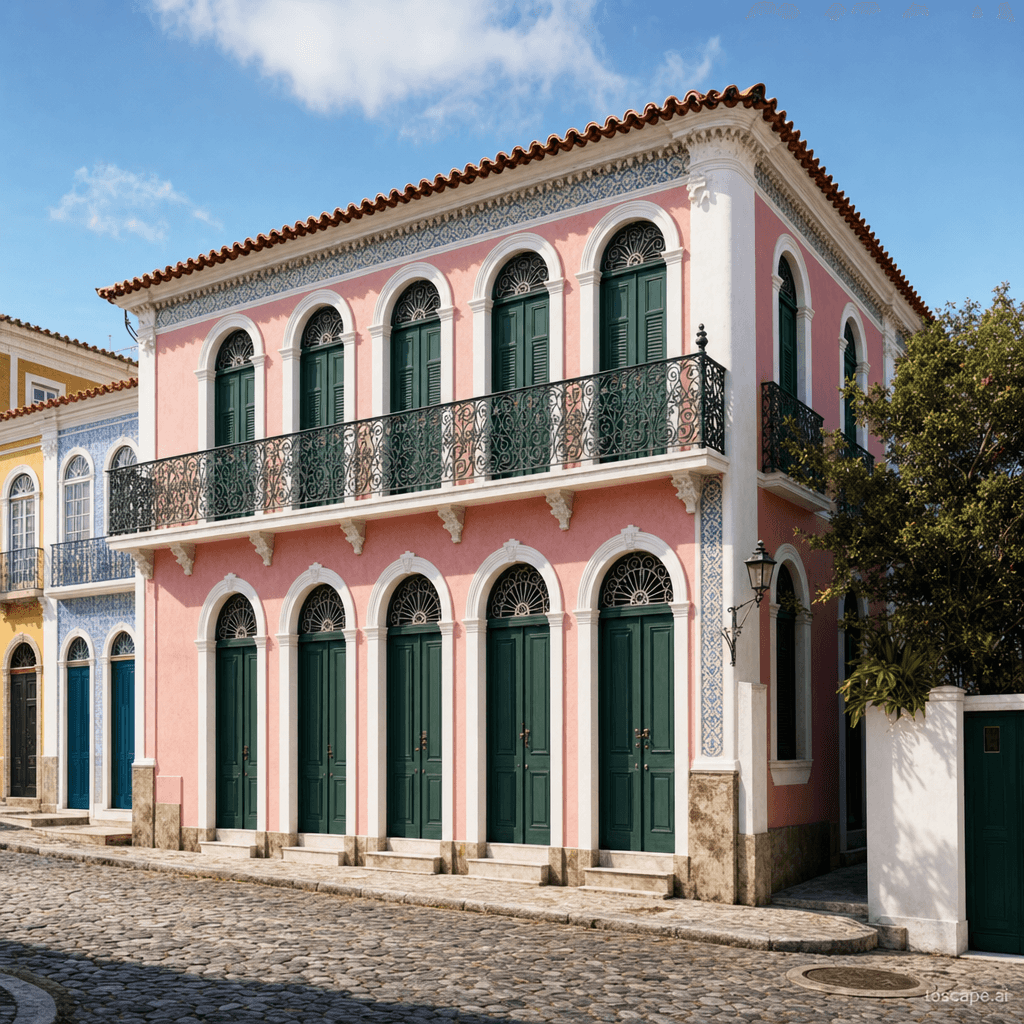
Bahia
Brazil · Bahia (Salvador, Recôncavo)
Multi-colored pastel plaster facades in pink (rosa), blue (azul), yellow (amarelo), ochre, and white with contrasting painted window and door surrounds (molduras de cor contrastante), Portuguese azulejo glazed tile panels on facades and church interiors, steep...
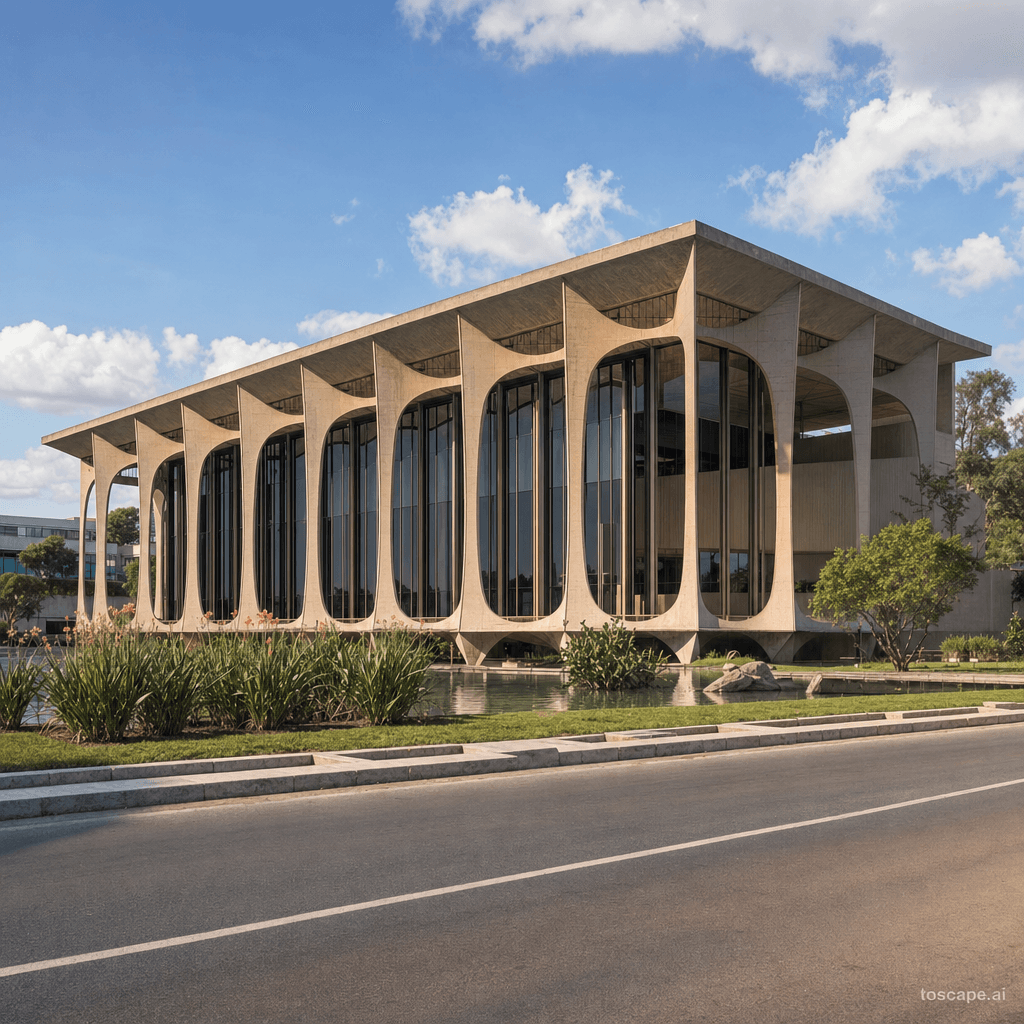
Brasília
Brazil · Brasília (Plano Piloto)
Sculptural reinforced concrete forms — hyperbolic paraboloid shells, inverted domes, sweeping curves (curvas sensuais), pilotis (slender V-shaped or sculptural columns) elevating buildings above ground plane as continuous public space, brise-soleil (horizontal...
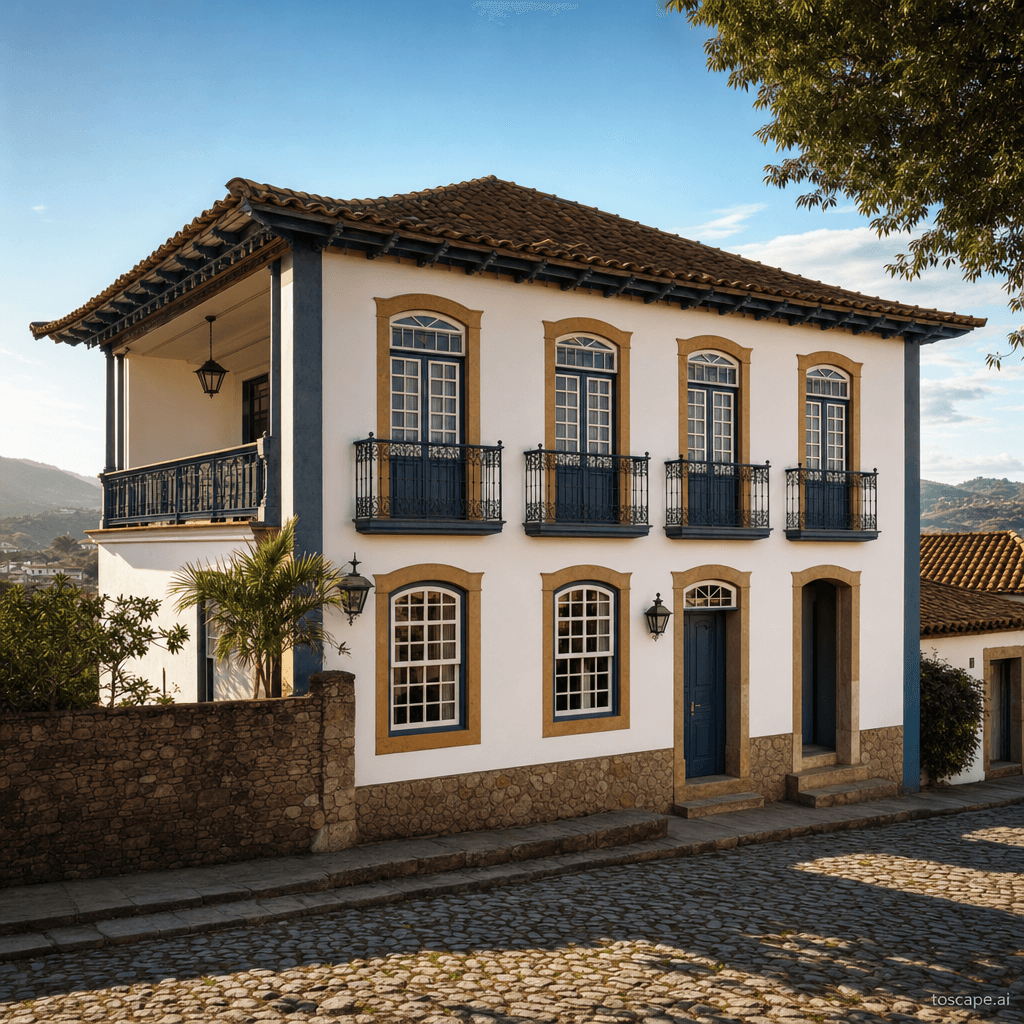
Minas Gerais
Brazil · Minas Gerais
Whitewashed lime-plastered facades with sculpted pedra-sabão (soapstone) door and window surrounds in grey-green to ochre tones, ornate Baroque church facades with curvilinear pediments and twin bell towers, Aleijadinho sculptural ornament — carved stone atlan...
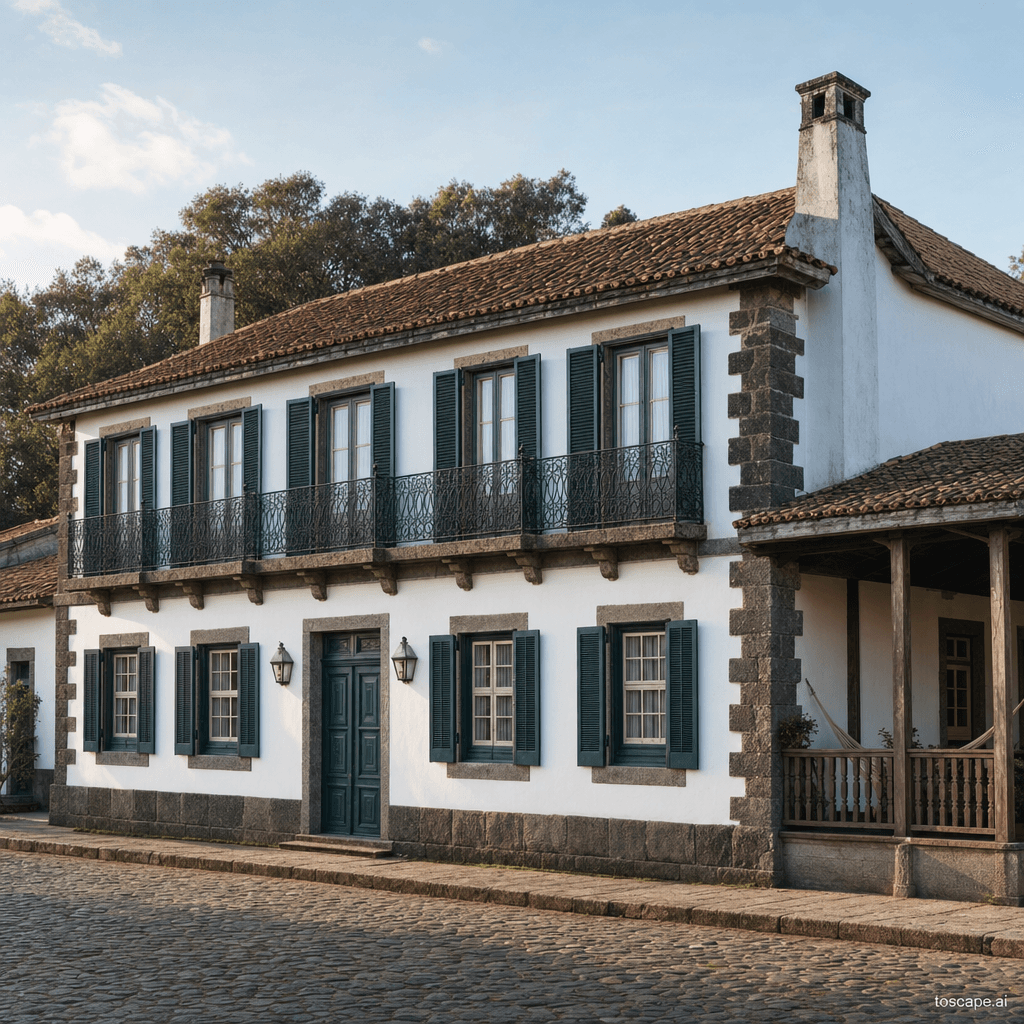
Rio Grande Do Sul
Brazil · Rio Grande do Sul
Heavy basalt stone (pedra basalto/pedra ferro) masonry walls in dark grey-black, whitewashed lime plaster facades with contrasting dark stone corner quoins (cunhais de pedra), Azorean Portuguese-influenced colonial sobrados with continuous balcões (wrought-iro...
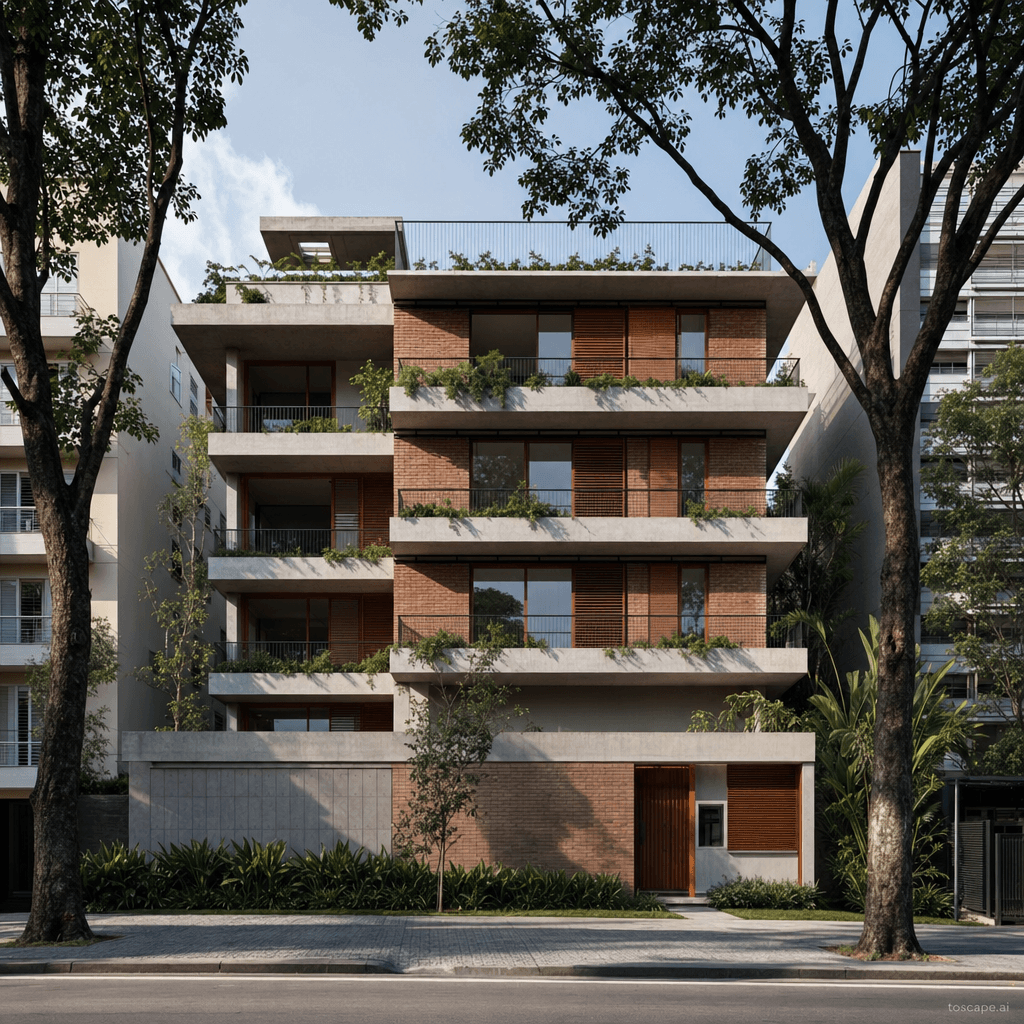
São Paulo
Brazil · São Paulo state
Paulista School (Escola Paulista) brutalist exposed concrete (concreto aparente) with bold structural expression — Vilanova Artigas, Paulo Mendes da Rocha, Lina Bo Bardi — heavy monolithic volumes with large-span beams and cantilevers, SESC Pompeia raw concret...
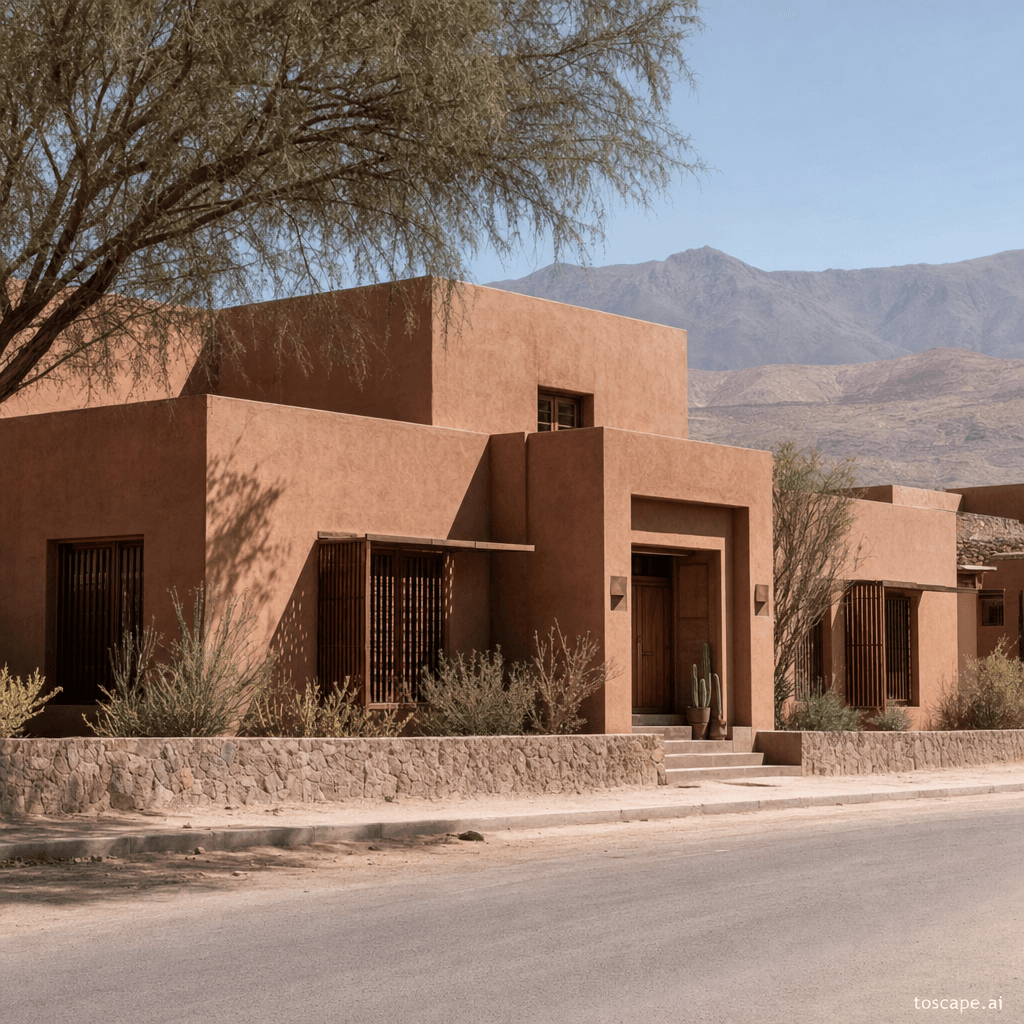
Atacama Desert
Chile · architectural identity of the Atacama Desert oasis settlements
The Atacameño adobe house — whitewashed adobe brick walls (50–80 cm thick) set on a stone foundation (piedra liparita — white volcanic stone), with a flat roof of chañar or algarrobo timber beams (vigas) overlaid with a cane or cardón-rib mat, then a thick lay...
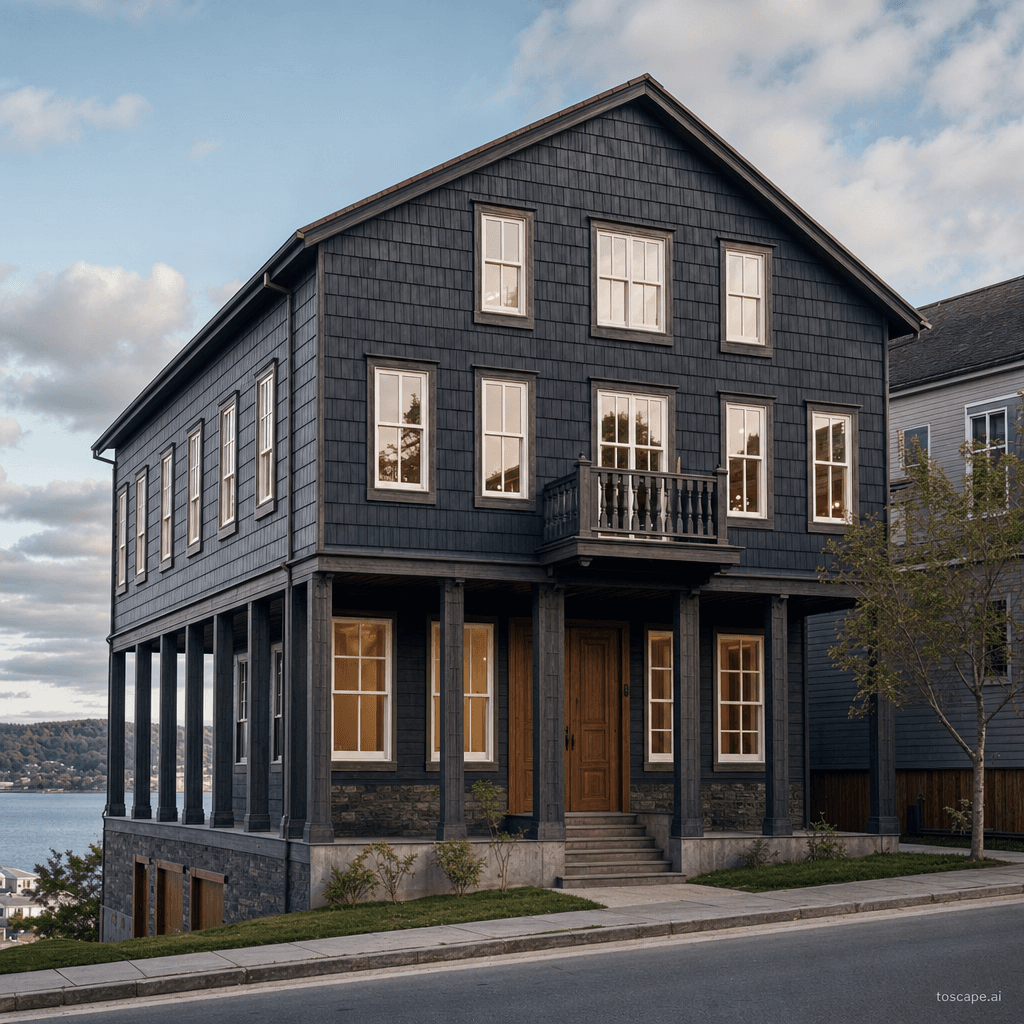
Chiloé Wooden
Chile · architectural identity of the Chiloé Archipelago (Los Lagos Region, southern Chi...
The Chilota wooden building — a timber frame (roble, coigüe, or ulmo) entirely clad in tejuelas de alerce (thin wooden shingles, typically 50–60 cm × 8–15 cm × 0.5–1 cm, cut from the alerce — Fitzroya cupressoides — a giant Patagonian cypress) — the tejuelas c...
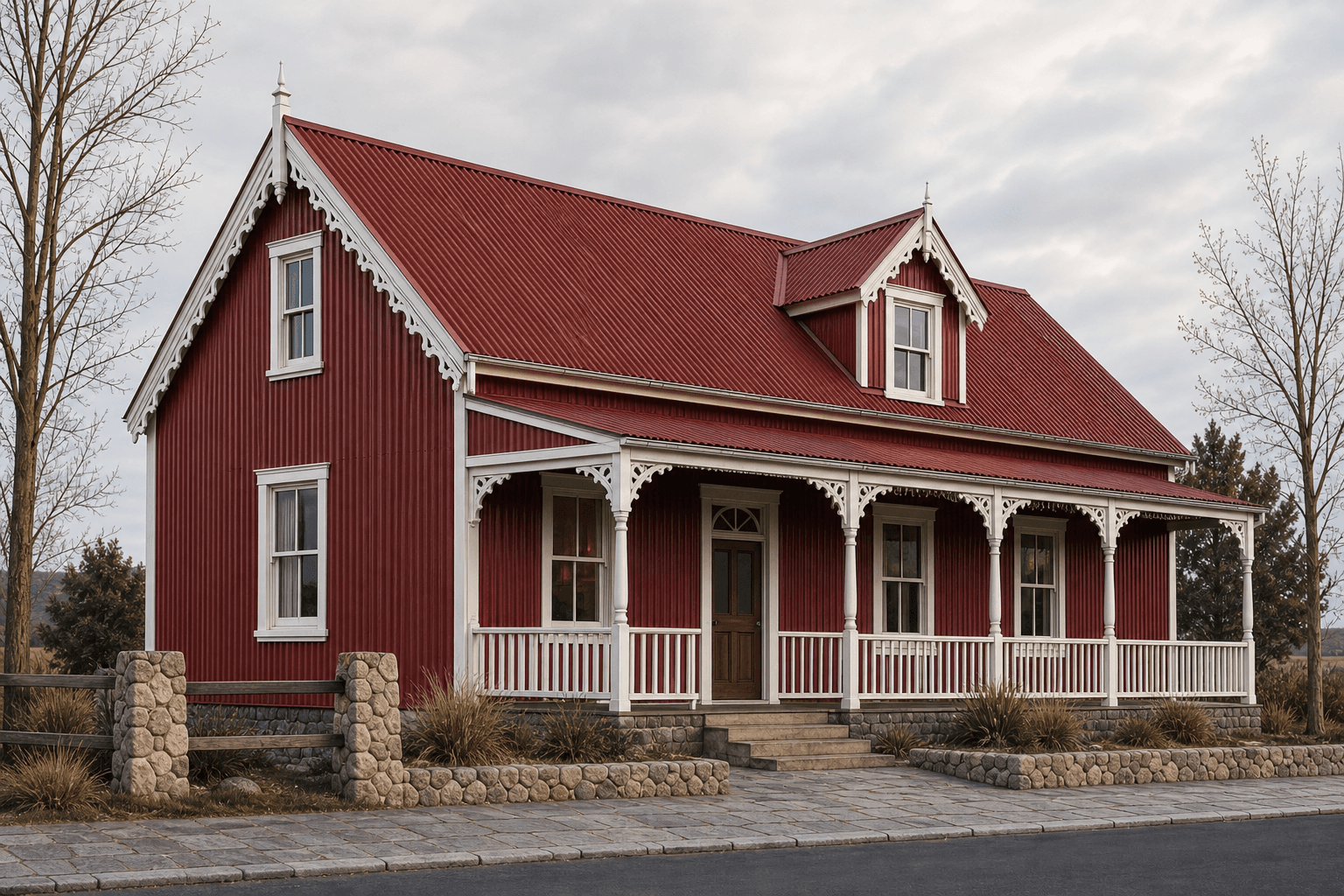
Patagonia Pioneer
Chile · architectural identity of the Magallanes Region (Chilean Patagonia, 52–56°S)
The Patagonian pioneer building — a timber balloon or braced frame (lenga — Nothofagus pumilio — the native southern beech, or imported Oregon pine) clad entirely in corrugated galvanized iron sheets, painted in rich colors: burgundy red, forest green, ochre y...
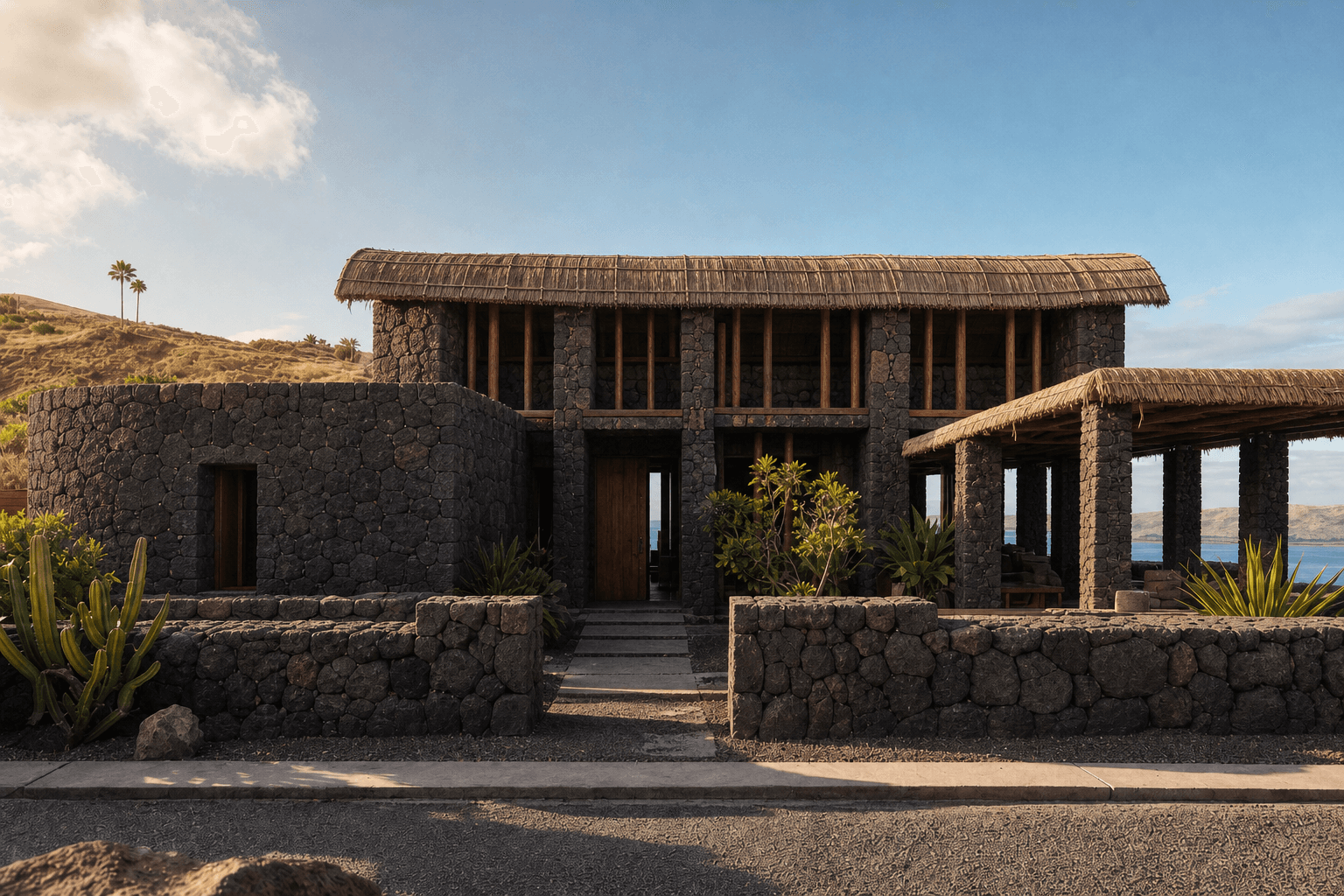
Rapa Nui
Chile · architectural identity of Rapa Nui (Easter Island / Isla de Pascua, Chile, UNESC...
The Rapa Nui architectural ensemble — the ahu (a precisely fitted dry-stone ceremonial platform, typically rectangular, 20–100 m long × 3–6 m wide × 3–6 m high, with a seaward-facing ramp) upon which the moai (monolithic anthropomorphic statues, 2–10 m tall, c...
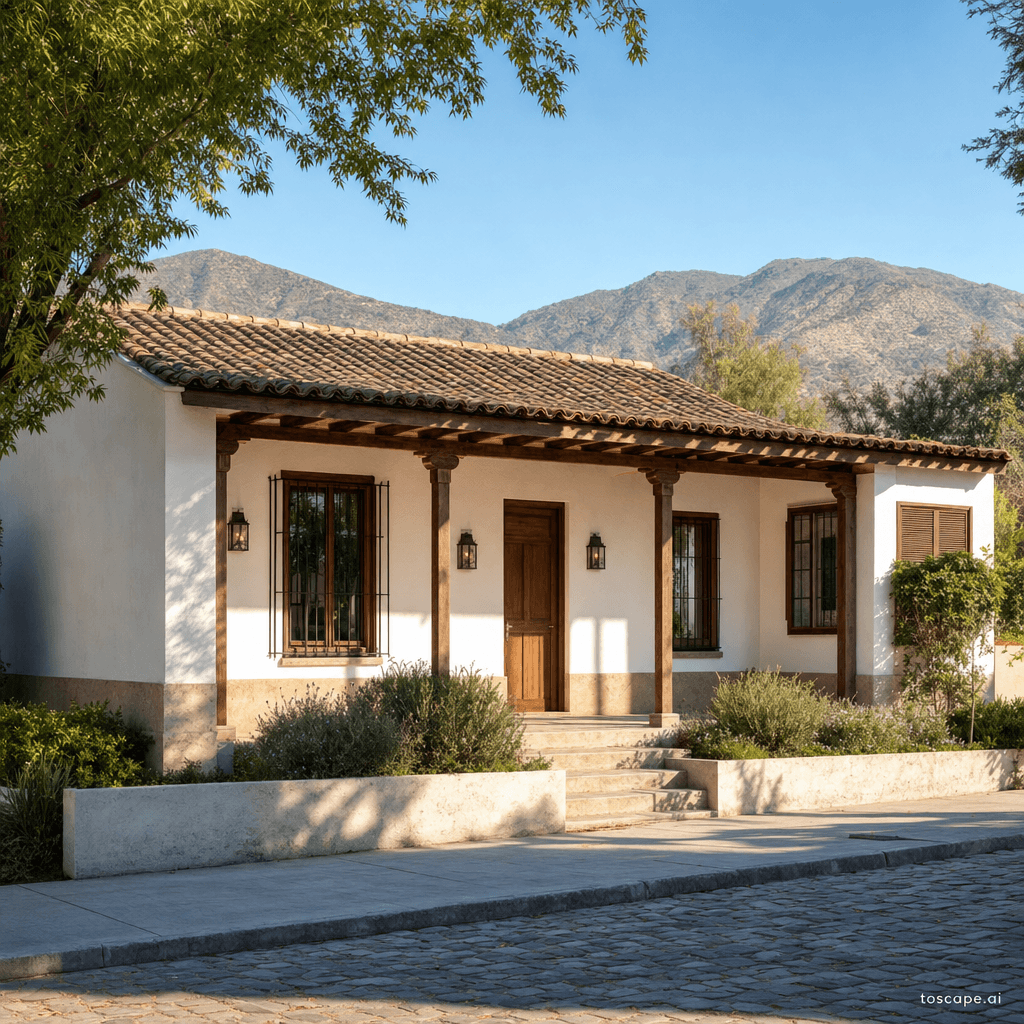
Santiago Central Valley
Chile · architectural identity of Chile's Central Valley (Santiago to the Bío-Bío River)
The Chilean colonial adobe house — a long horizontal composition of whitewashed or ochre adobe walls under a continuous red clay tile roof (teja curva) with deep projecting eaves supported by carved wooden brackets (canecillos) — the facade is organized by a r...
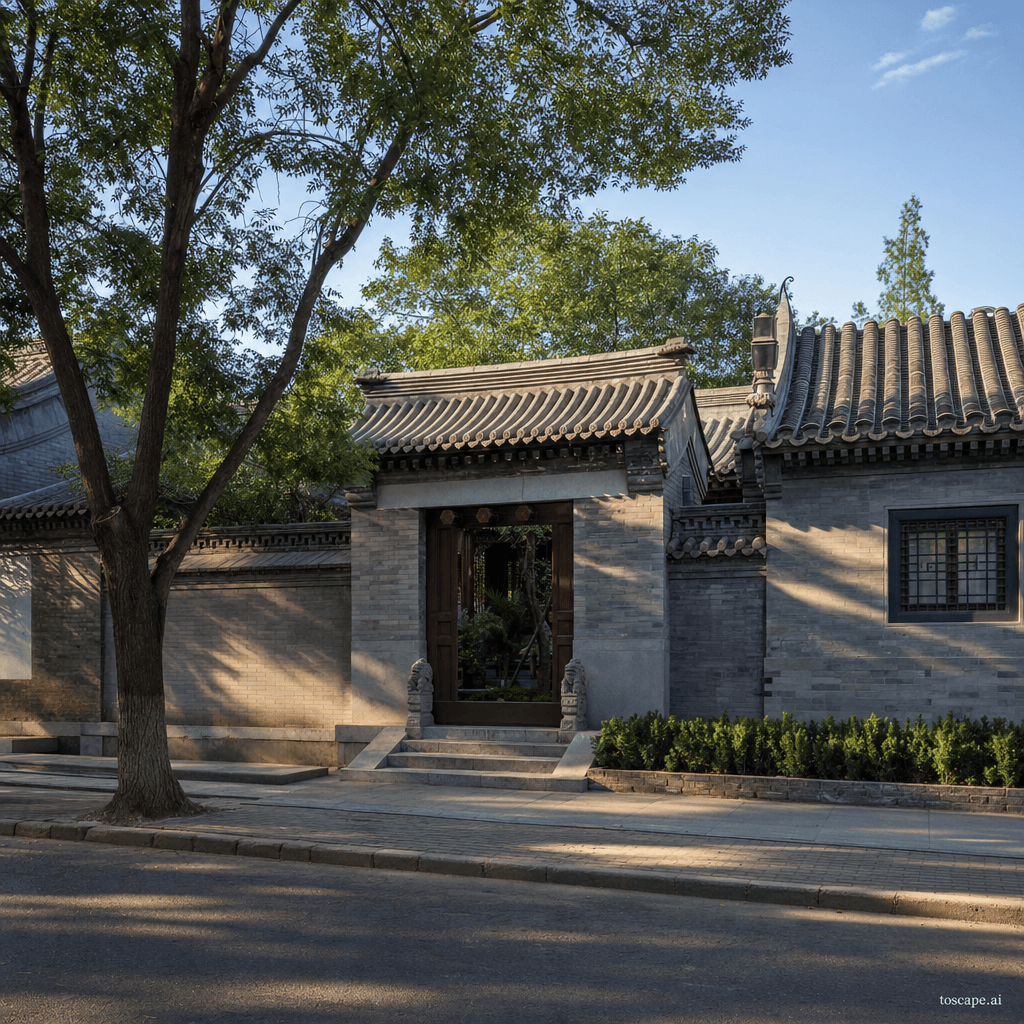
Beijing Siheyuan
China · Beijing Siheyuan
Four-sided rectangular courtyard (siheyuan) with buildings on four sides around central yard, grey brick (qing zhuan) with black tile roofs, hierarchical axial arrangement (north-south), elaborate gate typologies (chuihua men, guangliang men), feng shui orient...
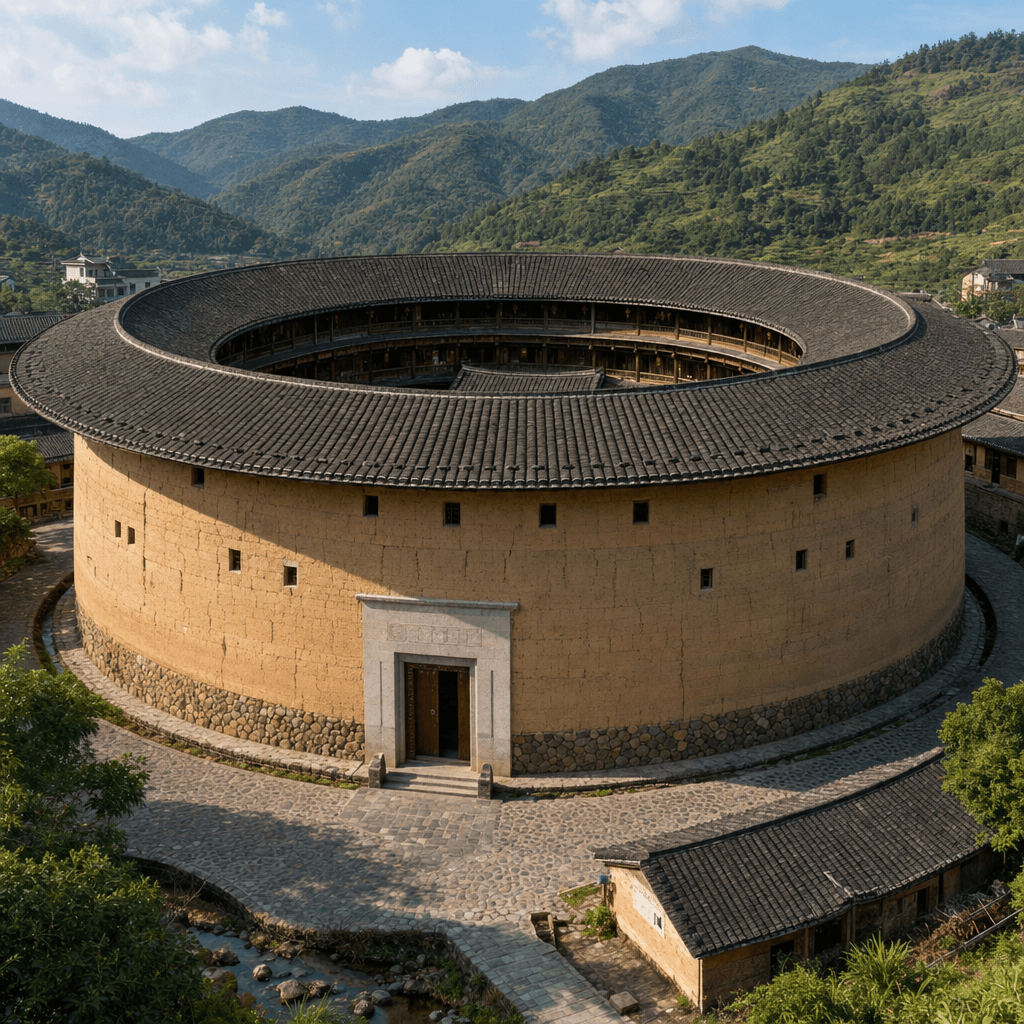
Fujian Tulou
China · Fujian Tulou
Monumental circular or square rammed-earth walls (up to 5 stories, 70m diameter), inward-facing with single fortified gate, timber gallery corridors circling inner courtyard, ancestral hall at center, grey tile roofs, defensive gun ports (qiang yan)
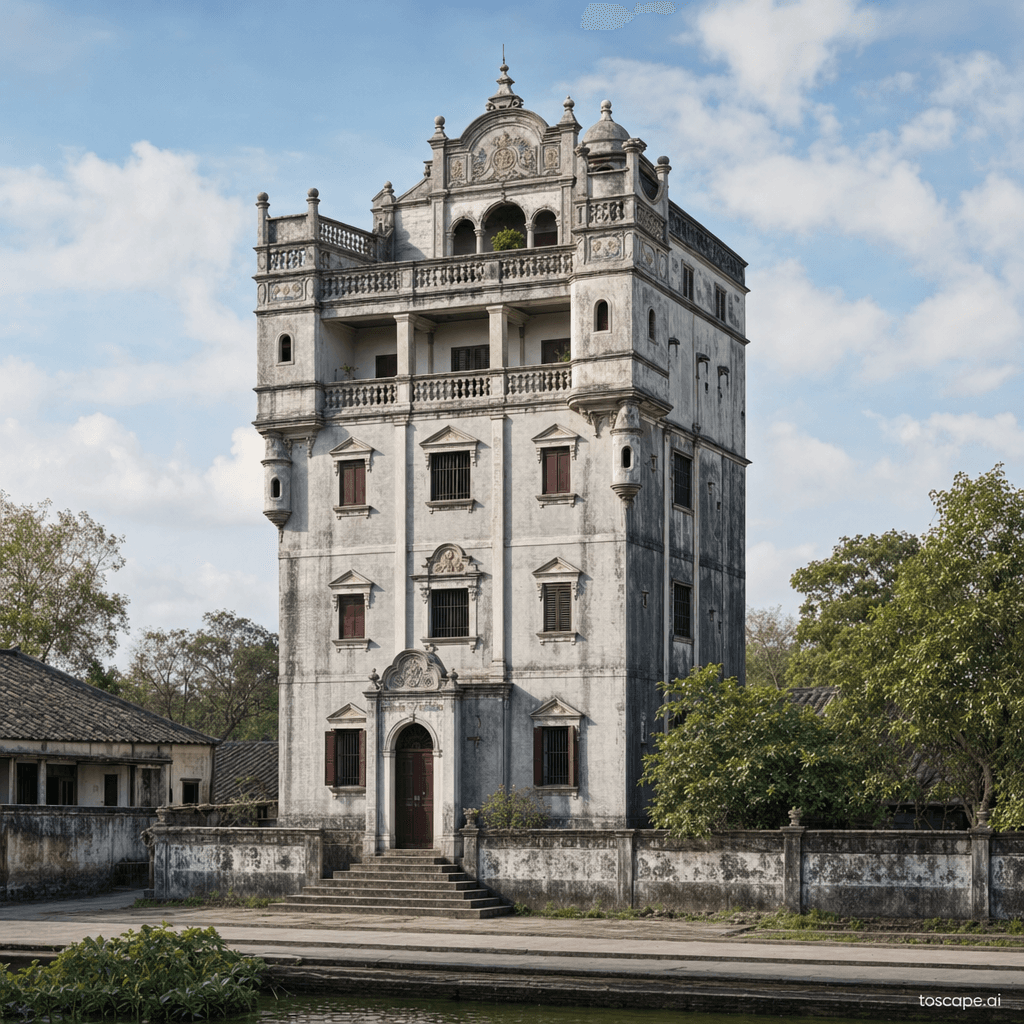
Guangdong Diaolou
China · Kaiping Diaolou
Reinforced concrete and stone towers 4-9 stories, eclectic fusion of Chinese traditional ornament with European Baroque, Neoclassical, and Art Deco elements, defensive iron gates and gun ports, terraced roof belvederes
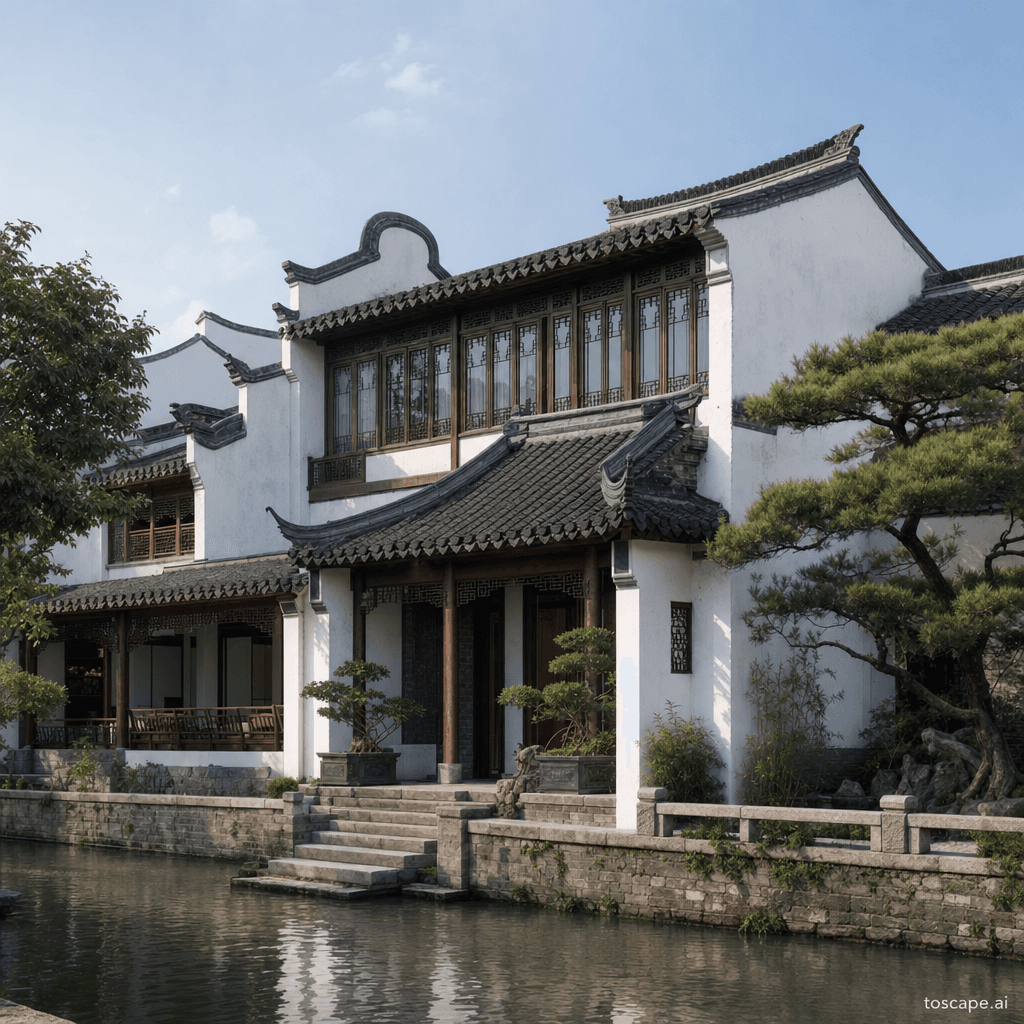
Jiangnan Water Town
China · Jiangnan region (Suzhou, Hangzhou, Tongli, Zhouzhuang)
Whitewashed lime plaster over brick walls (fen qiang), black-grey curved tile roofs (dai wa), canal-front houses with stone quays and arched bridges, classical scholar gardens (yuan lin) with rockery, pavilions, and moon gates, carved brick gate towers (men lo...
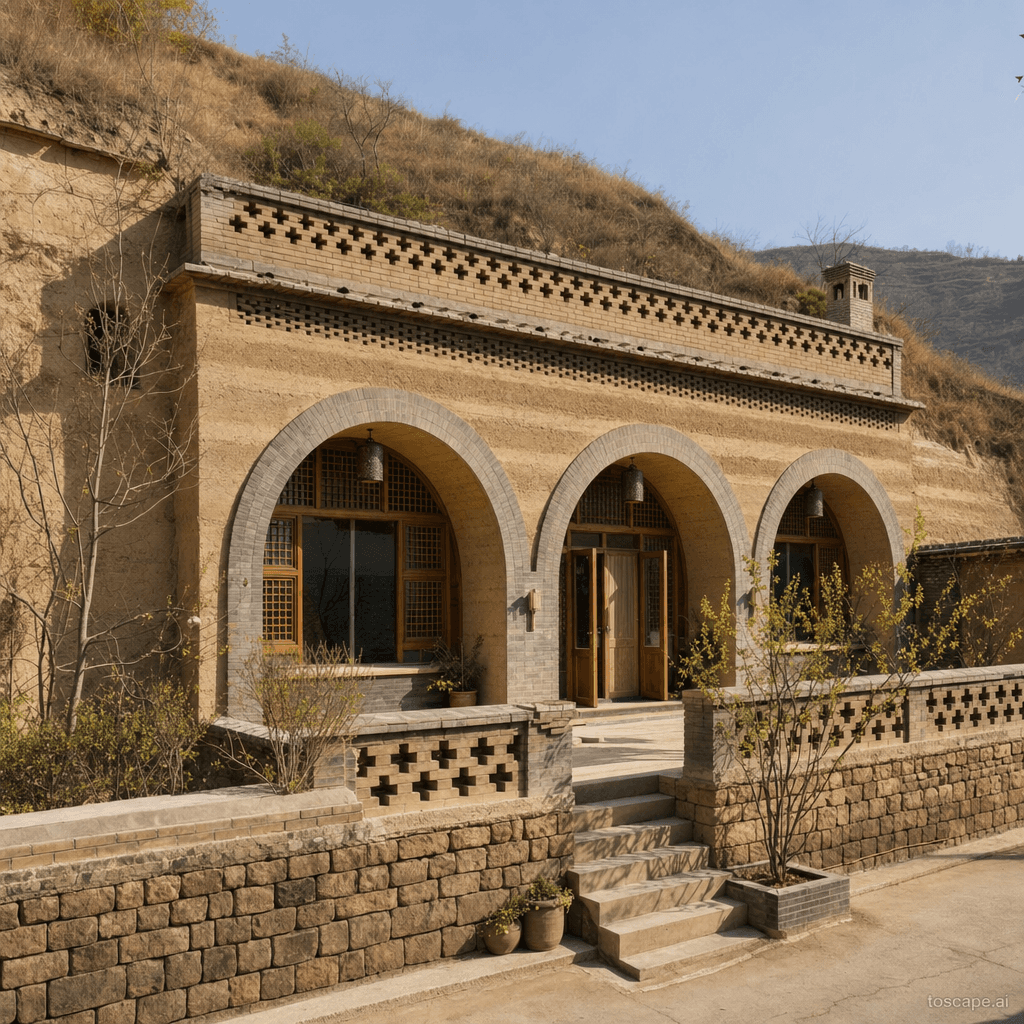
Shanxi Yaodong
China · Shanxi, Shaanxi, Henan Loess Plateau
Yaodong (kiln-like cave dwellings) carved horizontally into loess hillsides (kao yaodong) or excavated as sunken courtyards (dikengyuan) in flat terrain, vaulted earth ceilings, rammed earth and grey brick facade walls, passive earth-sheltering for extreme cli...
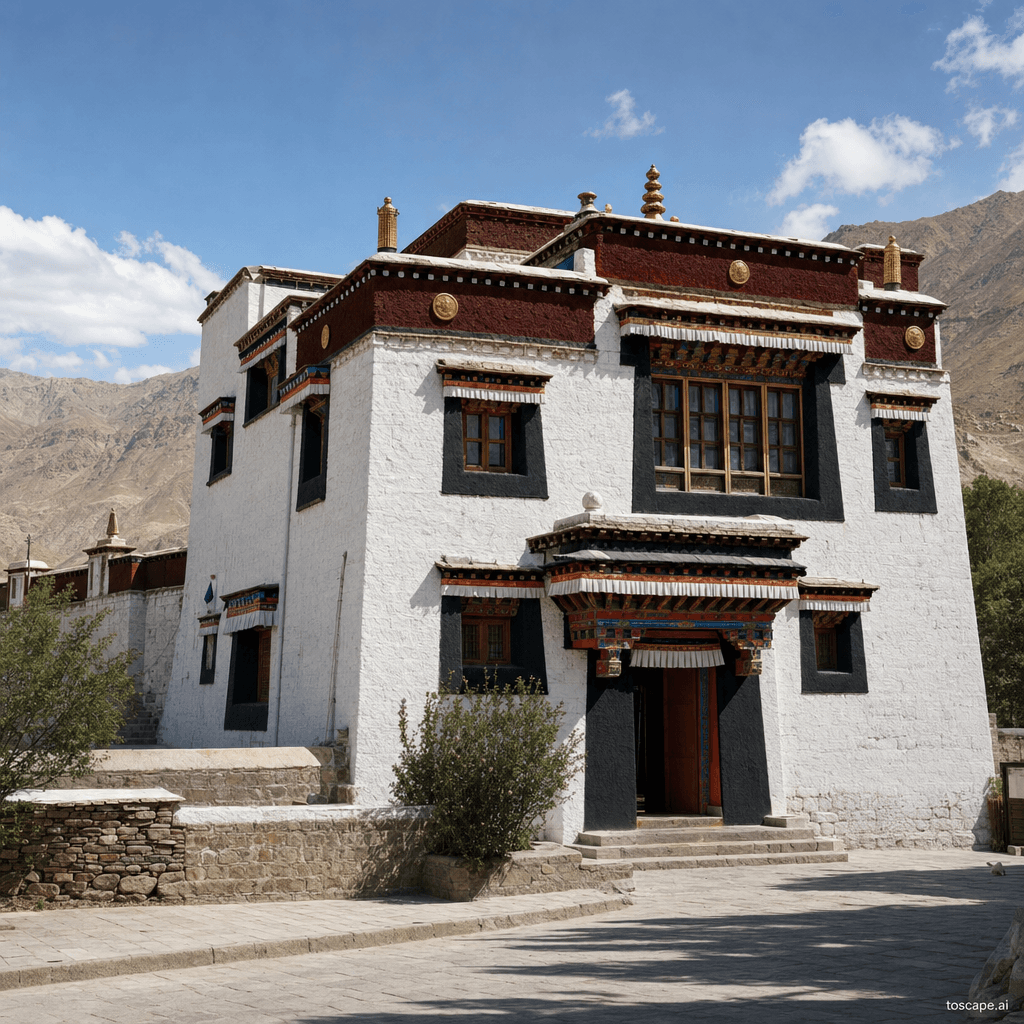
Tibetan Plateau
China · Tibetan Buddhist
Monumental whitewashed stone dzong (fortress-monasteries) with battered walls and flat roofs, red-band (marpo ri) upper stories on religious buildings, black yak-hair fringed windows, timber frame with painted brackets, mani stone walls and golden roof finials
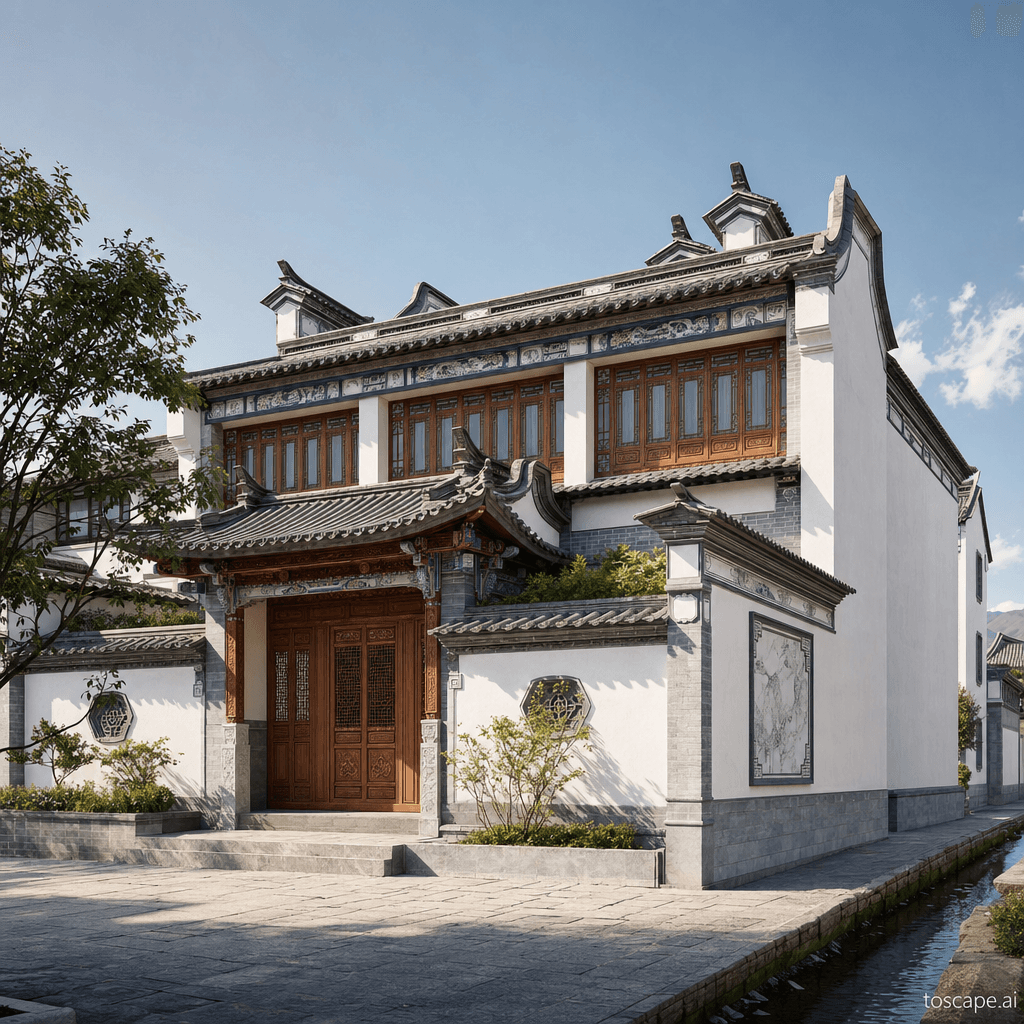
Yunnan Bai
China · Bai ethnic architecture of Dali, Yunnan
Whitewashed stone and brick courtyard compounds with grey tile roofs, elaborately painted and carved timber screen walls (zhao bi), flying eaves, marble panel inlays, fish-scale gable tiles, Cangshan marble (dali shi) as decorative element, intimate water-chan...
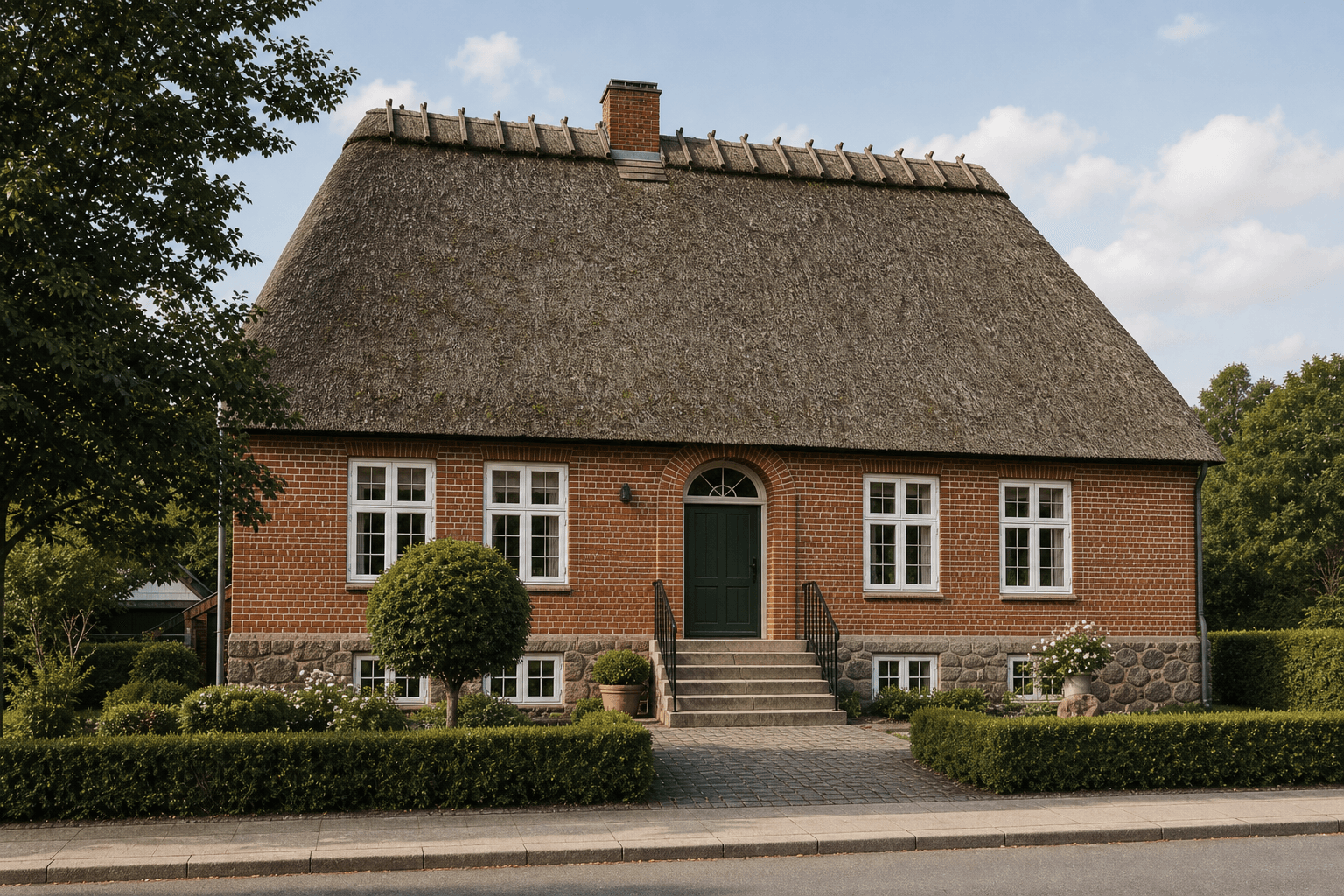
Danish Brick Vernacular
Denmark · Danish rural vernacular house
The Danish bondehus — a long low horizontal rectangle of red brick or whitewashed half-timbering, under a massive thatched roof that visually dominates (roof-to-wall ratio of 2:1 or greater) — the walls are modest in height (2.5–3 m), the eaves are low, and th...
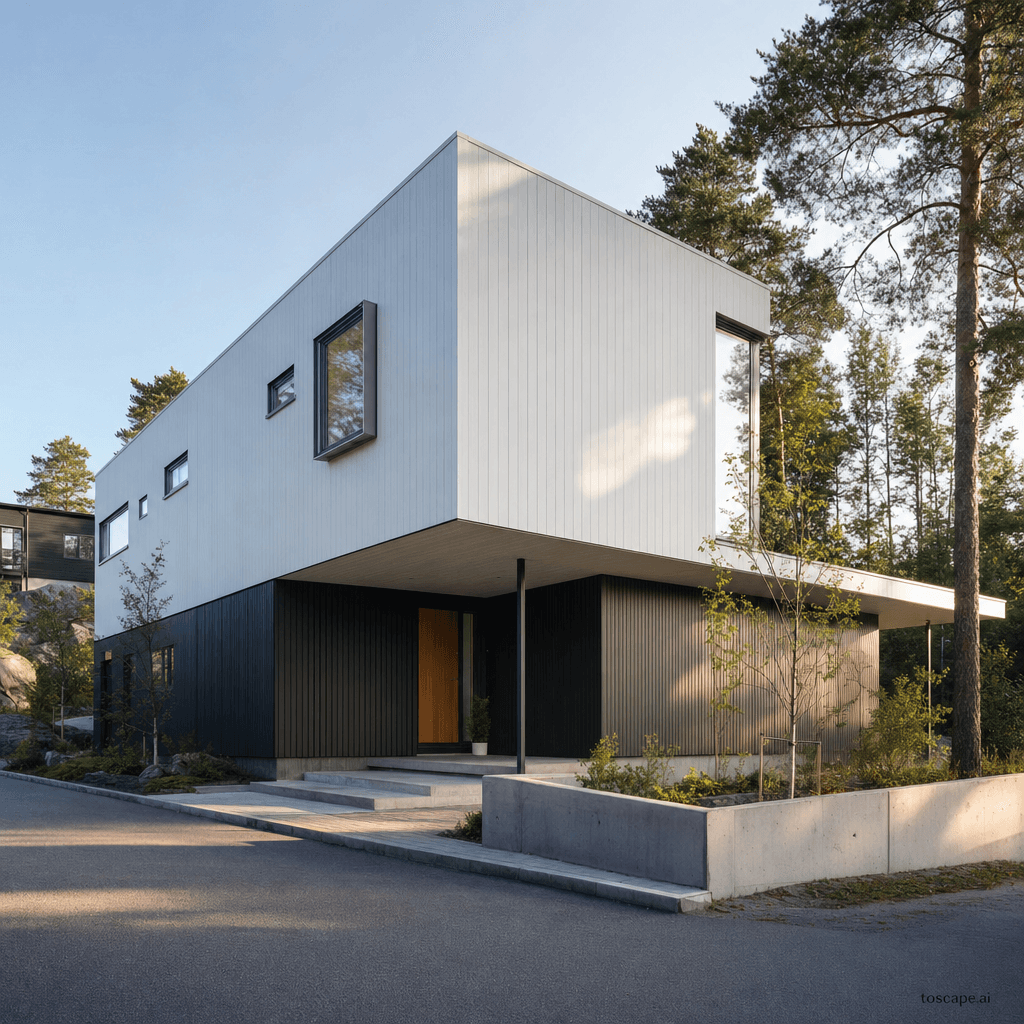
Finnish Modern
Denmark · Finnish modern architecture (1920s–1970s), defined by the work of Alvar Aalto (1...
Finnish modernism — a building that reads as a white or brick horizontal mass, with long ribbon windows, a floating flat or low-pitched roof, and warm material accents: a copper-clad entrance canopy, a birch-slatted ceiling, a brick wall that turns a corner —...
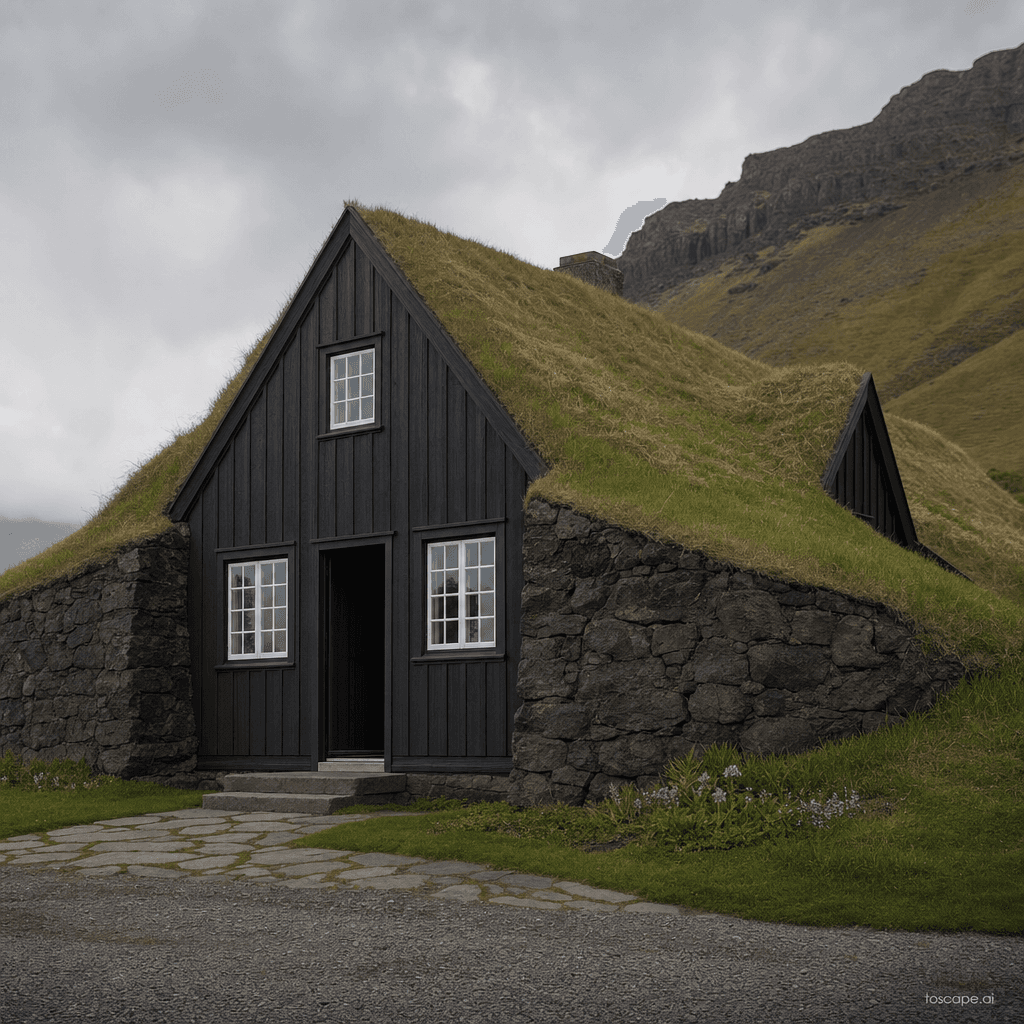
Icelandic Turf House
Denmark · Icelandic torfbær
The Icelandic turf house — a long, low structure (4–6 m wide, 10–30 m long or more) that reads as a grassy mound in the landscape — the walls are 1–2 m thick, built of alternating courses of turf strips (torfhnaus) and stone, with the grass side facing outward...
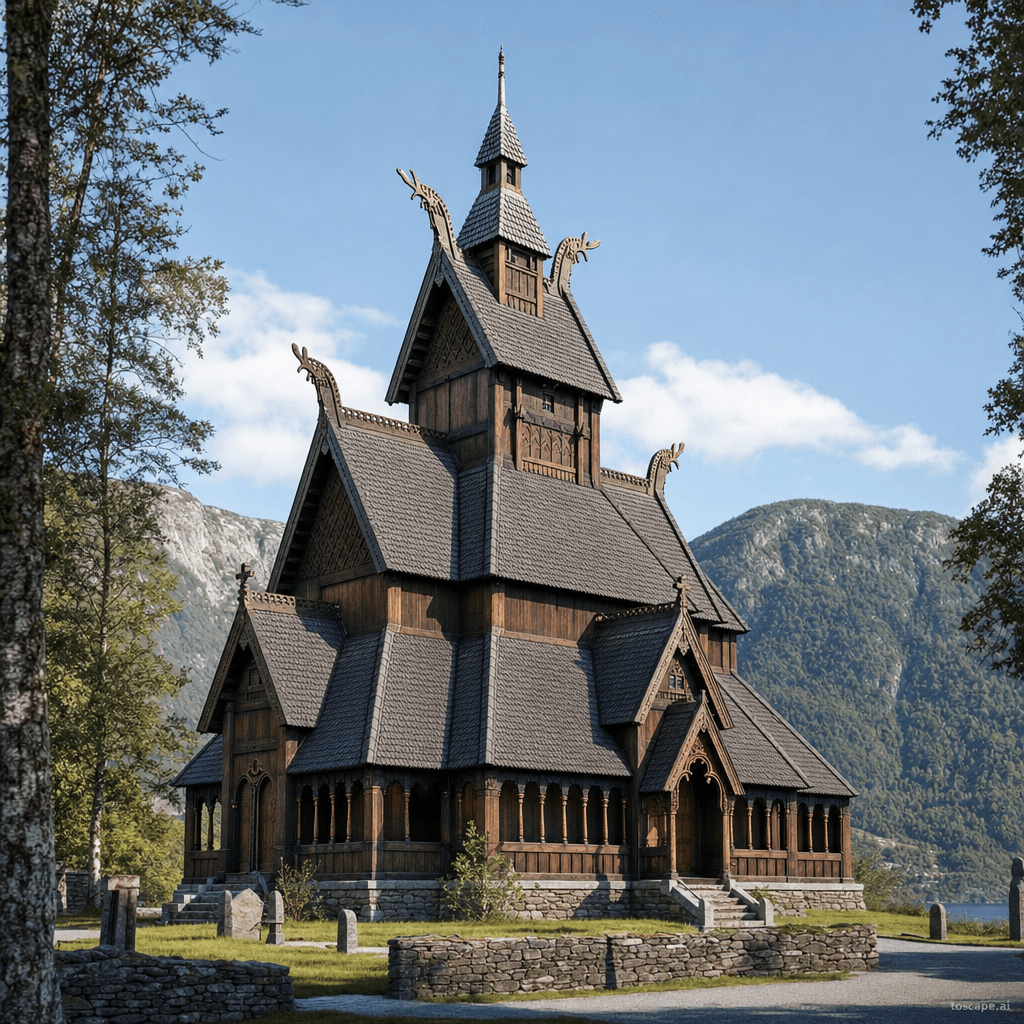
Norwegian Stave Church
Denmark · Norwegian stavkirke
The stavkirke — a dark, tarred vertical assembly of wood rising from a stone base, its roof planes stacking upward like a wooden mountain — the silhouette is the key identity: a series of cascading roof tiers (typically 3–5 levels from eaves to spire), each ti...
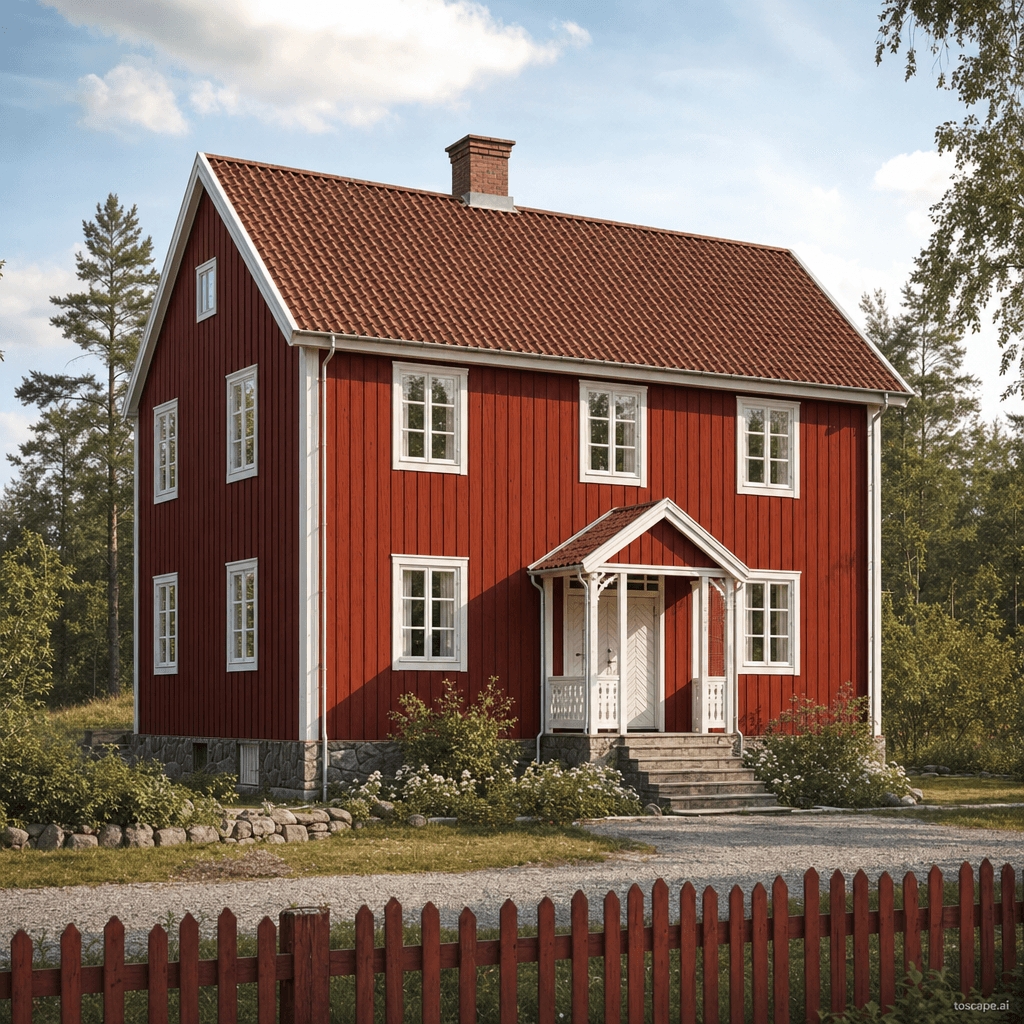
Swedish Falun Red Wooden House
Denmark · Swedish wooden house tradition
The Swedish Falun red house — a simple rectangular wooden volume with vertical board siding painted in the distinctive deep red-brown of Falu rödfärg — the red body is framed with white trim: white corner boards (knutbrädor) at every wall junction, white-frame...
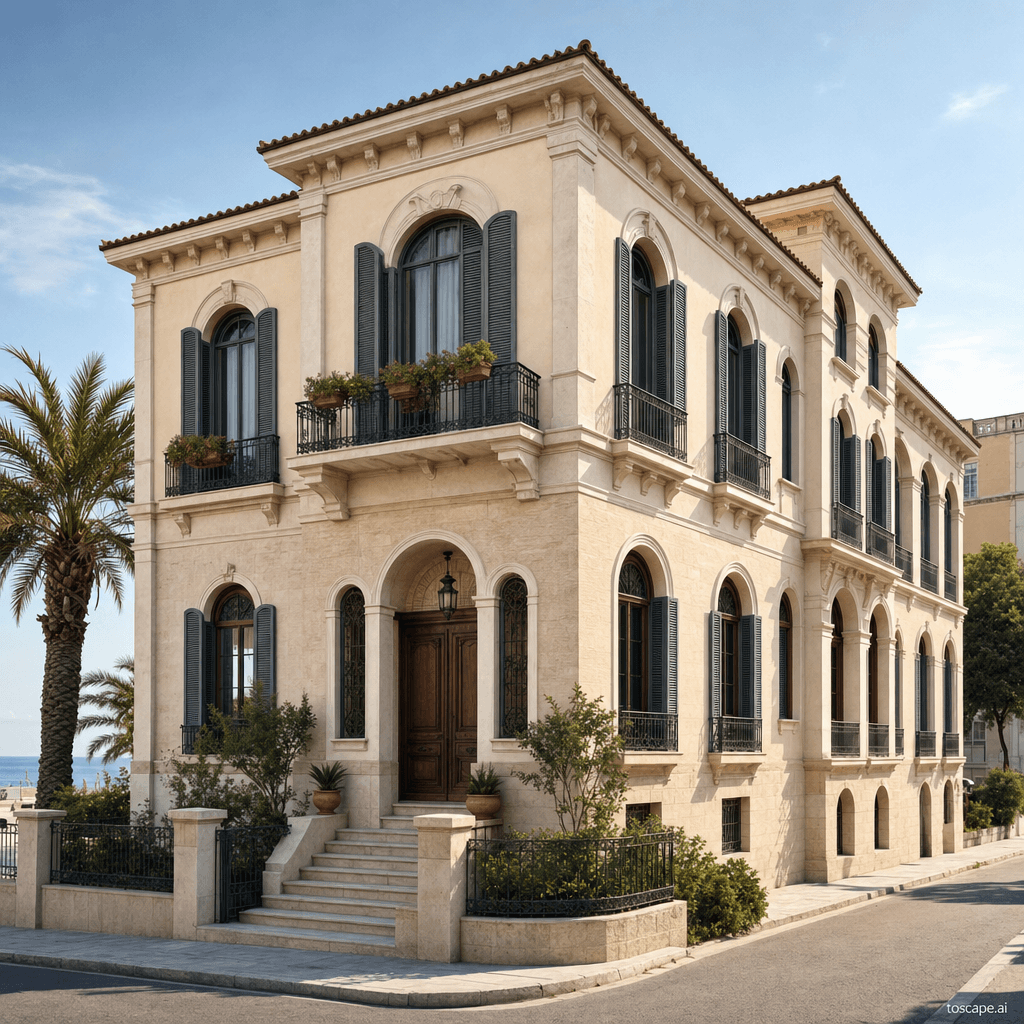
Alexandria Mediterranean
Egypt · distinctive Mediterranean architectural identity of Alexandria (Al-Iskandariyya)
Multi-storey (4–8 storeys) apartment blocks with flat roofs — continuous street wall with rhythmic balconies — wrought-iron and cast-iron balcony railings — rendered facades in cream, white, and pastel tones — vertical window proportions with louvered shutters...
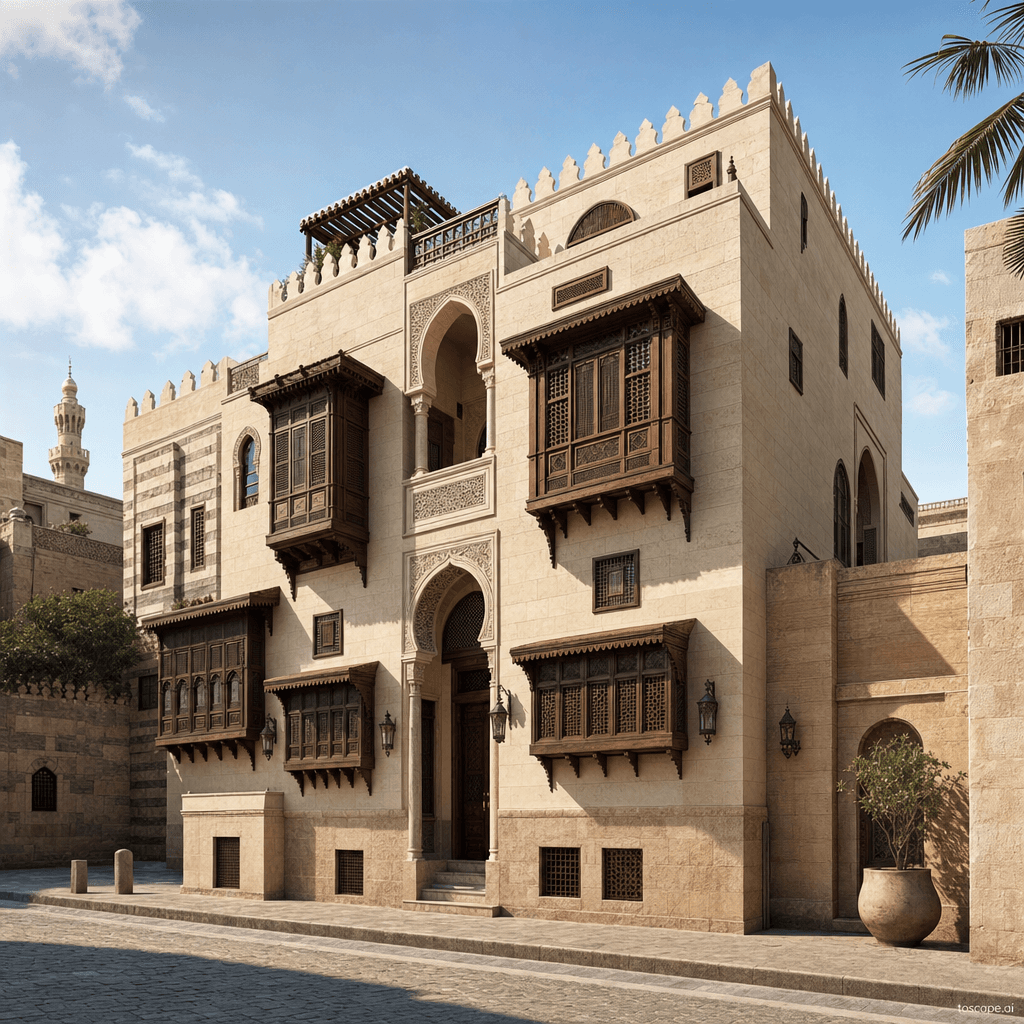
Cairo Islamic
Egypt · Islamic urban architecture of Historic Cairo (Al-Qahira) and the Nile Delta regi...
Introverted courtyard house (al-bayt al-arabi) — central open-air courtyard (hosh) with fountain — multi-storey with ground-floor service and upper-floor living — projecting timber bay windows (mashrabiya) — stone construction (limestone) with alternating colo...
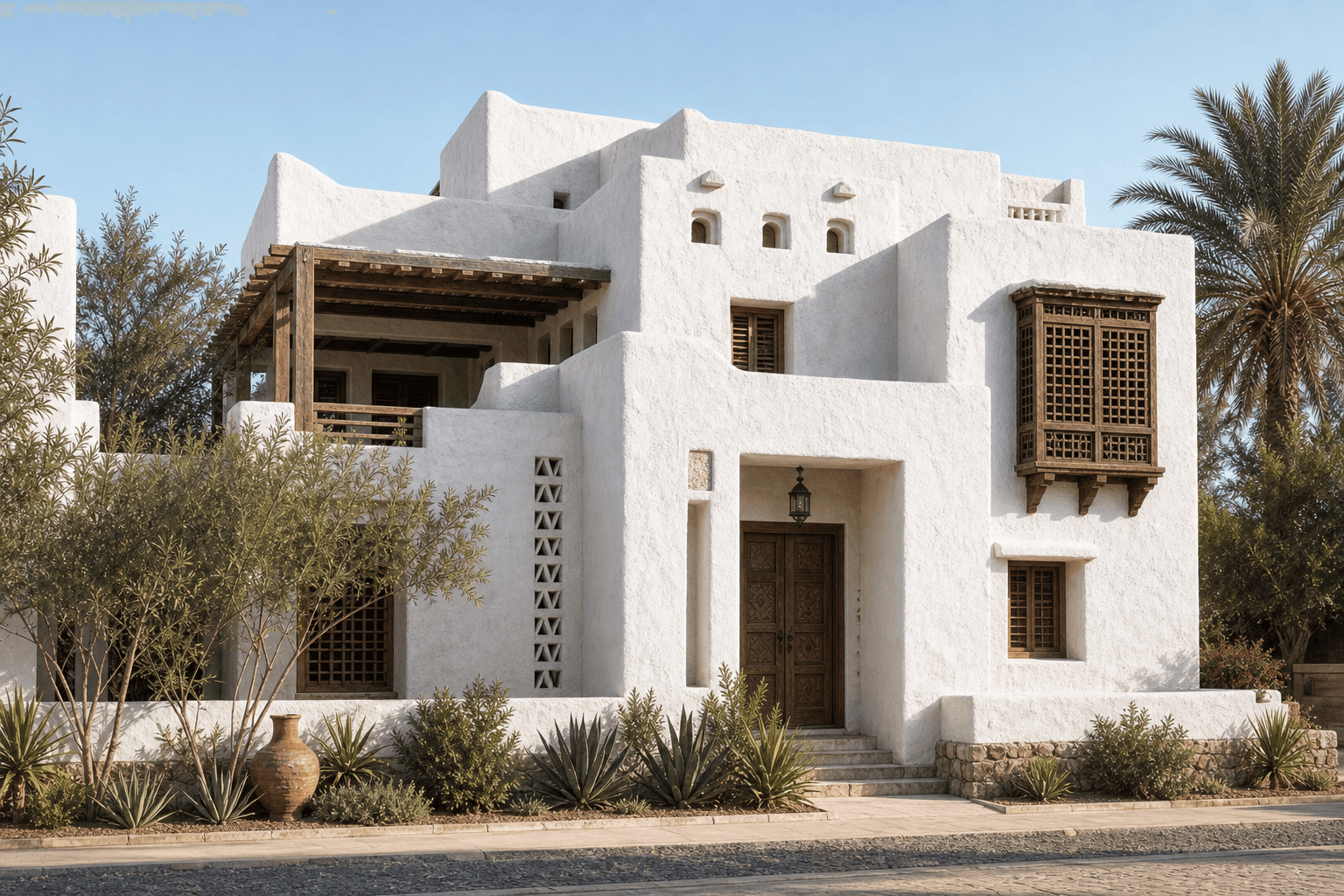
Red Sea Coastal
Egypt · coastal architecture of the Egyptian Red Sea region
Coral stone (al-hajar al-manqabi) construction — white lime-rendered cubic volumes — flat roofs with parapets — small, deep-set window openings — wooden shutters and carved doors — shaded verandahs and roof terraces — the mashrabiya screen for privacy and vent...
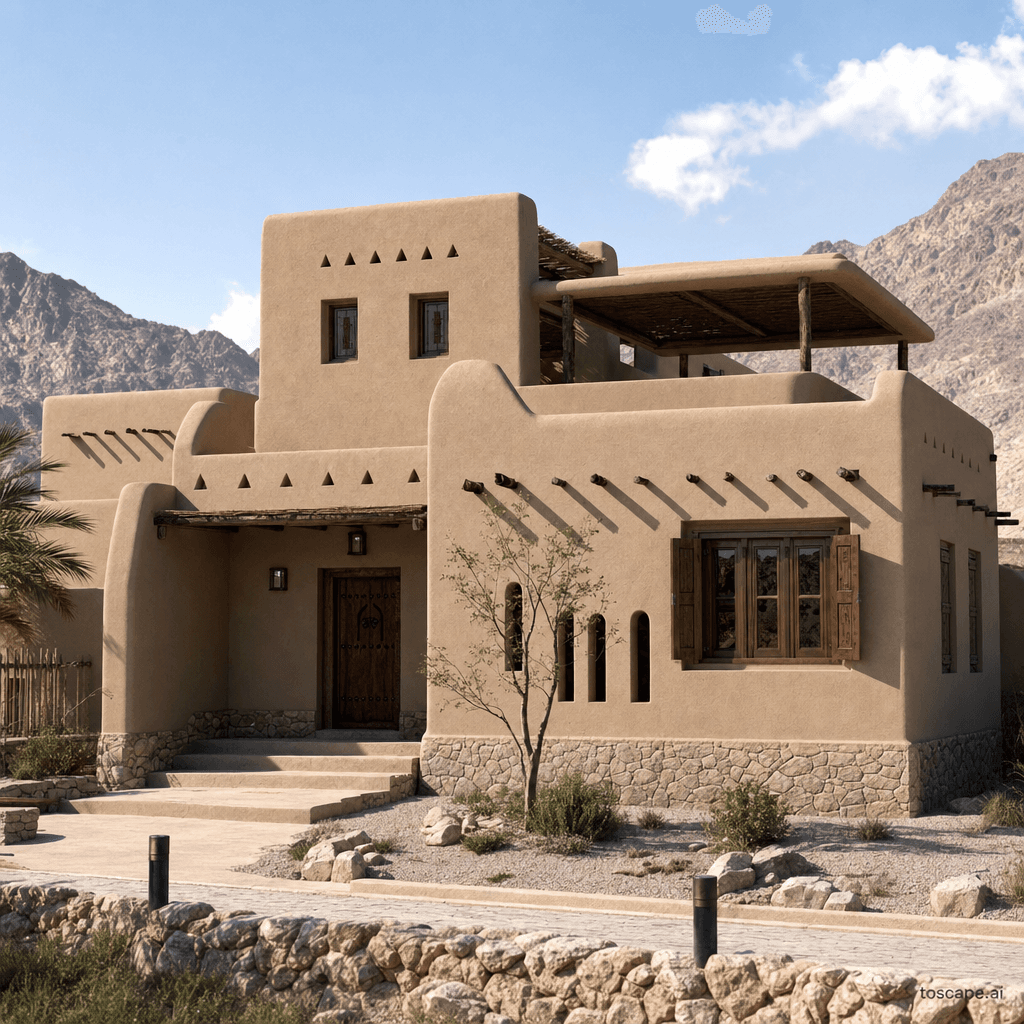
Sinai Bedouin Desert
Egypt · Bedouin architecture of the Sinai Peninsula
The Bedouin black goat-hair tent (bayt al-sha'r) — low horizontal profile — woven tent cloth that contracts when wet (rainproof) and expands when dry (ventilated) — stone-walled desert shelters (arish) with palm-frond roofs — courtyard compounds enclosed by st...
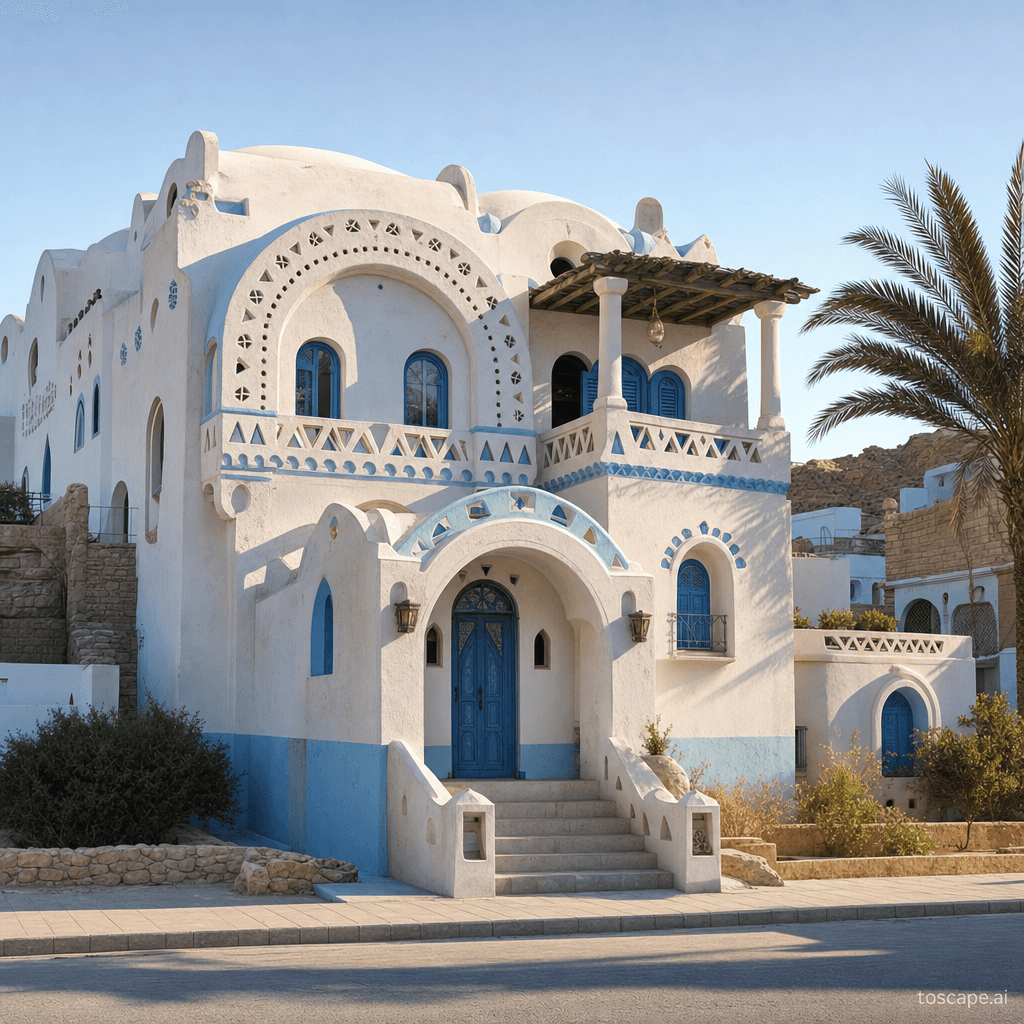
Upper Egypt Nubian
Egypt · Nubian vernacular architecture of Upper Egypt (Aswan Governorate) and the Lake N...
Mud-brick construction (adobe) — Nubian vault (akfu) — barrel-vaulted and domed roofs without timber centering — painted geometric facade patterns in white, blue, yellow, red, and green — open courtyard plan — thick walls (400–600 mm) for thermal mass — elevat...
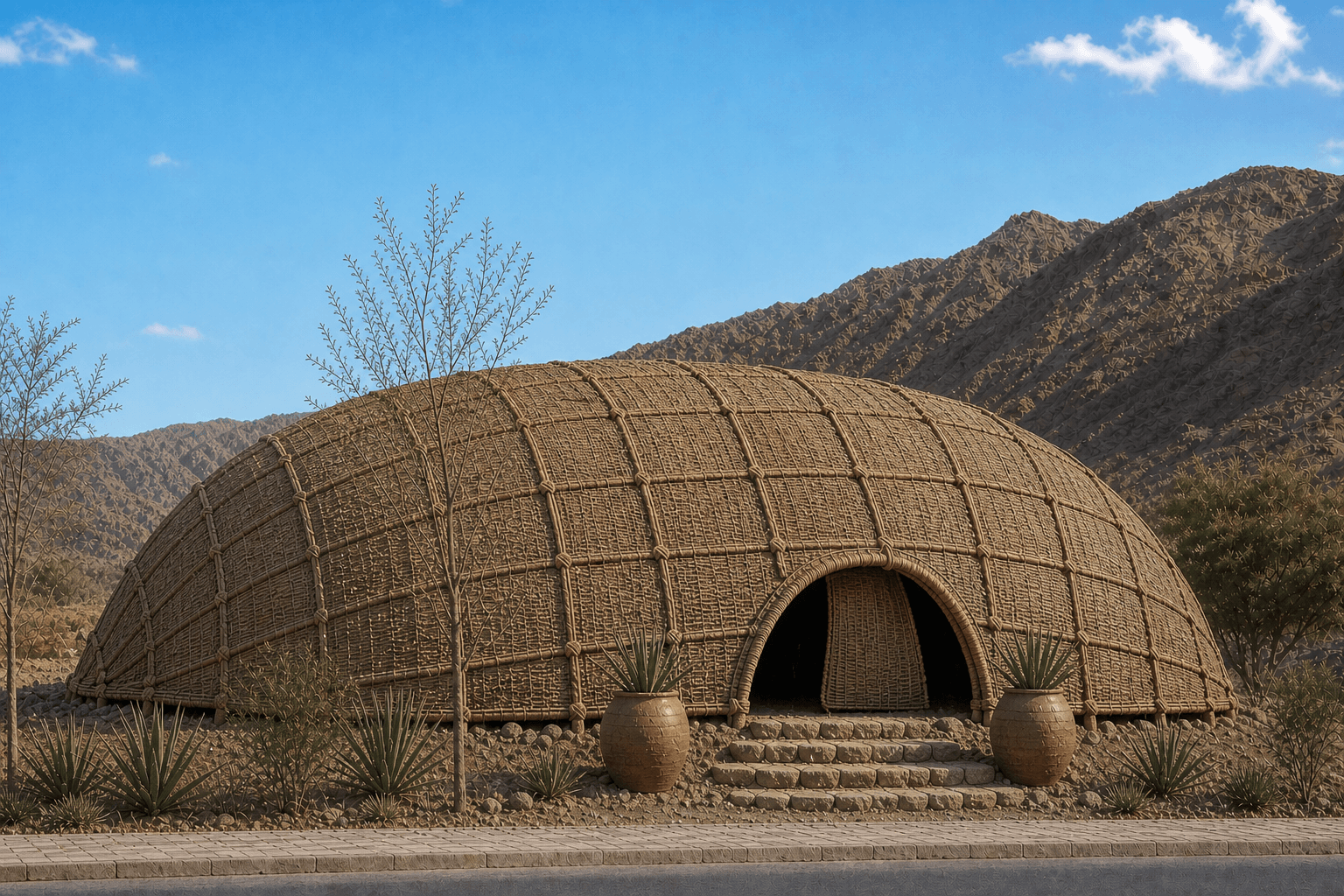
Afar Mat-Tent
Ethiopia · architectural identity of the Afar people
The Afar ari — a low hemispherical arch-tent (A-frame derived, but the poles are bent into smooth curves rather than triangular peaks), typically 3–5 m long × 2–3 m wide × 1.2–1.8 m high at the ridge — the arched pole framework (acacia or tamarix branches, 2–4...
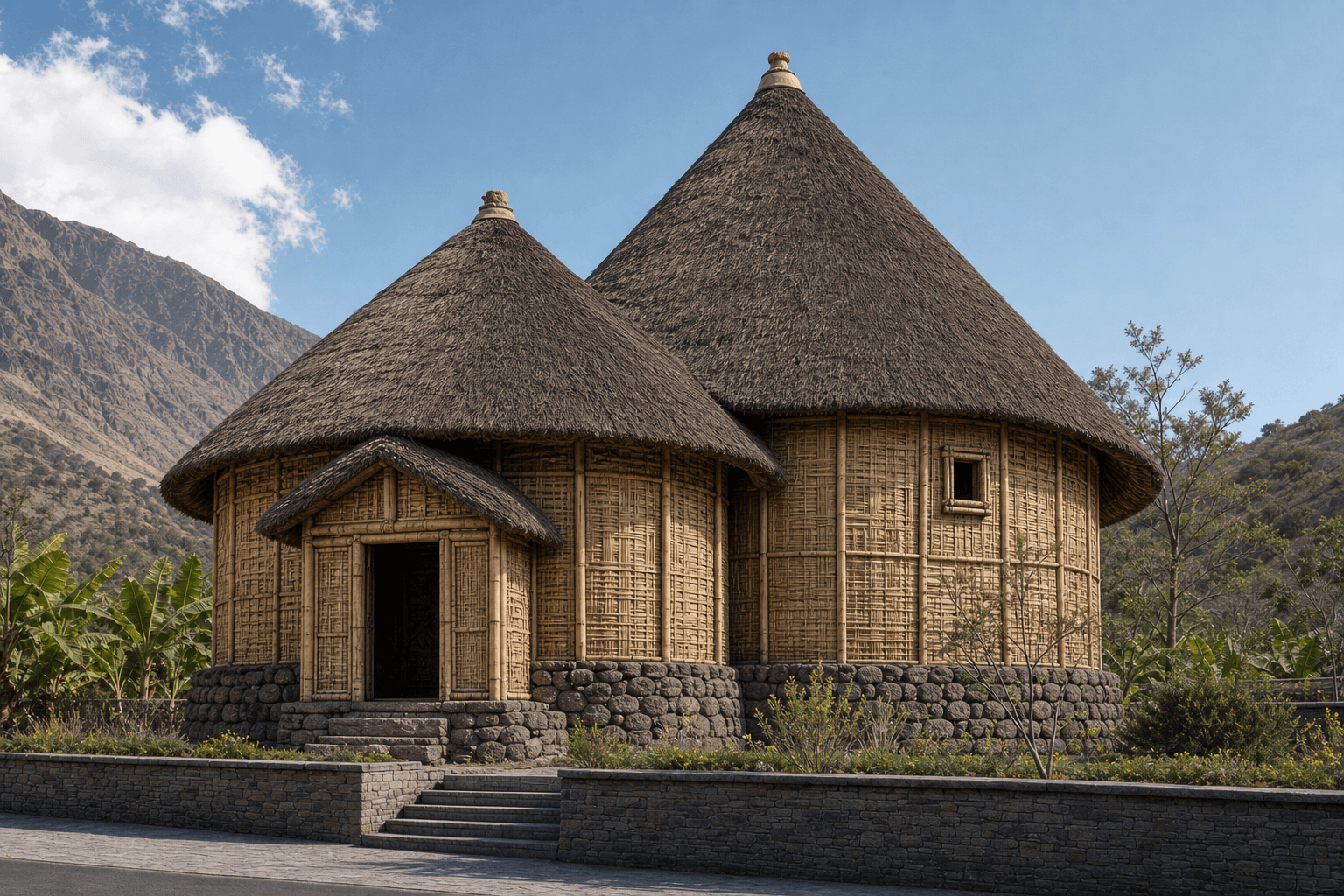
Gamo Highlands
Ethiopia · architectural identity of the Gamo Highlands
The Dorze tukul — a circular bamboo-framed structure (4–7 m diameter, 6–9 m total height from ground to roof peak) with three distinct vertical zones: (1) the entrance porch — a low bamboo-framed projection with a small door (1.2–1.5 m high, requiring a stoop...
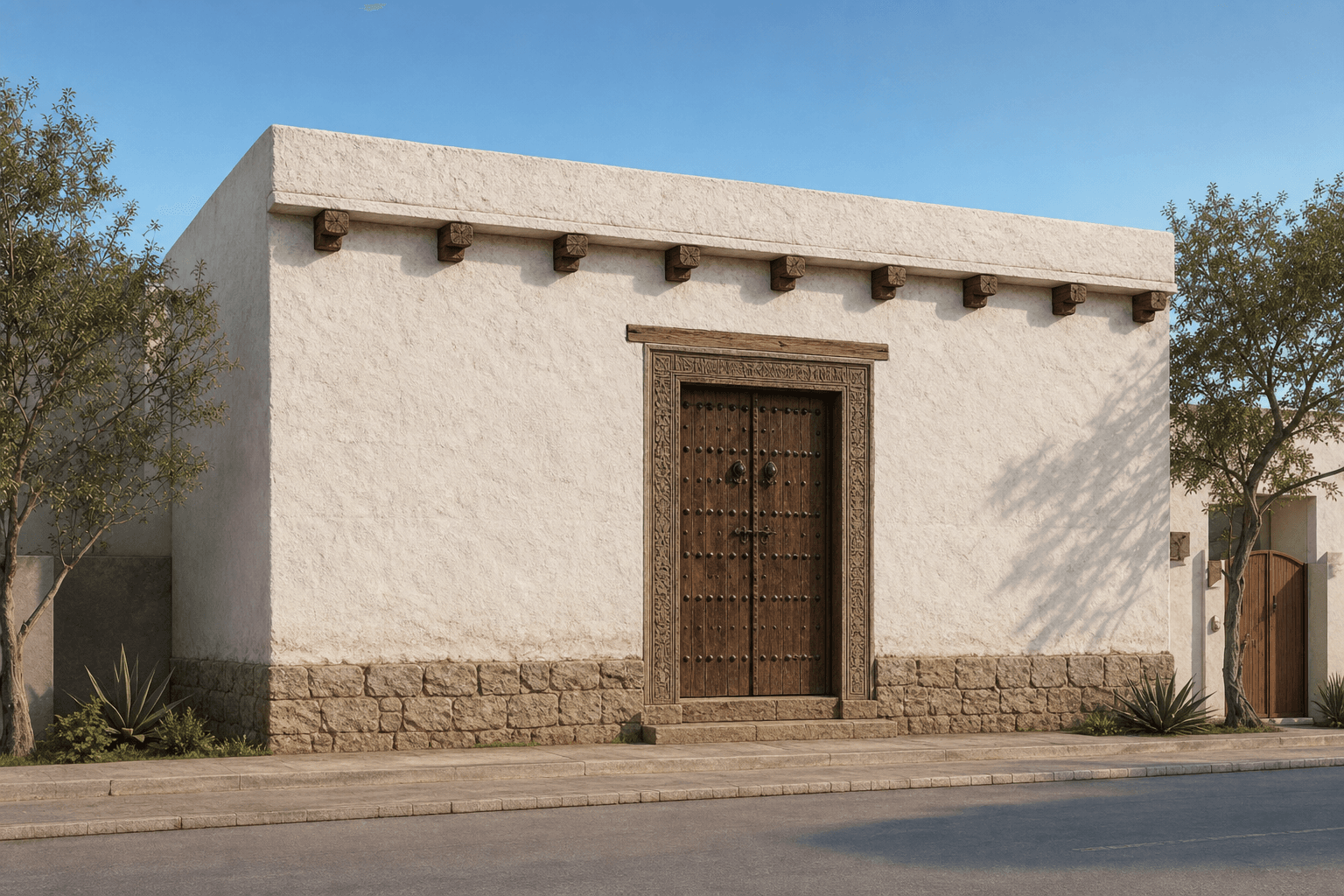
Harar Jugol
Ethiopia · architectural identity of Harar Jugol (UNESCO World Heritage, inscribed 2006)
The Harari townhouse (gey gar) — a single-volume rectangular room (typically 4–6 m × 3–4 m, 2.5–3.5 m height) entered from a narrow alley through a heavy carved wooden door (often with metal studs) — the interior is defined by the nadaba system: five horizonta...
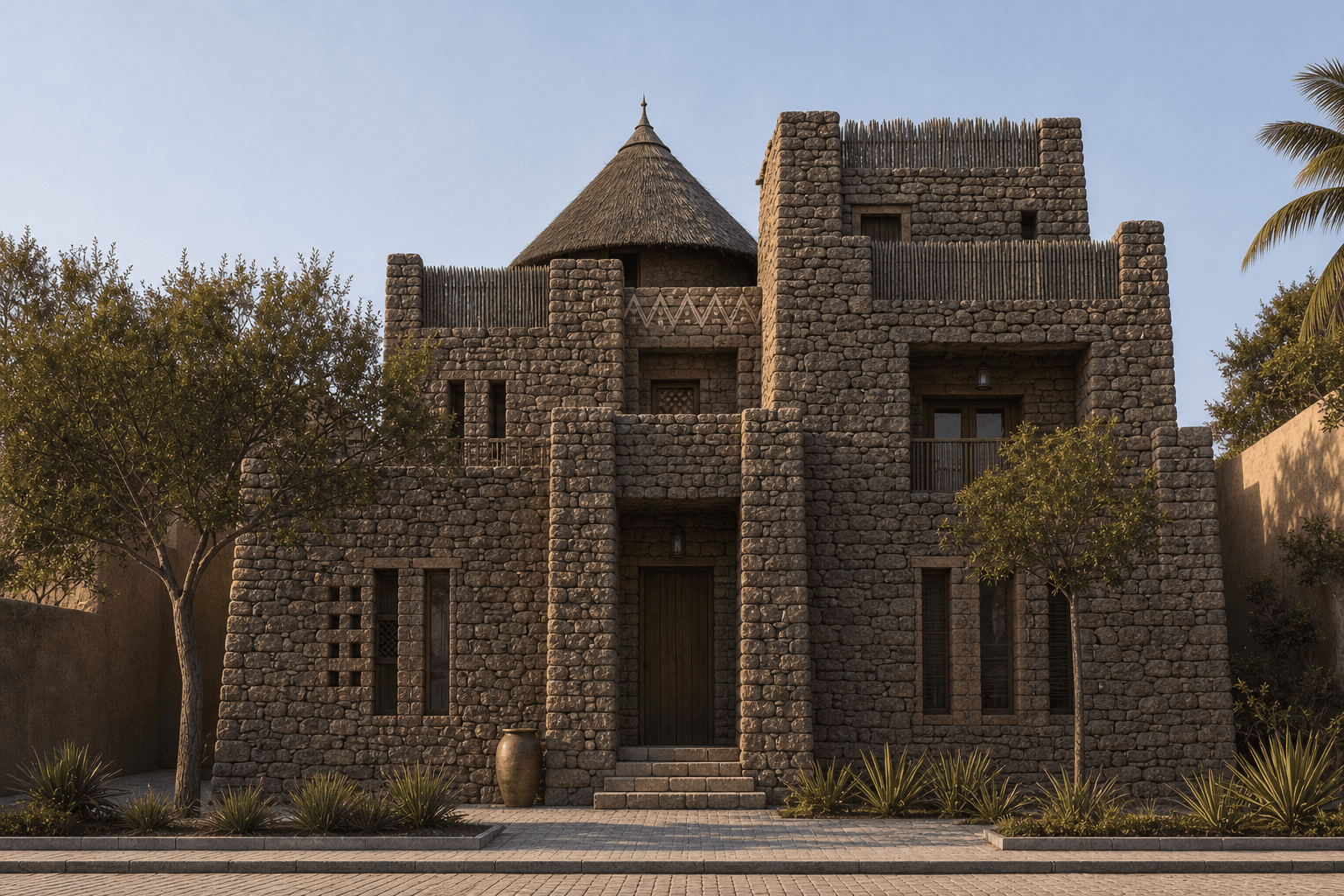
Konso
Ethiopia · architectural identity of the Konso cultural landscape (UNESCO World Heritage, i...
The Konso walled hilltop village (paleta) — a dense settlement of 200–600 rectangular houses protected by 2–4 concentric dry-stone walls built from local basalt without mortar — the mora at the center, a large circular community house with a tall conical thatc...
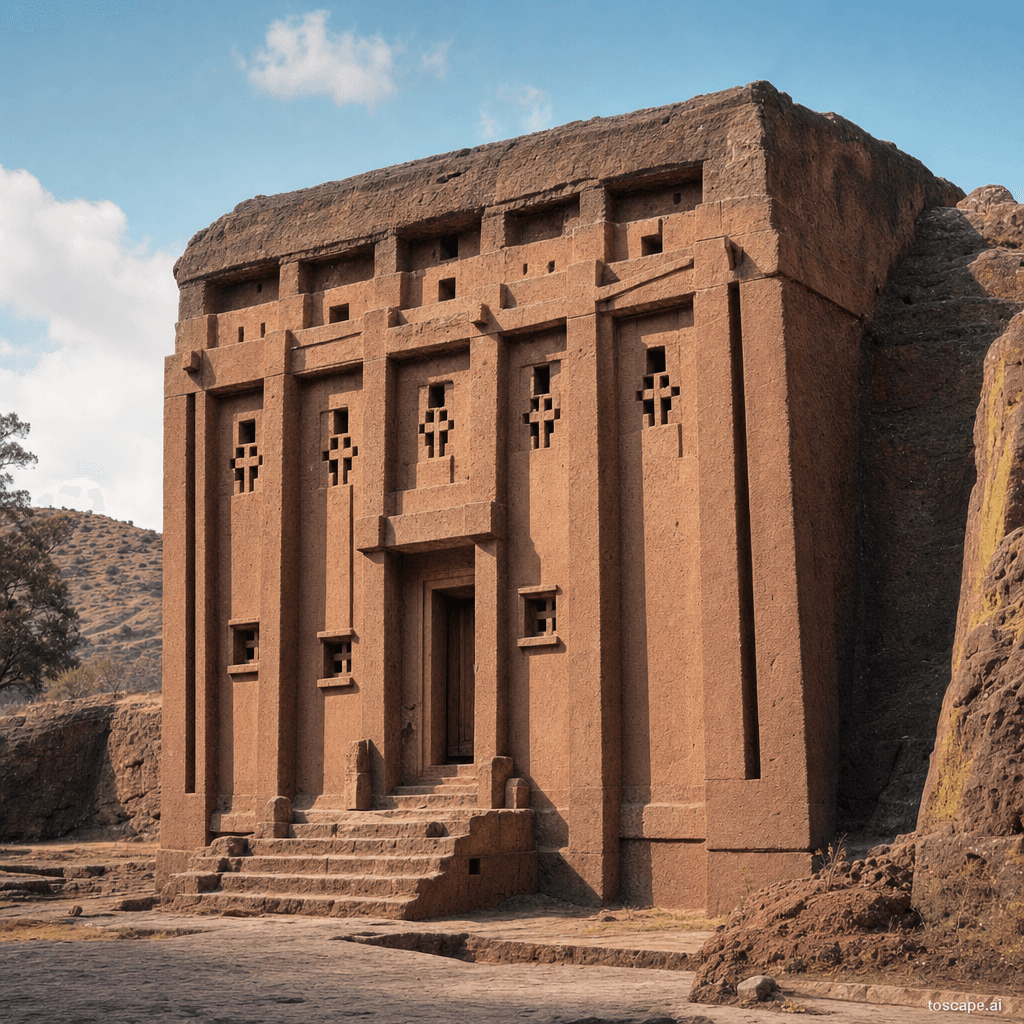
Lalibela Rock-Hewn
Ethiopia · architectural identity of Lalibela
The monolithic rock-hewn church — carved entirely from a single block of volcanic tuff (ignimbrite), freed from the surrounding rock matrix by deep trenches (12–15 m deep) and connected to the living rock only at the base — cruciform or rectangular plan — Aksu...
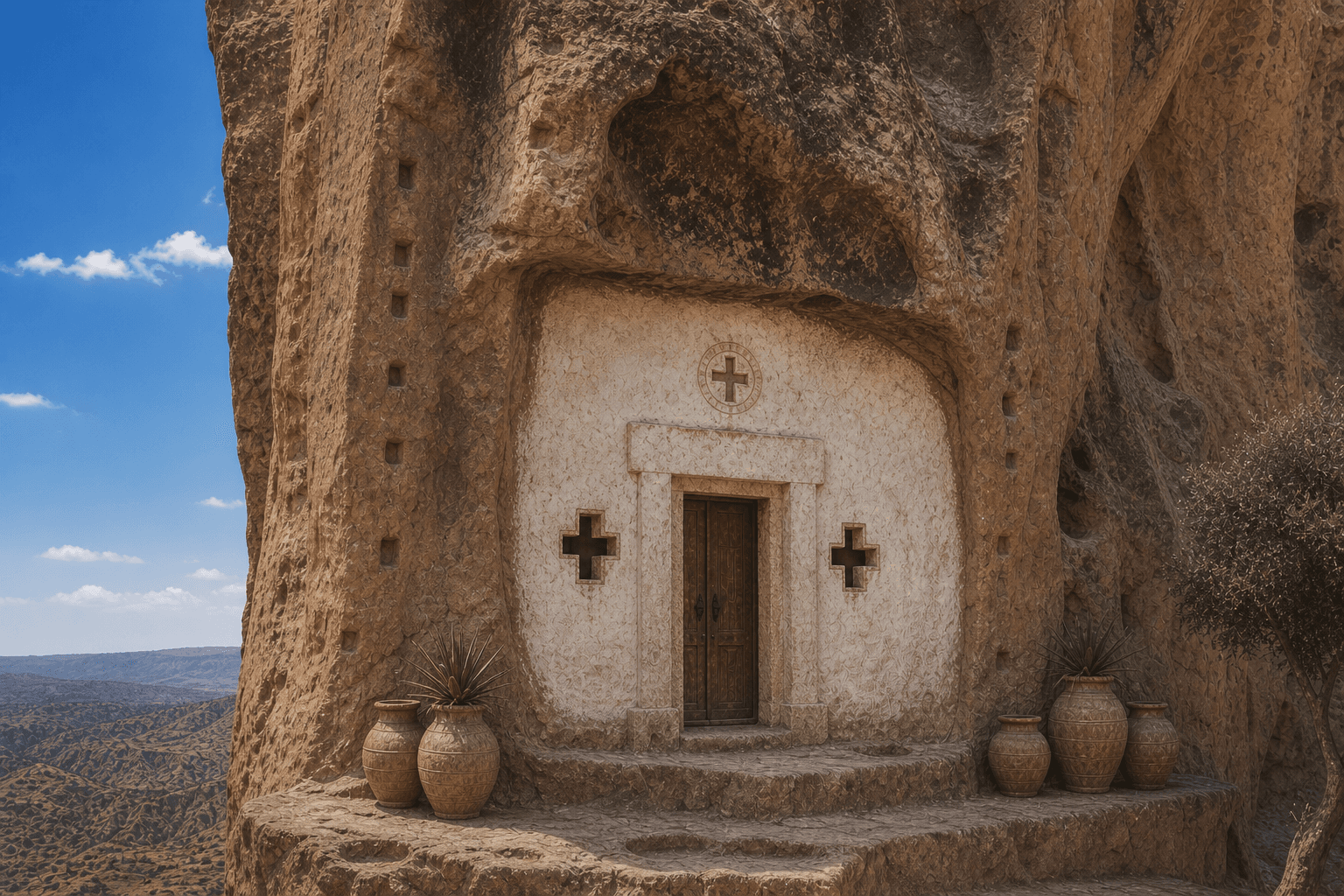
Tigray Cliff-Church
Ethiopia · architectural identity of the Tigray cliff churches
The cliff-face rock-hewn church — carved into the vertical face of a sandstone cliff (Enticho and Amba Aradam Formations) at extreme height — the facade is a carved portal and small windows visible on the cliff face, often with a narrow ledge or natural rock s...
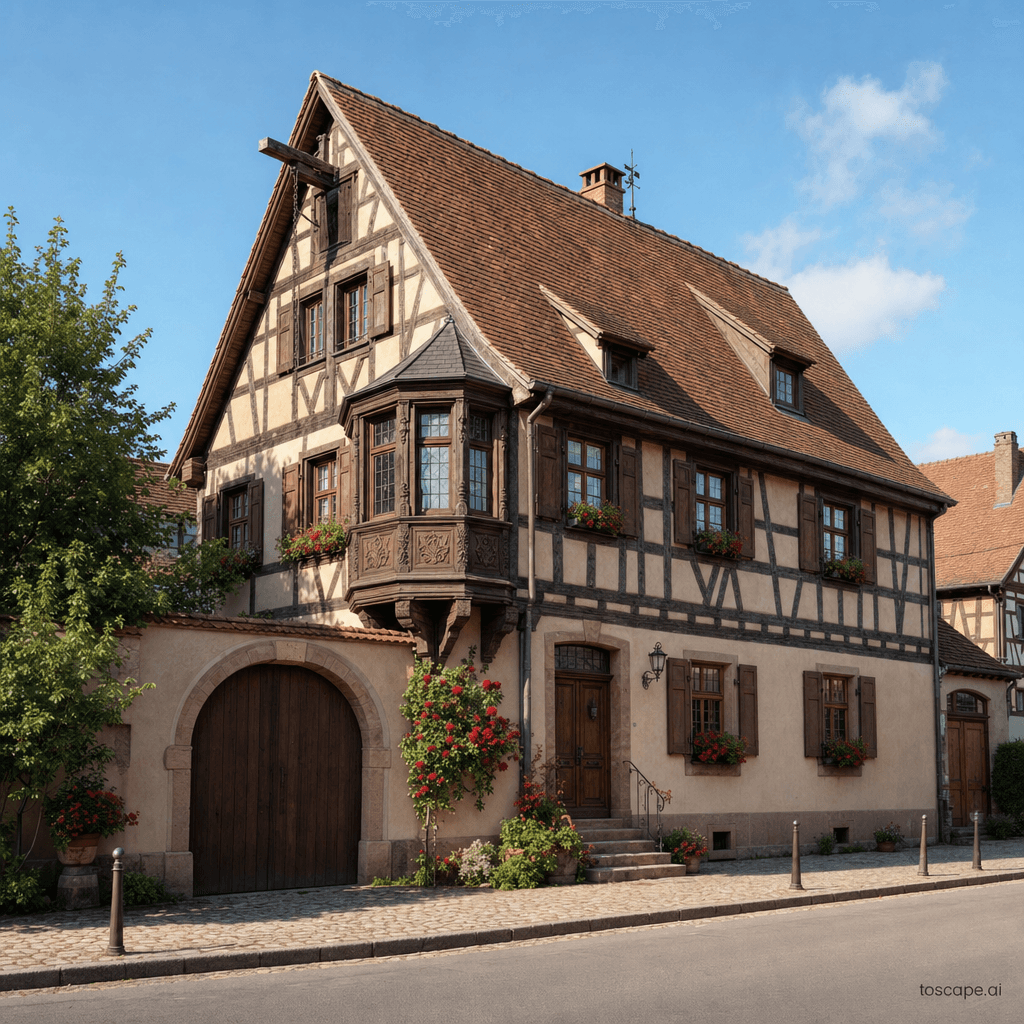
Alsace
France · Alsace region (Bas-Rhin, Haut-Rhin)
Exposed timber-frame (colombage/pan de bois) with colored infill panels — ochre, salmon, pale blue, cream rendered between dark timber members, steep pitched (50-60°) terracotta tile roofs (tuile plate alsacienne) often in coloured glazed fish-scale patterns...
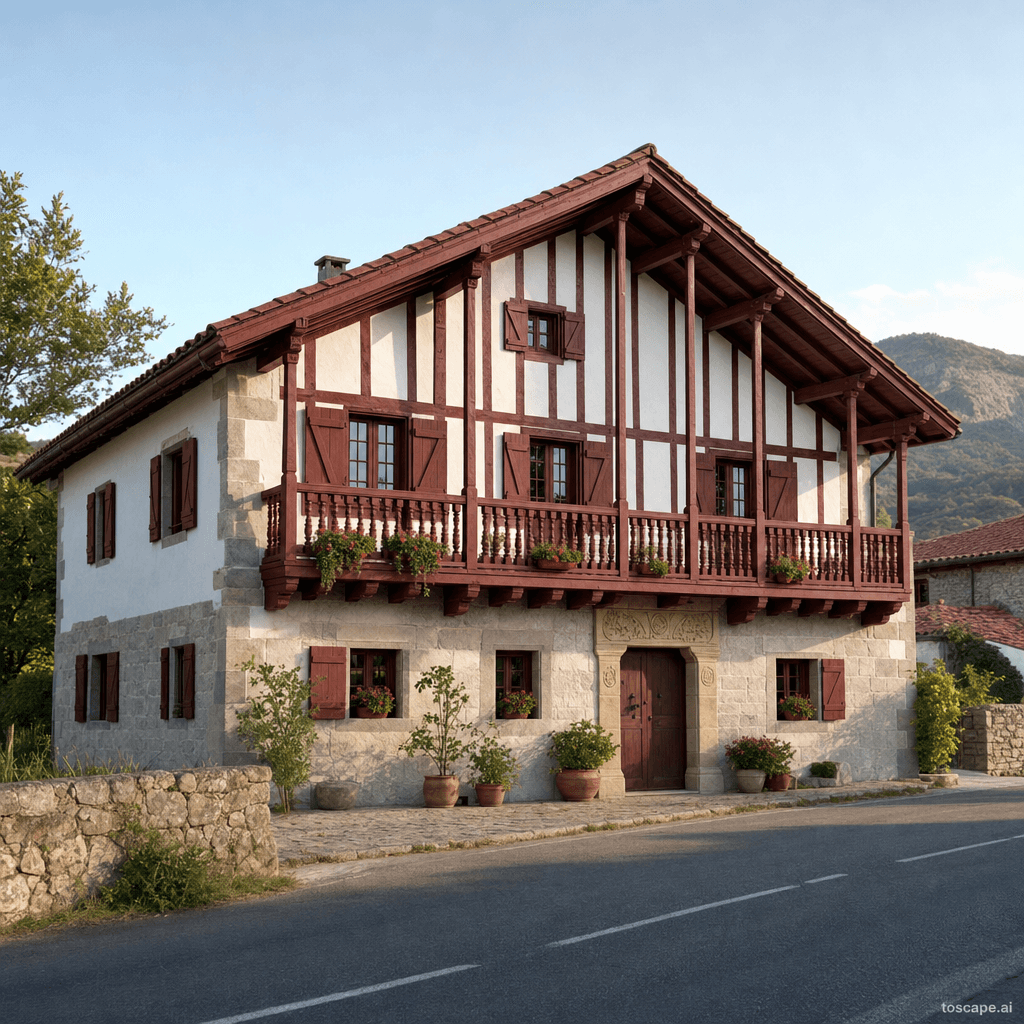
Basque Country
France · French Basque Country / Pays Basque (Labourd, Basse-Navarre, Soule)
Whitewashed lime plaster or pale stone facades with exposed red-brown (oxblood) or green painted half-timbering (colombage basque), asymmetrical steep terracotta tile roofs (typically 40-50° pitch) with deep overhanging eaves, full-width timber balcony (balcon...
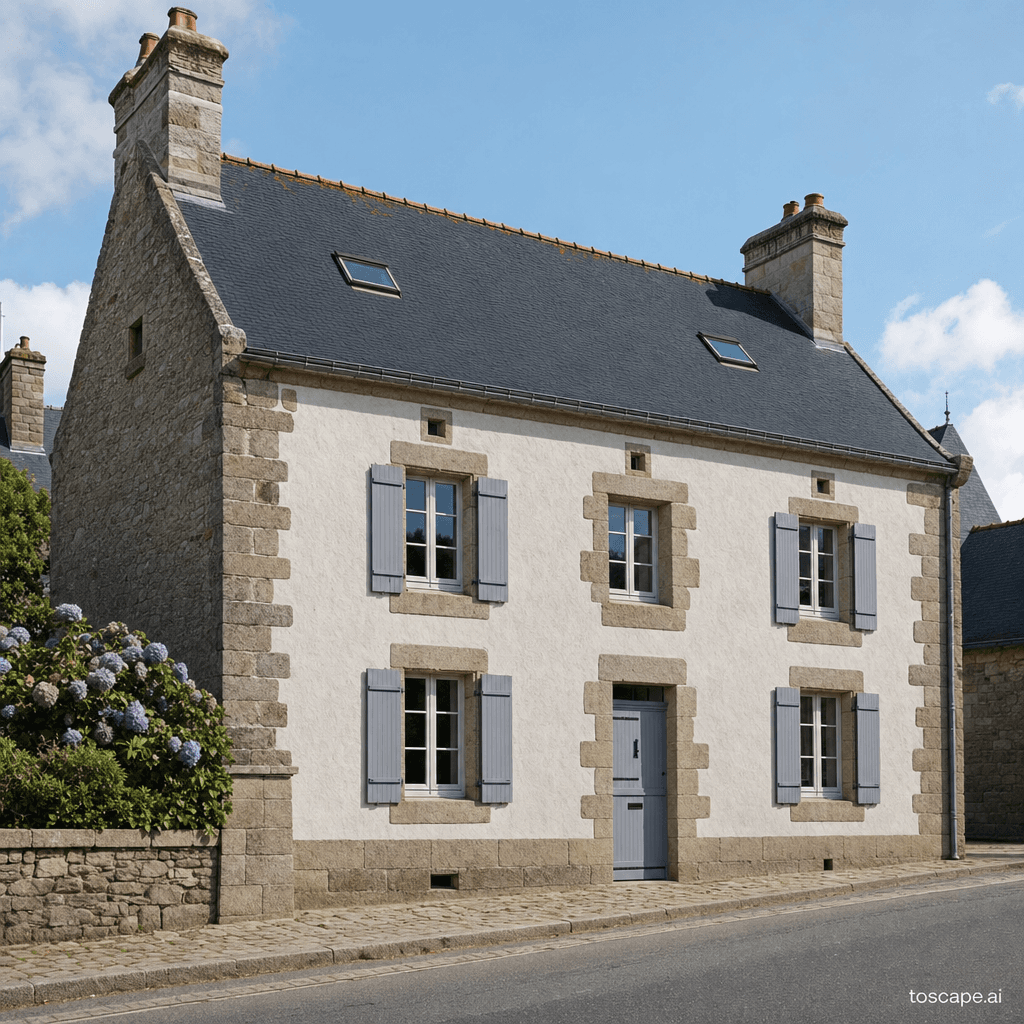
Brittany
France · Brittany peninsula (Finistère, Côtes-d'Armor, Morbihan, Ille-et-Vilaine)
Grey and rose granite (granit gris/rose) load-bearing masonry, steep dark blue-grey slate roofs (ardoise d'Angers), massive granite chimney stacks with decorated caps, white-lime-rendered or exposed granite facades, thatched cottage (chaumière) in interior, en...
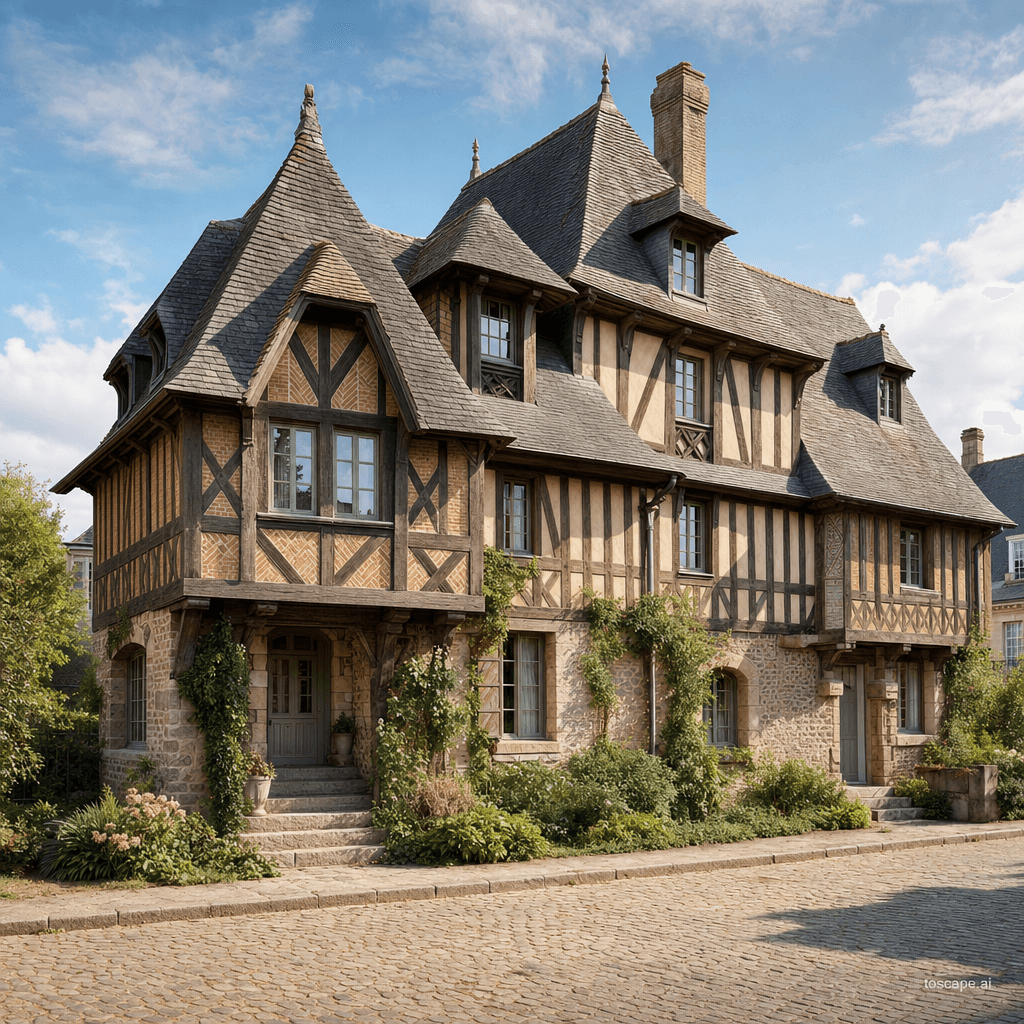
Normandy
France · Normandy region (Pays d'Auge, Pays de Caux, Cotentin, Bocage Normand)
Exposed dark brown oak half-timbering (colombage normand) with colombage fill panels in warm ochre brick, cream plaster, or flint (silex) infill, steep roofs in thatch (chaume) with iris ridge or grey-blue slate (ardoise), asymmetrical massing with cantilevere...
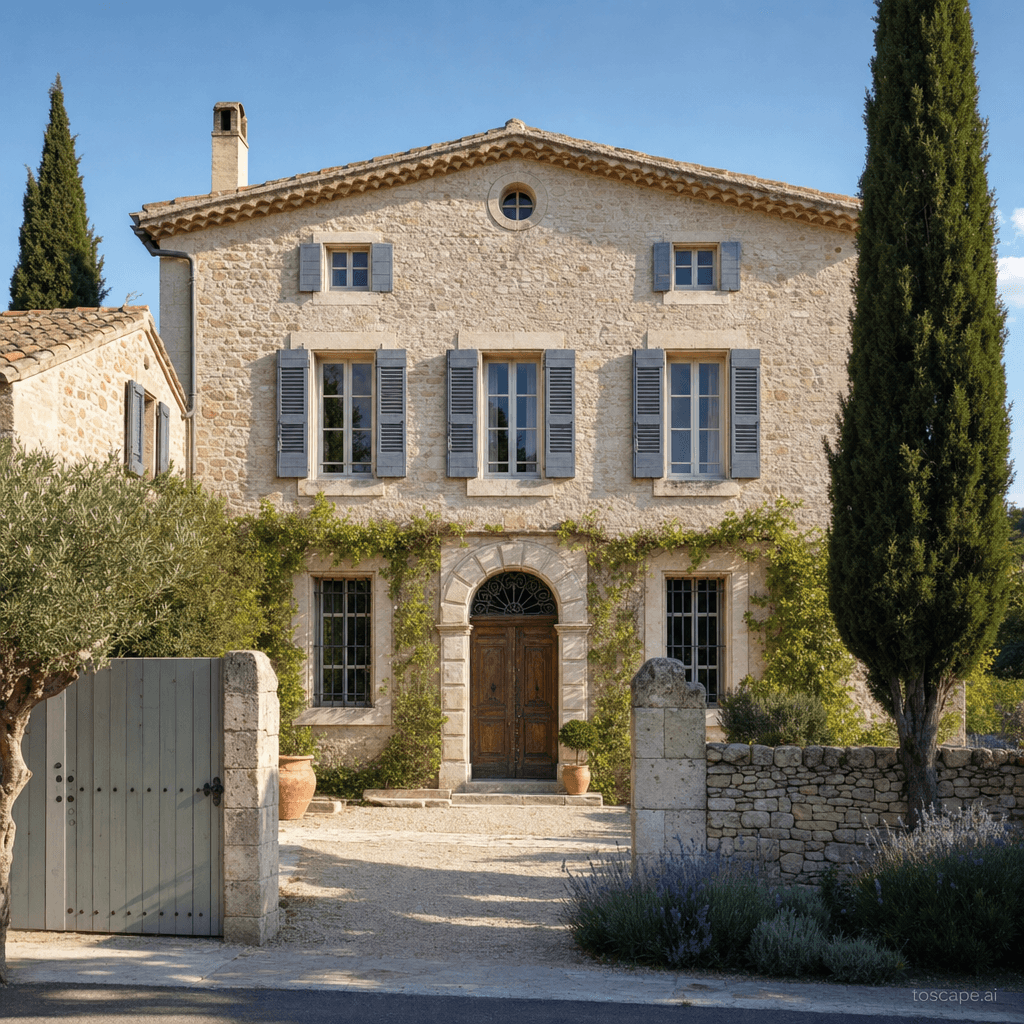
Provence
France · Provence region (Bouches-du-Rhône, Vaucluse, Alpes-de-Haute-Provence, Var)
Pale cream-grey limestone (pierre du Midi / pierre de Rognes) block walls with exposed or rendered finish, shallow-pitch Roman terracotta canal tile roofs (tuile canal), génoise corbelled tile eaves cornice, painted louvered shutters (volets) in faded blue-gre...
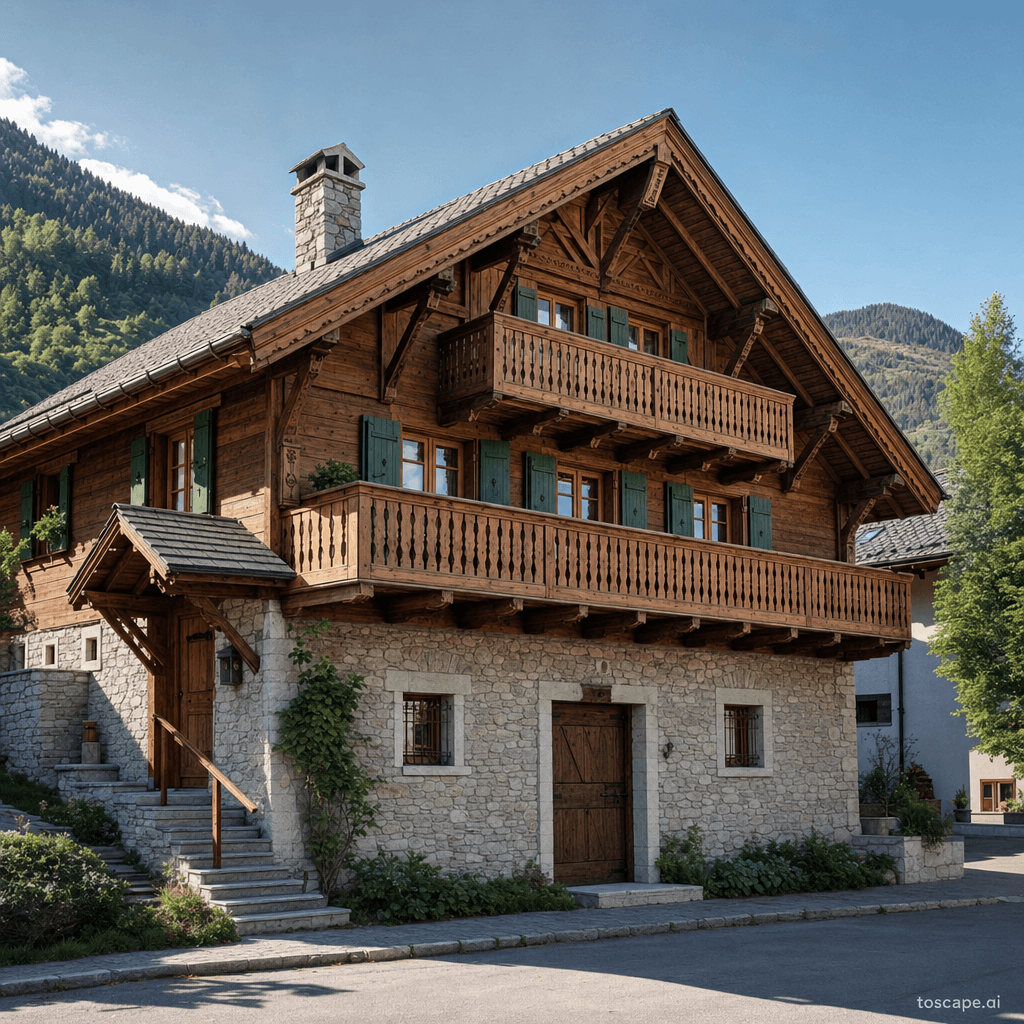
Savoy Alps
France · Savoy region / Savoie and Haute-Savoie
Solid stone ground floor (solin en pierre) with timber log or plank upper floor (madrier/blockbau), wide projecting timber balconies (balcon/galerie) with carved or sawn balustrades, broad gable roof (toit à deux pans) at medium-steep pitch (40-50°) in slate (...
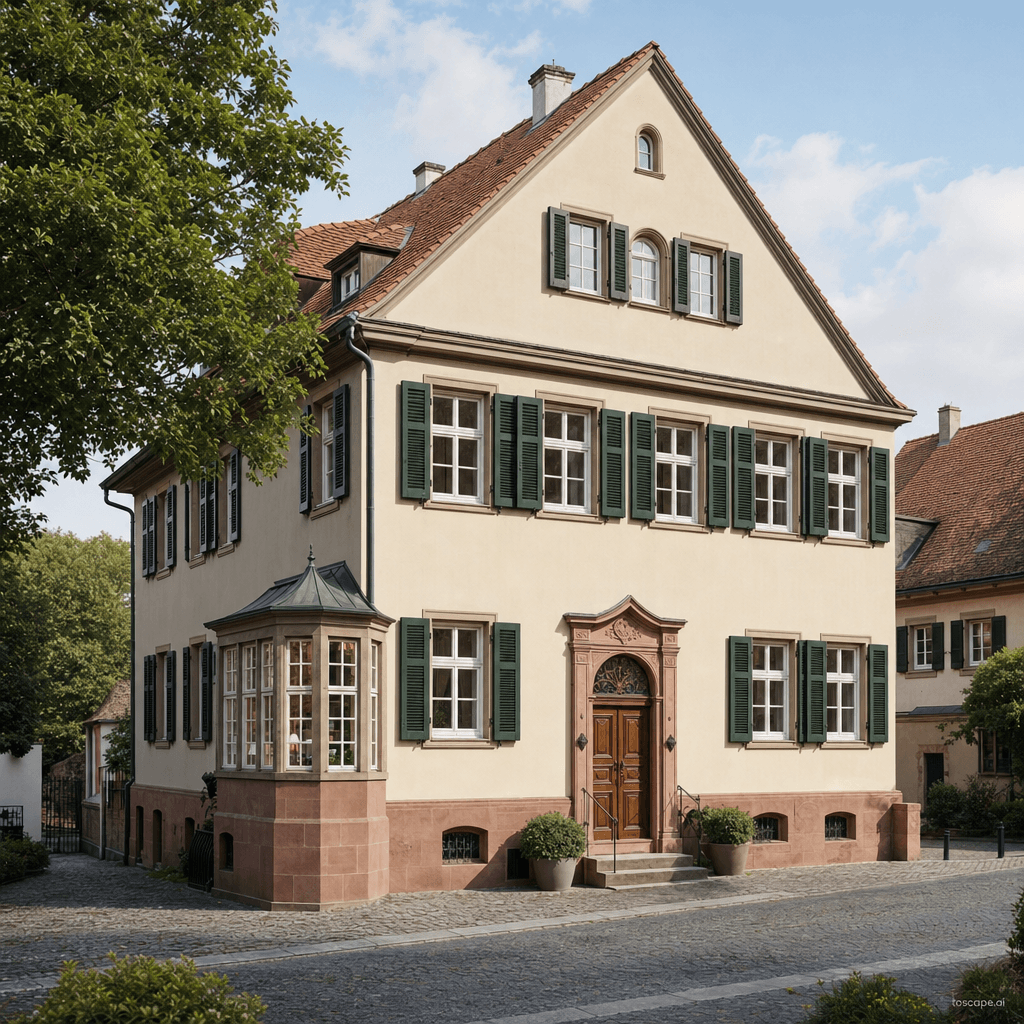
Baden-Württemberg
Germany · Baden-Württemberg (Schwaben, Schwarzwaldrand, Neckar valley)
Exposed dark oak half-timbering (Fachwerk) with complex decorative bracing patterns — curved St. Andrew's crosses (gebogene Andreaskreuze), diamond lattice (Rautenfach), man-figure motifs (Mann-Figuren), and elaborate corner posts (Eckständer), white or pale o...
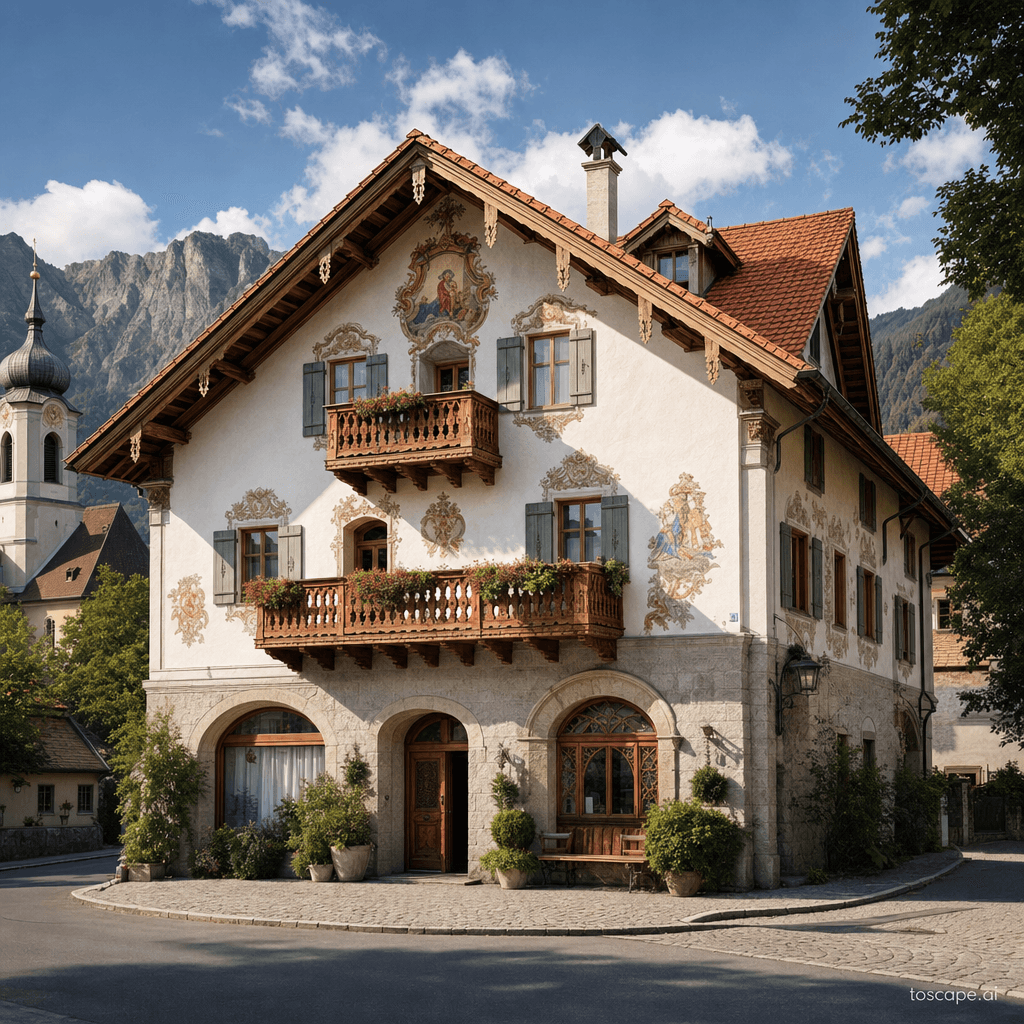
Bavaria
Germany · Bavaria / Bayern (Oberbayern, Allgäu)
White lime-plastered facades with elaborate exterior fresco paintings (Lüftlmalerei) in pastel and earth tones, steep terracotta tile or wooden shingle roofs with deep overhanging eaves, carved timber balconies (Balkon/Laube) with turned balusters and floral s...
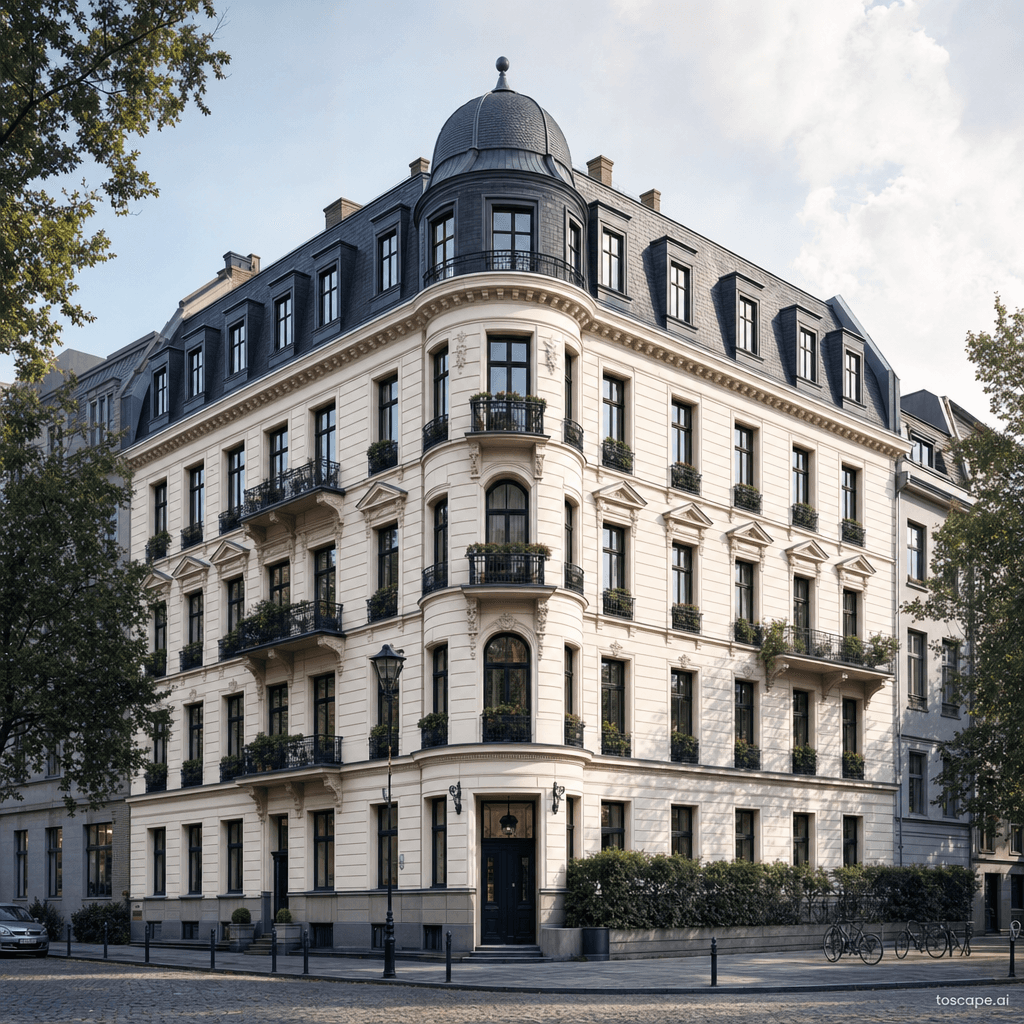
Berlin-Brandenburg
Germany · Berlin and Brandenburg region
Smooth plastered facades (Putzfassade) in pale ochre, cream, or grey with classical stucco ornament — cornices (Gesimse), pilasters (Pilaster), window pediments (Fensterverdachungen) alternating triangular and segmental, deep building volumes with multiple rea...
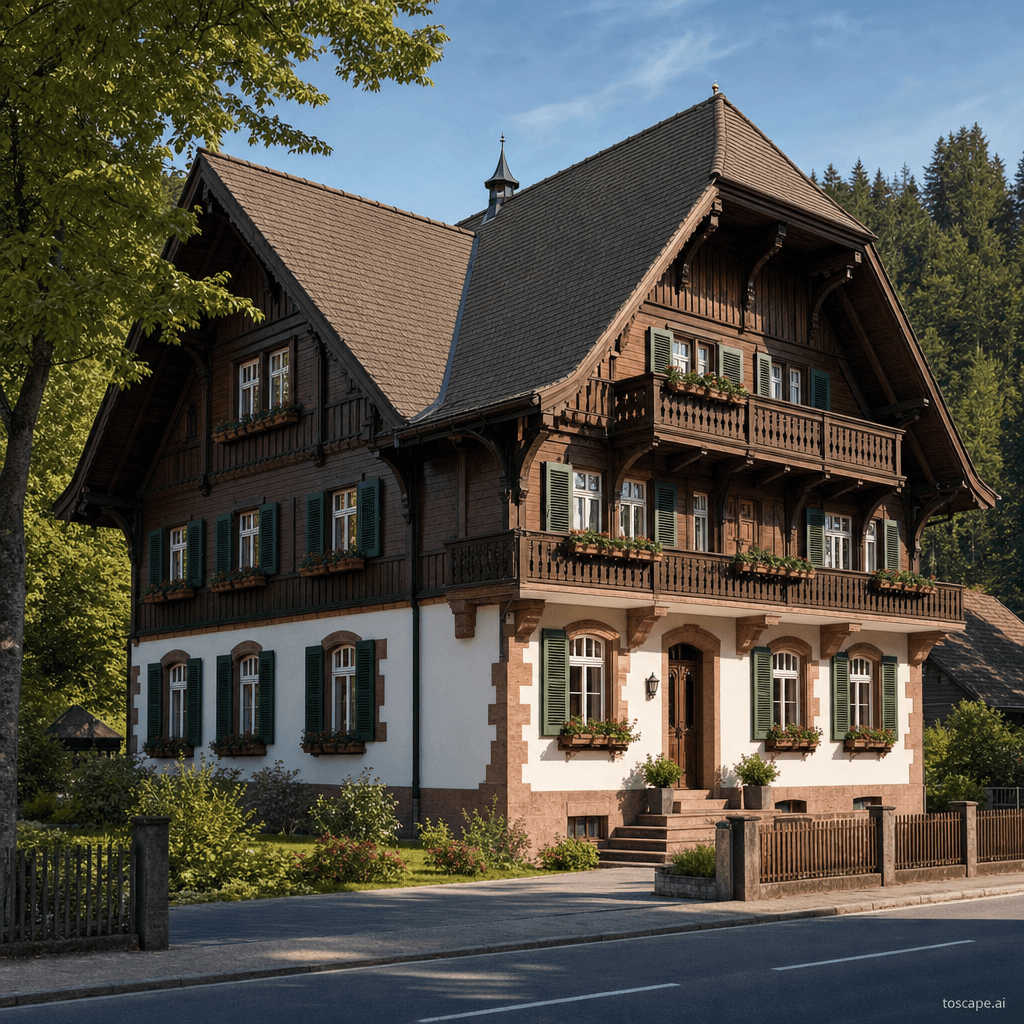
Black Forest
Germany · Black Forest / Schwarzwald
Massive broad-hipped or half-hipped roof (Walmdach/Krüppelwalmdach) dominating the volume with deep overhangs sheltering all sides, timber construction — either log (Blockbau) or post-and-beam with timber cladding (Verbretterung) in weathered silver-grey, ston...
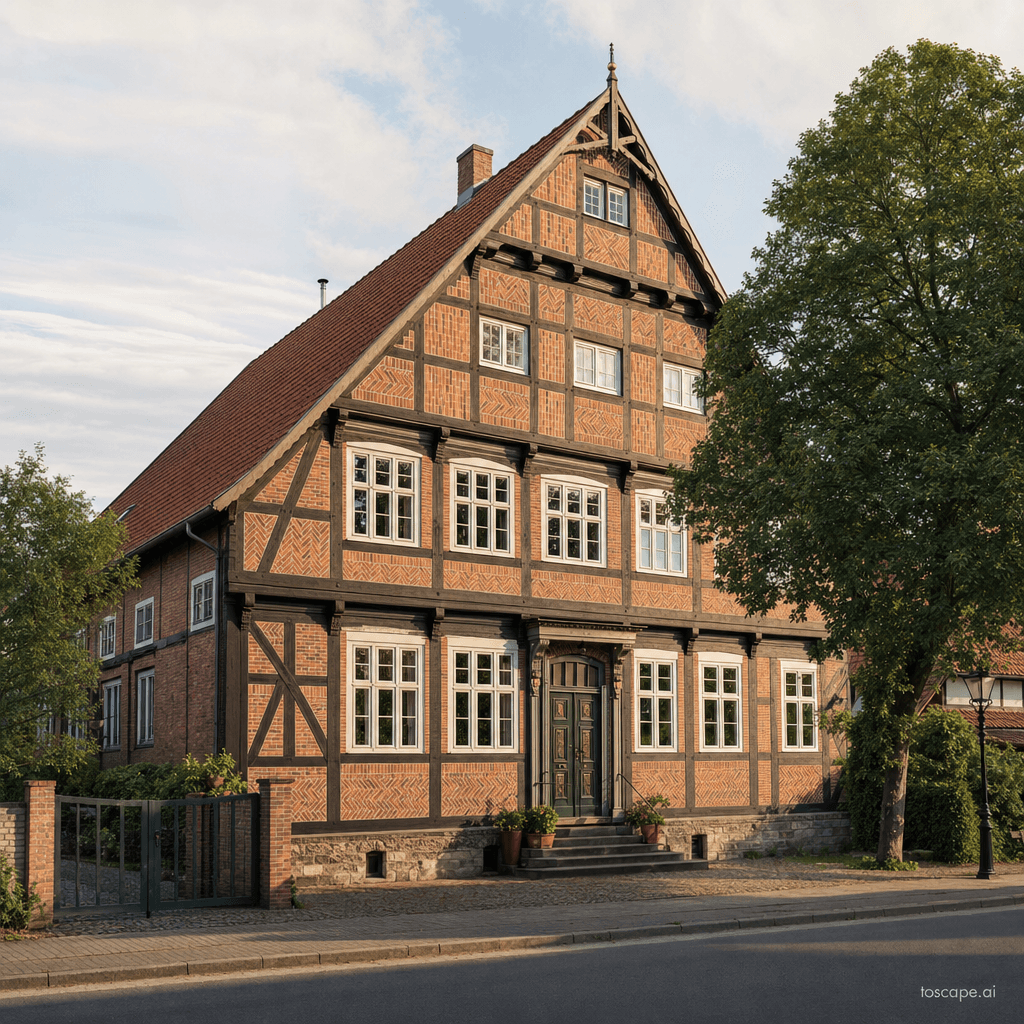
Lower Saxony
Germany · Lower Saxony / Niedersachsen
Deep red-brown fired brick (Backstein) load-bearing walls with dark joints, steep terracotta tile or thatched reed roofs (Reetdach), Fachhallenhaus (Low German hall house) — the large barn-dwelling typology with central threshing floor (Diele) and high double...
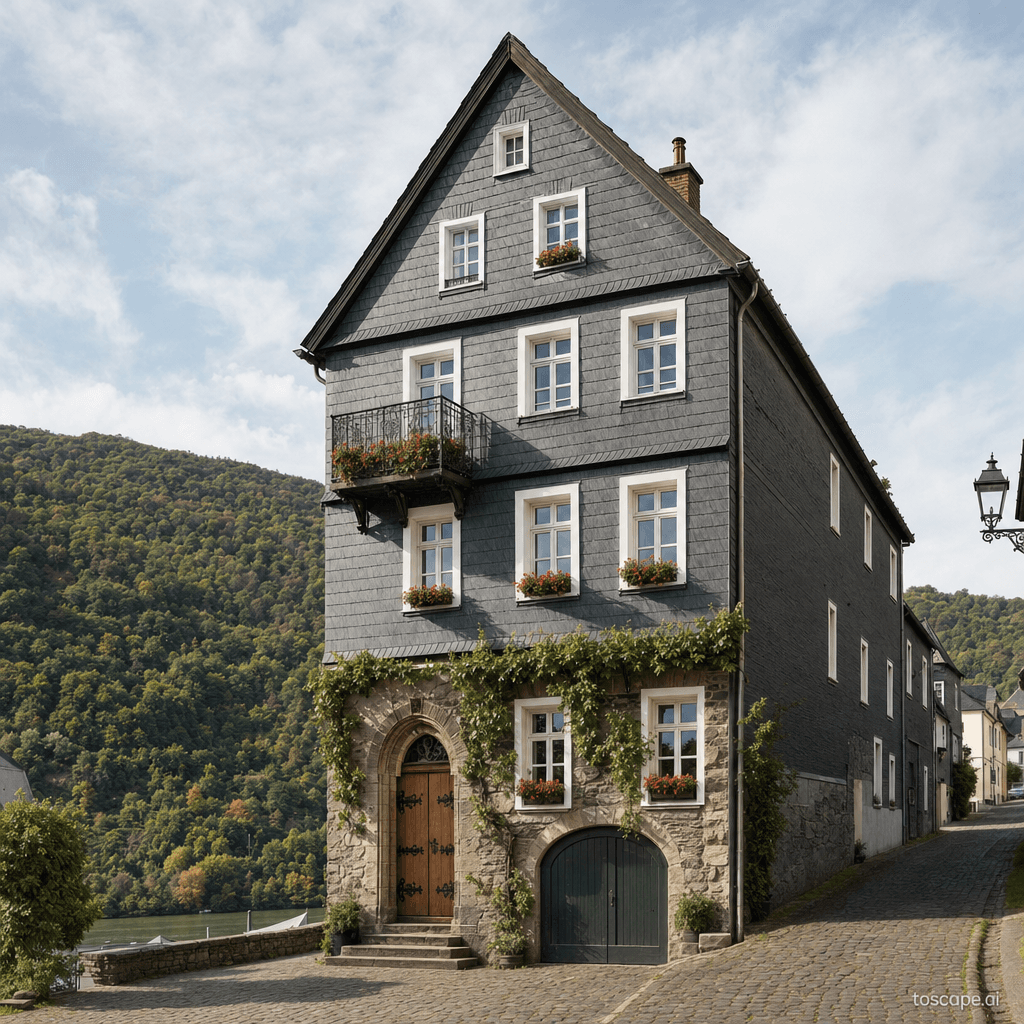
Rhineland
Germany · Rhineland / Rheinland (Middle Rhine, Eifel, Moselle valley)
Dark grey-black slate-hung facades (Schieferverkleidung/Schieferfassade) with ornamental nail patterns (Schieferornamente) — diamond, fish-scale, and scallop motifs, exposed half-timbering (Fachwerk) with dark timber and white or ochre rendered infill on upper...
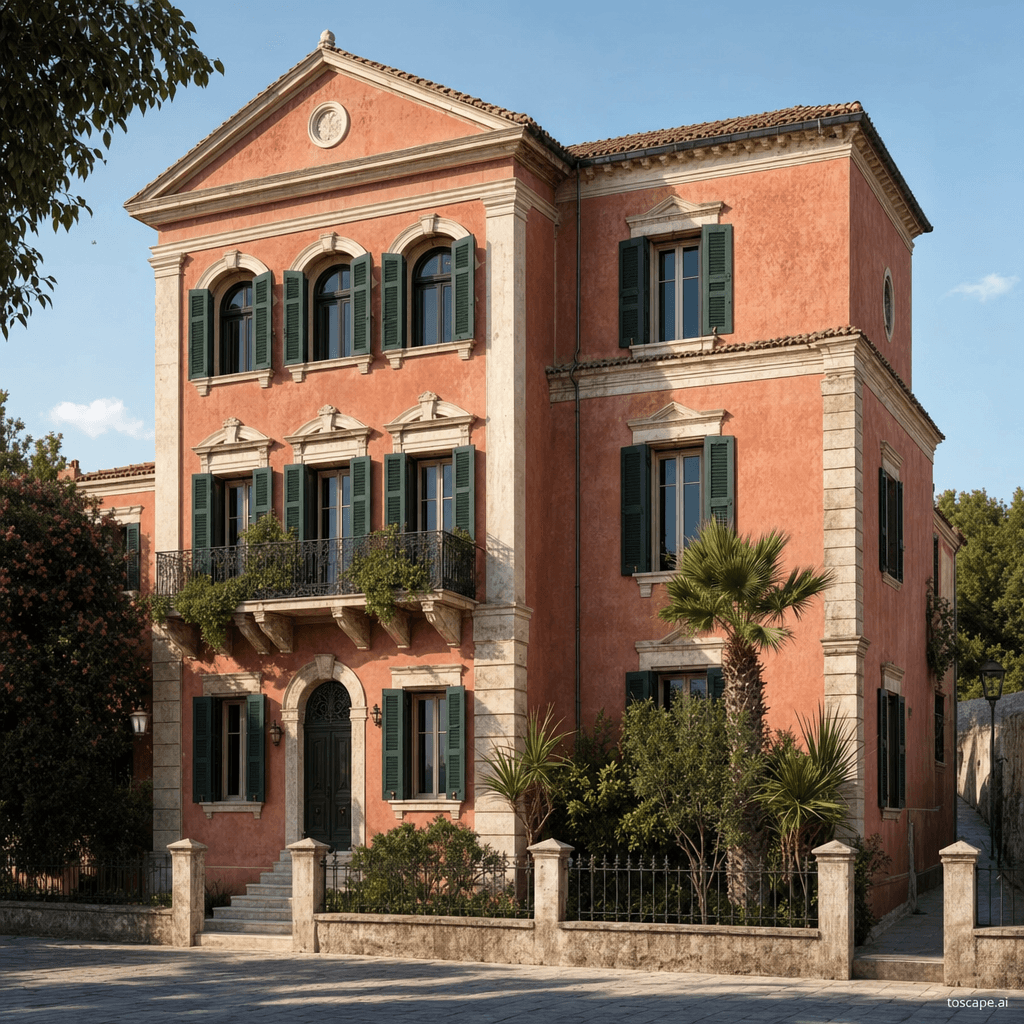
Corfu Ionian Island Venetian
Greece · Old Town of Corfu (Kerkyra), a UNESCO World Heritage site
Multi-storey (3–6 storeys) rendered buildings in warm ochre, terracotta, and pale yellow — the Venetian Mediterranean colour palette, fundamentally different from Cycladic white — narrow, tall proportions — shuttered windows with stone architraves — wrought-ir...
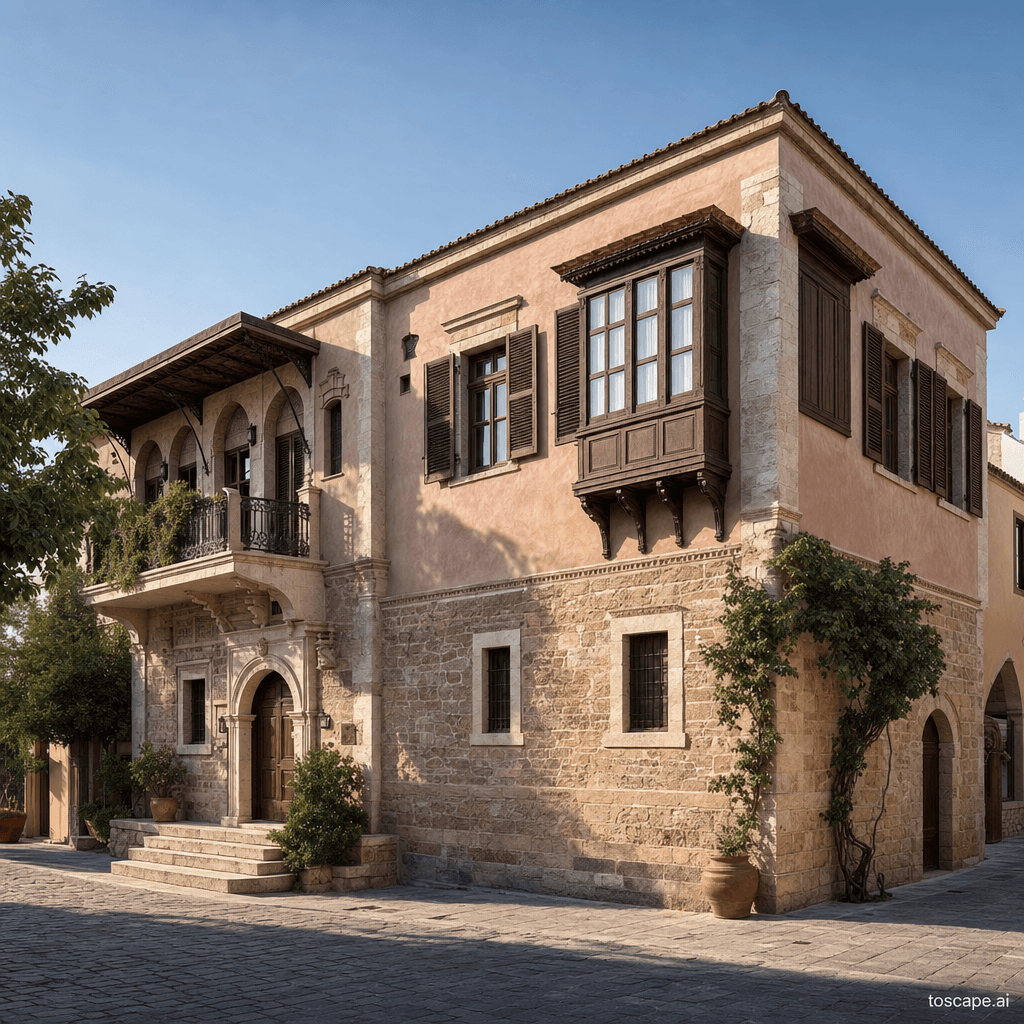
Crete Venetian-Ottoman Hybrid
Greece · domestic architecture of Crete, primarily the Venetian harbour towns (Chania, Re...
Stone masonry (local limestone) — partially rendered, partially exposed — warm ochre and cream rendered facades with exposed stone quoins and details — the "Cretan arch" — a distinctive low, broad stone arch over ground-floor doors and workshops — timber-balco...
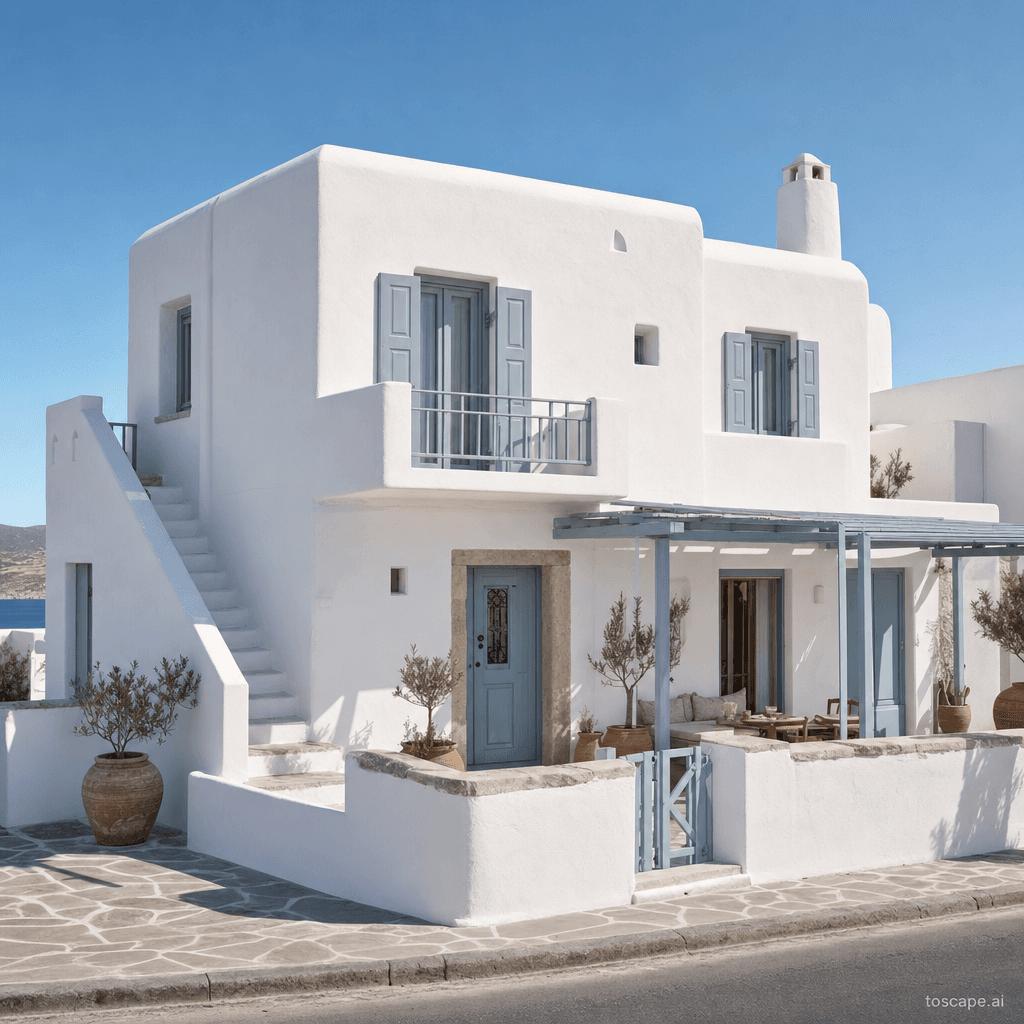
Cyclades Islands
Greece · vernacular architecture of the Cyclades Islands, Greece
Pure white lime-washed cubic volumes — flat roofs with parapets — blue-painted woodwork (doors, windows, domes) — organic, clustered settlement form on hillsides — narrow, winding, shaded pedestrian streets (sokakia) — external staircases connecting roof terra...
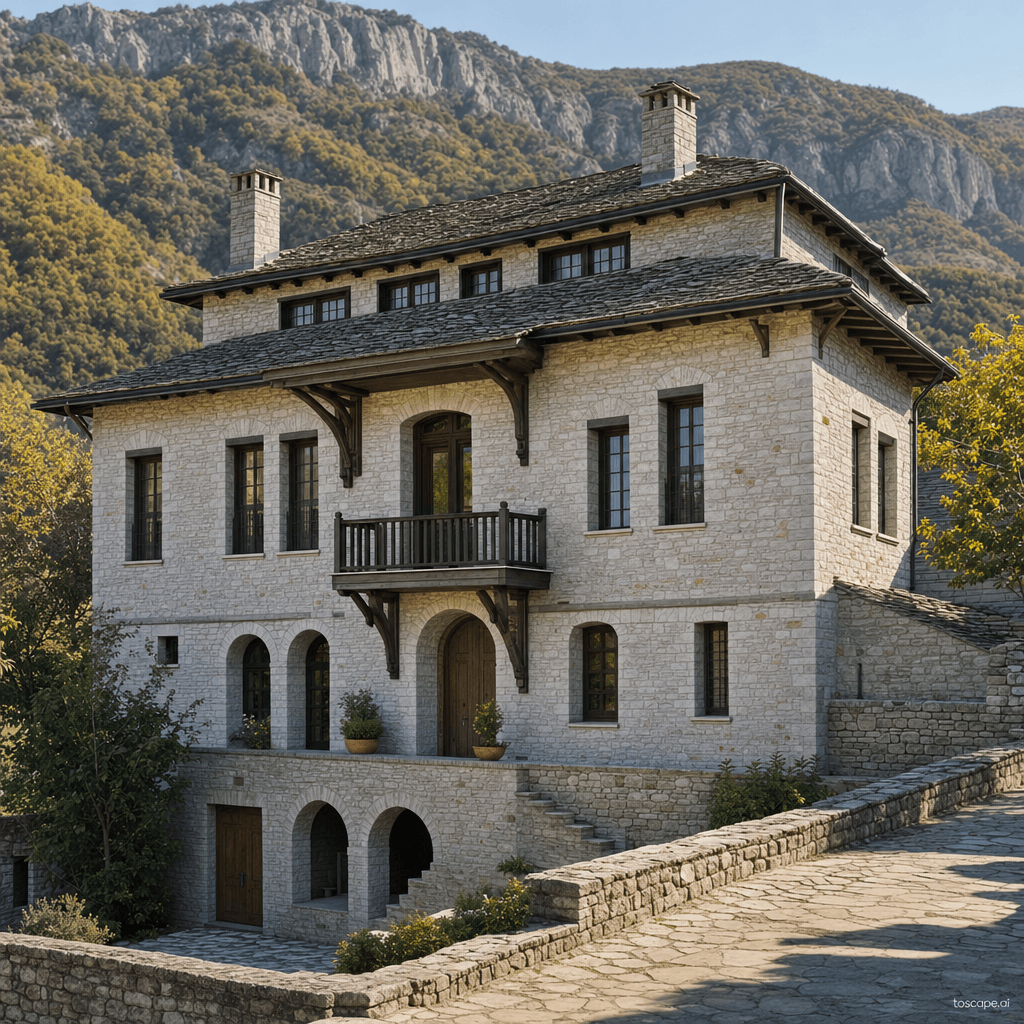
Epirus Zagori Stone Bridge & Mountain Village
Greece · Zagorochoria (Zagori villages) of Epirus, northwestern Greece
Grey limestone mansions (archontika) — two-to-three storey stone houses with distinctive stone-slab roofs (schist plates, not ceramic tiles) — the "skales" (slate roofs) of Zagori — massive stone walls (600–800 mm) — small, symmetrically arranged windows with...
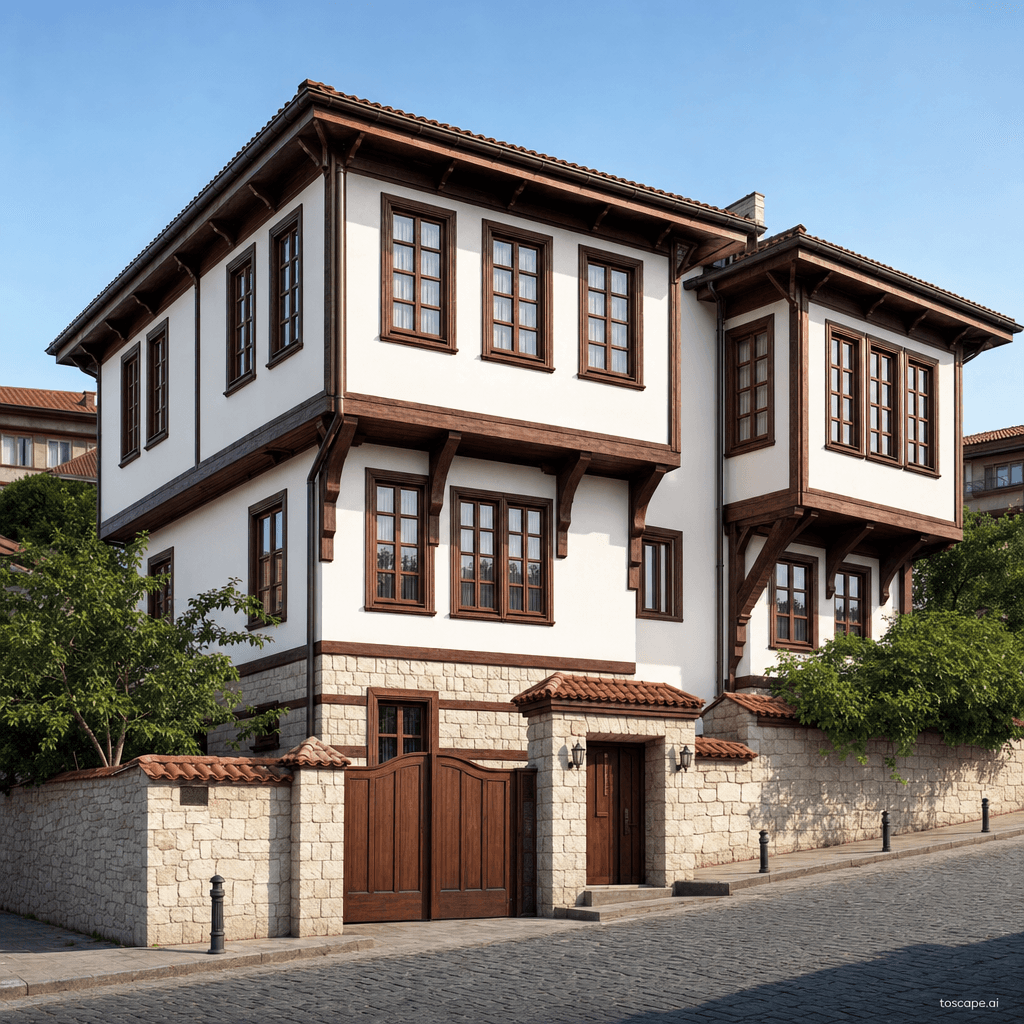
Macedonian Urban Balkan
Greece · domestic architecture of Thessaloniki's Upper Town (Ano Poli) and the Macedonian...
Timber-framed upper floors projecting over stone ground floors — the "sachnisia" enclosed balcony (shared with Crete and wider Ottoman Balkans) — half-timbered (tsatmas) construction with brick or plaster infill — rendered in warm ochre, pale blue, or pastel c...
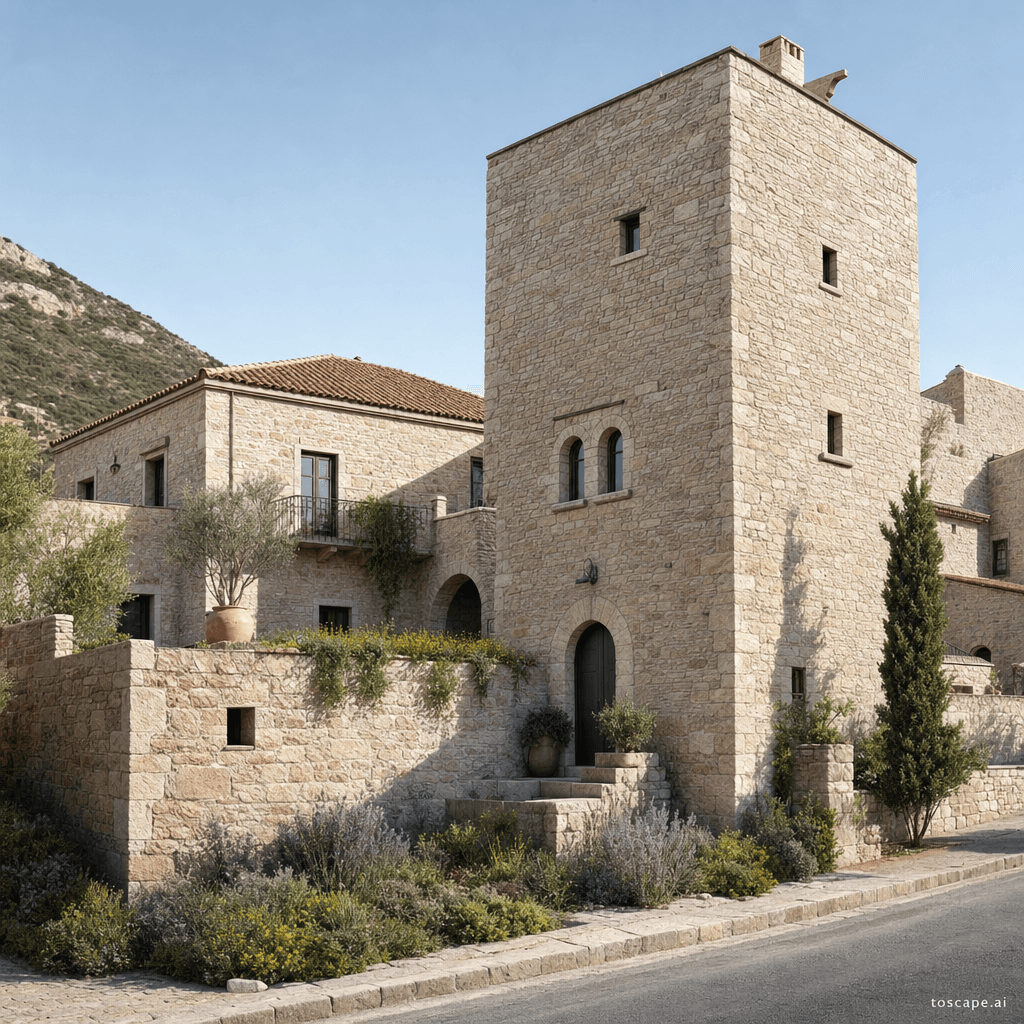
Peloponnese Stone Tower & Village
Greece · stone tower-house (pyrgospito) of the Mani Peninsula and the vernacular stone vi...
Tall, narrow, defensive stone tower-houses (3–5 storeys, 15–20 m) in the Mani — the "skyscrapers of the Middle Ages" — exposed grey limestone masonry (unrendered — contrasting with the whitewashed Cyclades) — flat roofs with crenellated parapets — tiny, deeply...
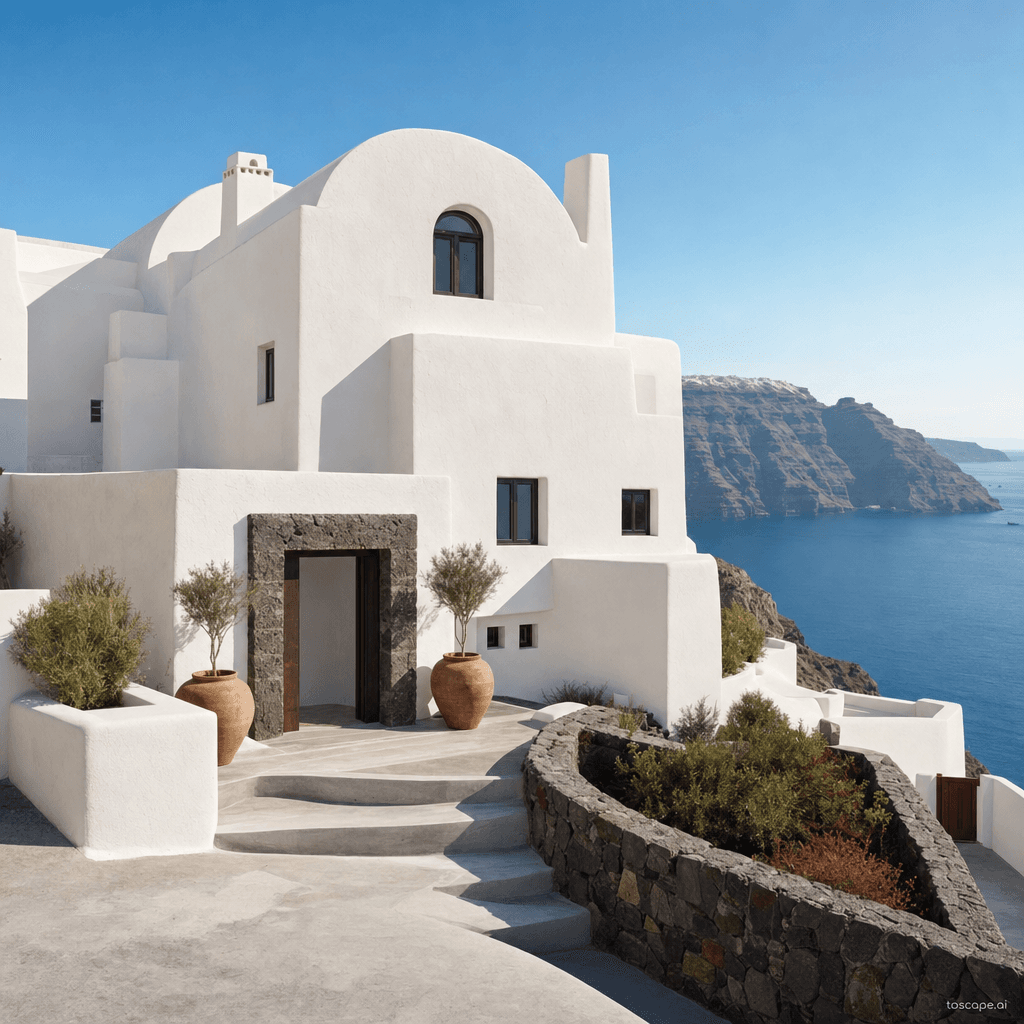
Santorini Volcanic Caldera
Greece · distinctive volcanic architecture of Santorini (Thira)
Pure white rendered cubic volumes emerging from dark volcanic cliff — hyposkafa (cave houses) with single exposed facades — barrel-vaulted ceilings (volta) — blue-domed churches on the caldera edge — the most dramatic architectural site in the Mediterranean
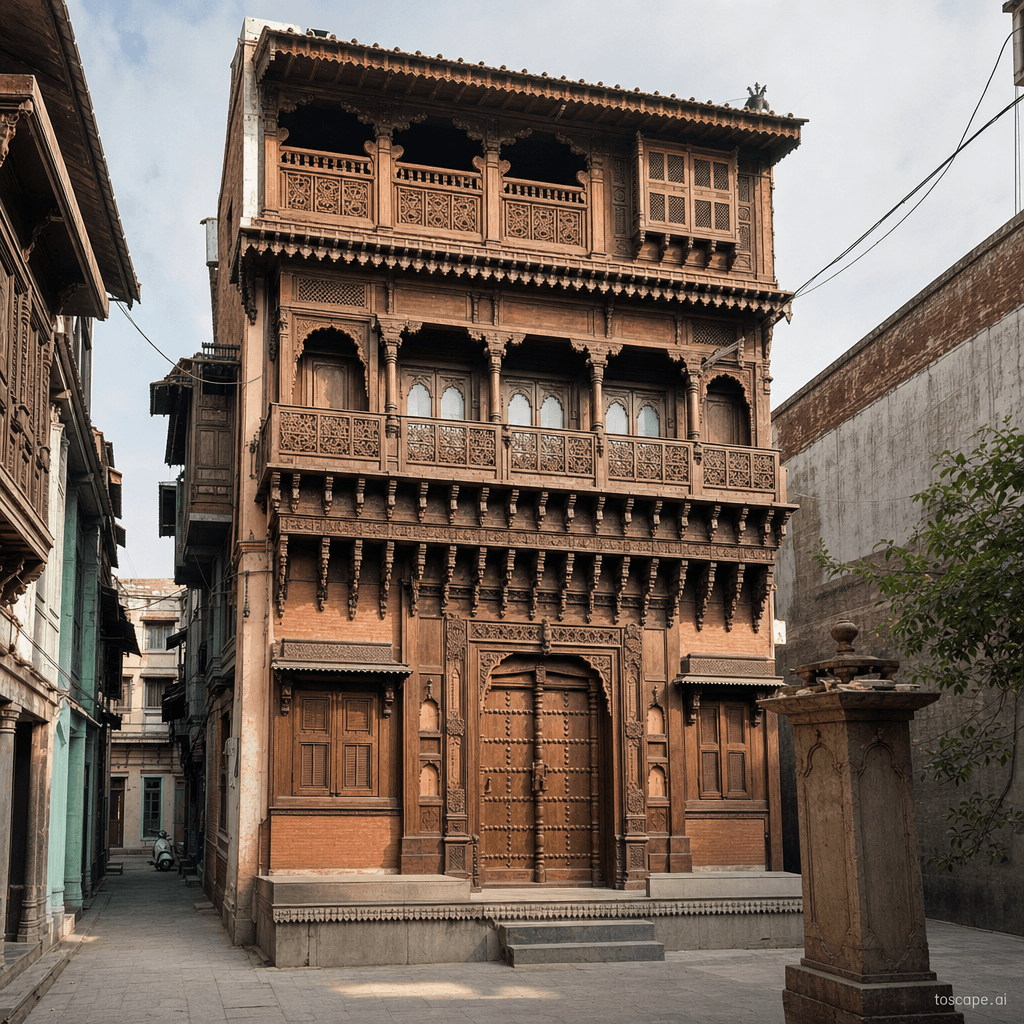
Gujarat Pol House
India · Ahmedabad pol house
Narrow 3-4 story timber-fronted houses lining tight lanes, raised front platform (otla) as public-private threshold, intricately carved wooden brackets and balconies, chabutro bird-feeder as community landmark, secret interior courtyards (chowk)
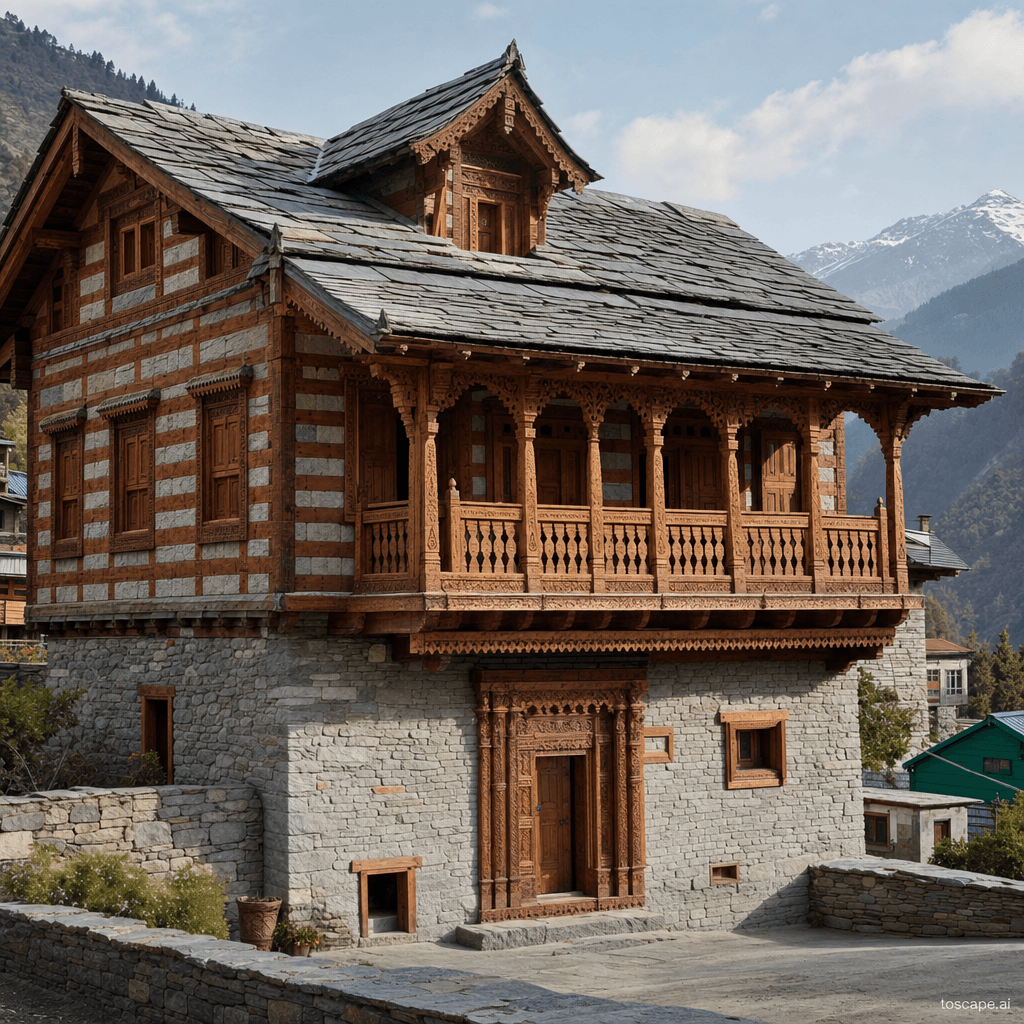
Himachal Dhajji Dewari
India · Western Himalayan traditional
Seismic-resistant timber frame with stone infill (dhajji dewari), cantilevered wooden balconies with carved details, heavy slate roofs, alternating timber-and-stone wall bands (kath-kuni), temple-like residential aesthetic
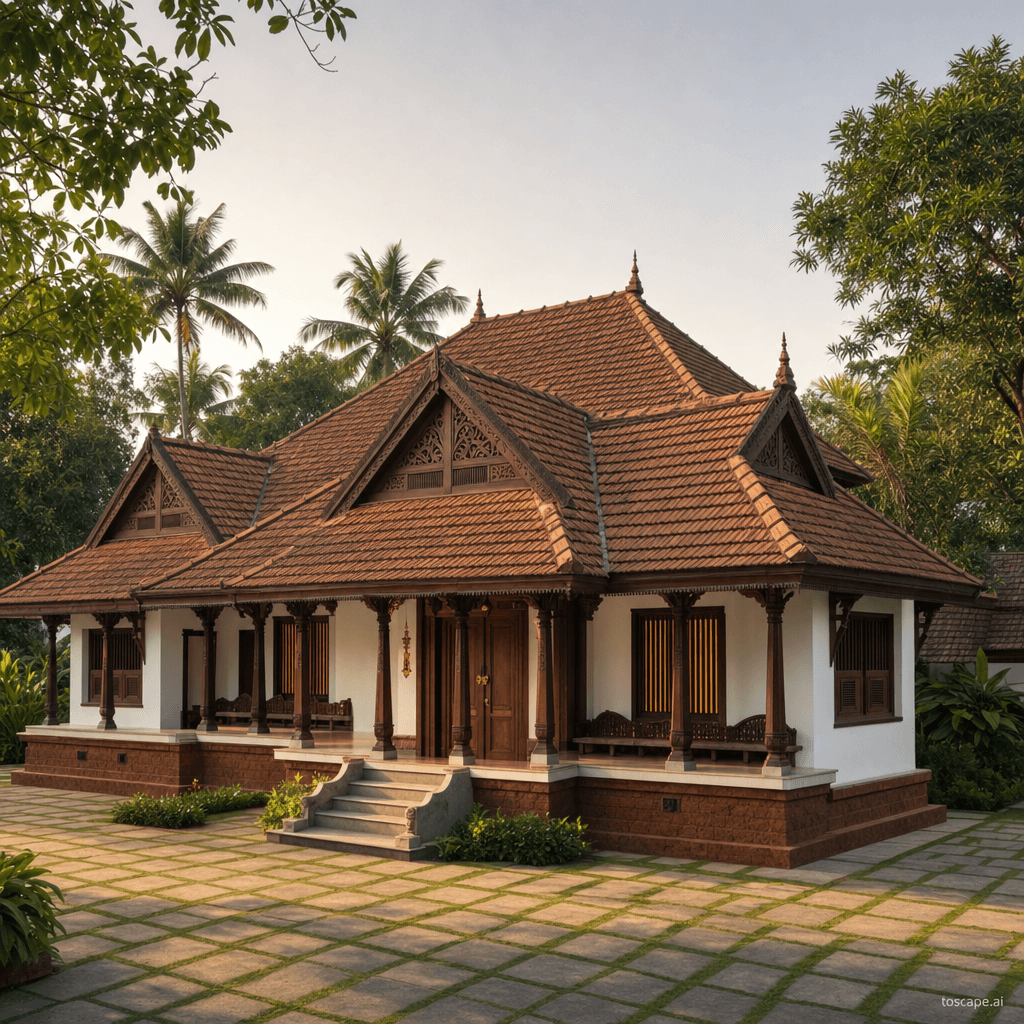
Kerala Nalukettu
India · Kerala nalukettu courtyard house
Central open courtyard (nadumuttam) surrounded by four halls, steeply pitched terracotta-tiled roofs with ornate timber gables, deep overhanging eaves on carved brackets, open verandahs (poomukham), laterite stone plinths
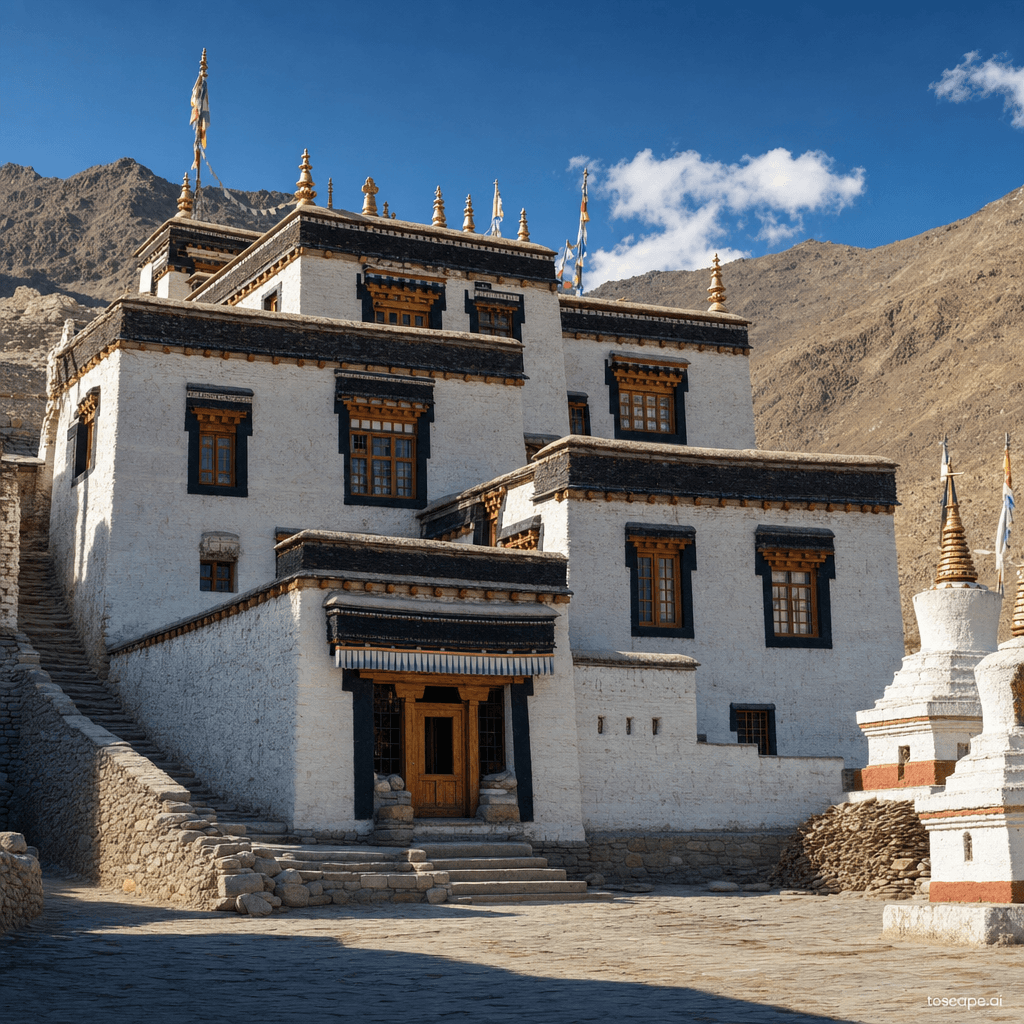
Ladakh Tibetan Buddhist
India · Ladakhi Tibetan Buddhist
Whitewashed mud-brick walls with dark timber window bands, flat poplar-beam roofs, Buddhist gompa fortress-monasteries on hilltops, rows of white chorten stupas, prayer flags as landscape color
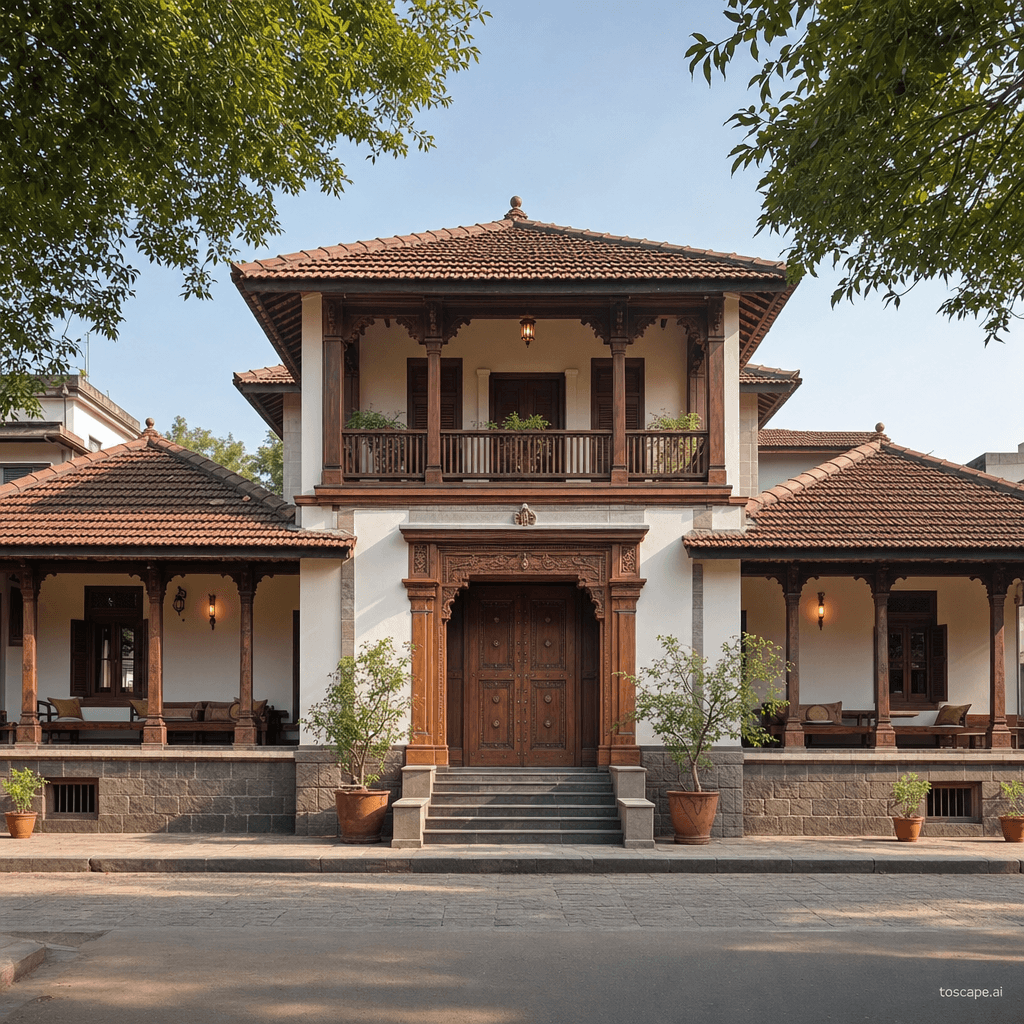
Maharashtra Wada
India · Maratha wada
Central courtyard (chowk) surrounded by timber-pillared verandah (osari/sopa), carved wooden columns and brackets, sloping Mangalore tile roofs, stone plinth, painted wall panels
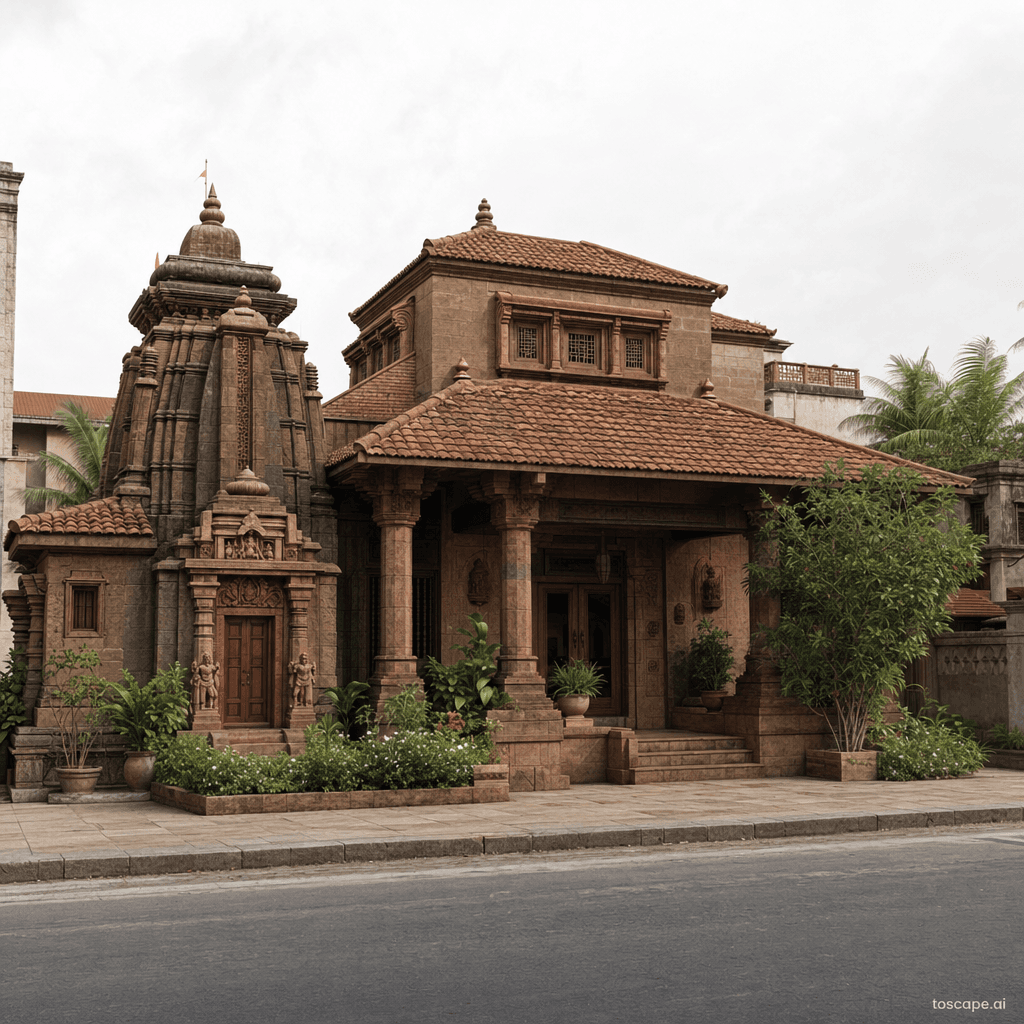
Odisha Temple Town
India · Odisha temple town
Curvilinear deula (rekha) temple tower, pyramidal jagamohana (porch hall), khondalite/laterite stone construction, temple-centered urban morphology with pilgrimage infrastructure, ornate stone carving
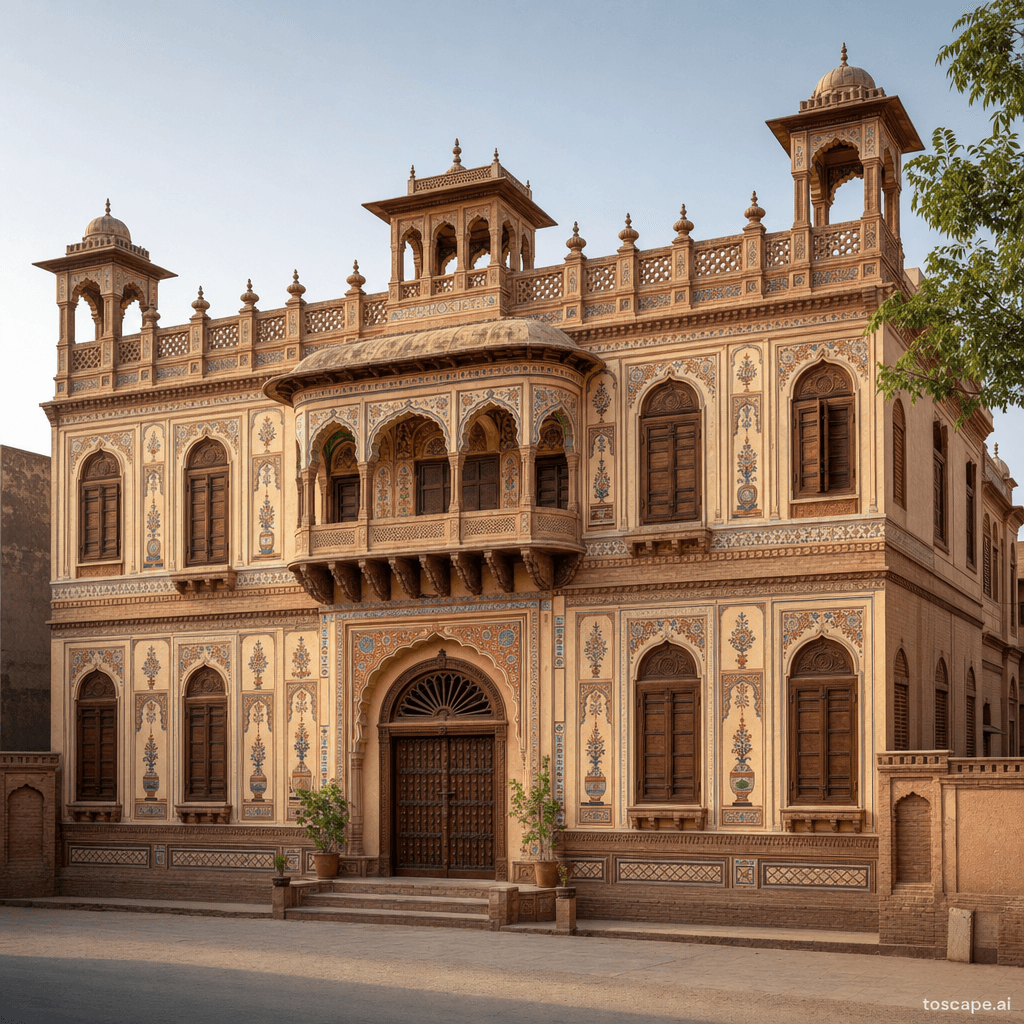
Punjab Haveli Fresco
India · Punjabi haveli
Thin Nanakshahi brick construction, vibrant fresco-painted facades and interiors (Punjabi fresco tradition), carved wooden jharokha balconies, ornamental stucco, enclosed courtyard (vehra)
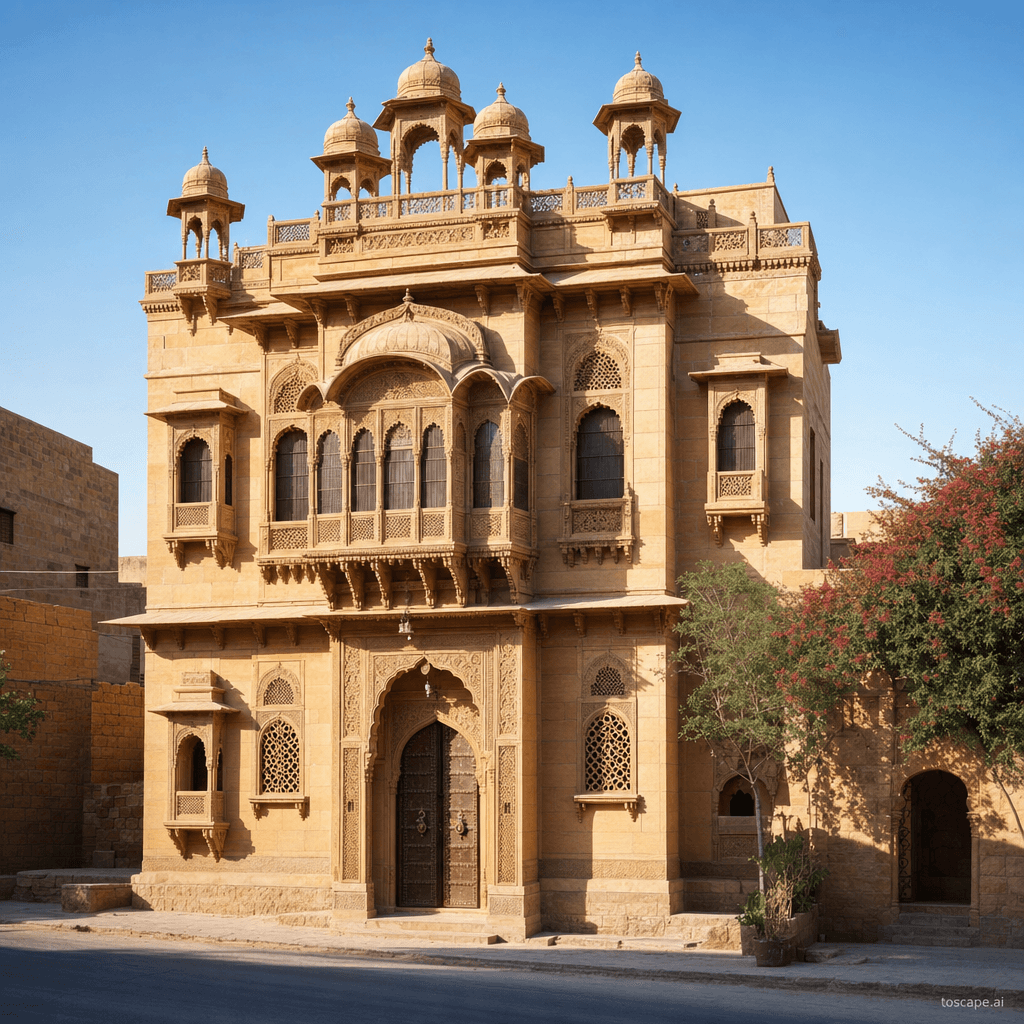
Rajasthan Haveli
India · Rajasthani haveli
Sandstone jali screens, overhanging enclosed jharokha balconies, domed chhatri pavilions, interior courtyards with painted walls, regional stone color variation (golden Jaisalmer, pink Jaipur, blue Jodhpur)
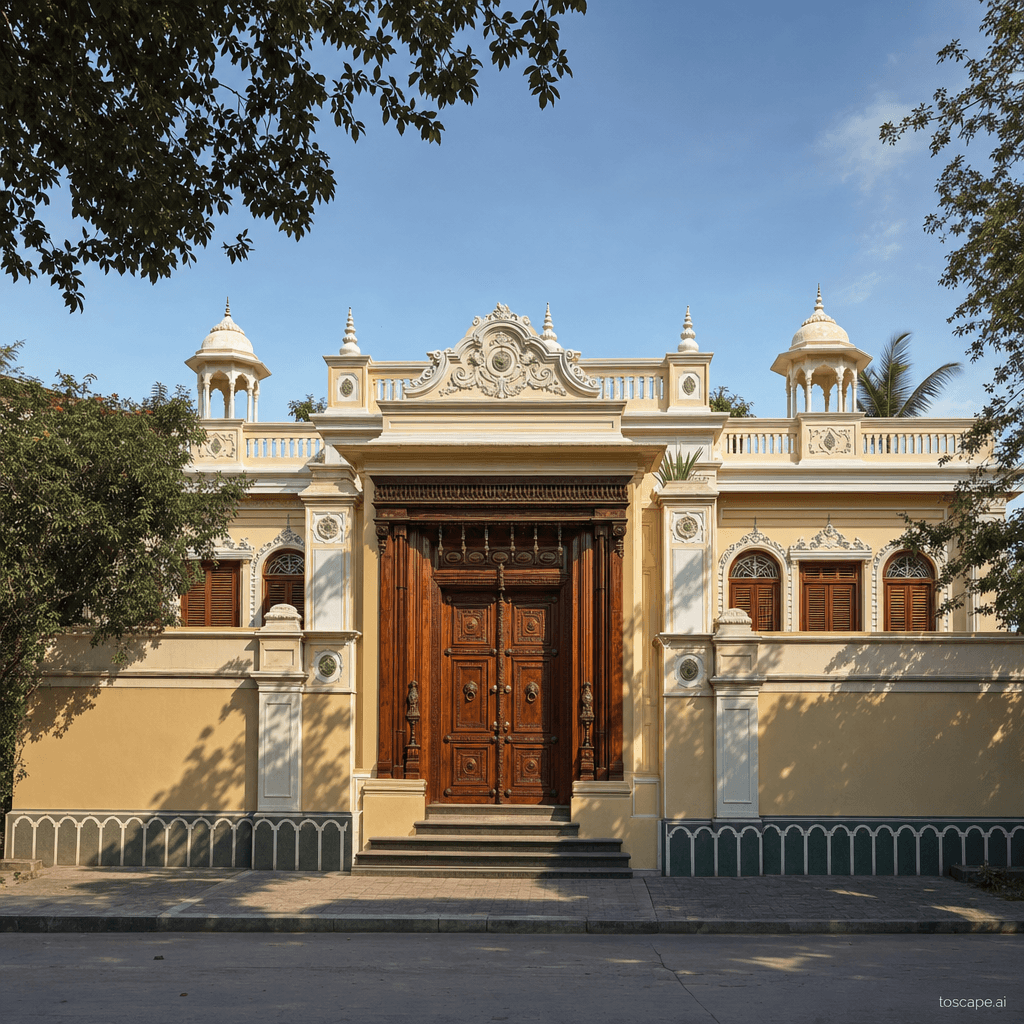
Tamil Nadu Chettinad
India · Chettinad mansion
Massive Burma teak columns and door frames, Athangudi cement tiles in vibrant geometric patterns, central courtyard (valavu) with raised seating platform (thinnai), egg-white polished plaster (madras terrace), ornate stucco facades
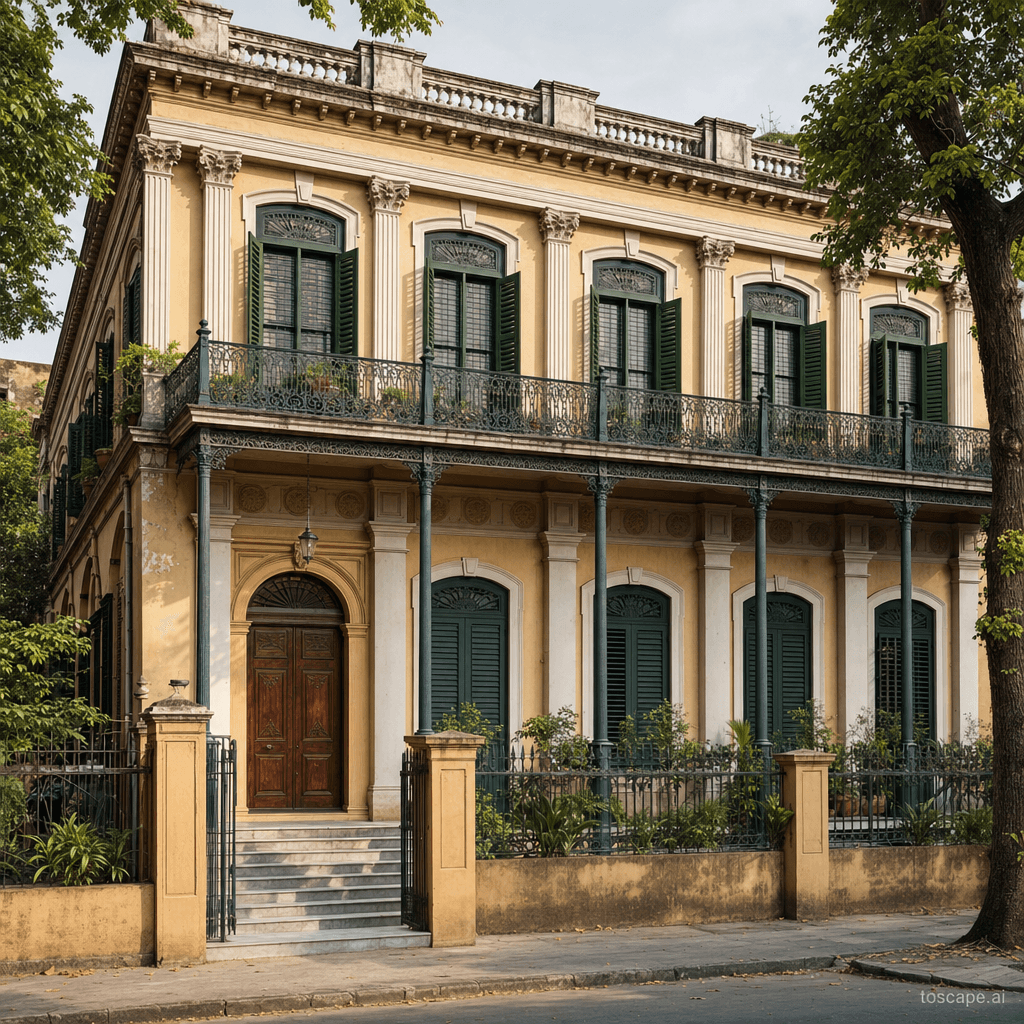
West Bengal Colonial Courtyard
India · Bengali colonial courtyard house
Central courtyard (uthon) with thakur-dalan (domestic temple pavilion), intricate cast-iron balconies and railings, louvered green shutters (khorkhori), neoclassical columns and pediments, narrow deep plan
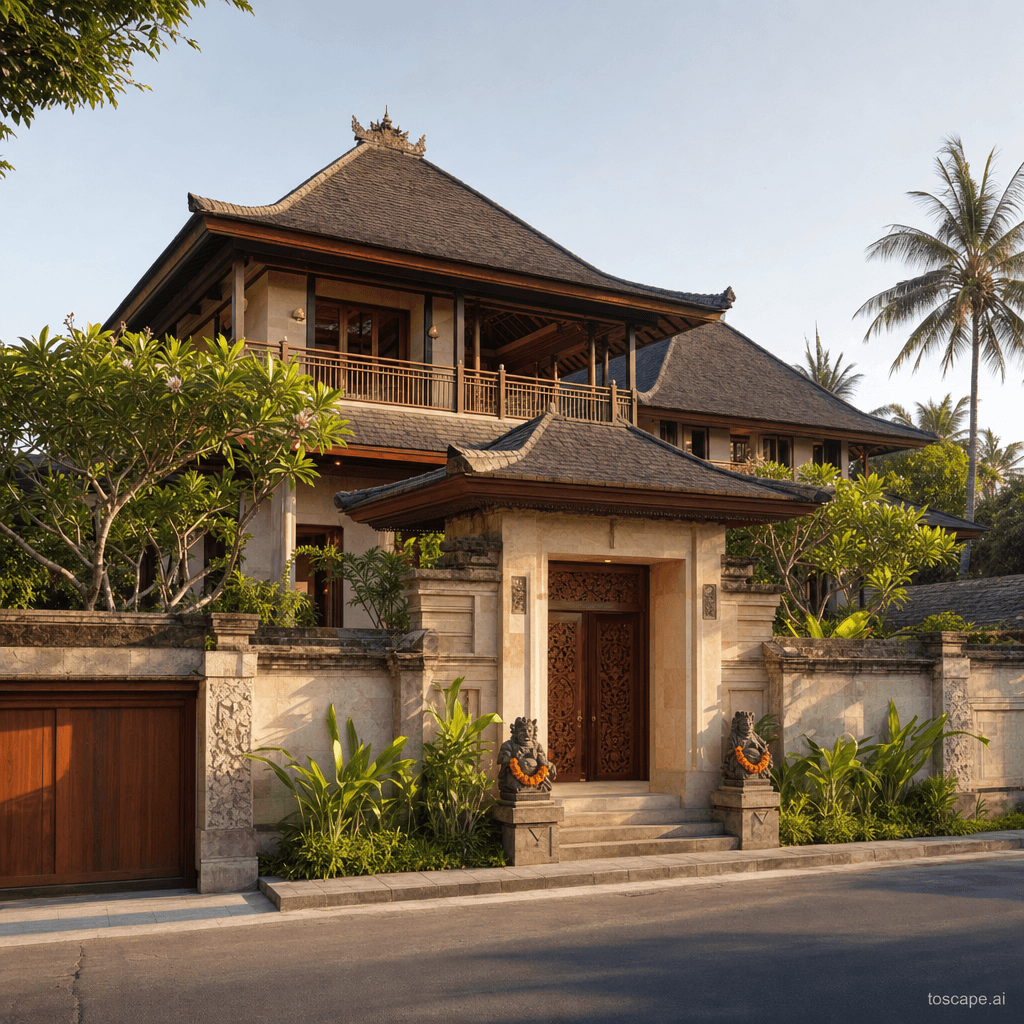
Balinese Compound
Indonesia · traditional Balinese house compound (pekarangan or umah)
The Balinese compound — a walled microcosm organized around a central open courtyard (natah), with multiple single-function pavilions (bale) under steep hipped clay-tile roofs — the pavilions are the architectural vocabulary: each is a raised platform (0.5–1 m...
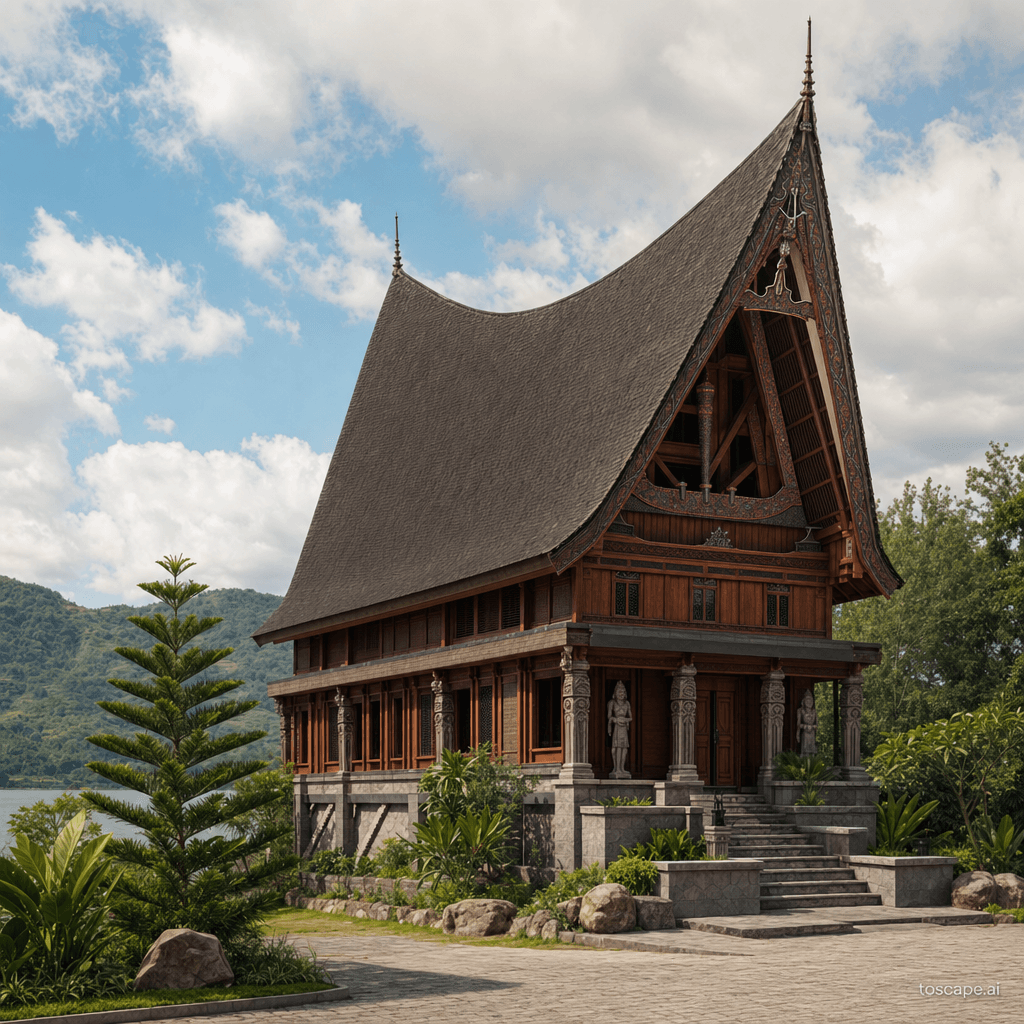
Batak Toba House
Indonesia · Rumah Bolon (Great House) and the traditional sopo (rice barn) of the Batak Toba...
The Batak Toba house — a substantial timber post-and-beam structure elevated on posts, with a massive saddleback roof — the roof ridge extends 2–3 m beyond each gable wall and curves upward at the tips (tanduk — "horn" finials), giving the house its distinctiv...
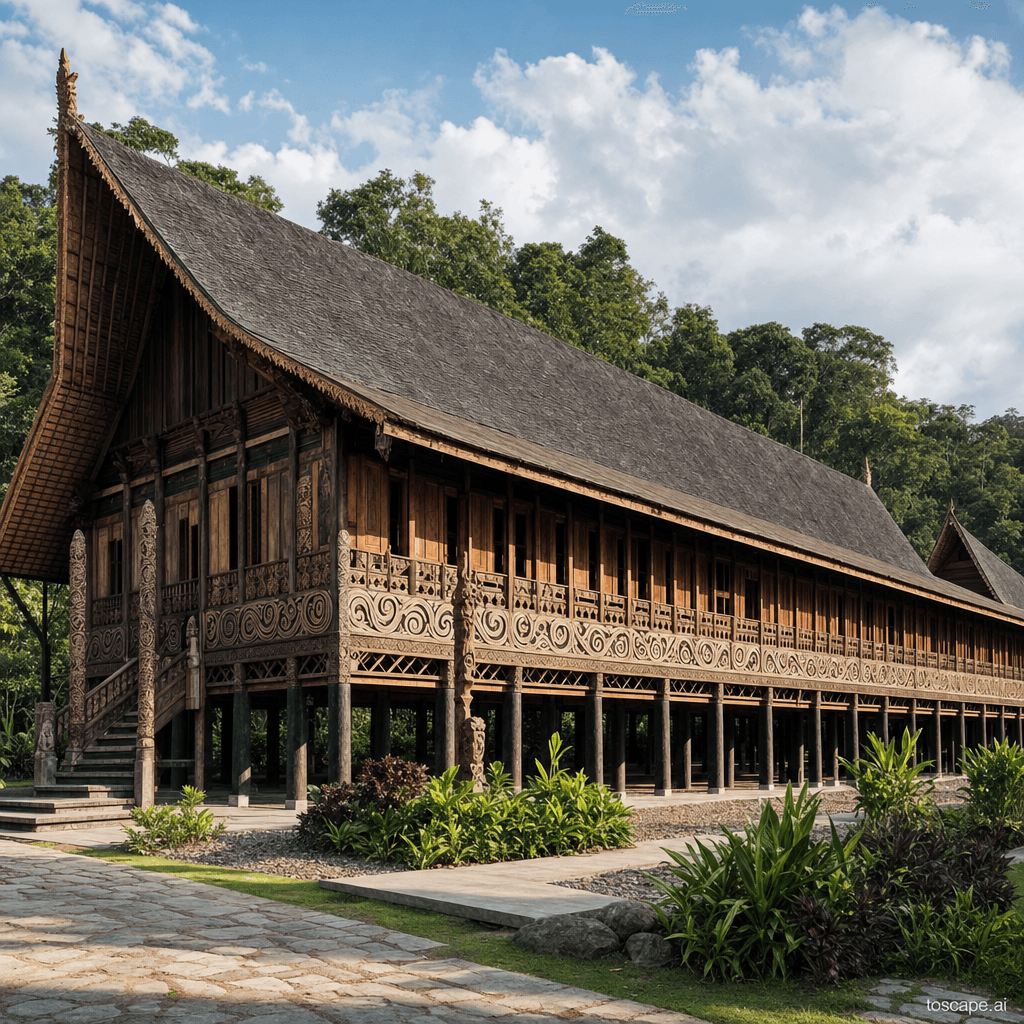
Dayak Longhouse
Indonesia · Dayak longhouse (rumah betang or lamin) of Kalimantan (Indonesian Borneo)
The Dayak longhouse — a linear elevated timber structure on ironwood posts, organized as a continuous covered verandah (ruai) with private family apartments (bilik) behind — the ruai is the architectural and social spine: a open-sided gallery 3–5 m wide, runni...
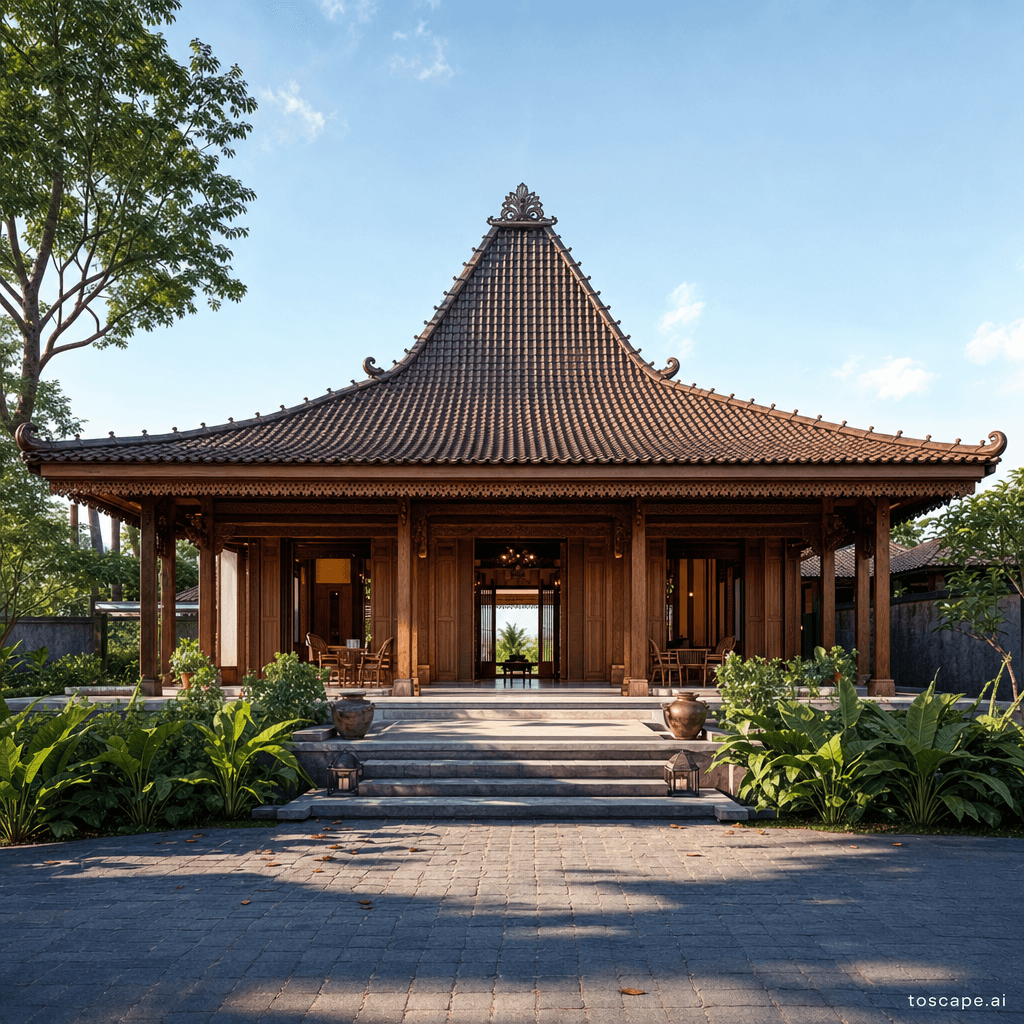
Javanese Joglo
Indonesia · Joglo house of the Javanese aristocracy
The Joglo — the roof IS the architecture — a two- or three-tiered stepped pyramidal roof (tajug) whose internal structure is the tumpang sari: a series of layered, diminishing square timber beams rising from the four saka guru columns to a single central point...
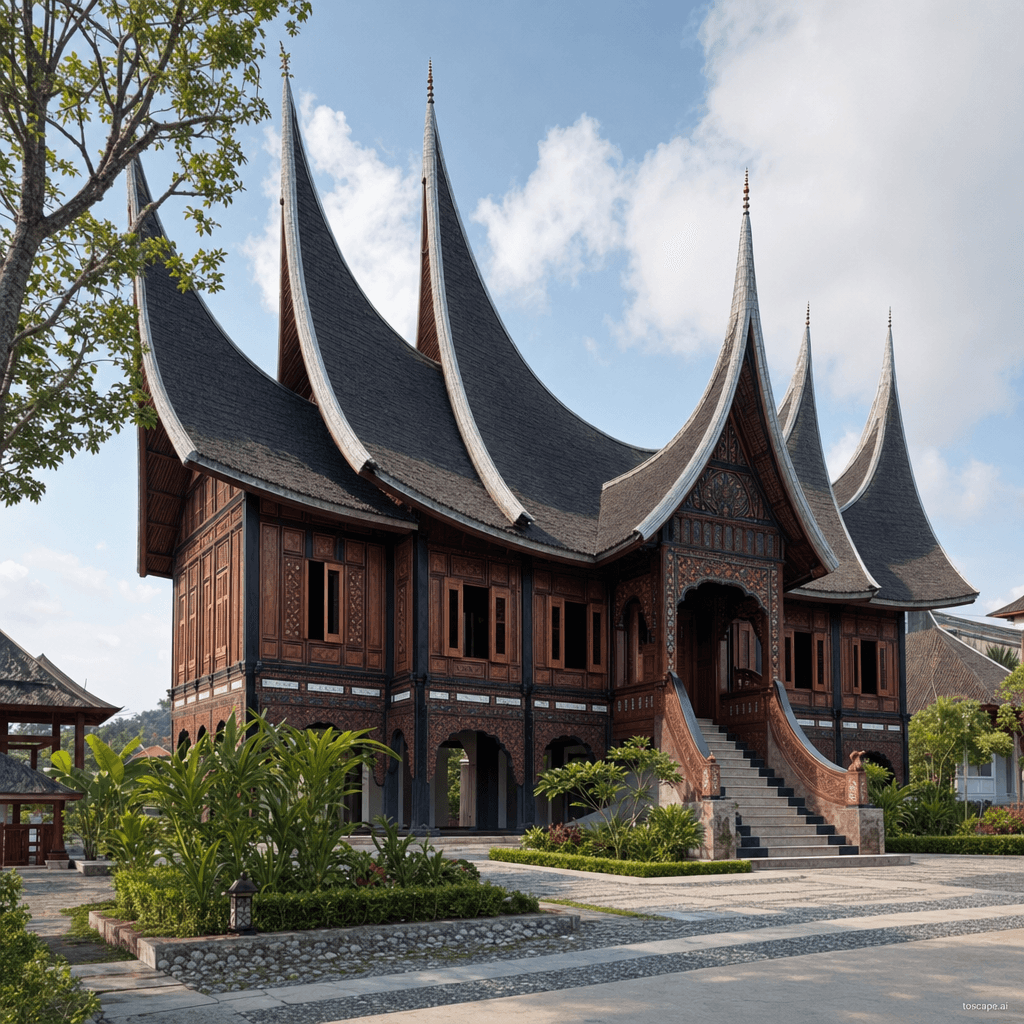
Minangkabau Rumah Gadang
Indonesia · Rumah Gadang (Big House) of the Minangkabau people of West Sumatra, Indonesia
The Rumah Gadang — a timber house elevated on posts (tonggak), with a dramatic multi-tiered roof of black ijuk (Arenga pinnata sugar palm fiber) thatch — the gonjong (sweeping horn-like roof peaks) are the defining visual element: each curved spire rises at bo...
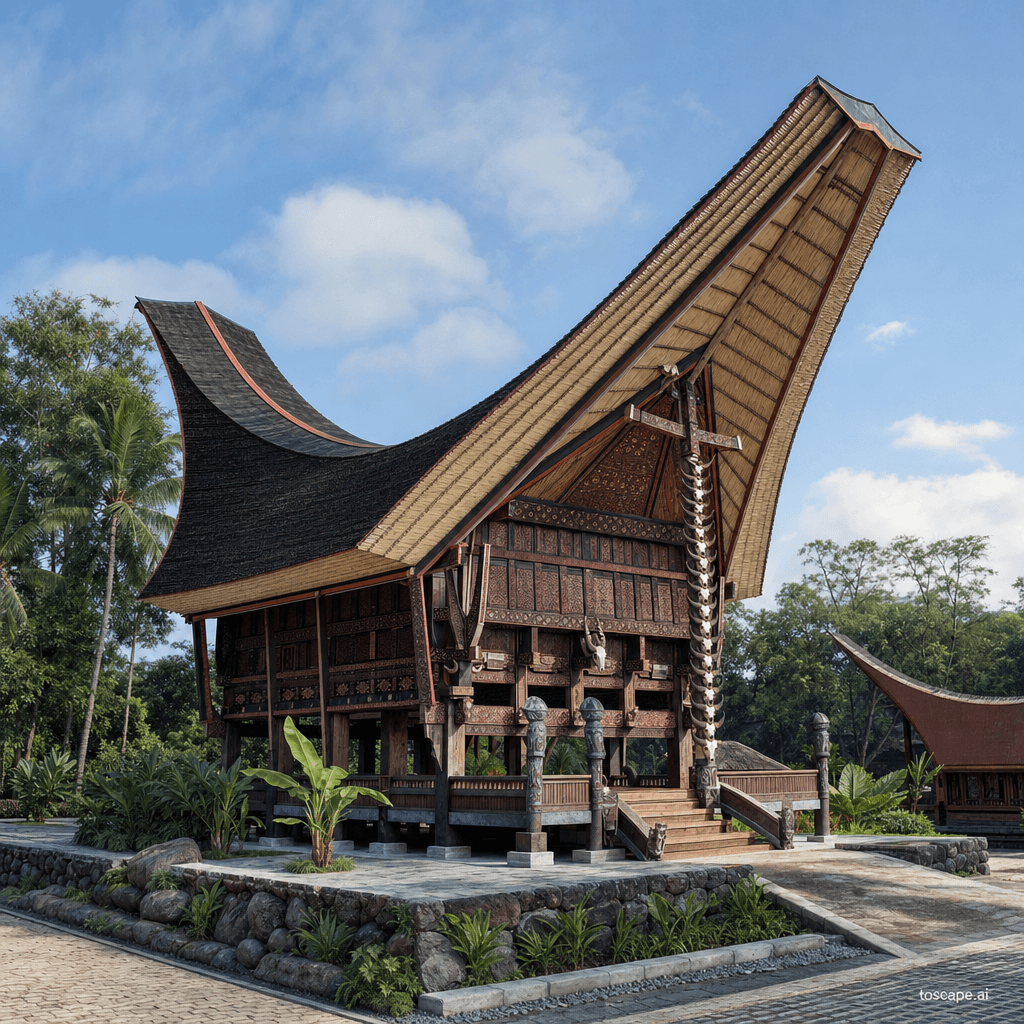
Toraja Tongkonan
Indonesia · Tongkonan (ancestral house) of the Toraja people of Tana Toraja, South Sulawesi...
The Tongkonan — a timber post-and-beam house with a hyperbolic paraboloid roof (the boat-form) — the roof structure is achieved through a system of layered longitudinal rafters that curve upward at both ends, covered in dense black ijuk thatch or split-bamboo...
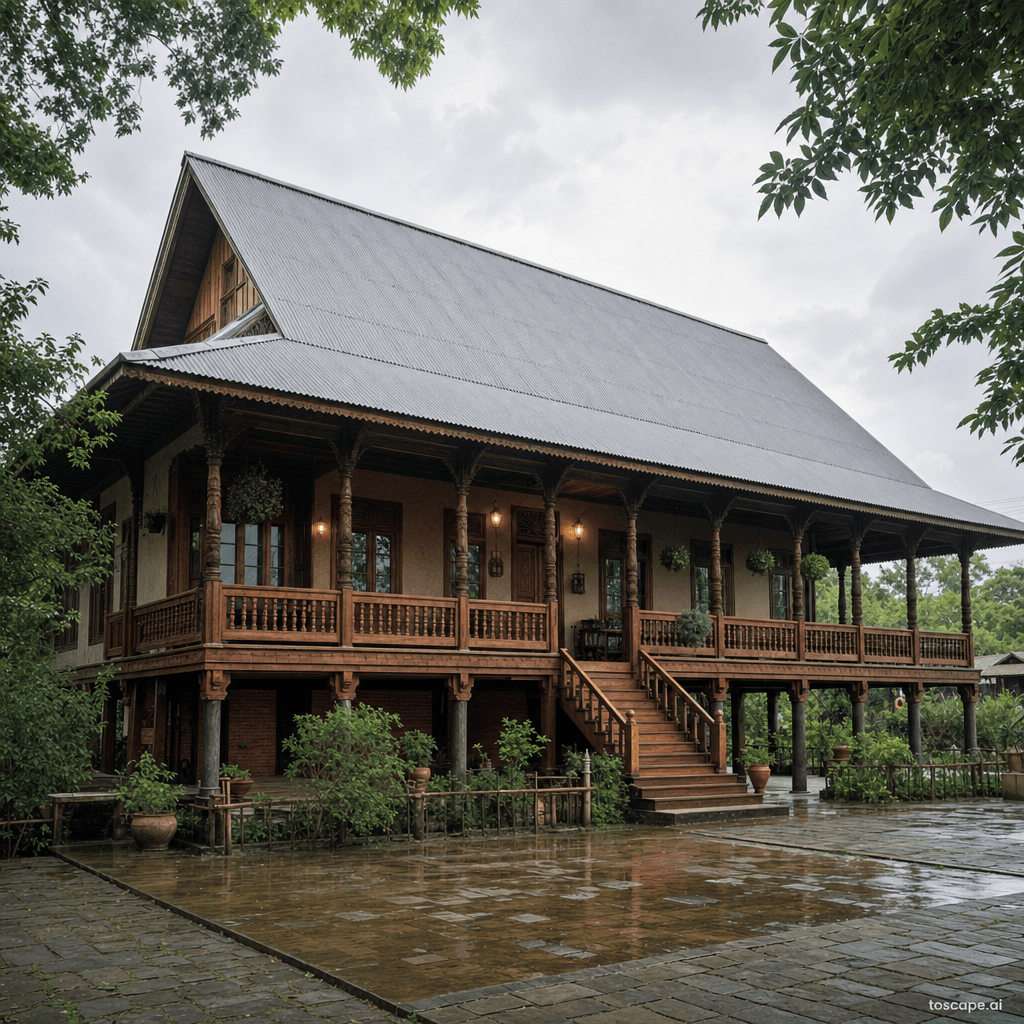
Gilan Caspian Timber
Iran · Gilan and Mazandaran Caspian Sea region
Steep-pitched corrugated or tile roofs with wide overhanging eaves, timber-frame construction on raised platforms, open verandah (telar) with carved wooden columns, adaptation to extreme rainfall (1200+mm/year)
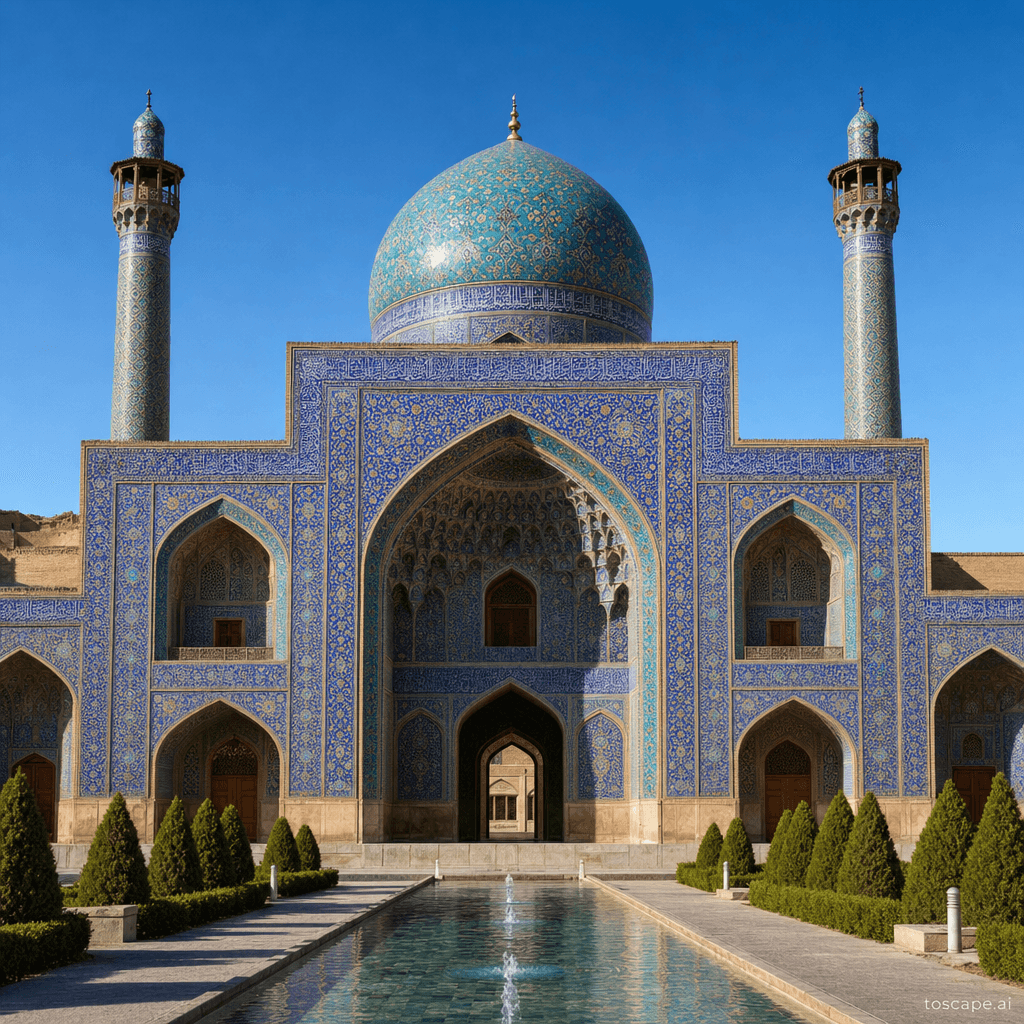
Isfahan Safavid
Iran · Safavid-era Isfahan (1598-1722)
Four-iwan mosque typology, turquoise-blue tile mosaic (haft-rang / mo'arraq kashi), monumental arched portals (pishtaq), double-shelled domes on high drums, arcaded bazaar entries, chahar-bagh garden geometry
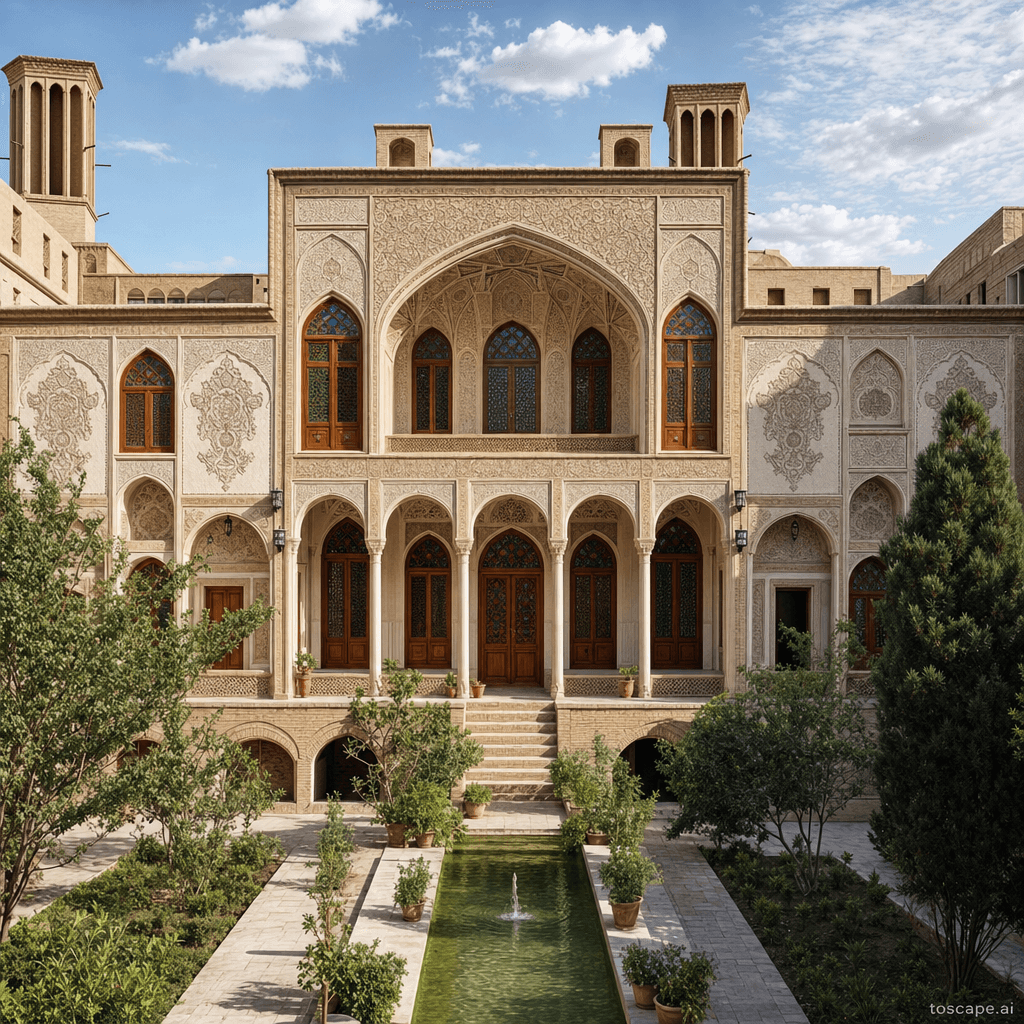
Kashan Courtyard House
Iran · Kashan's 19th-century merchant courtyard houses
Intricate carved stucco (gach-bori) panels, mirror-work (aineh-kari) halls, sunken garden courtyards (baghcheh), painted wooden ceilings, colored-glass orosi windows, badgir integration
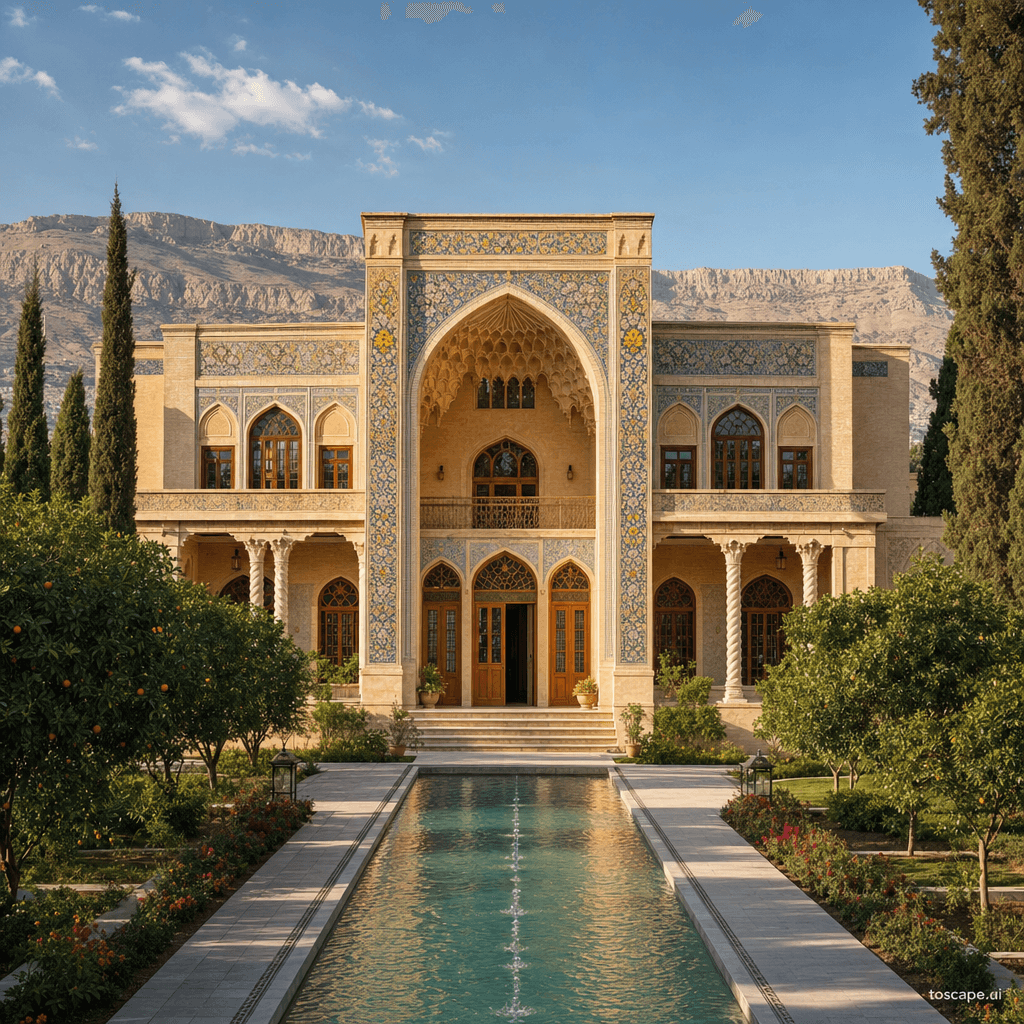
Shiraz Garden Pavilion
Iran · Shiraz
Persian bagh (walled paradise garden) with axial water channels and central pavilion (kushk), gol-o-morgh (bird-and-flower) tile panels, pink and yellow stone (limestone/marble) from nearby quarries, citrus groves within garden walls
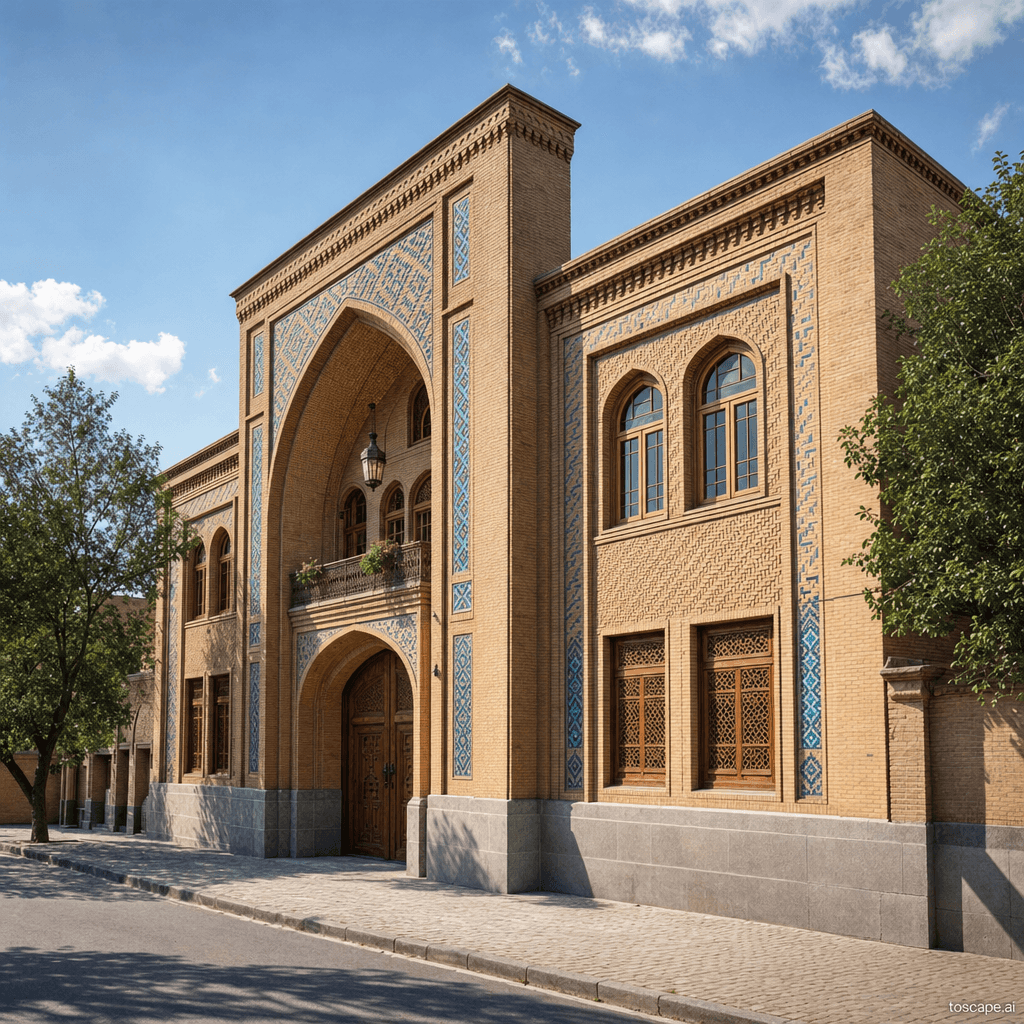
Tabriz Azerbaijani Brickwork
Iran · Tabriz
Decorative brick bonding patterns (khavun-chini, hasir-chini), blue-glazed brick and turquoise tile accents on brick grounds, monumental brick vaulting in Grand Bazaar, stone plinth bases, octagonal vaulted timchehs
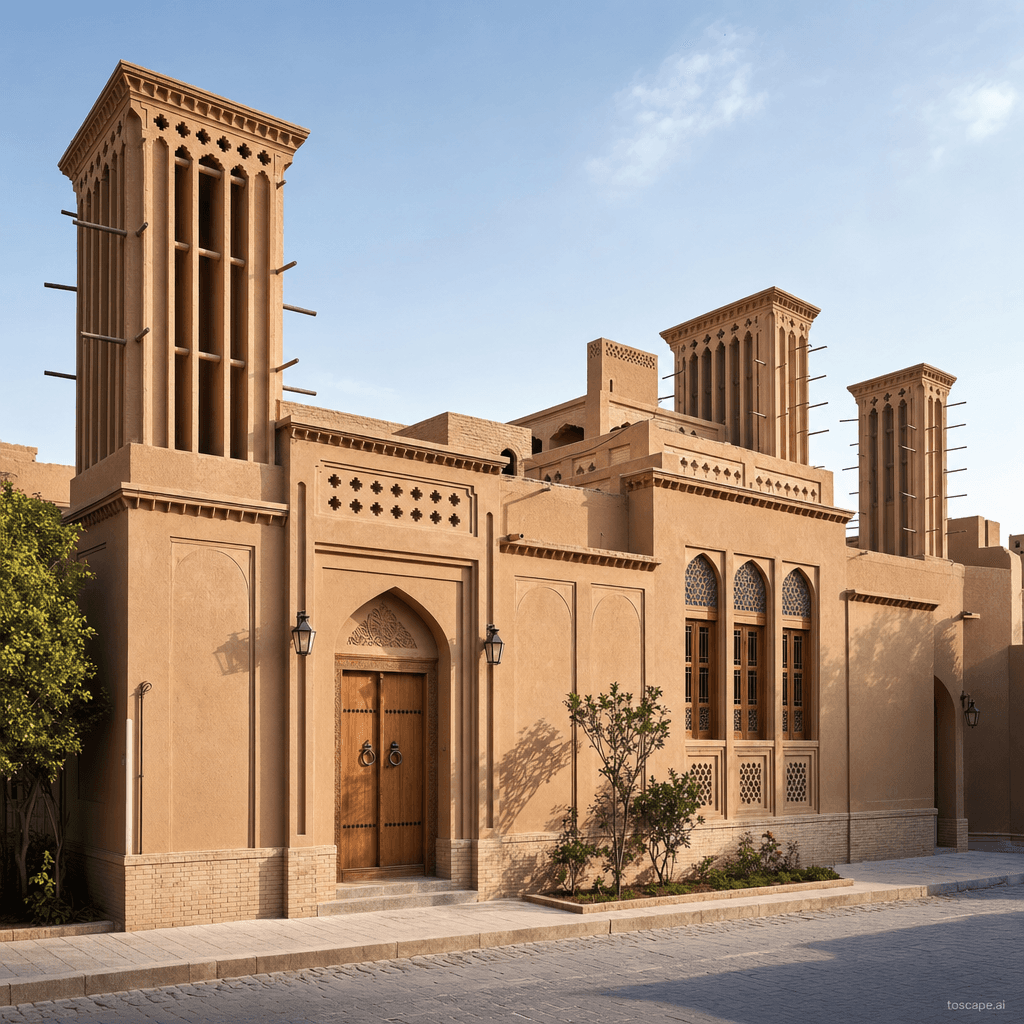
Yazd Desert Adobe
Iran · Yazd desert city
Tall windcatchers (badgir) as iconic skyline element, adobe mud-brick construction, central courtyards with pools (howz), underground qanat water channels, narrow vaulted bazaar lanes (sabats), domed cisterns (ab-anbar)
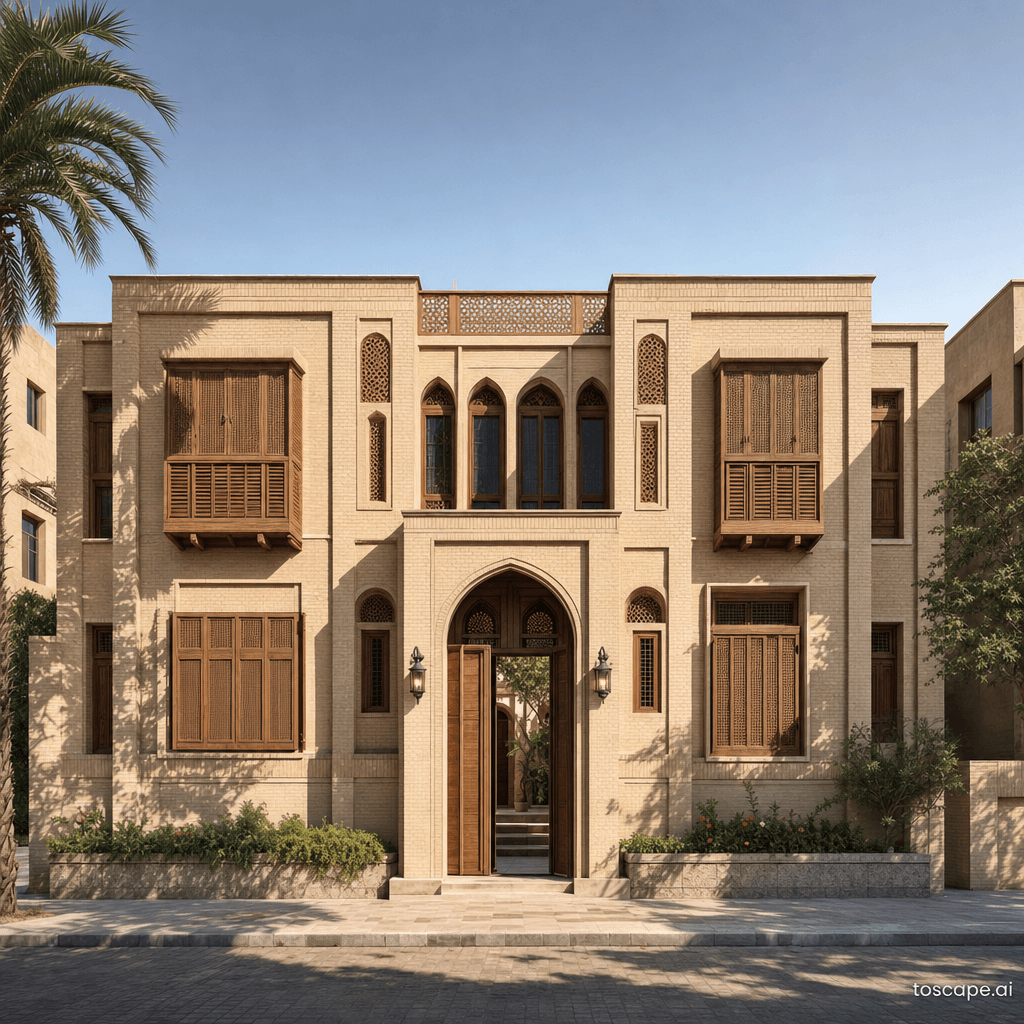
Baghdad Courtyard
Iraq · domestic architecture of historic Baghdad (Al-Rusafa and Al-Karkh districts alon...
The shanasheel — projecting timber oriel bay windows with intricate lattice screens — the defining Baghdad architectural signature — courtyard house (al-bayt al-baghdadi) with central open court (hosh) — the serdab — semi-basement room for summer cooling, a un...
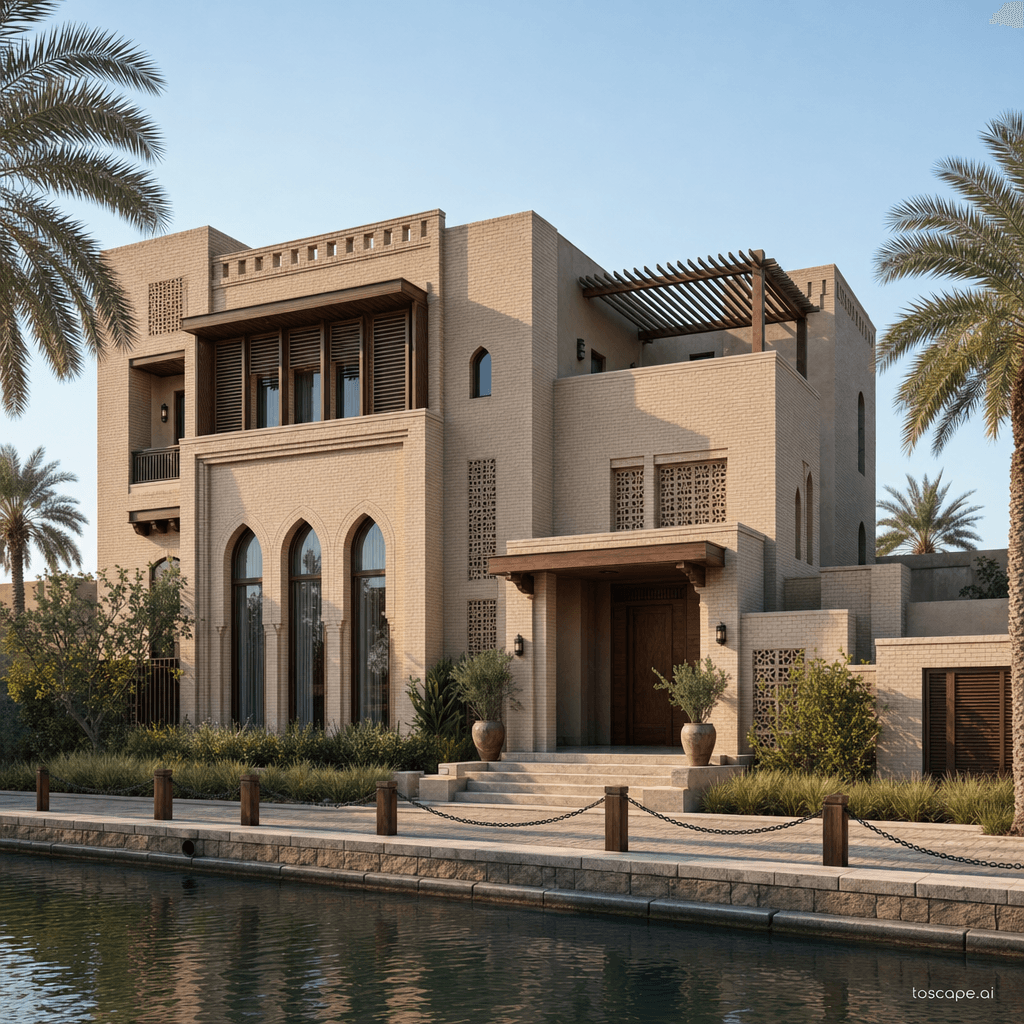
Basra Canal
Iraq · Basra
Canal-fronting houses (buyut al-shatt) with direct water access — coral stone (farrush / hasa bahri) construction reflecting Gulf coastal influence — the shanasheel balcony tradition shared with Baghdad but adapted for the humid maritime climate — mashrabiya s...
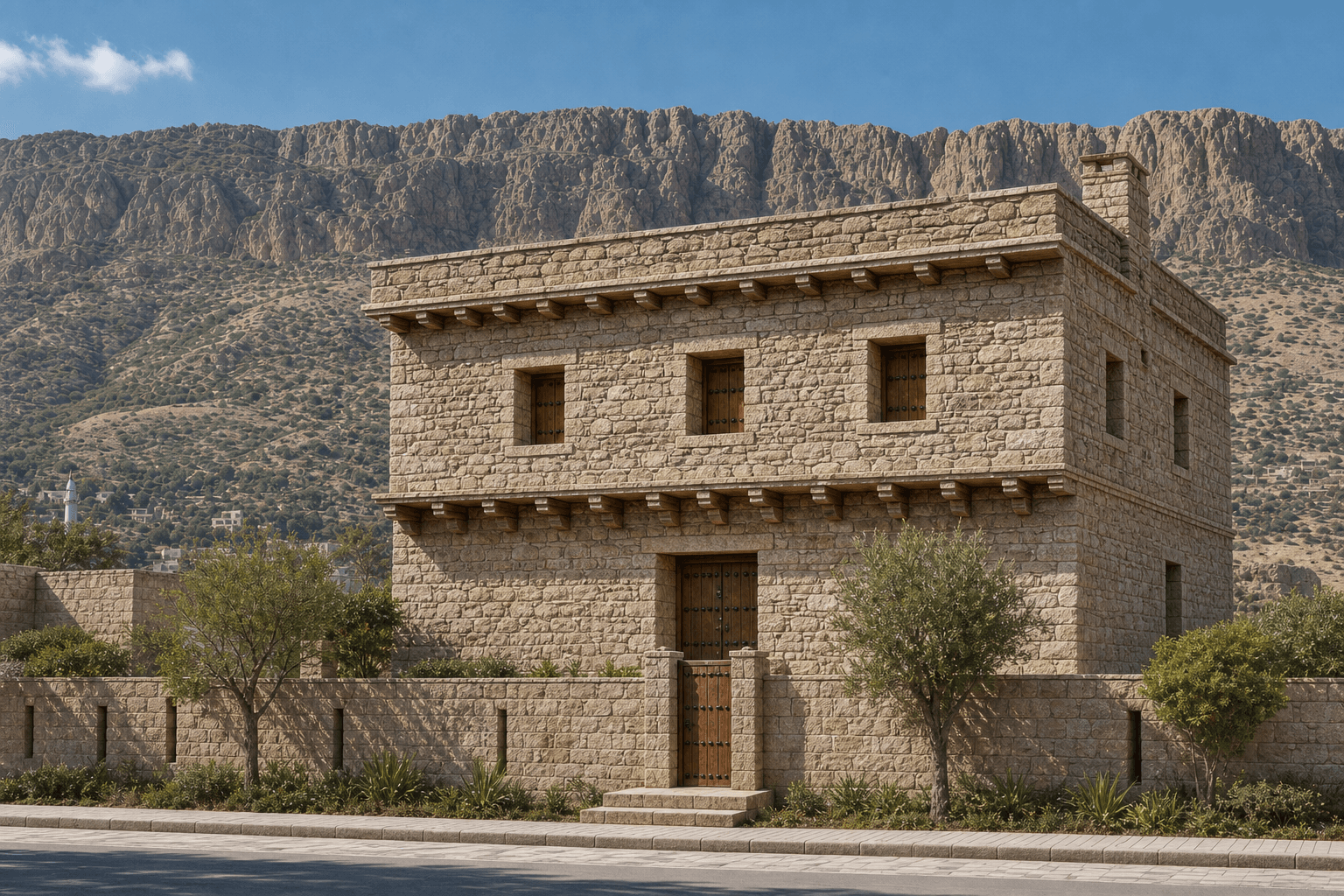
Kurdistan Mountain
Iraq · mountain architecture of the Kurdistan Region of Iraq
Stone masonry — the universal mountain construction material — local limestone and mountain stone in warm gray, brown, and ochre tones — flat roofs with timber beams and compacted earth — the citadel (qalat) as the dominant settlement typology — Erbil Citadel...
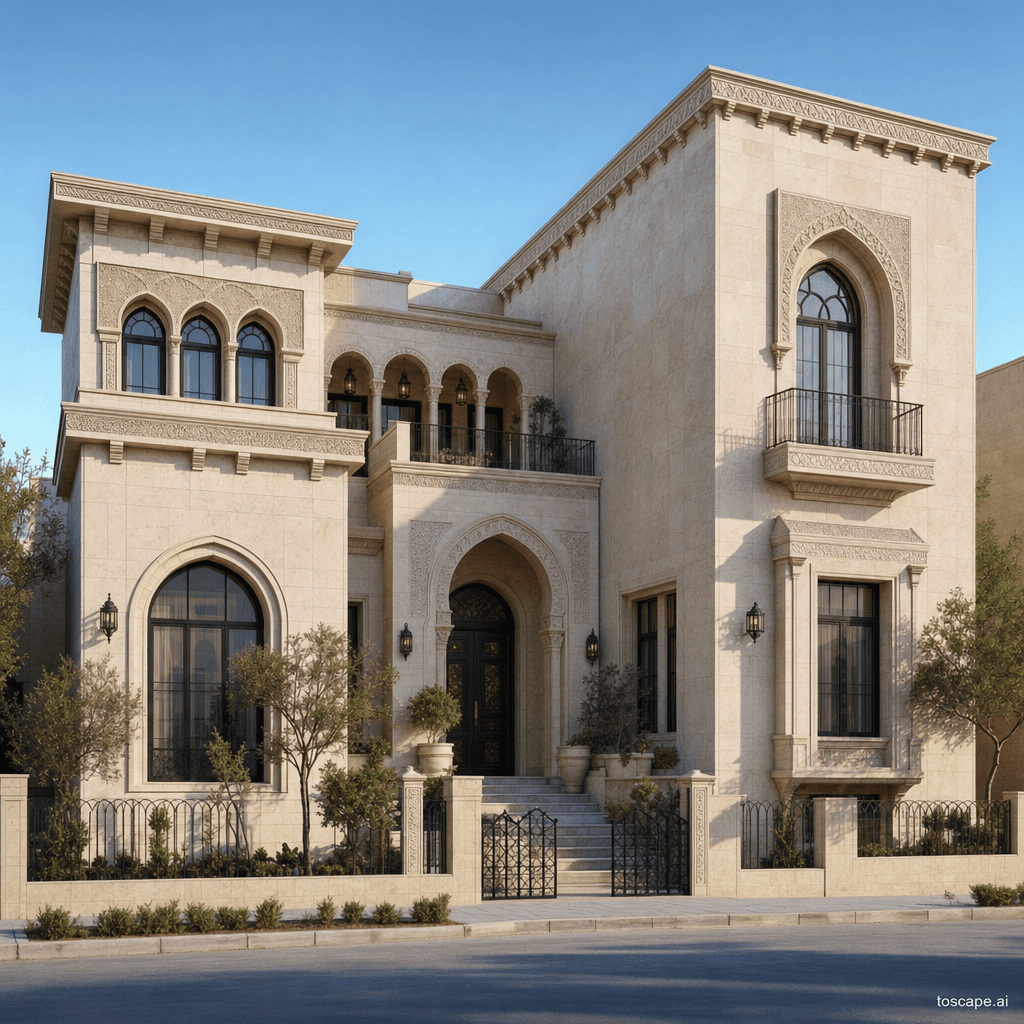
Mosul Marble
Iraq · Mosul (Al-Mawsil)
Alabaster and local marble (rathma / farsh) as the defining construction and decorative material — elaborate carved stone window surrounds (shubbak al-mawsili) with geometric and floral patterns — the courtyard house (al-bayt al-mawsili) with central hosh — th...
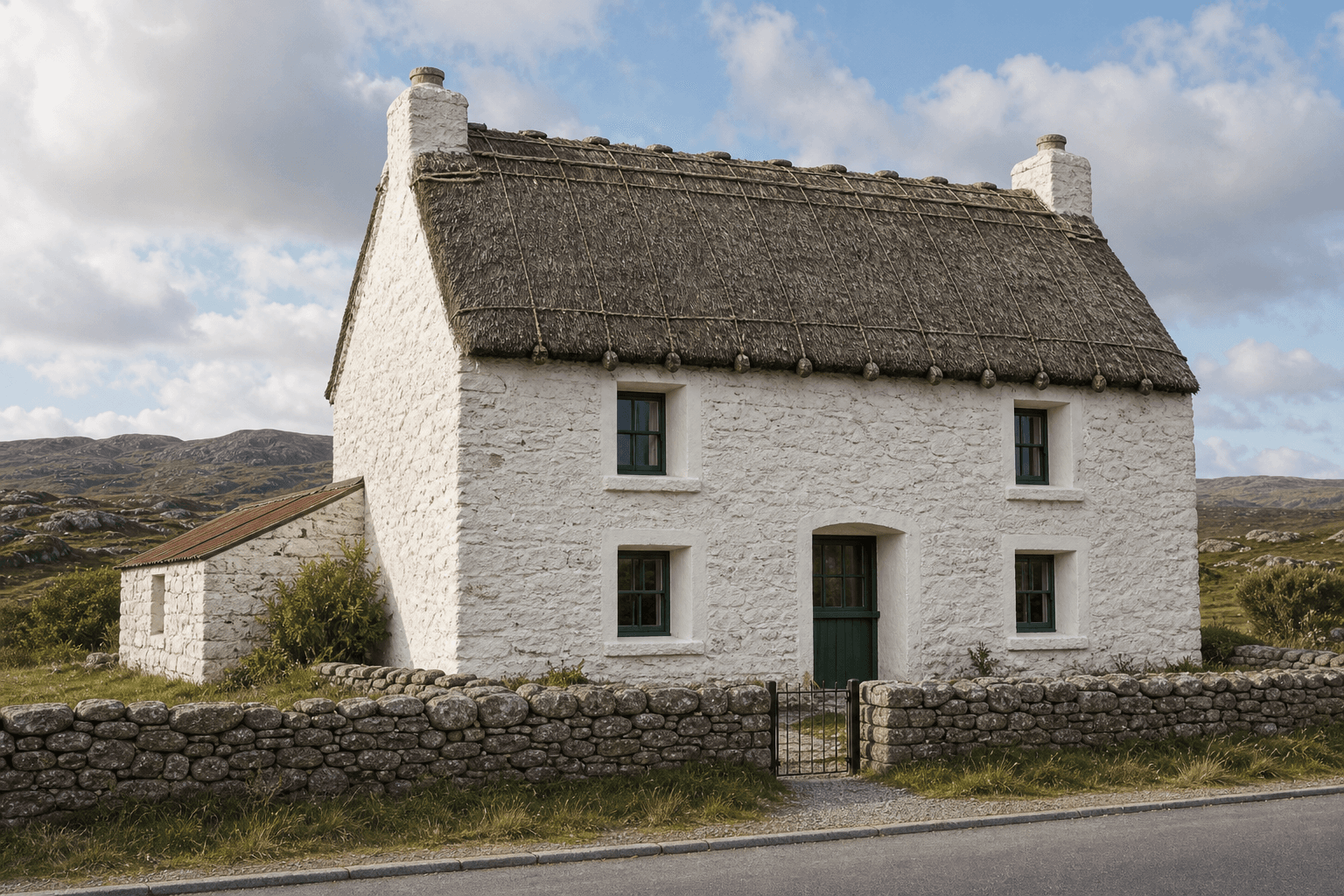
Donegal Northwest Vernacular
Ireland · Donegal cottage and the northwestern vernacular
The Donegal cottage — a solid white stone rectangle anchored in the wildest landscape in Ireland — the cottage reads as a refuge, a shelter against the elements — the whitewashed walls glow against the dark bog, the grey rock, and the steel-grey Atlantic — the...
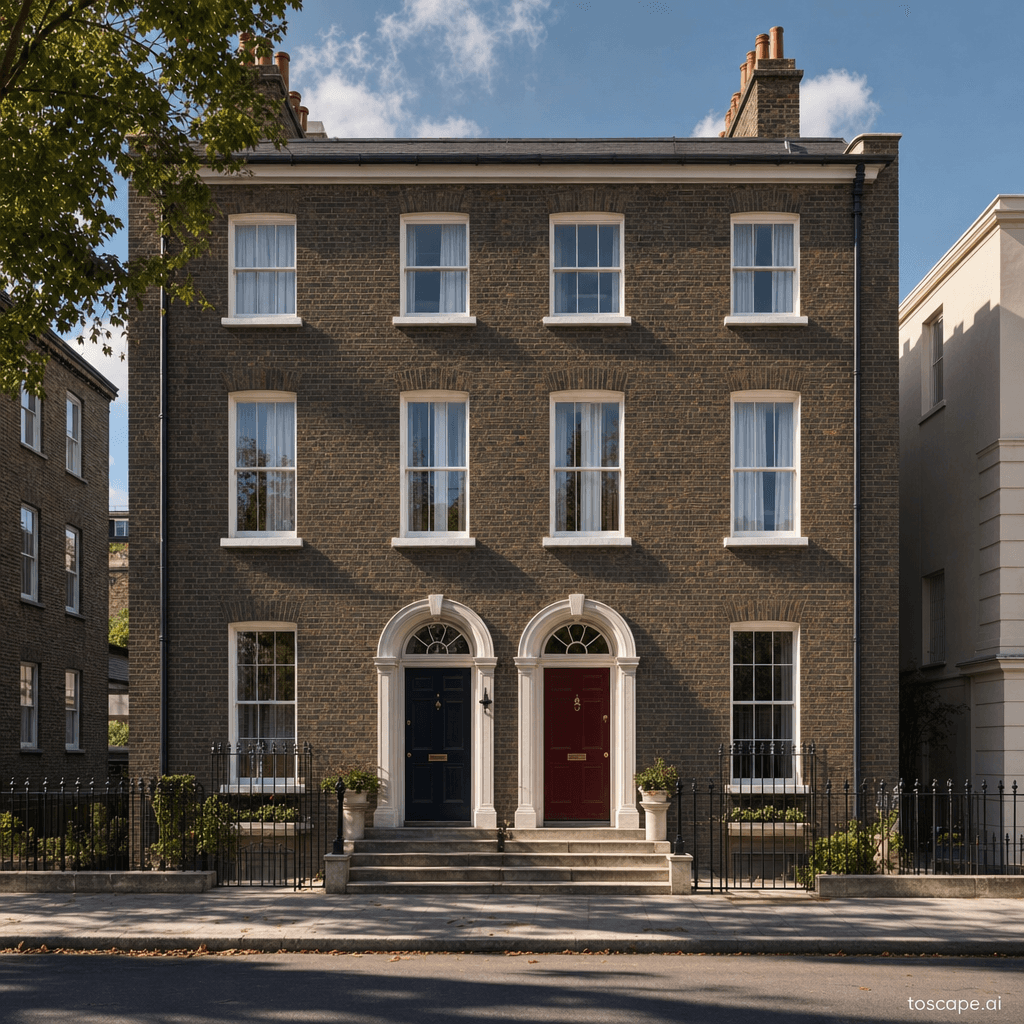
Dublin Georgian Townhouse
Ireland · Dublin Georgian townhouse (c. 1720–1830)
The Dublin Georgian streetscape — a continuous rhythmic terrace of red brick houses, each with its granite base, its colored door with fanlight, its symmetrical sash windows, and its wrought-iron railings at the front — the street reads as a unified architectu...
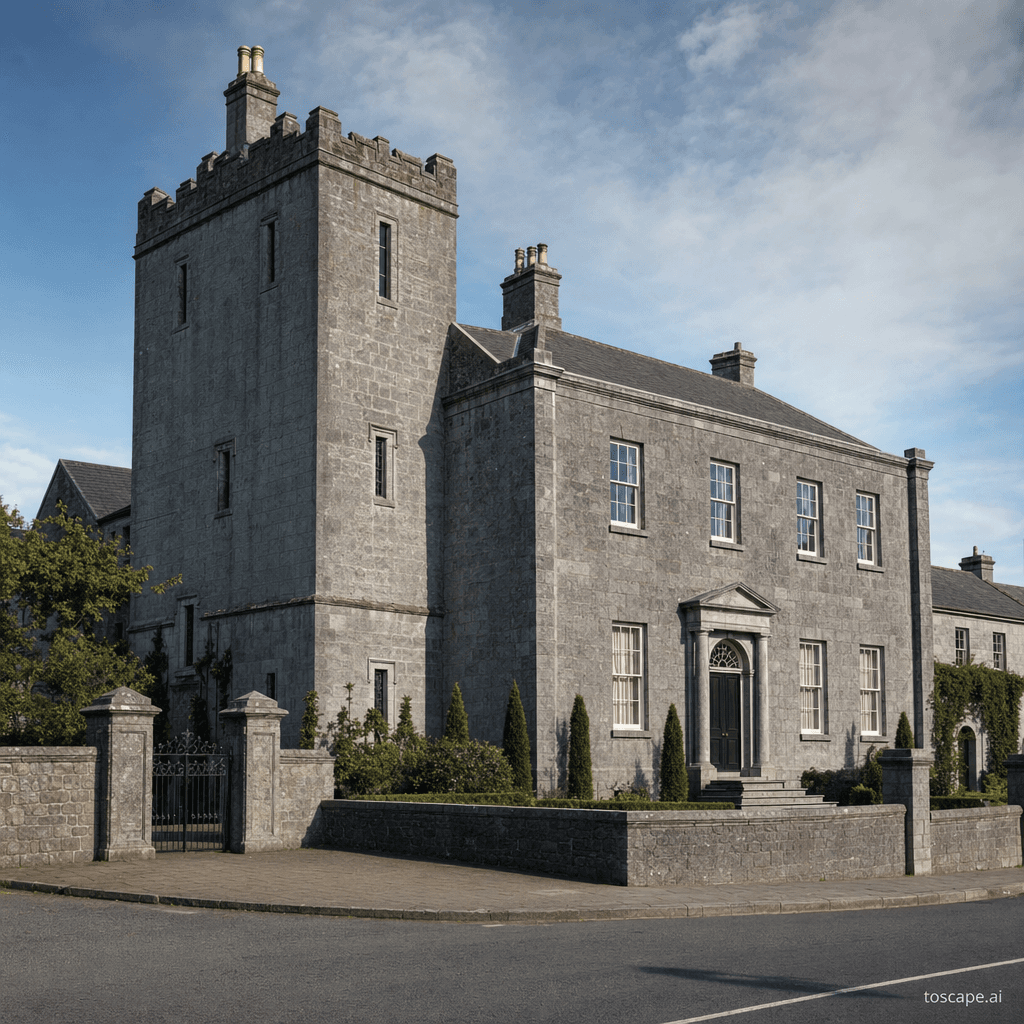
Irish Midlands Limestone Tower House & Georgian
Ireland · Irish midlands architectural identity is defined by two historic layers: (1) The...
The Irish midlands architectural identity — the contrast between the solitary medieval tower house rising from the flat pastoral landscape and the ordered Georgian streetscape of the market town — the tower house: a tall narrow rectangle of grey limestone, wit...
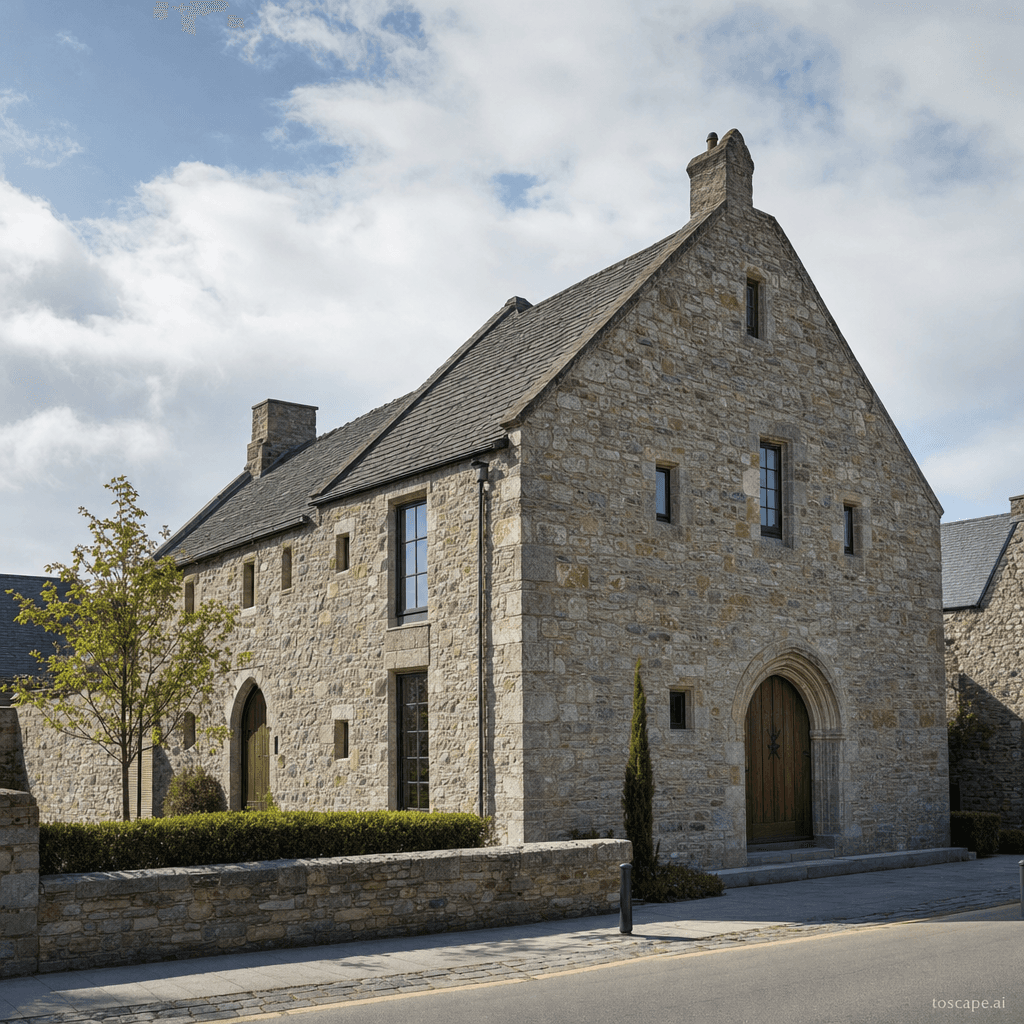
Irish Southeast Medieval & Vernacular
Ireland · southeast of Ireland (counties Kilkenny, Waterford, Wexford, Tipperary, Carlow)
The southeast Irish identity — the dark polished limestone of Kilkenny's medieval streets (the city where the stone itself is black), the dramatic limestone crag of the Rock of Cashel with its ruined cathedral silhouetted against the sky, and the soft rounded...
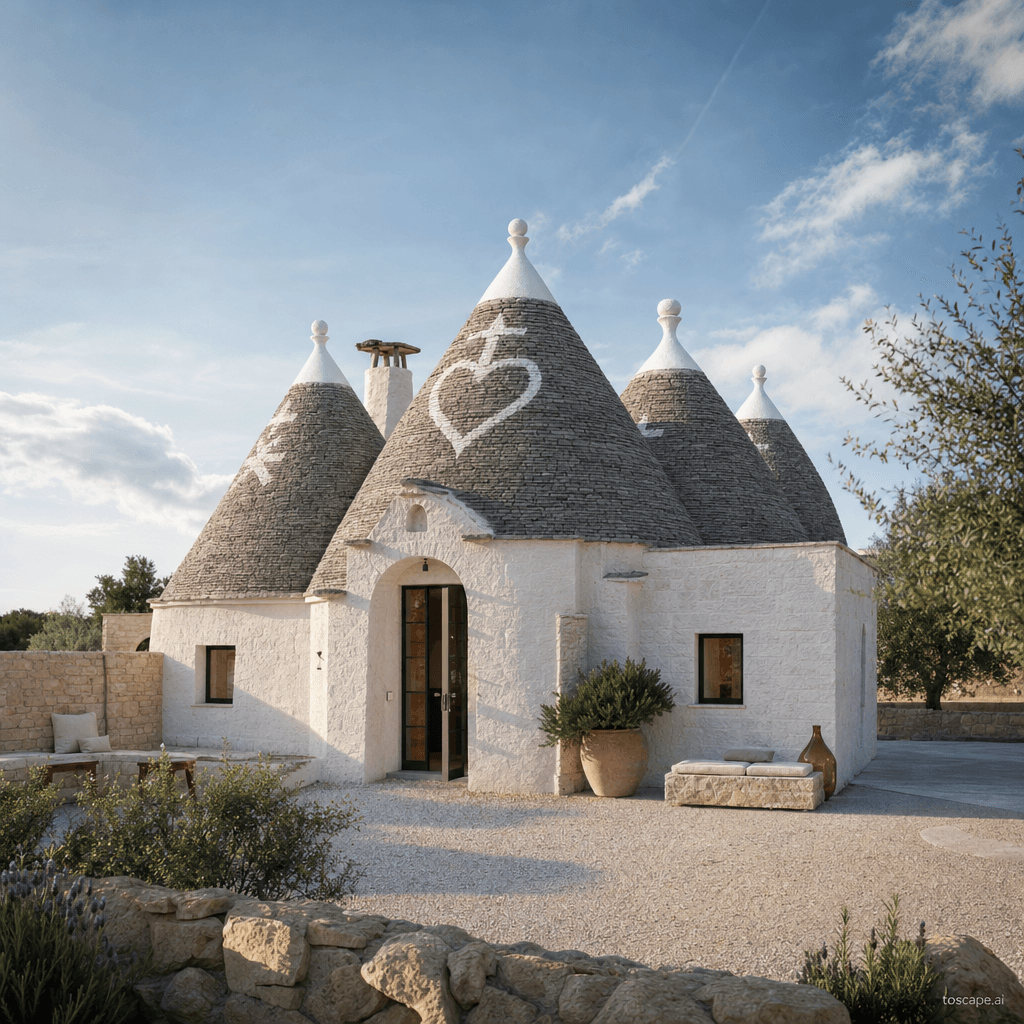
Apulia Trulli
Italy · Trulli of Alberobello
Corbelled conical stone roofs (a tholos/chiancarelle) with whitewashed pinnacolo finials, dry-stone limestone walls (a secco), circular or square plan, painted astrological and Christian symbols on roof cones, clustered in dense settlements
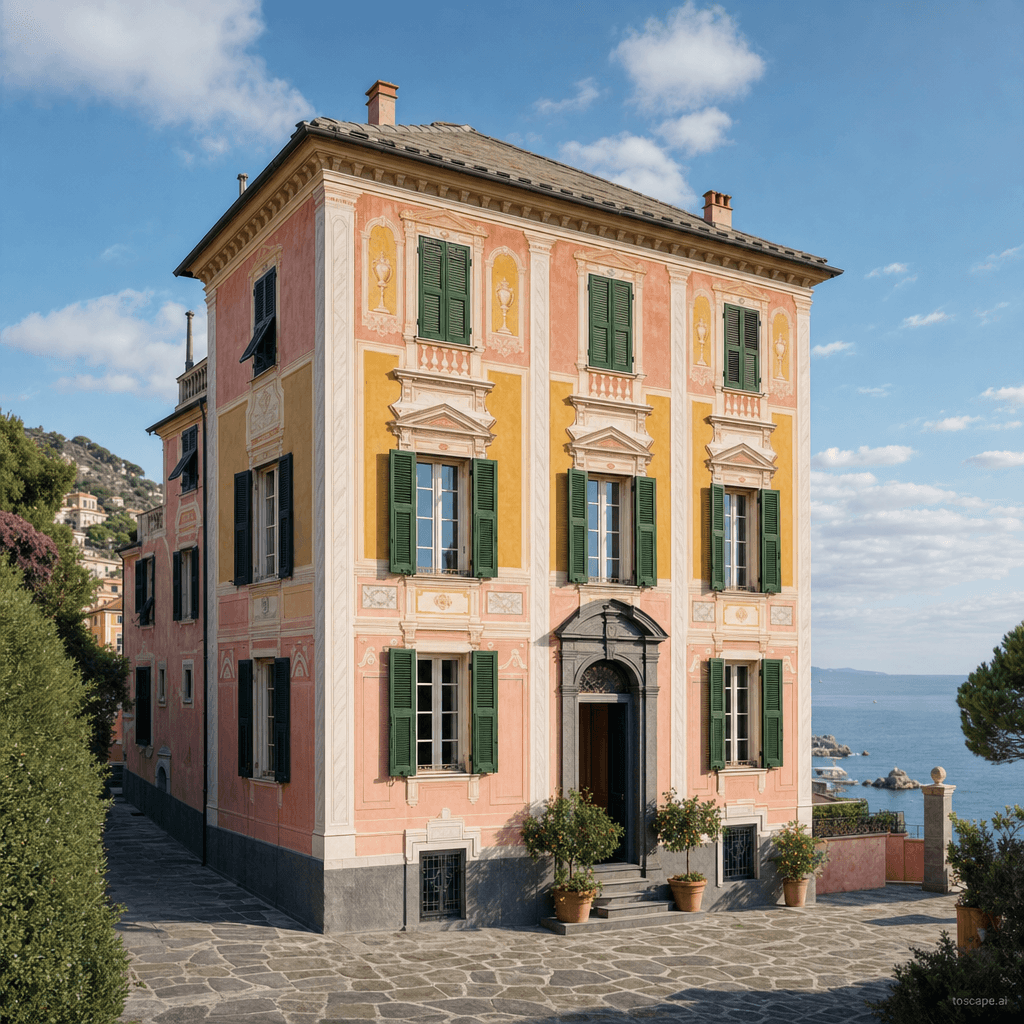
Liguria Riviera
Italy · Ligurian Riviera arc (Cinque Terre, Genoa historic center, Portofino promontory...
Tall narrow tower-houses (case torri) in vivid pastel pigments with trompe-l'œil painted architectural details, grey-black slate (ardesia) roofs and portals, Genoese green persiane shutters, marble-intonaco hybrid facades, steep terraced coastal sites
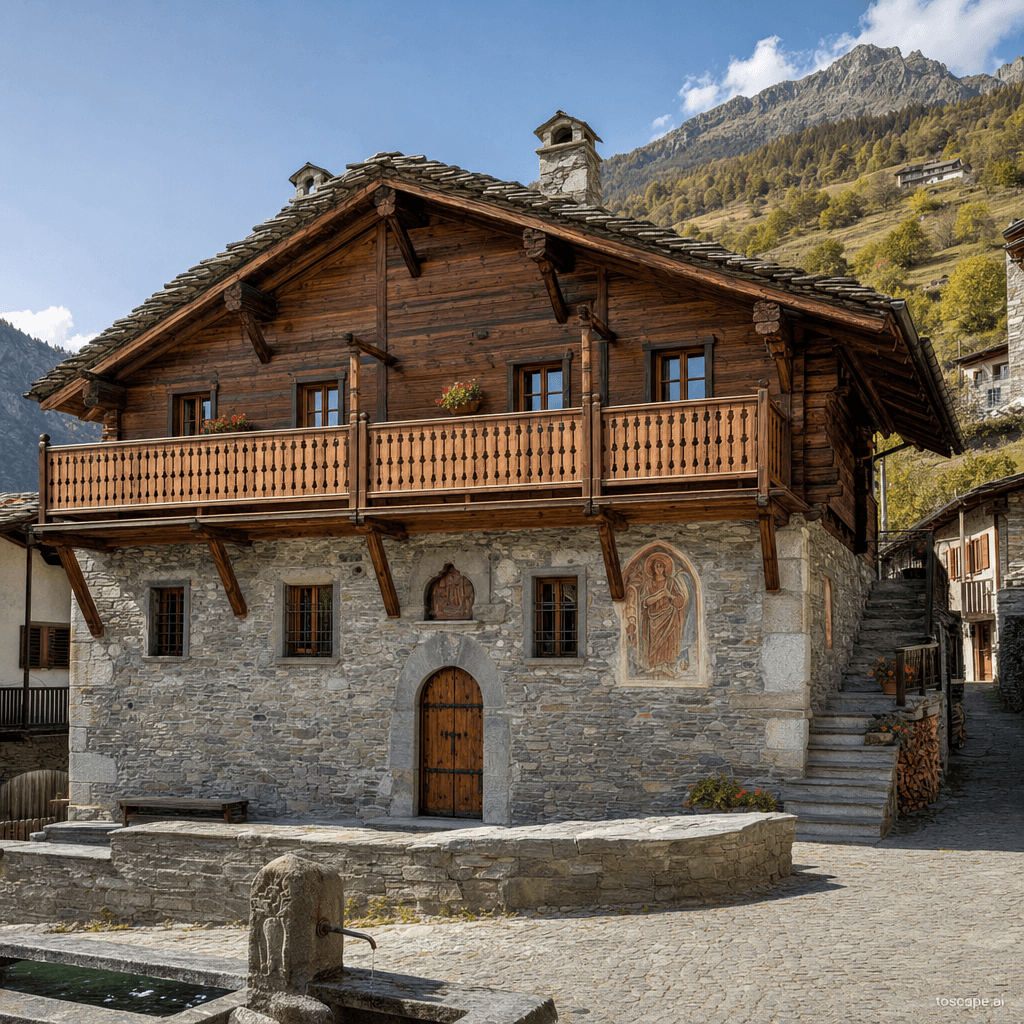
Lombardy Alpine
Italy · Lombardy Alpine arc (Valtellina, Val Camonica, Lake Como mountains)
Stone ground floor with timber log (blockbau) or timber frame upper floors, projecting timber balconies (balconi/poggioli) with turned balusters, pitched stone slab roofs (piode) or tile, external stone staircases, frescoed stone facades in lower valleys
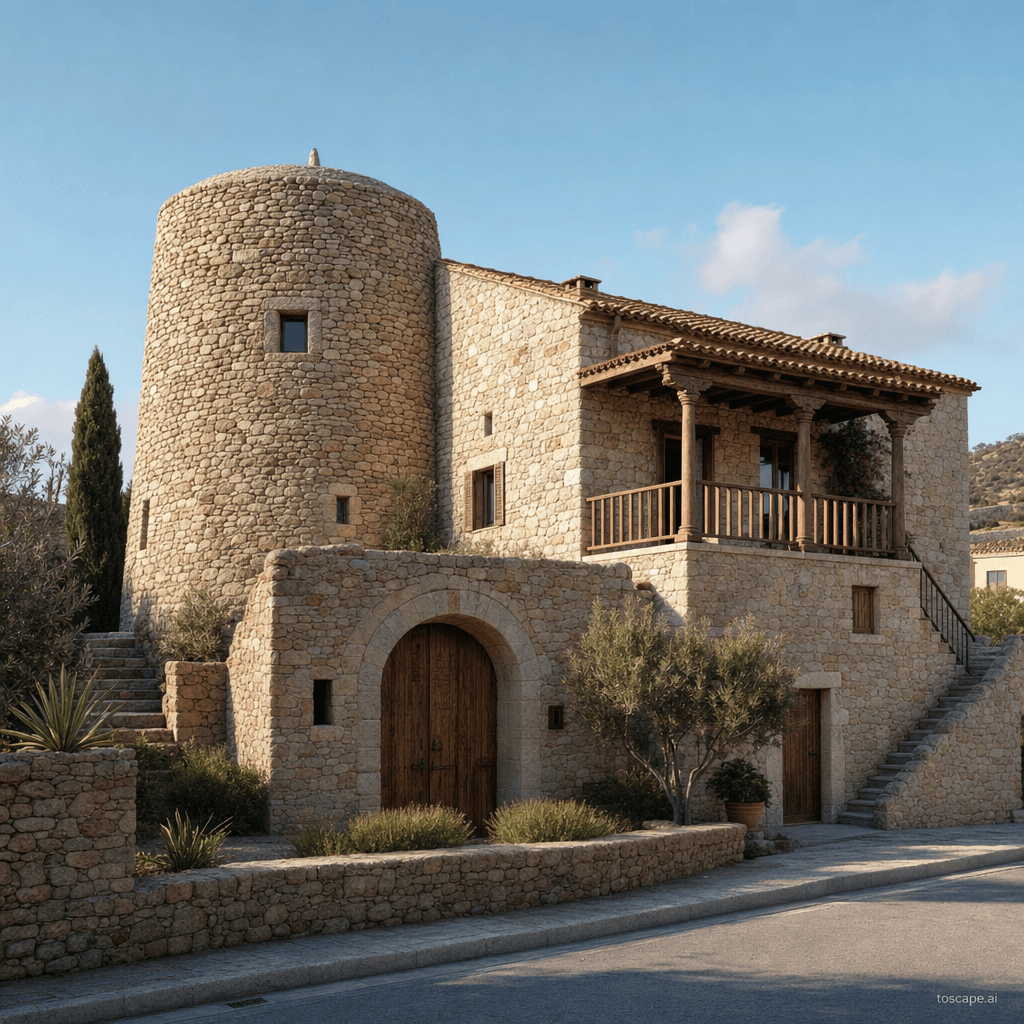
Sardinia Nuragic Stone
Italy · Sardinian vernacular
Nuraghi: truncated-cone dry-stone towers with corbelled tholos interiors (1500-500 BCE). Vernacular: rectangular stone houses (casa campidanese) with timber balcony loggia (lolla), juniper and corbezzolo timber elements, flat or low-pitch tile roofs, external...
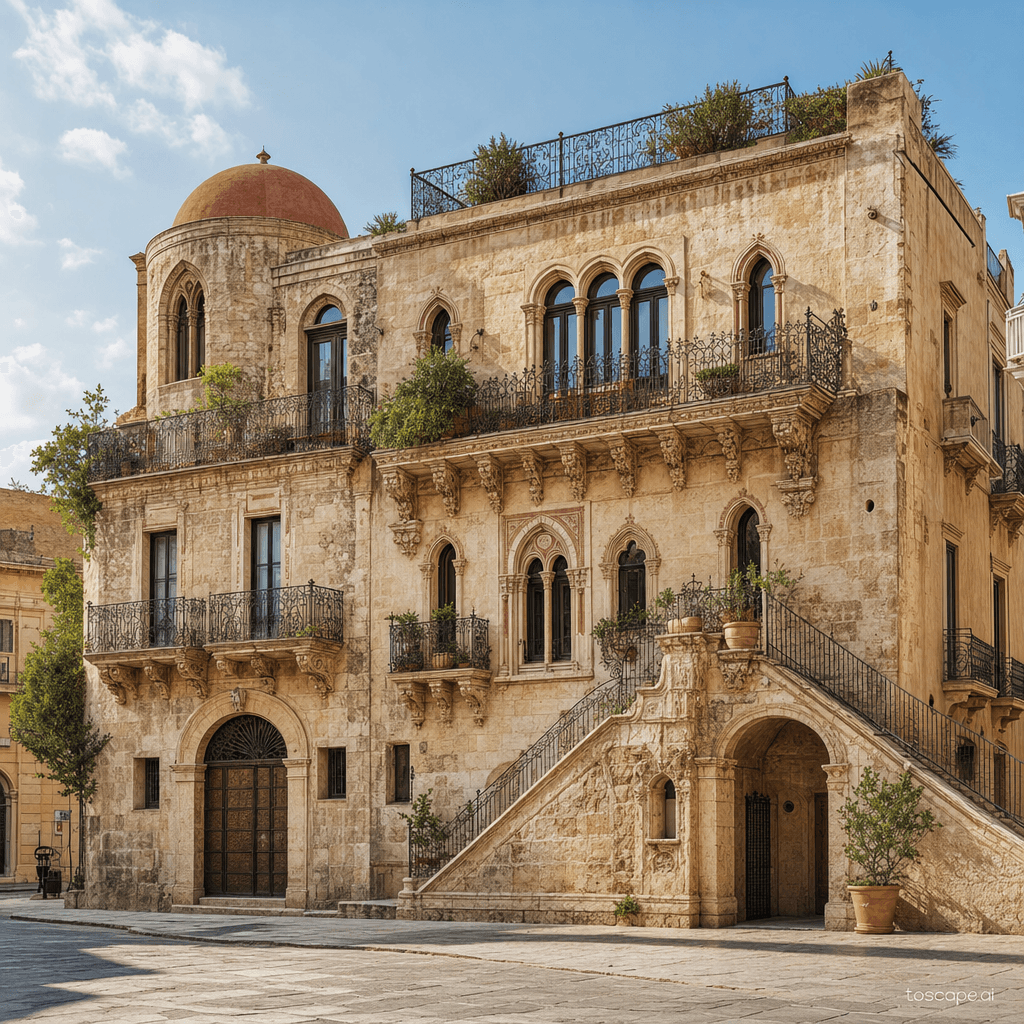
Sicily Mediterranean Island
Italy · Sicilian architectural identity
Arabic-Norman Palermo (UNESCO): polychrome stone inlay (intarsio marmoreo), red domes, pointed arches, geometric ornament. Sicilian Baroque (Val di Noto): exuberant carved limestone facades, wrought iron balconies (balconi in ferro battuto) with grotesque brac...
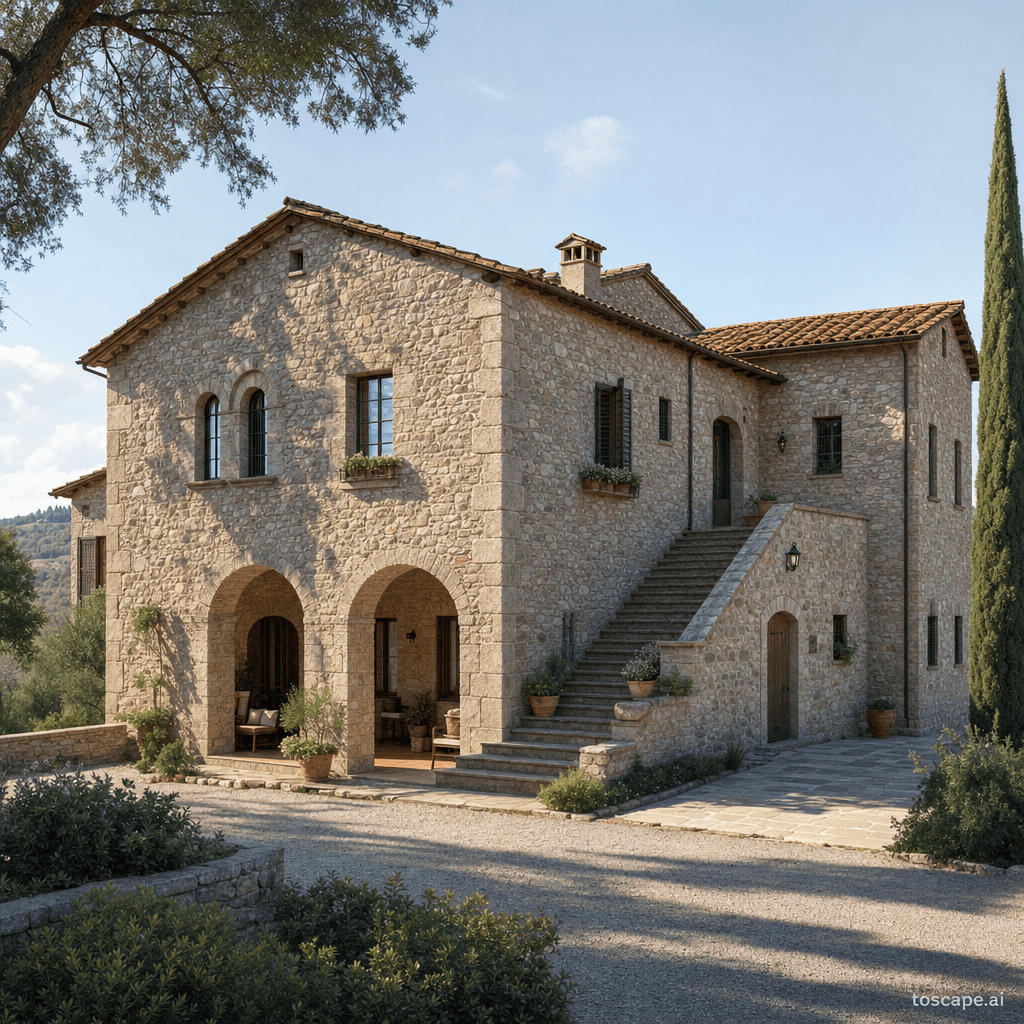
Tuscany Rural Stone
Italy · Tuscan rural
Warm terracotta barrel-tile roofs (coppi/tegoli), local sandstone (pietra serena / pietra forte) and limestone walls, rusticated stone quoins and surrounds, cypress-lined drives (viale di cipressi), arched loggias, external stone staircases (scala esterna)
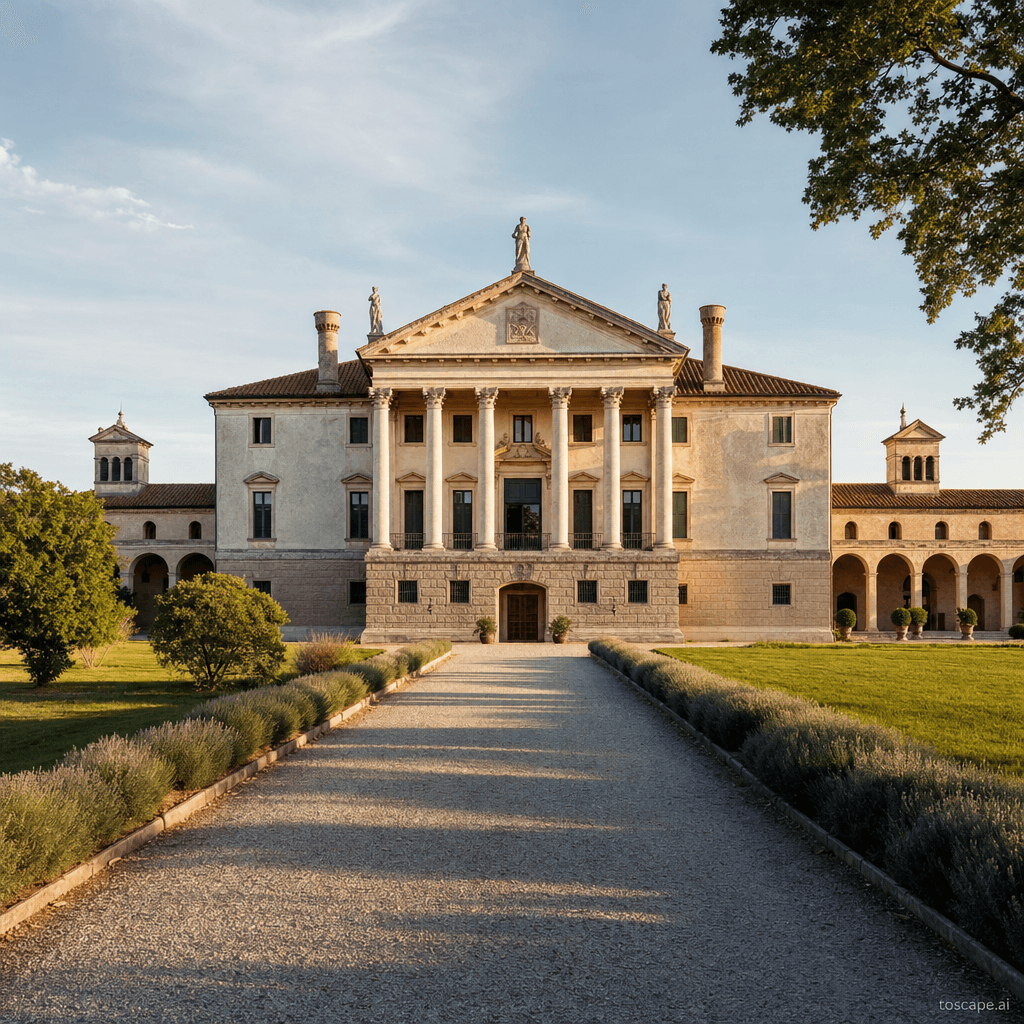
Veneto Palladian Villa
Italy · Palladian villas of Veneto
Symmetrical temple-front portico with columns (pronaos), rusticated base (bugnato), stuccoed brick walls (intonaco), terracotta barrel-tile roof (coppi), barchessa (arched agricultural wings), axial relationship to working farmland, frescoed piano nobile inter...
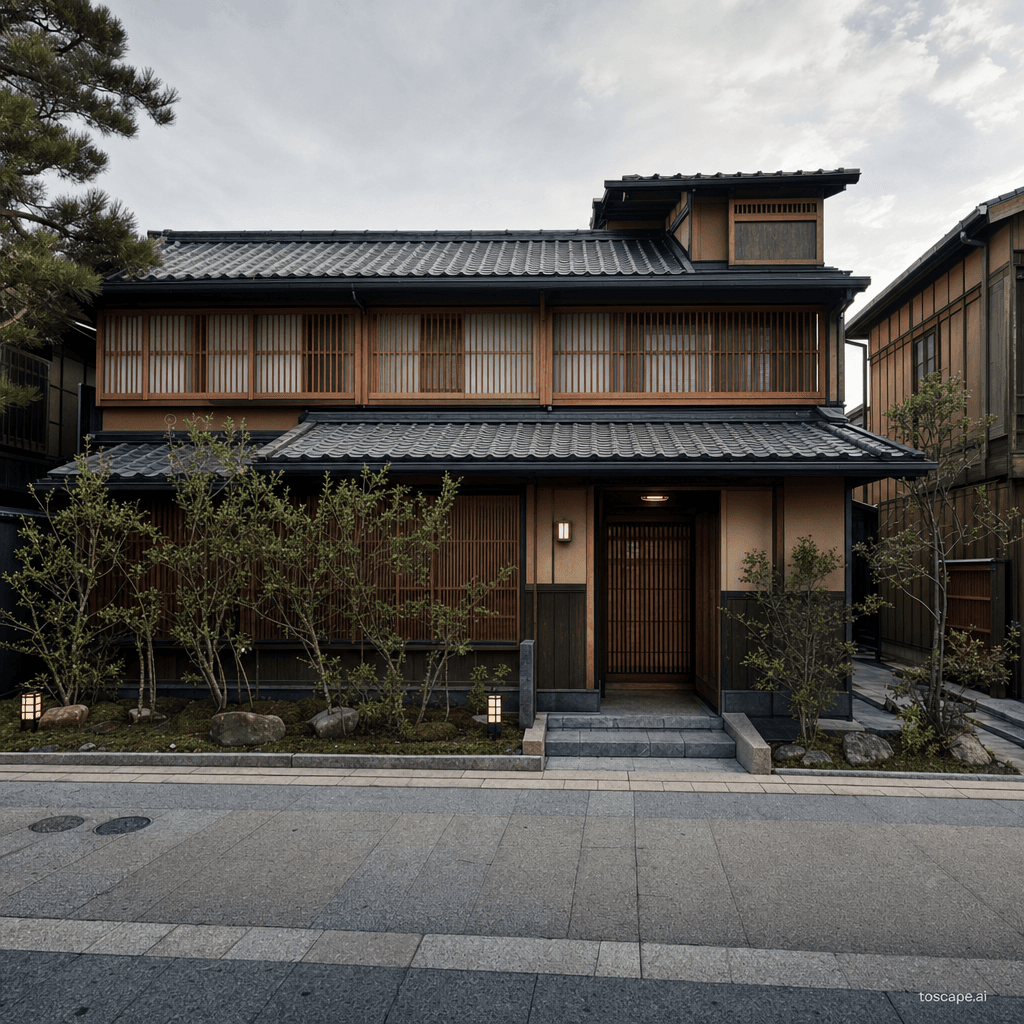
Kanazawa Samurai & Chaya Teahouse
Japan · domestic architecture of Kanazawa, Ishikawa Prefecture
Samurai bukeyashiki (warrior residences) with earthen perimeter walls (tsuiji-bei) and formal entrance gates — larger plots (15–25 m frontage vs. machiya's 3–5 m) — chaya (teahouse) architecture with elaborate street-facing lattice (kōshi) in warm red-brown ti...
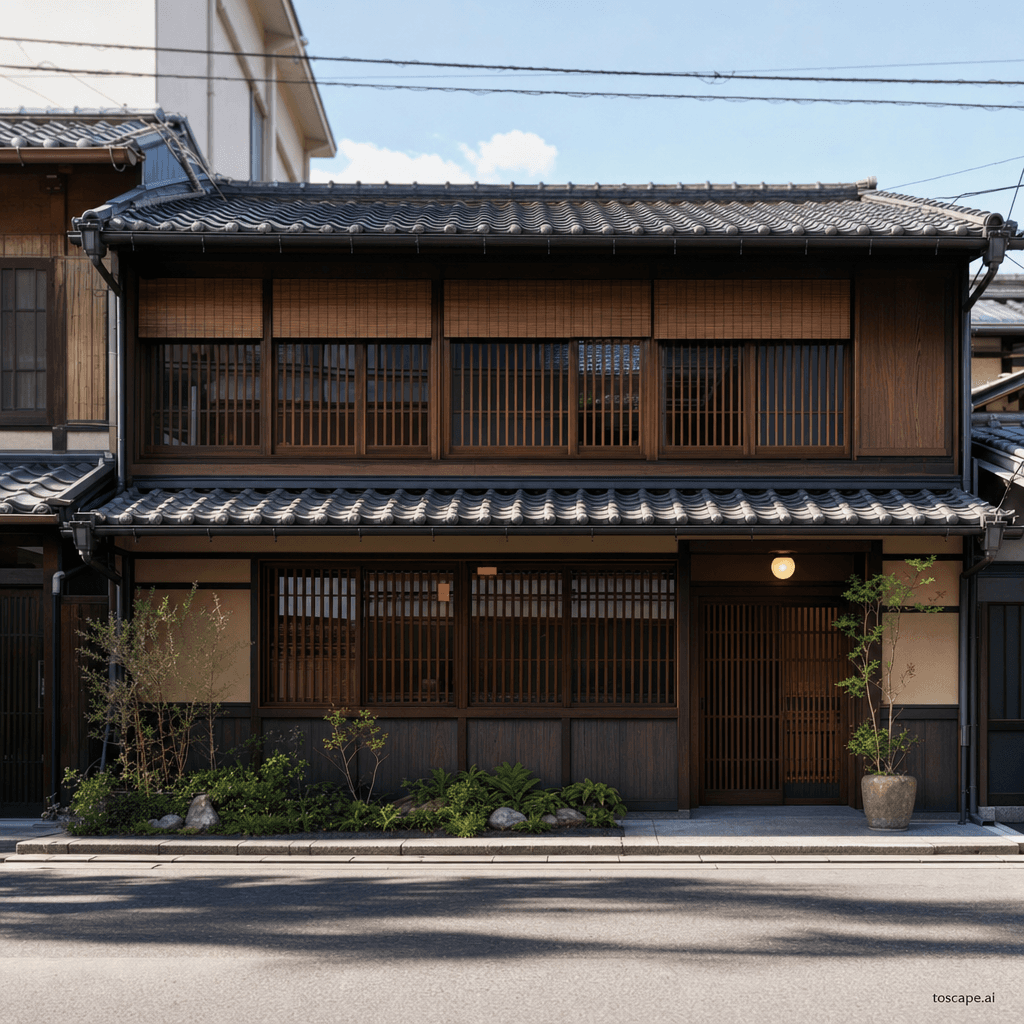
Kyoto Machiya Townhouse
Japan · Kyoto machiya
Narrow street frontage (3–5.5 m, reflecting Edo-period frontage taxation — "narrow front, deep body") — extremely deep plan (15–30 m, extending from street to rear lane) — the "unagi no nedoko" (eel's bed) spatial organization — tsuboniwa (small internal court...
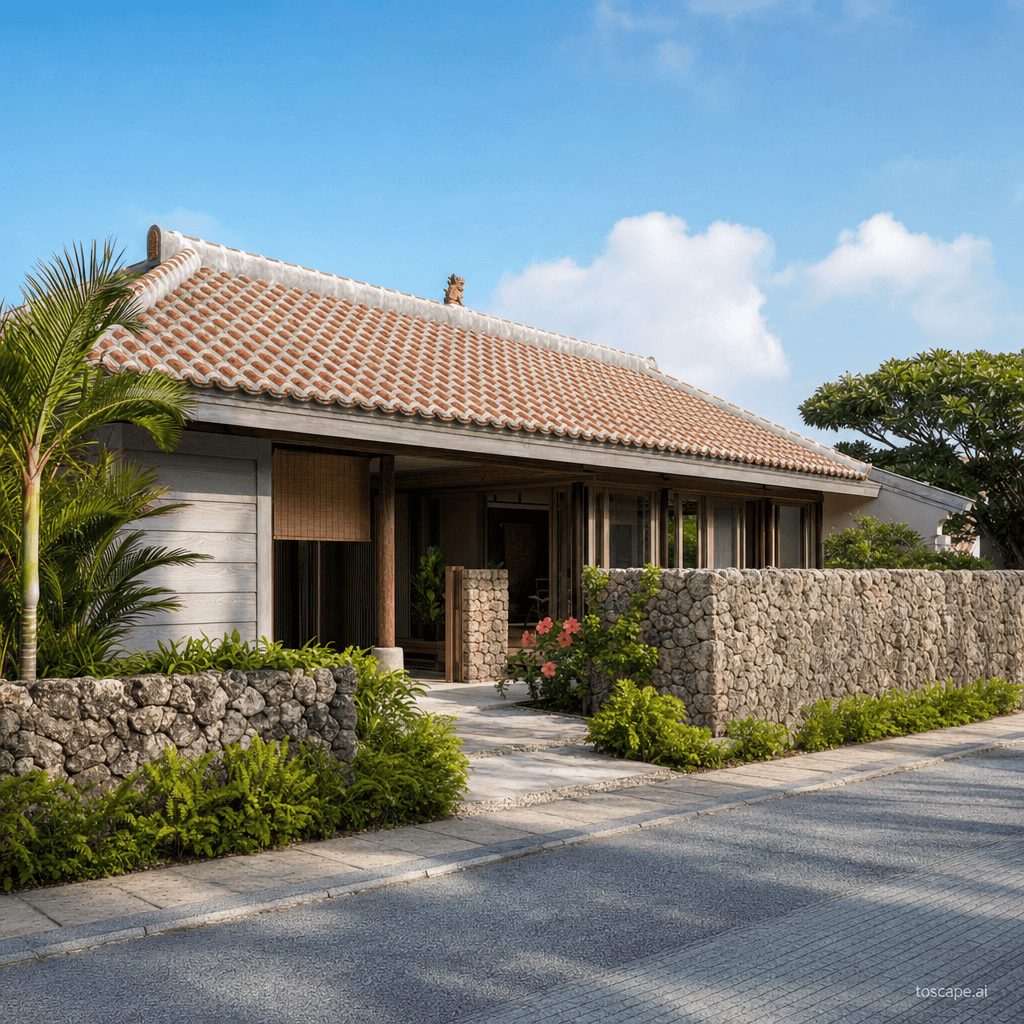
Okinawa Ryukyu
Japan · domestic architecture of Okinawa (Ryukyu Islands)
Red-orange unglazed ceramic roof tiles (akagawara) — the defining Okinawan roof, entirely different from mainland Japanese grey-black kawara — shisa (lion-dog) ceramic guardians on roof ridges — low, single-storey, ground-hugging massing for typhoon resistance...
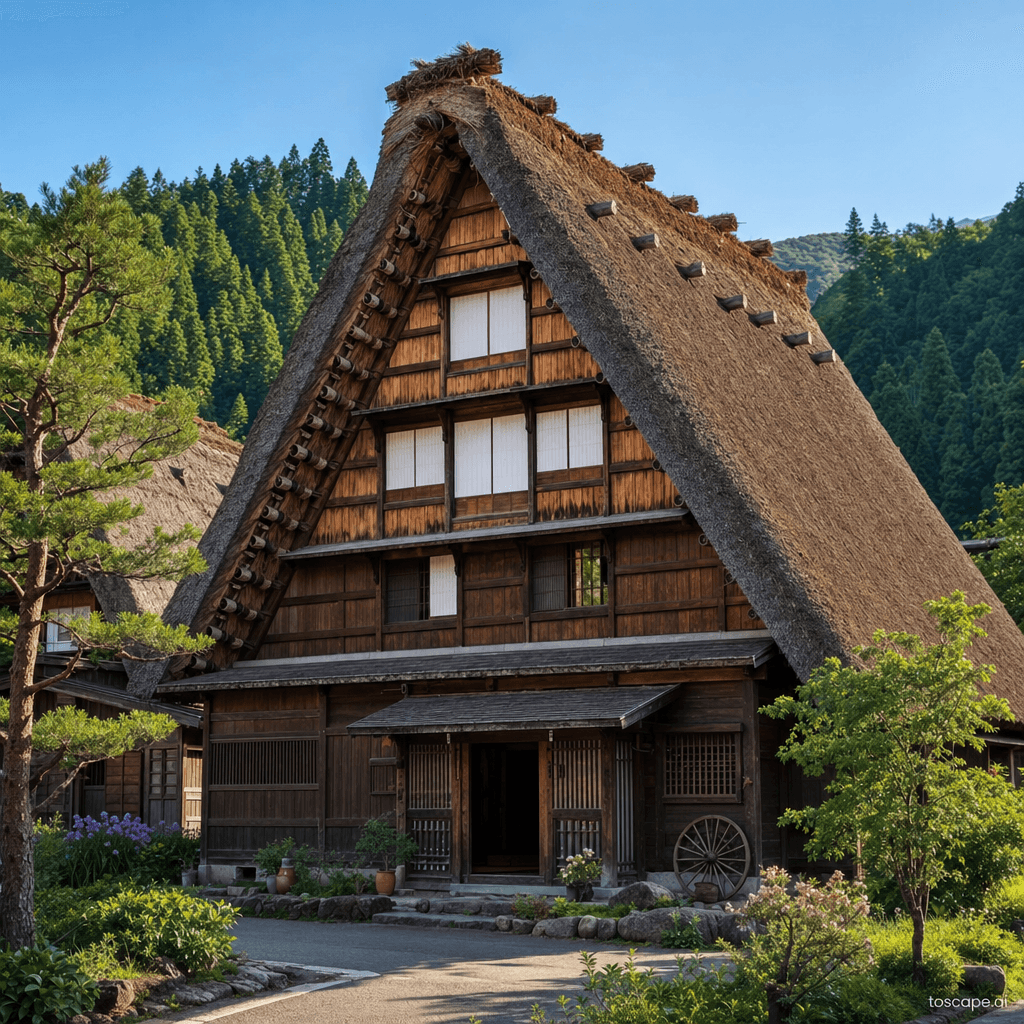
Shirakawa-Go Gasshō-Zukuri Farmhouse
Japan · gasshō-zukuri (praying-hands construction) farmhouses of Shirakawa-go and Gokaya...
Monumental steep-pitched thatched roof (45–60°) — the gasshō ("praying hands") profile — one of the steepest domestic roofs in world architecture — kaya (miscanthus grass) thatch — immense roof volume creating a 3–4 storey attic space within the roof — the att...
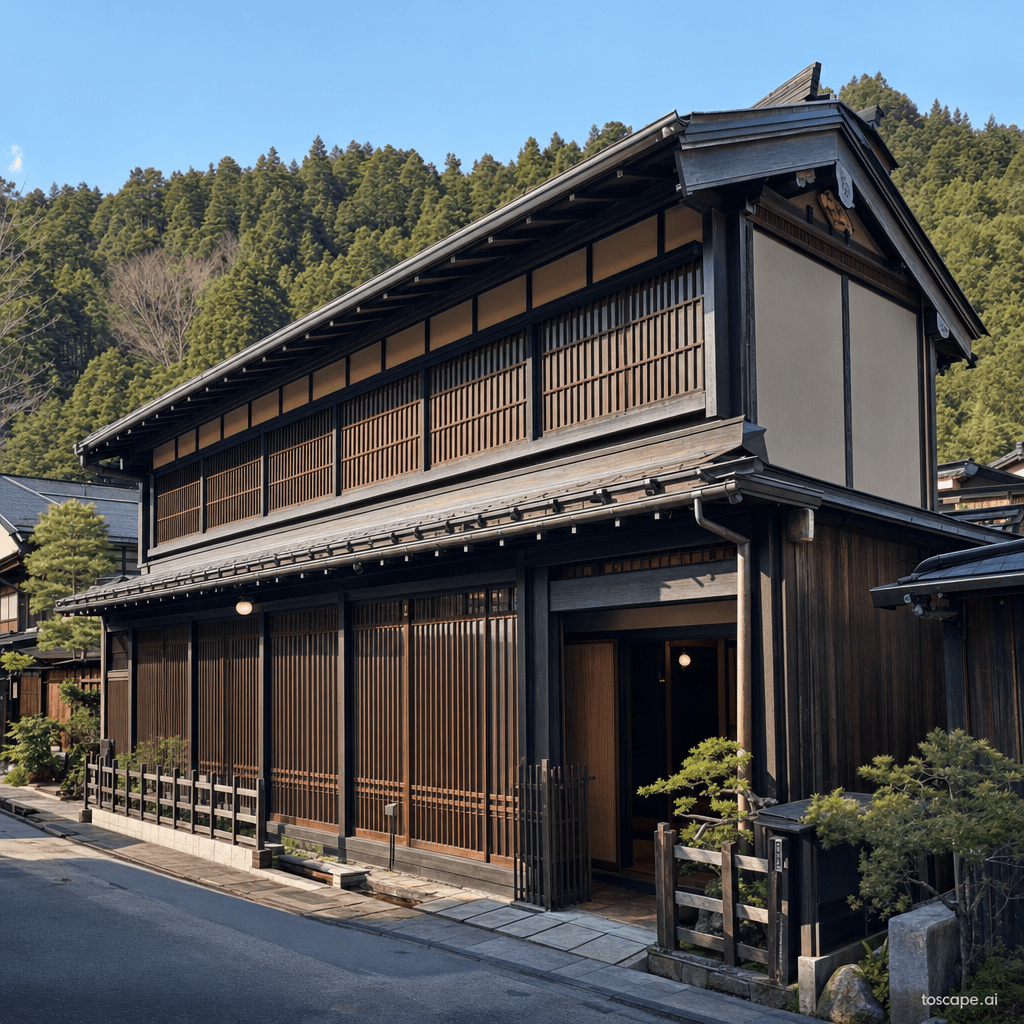
Takayama Hida Mountain Town
Japan · town architecture of Takayama (Hida-Takayama), Gifu Prefecture
Deep, heavy snow-country roofs with pronounced eaves — dark-stained timber (sumi-blackened) for snow-country durability — the "degōshi" projecting lattice bay window on the street frontage — hida-sashimono (Hida joinery) — the town's celebrated timber carpentr...
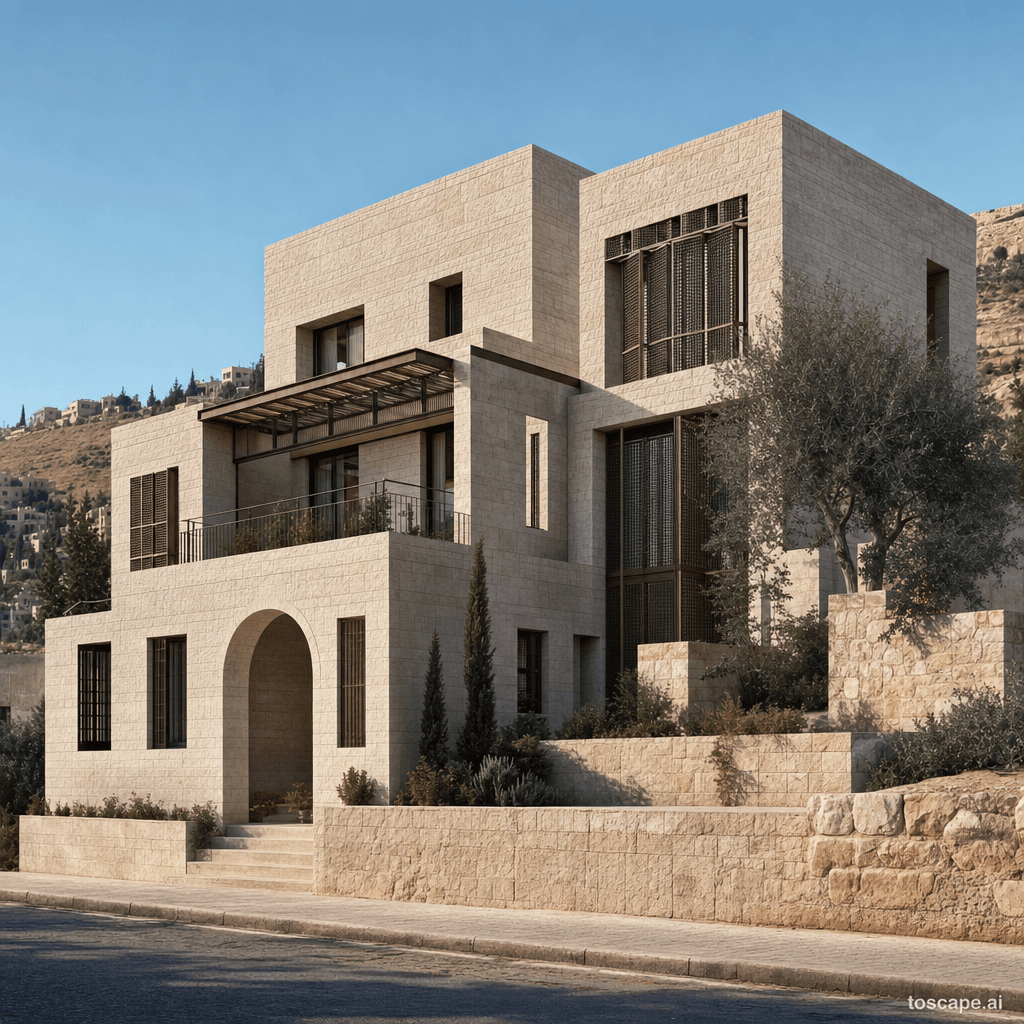
Amman Highlands
Jordan · domestic and urban architecture of Amman and the central Jordanian highlands (Ba...
The Ammani limestone house — cut local limestone (malaki and hayyan stone) in warm cream and honey tones — two-to-three storey hill-hugging volumes with flat roofs and cross-vaulted ceilings — central courtyard (hosh) with shade trees (fig, olive, lemon) — the...
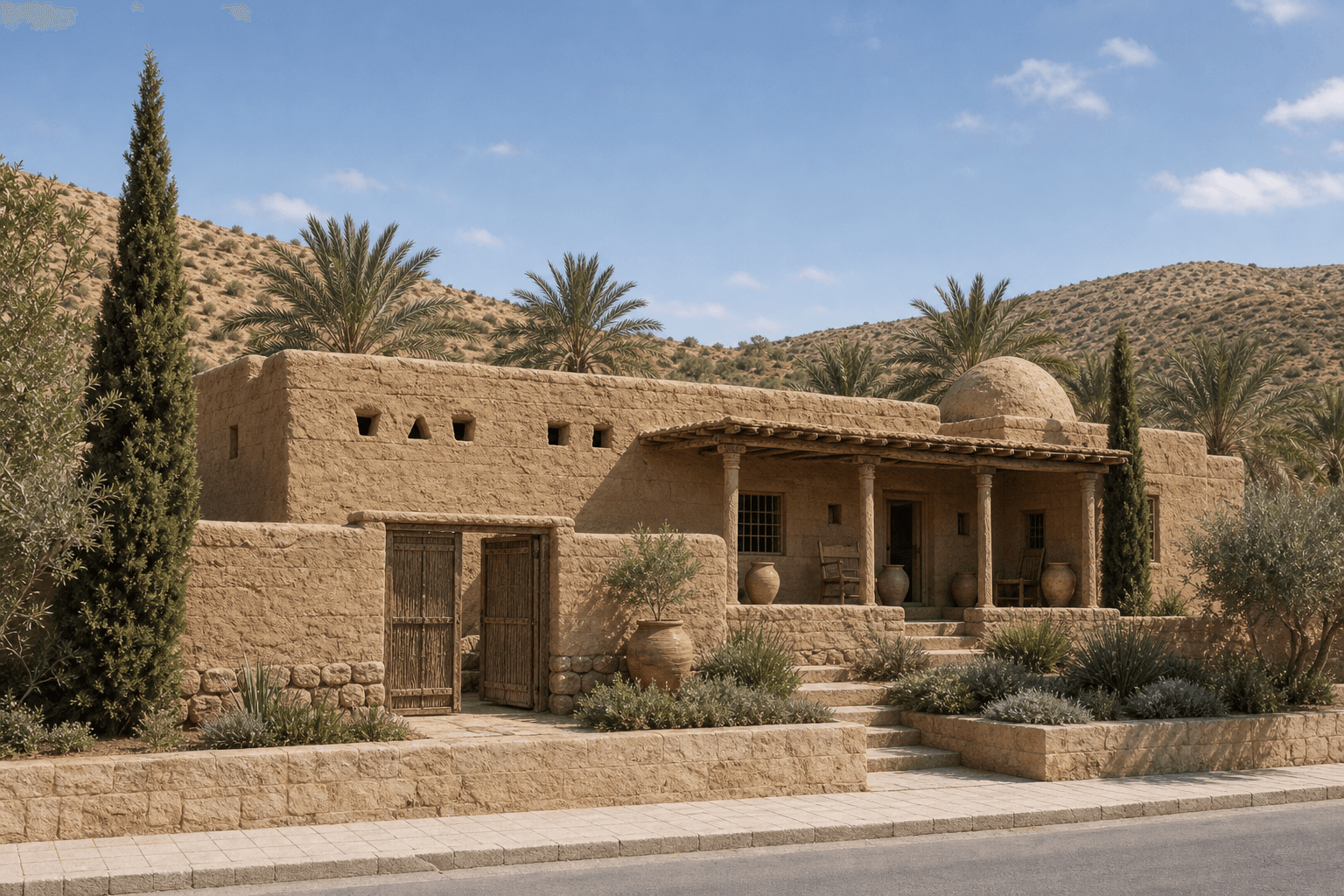
Jordan Valley
Jordan · vernacular architecture of the Jordan Valley (Al-Ghor)
The Ghor farm compound (mazra'a) — a walled enclosure containing the family dwelling, animal shelters, and agricultural processing spaces — mud-brick (libn) walls on stone foundations — flat roofs of palm trunk (jarid) beams with reed matting and compacted ear...
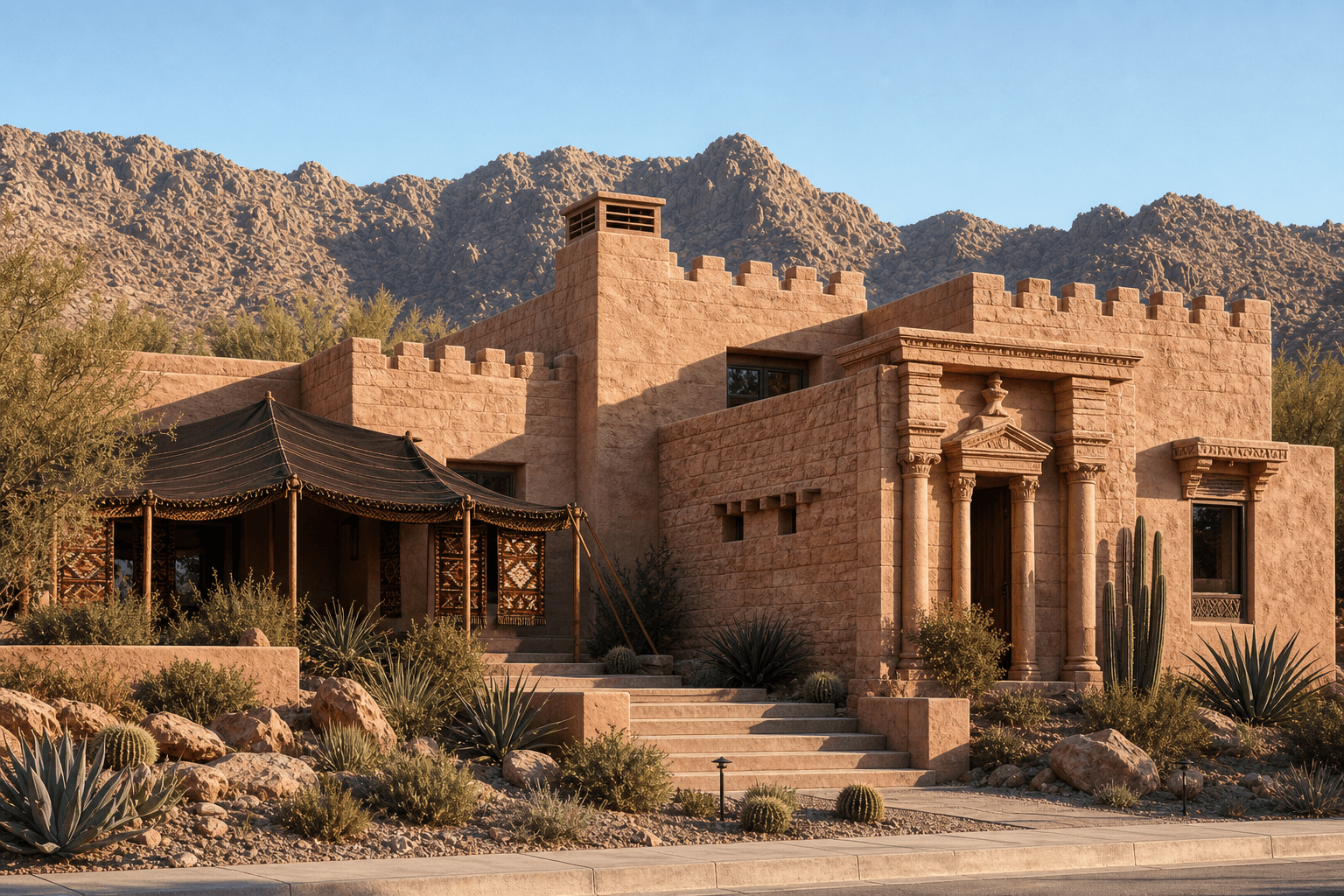
Southern Desert
Jordan · dual architectural traditions of southern Jordan's desert zone (Ma'an and Aqaba...
The Bedouin tent — bayt al-sha'r (house of hair) — a long rectangular tensile structure of woven black goat-hair cloth supported on timber poles, divided by a central curtain (qata') into men's (shigg / rab'a) and women's (mahram / makhzan) sections — the tent...
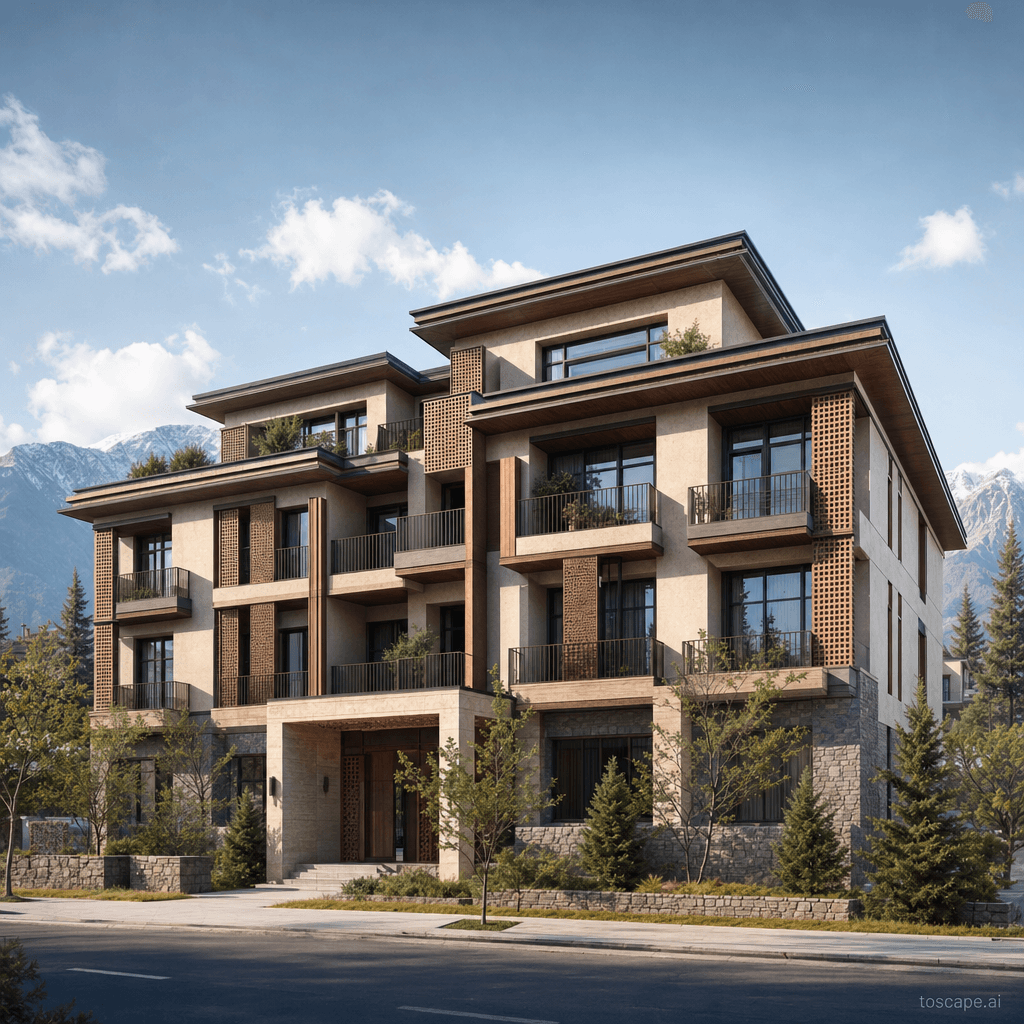
Almaty Mountain-Steppe City
Kazakhstan · architectural identity of Almaty (Alma-Ata during the Soviet period, renamed 199...
The layers of Almaty — (1) Tsarist Verny: one- to two-story timber houses with ornate carved window surrounds (nalichniki) and fretwork eaves, painted in blue, green, or ochre against white — the Russian "wooden lace" tradition transposed to Central Asia, shad...
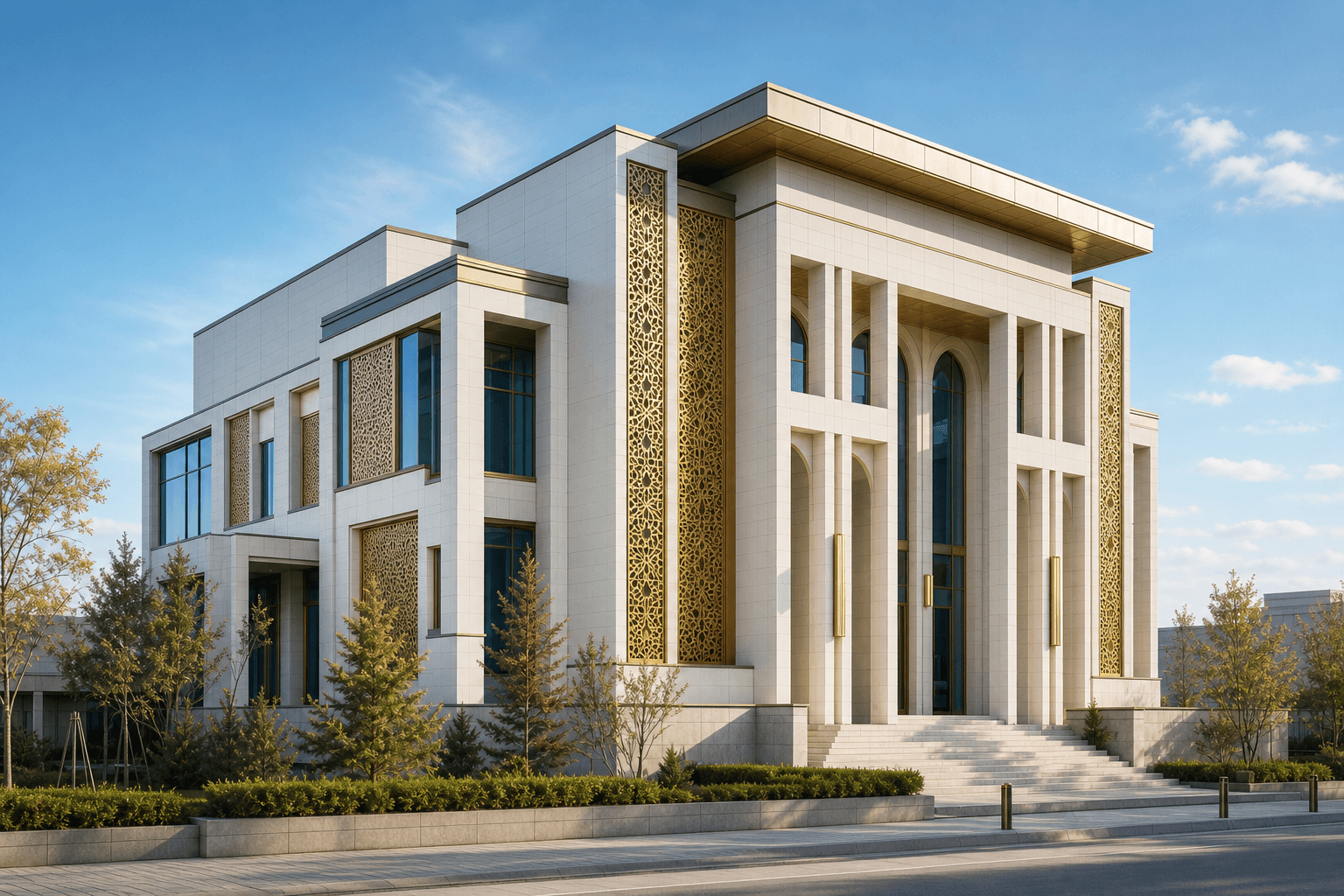
Nur-Sultan Modern Capital
Kazakhstan · architectural identity of Nur-Sultan (Astana until 2019, now returned to origina...
The Nur-Sultan skyline — a collection of singular iconic objects on the flat Ishim River steppe, each building a self-contained architectural statement — the Bayterek Monument (2002, by Akmurza Rustembekov) — a 97 m tower with a golden sphere (diameter 22 m) c...
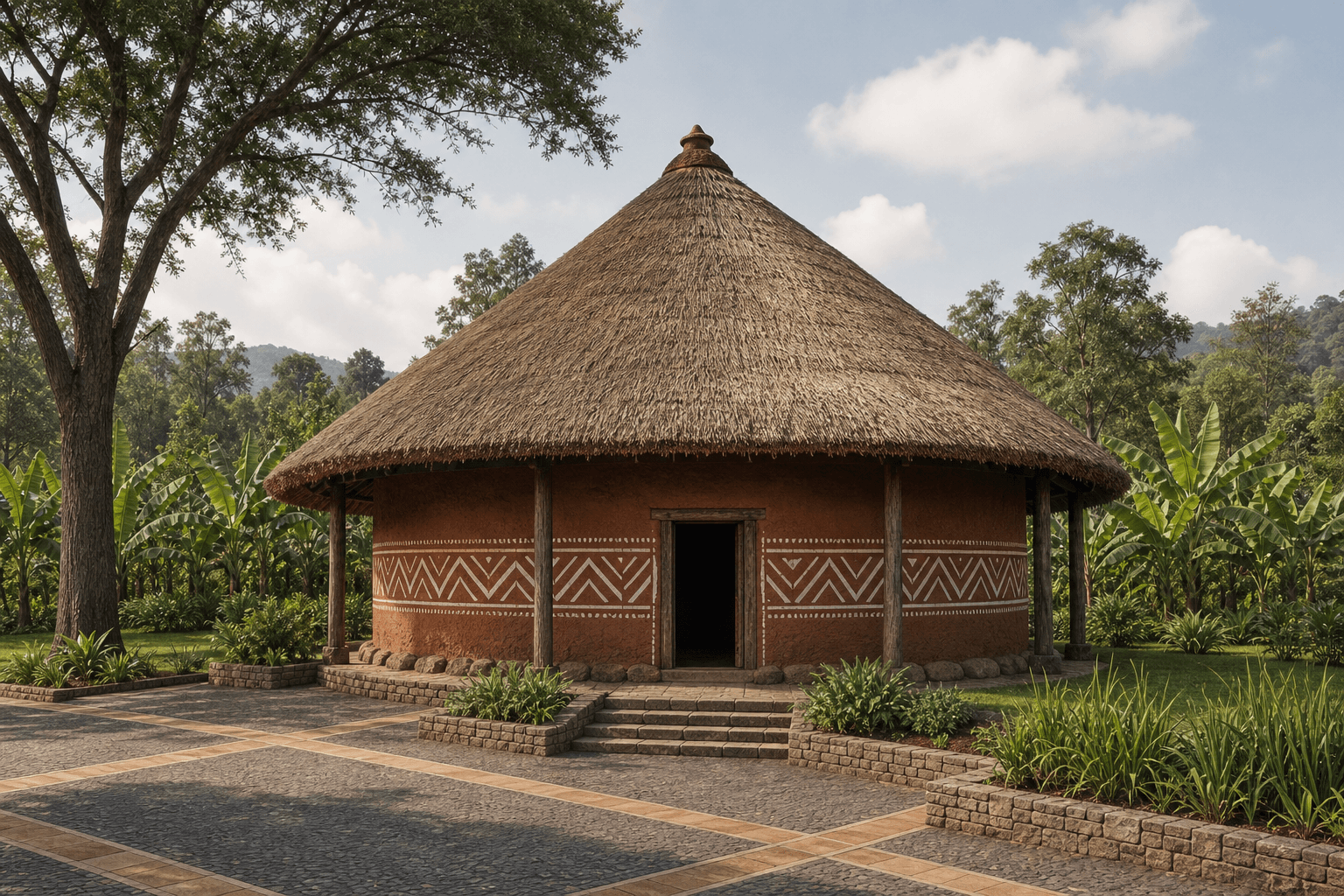
Kikuyu Central Highlands
Kenya · architectural identity of the Kikuyu (Gikuyu) of Kenya's Central Highlands
The Kikuyu nyumba — a circular wattle-and-daub house with a steep conical grass-thatch roof (pitch 45–55°) that extends to within 1–1.5 m of the ground, creating a deep overhang that shades the walls and creates a covered veranda space around the perimeter — t...
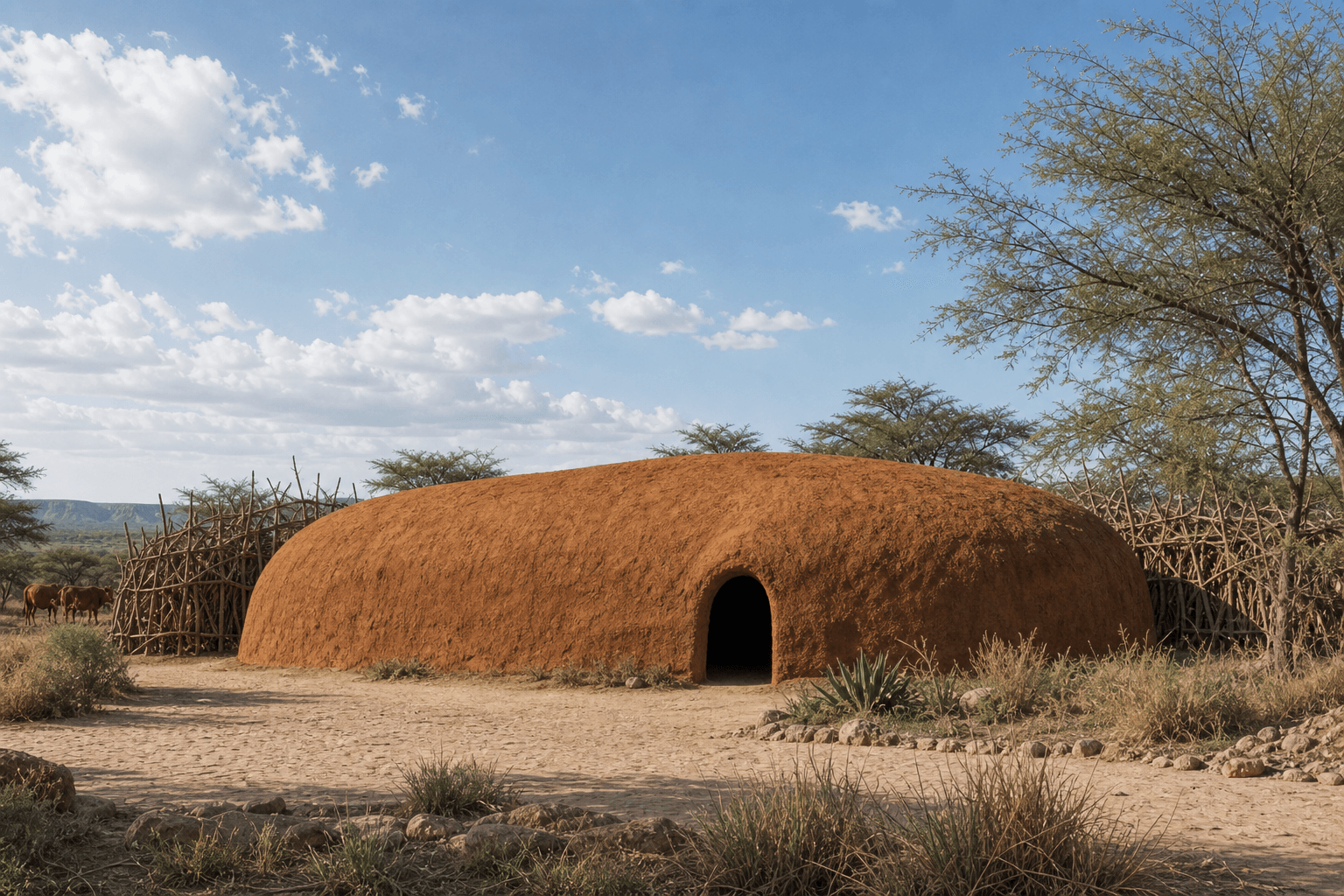
Maasai Rift Valley
Kenya · architectural identity of the Maasai (Maa-speaking pastoralists) of the Kenya Ri...
The Maasai enkaji — a low elongated dome or loaf-shaped structure, its frame of flexible saplings (oloirien, wild olive, or oltarakwai, a shrub) bent into a series of arched ribs, interlaced with horizontal withies to form a continuous vaulted cage — this fram...
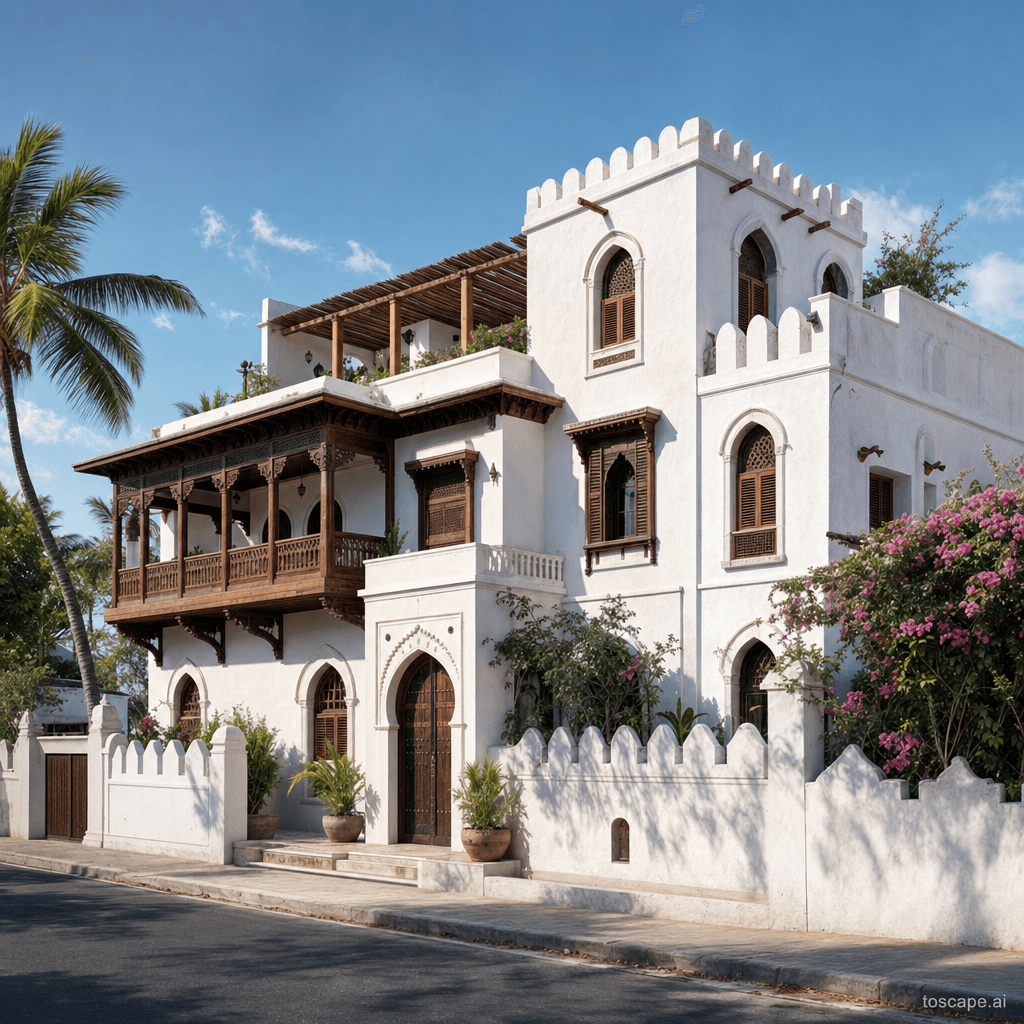
Swahili Coast
Kenya · architectural identity of the Swahili coast as expressed in Lamu Old Town (Kenya...
The Lamu Swahili townhouse — constructed of coral rag stone (porites coral quarried from the reef) set in lime mortar and rendered with lime plaster, whitewashed inside and out — the plan is a deep narrow rectangle (4–6 m wide × 12–20 m deep) on a plot accesse...
Kuwait City
Kuwait · Kuwait City's pre-oil urban core
Courtyard house (al-hosh) — introverted plan around central open court — projecting timber mashrabiya balconies for privacy, ventilation, and street-level visual interest — lime-rendered walls in white to cream tones — flat roofs with accessible terraces used...
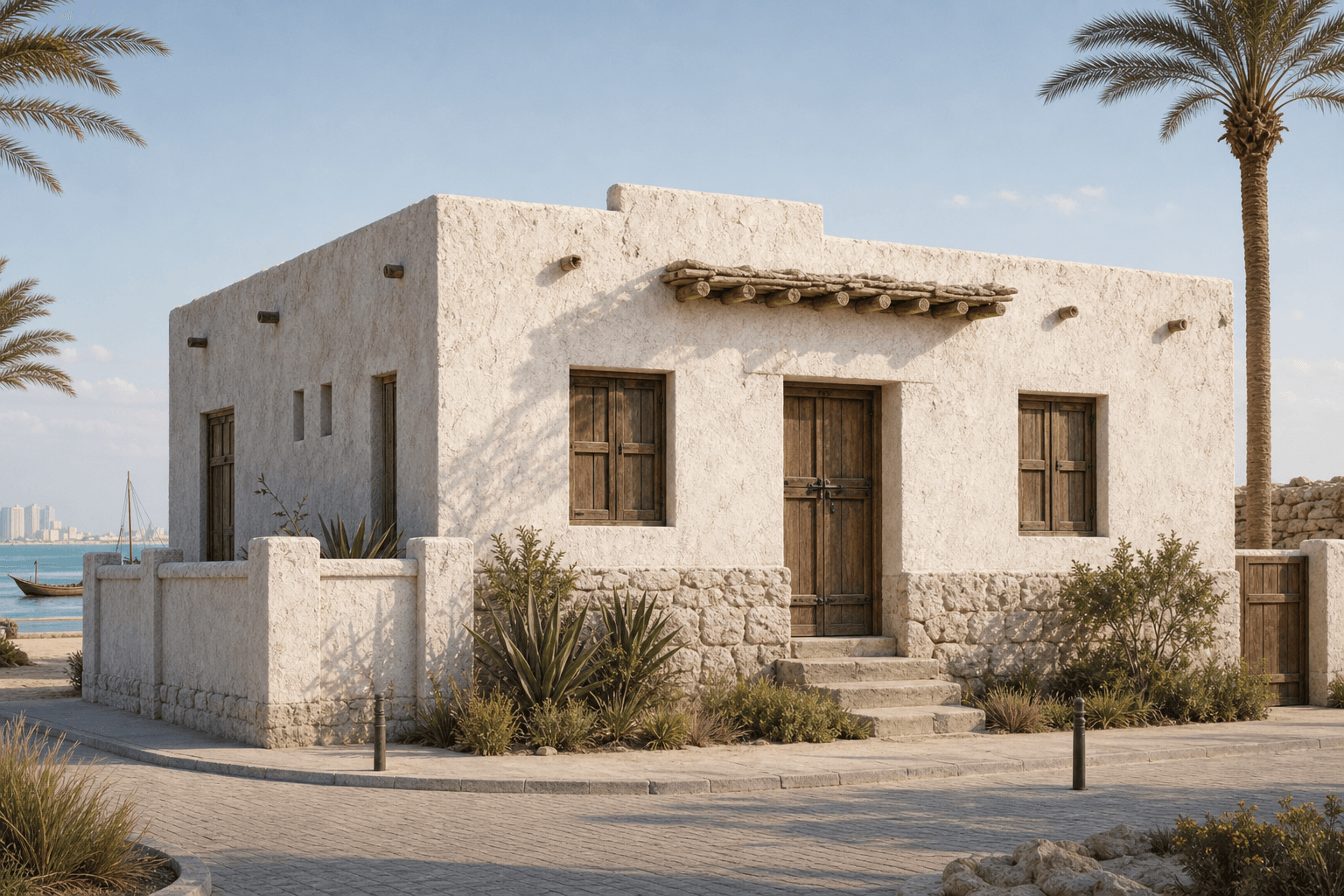
Kuwait Coastal Village
Kuwait · Kuwait's coastal villages and Failaka Island
Simplified courtyard houses — often single-storey — with coral stone and mud-brick walls — lime-rendered white finish — flat roofs with palm-trunk beams and barusti matting — the dhow-building yard (bannat al-safinat) as the central productive space — fish tra...
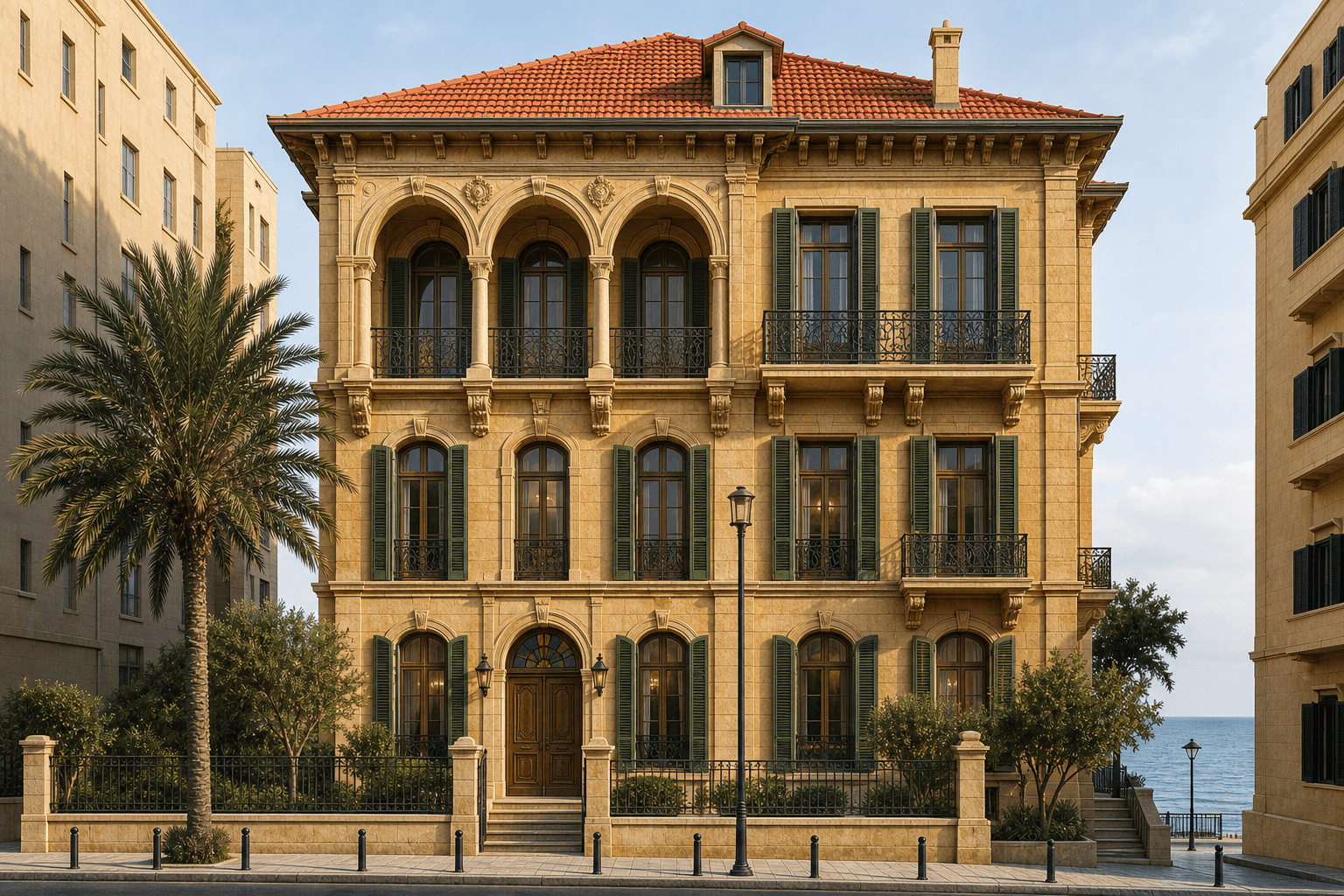
Beirut Coastal
Lebanon · and late-Ottoman domestic architecture of Beirut and the Lebanese coastal strip
The Beirut central-hall house — a rectangular two-to-three storey volume of yellow Ramla sandstone — the triple-arched arcade (liwān / mandalun) as the primary façade motif, with three pointed or round arches springing from slender engaged columns — red Marsei...
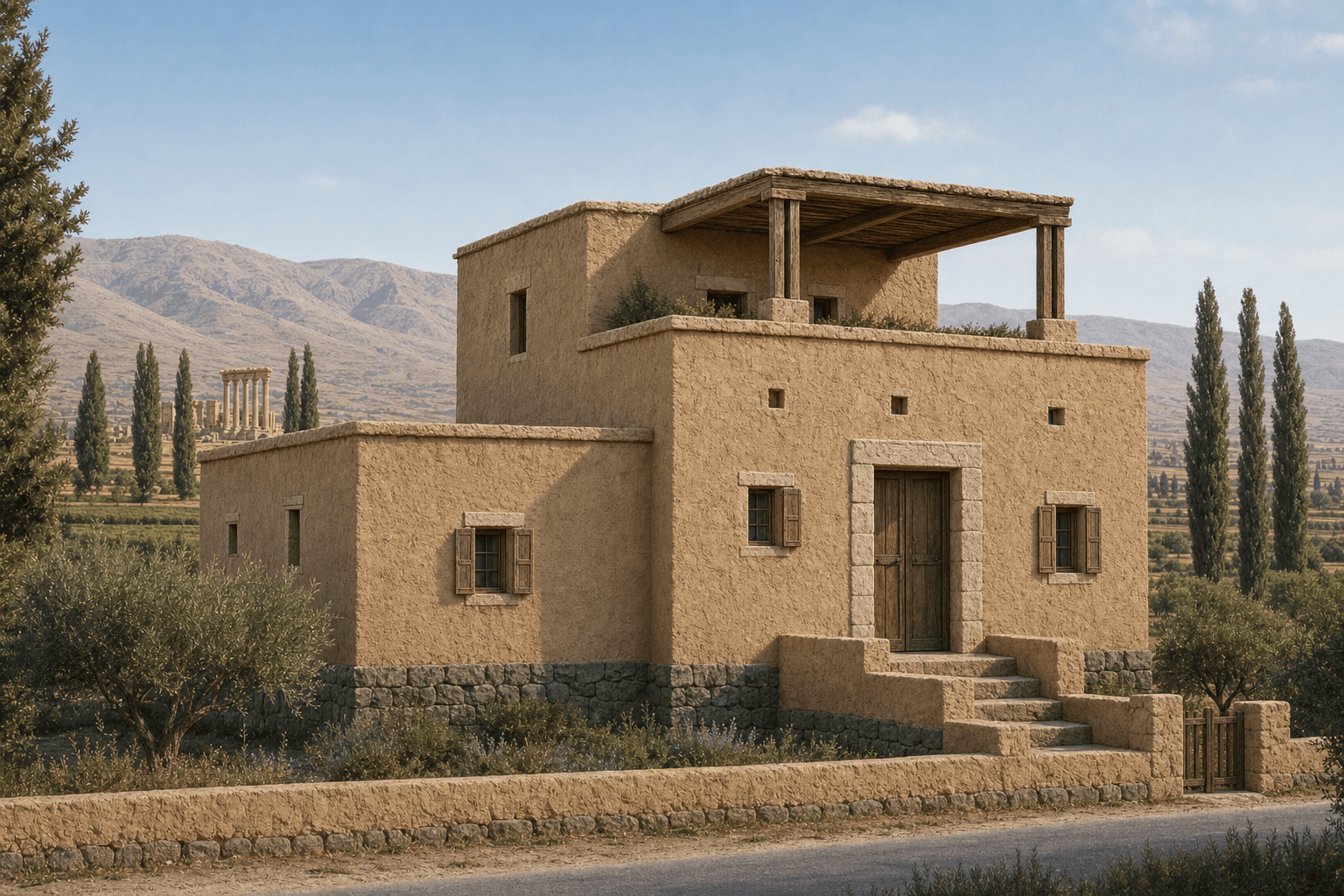
Bekaa Valley
Lebanon · domestic and agricultural architecture of the Bekaa Valley
The Bekaa courtyard farmhouse — mud-brick (libn) walls on basalt or limestone rubble foundations — flat earth-and-timber roofs — the walled agricultural compound (hosh) with separate dwelling, animal shelter, and grain storage volumes arranged around a central...
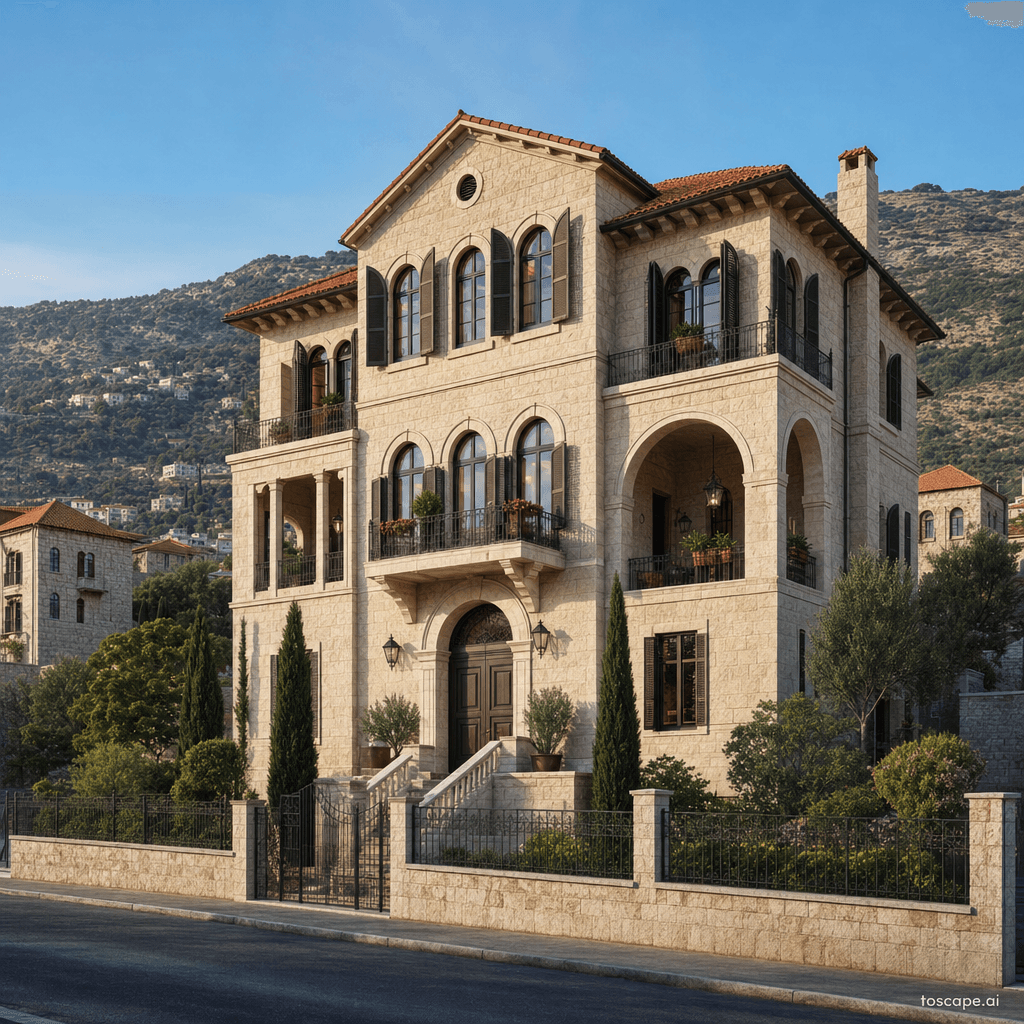
Mount Lebanon
Lebanon · vernacular and late-Ottoman domestic architecture of the Mount Lebanon highlands...
The Mount Lebanon stone house — coursed limestone masonry in warm gray-white to pale beige — two-to-three storeys stepping down the mountain terrace — red Marseille tile pitched roof, often hipped with central chimney — the liwān — a ground-floor arcaded loggi...
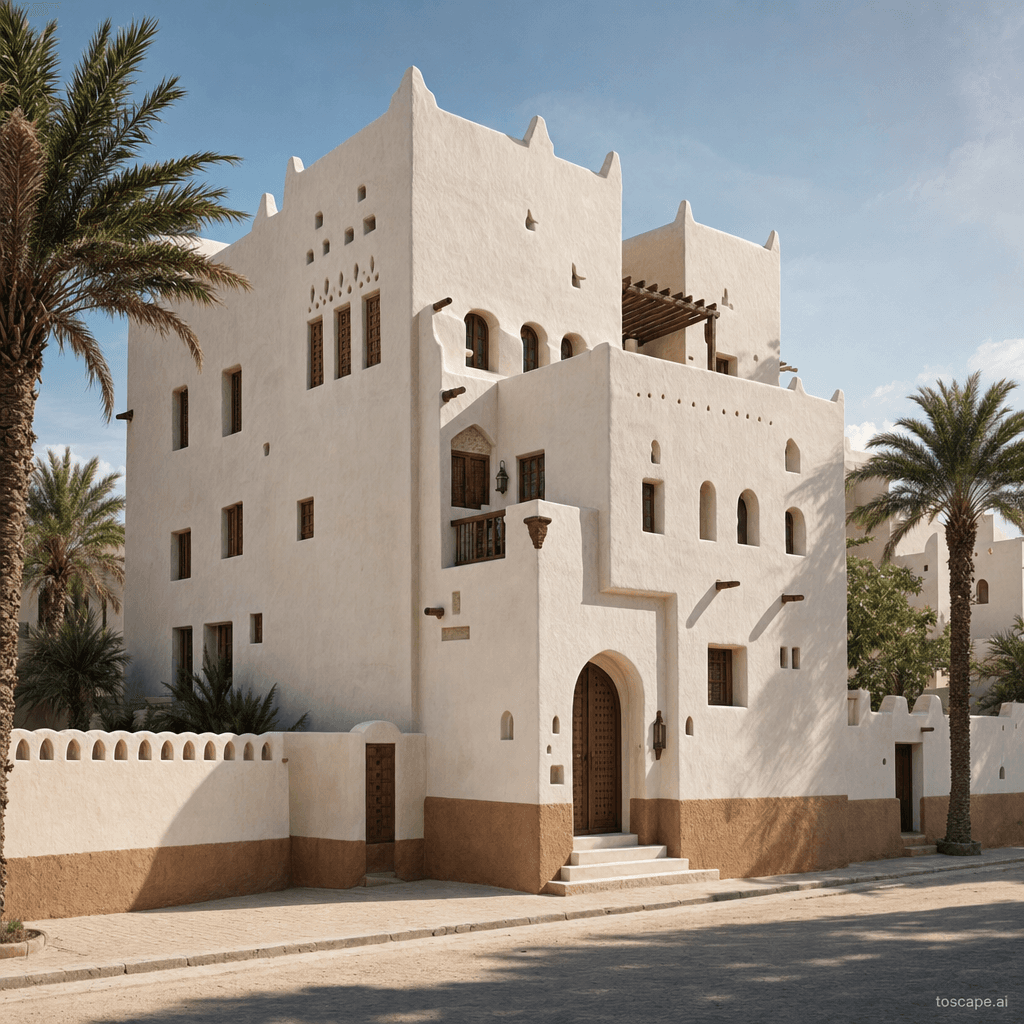
Ghadames Oasis Desert
Libya · traditional oasis architecture of Ghadames (Ghadāmis)
The Ghadames house — a two-story mud-brick dwelling with a subterranean ground floor and an upper level — the ground floor is semi-subterranean (dug into the earth), used for storage of dates, grains, and water in large clay jars (khābīya) — the upper level is...
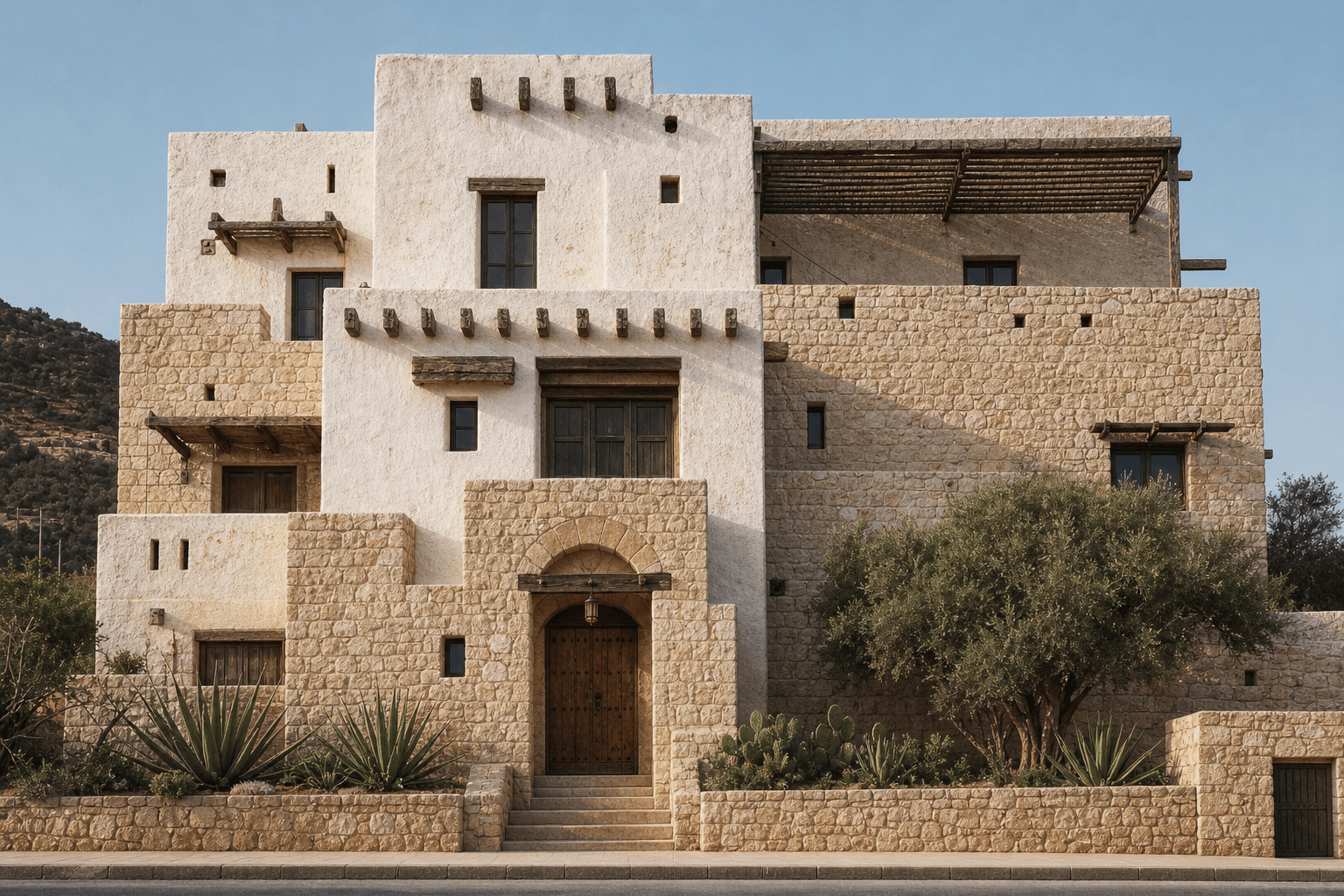
Nafusa Mountains Berber
Libya · vernacular architecture of the Nafusa Mountains (Jebel Nafusa), a limestone esca...
The Nafusa dāmūs — a semi-subterranean house excavated horizontally into the limestone bedrock — the house is organized around a rectangular courtyard (ḥawsh) cut into the hillside, open to the sky, with rooms carved or built into the courtyard's perimeter — t...
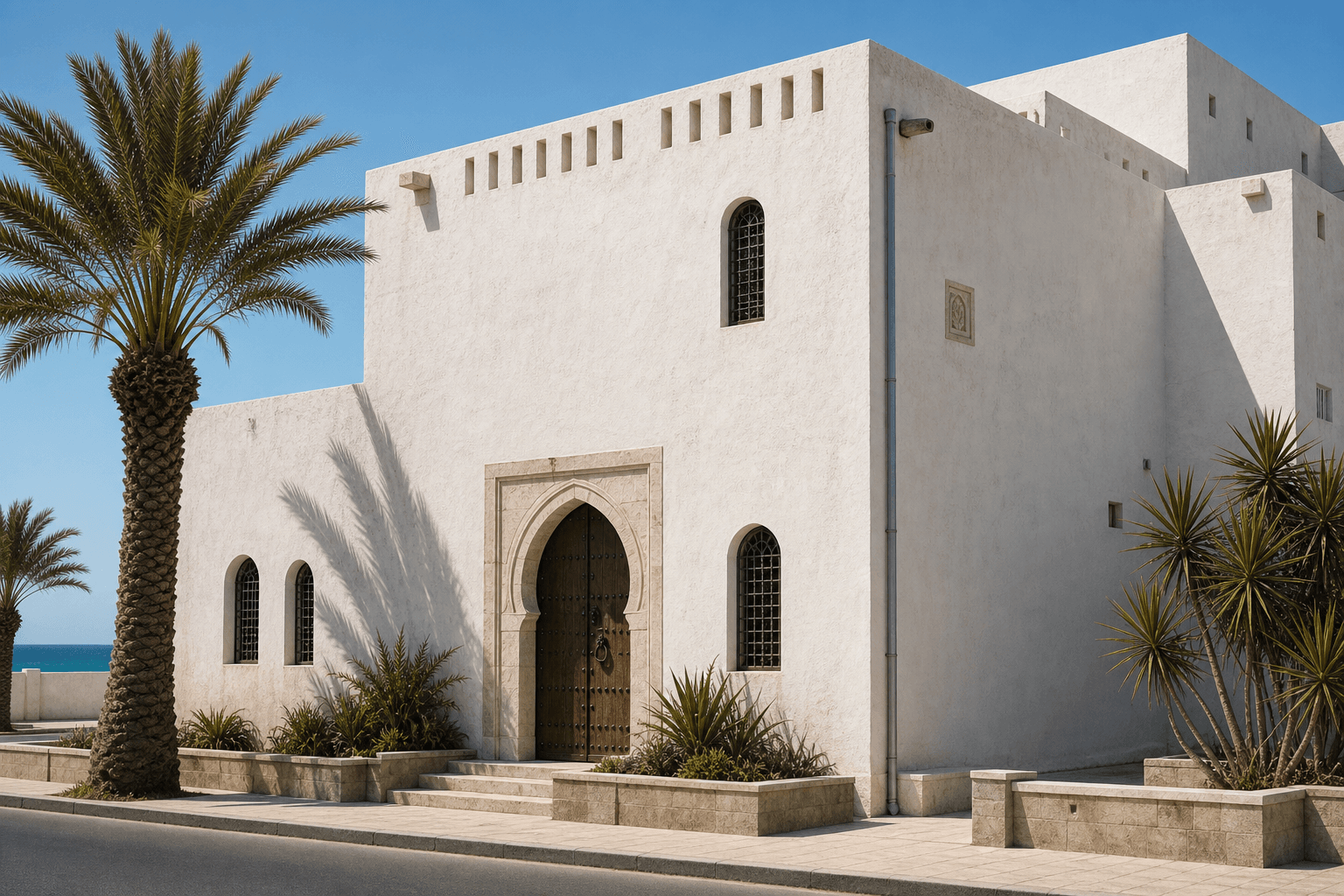
Tripoli Coastal Medina
Libya · coastal urban house of Tripoli (Ṭarābulus al-Gharb)
The Tripoli medina house — an inward-turning courtyard dwelling where all ornament is reserved for the interior — the exterior is a pure white cubic mass with minimal openings — the entrance is via a bent corridor (majāz or dahlīz) that prevents direct visual...
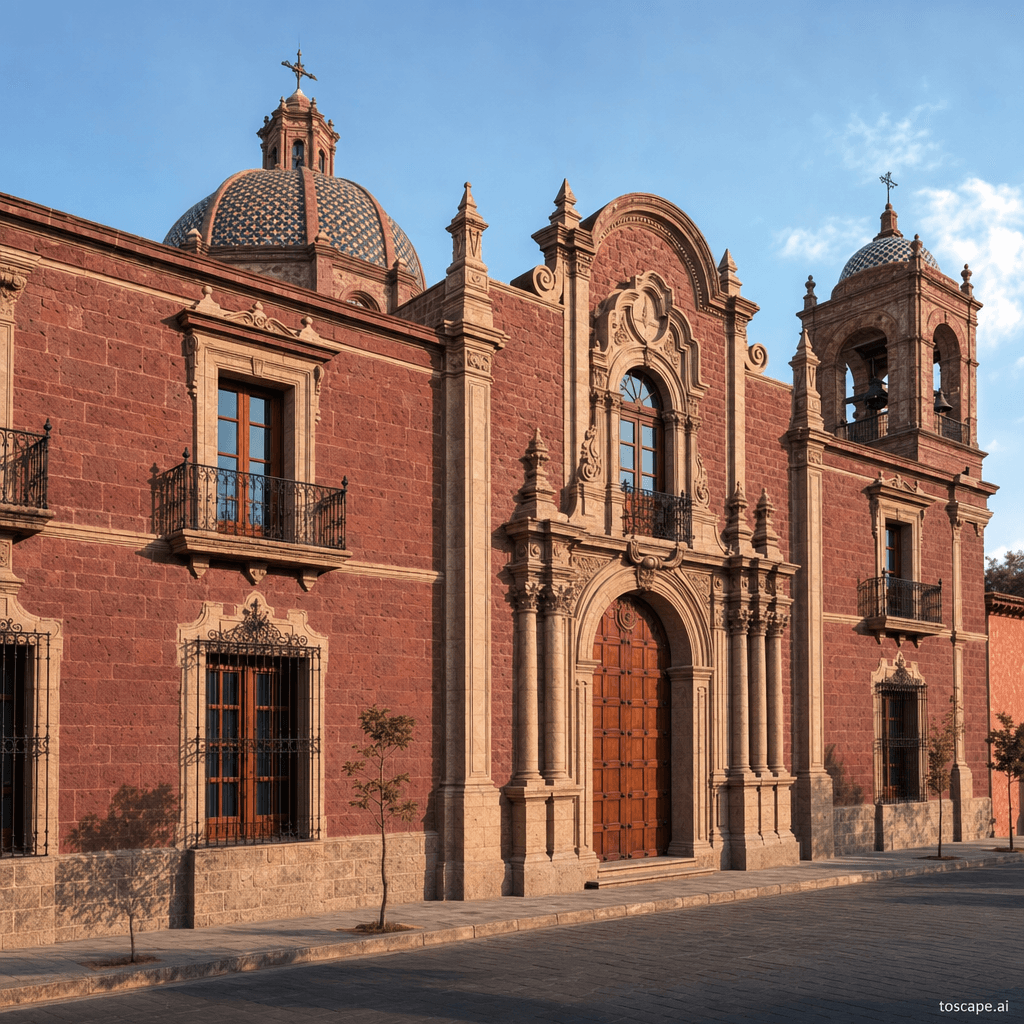
Central Highlands Colonial
Mexico · Mexican colonial architecture of the Bajío and Central Highlands
Red tezontle volcanic stone + carved cantera trim, domed baroque churches, hacienda complexes around courtyards, talavera tile accents
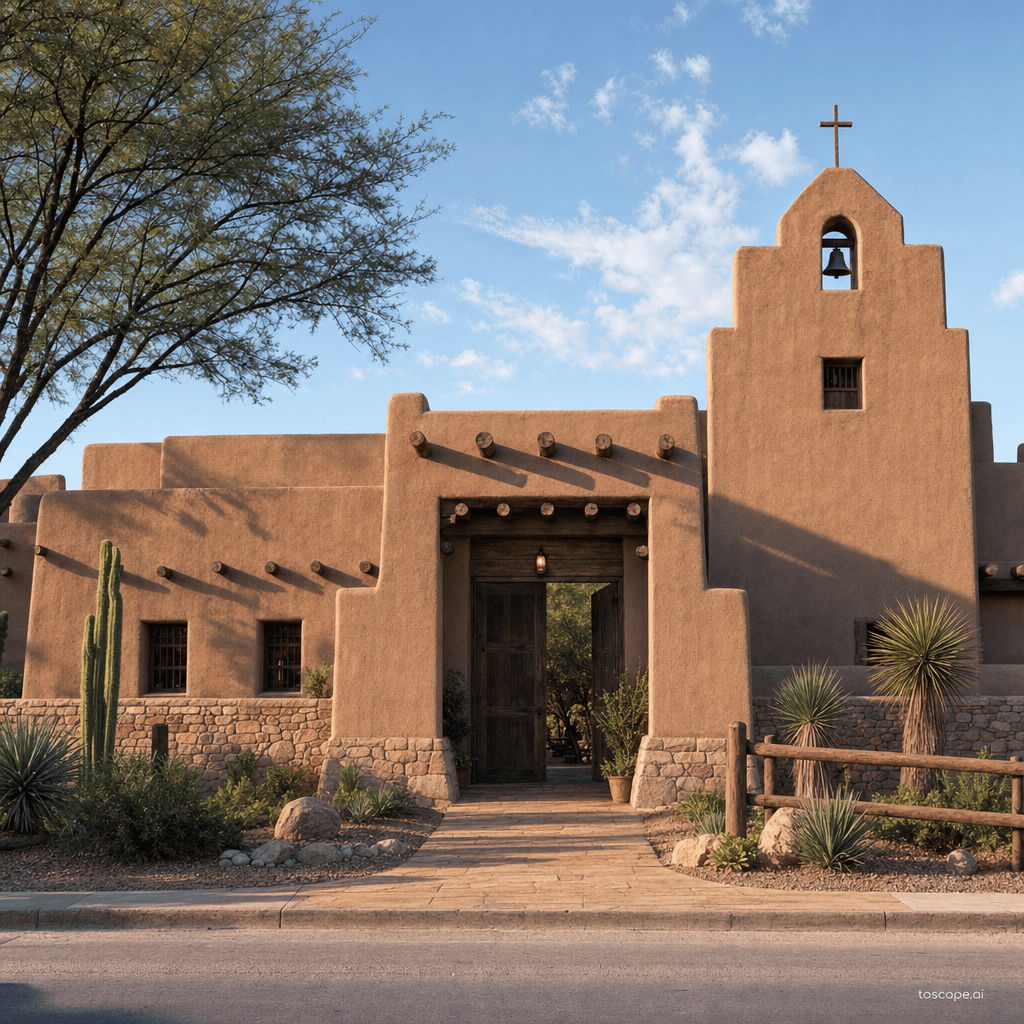
Northern Desert Adobe
Mexico · Northern Mexican desert belt (Chihuahua, Sonora, Coahuila)
Mud-brick adobe walls, projecting timber roof beams (vigas), flat earth roofs, defensive compound layouts, mission church typology of the Camino Real
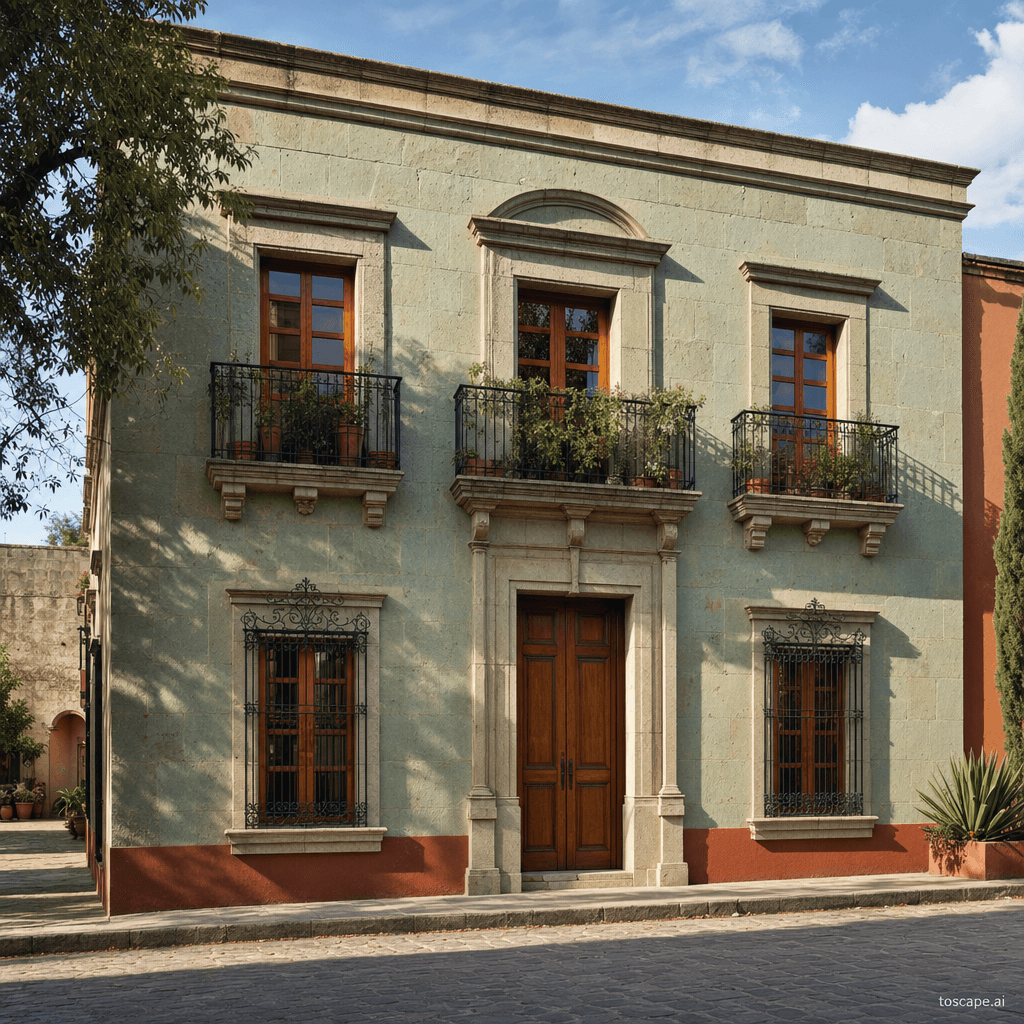
Oaxaca Zapotec Colonial
Mexico · Oaxaca Valley
Green cantera stone defining Oaxaca's chromatic identity, monumental convent complexes (ex-conventos), indigenous market (tianguis) architecture, courtyard-centered living
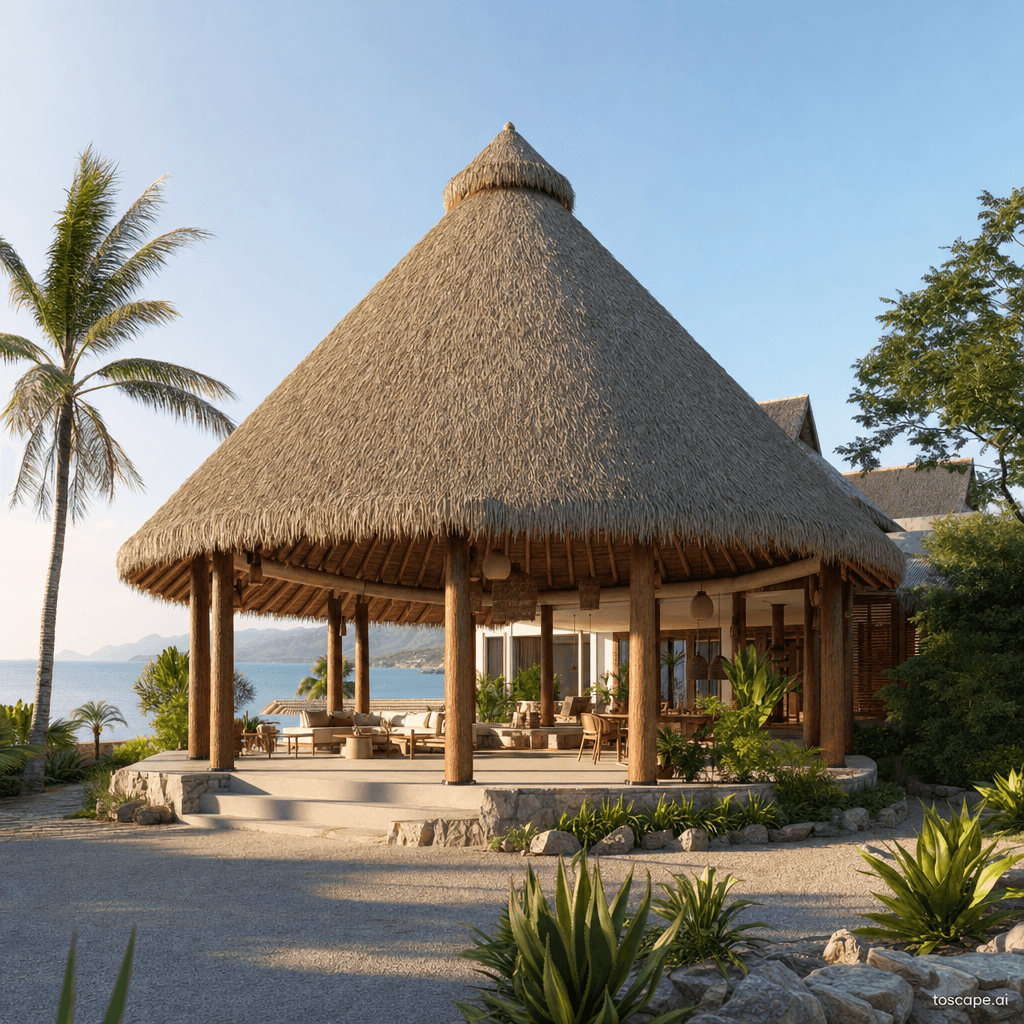
Pacific Coast Tropical
Mexico · Mexican Pacific coastal vernacular
High conical palm-thatch palapas, open-air plan with no solid walls on sea-facing side, tropical hardwood posts, raised platform living, seamless indoor-outdoor transition
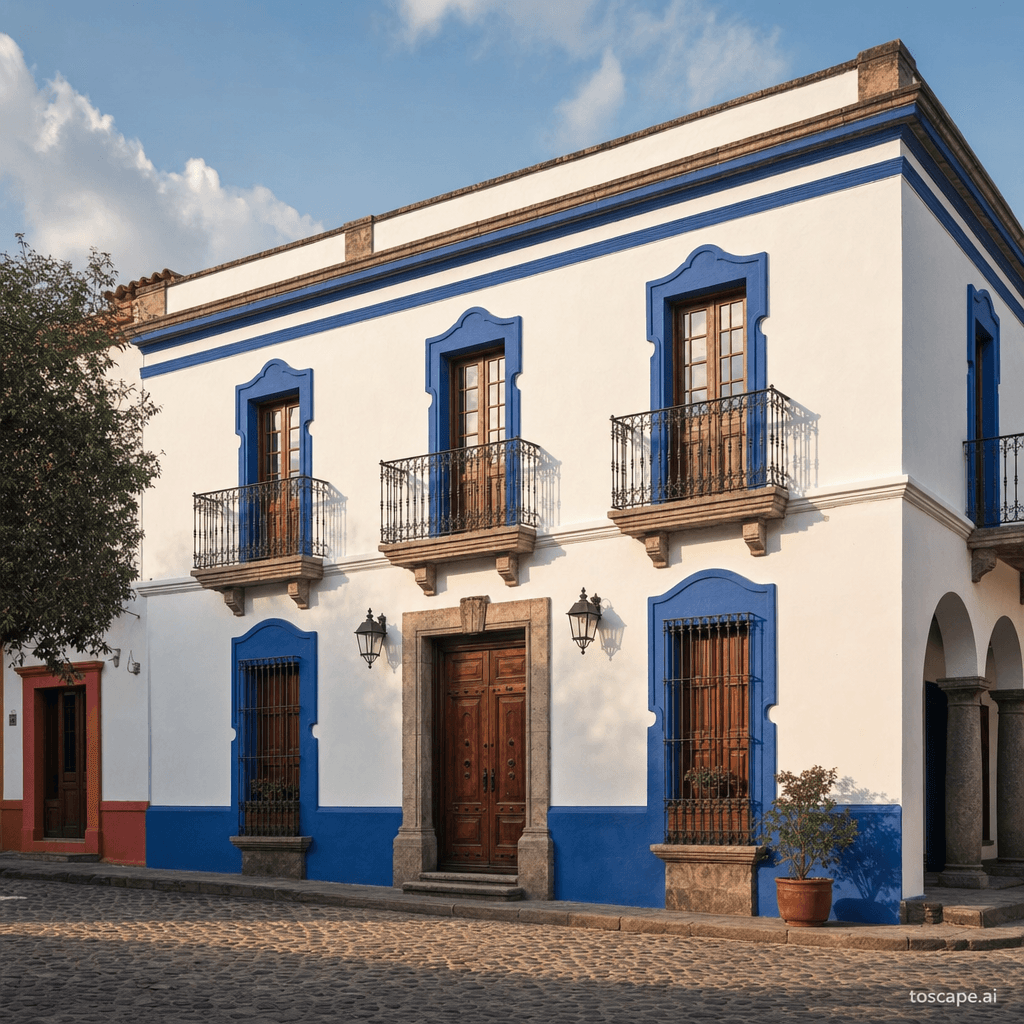
Pueblos Mágicos Identity
Mexico · Pueblos Mágicos program's architectural identity framework
SECTUR-mandated imagen urbana (urban image) regulations, whitewashed + accent-color facades, cobblestone street preservation, plaza-centered town plans, regional craft-as-architecture integration
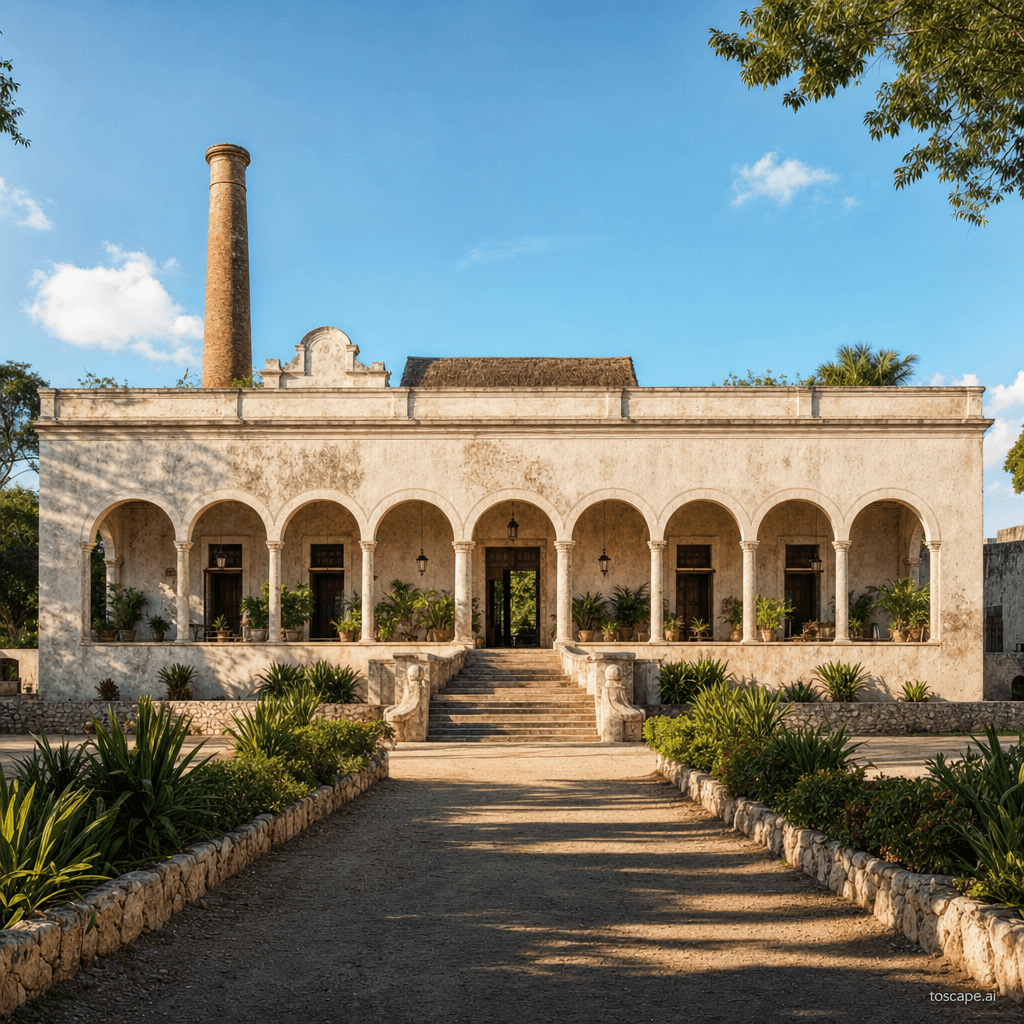
Yucatán Mayan Hacienda
Mexico · Yucatán Peninsula hacienda
Monumental hacienda compounds with arched portales, Mayan thatched-roof palapas, white limestone (sascab) rendering, high-ceiling tropical adaptation
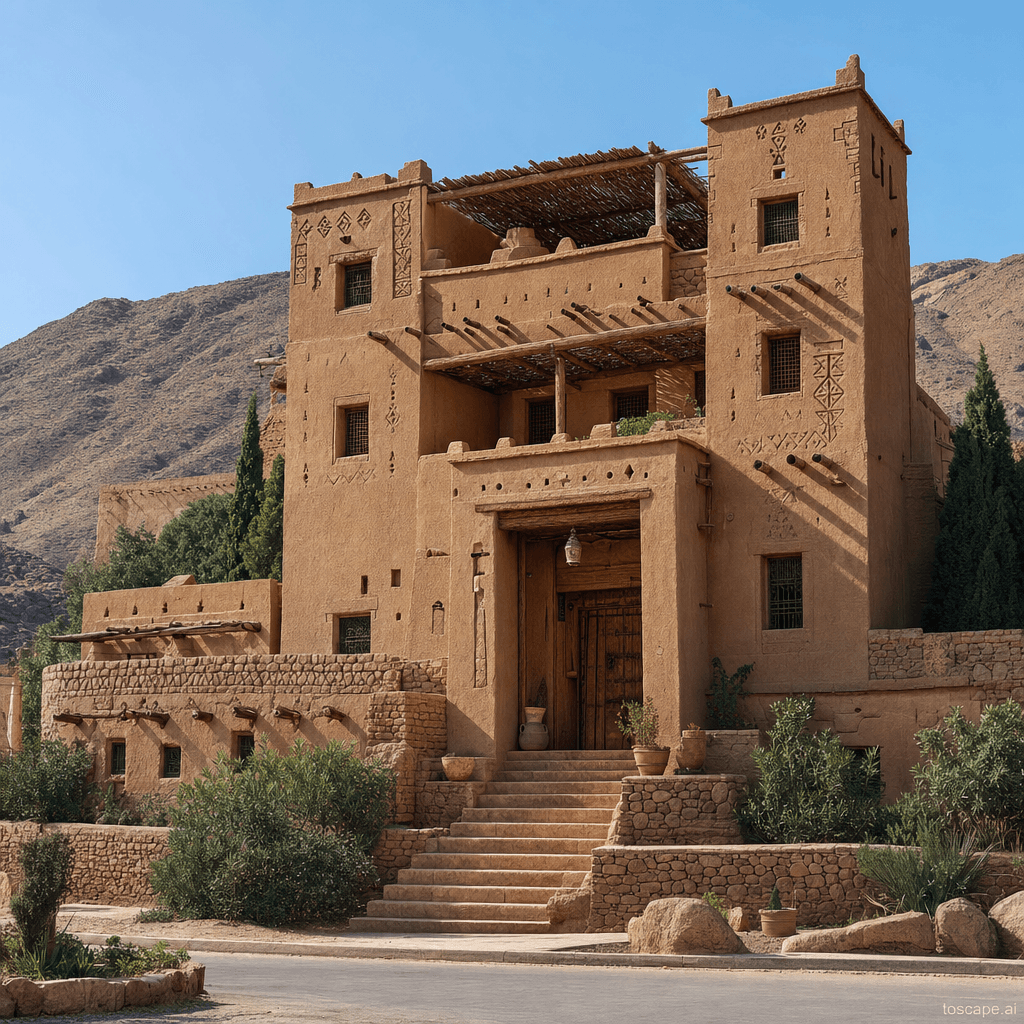
Atlas Mountain Berber Vernacular
Morocco · Berber (Amazigh) vernacular architecture of the High Atlas, Middle Atlas, and An...
Monumental rammed-earth (pisé) construction — thick earth walls (600–1000 mm), reddish-brown in color — multi-storey tower-houses (tighremt) rising 3–5 storeys — corner towers with decorative crenellations and geometric brick/stone inlay patterns — flat roofs...
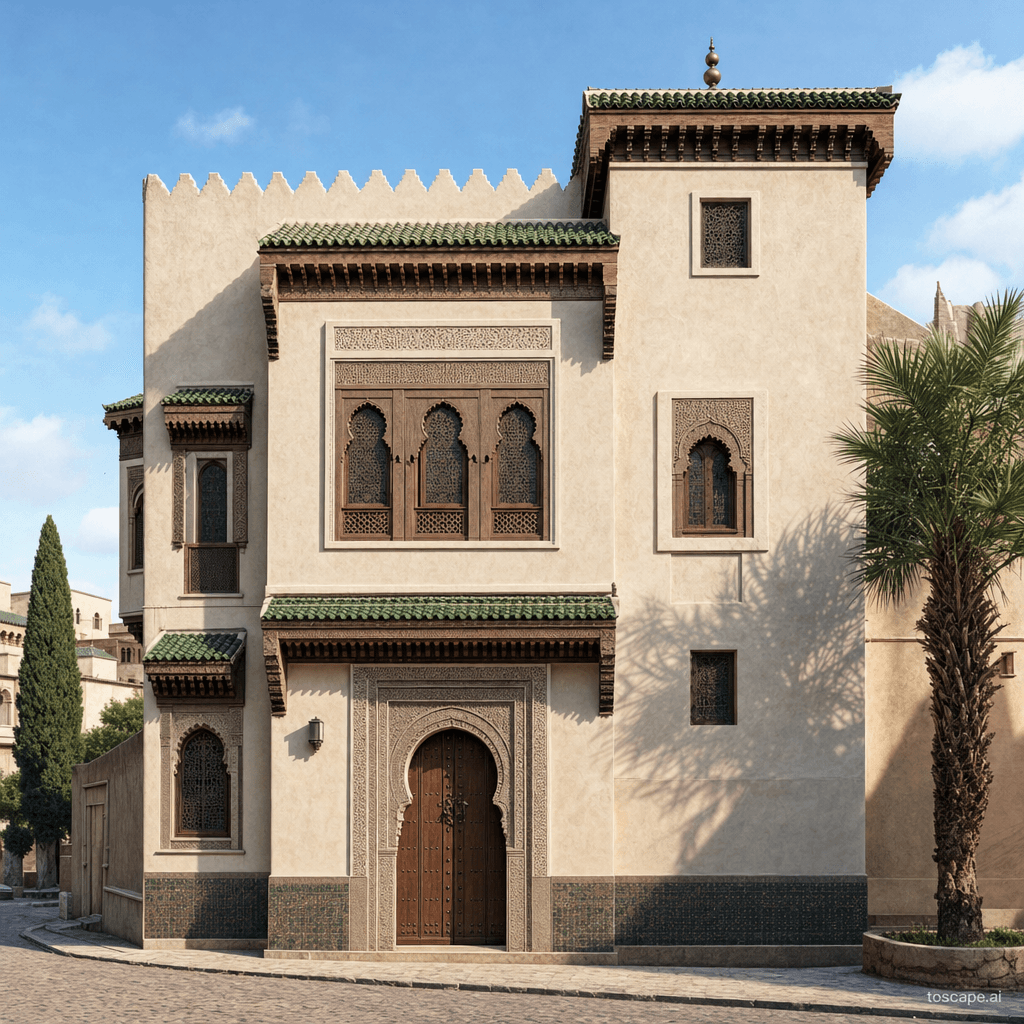
Fès-Meknès Imperial Medina
Morocco · traditional urban courtyard house (dar/riad) of Fès and Meknès medinas
Inward-facing courtyard house on a deep, narrow urban plot (typically 8–15 m wide × 20–40 m deep) — central open courtyard (wust ad-dar) with fountain, planted with citrus trees — elaborated zellij (geometric tile mosaic) on lower walls — carved stucco (gebs)...
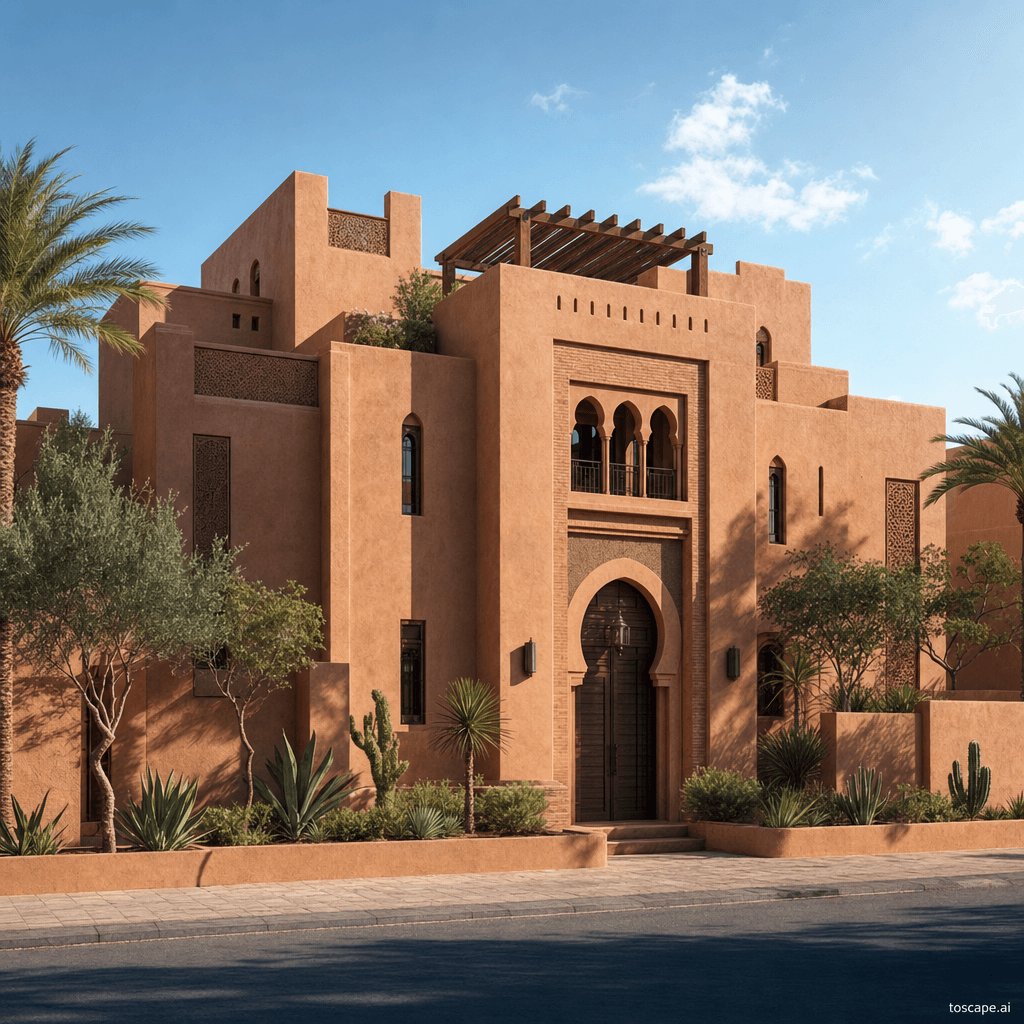
Marrakech-Safi Regional
Morocco · domestic architecture of Marrakech and the surrounding Haouz Plain
Rammed-earth (pisé) and brick construction rendered in pinkish-tadelakt — the "Rose City" color identity — larger, more garden-like courtyards (riads) with four-part chahar bagh garden layout — simpler ornament compared to Fès — more use of painted wood (zouaq...
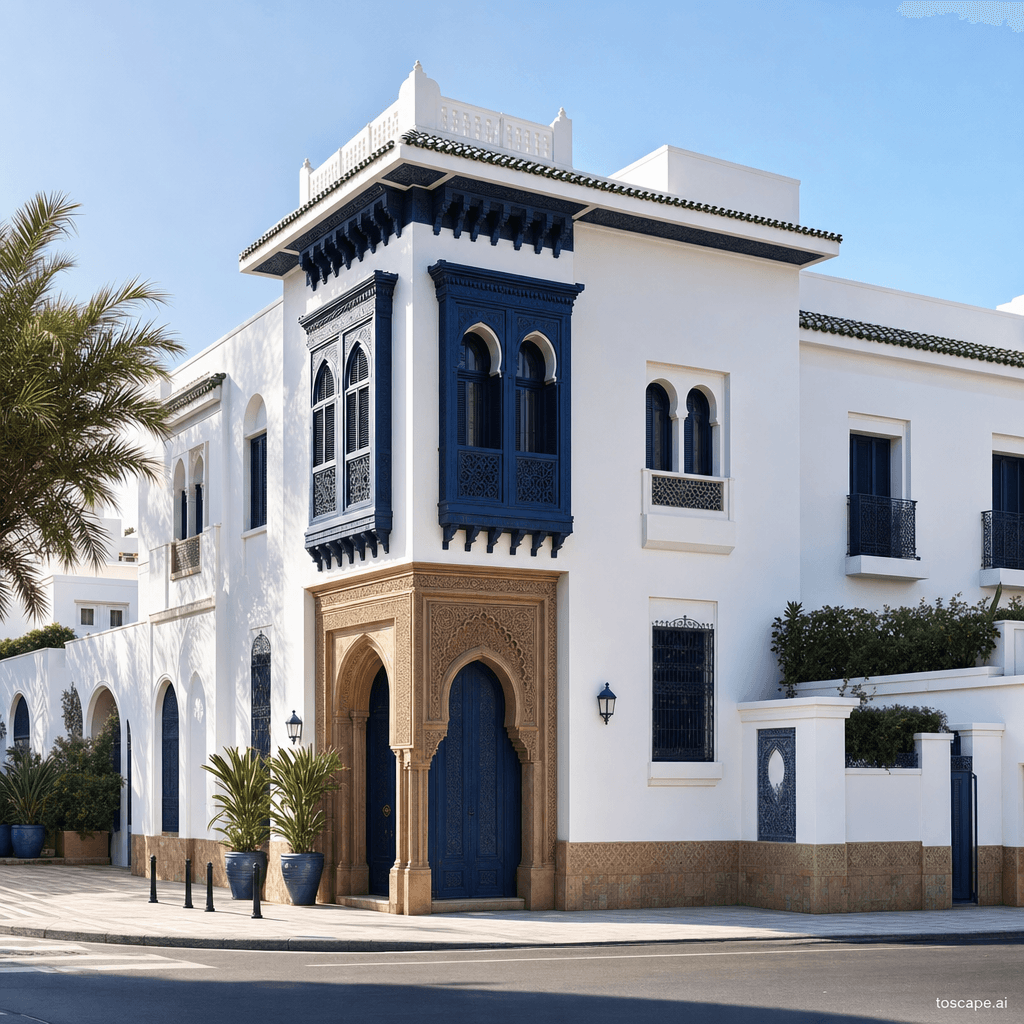
Rabat-Salé Coastal Imperial
Morocco · domestic architecture of Rabat and Salé
Whitewashed lime-rendered walls (bright white, not the pinkish-ochre of Marrakech) — the "White City" identity — more ordered medina layout due to later development and French Protectorate planning (Rabat's médina is 17th–18th century compared to Fès's 9th cen...
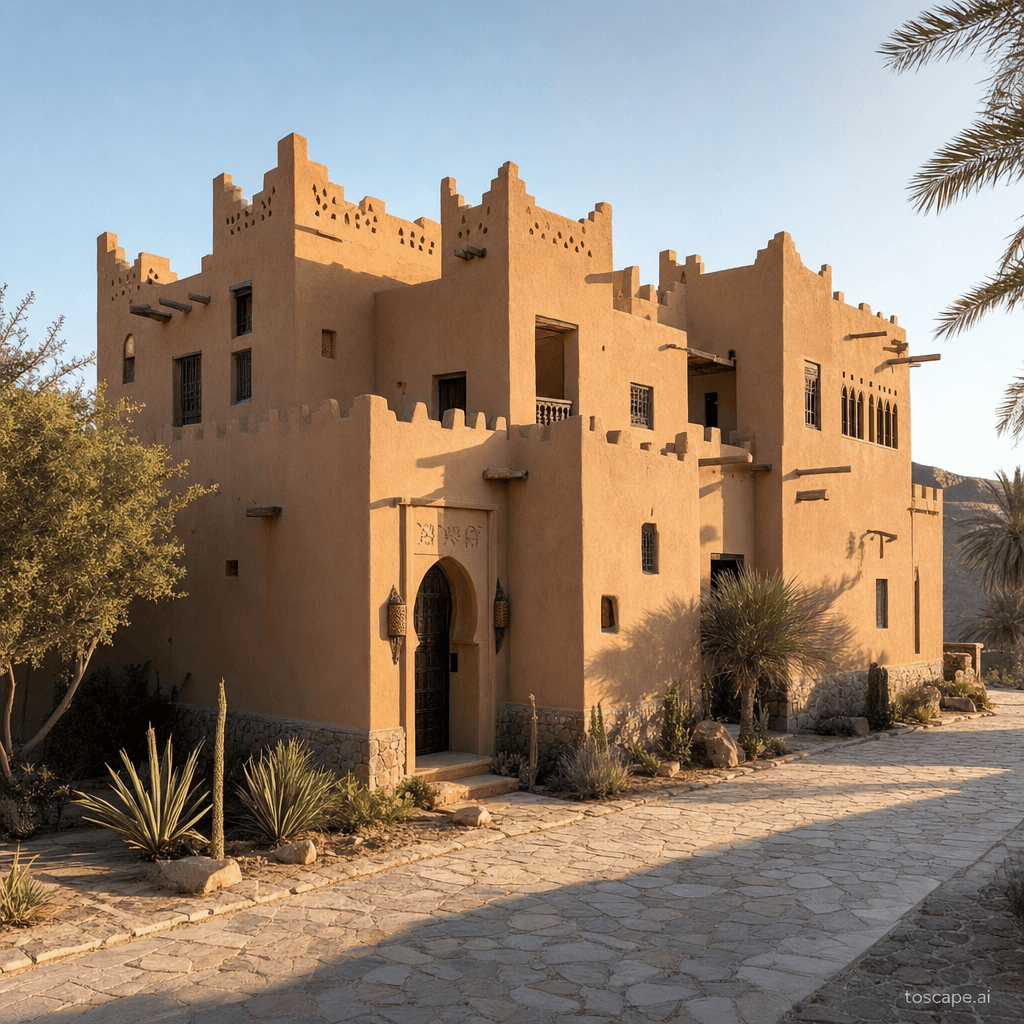
Sahara Desert Ksar / Kasbah
Morocco · ksar (fortified village) and kasbah architecture of Morocco's pre-Saharan oases
Compact, clustered ksar (fortified village) of attached earth-brick houses within a continuous defensive wall — mud-brick (adobe) rather than rammed earth (pisé) in the southern oases — lighter, more open construction responding to extreme summer heat (45°C+)...
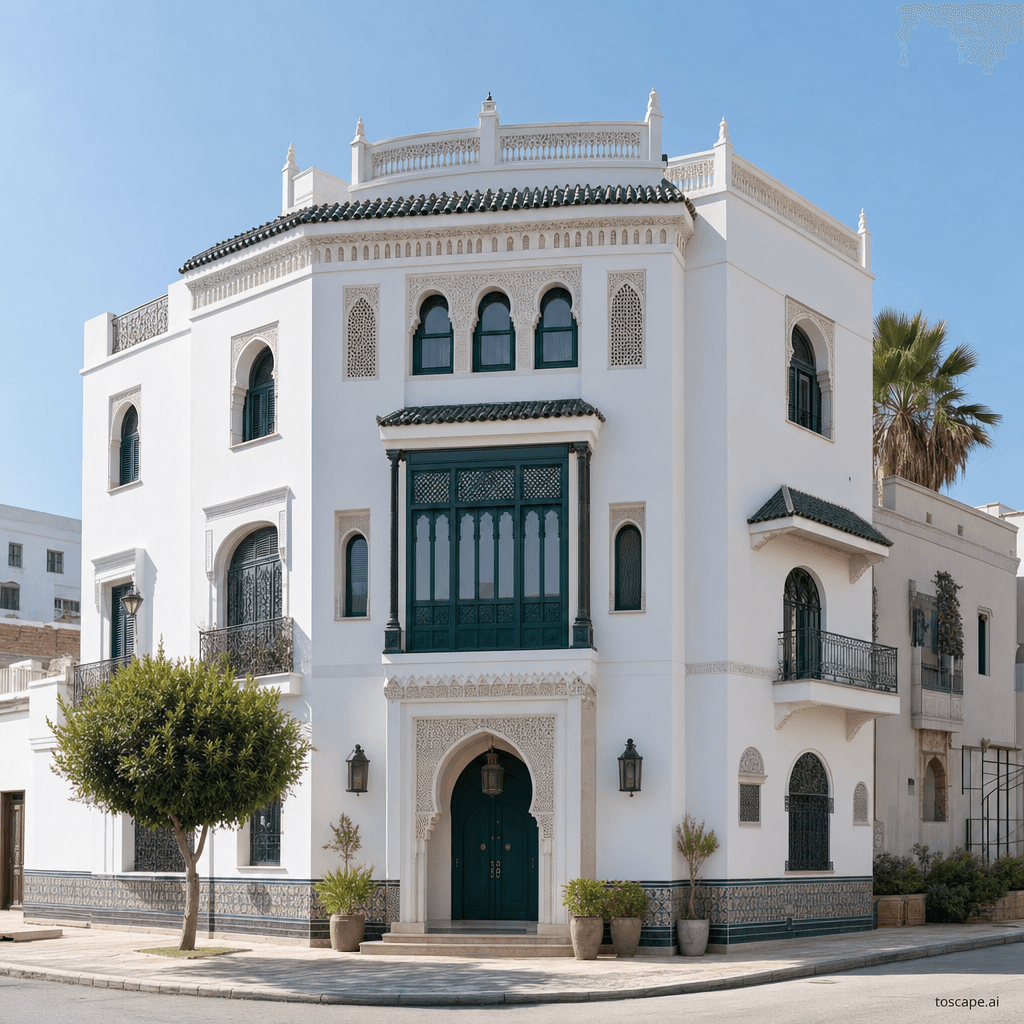
Tangier-Tetouan Mediterranean
Morocco · domestic architecture of Tangier and Tetouan
Whitewashed lime-rendered walls (bright stark white) with blue accents — the strongest "white village" aesthetic in Morocco — Tetouan's distinctive painted wood ceilings (zouaq Tetouani) with intricate floral patterns — Spanish-style wrought-iron balconies (ba...
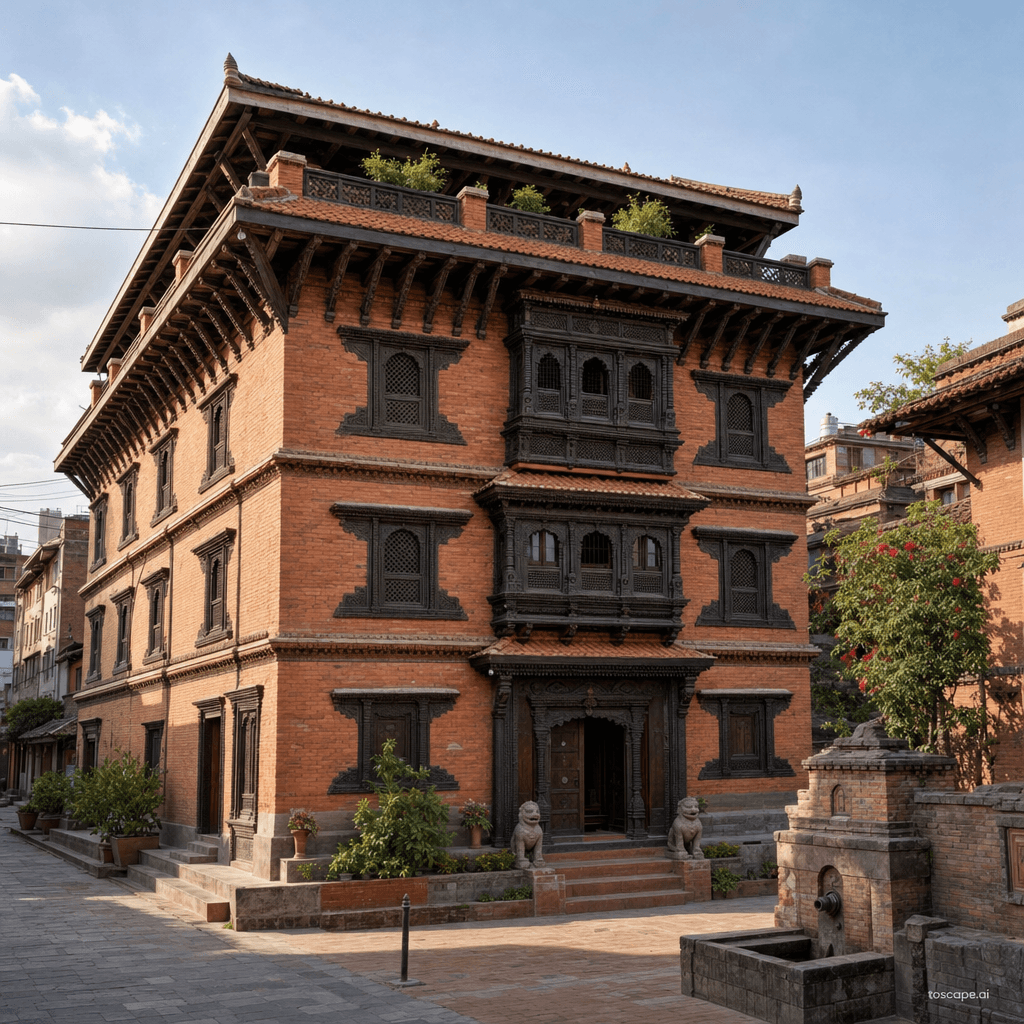
Kathmandu Valley Newari
Nepal · Kathmandu Valley Newari
Tiered pagoda temples with strut-supported sloping roofs, fired brick with carved timber windows (tiki-jhya / sajhya), brick-paved courtyard neighborhoods (bahal / chowk), jhingati clay tiles, hiti stone water spouts
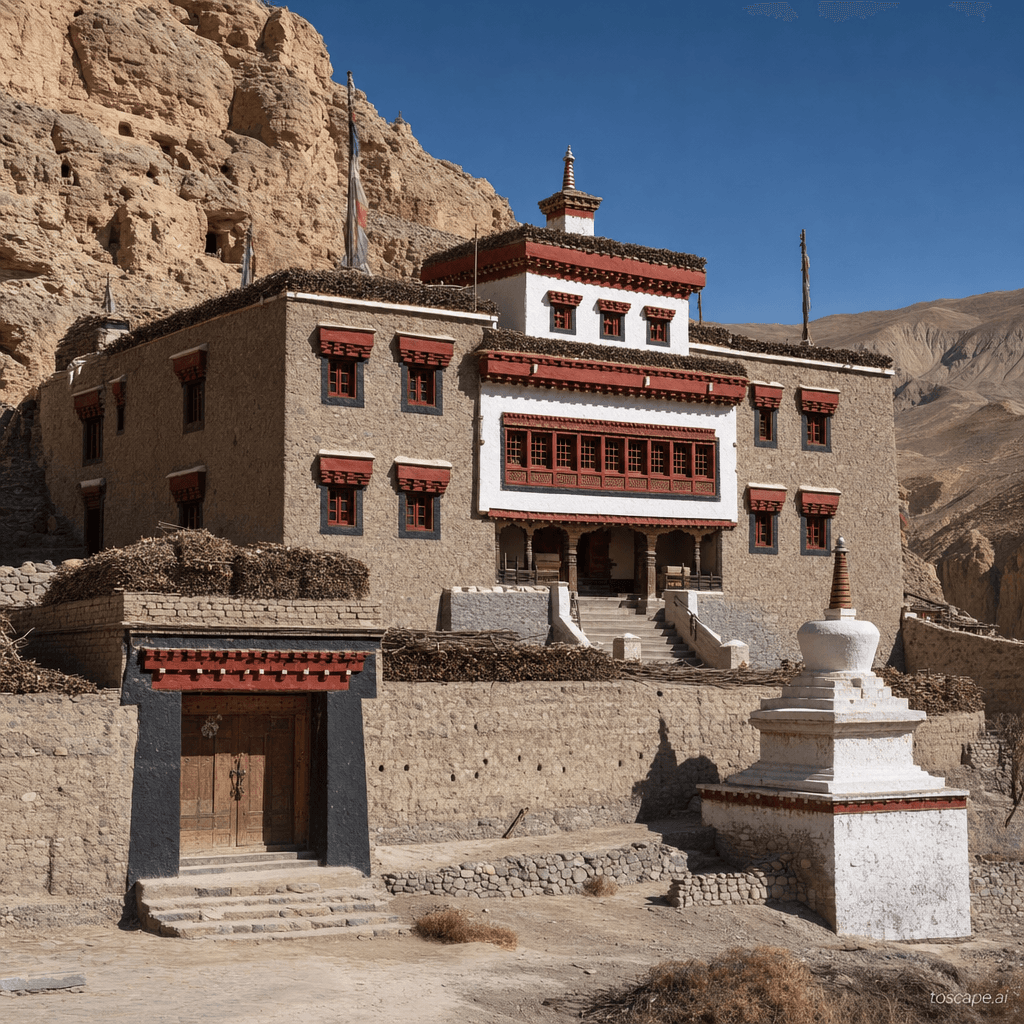
Mustang Trans-Himalayan
Nepal · Upper Mustang (Lo Manthang)
Rammed earth and sun-dried mud-brick construction, flat roofs with tamarisk branch parapets, fortified village walls (dzong-like), cave monastery complexes (gompa), mani walls and chorten (stupa) as landscape elements
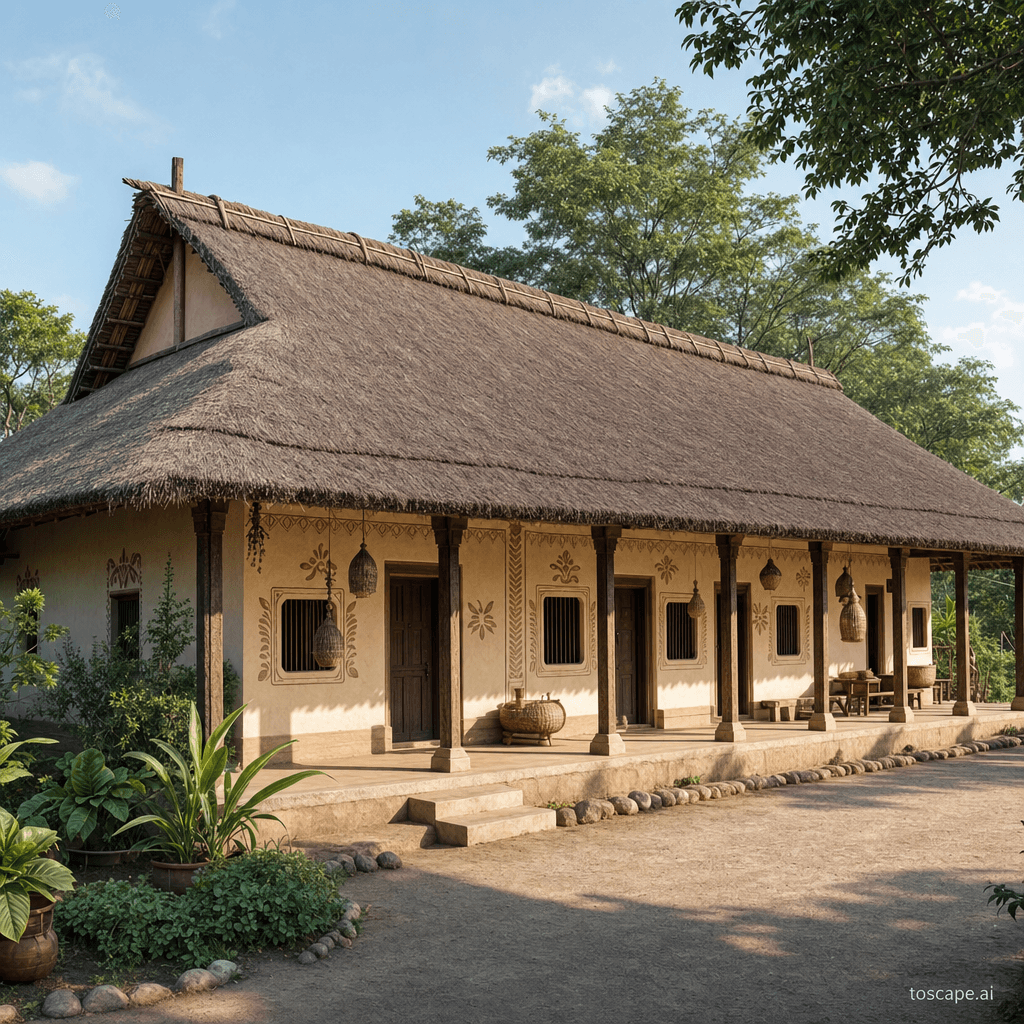
Terai Tharu
Nepal · Tharu ethnic architecture of Nepal's southern Terai
Elongated rectangular longhouse plan (multi-family), mud-plastered walls with relief decoration (dhus/ghar-gharai), thatch or tile roof with wide overhangs, wattle-and-daub construction in poorer variants, raised plinth for monsoon flooding
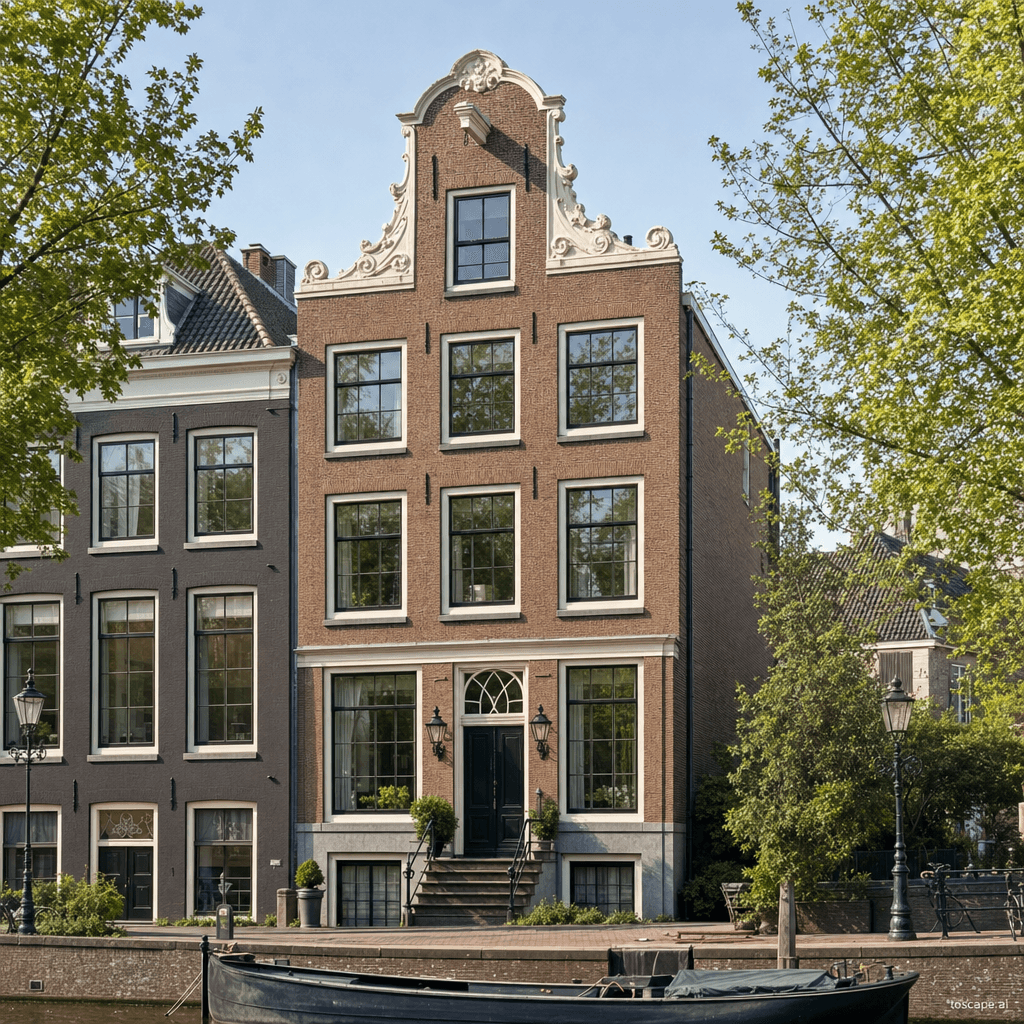
Dutch Amsterdam Canal House
Netherlands · Amsterdam canal house (Grachtenpand) of the 17th-century Dutch Golden Age (Goude...
The Amsterdam Grachtenpand — a tall narrow brick block, 5–7 m wide, rising 4–6 stories from the canal quay — the brick walls are typically dark red-brown, with contrasting white or pale stone elements: the horizontal stone water-table bands (speklagen — "bacon...
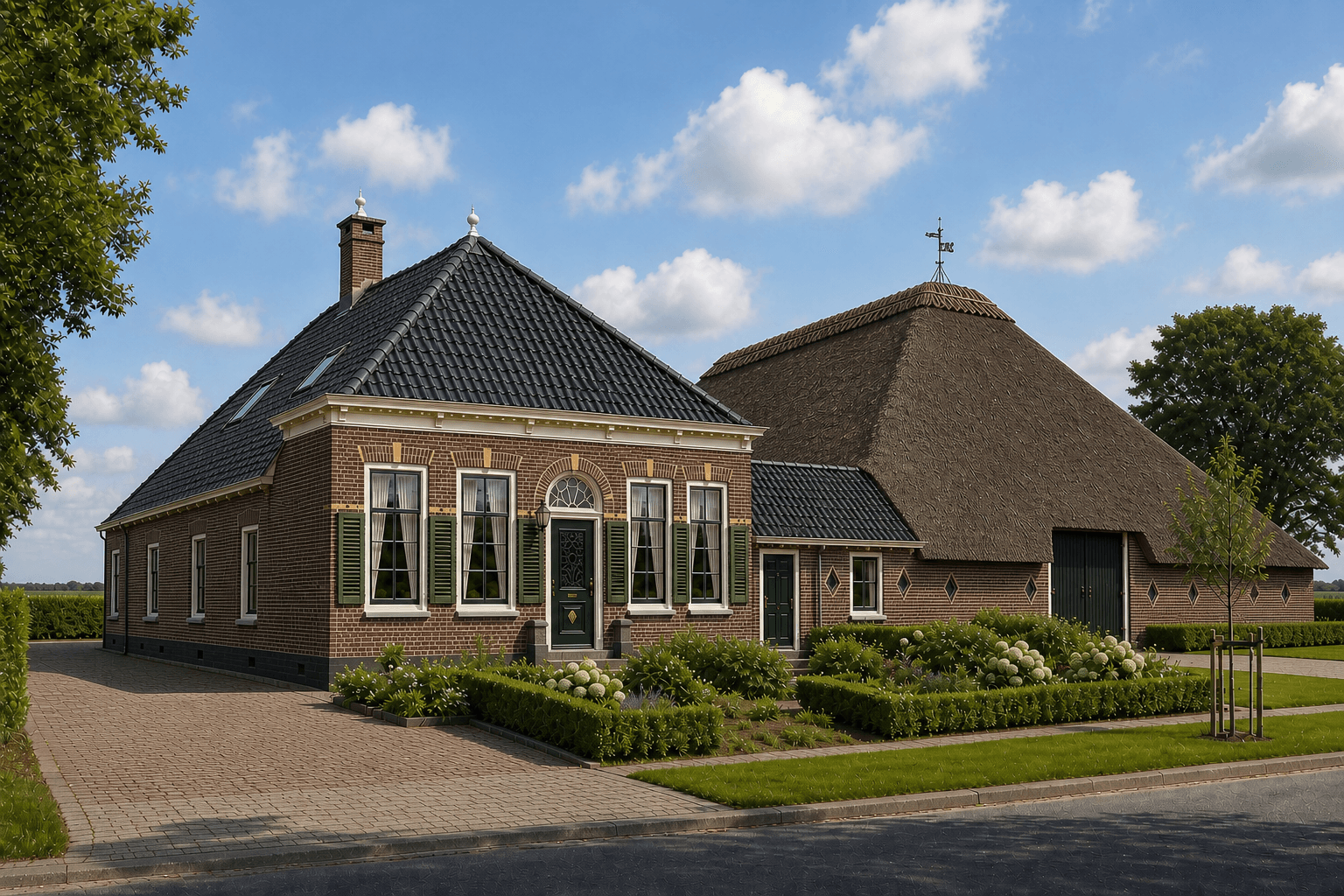
Dutch Friesland Farmhouse
Netherlands · Frisian farmhouse (Friese boerderij) of the northern Dutch province of Friesland
The Friese kop-hals-romp boerderij — an elongated brick farmstead, oriented with the dwelling (kop) facing the road or canal, the barn (romp) extending behind — the kop is a dignified brick house, 1.5–2 stories, with a symmetrical facade, a central entrance do...
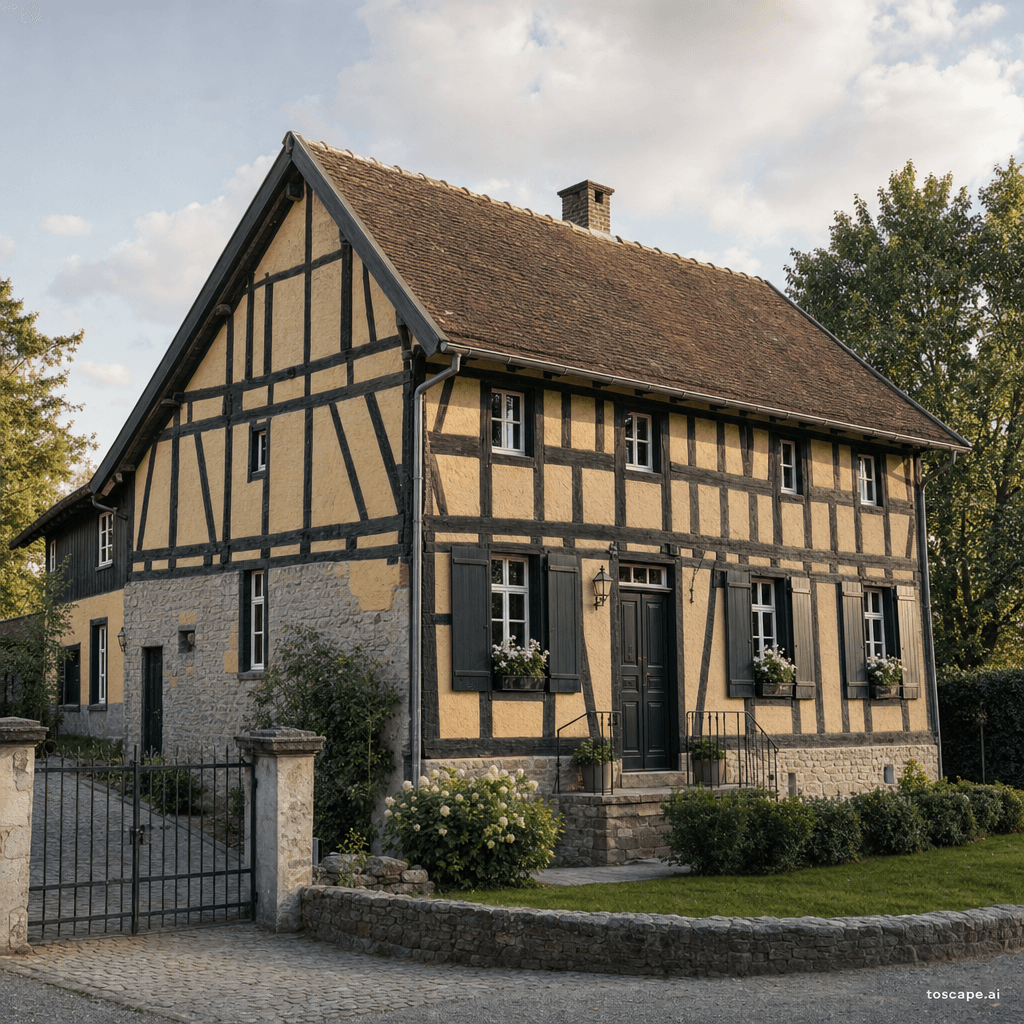
Dutch Limburg Half-Timbered Farmhouse
Netherlands · Limburg half-timbered farmhouse (Limburgse vakwerkboerderij) of the southernmost...
The Limburgse carréboerderij — a four-sided enclosed farm complex (30–50 m per side), with all buildings facing inward to the central courtyard — the street-facing exterior is relatively closed (few windows, the gateway as the single large opening), while the...
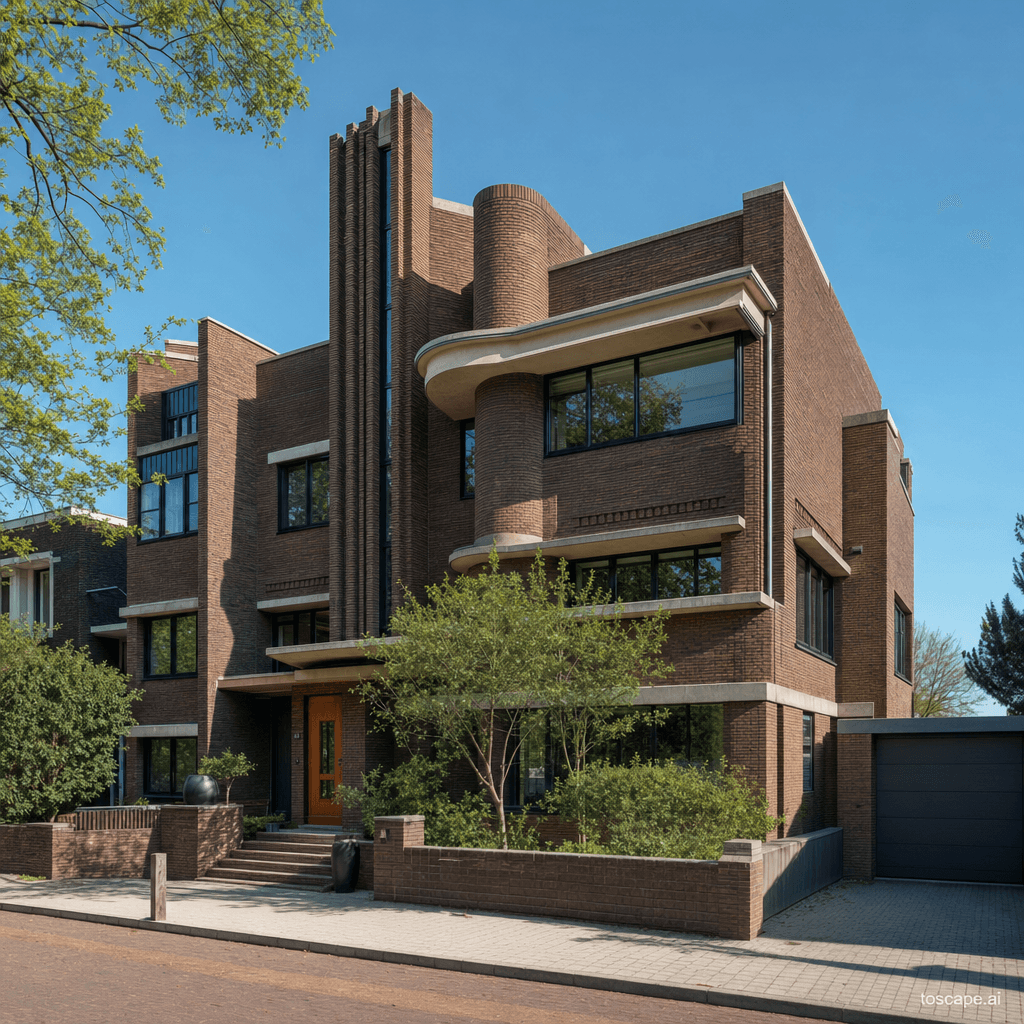
Dutch Rotterdam Modern Brick Expressionism
Netherlands · Amsterdam School (Amsterdamse School) brick architecture of Rotterdam and the Ne...
An Amsterdam School social housing block or civic building — a brick building of 3–5 stories where the brick wall is treated as a plastic, sculptural surface — the facade undulates horizontally (curved corners, projecting bays, recessed entrance portals) and t...
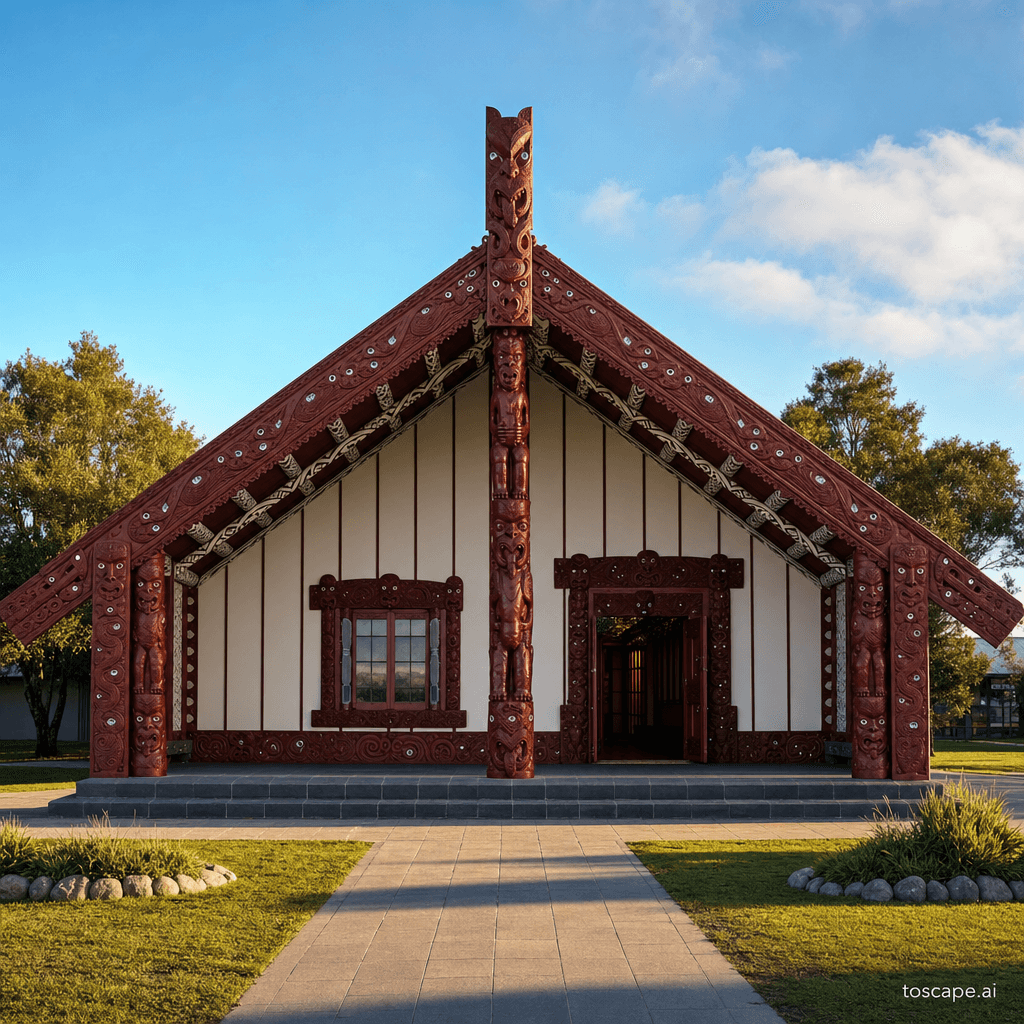
Māori Marae
New Zealand · architectural identity of the Māori marae
The wharenui — a timber post-and-beam structure on a rectangular plan, entered through a low doorway (rori) under the carved porch — the mahau (porch) is the transitional space between the profane outside and the sacred interior, defined by the carved amo (ver...
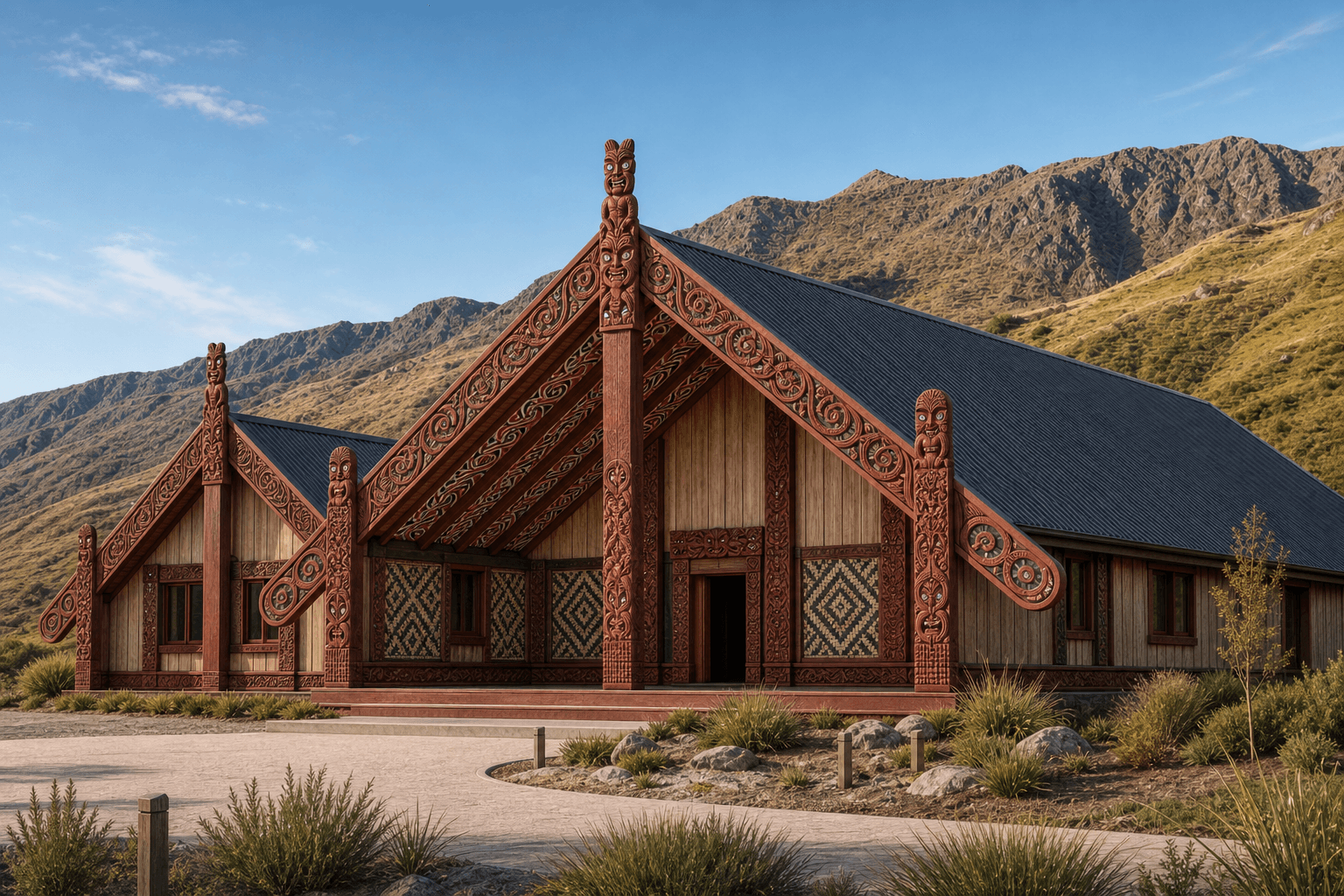
Ngāi Tahu South Island Māori
New Zealand · architectural identity of Ngāi Tahu (Kāi Tahu) marae and wharenui across Te Waip...
The Ngāi Tahu wharenui — a timber post-and-beam meeting house on a rectangular plan (8–25 m long, 5–8 m wide) adapted to the cold South Island climate — the mahau (porch) is often enclosed with glass or timber screens to create a wind-protected transitional sp...
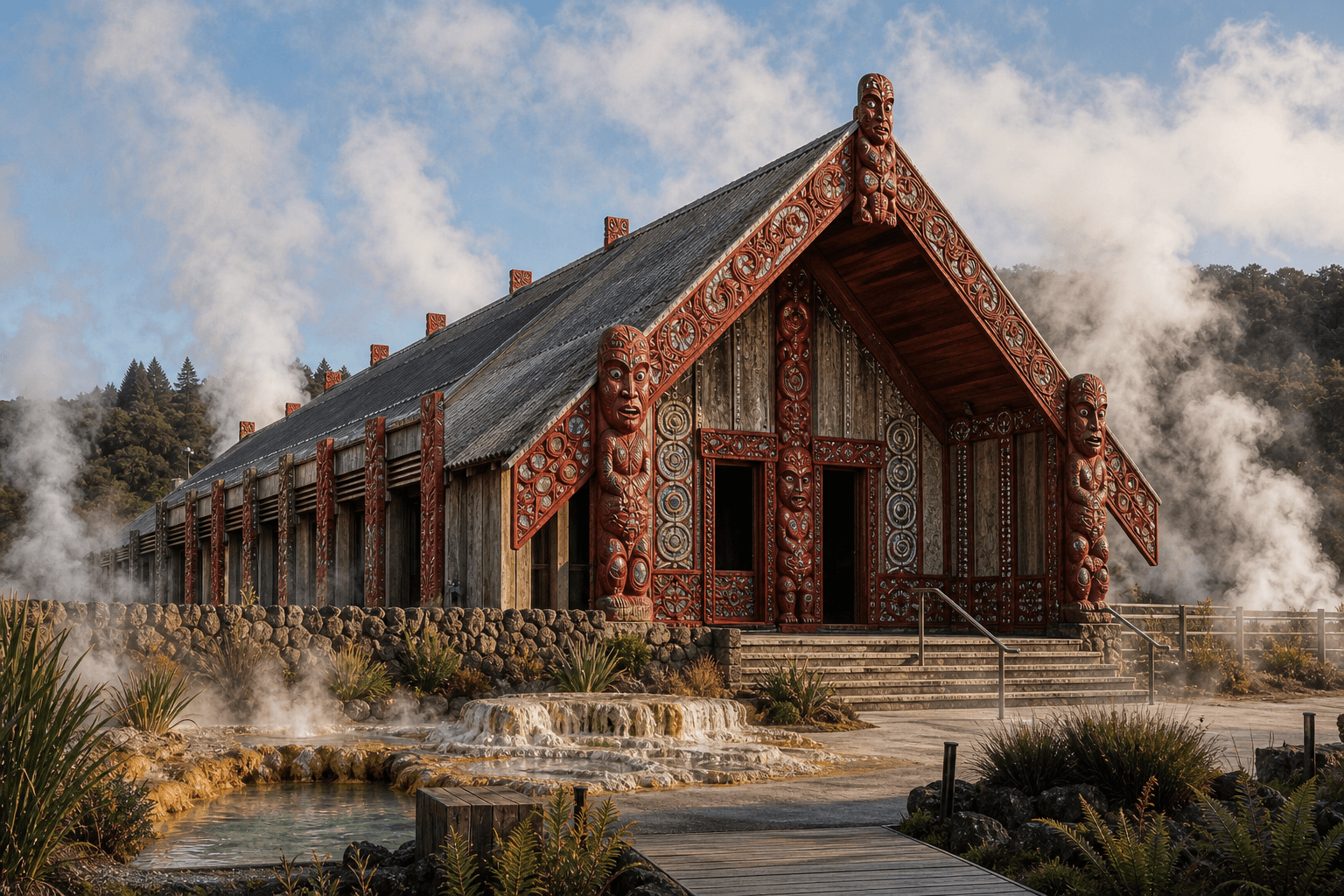
Rotorua Thermal Māori
New Zealand · architectural identity of Rotorua's geothermal Māori settlements
Te Arawa carved wharenui (meeting houses) and wharepuni (dwelling houses) sited among active geothermal features — the buildings use the same post-and-beam timber structure as other Māori traditions, but the Te Arawa carving style is distinctive: deeply underc...
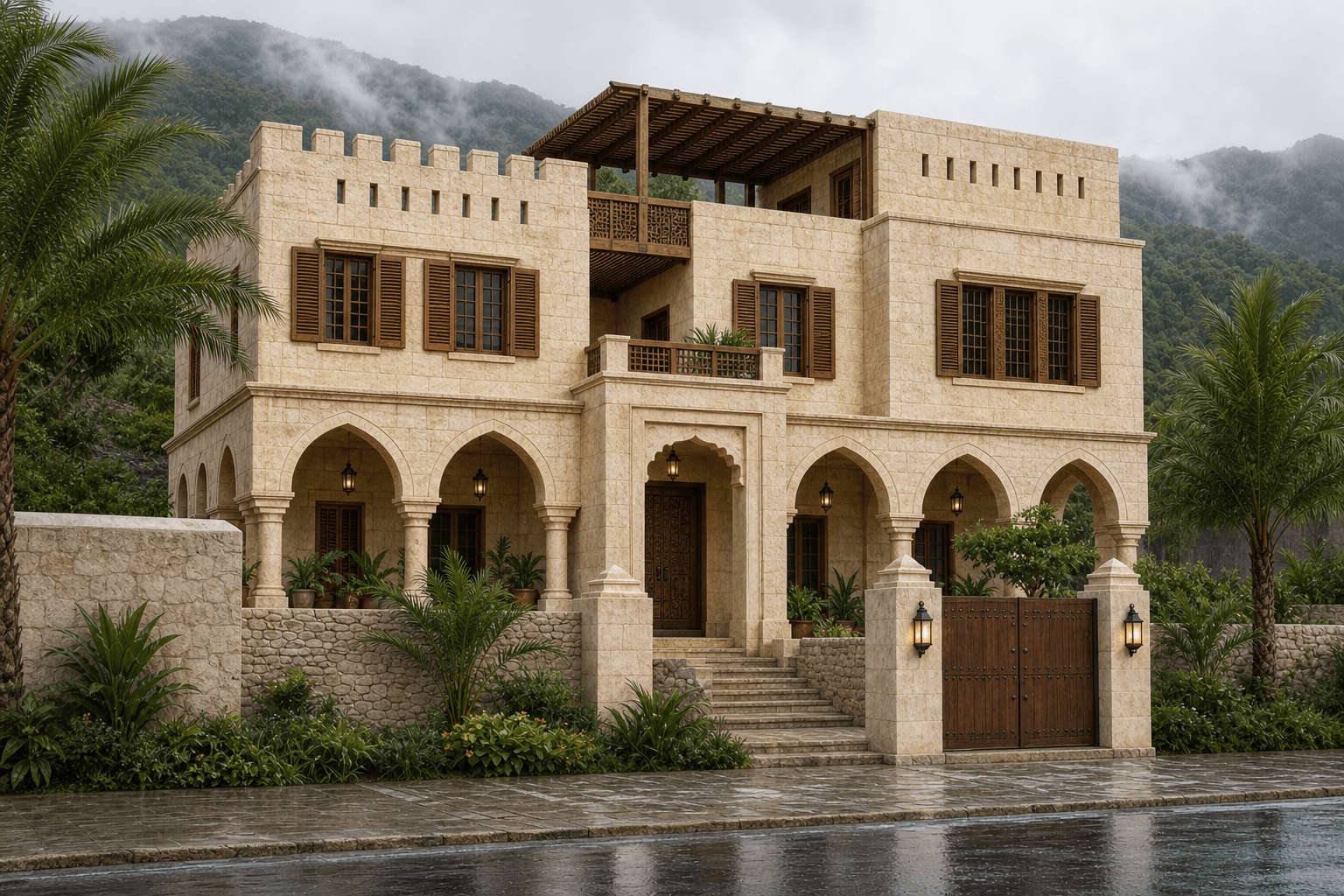
Dhofar Monsoon
Oman · and contemporary architecture of Salalah and the Dhofar Governorate
Limestone masonry construction — warm cream to pale golden stone with smooth or lightly textured finish — a hybrid of flat and low-pitched roof forms to manage monsoon rainfall — wide covered verandahs (barza / liwan) as transitional living spaces mediating th...
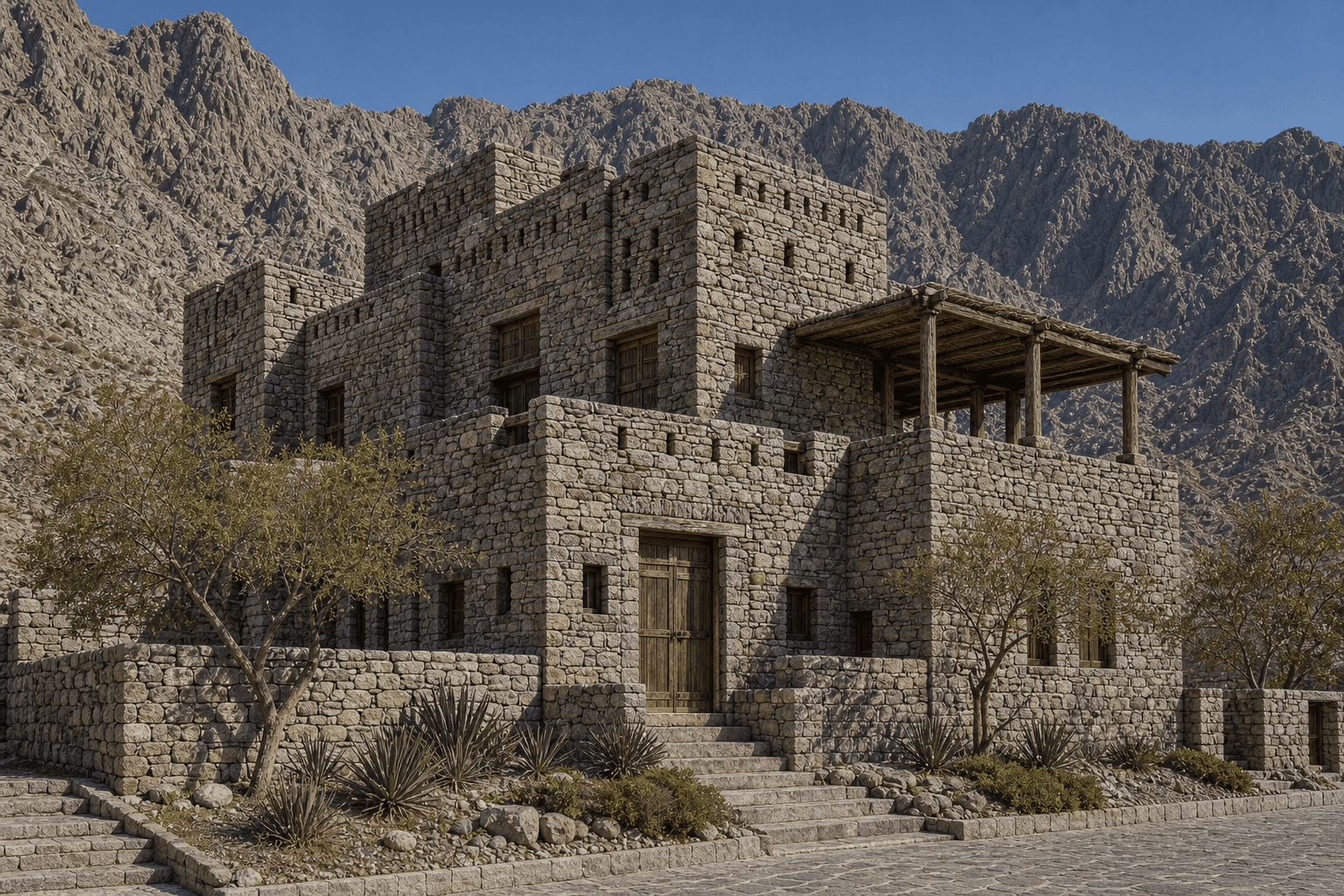
Musandam Mountain
Oman · mountain architecture of the Musandam Governorate
Dry-stone masonry construction — local dark gray-brown mountain stone, laid without mortar in some traditional buildings — steeply terraced settlement plans stepped up mountain slopes following contour lines — small, compact volumes (4–8 m wide × 5–10 m deep)...
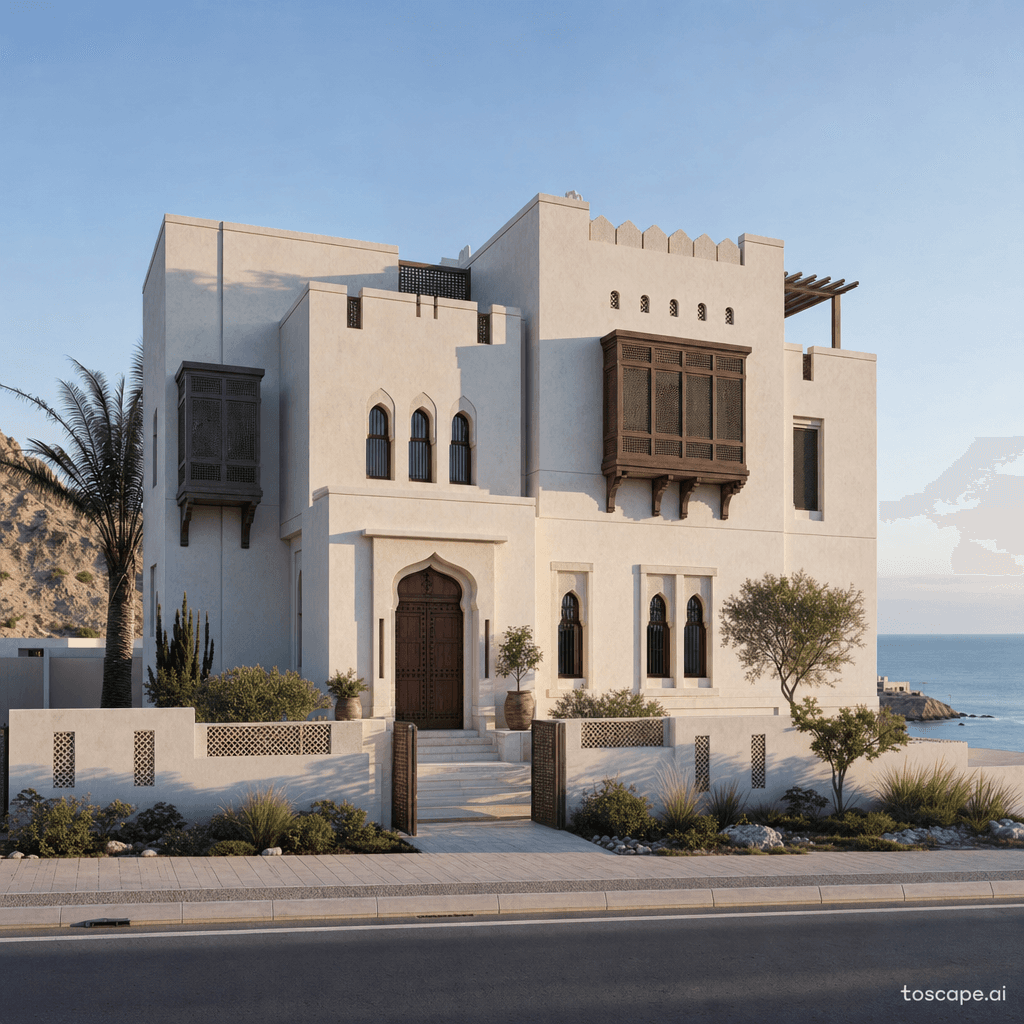
Muscat Coastal
Oman · Muscat Governorate and the Batinah coast
Low-rise rendered volumes, pointed Omani arches, carved timber doors, crenellated parapets, and inward-looking courtyard organization define Muscat's coastal identity. The architecture stays bright, compact, and horizontally composed in deference to harbors, forts, minarets, and the Hajar Mountains.
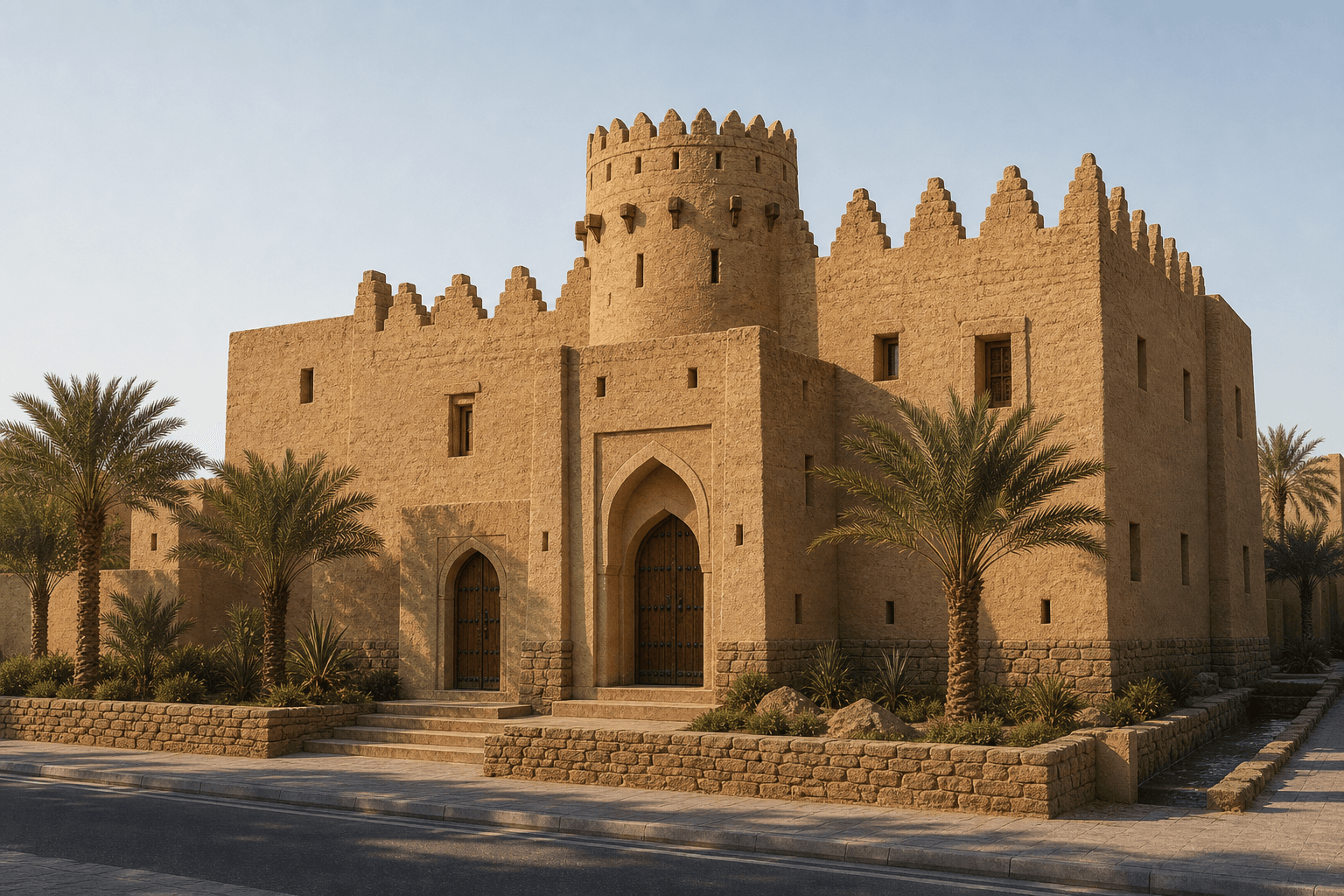
Nizwa Interior
Oman · inland architecture of the Nizwa region and Ad Dakhiliyah Governorate
Mud-brick (adobe) construction — warm earth-brown to golden-ochre color range — massive, fortress-like volumes with minimal openings — the round watchtower (burj) as the defining architectural silhouette — flat roofs with crenellated mud-brick parapets — dense...
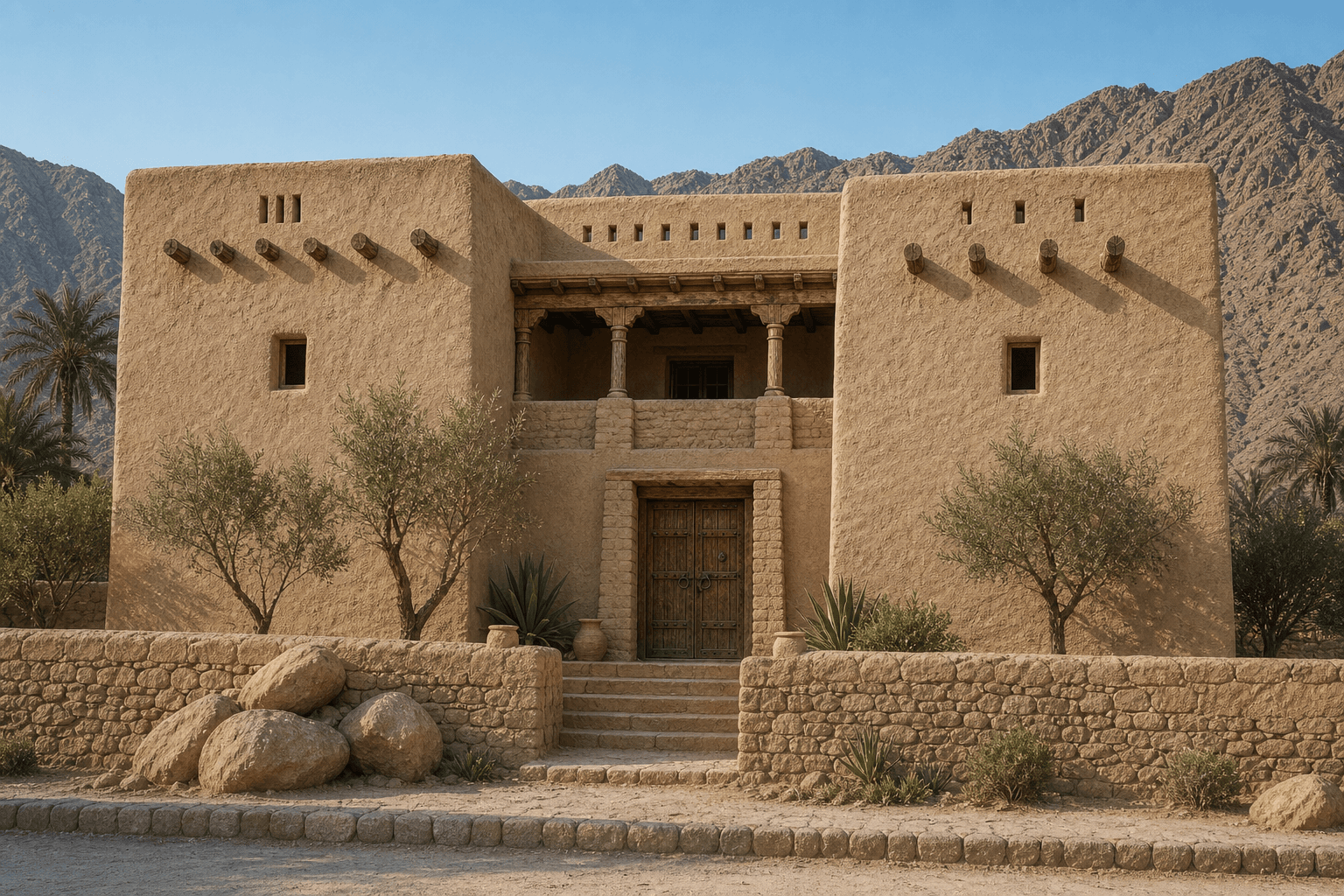
Balochistan
Pakistan · vernacular architecture of Balochistan
The Balochi compound — a walled courtyard enclosure (kot) containing low, single-storey rectangular rooms of mud-brick or stone — flat roofs of timber beams with reed matting and earth — the kaar-gah (mud-plastered domed room) of coastal Makran — a distinct va...
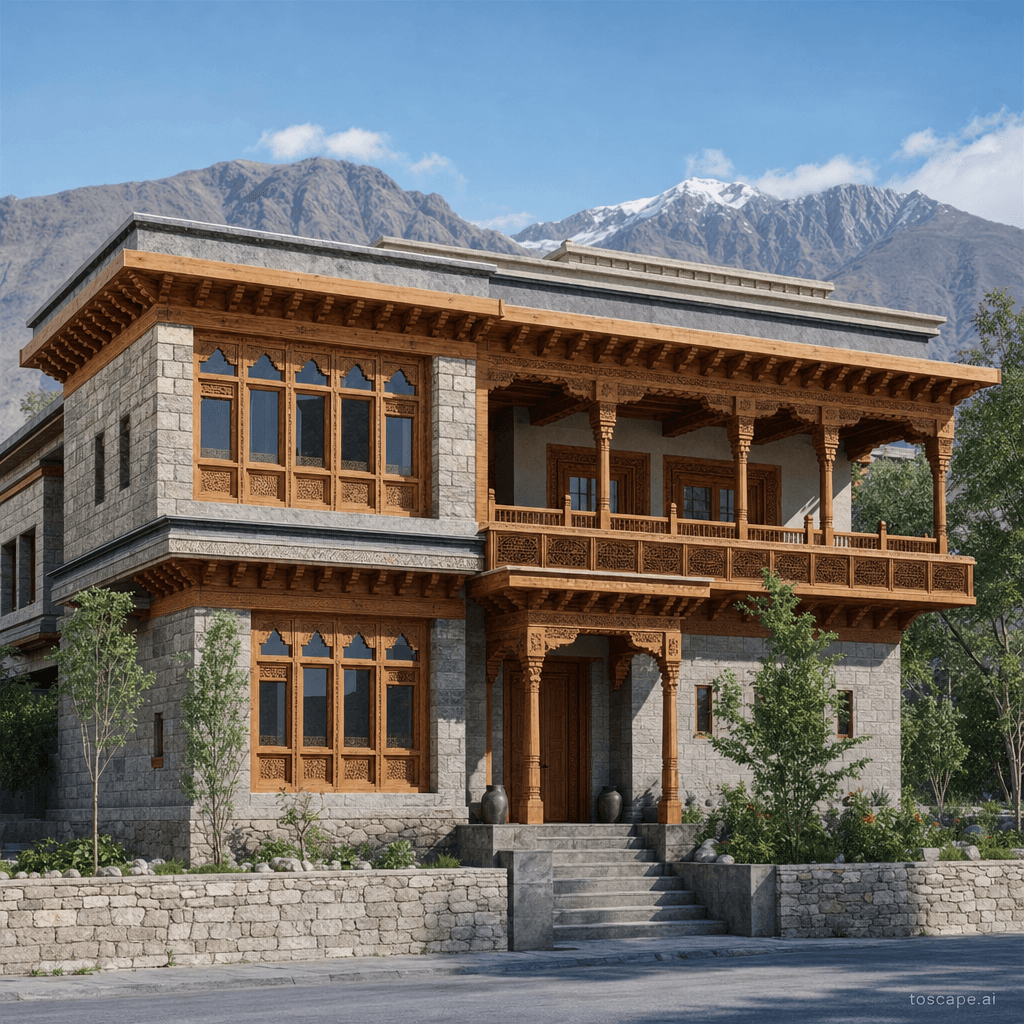
Gilgit-Baltistan
Pakistan · vernacular architecture of Gilgit-Baltistan
The Gilgit-Baltistan fortified village — dense clusters of stone-and-timber houses stepped up steep mountain slopes — kat-o-kari construction: horizontal timber cribbage (timber grid) infilled with stone rubble, creating a highly seismic-resistant structural s...
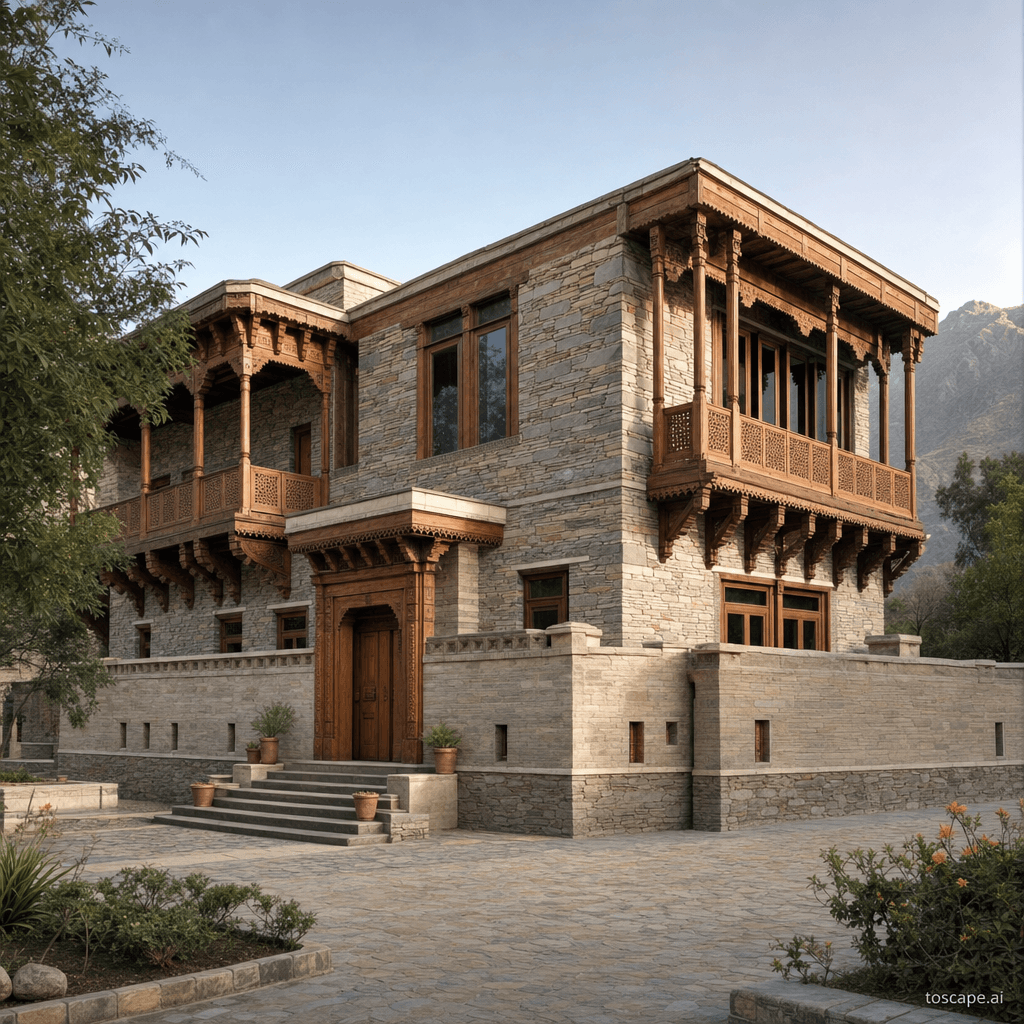
Khyber Pakhtunkhwa
Pakistan · vernacular architecture of Khyber Pakhtunkhwa (formerly NWFP)
The Khyber Pakhtunkhwa mountain house — a two-to-three-storey stone-and-timber volume stepping up the mountain slope — "timber-laced" masonry: horizontal timber beams (kath) embedded every 0.8–1.2 m within coursed stone rubble walls, creating a distinctive str...
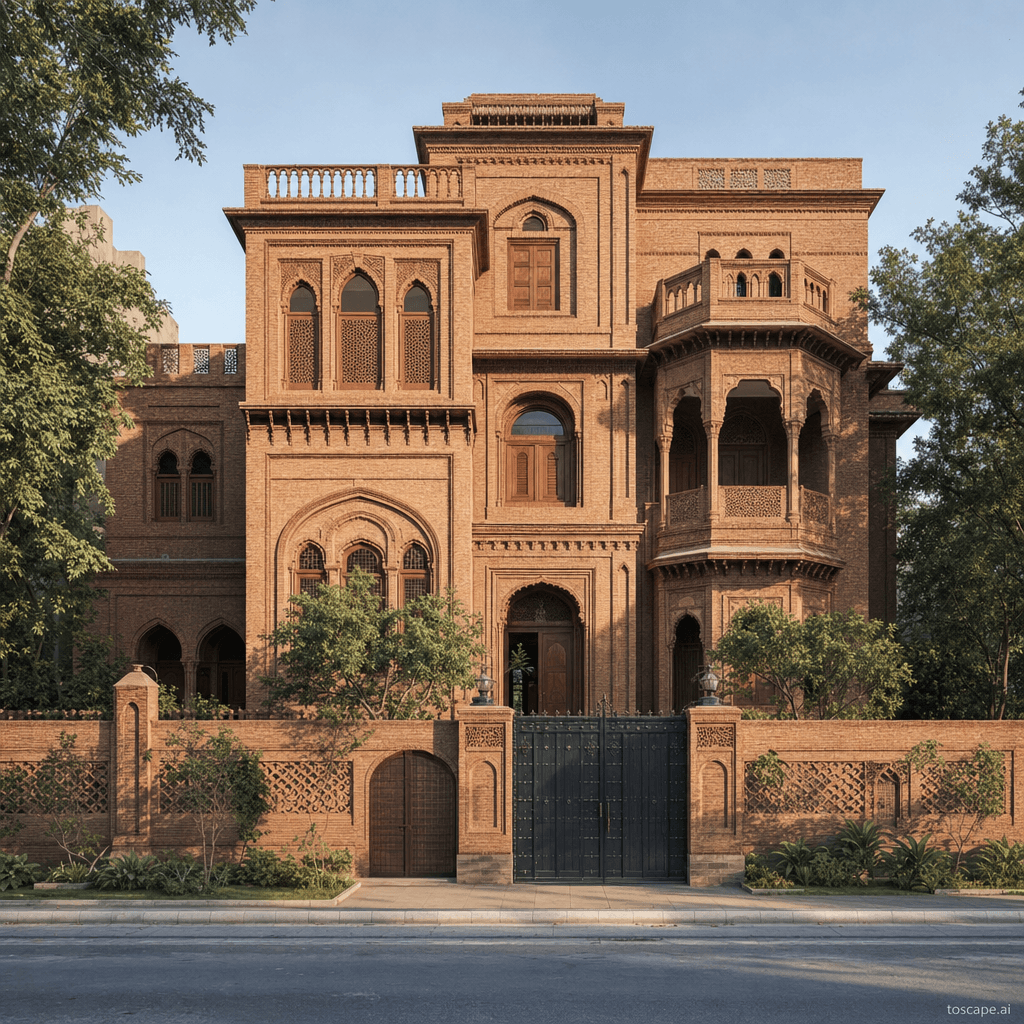
Punjab Lahore
Pakistan · domestic and monumental architecture of the Punjab region centered on Lahore
The Lahori haveli — a two-to-four storey urban mansion organized around one or more courtyards (sehns) — the distinctive small-format Lahori brick (nanak-shahi, 190 × 130 × 50 mm) in warm terracotta-red to deep ochre — ornamental brickwork (brick-on-edge, diap...
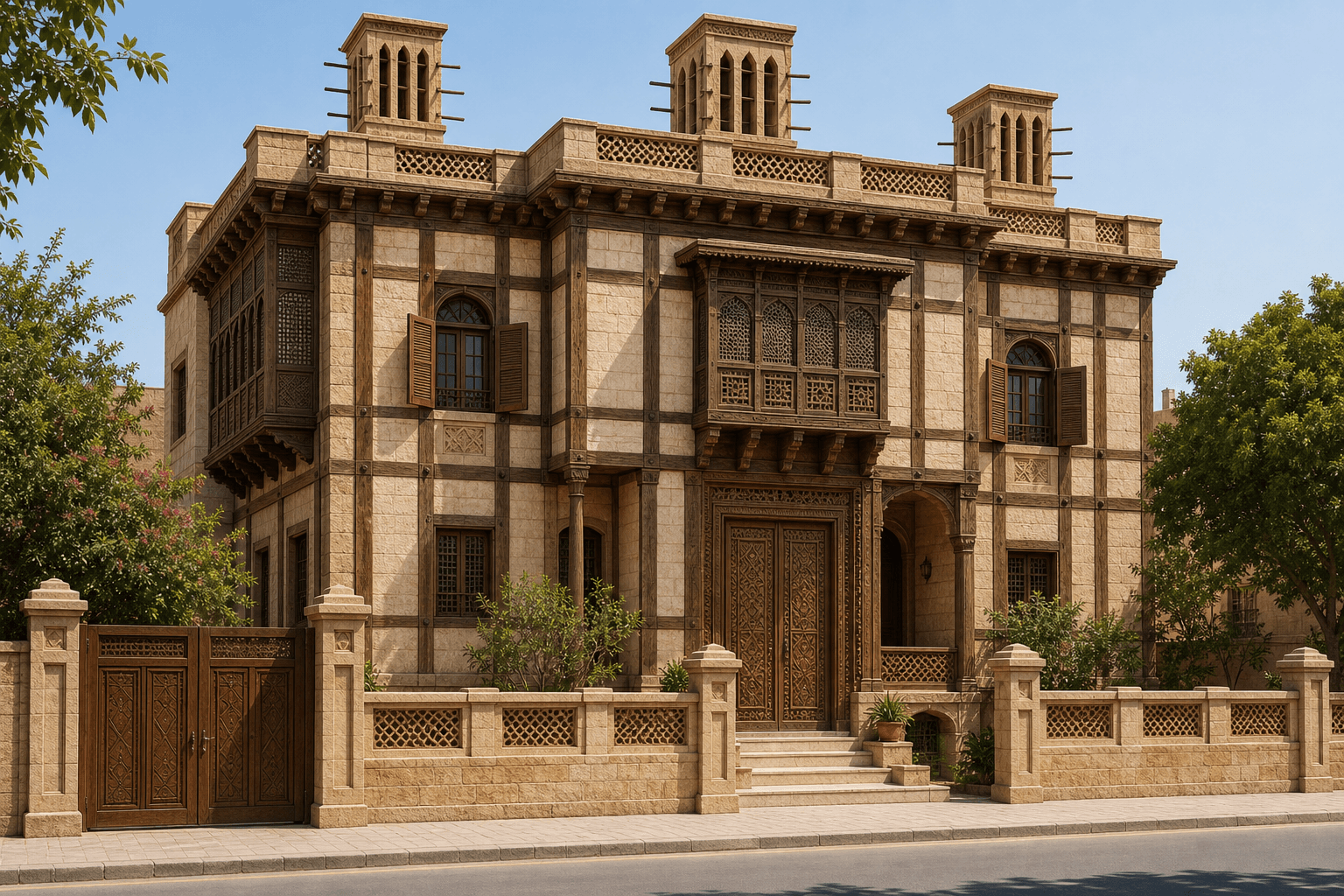
Sindh Karachi
Pakistan · domestic architecture of Sindh province, centered on the historic quarters of Ka...
The Sindhi badgir — a square or octagonal wind-catcher tower rising 3–6 m above the roof with angled wind scoops capturing the prevailing south-west monsoon breeze (the sindh-jo-bad) and channeling it into interior rooms — the defining architectural signature...
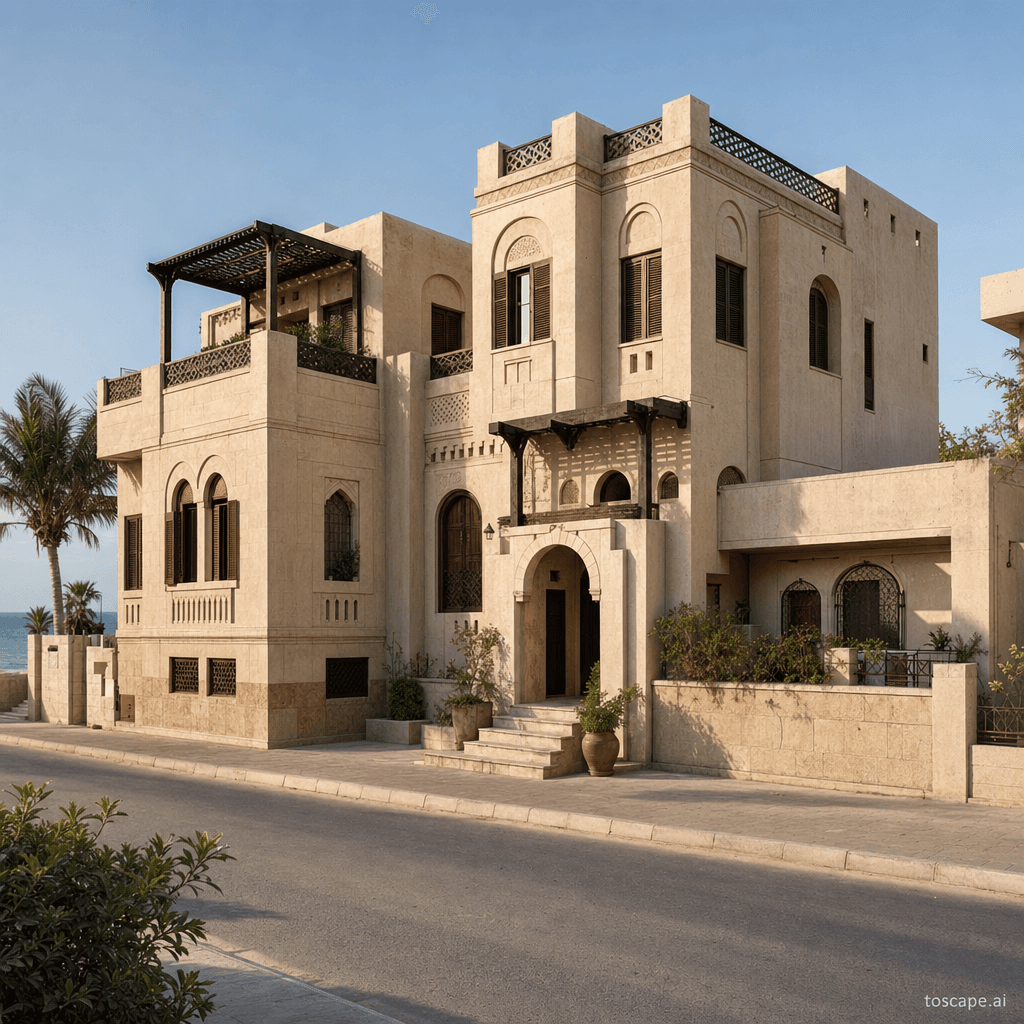
Gaza Coastal Palestinian
Palestine · traditional architecture of the Gaza coastal plain
The Gazan courtyard house (dār) — a one- to two-story dwelling of kurkar sandstone masonry, organized around a central courtyard (ḥawsh) that opens to the sky — the walls are built of locally quarried kurkar (a porous calcareous sandstone, #E8DCC0 to #D4C898 c...
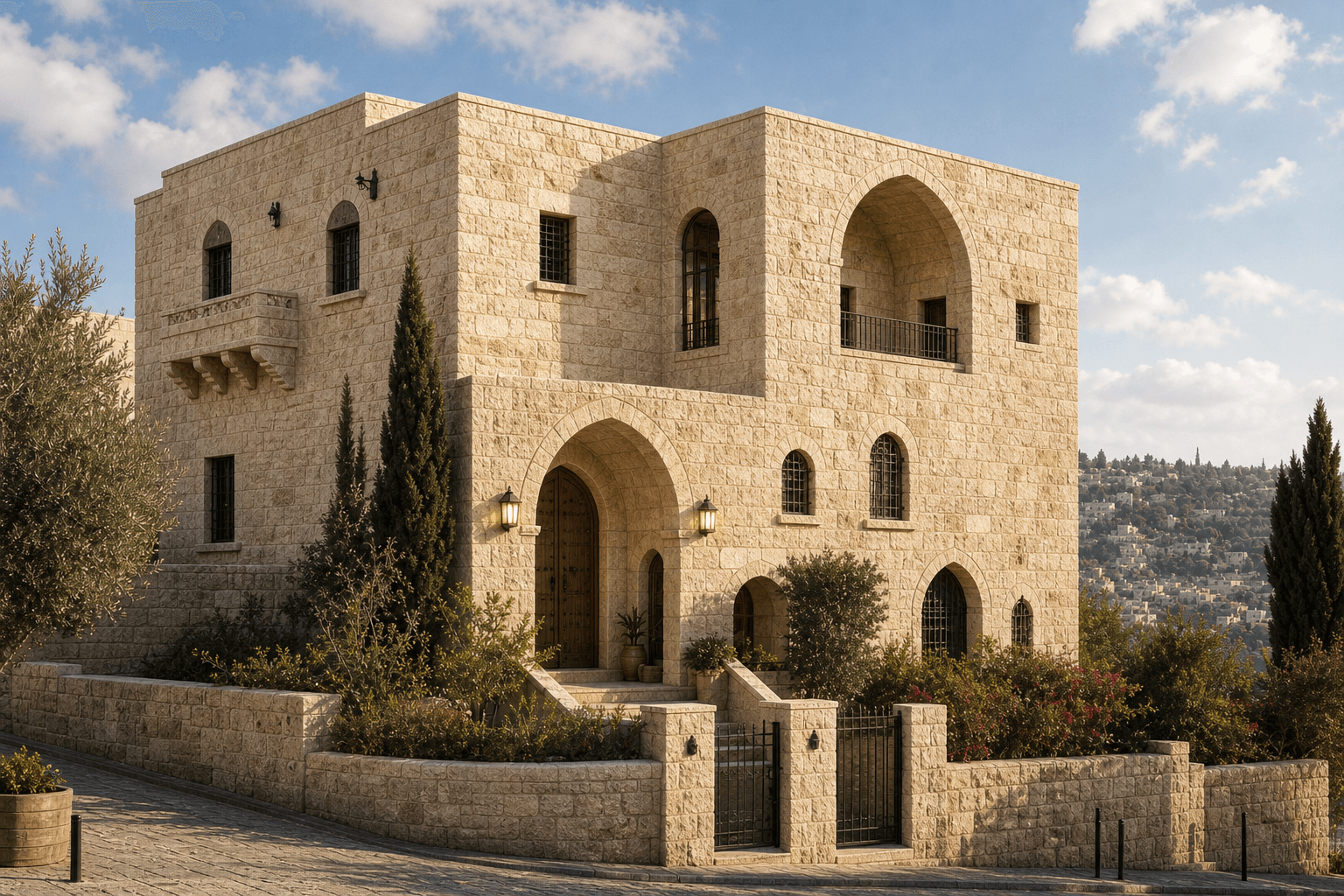
Jerusalem Highlands Palestinian
Palestine · traditional architecture of the Palestinian Central Highlands
The Palestinian highland house (dār or bayt) — a single-family courtyard dwelling built entirely of load-bearing limestone masonry, characterized by the cross-vault (qabw muṭābaq) and the dome (qubba) as the primary roofing elements — the house is organized ar...
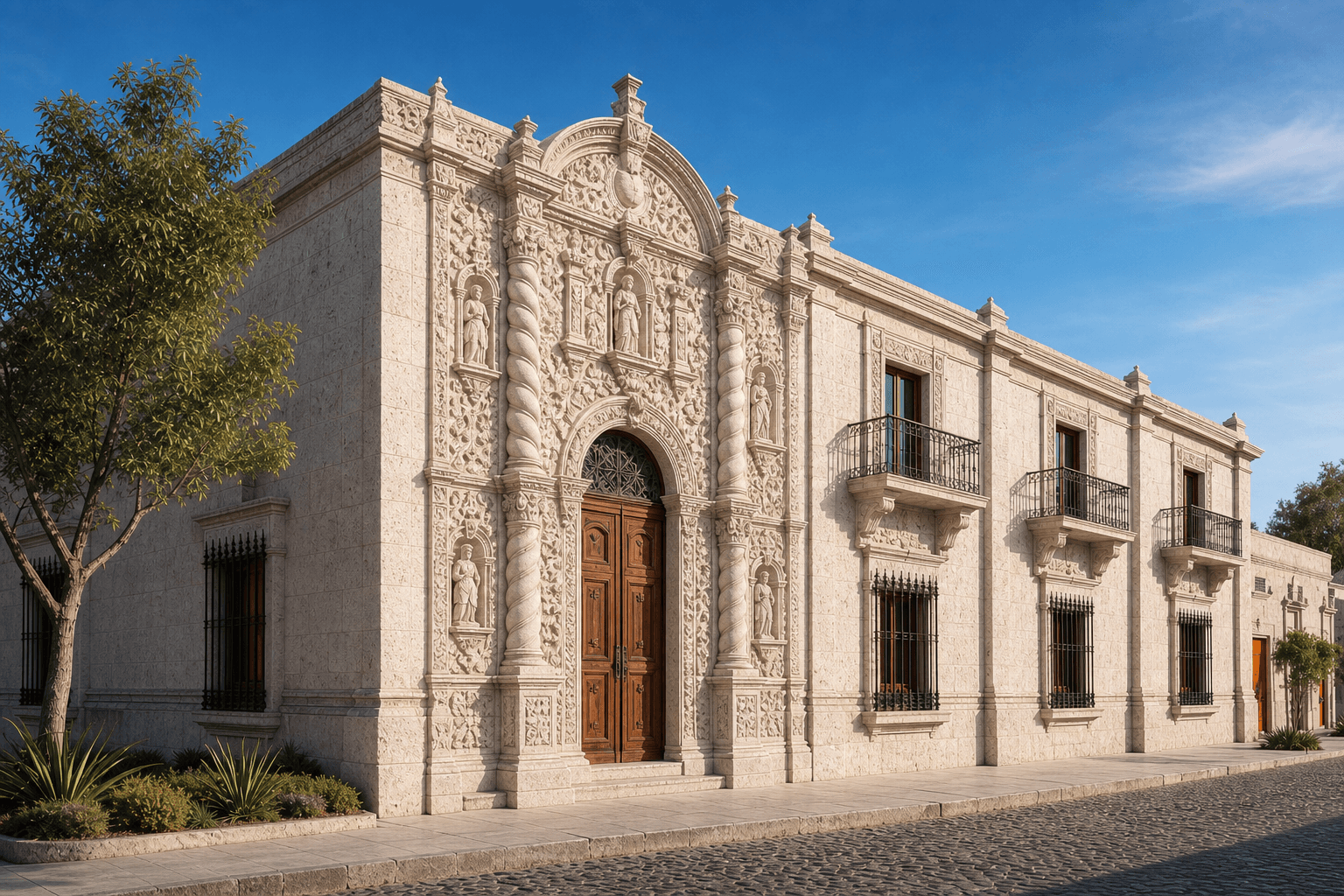
Arequipa Sillar
Peru · architectural identity of Arequipa (UNESCO World Heritage, inscribed 2000)
The Arequipa sillar facade — a white or pale pinkish-white ignimbrite wall surface carved with dense, flat relief ornament organized around the portal — the Baroque-Mestizo portal (portada) is the dominant compositional element: a multi-tiered composition of p...
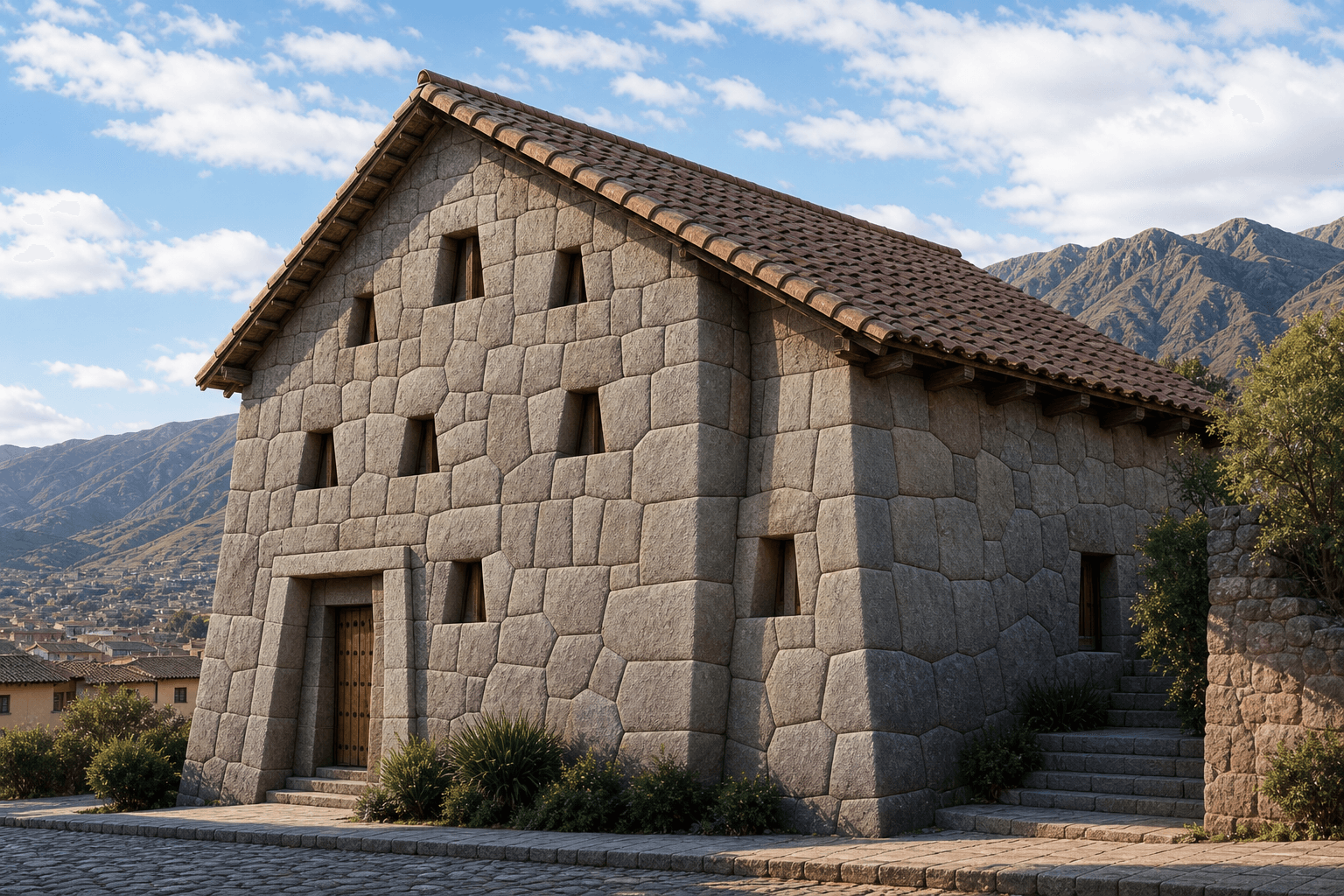
Cusco Inca
Peru · architectural identity of Inca Cusco (UNESCO World Heritage) and the Sacred Vall...
The Inca wall — a mortarless ashlar masonry surface composed of polygonal or rectangular blocks (0.3–2 m in size, finely dressed on the exposed face with a slight pillow-like convexity) — each block individually shaped by pecking and grinding with harder stone...
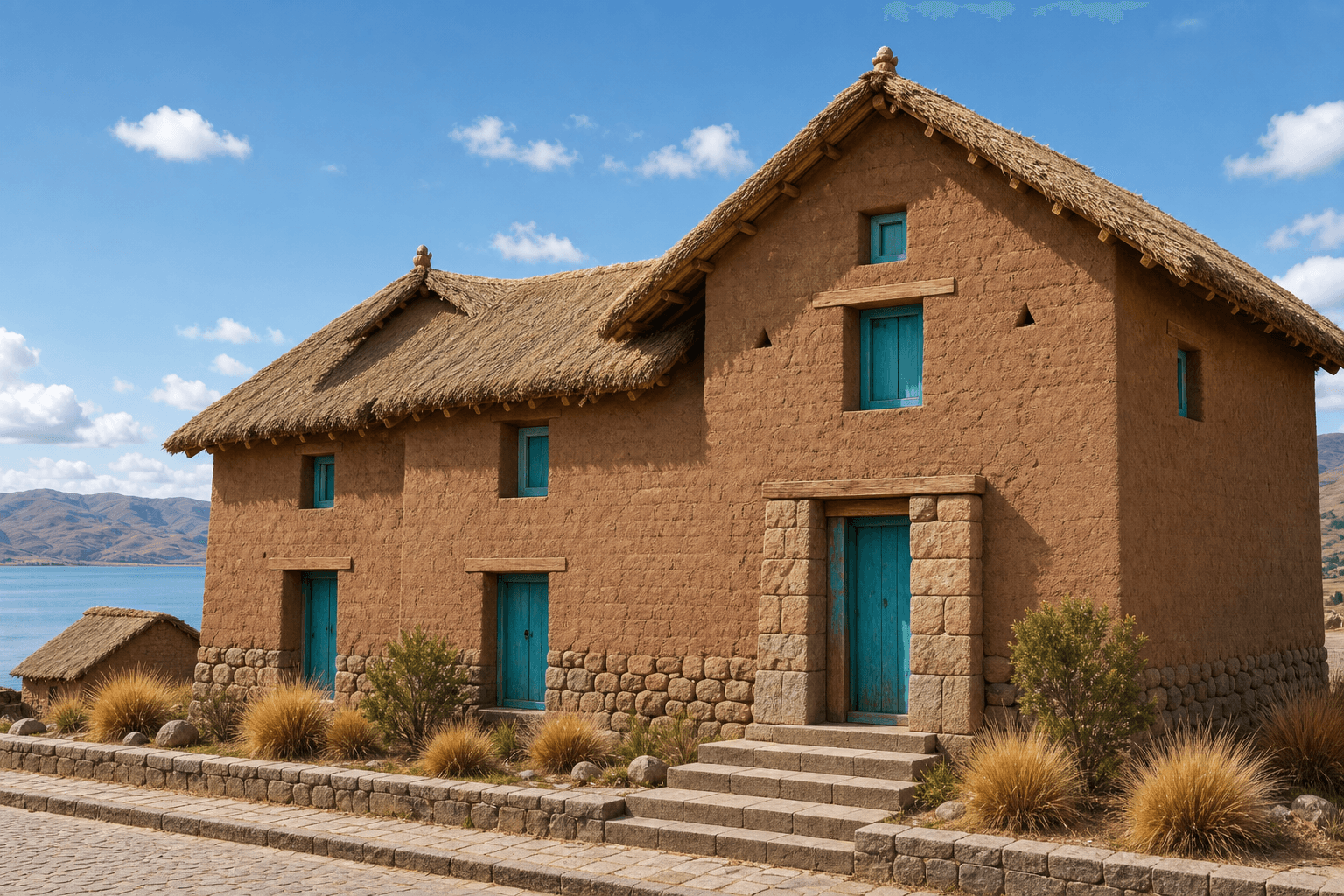
Lake Titicaca Altiplano
Peru · architectural identity of the Lake Titicaca basin (Puno region, Peru)
The Uros floating island — a living surface of cut totora reeds (1–3 m thick) built upon a buoyant base of totora root blocks (khili), anchored to the lakebed with ropes and wooden stakes — on this surface, single-room houses are constructed from a framework o...
Cordillera
Philippines · Ifugao Province
Bale (or fale) — the Ifugao native house: compact square-plan elevated timber hut on four massive wooden posts (tukud/haligi) with distinctive rat-guard discs (oliang/ha-leb) carved from single hardwood trunks, steep pyramidal cogon grass thatch roof (up to 55...
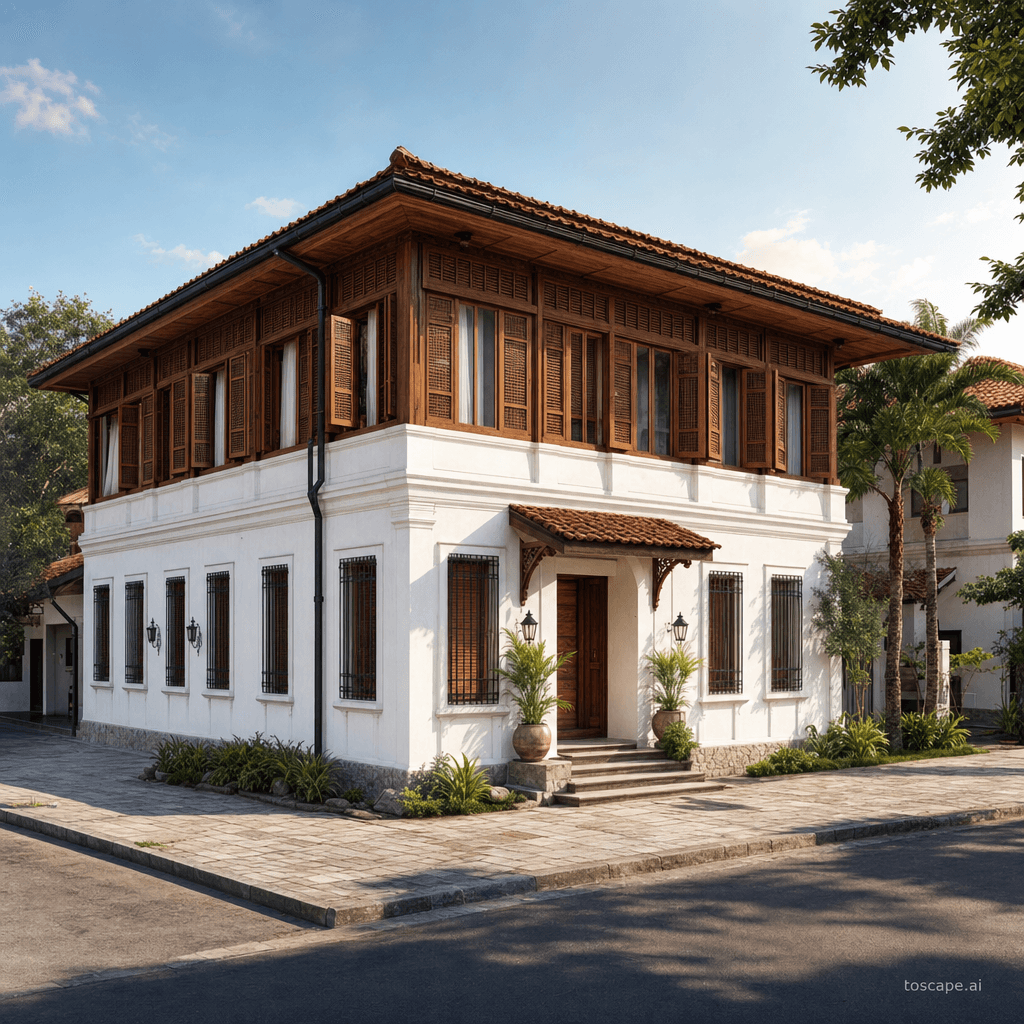
Luzon
Philippines · Ilocos Region & Central Luzon
Two-story hybrid typology — planta baja (ground floor) of cut stone or brick masonry (piedra china in Vigan), wooden upper floor (entresuelo/principal) with capiz-shell sliding windows (ventanillas), steep hipped roofs of curved terracotta teja curva tiles, ca...
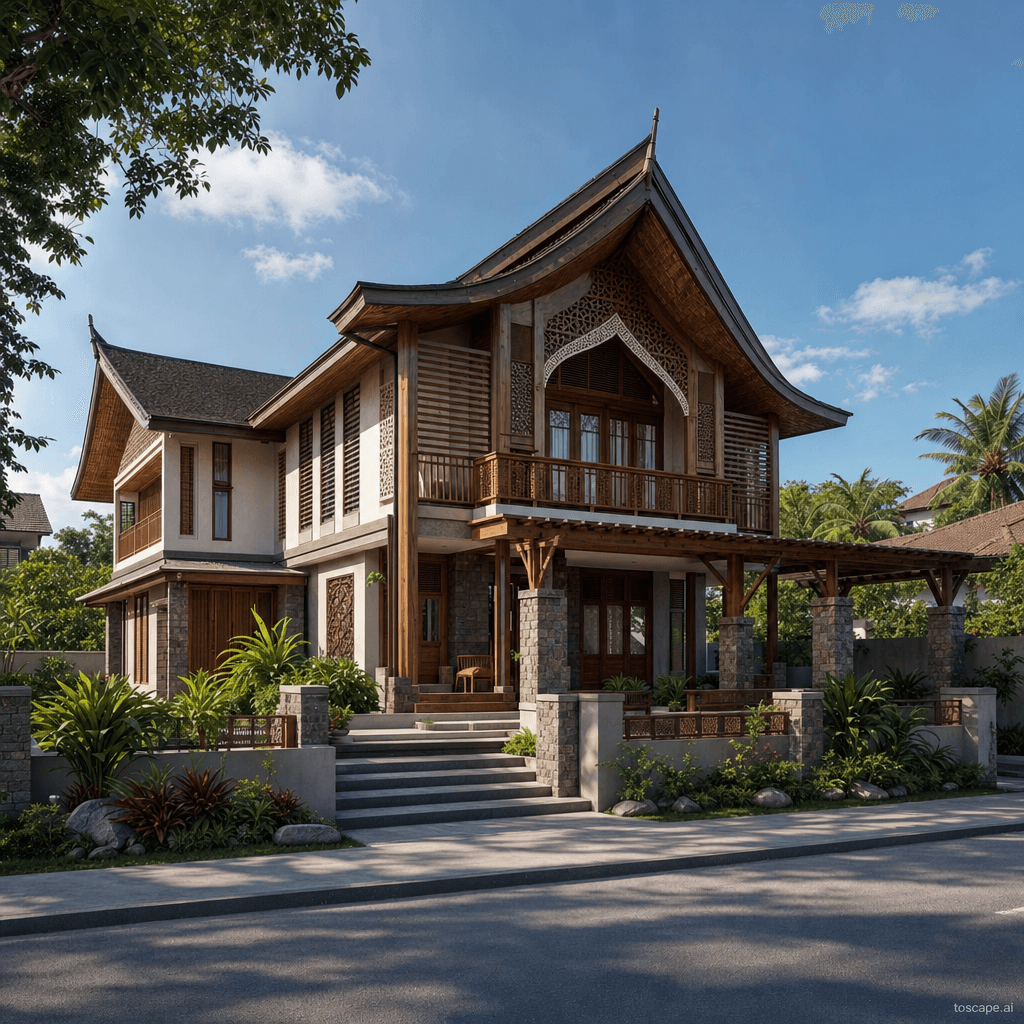
Mindanao
Philippines · Lanao del Sur
Torogan — the Sultan's great house: massive elevated timber hall (40m+ long) raised on colossal tree-trunk pillars (tapuwilih), no nails — all mortise-and-tenon and peg joinery, enormous steeply-pitched crenellated roof with sweeping flared eaves extending int...
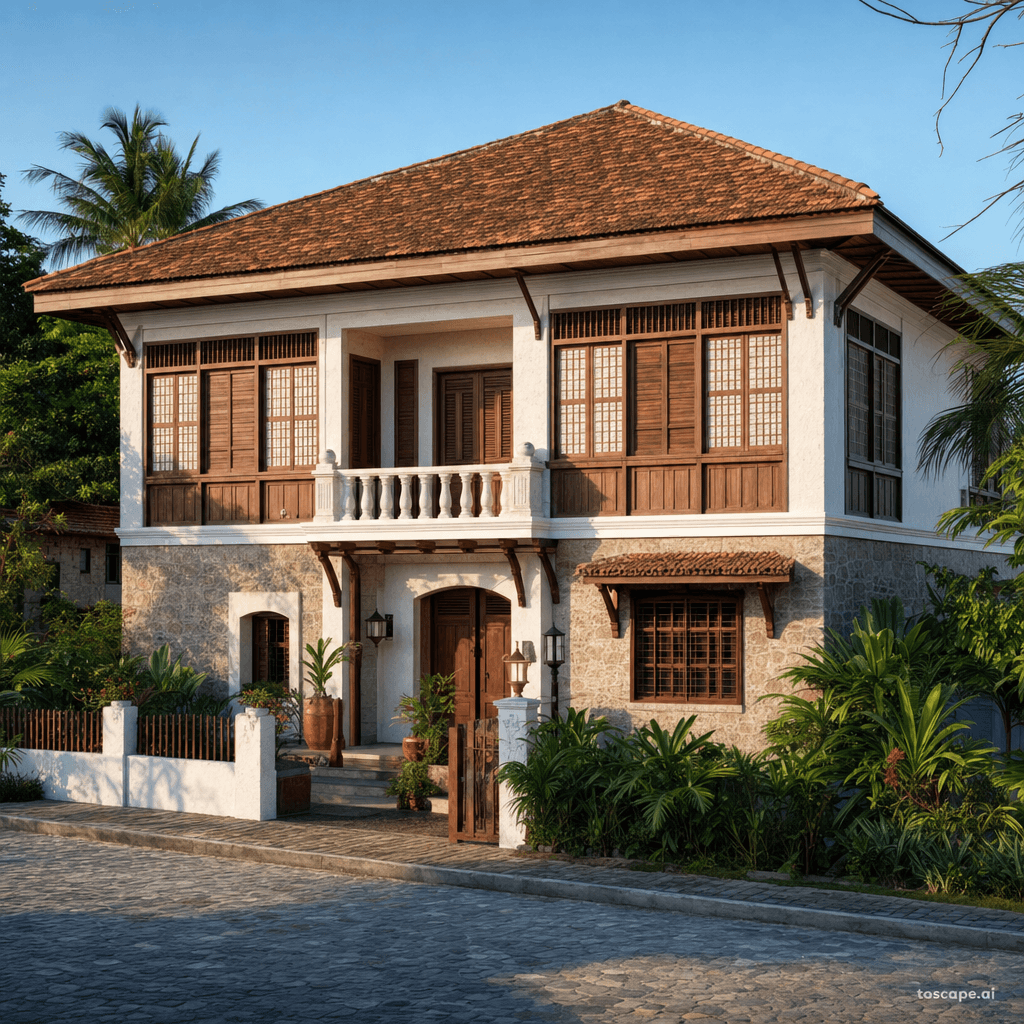
Visayas
Philippines · Bohol, Cebu, Panay
Massive coral stone (piedra de coral / batong korales) churches and watchtowers — quarried from reef limestone, buff-cream to honey-brown with visible coral fossils and shell inclusions, set with white lime mortar enhanced with egg-white (clara de huevo) for h...
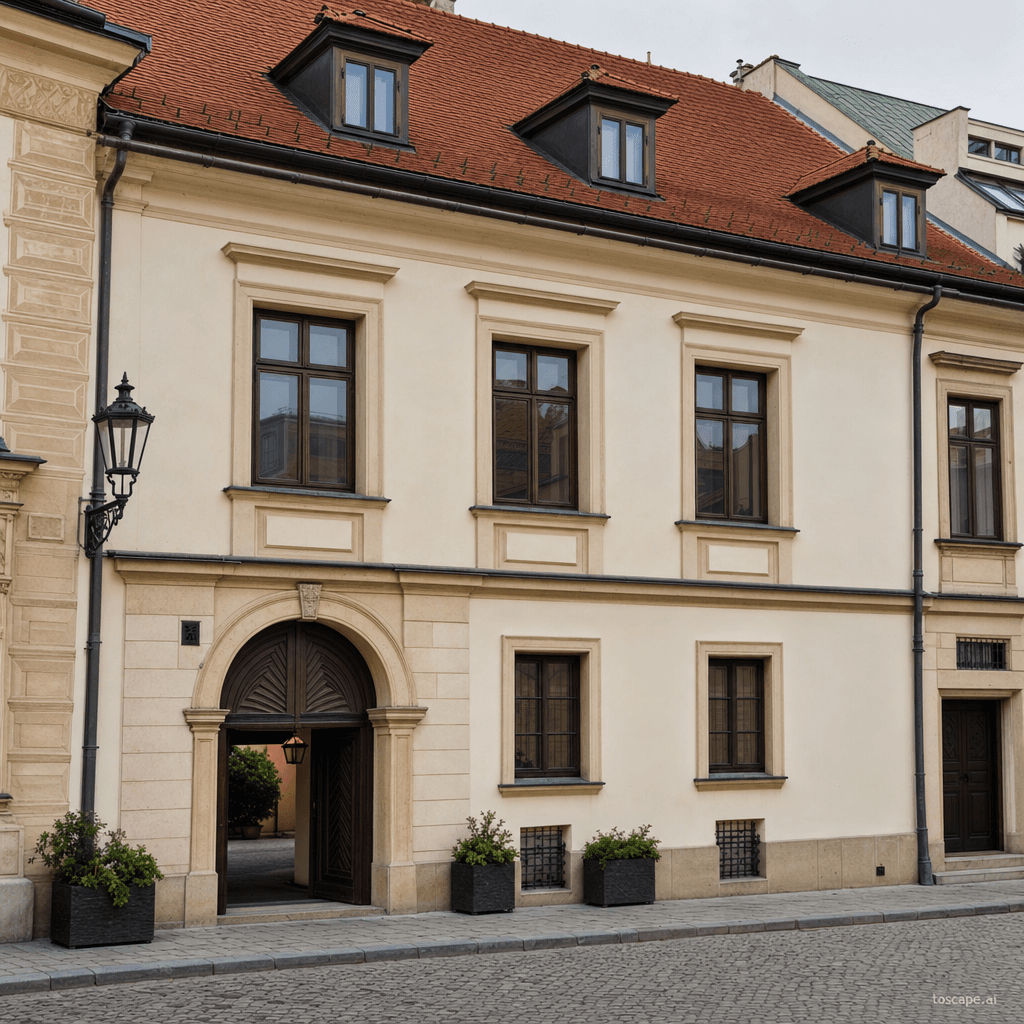
Polish Małopolska Kraków Courtyard Townhouse
Poland · Kraków kamienica
The Kraków kamienica — a masonry townhouse (brick with stone detail, rendered in warm cream or ochre tones) with a decorated attyka parapet crowning the facade — the street facade is organized in a vertical tripartite rhythm: ground-floor entrance hall (wide a...
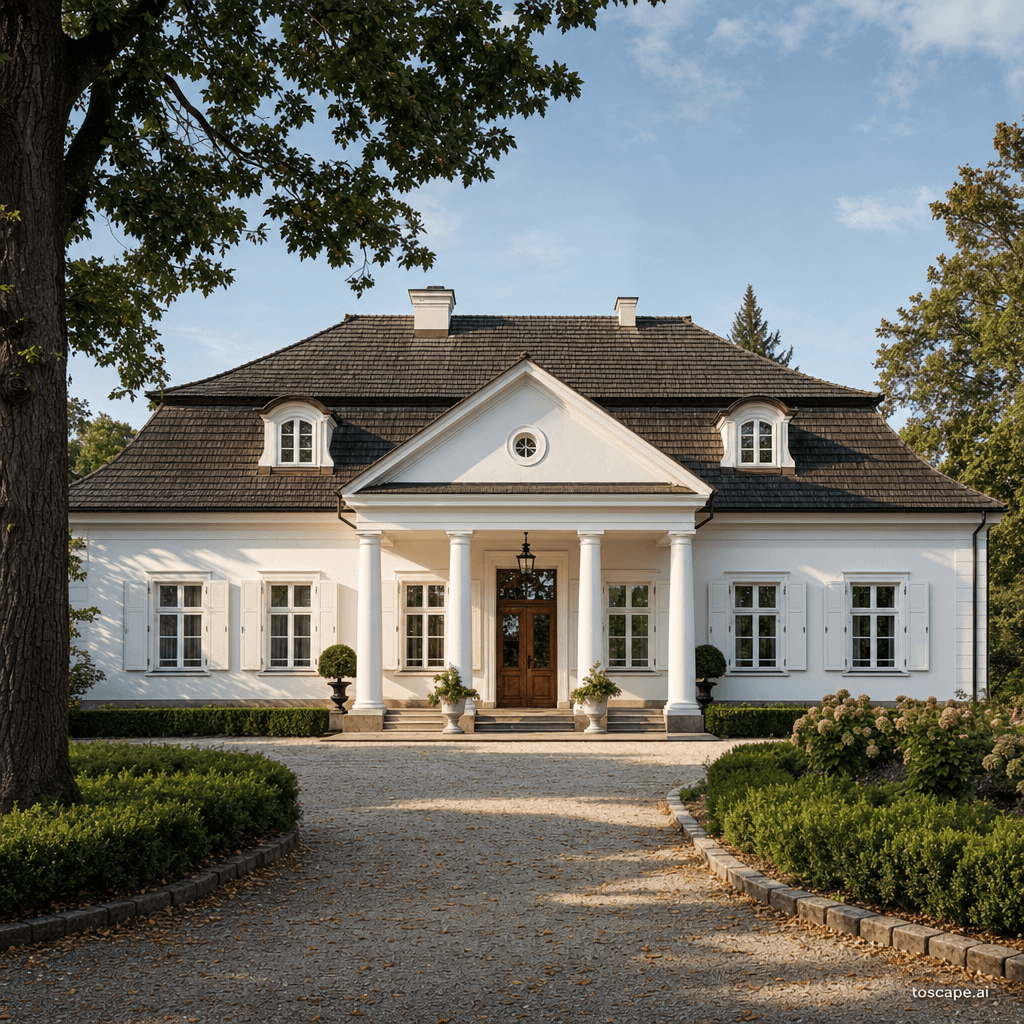
Polish Mazovia Manor House
Poland · Polish manor house (dwór szlachecki) of the Mazovia region
The Mazovian dwór — a symmetrical neoclassical country house, typically one story high on a low stone plinth, with a hipped roof (dach czterospadowy) or a Polish mansard (dach mansardowy polski — a mansard with a broken slope, steeper below and shallower above...
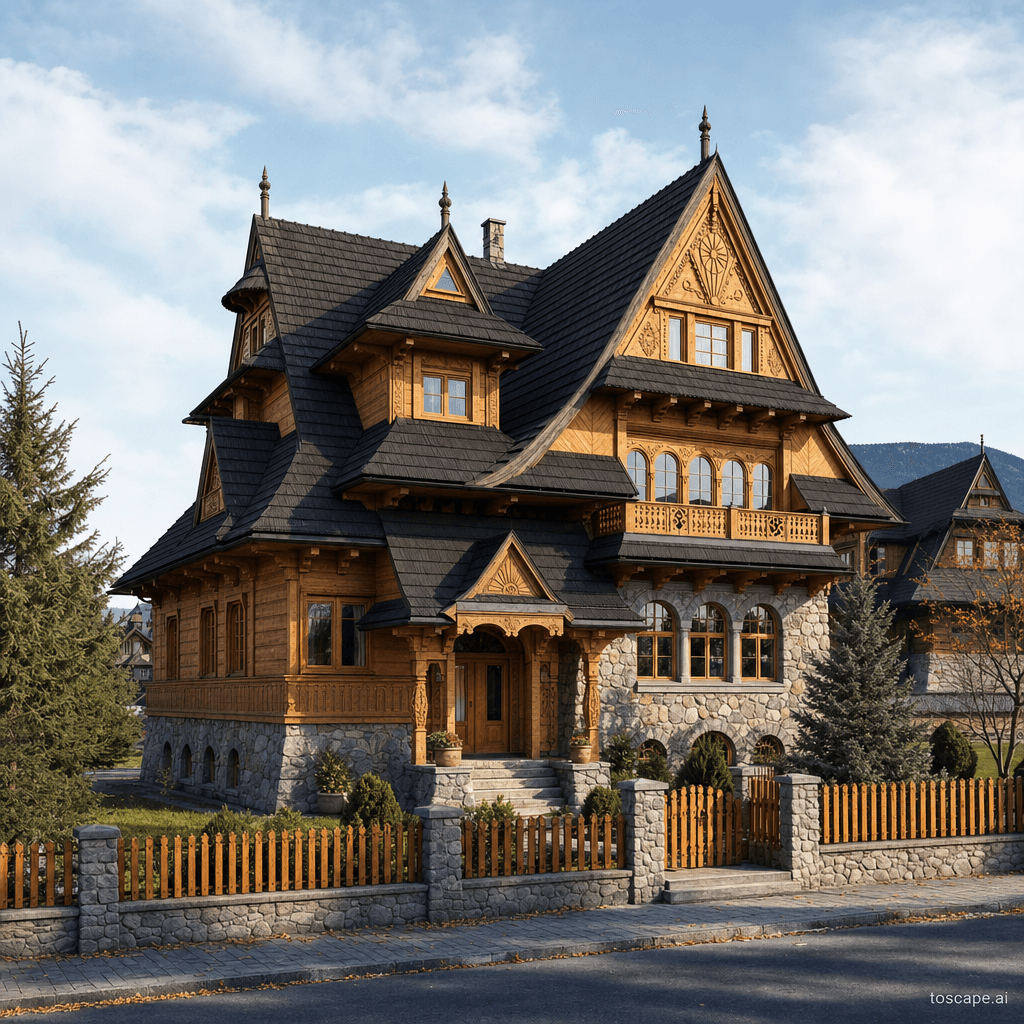
Polish Podhale Zakopane Style
Poland · Zakopane Style (Styl Zakopiański)
The Zakopane Style chałupa — a rectangular log house (6–10 m wide, 10–20 m long) on a stone foundation (podmurówka, 1–1.5 m high, fieldstone or ashlar) — the walls are of horizontally laid spruce logs with projecting corner joints — the steep gable roof (45–55...
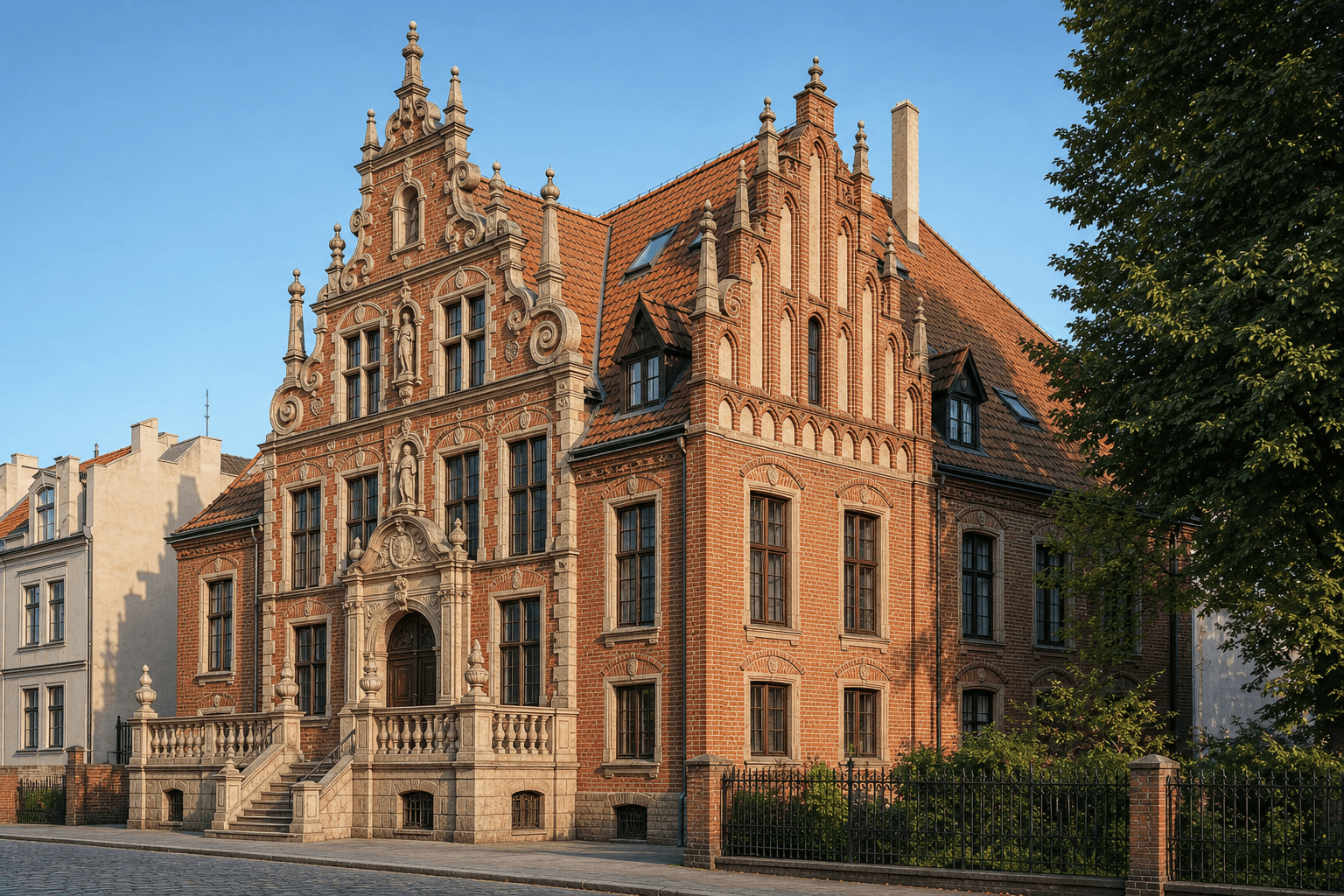
Polish Pomerania Gdańsk Brick Gothic
Poland · Hanseatic brick architecture of Gdańsk (Danzig) and the Pomeranian (Pomorze) Bal...
The Gdańsk kamienica — a tall narrow brick townhouse with a richly ornamented gable facade — the walls are of red brick (cegła gotycka — hand-formed brick, color ranging from warm orange-red to deep burgundy, #B85C3A to #8B3A2A) with contrasting stone elements...
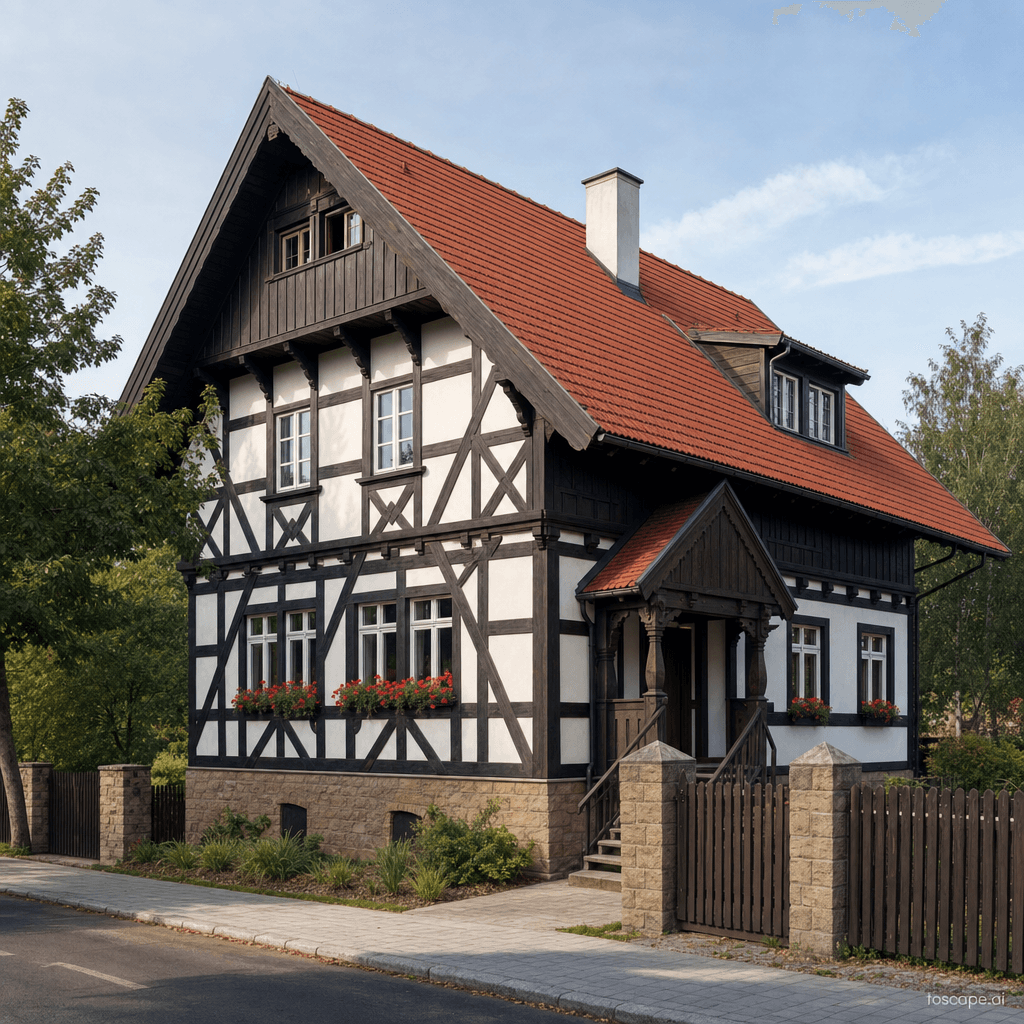
Polish Silesia Half-Timbered Cottage
Poland · Silesian timber-framed cottage
The dom przysłupowy / Umgebindehaus — a hybrid wooden house where the ground-floor living room is a massive dark log cube, while the upper floor and gable are a lighter half-timbered (Fachwerk) structure with whitewashed panels — the most distinctive visual el...
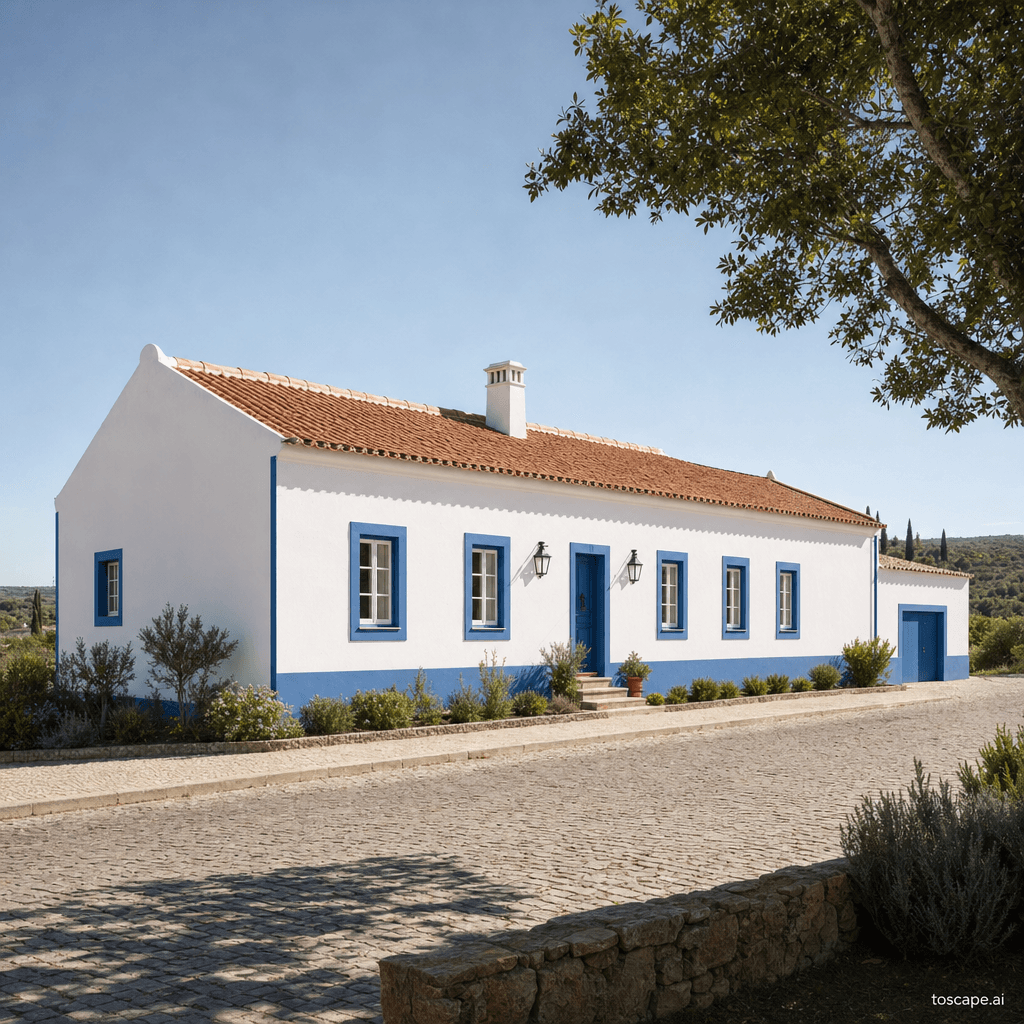
Alentejo
Portugal · Alentejo province
Brilliant white lime-washed cubist volumes — simple, stark, geometric rectangular blocks under the intense Alentejan sun, with minimal openings piercing the thick walls, flat or very low-pitched roofs hidden behind parapet walls (platibanda) giving a pure cubi...
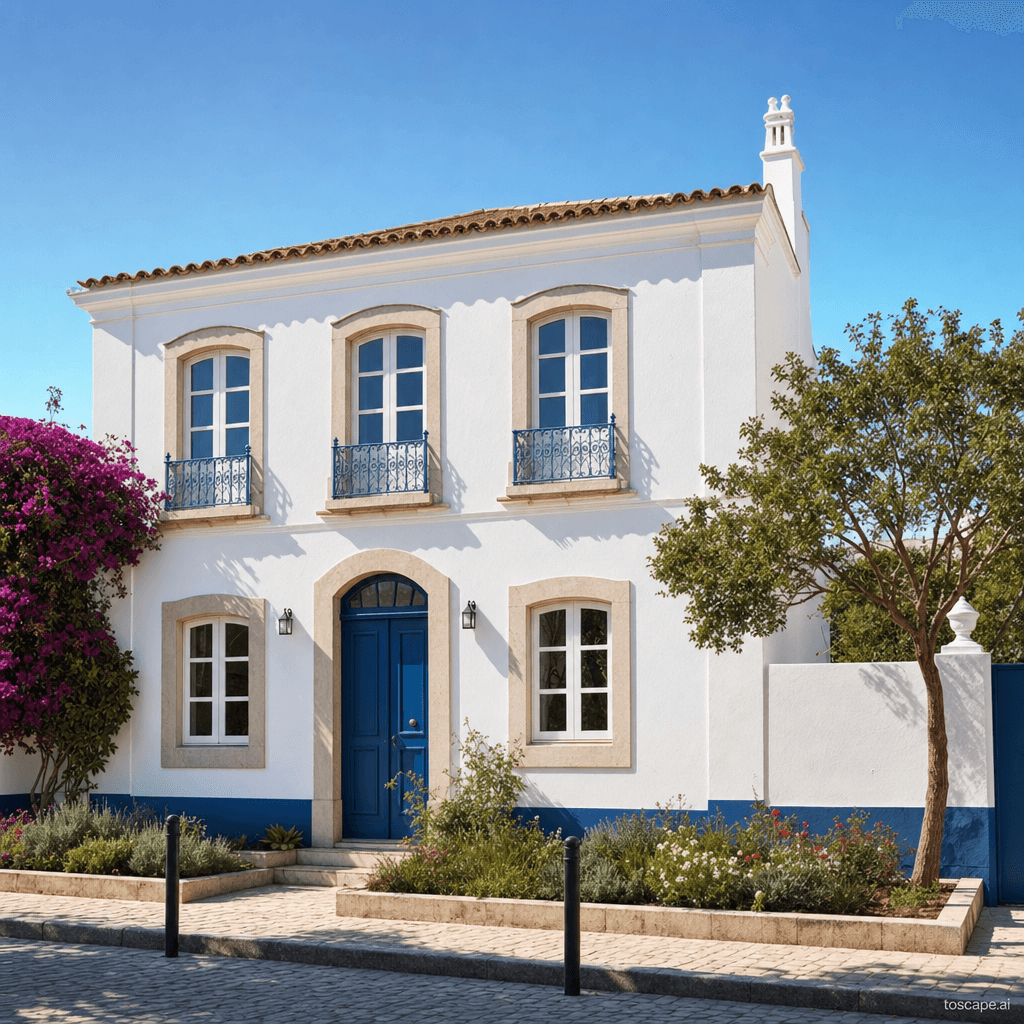
Algarve
Portugal · Algarve
Brilliant whitewashed cubic volumes — the defining Algarvian architecture, a legacy of Moorish (al-Andalus) influence on Portugal's southern coast, flat roofs used as habitable terraces (açoteias) with low parapet walls — the rooftop as living space, white pla...
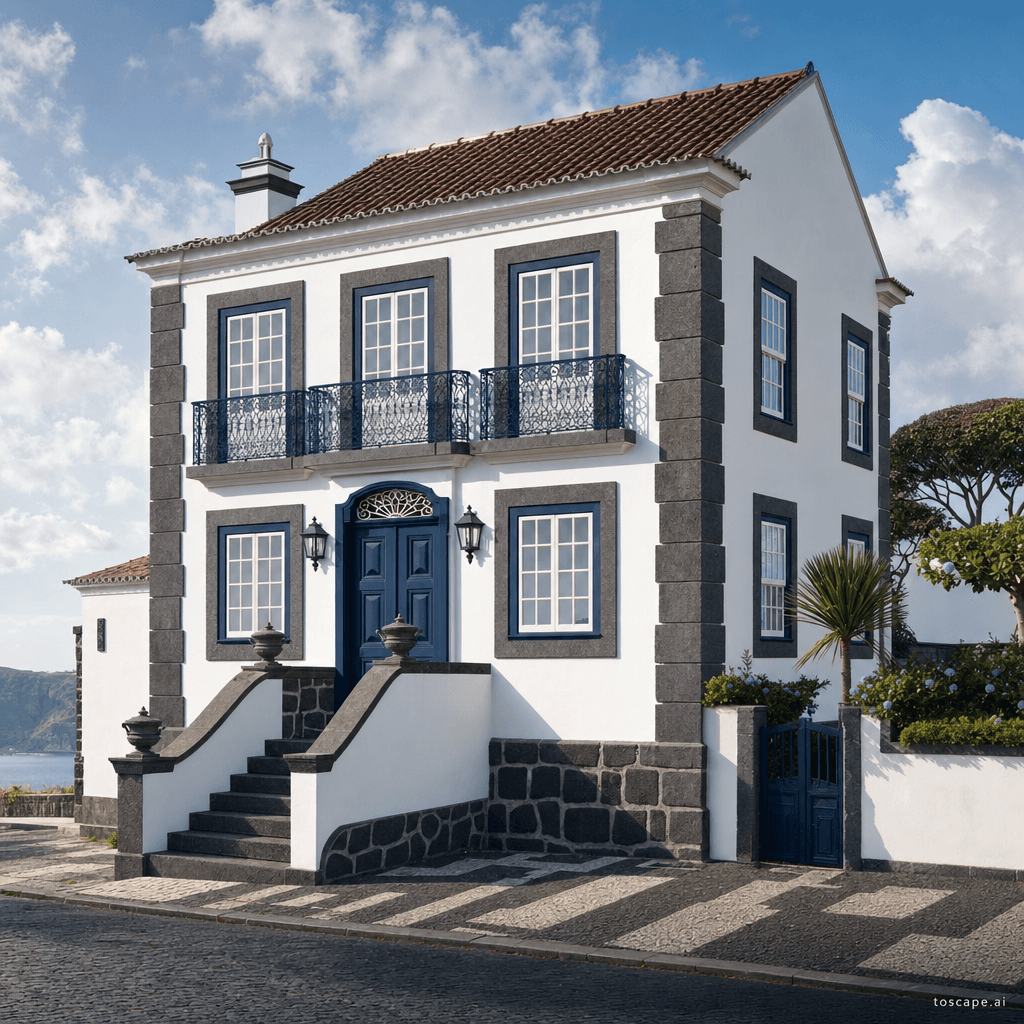
Azores
Portugal · Azores archipelago
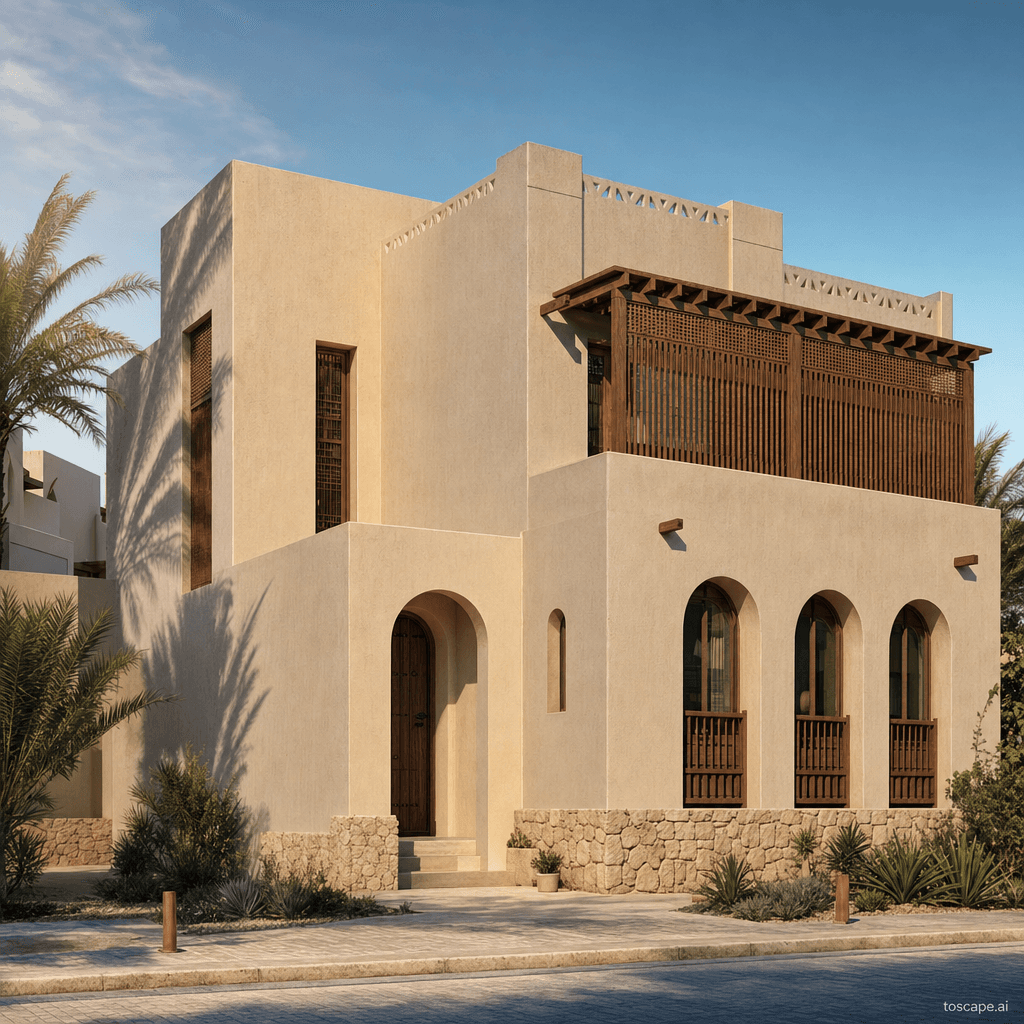
Dark grey to black volcanic basalt stone walls — the defining Azorean building material, quarried from the ubiquitous volcanic bedrock, laid as coursed rubble or dressed ashlar, often with white-painted lime mortar joints creating a striking black-and-white gr...
Beira
Portugal · Beira region (Beira Alta and Beira Baixa)
Dark grey schist (xisto) stone walls — the defining material of Beira mountain villages (Aldeias do Xisto), laid as random rubble with thick mortar joints, often left unrendered, creating a dark, monolithic architecture that blends into the grey mountain lands...
Madeira
Portugal · Madeira archipelago
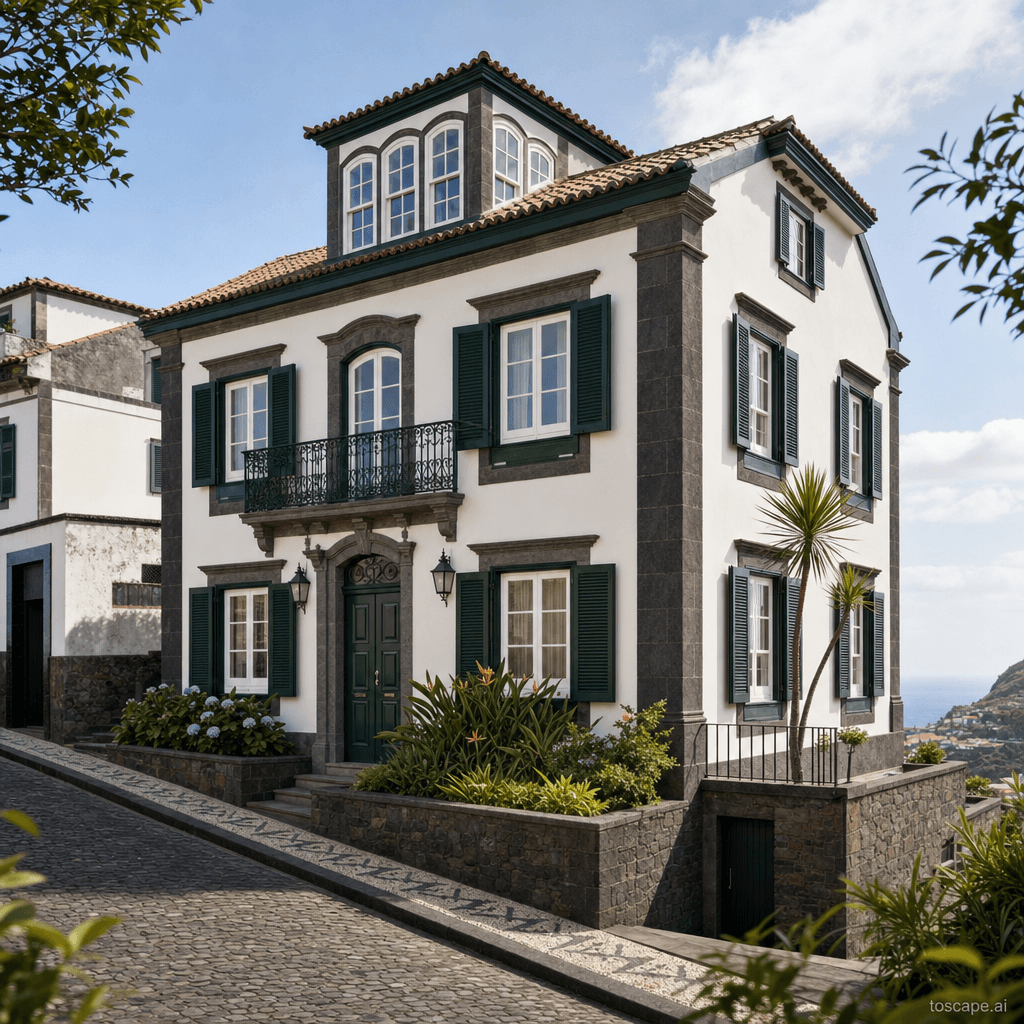
Dark grey basalt stone walls — the volcanic bedrock of Madeira, laid as coursed rubble with thick mortar joints, often whitewashed (caiação) for brightness, steep pitched roofs in red clay canal tiles or, in the distinctive Santana houses (casinhas de Santana)...
Minho
Portugal · Minho province
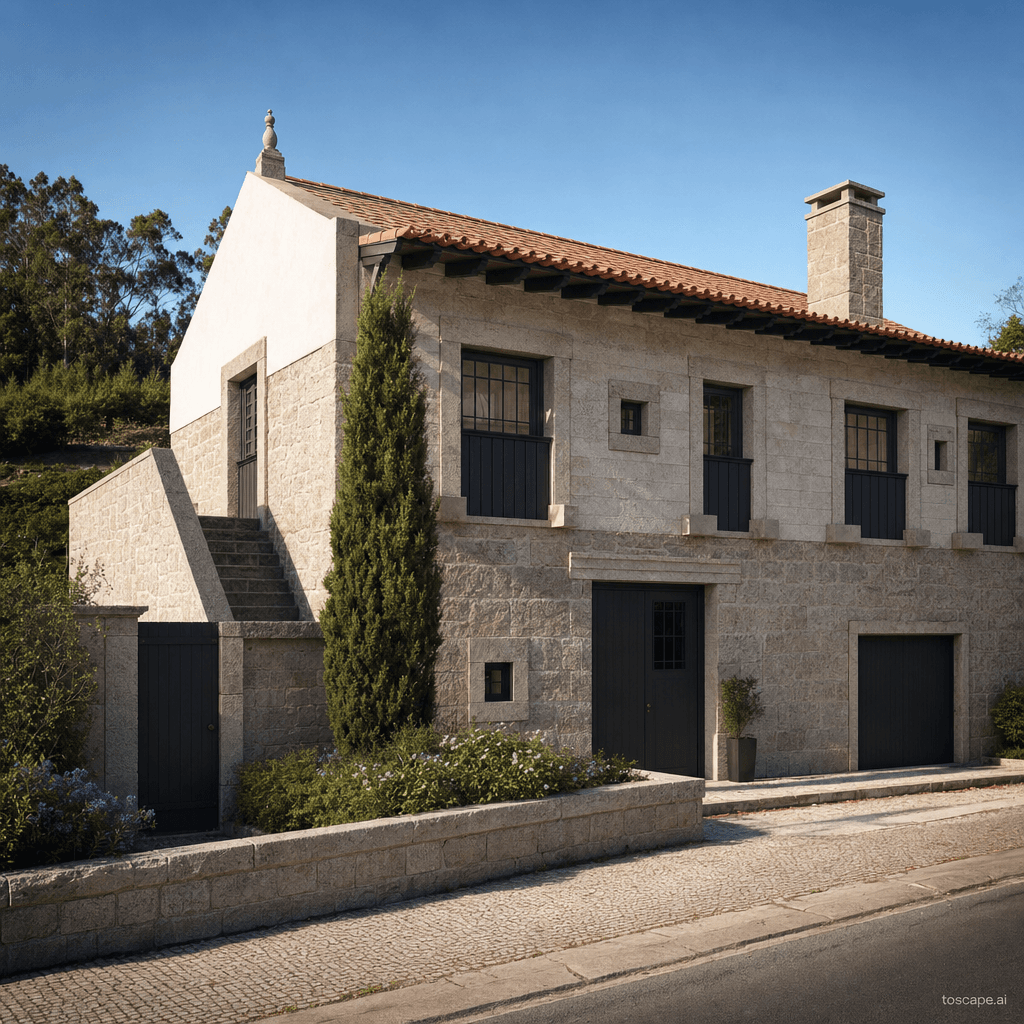
Massive grey granite (granito) walls — the defining Minho building material, laid as coursed rubble or dressed ashlar in monumental blocks, often left exposed with wide lime mortar joints — a northern Portuguese stonemasonry tradition of great weight and prese...
Doha Urban
Qatar · and contemporary architecture of Doha and the Qatar peninsula
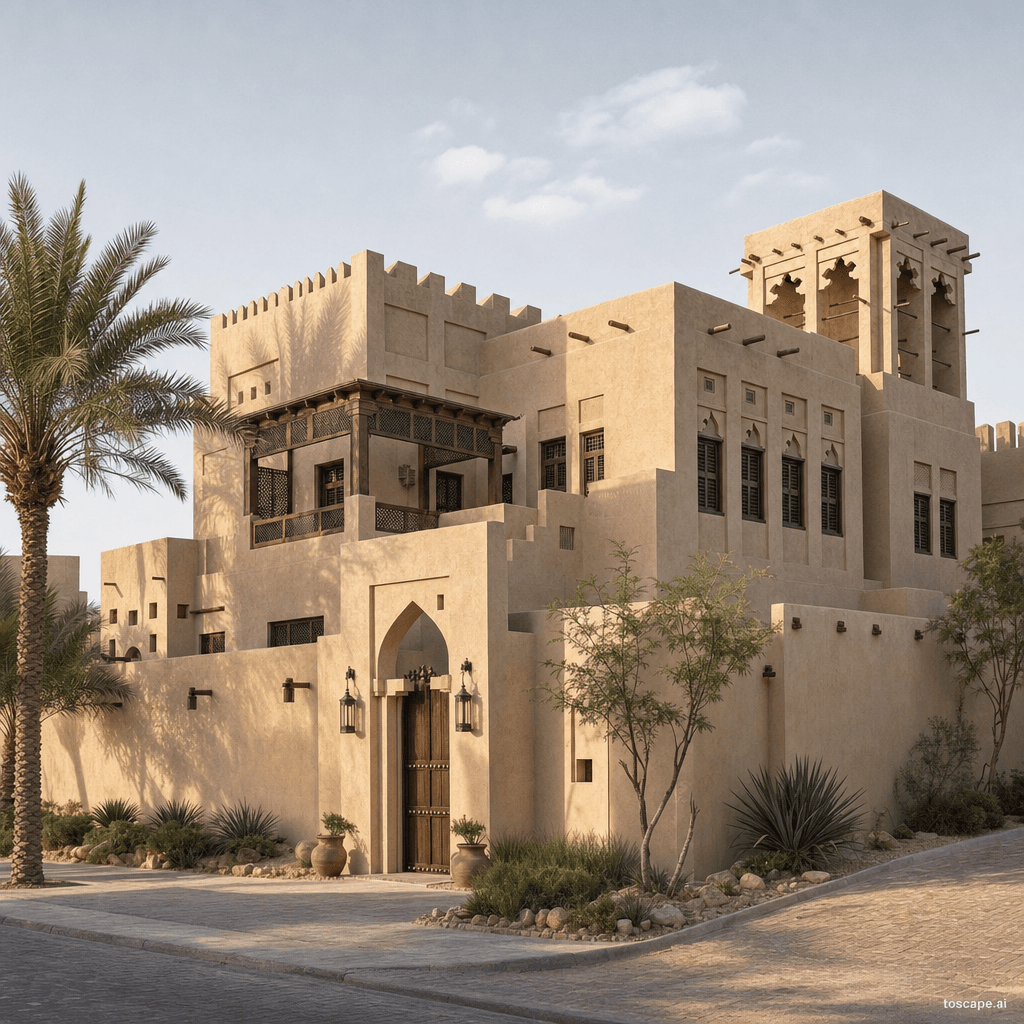
Courtyard house (al-hosh) as spatial DNA — introverted plan around central open space — badgir (wind tower) integration for passive cooling — screened openings with privacy gradient from public to private — limestone and gypsum plaster material palette — flat...
Qatar Inland Desert
Qatar · desert architecture of Qatar's interior
The Bedouin tent (bayt al-sha'r) — woven black goat-hair cloth stretched over wooden poles — the portable architecture of nomadic herding life — desert fortresses (husn) — rectangular or square stone-and-mud compounds with corner towers, crenellated parapets...
Qatar Northern Coastal
Qatar · coastal architecture of Qatar's northern settlements
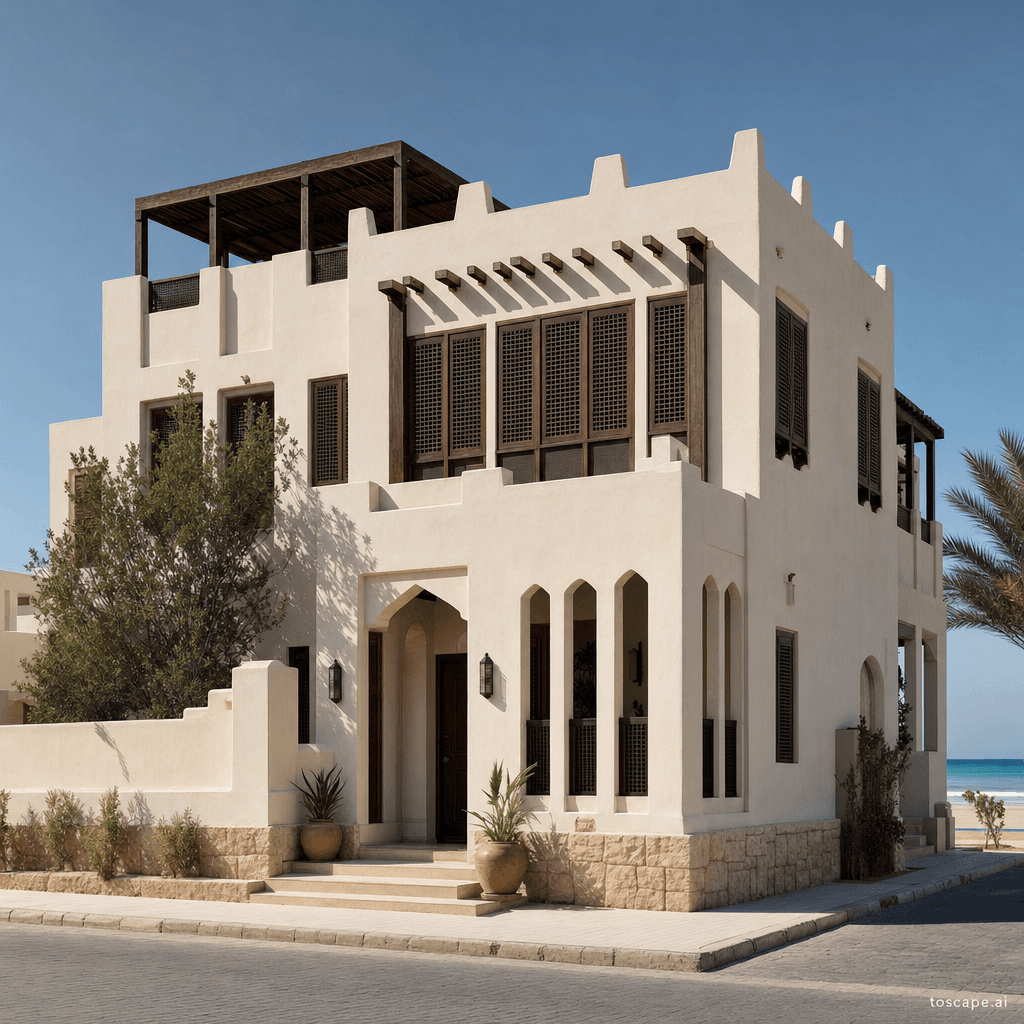
Coral stone (farrush) and limestone construction — walls of quarried coastal rock set in gypsum mortar — flat roofs with mangrove pole beams (dangal) and palm-frond matting (barusti) — compact, clustered settlement morphology around the natural harbor (khor) —...
Caucasus Mountain
Russia · mountain architecture of the North Caucasus
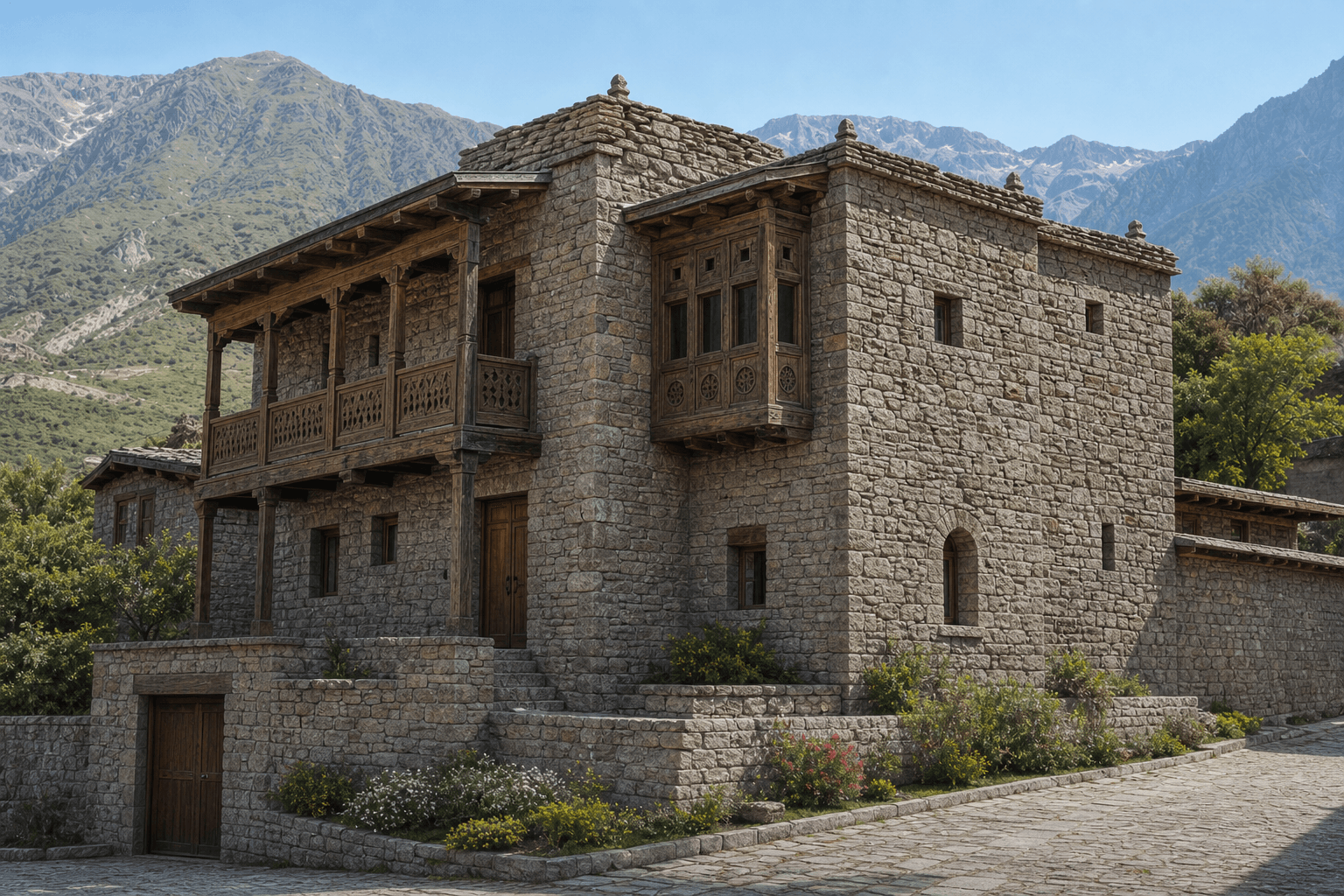
The Caucasus mountain aul — a terraced stone village (50–200 structures) clinging to a mountainside at 1,500–2,500 m elevation, built entirely from local stone (limestone, shale, sandstone) with minimal or no mortar in the oldest structures — the defensive tow...
Karelian Log
Russia · traditional Karelian log house (pirtti/izba) of the Republic of Karelia and the...
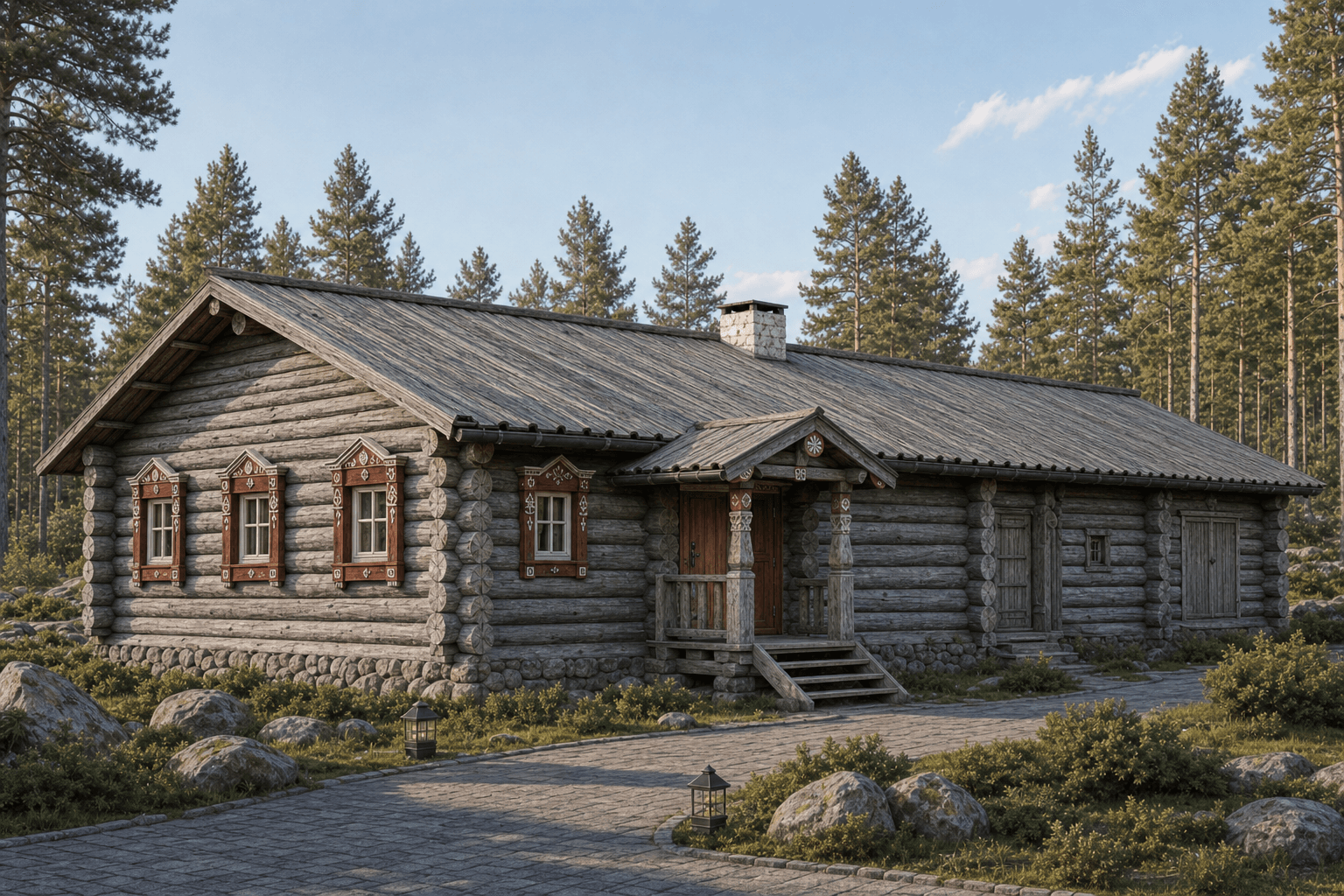
The Karelian dom-kompleks — a single long log structure (15–30 m long, 5–8 m wide) combining human dwelling and farm buildings under one continuous gable roof (30–40° pitch) — the living quarters occupy one end, with the Russian stove (pech) as the center, ext...
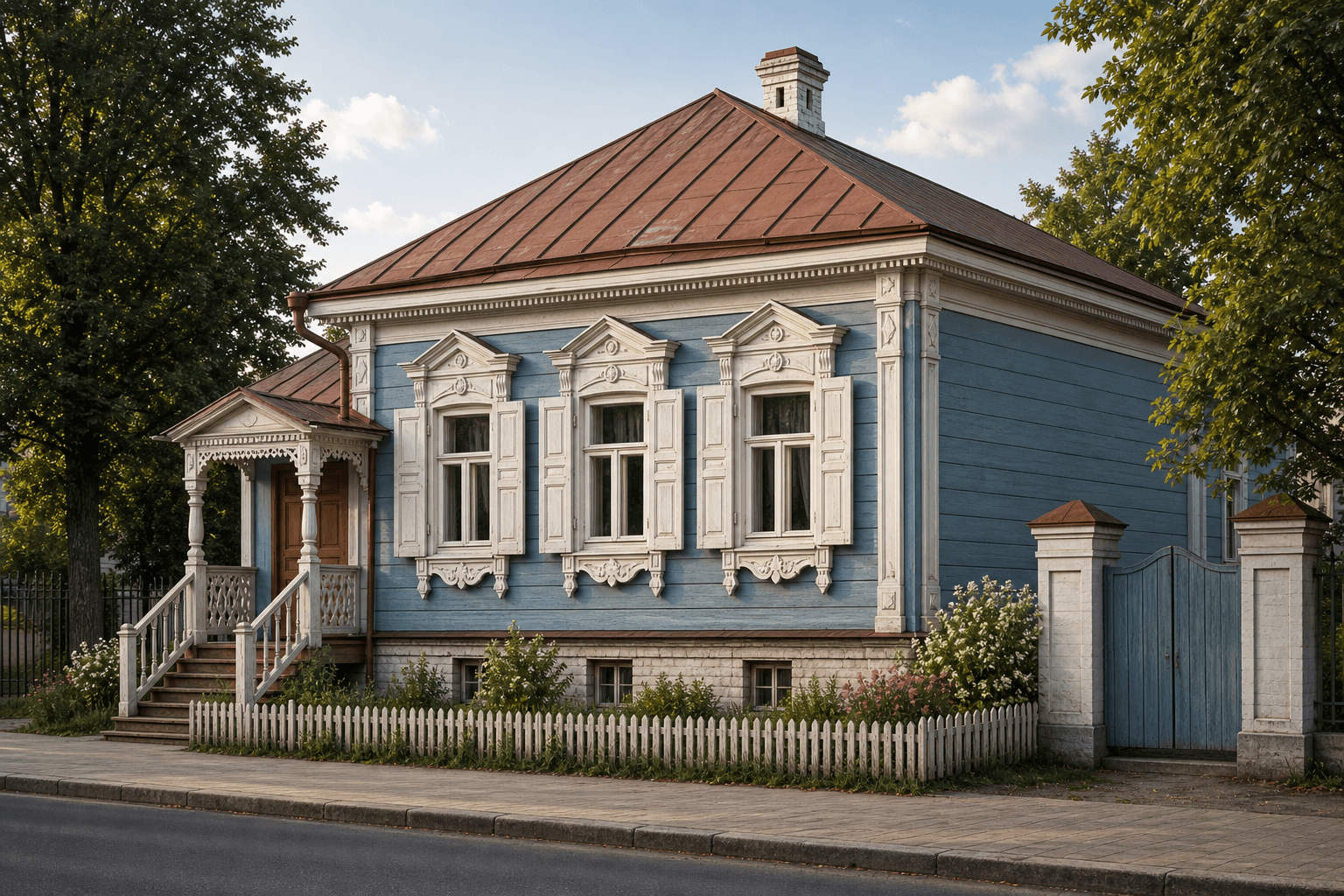
Moscow Central Russian
Russia · central Russian izba of the Moscow, Vladimir, Yaroslavl, and Tver regions
The central Russian izba — a log house (5–7 m wide, 7–12 m deep) with a hipped roof (25–35° pitch) clad in planks or sheet metal — the podklet is low or absent — the facade is organized symmetrically with 3 windows (a three-window composition is standard: okna...
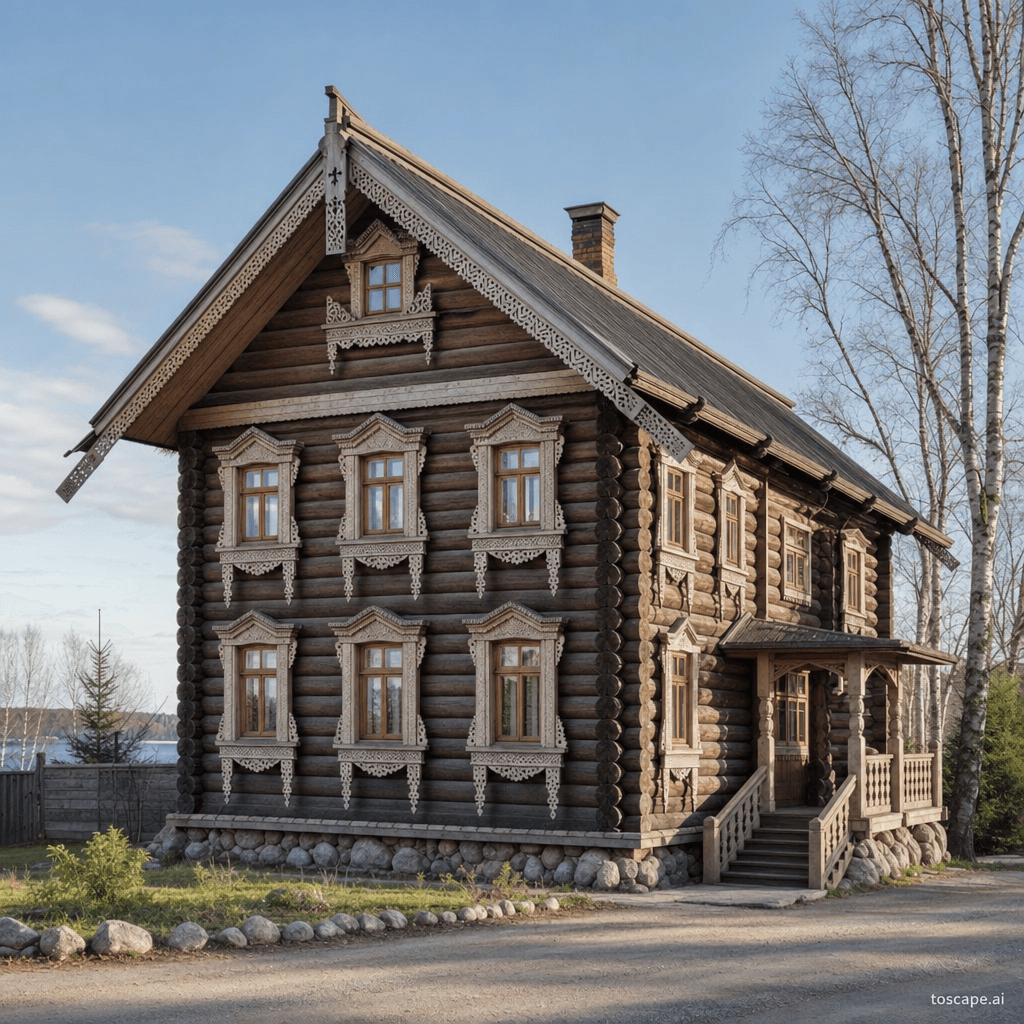
Russian Northern Izba
Russia · northern Russian izba (peasant house) of the Russian North
The northern izba — a single massive log cube (5–8 m wide, 8–15 m long) with a steep gable roof (40–50° pitch) clad in wood shingles (lemekh) or planks — the walls are of horizontally laid pine logs, their ends projecting at the corners — the high podklet rais...
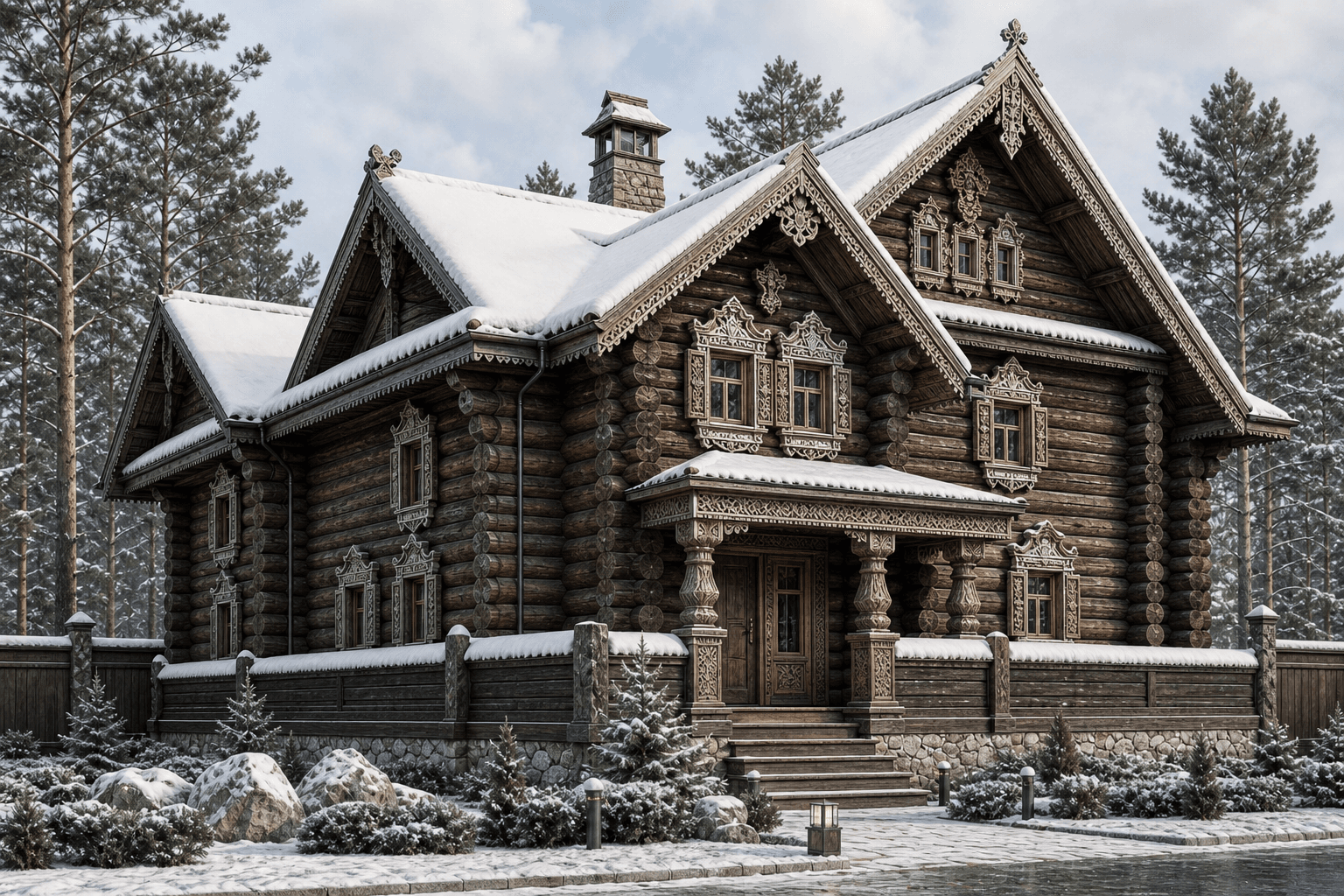
Siberian Log
Russia · traditional Siberian log house
The Siberian izba — a massive log cube (6–10 m wide, 8–16 m long) with thick walls (20–40 cm logs), a steep gable roof (45–55°) to shed heavy snow, and the defining Siberian element: the zamet — a low timber wall or fence built around the eaves, effectively cr...
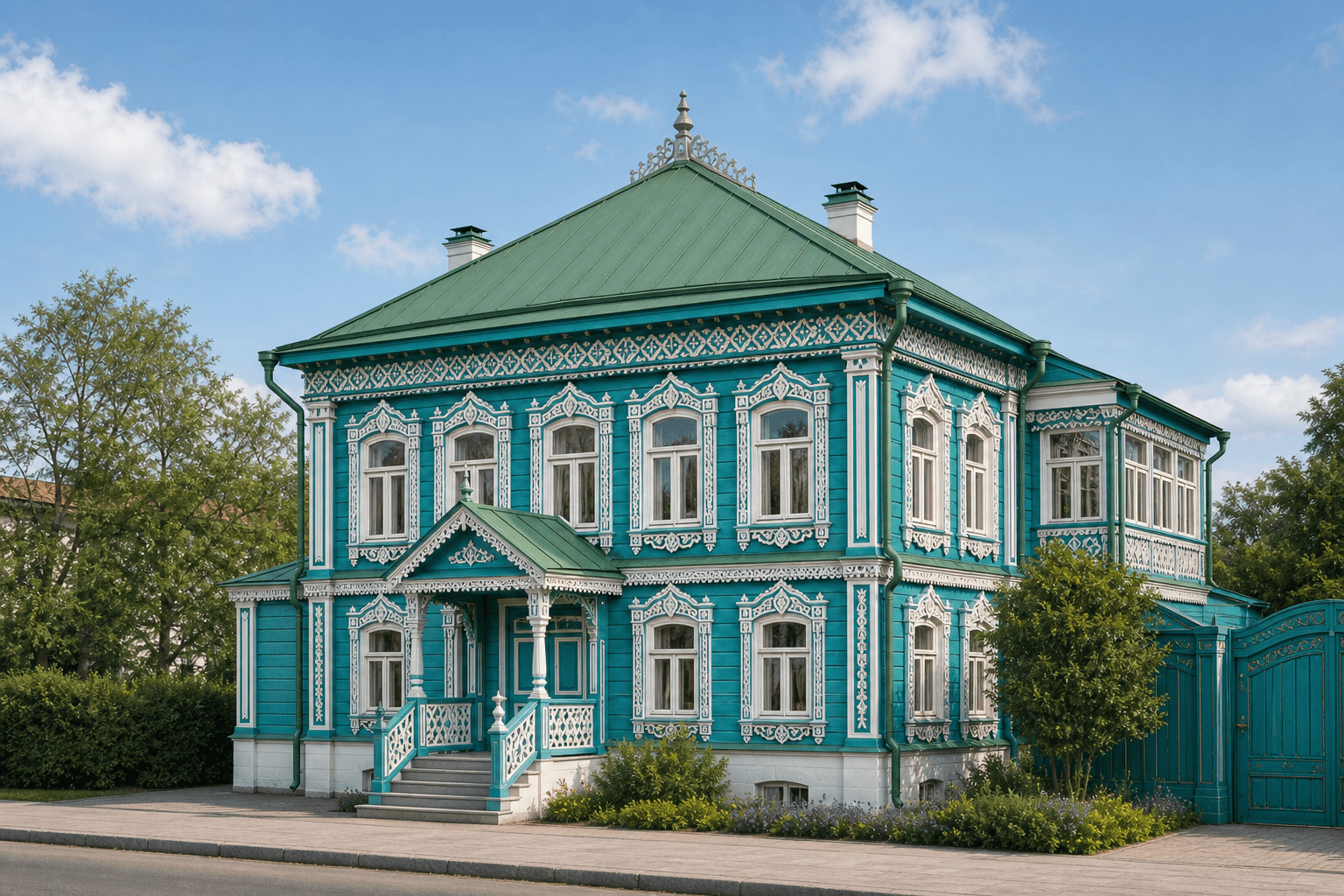
Tatarstan Wooden House
Russia · traditional Tatar wooden house (agaç öy) of Tatarstan and the Middle Volga regio...
The Tatar agaç öy — a log house (5–8 m wide, 8–14 m deep) with a high hipped roof (35–45°), clad in brightly painted planks or with painted log walls — the defining visual element is the polychrome color scheme: the walls in turquoise, sky blue, or green; the...
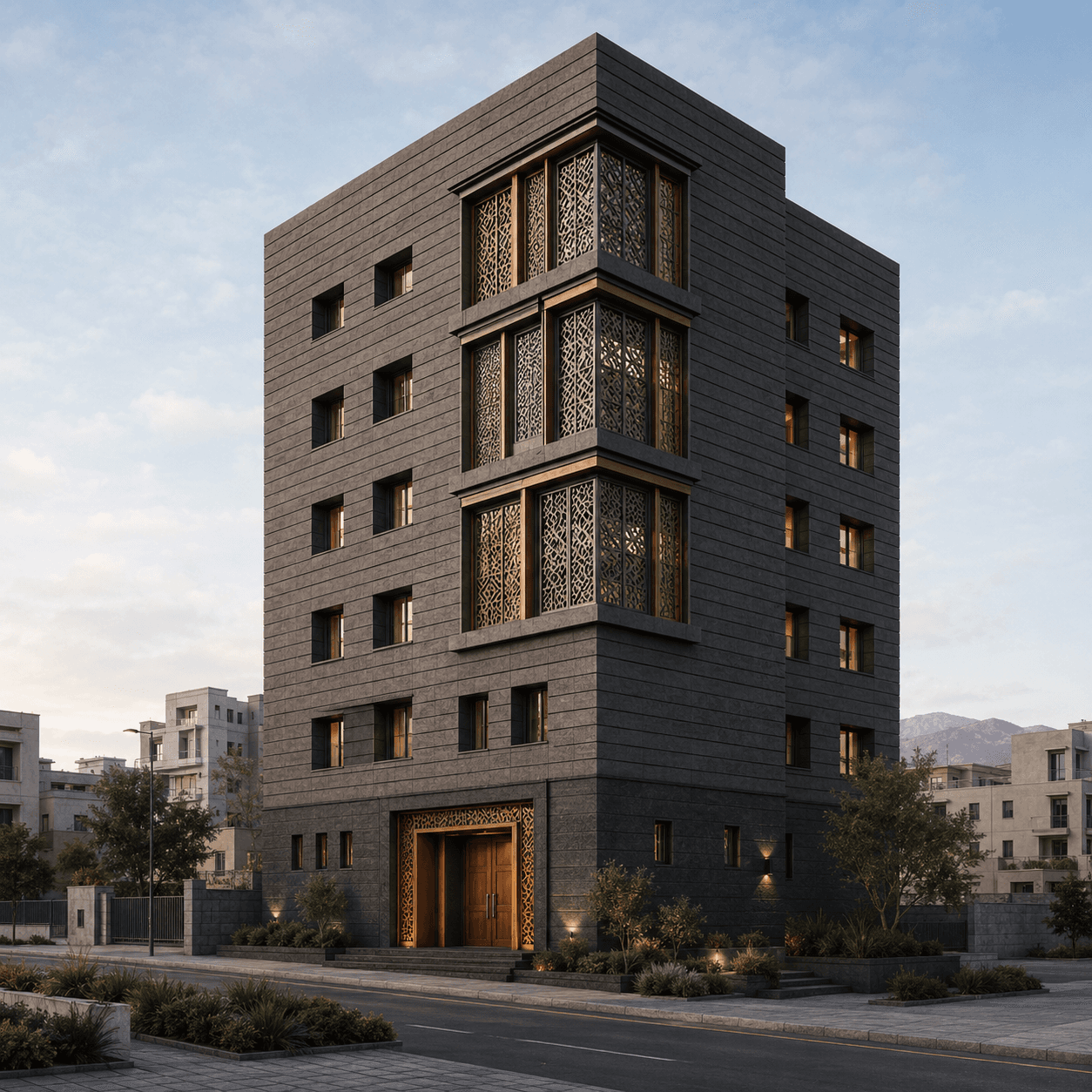
Abha Highlands Contemporary
Saudi Arabia · Abha Highlands
Light-strength essence — dark or warm-dark material palette referencing basalt stone — abstracted horizontal coursing logic replacing literal rushashah projections (horizontal recessed shadow lines or projecting concrete ribs at 35–60cm intervals) — deep windo...
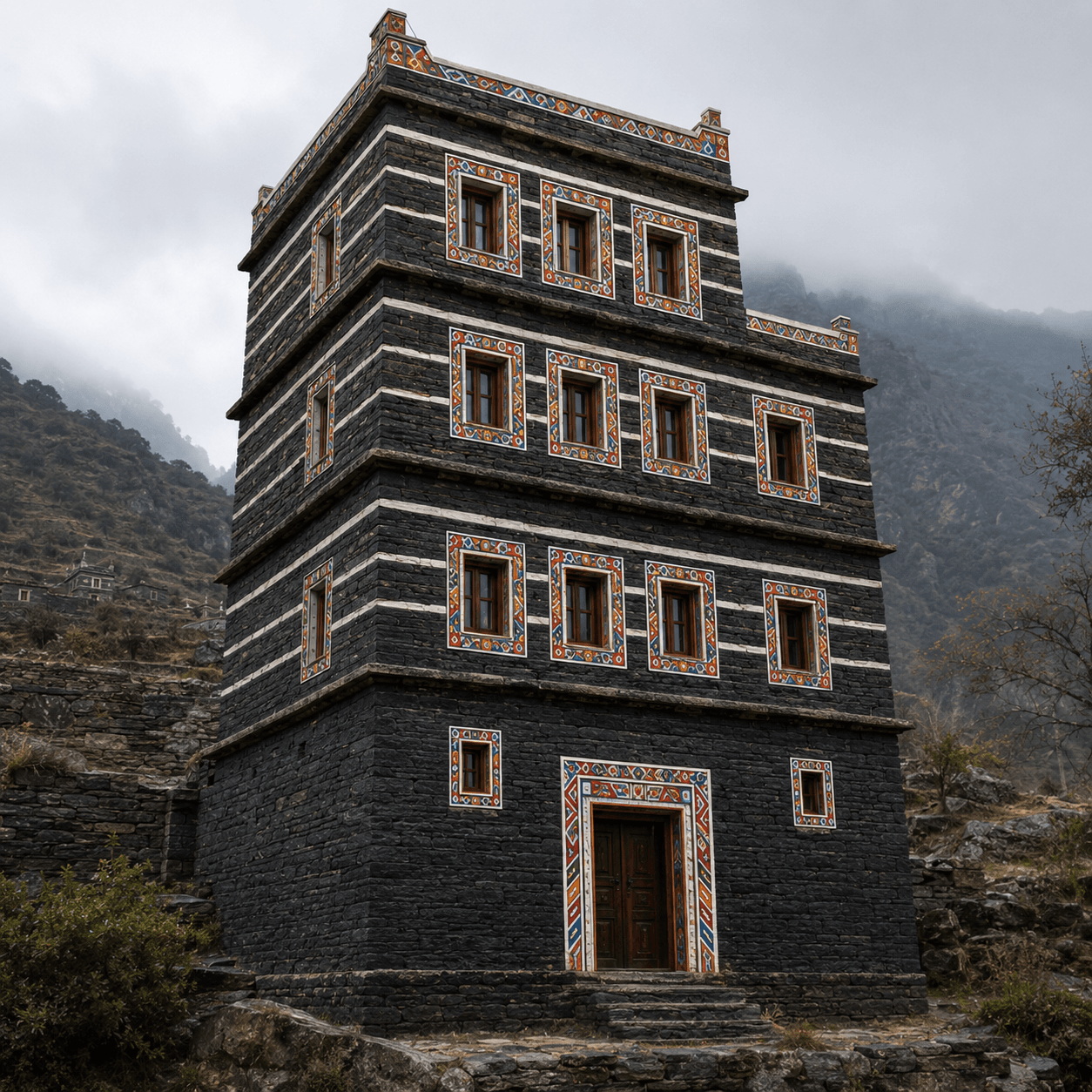
Abha Highlands Traditional
Saudi Arabia · Abha Highlands
Full-strength vernacular fidelity — dark basalt and slate stone load-bearing masonry — continuous rushashah projecting horizontal stone eyebrow courses at 30–50cm intervals — white lime takhreem banding between every course — compact vertical tower-house massi...
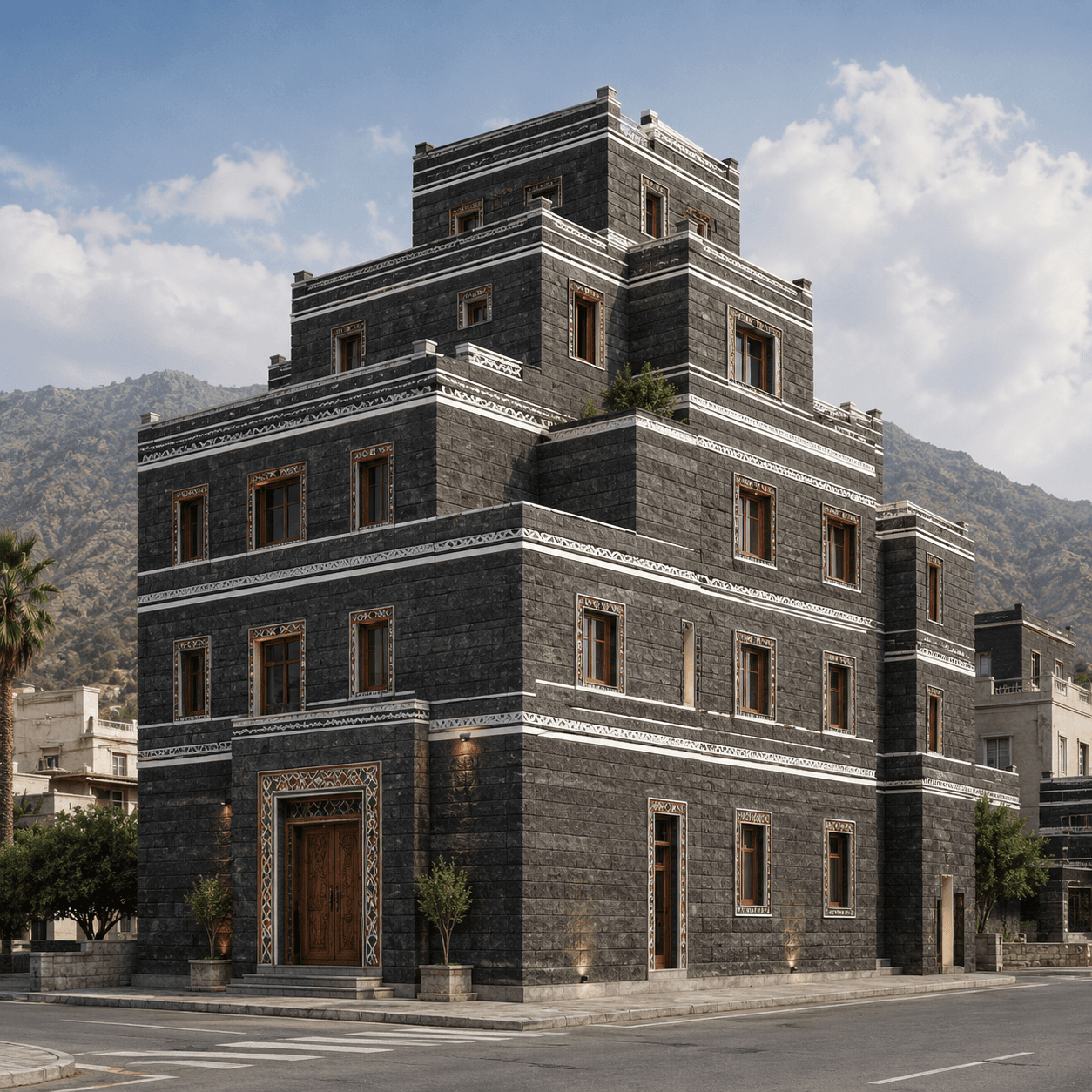
Abha Highlands Transitional
Saudi Arabia · Abha Highlands
Medium-strength traditional reference — dark stone or close-equivalent cladding retaining rushashah coursing logic (projecting stone cladding strips or concrete fins at 30–55cm intervals) — takhreem white banding maintained — simplified Al Qatt-inspired geomet...
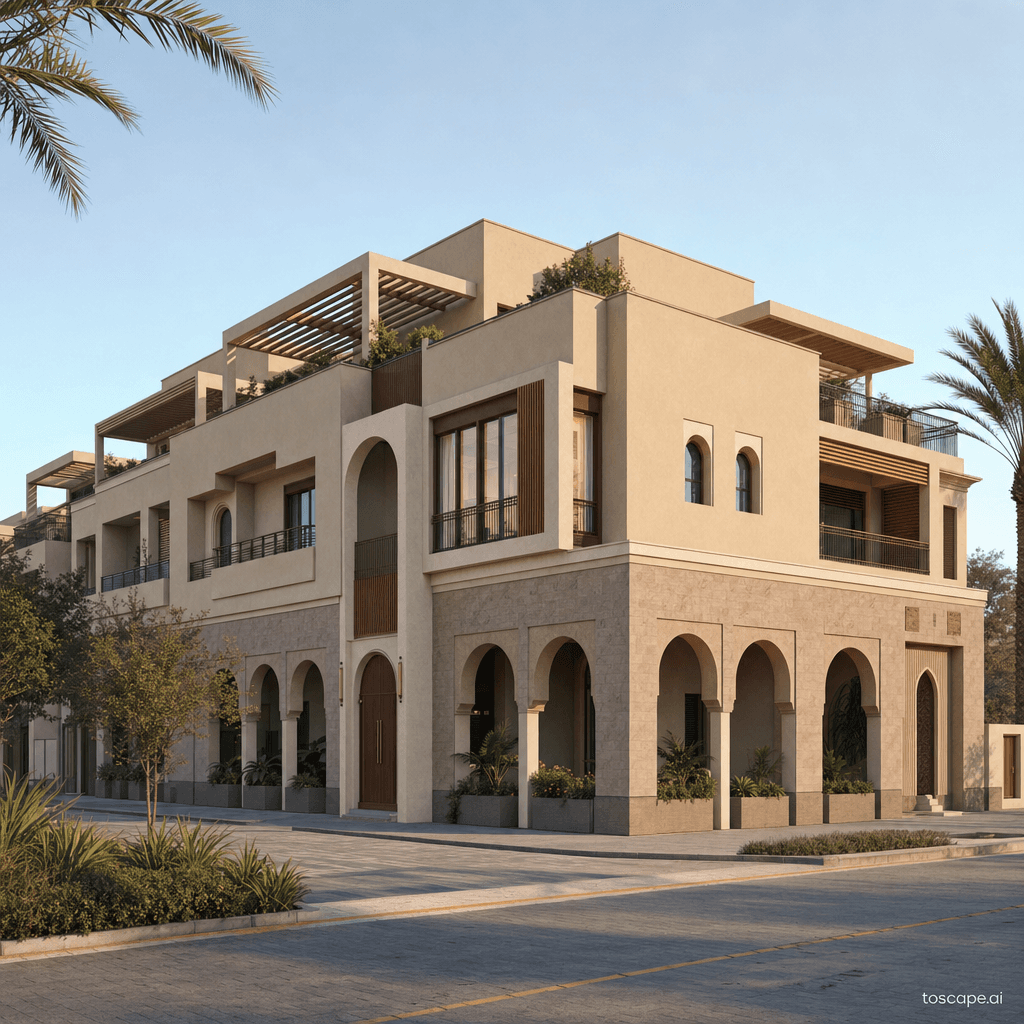
Al Ahsa Oasis Contemporary
Saudi Arabia · Al Ahsa Oasis
Horizontal massing maintained — abstraction of geometric planes and forms — less-ornamented arched elements — increased daylighting (40-60% void) — setbacks for shade — rooftops without crenellations — warm earth-tone palette — 70% primary earth tones / 30% ac...
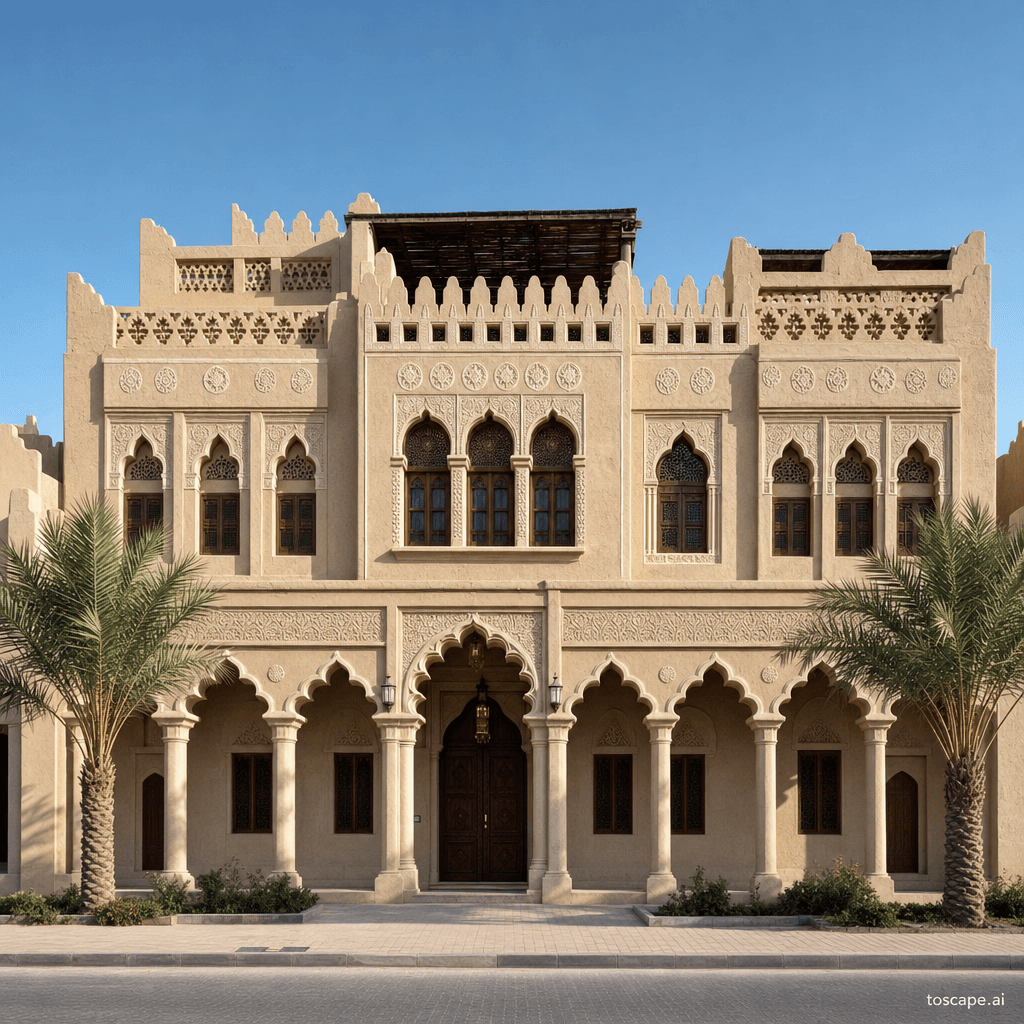
Al Ahsa Oasis Traditional
Saudi Arabia · Al Ahsa Oasis
Horizontal massing (width-to-height 1.3:1 to 2.2:1) — tripartite facade with base arcades + windowed middle + crenellated top — lotus-blossom cusp arches as signature element — elaborate carved plaster ornamentation with floral motifs and rosettes — stepped ro...
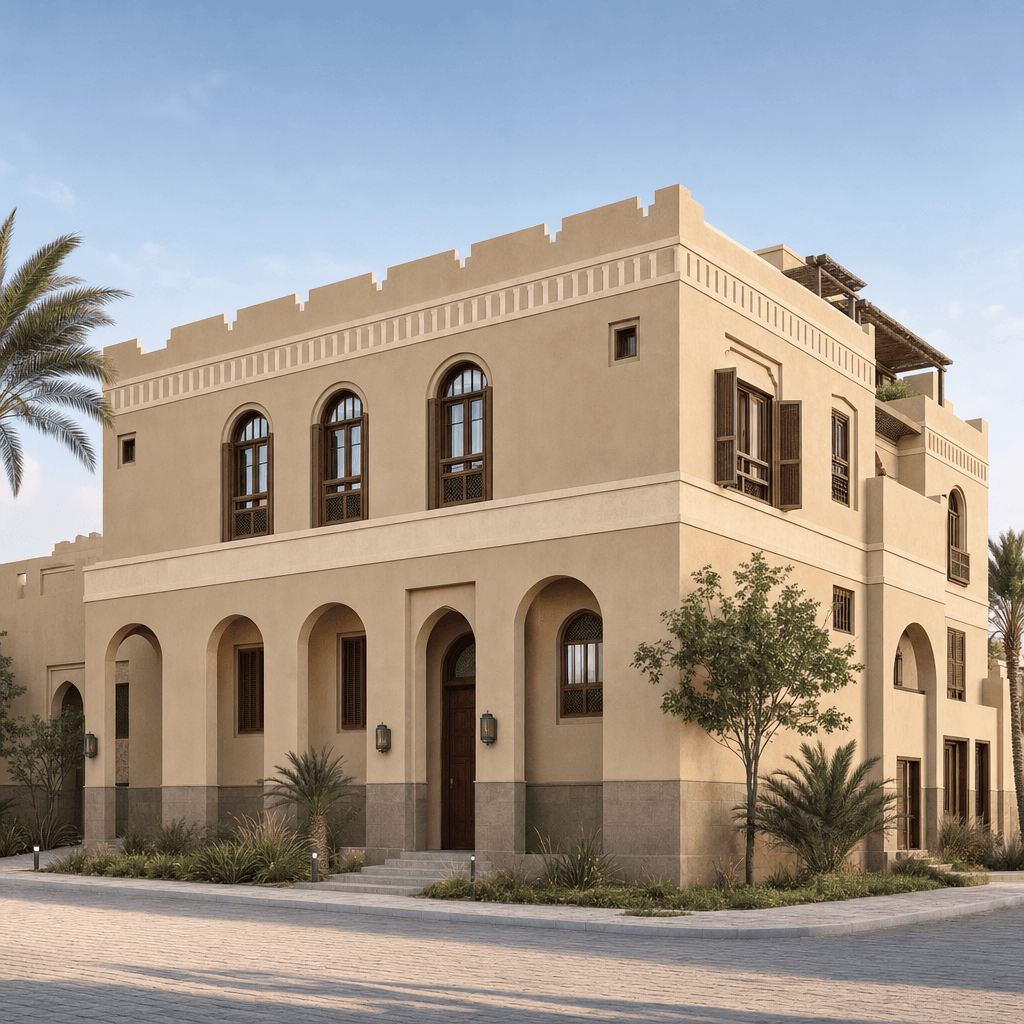
Al Ahsa Oasis Transitional
Saudi Arabia · Al Ahsa Oasis
Horizontal massing maintained — smooth planes in earth tones — reinterpreted arched colonnades with increased openings — more abstract ornamentation — crenellations less ornamental — small integral windows and openings — tripartite facade reading retained — 80...
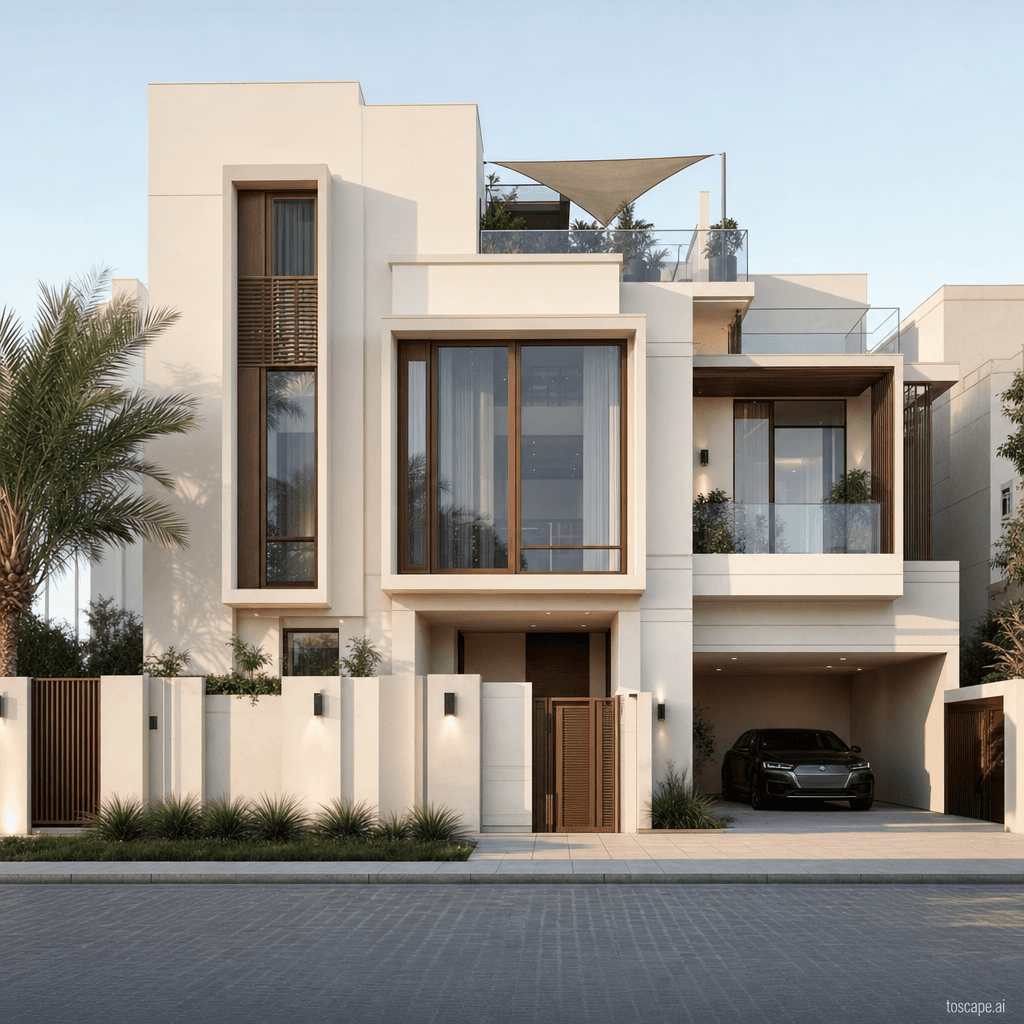
Al Qatif Oasis Contemporary
Saudi Arabia · Al Qatif Oasis
Asymmetrical composition — off-white matte plaster retained — flat angular minimal parapets with very slight differentiation — windows and protruding elements mostly glass — 50% void — flat walls with angular corners — general linear style — abstract geometric...
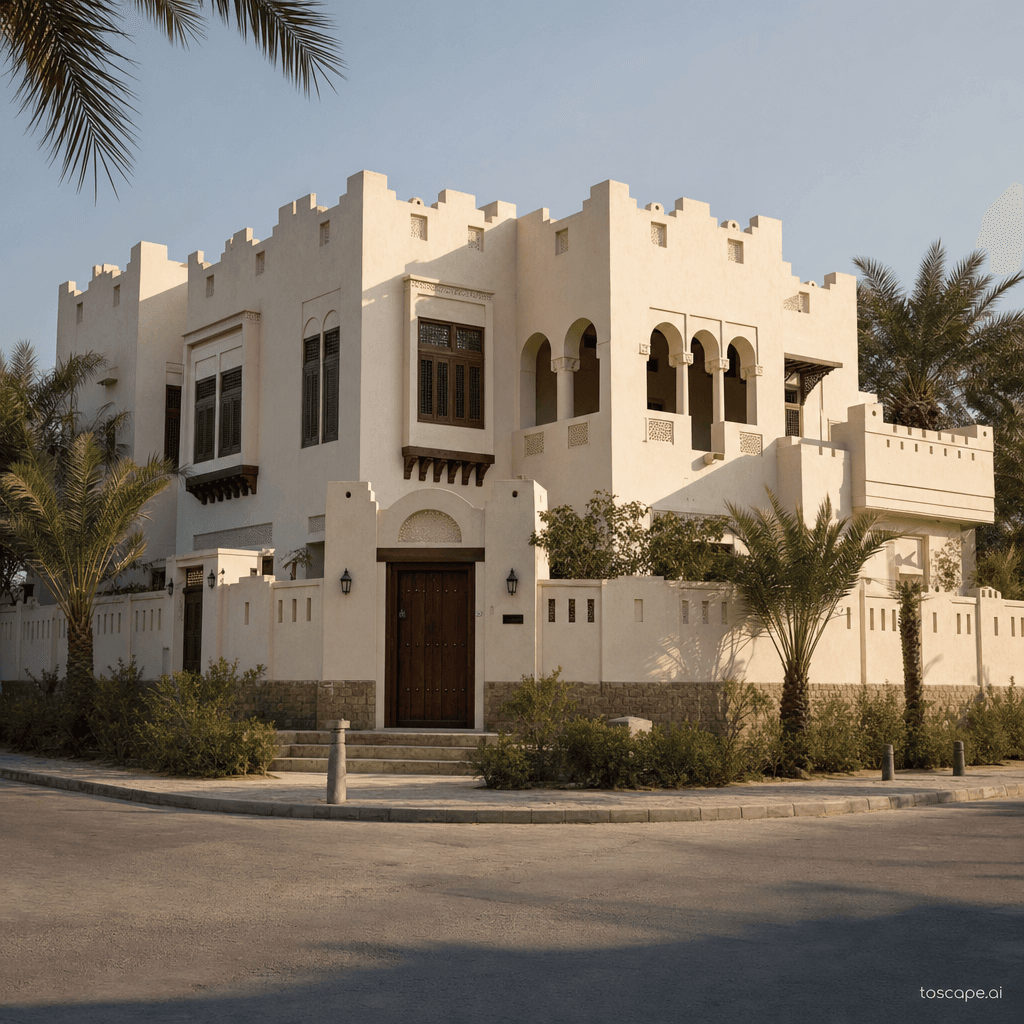
Al Qatif Oasis Traditional
Saudi Arabia · Al Qatif Oasis
Asymmetrical horizontal composition — off-white matte plaster/limewash walls — flat roofs with stepped crenellations at every vertical bay — Al Darisha window screens reflecting light at specific angles — upper-level cul-de-four arch arcades — rectangular timb...
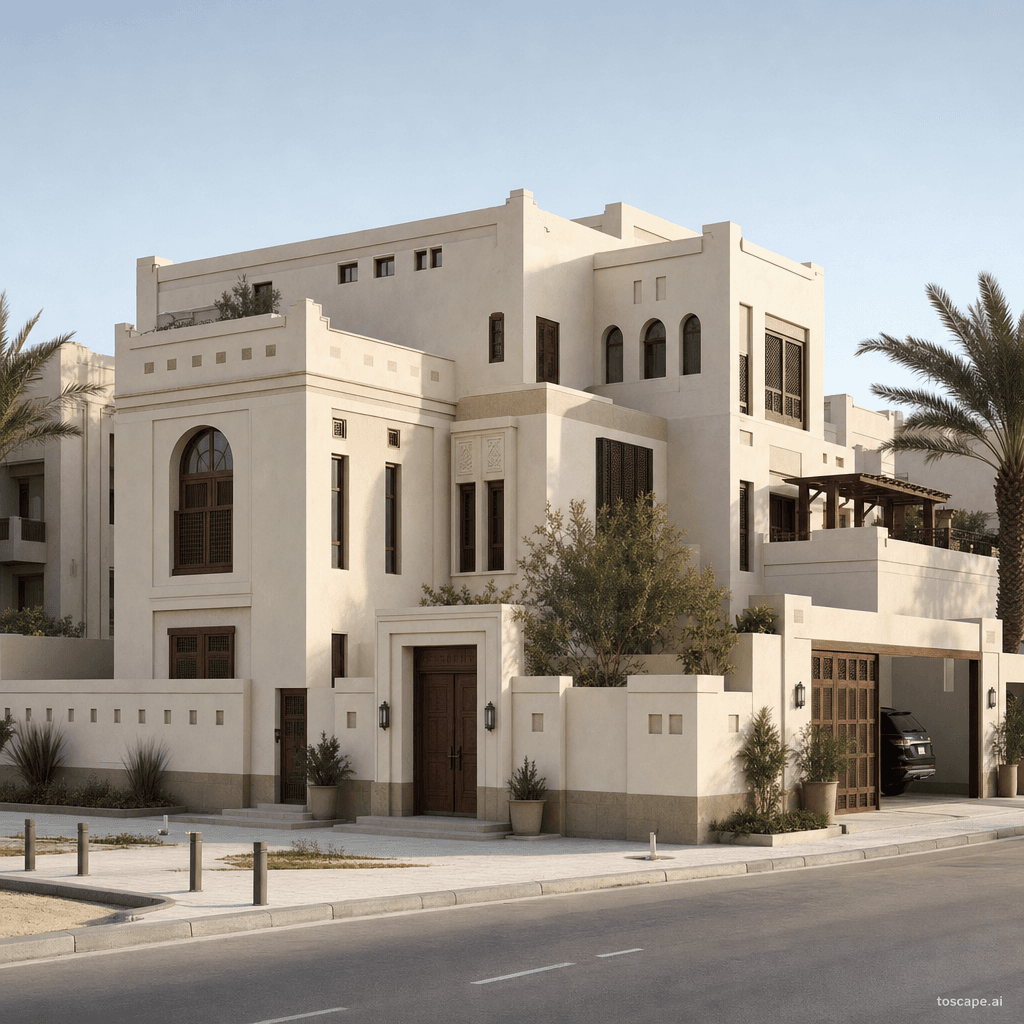
Al Qatif Oasis Transitional
Saudi Arabia · Al Qatif Oasis
Asymmetrical horizontal composition — off-white matte plaster — flat rectilinear parapets with single stepped corners/merlons — interpreted arch openings (semi-circular, rectangular) — windows 30-45% void — timber doors and screens — stone plinth retained — si...
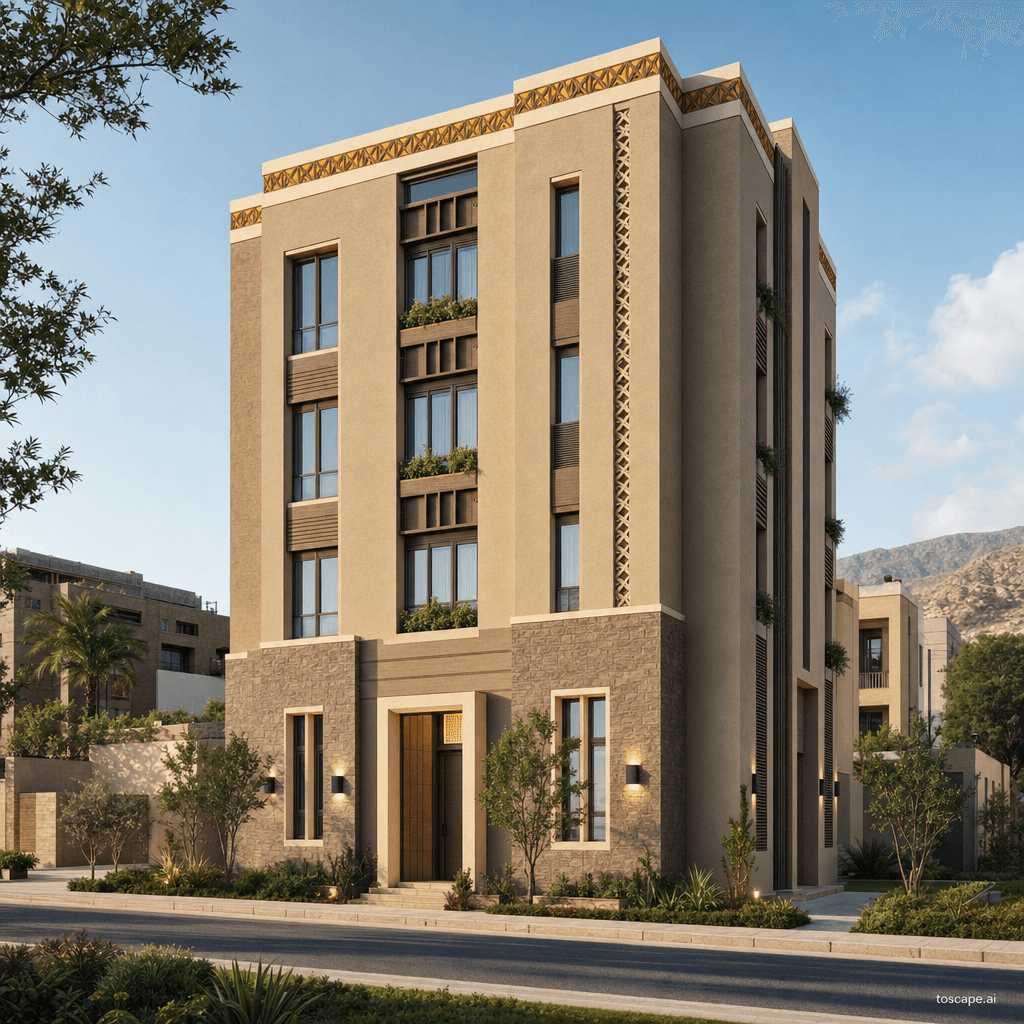
Aseer Asdar Contemporary
Saudi Arabia · Aseer Asdar
Light-strength vernacular interpretation — vertical massing maintained (1:0.9 to 1:2.5 width-to-height) — tripartite facade loosely readable — contemporary materials in warm earth-tone palette — flat roofs with interpreted parapet — maximum 50% opening ratio —...
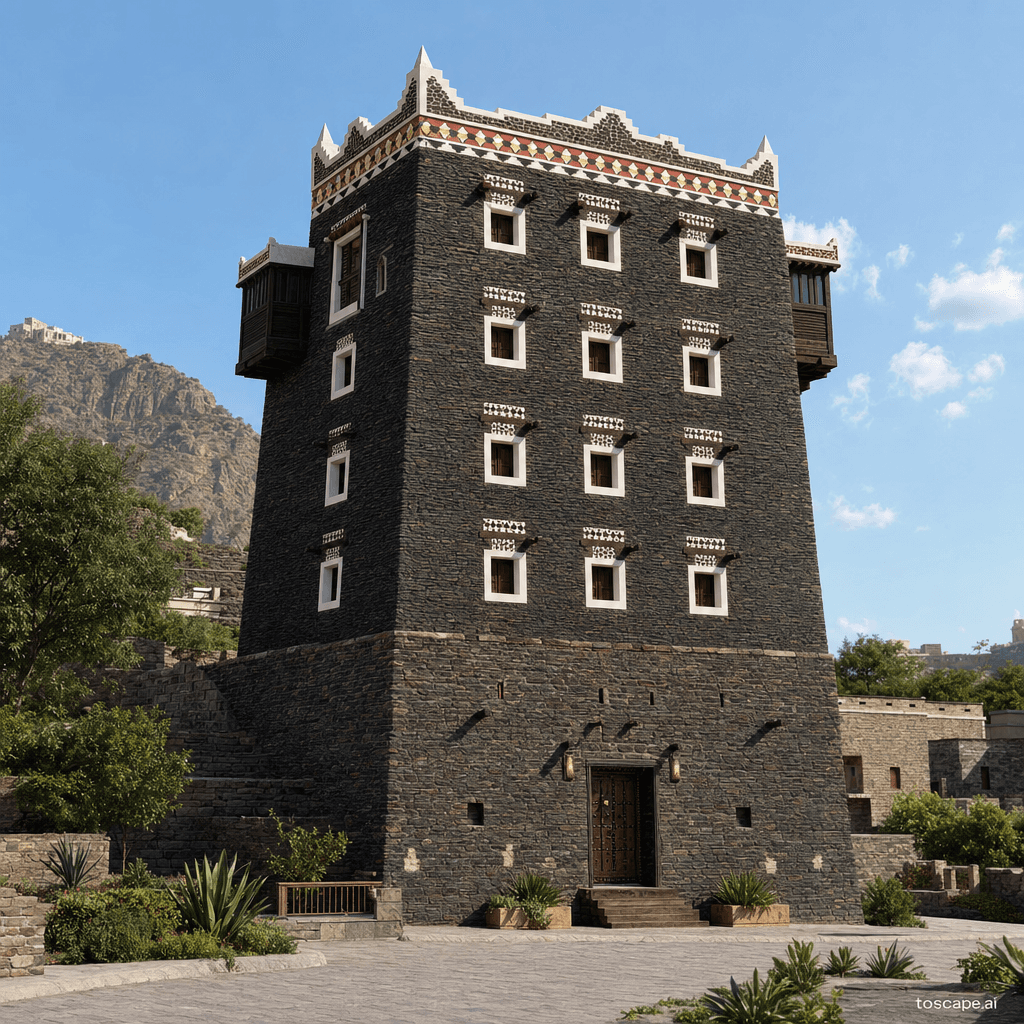
Aseer Asdar Traditional
Saudi Arabia · Aseer Asdar
Vertical dark stone tower houses (3–6 storeys, width-to-height 1:0.9 to 1:2.5 — taller than wide) — gently tapered walls (max 5°, at least 50% of form) — tripartite facade (solid stone base / windowed middle with white surrounds and quartz-inlaid motifs / step...
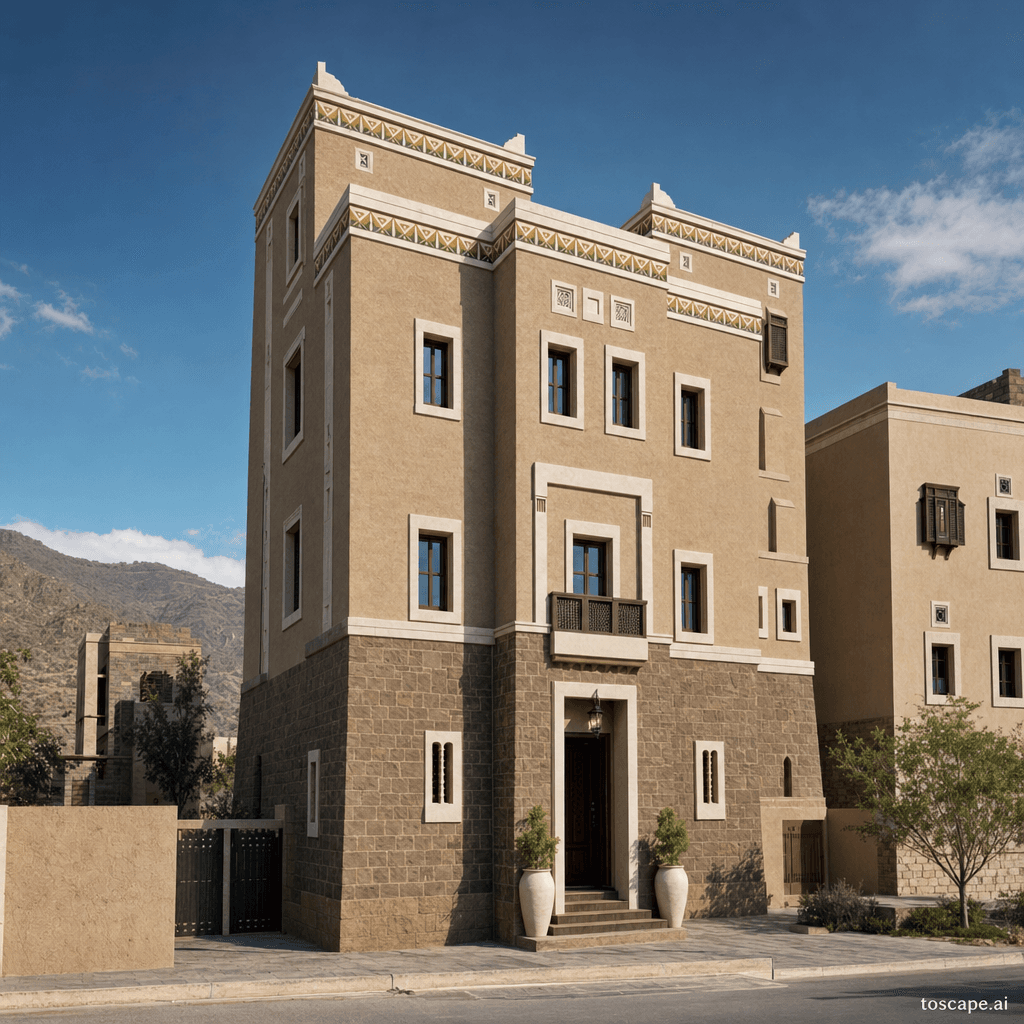
Aseer Asdar Transitional
Saudi Arabia · Aseer Asdar
Vertical massing maintained (1:0.9 to 1:2.5 width-to-height) — smooth stone cladding or earth-tone plaster — tripartite facade reading retained — interpreted light-colored window surrounds — interpreted Al Qatt pattern at parapet (10–15% facade) — stone at min...
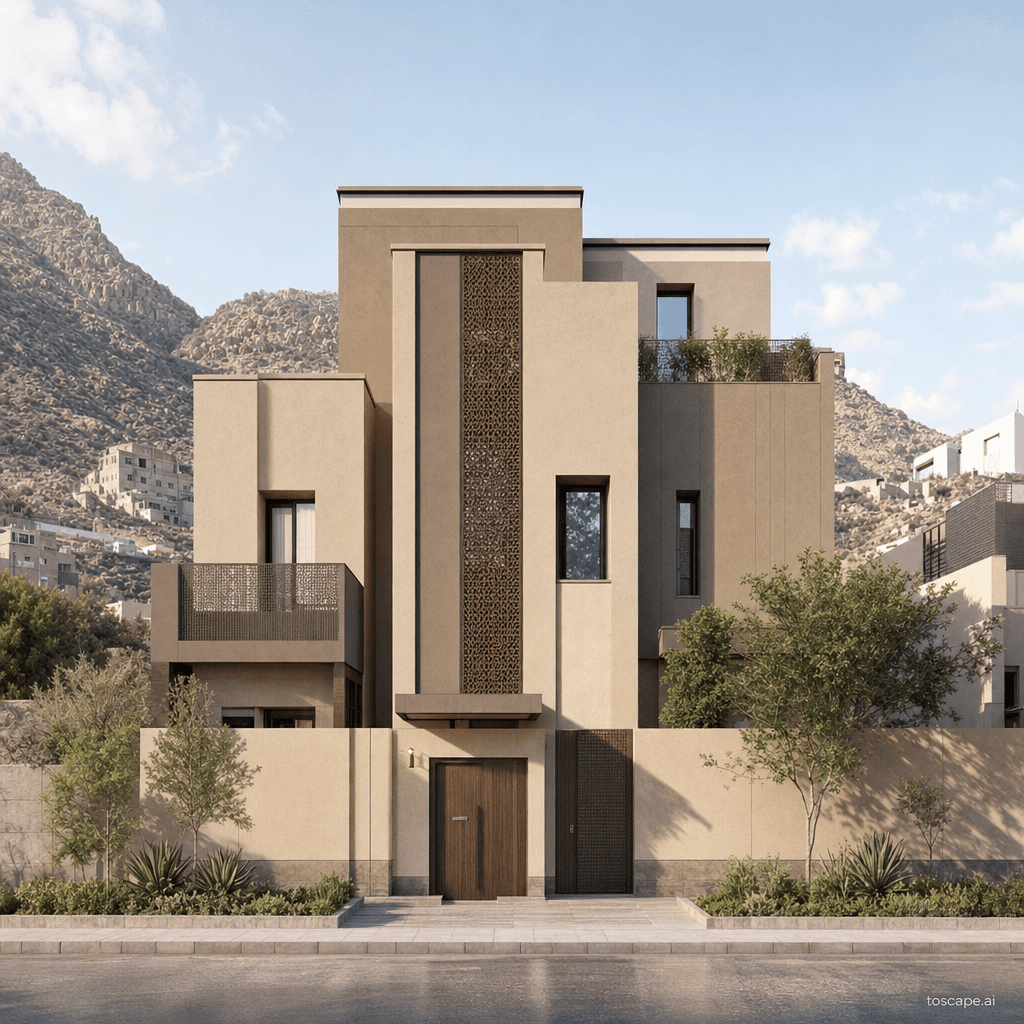
Aseer Escarpment Contemporary
Saudi Arabia · Aseer Escarpment
Abstracted geometric stone-finish plane composition — balanced volumes with interpretive use of screens and setbacks for shade — maximum two compositional motives drawn from the tradition — flat roofs with simple articulated parapets — beige-brown-white palett...
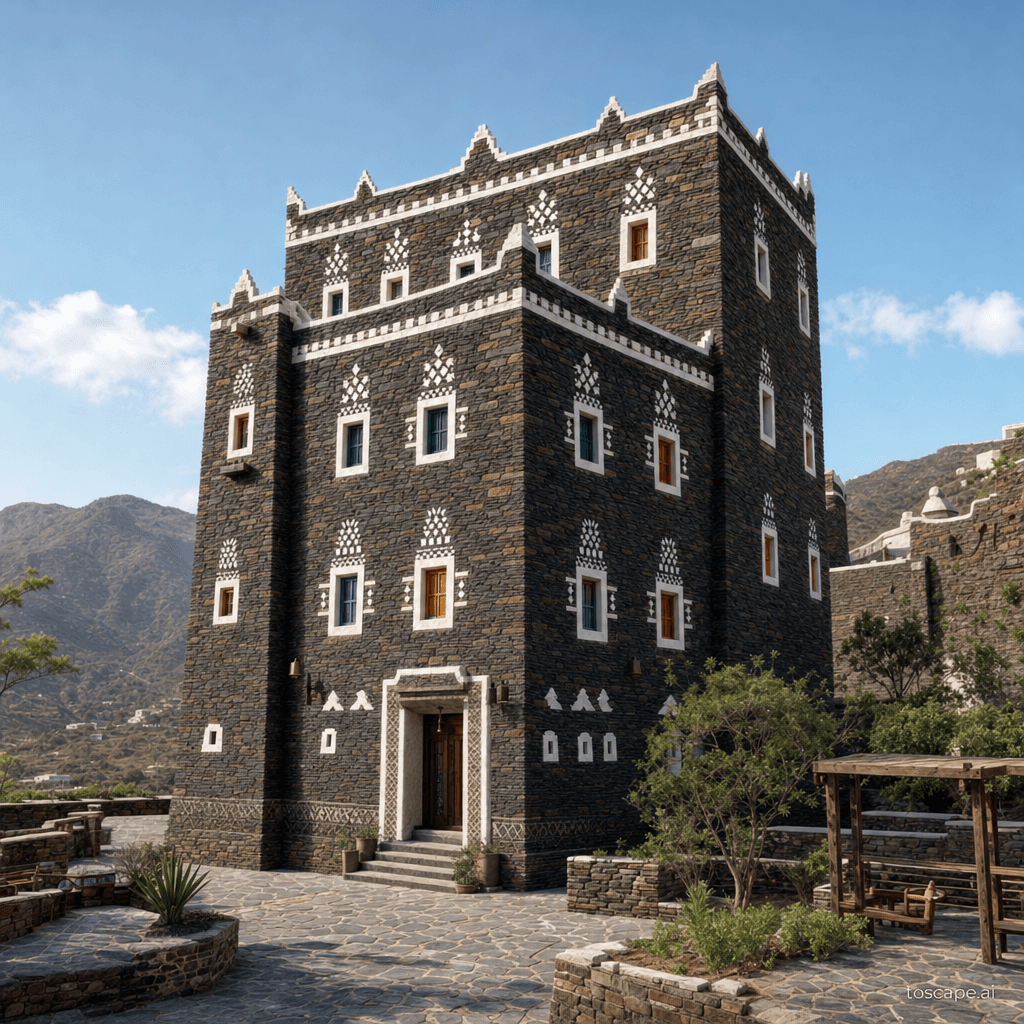
Aseer Escarpment Traditional
Saudi Arabia · Aseer Escarpment
Dark basalt-and-granite stone-bearing-wall tower masses — gently tapered walls with maximum 5° inward inclination — small punched-hole windows with bold whitewashed surrounds and inlaid quartz decorative motifs — colored wooden shutters in bright complementary...
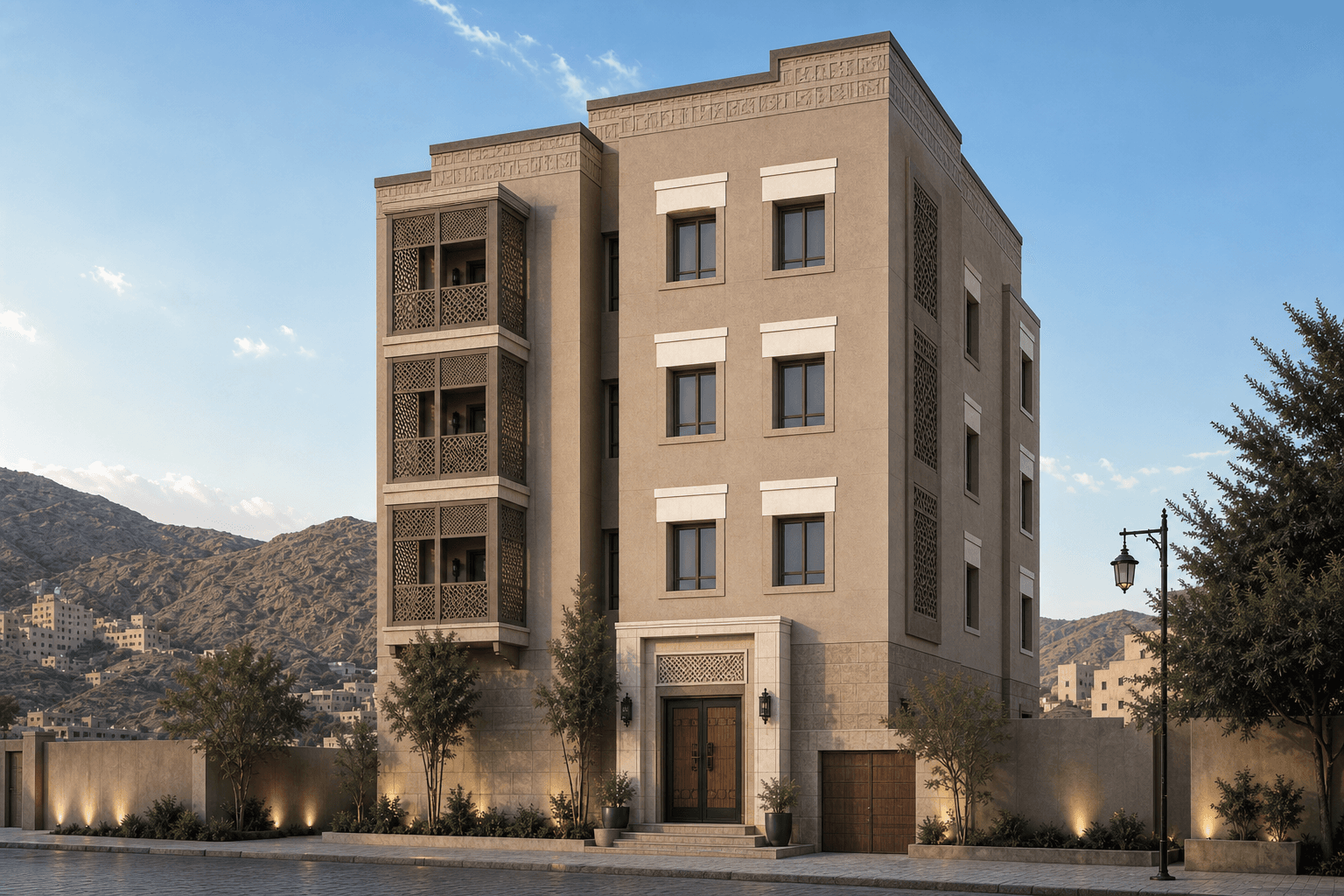
Aseer Escarpment Transitional
Saudi Arabia · Aseer Escarpment
Smooth earth-toned planar facades with stone-finish material continuity — integral windows with white articulated surrounds and interpreted Al Qatt geometric motifs — projected screened balconies providing shade and privacy — flat roofs crowned by articulated...
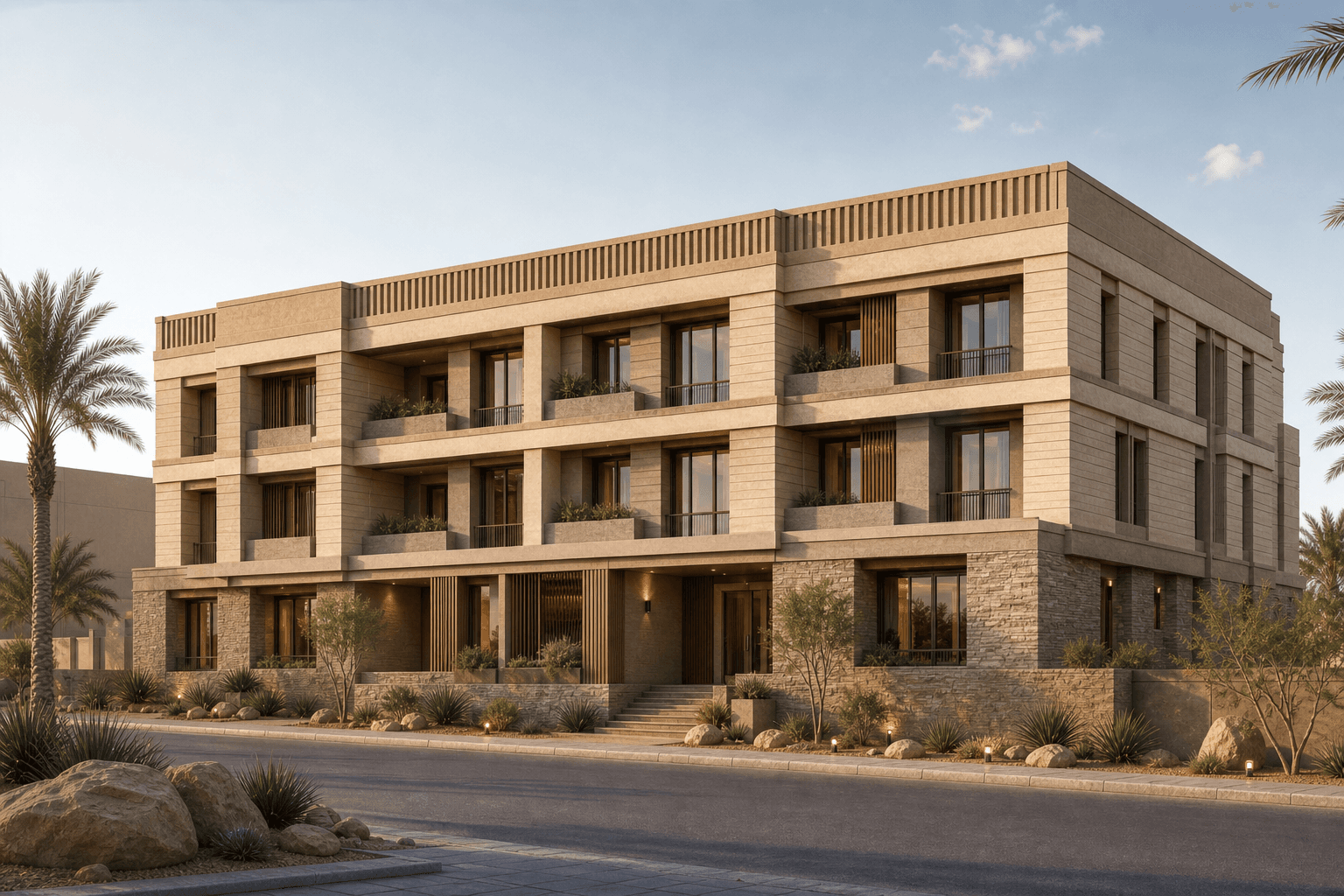
Bisha Desert Contemporary
Saudi Arabia · Bisha Desert
Strongly horizontal compact form — flat roofs non-negotiable — earth-tone contemporary materials — max 50% opening ratio — abstracted parapet and horizontal layering — 70% primary earth tones / 30% accent — floor-to-ceiling glazing in selective zones only — NO...
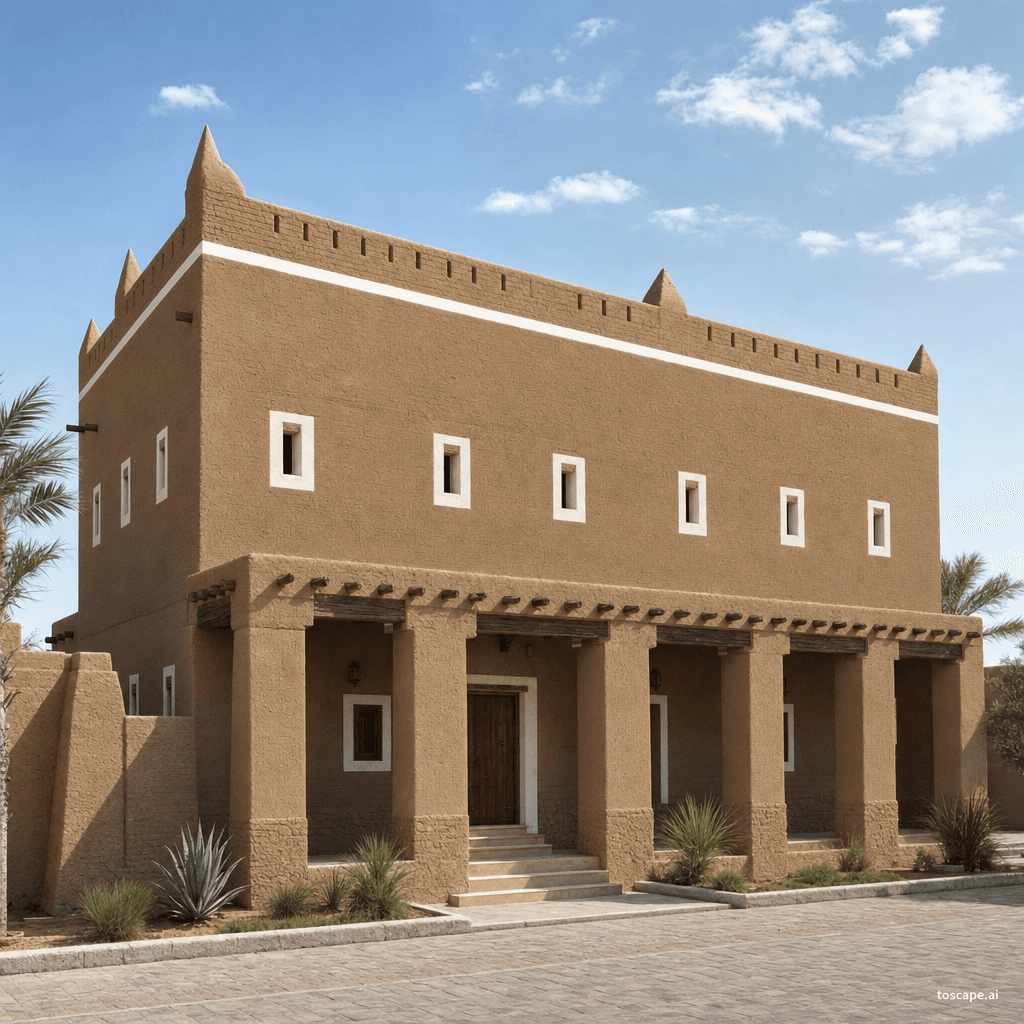
Bisha Desert Traditional
Saudi Arabia · Bisha Desert
Emphatically horizontal mud-brick volumes (1:0.25 to 1:0.94 width-to-height) — colonnaded ground floor — small high-positioned narrow windows with obligatory white banding — pointed corner parapet — gently tapered walls (max 3°) — flat palm-trunk lintels only...
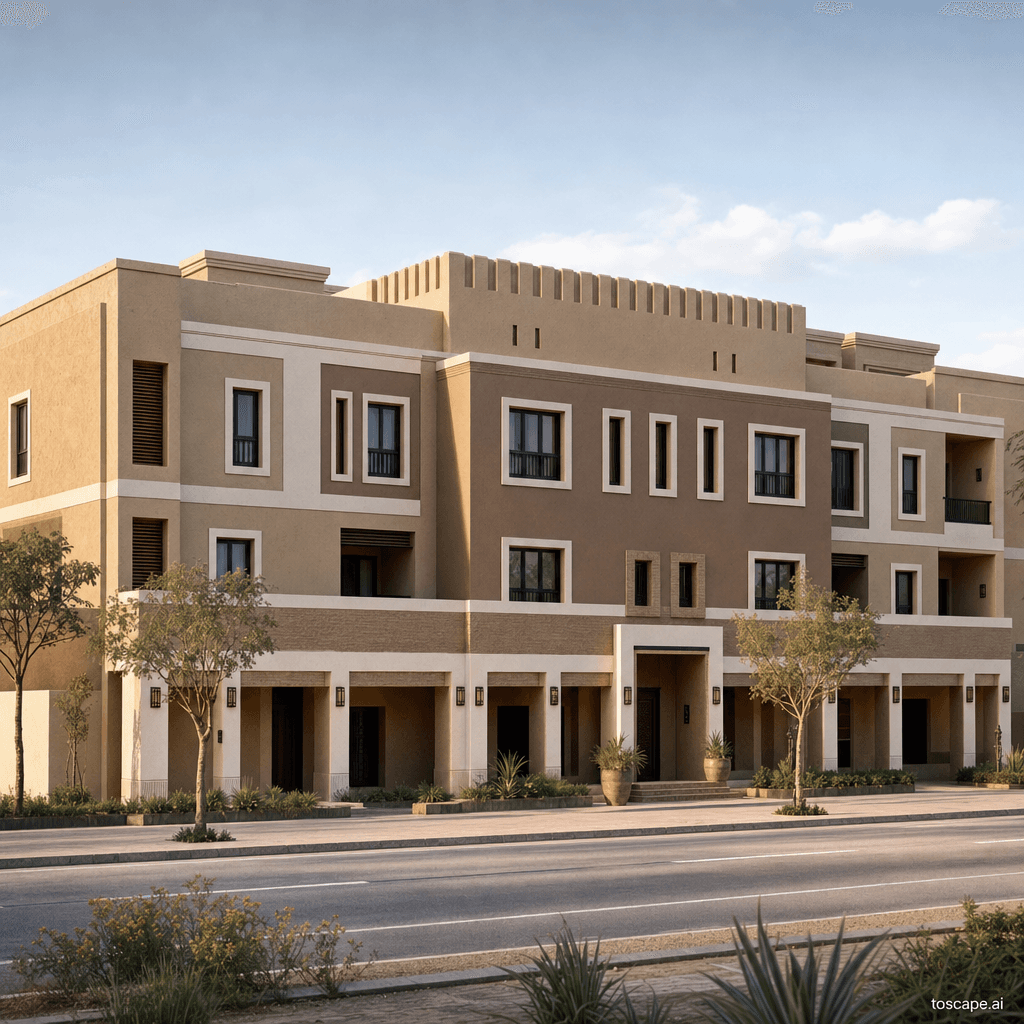
Bisha Desert Transitional
Saudi Arabia · Bisha Desert
Horizontal massing maintained — earth-tone materials with contemporary substitutions — interpreted parapet articulation (vertical stripes or stepped) — moderate window openings (max 40%) — interpreted white/light banding at openings — 80% primary earth tones /...
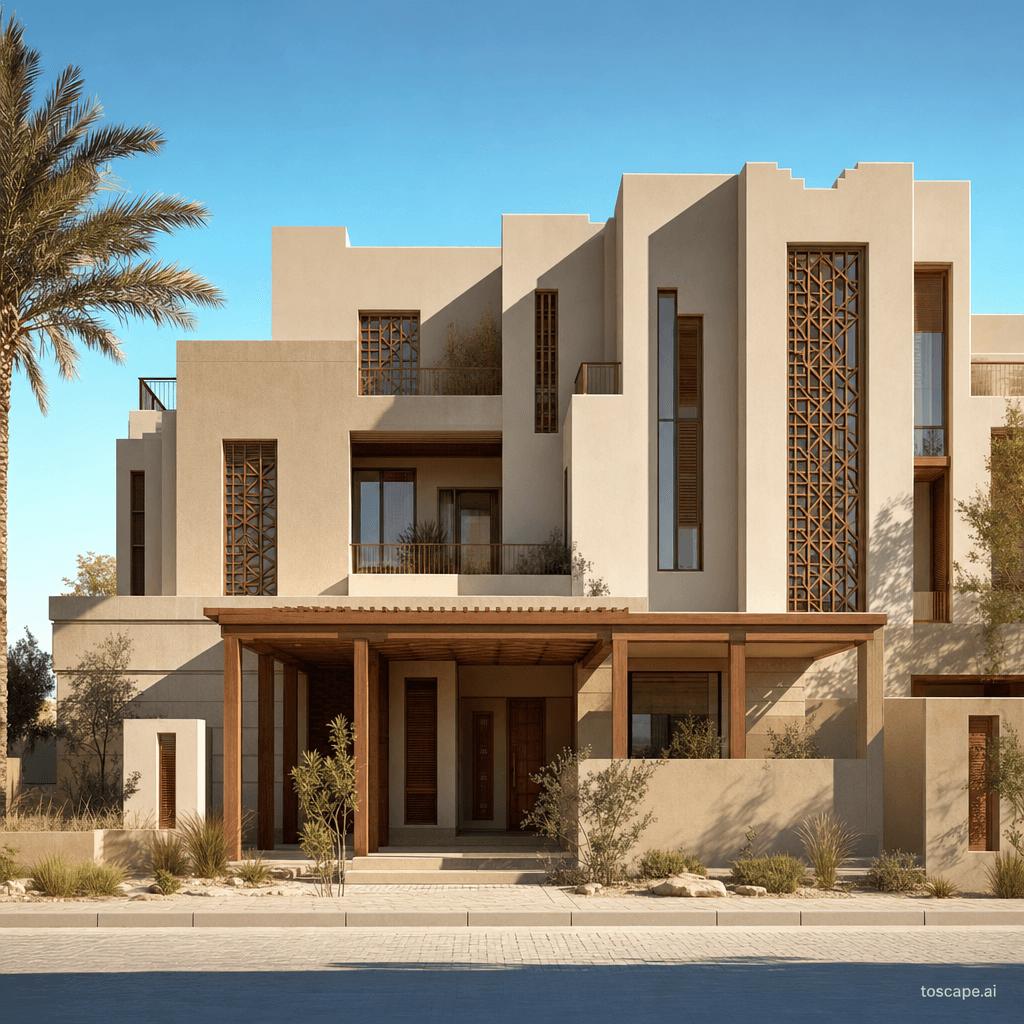
Central Najdi Contemporary
Saudi Arabia · Central Najd
Abstraction of geometric Najdi patterns upon smooth rendered facades — large vertical rectangular openings with abstract timber louvers and direct balcony access — perforated wall screens for shade and privacy — minimal articulated parapet referencing the five...
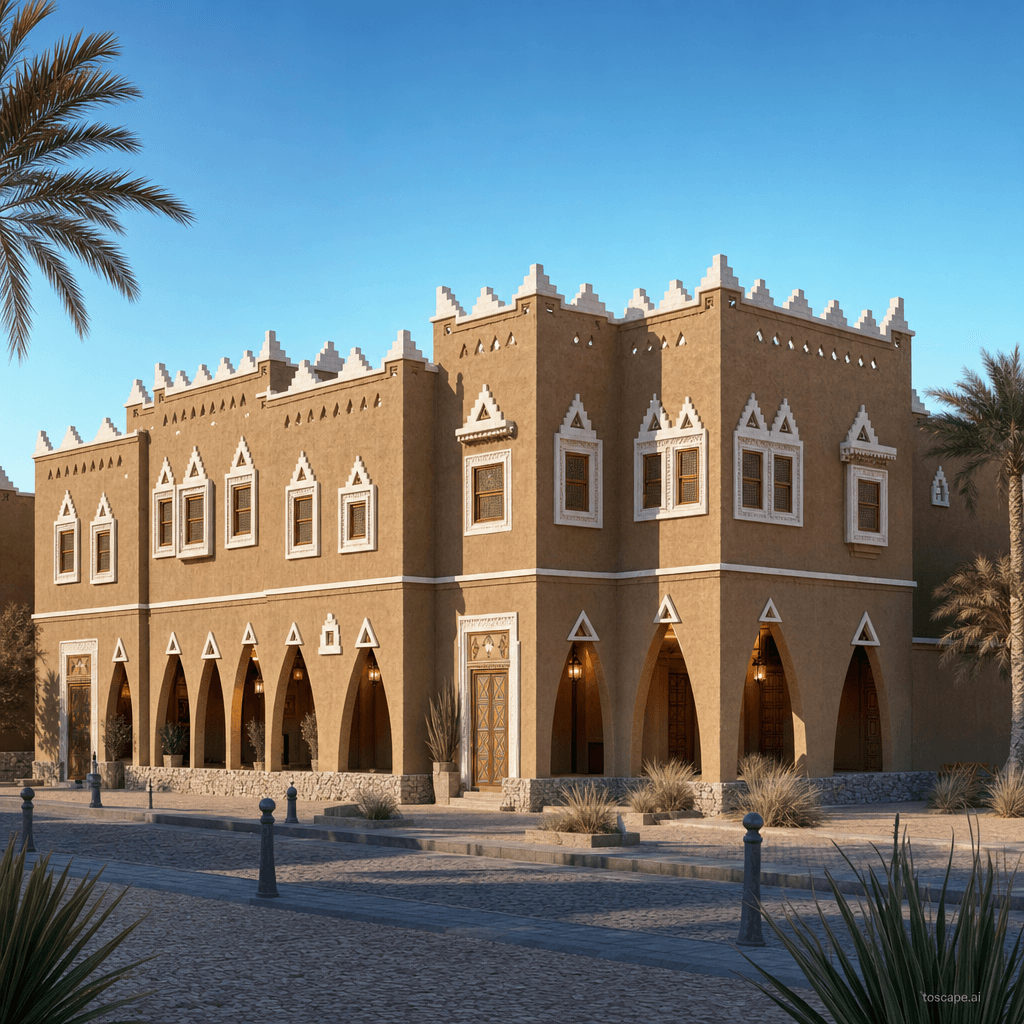
Central Najdi Traditional
Saudi Arabia · Central Najd
Earth-toned mud-brick bearing-wall mass — horizontal rectangular block with irregular asymmetric massing — five-stepped triangulated crenellated parapet capped in white gypsum plaster — abundant ornamentation with gypsum-framed windows and geometric-painted do...
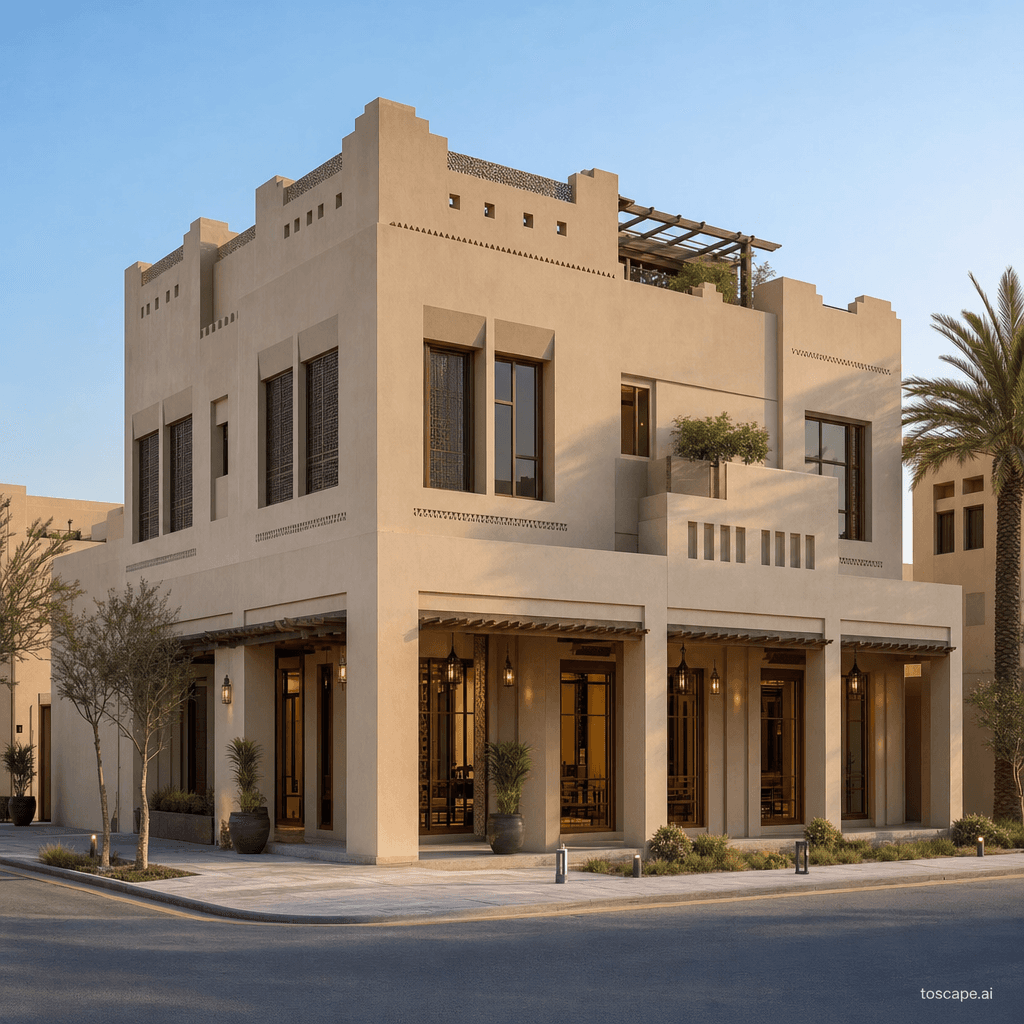
Central Najdi Transitional
Saudi Arabia · Central Najd
Smooth earth-toned rendered planes replacing textured mud — larger glass openings with simplified timber latticework — cleaner geometric parapets maintaining traditional five-step rhythm — reduced but still present triangular band ornamentation — seamless vert...
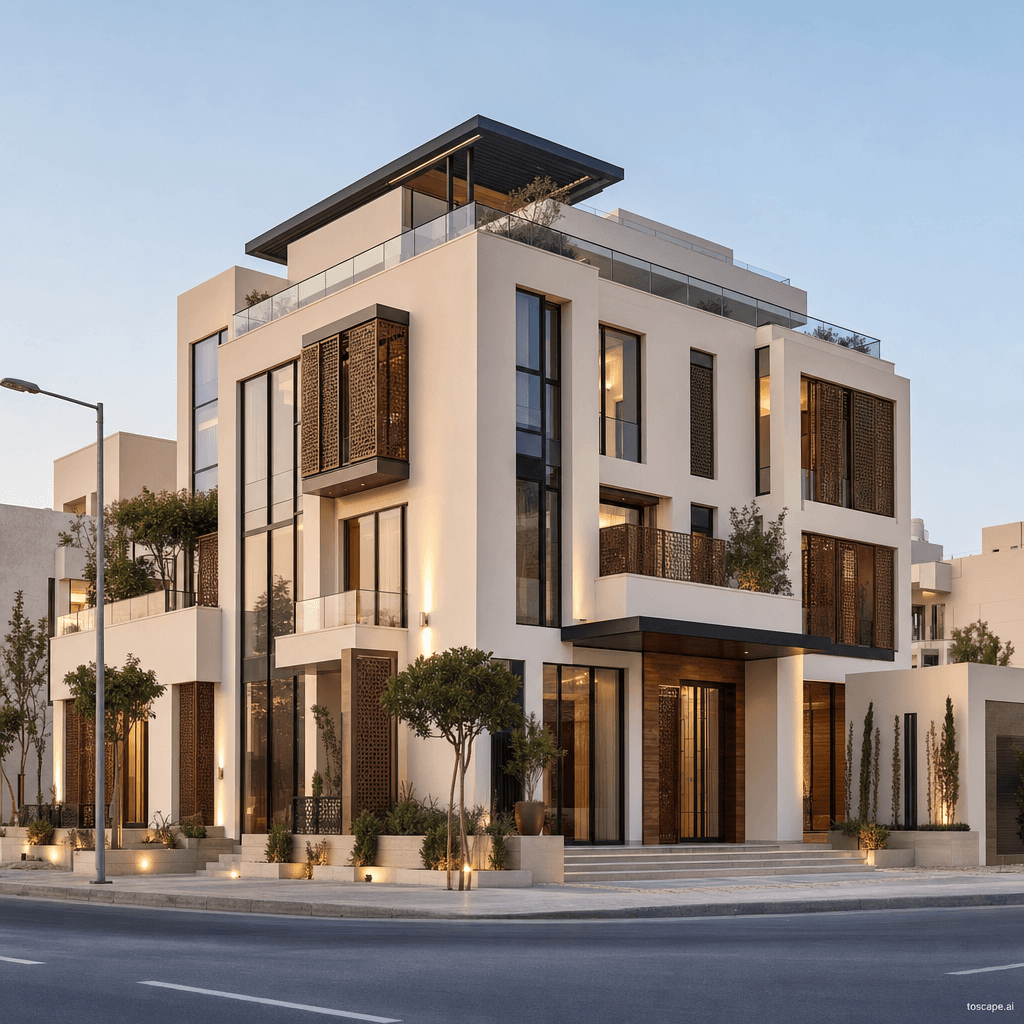
East Coast Contemporary
Saudi Arabia · Eastern Coast / Arabian Gulf
Large vertical windows — floor-to-ceiling possible, diverse widths and heights, NOT shuttered — MODERNIZED MASHABRIYA as projected balconies with sliding/folding/rotating timber perforated panels — GLASS CURTAIN WALL ENTRANCE recessed from main facade with sha...
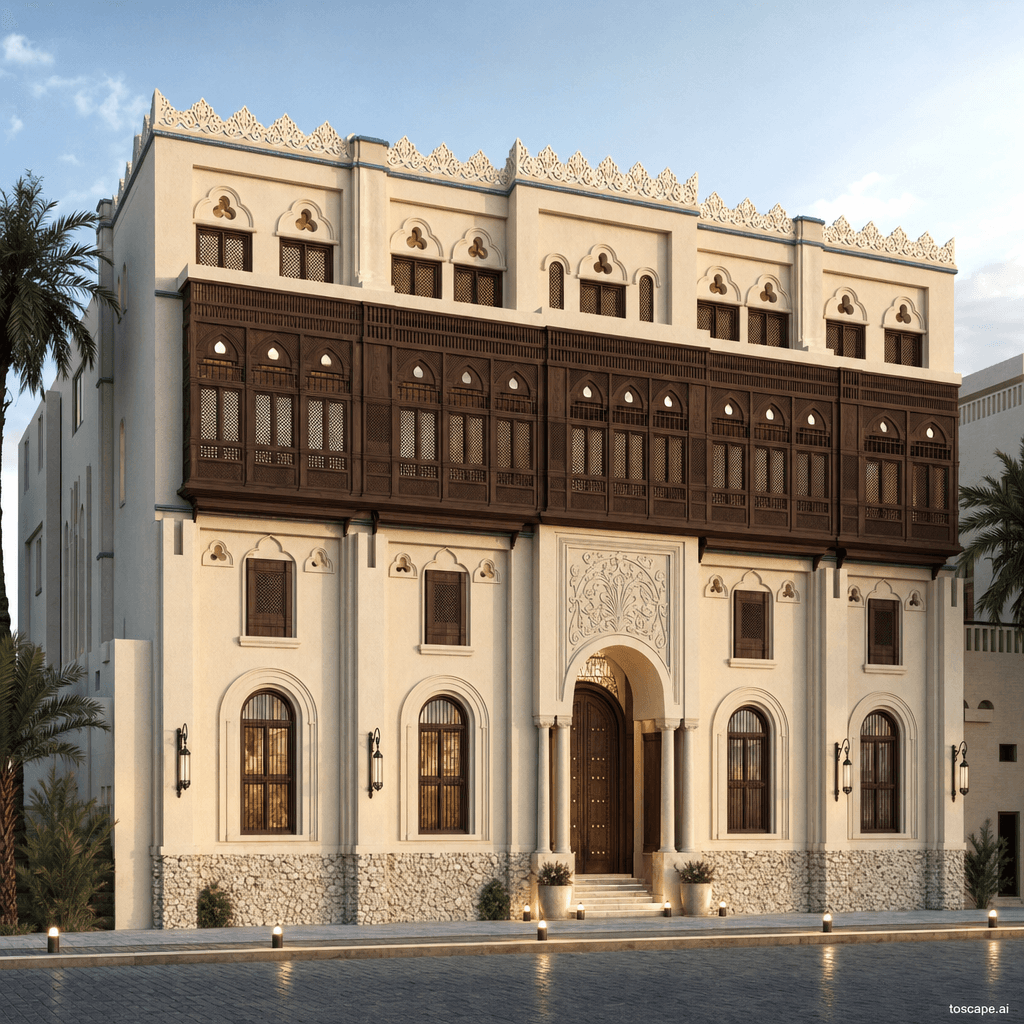
East Coast Traditional
Saudi Arabia · Eastern Coast / Arabian Gulf
Thick coral aggregate / lime plaster walls (off-white matte) — large projecting hardwood MASHABIYA as MANDATORY DOMINANT element running the full length of the majlis on the upper middle floor — HIGH PORTAL DOORWAY with ROUND ARCH and stylized floral design in...
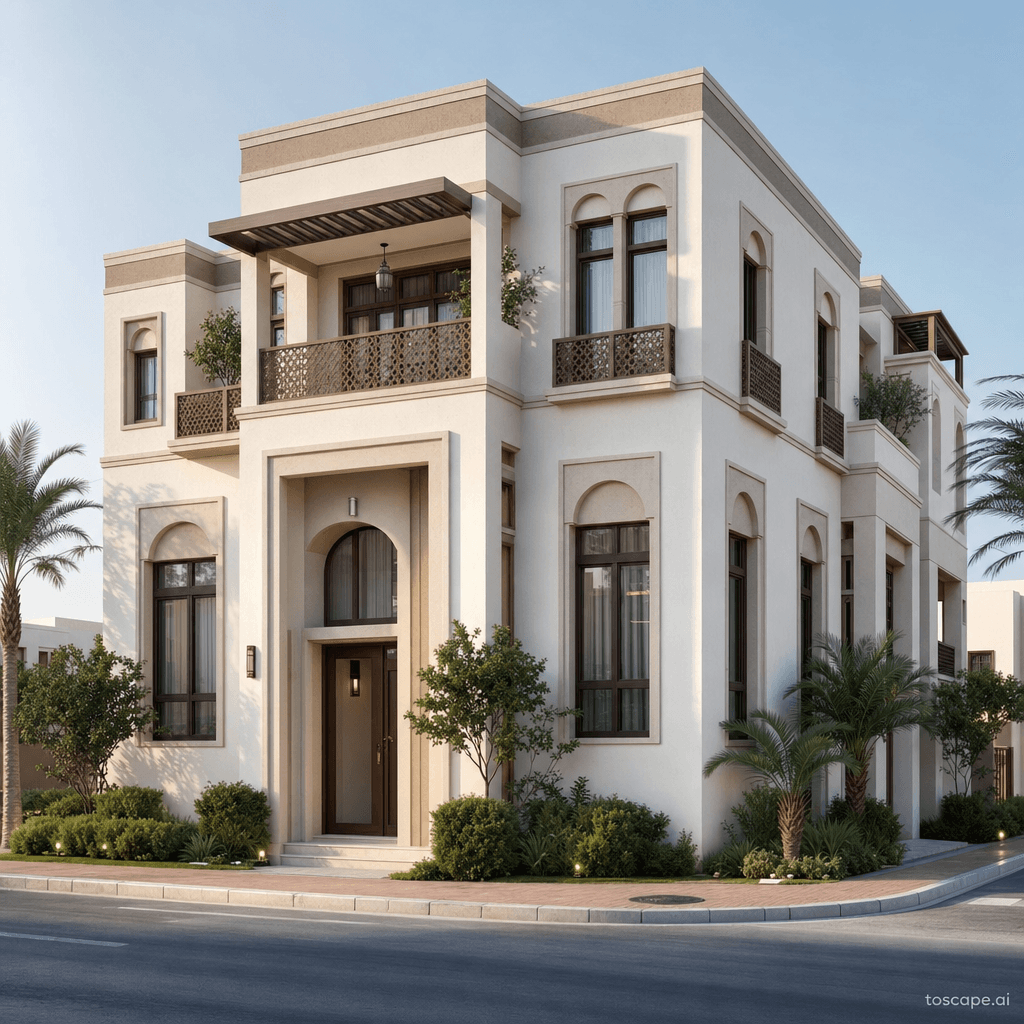
East Coast Transitional
Saudi Arabia · Eastern Coast / Arabian Gulf
Smooth facades in warm earth tones (pearl white, light beige) — mashrabiya PRESENT BUT MORE OPEN — lighter materials, less intricate screening, columns extend to ground floor, exposed frame — HIGH PORTAL with FLAT ARCH OR minimal doorway with SEMICIRCULAR ARCH...
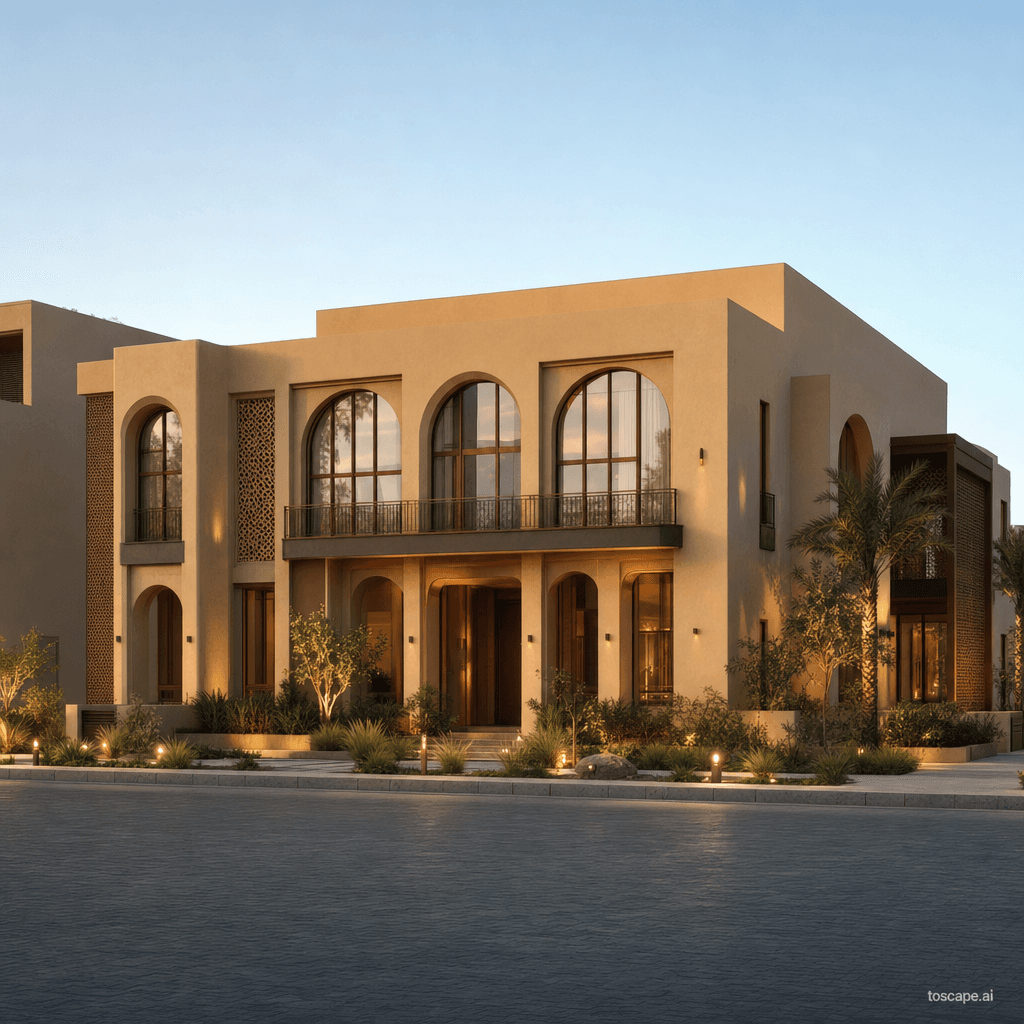
Eastern Najdi Contemporary
Saudi Arabia · Eastern Najd
Warm earth-toned rendered mass transitioning to organic forms — expanded glazed openings (40–60% void) with semicircular arched frame language — recessed squared-column arcade with varied bay spacing — re-interpreted abstracted Najdi geometric patterns in fene...
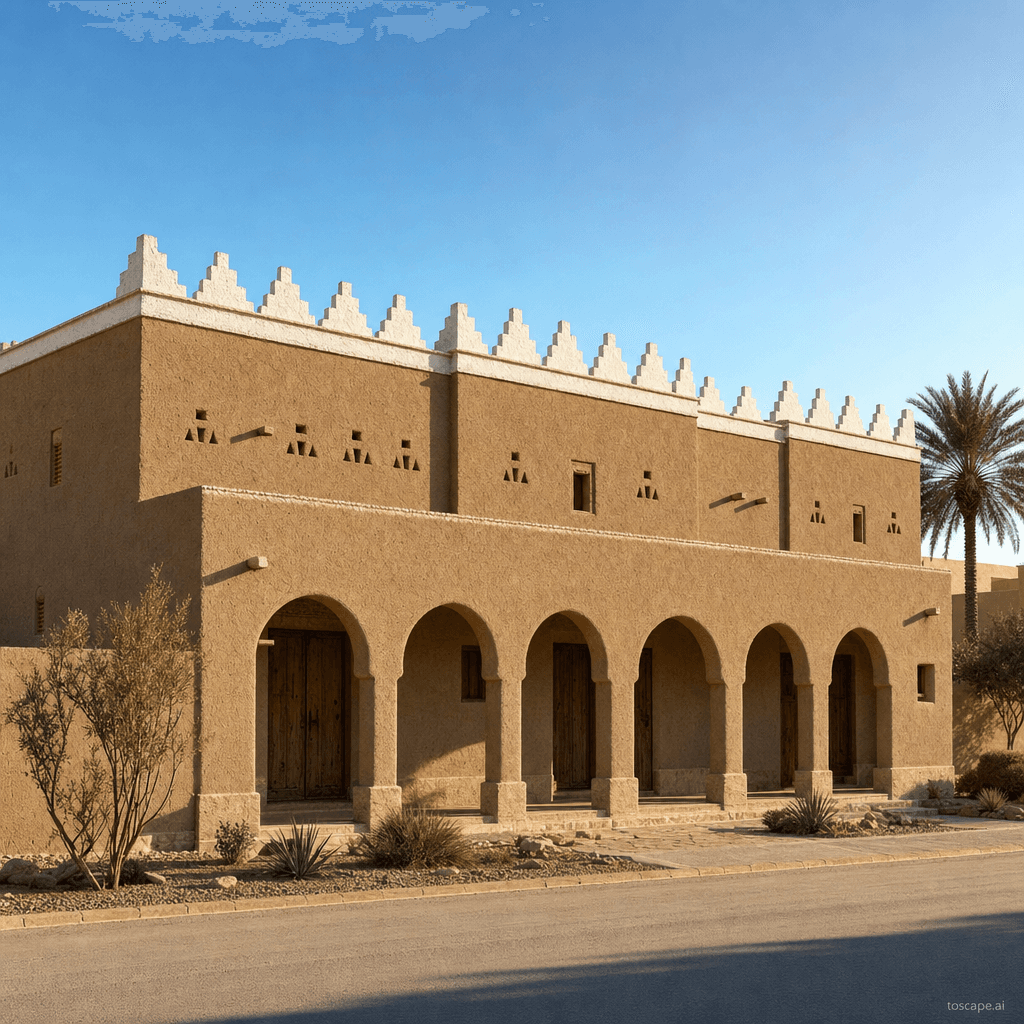
Eastern Najdi Traditional
Saudi Arabia · Eastern Najd
Earth-toned mud-brick bearing-wall mass — minimally-ornamented horizontal block with tripartite facade tiers — three-stepped triangular crenellated parapet capped in white gypsum plaster — small geometric punched fenestrations at upper wall — semicircular arch...
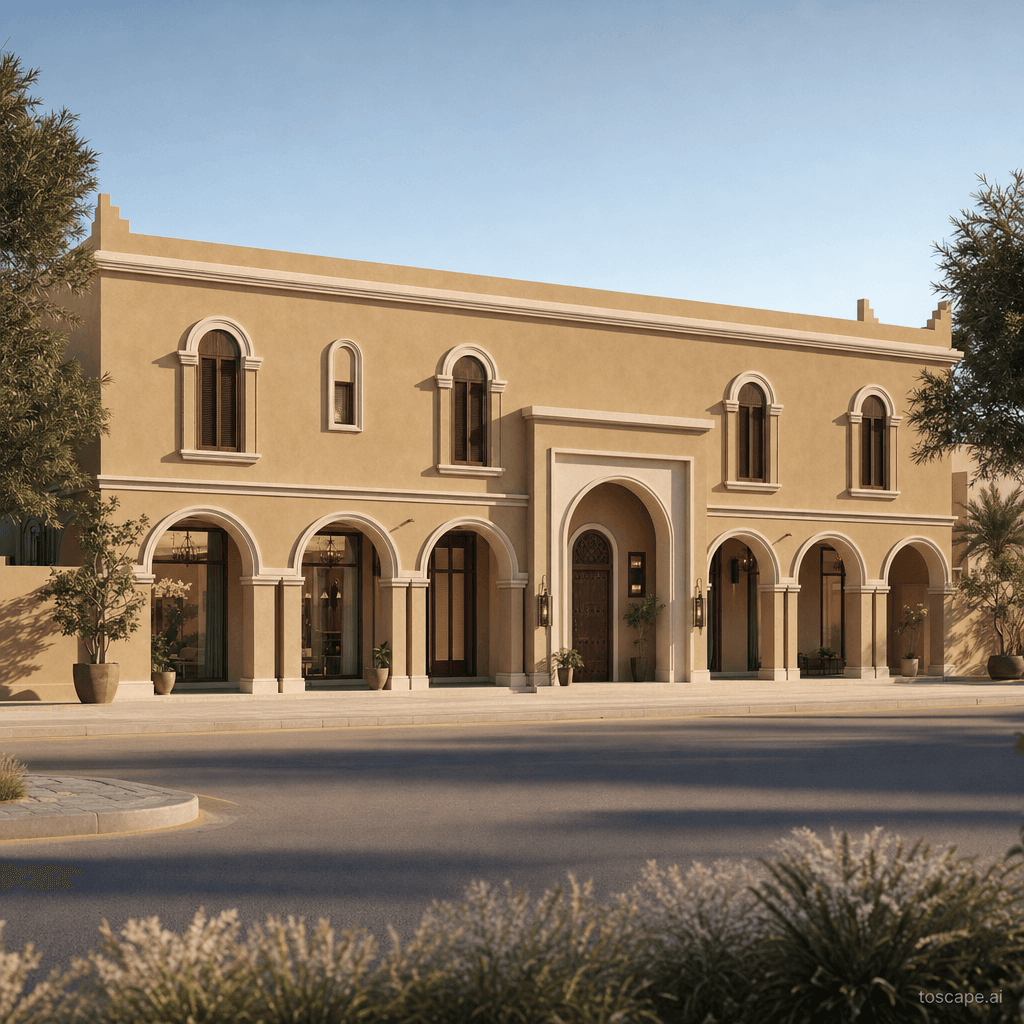
Eastern Najdi Transitional
Saudi Arabia · Eastern Najd
Smooth earth-toned rendered wall plane — horizontal mass with flat or corner-crenellated parapet — semicircular arched openings with gypsum frames reintroduced — arcaded ground floor with squared columns — monumental entrance with arched niche — increased but...
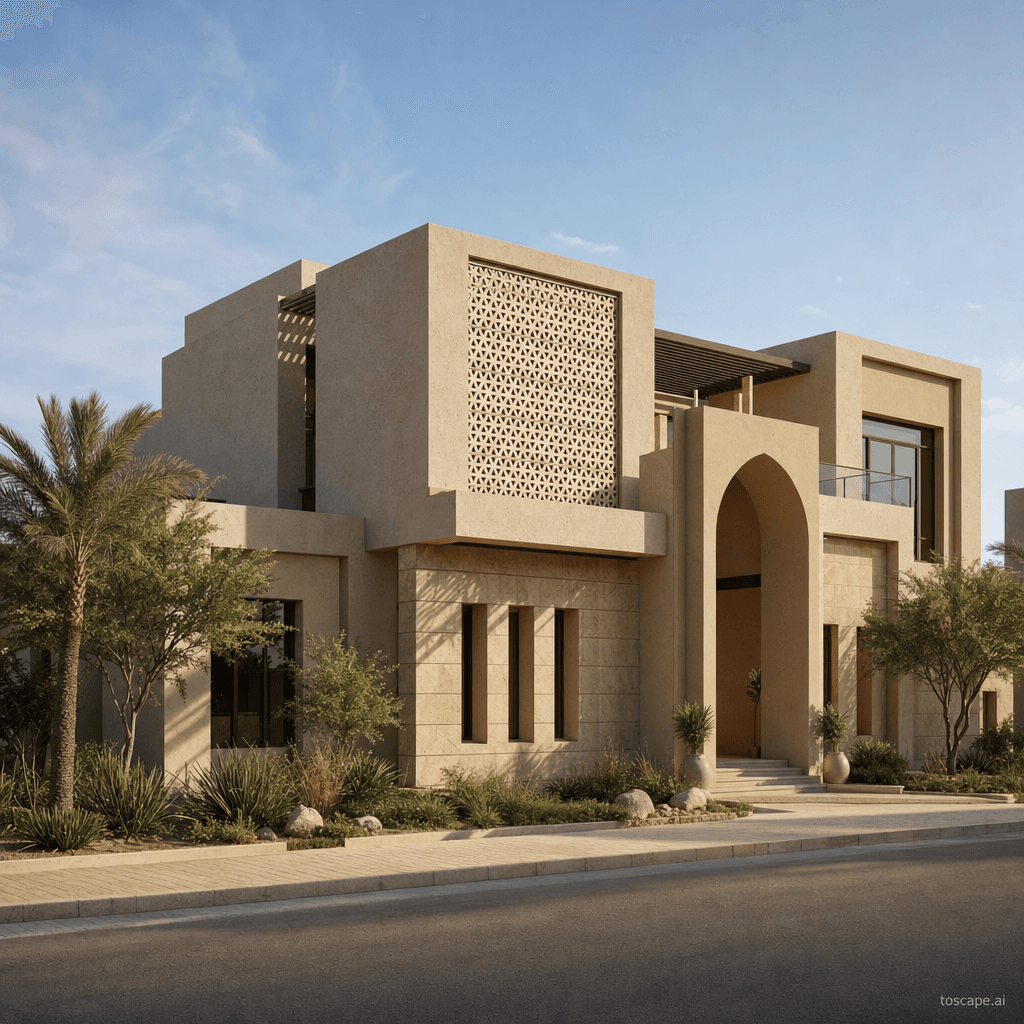
Farasan Islands Contemporary
Saudi Arabia · Farasan Islands / Red Sea
Horizontal composition of rectilinear volumes — contemporary warm textured surfaces (cream/sandy aggregate concrete, stone cladding) — deeply recessed openings creating shadow-line character — abstract bipartite reading — ONE geometric screen or pattern highli...
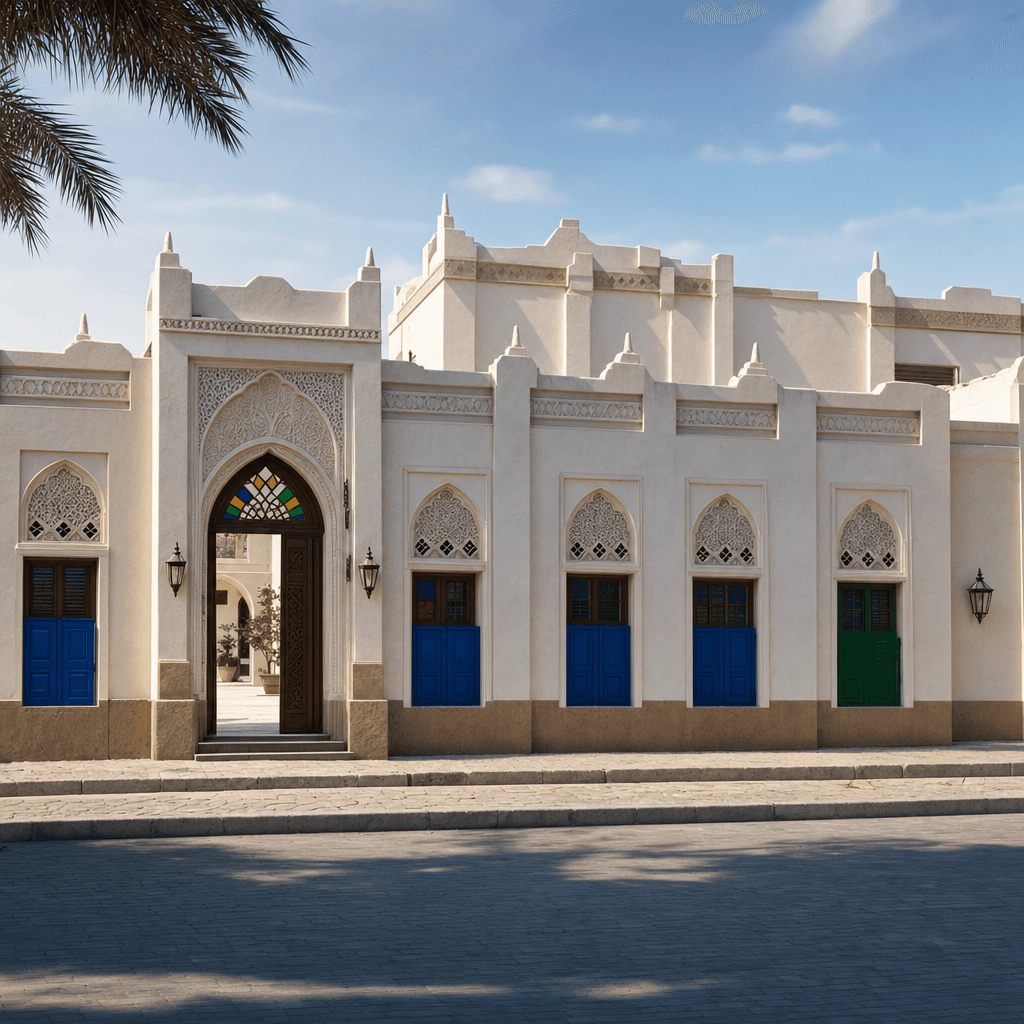
Farasan Islands Traditional
Saudi Arabia · Farasan Islands / Red Sea
Horizontal low-rise coral-stone compound mass (1:0.4 to 1:0.8 width-to-height, 1–2 storeys) — white lime-plastered walls — elaborate hand-carved gypsum niche or decorative panel above EVERY significant opening — arched compound gateway with decorated carved to...
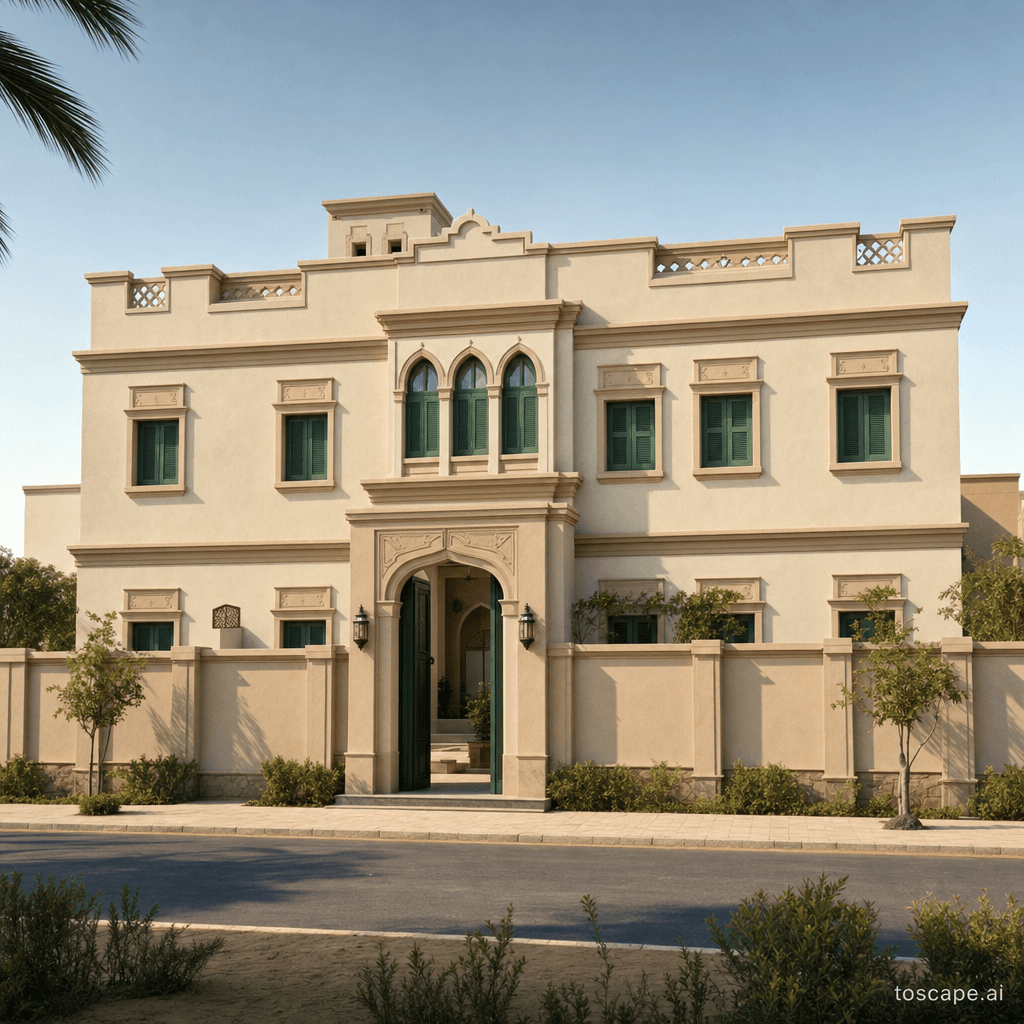
Farasan Islands Transitional
Saudi Arabia · Farasan Islands / Red Sea
Horizontal rectilinear compound mass (1:0.4 to 1:1 width-to-height, 2–3 storeys) — sand-cream plastered masonry — bipartite facade organization — simplified molded relief panels above principal openings — arch forms referenced and simplified — arched gateway r...
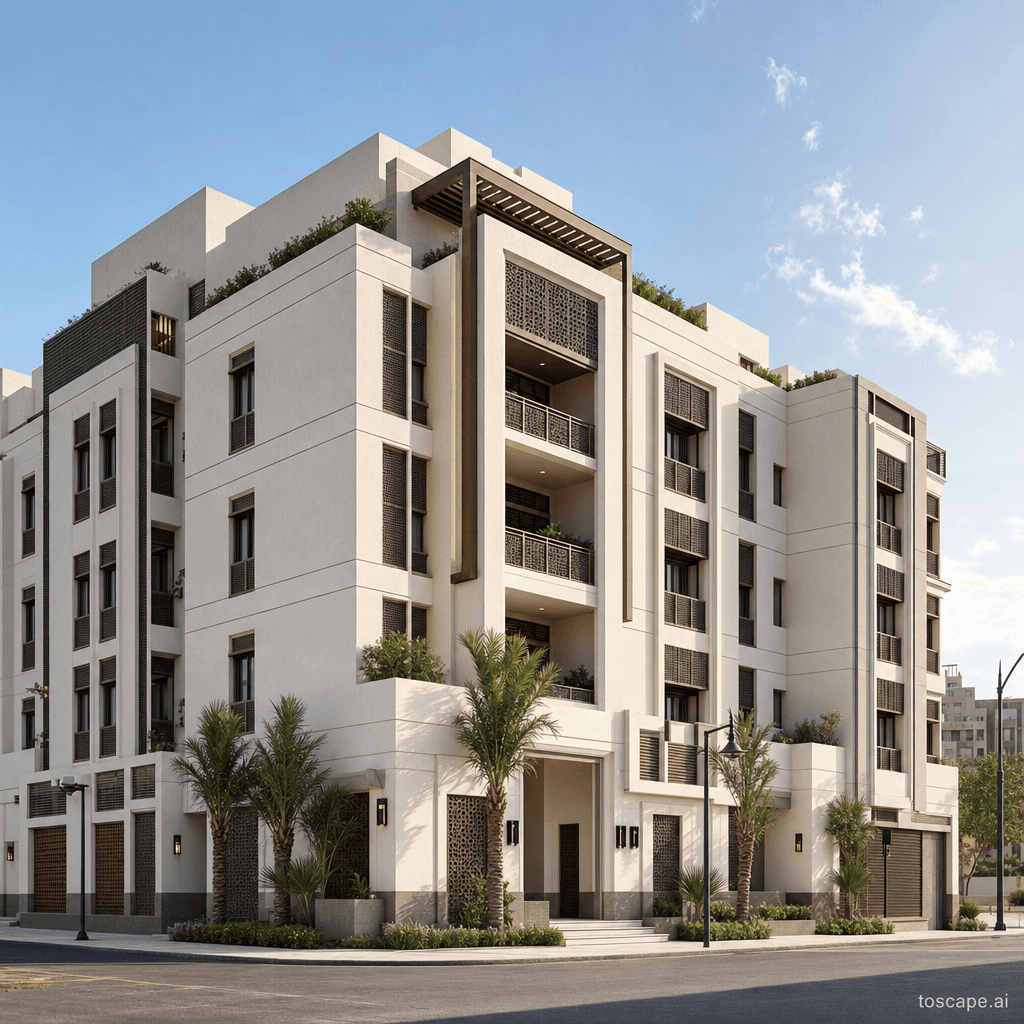
Hejazi Contemporary Coastal
Saudi Arabia · Hejaz / Red Sea Coast
Abstracted white wall plane — roshan identity reinterpreted as deep-shadow geometric-screen void or layered-perforation facade system — horizontal banding expressed as tectonic joints in a modern frame — rectangular-opening grammar maintained at macro scale —...
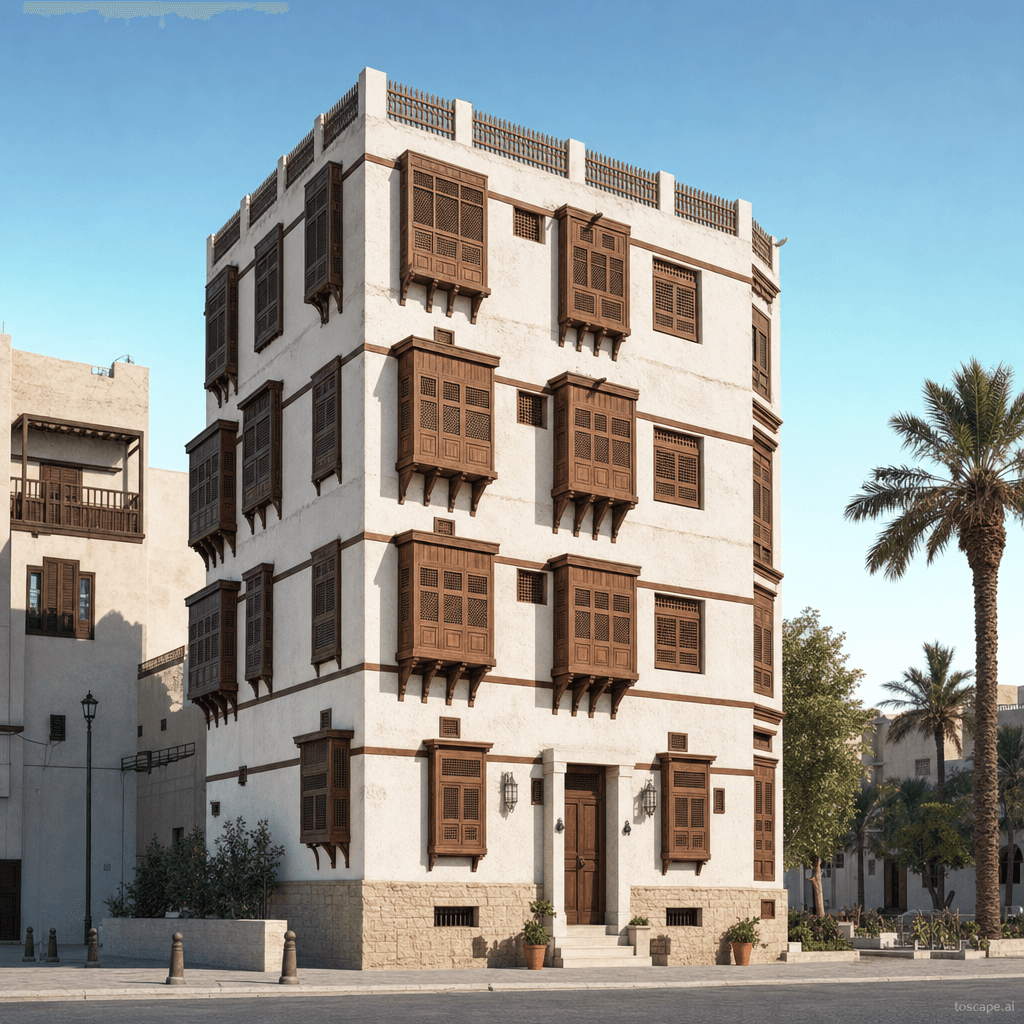
Hejazi Traditional Coastal
Saudi Arabia · Hejaz / Red Sea Coast
Vertical rectangular prism of 3–7 storeys — load-bearing coral-limestone (al-manqabi) walls rendered in warm off-white juss plaster — projecting rawashin timber bay windows with intricately assembled lattice screens (shish) on every upper floor — horizontal ti...
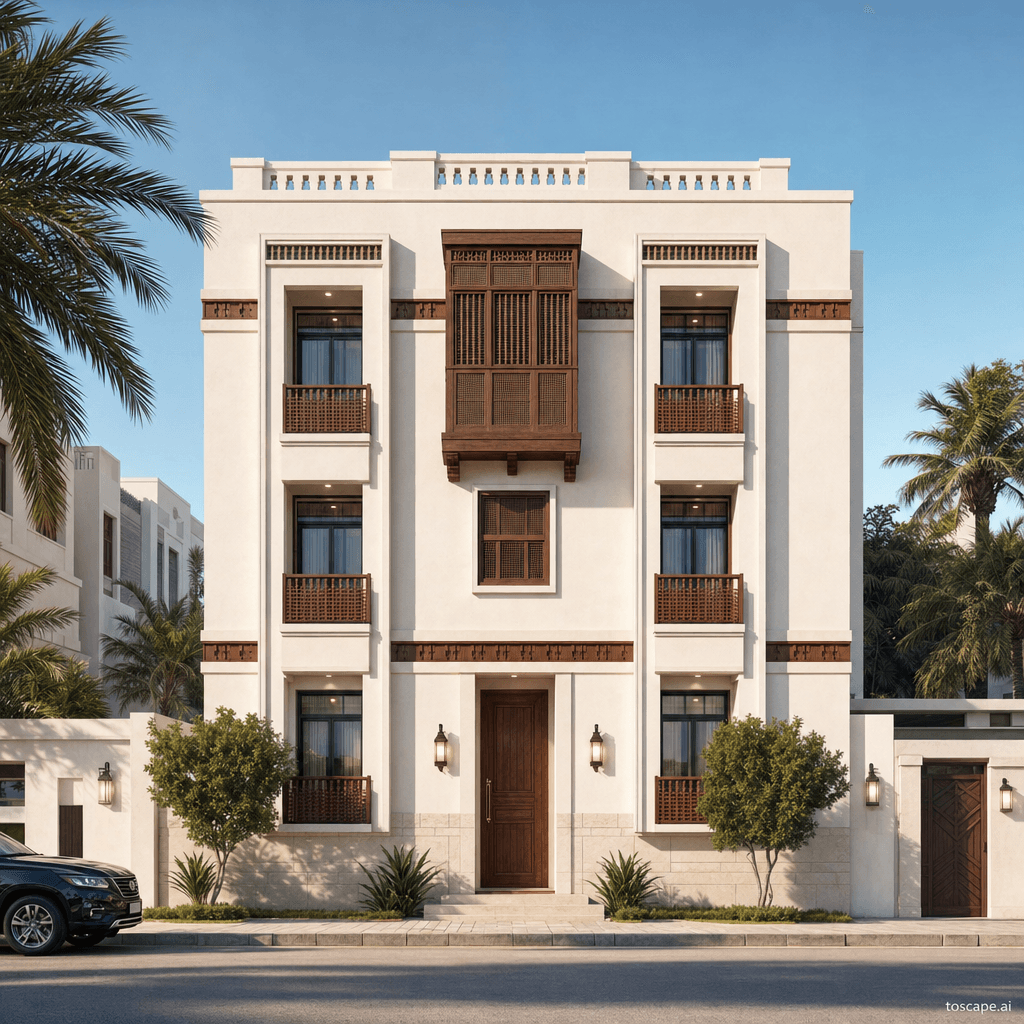
Hejazi Transitional Coastal
Saudi Arabia · Hejaz / Red Sea Coast
Symmetrical composed facade — simplified roshan-inspired projecting bays integrated into a rendered wall plane — reduced but still legible horizontal banding — modern glazing contained within traditional-opening proportions — retained flat parapet with simplif...
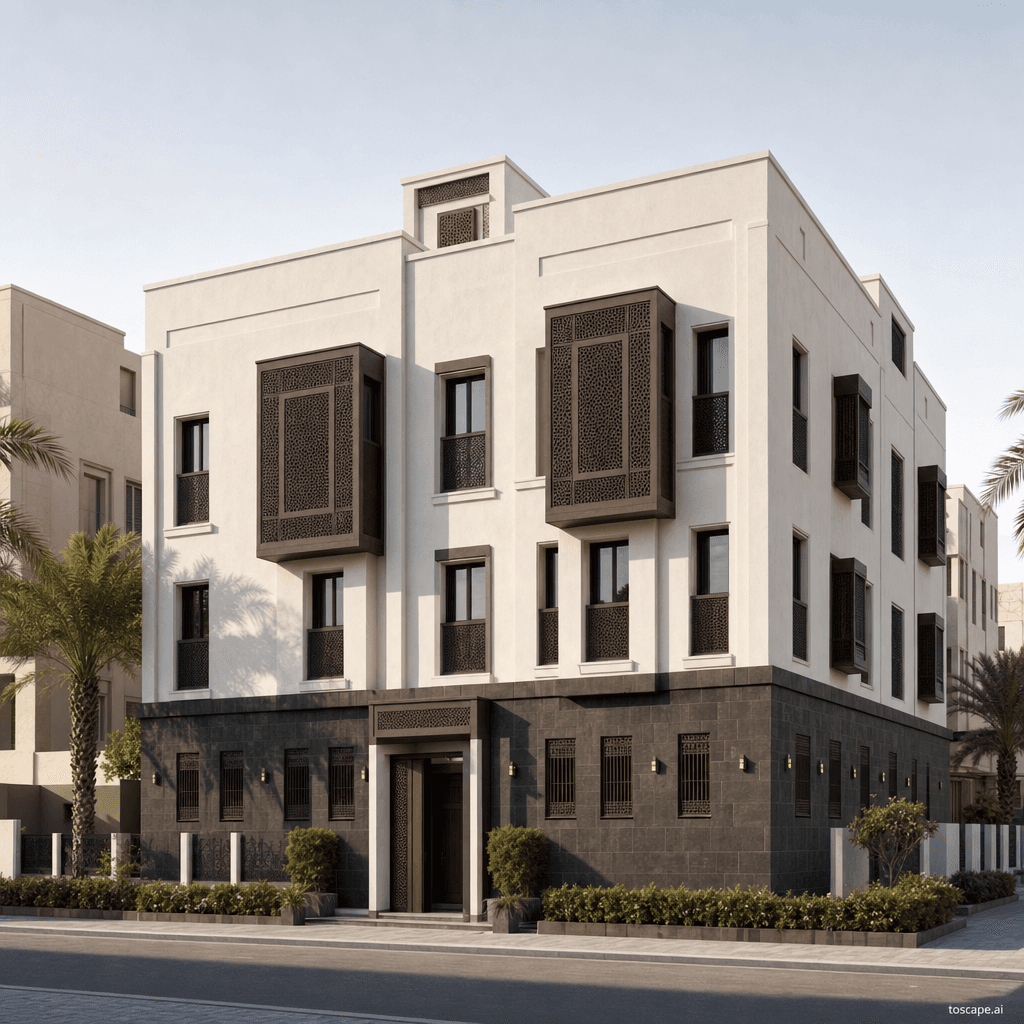
Inner Madinah Contemporary
Saudi Arabia · Inner Madinah
Same massing and tripartite reading as Traditional — dark basalt cladding base, smooth white-washed render upper walls, plain tall parapet — but executed with ordered geometric clarity — projecting frames ABSTRACTED from the roshan replace true timber bay wind...
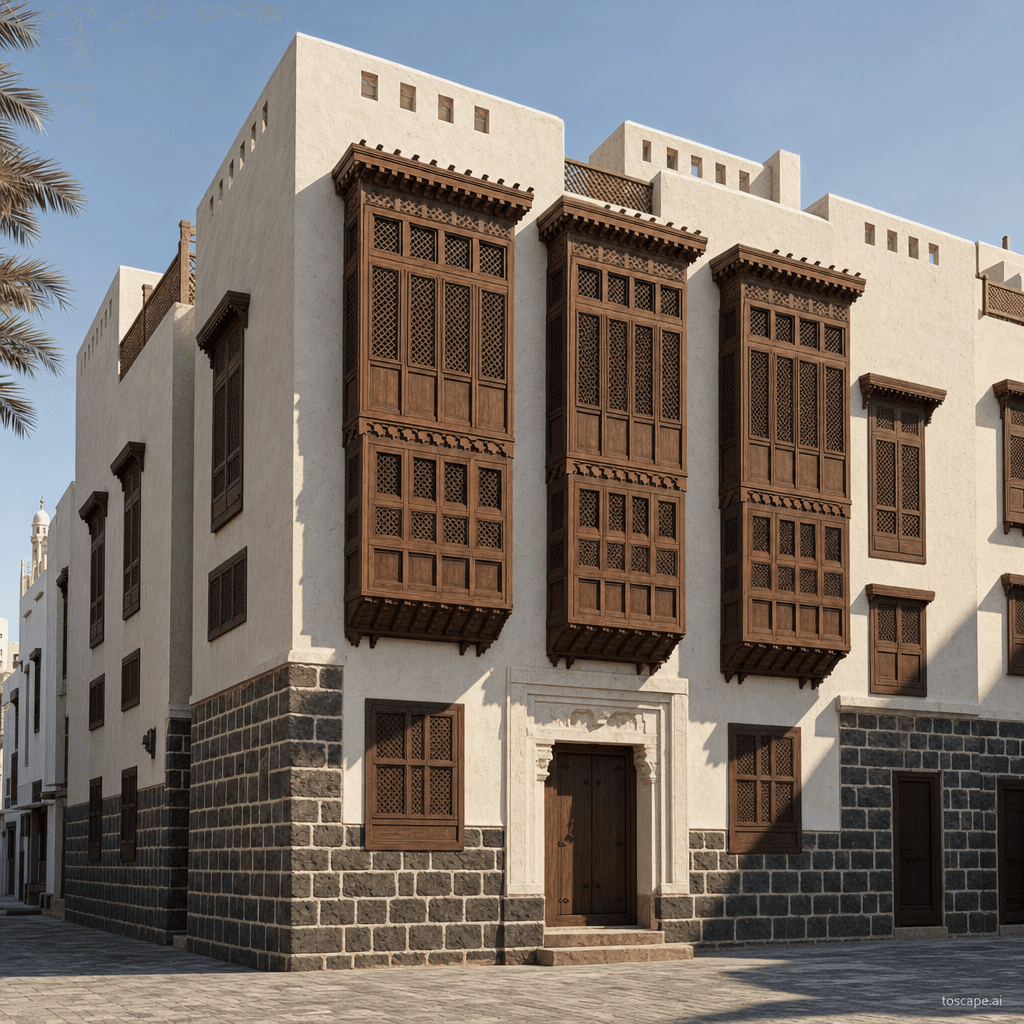
Inner Madinah Traditional
Saudi Arabia · Inner Madinah
Dark grey basalt lava stone base (0.6–4m high) with raised off-white lime mortar joints — off-white hand-troweled limewash render on all upper walls — tall deeply-projecting dark teak-brown timber roshans dominating the middle tier with geometric mashrabiya la...
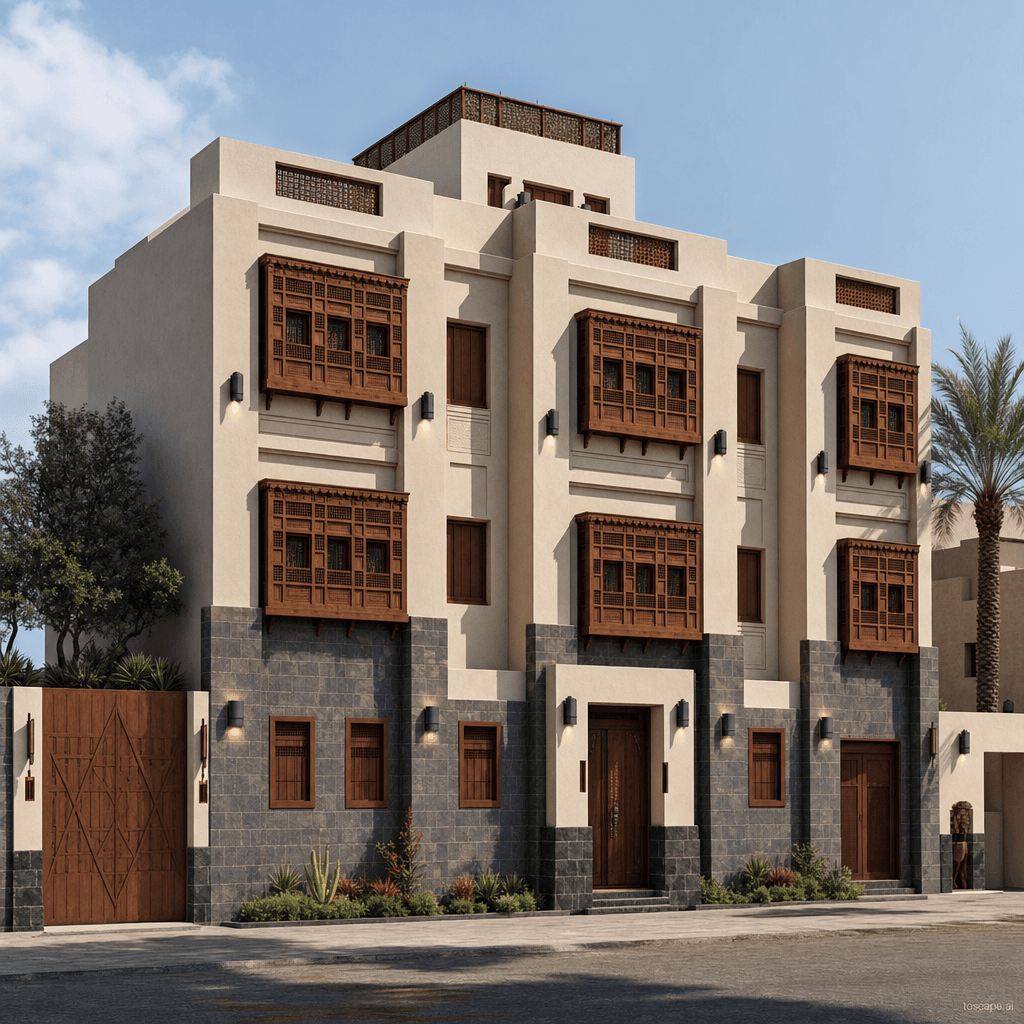
Inner Madinah Transitional
Saudi Arabia · Inner Madinah
Traditional silhouette and tripartite logic preserved — basalt-and-render duality retained but executed with cleaner contemporary fabrication — roshans simplified and spaced with deliberate horizontal gaps between groups (rosan-gap-roshan, not continuous rosha...
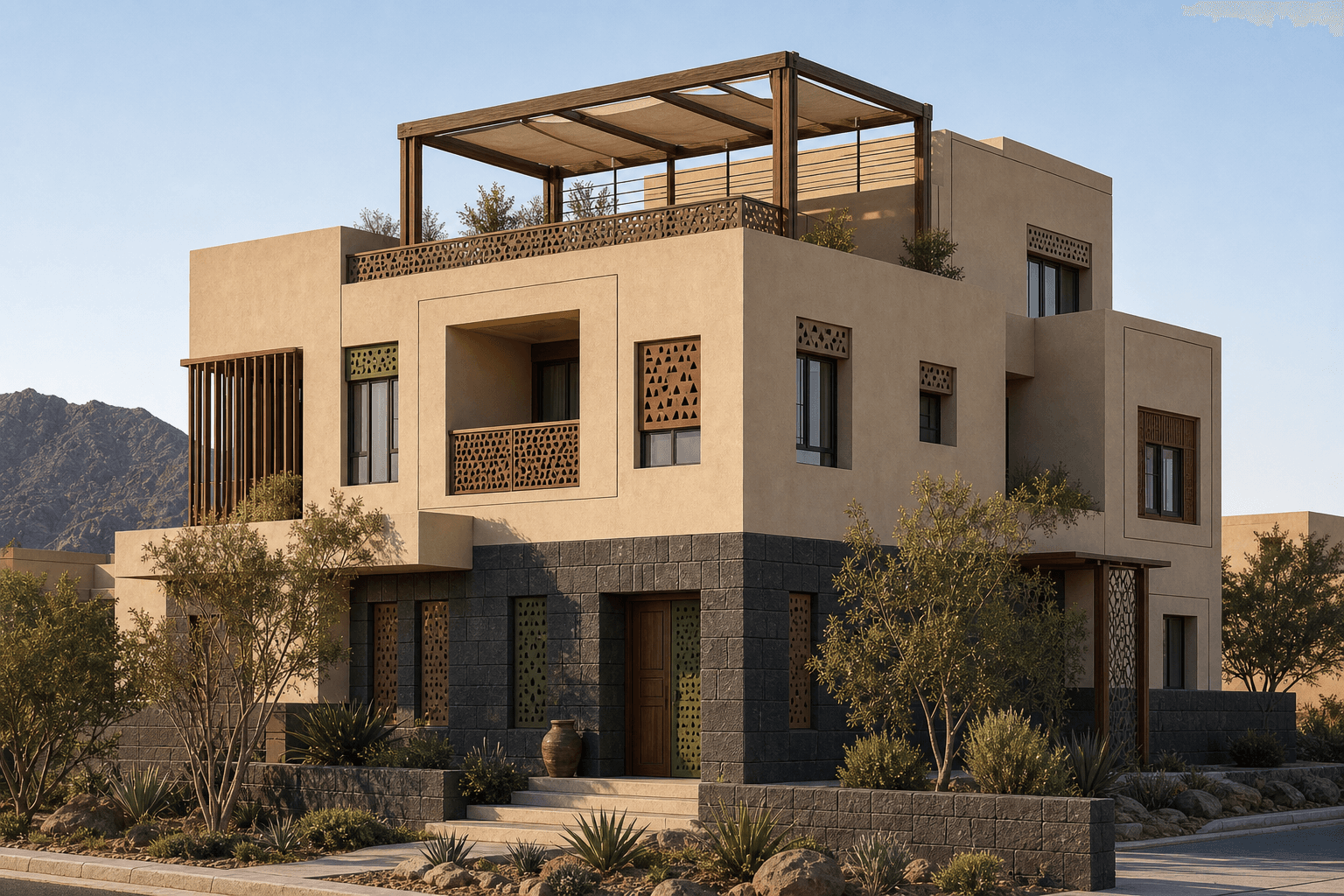
Madinah Rural Contemporary
Saudi Arabia · Madinah Rural
Dark engineered stone base (playful, abstract articulation) — warm smooth render upper — abstracted triangular vent character (into over-panels, perforated screens, or window design) — NO parapet finials (flat clean edge preferred) — active rooftop with timber...
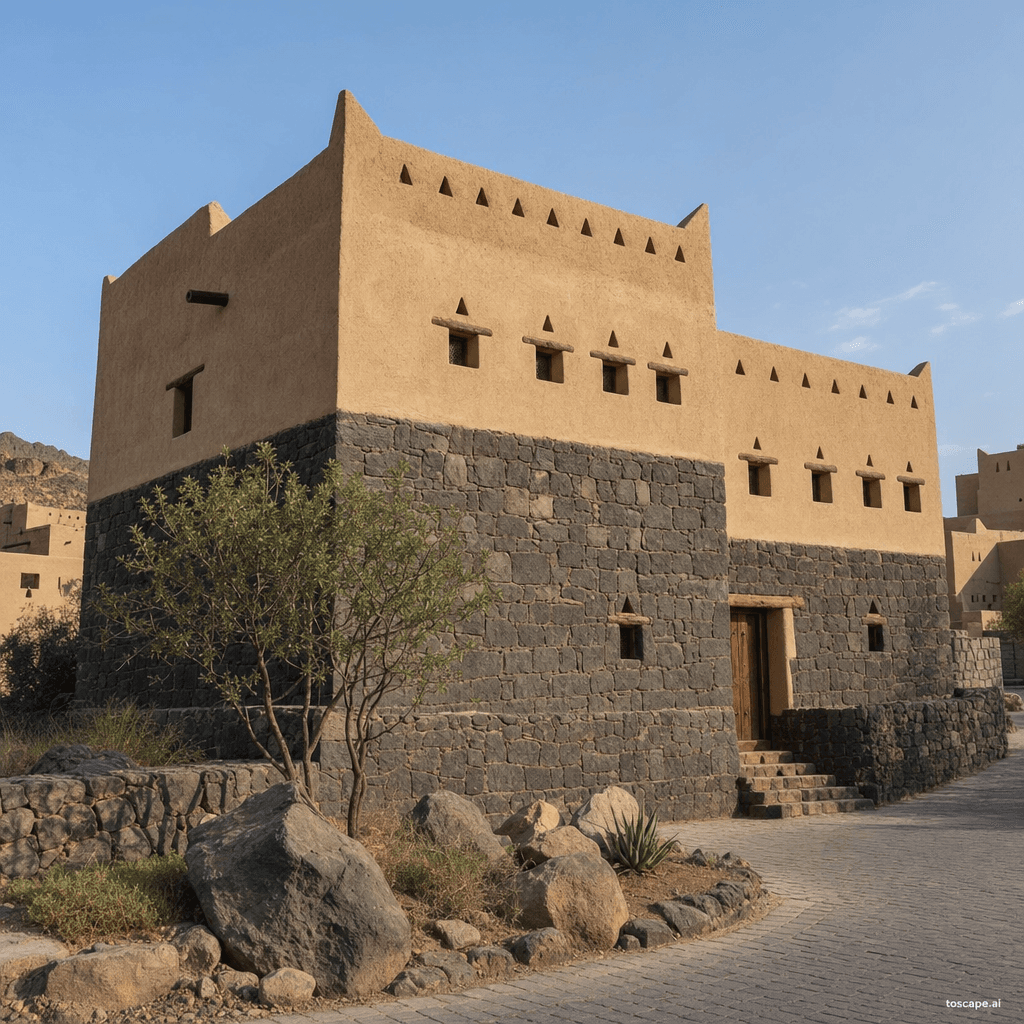
Madinah Rural Traditional
Saudi Arabia · Madinah Rural
Dark gray basalt/lava stone base — warm earth-tone lime plaster upper — extremely small punched windows (≤25–35% void ratio) — defining triangular vent openings in rows above every window — expressed palm-trunk lintels — angled (oblique-cut) parapet finials at...
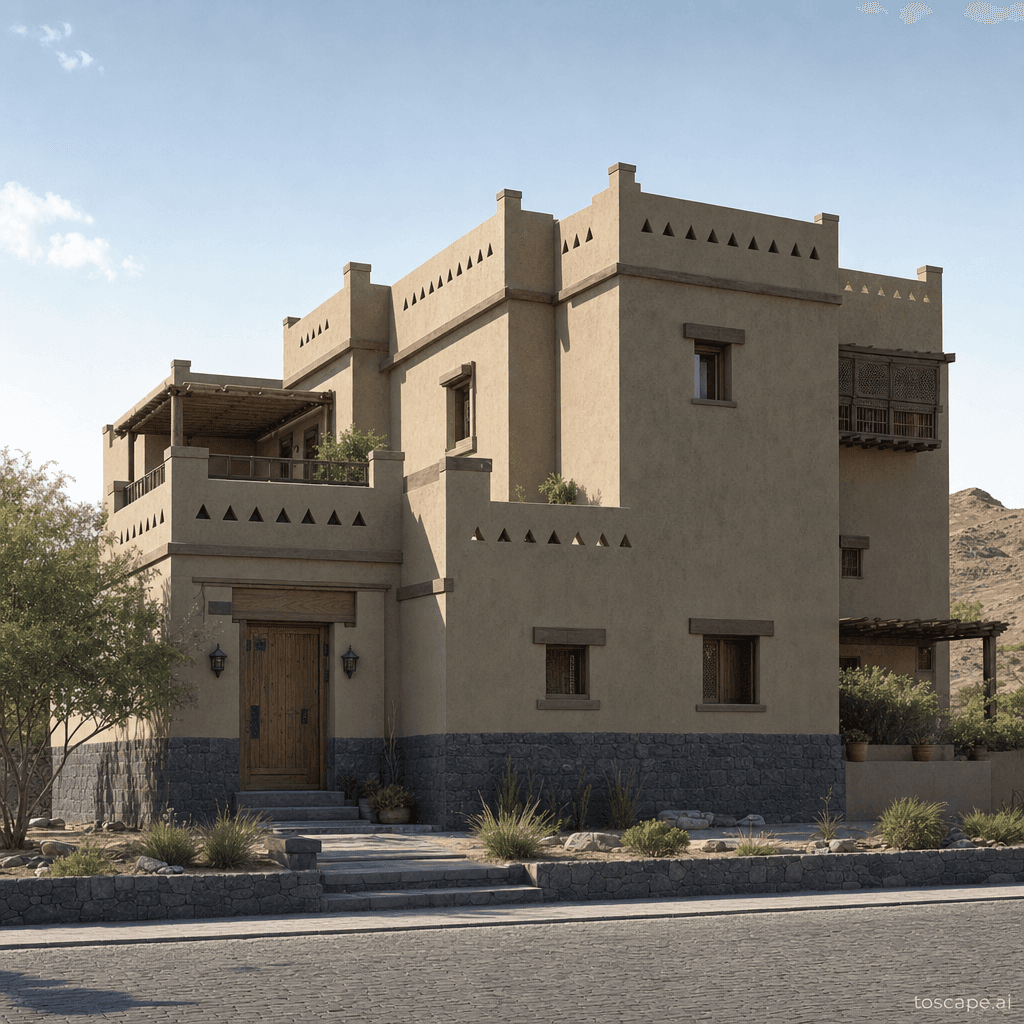
Madinah Rural Transitional
Saudi Arabia · Madinah Rural
Dark gray stone base (refined, smoother texture than Traditional) — warm earth-tone render upper — triangular vent rows maintained as characteristic feature — simplified SQUARE corner finials (replacing angled) — expressed lintels — asymmetrical conjoined orth...
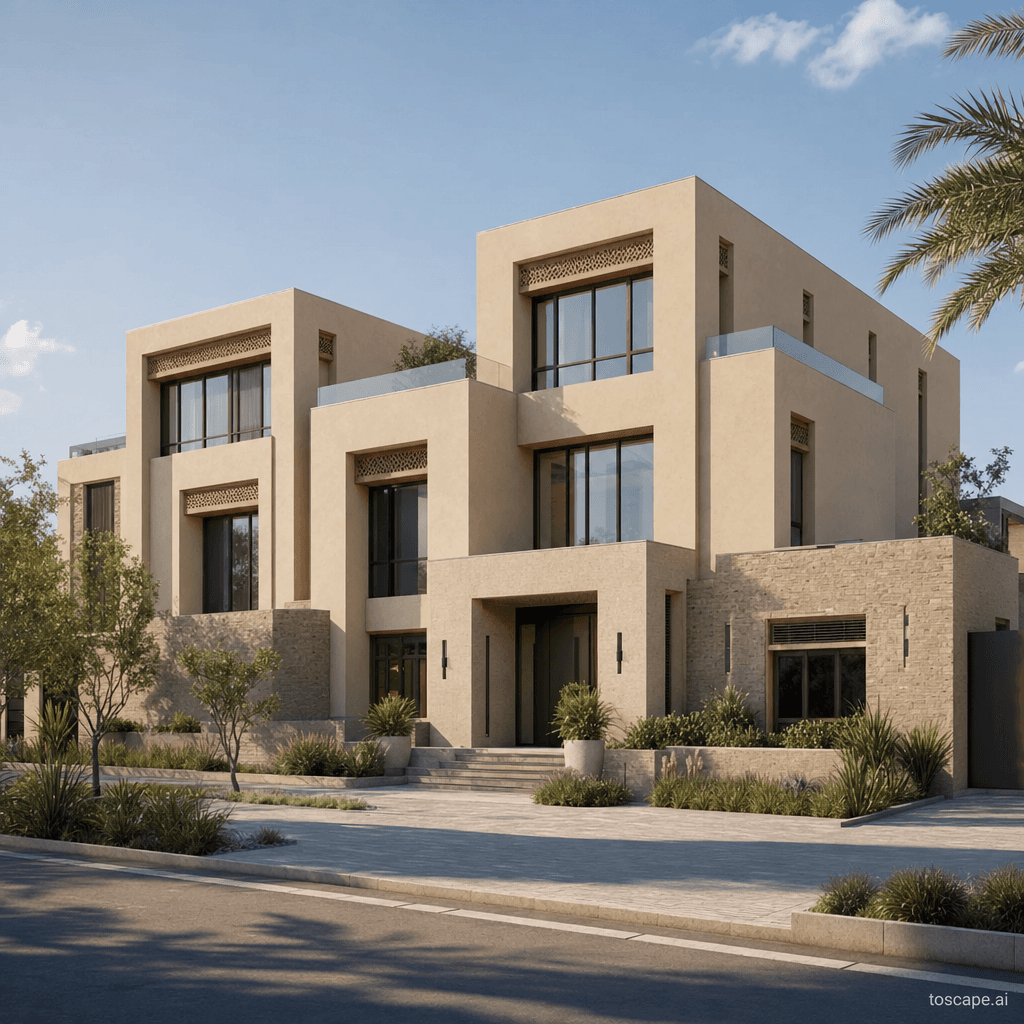
Najran Contemporary
Saudi Arabia · Najran Highlands
Distinct grouped masses with simplified geometry — mostly vertical forms with occasional residual tapering — flat rectilinear parapets flush with the building line — monumental openings and continuous glazing used selectively — slanted recessed or chamfered wi...
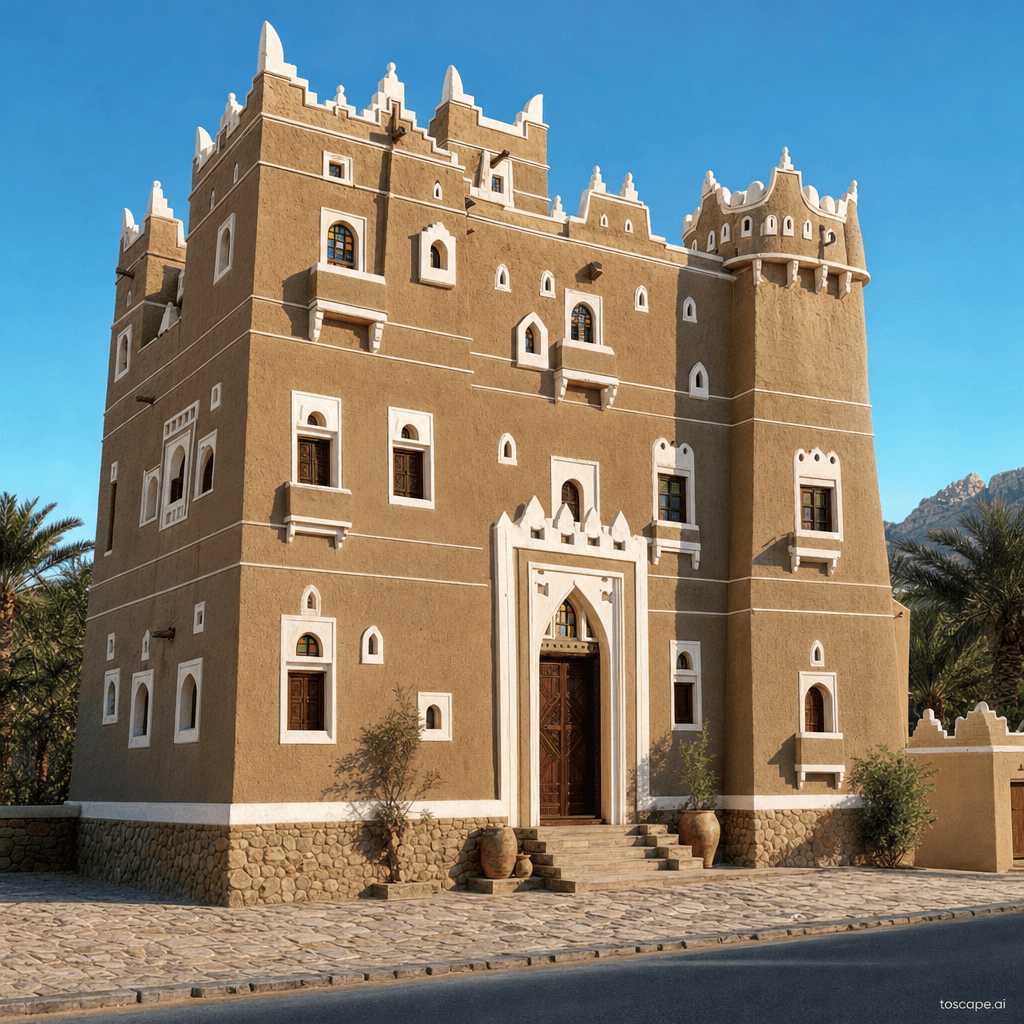
Najran Traditional
Saudi Arabia · Najran Highlands
TAPERED walls with wide base narrowing upward — asymmetric clustered vertical masses — continuous horizontal mud banding — white gypsum frames around every door and window — mixed rectangular, square, and oval openings — stained glass in selected windows — cur...
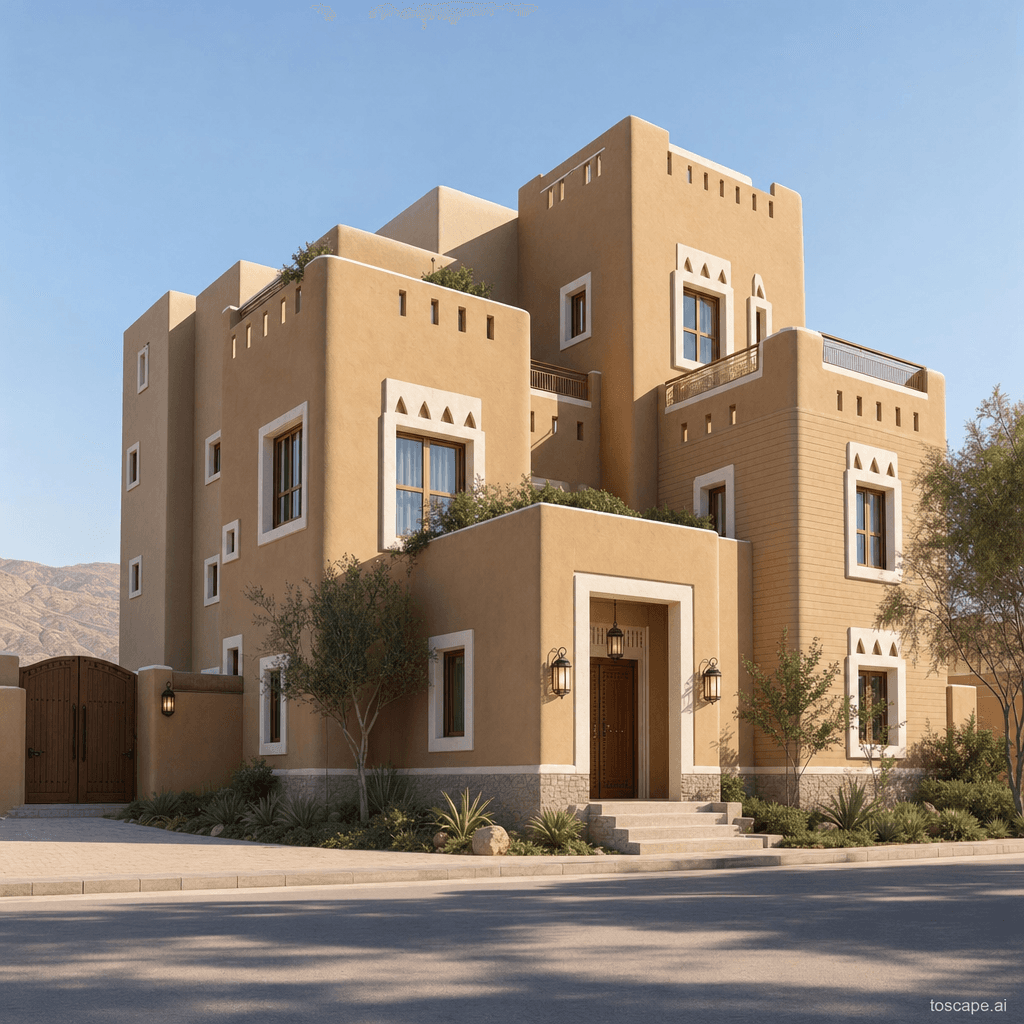
Najran Transitional
Saudi Arabia · Najran Highlands
Asymmetric grouped masses with selective setbacks — mostly vertical walls with reduced tapering — rounded corners retained on key masses — selective horizontal lining on some volumes and smooth neutral surfaces on others — wider slim rectangular and larger squ...
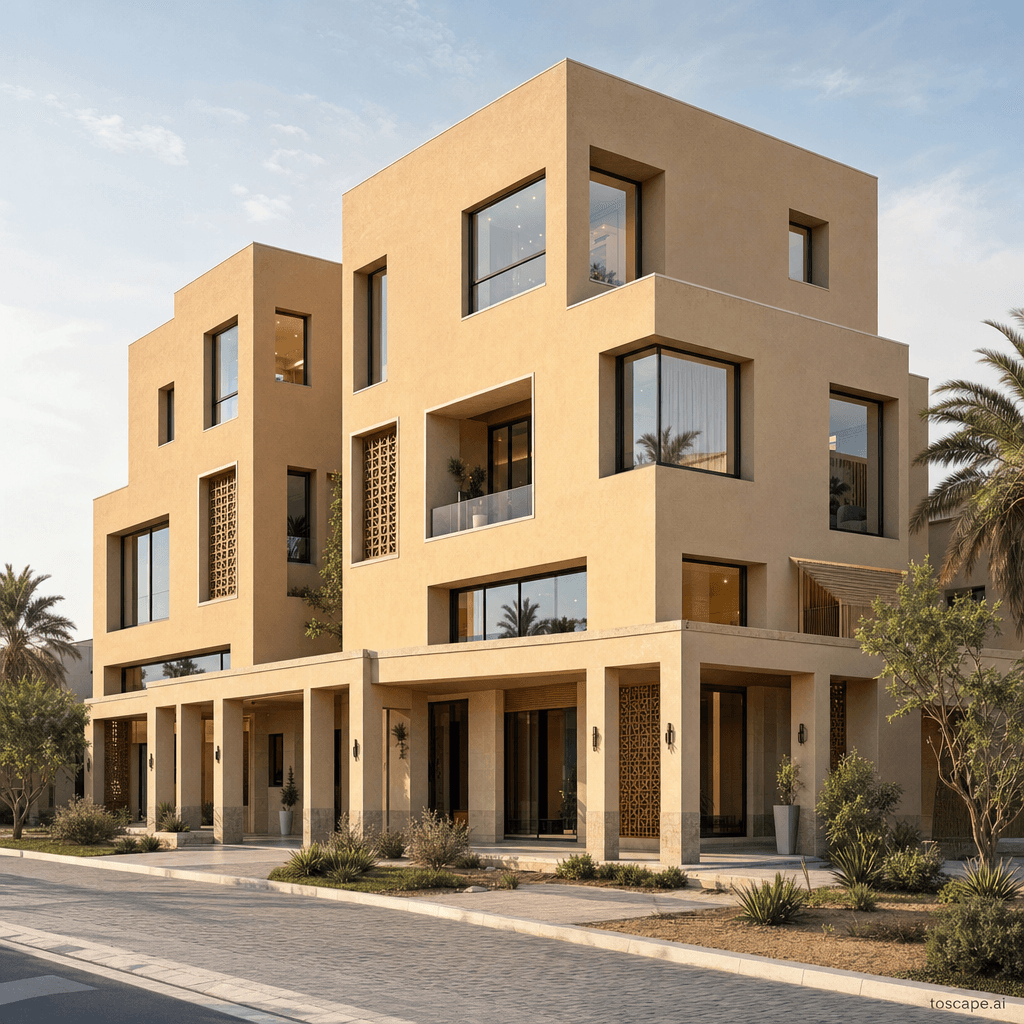
Northern Najdi Contemporary
Saudi Arabia · Northern Najd
Vertical square robust mass with flat undecorated parapet — zero crenellations — large rectangular windows NOT vertically aligned (40–60% opening ratio) — ground-floor contemporary arcade with squared columns, rectangular openings, and timber louvres with abst...
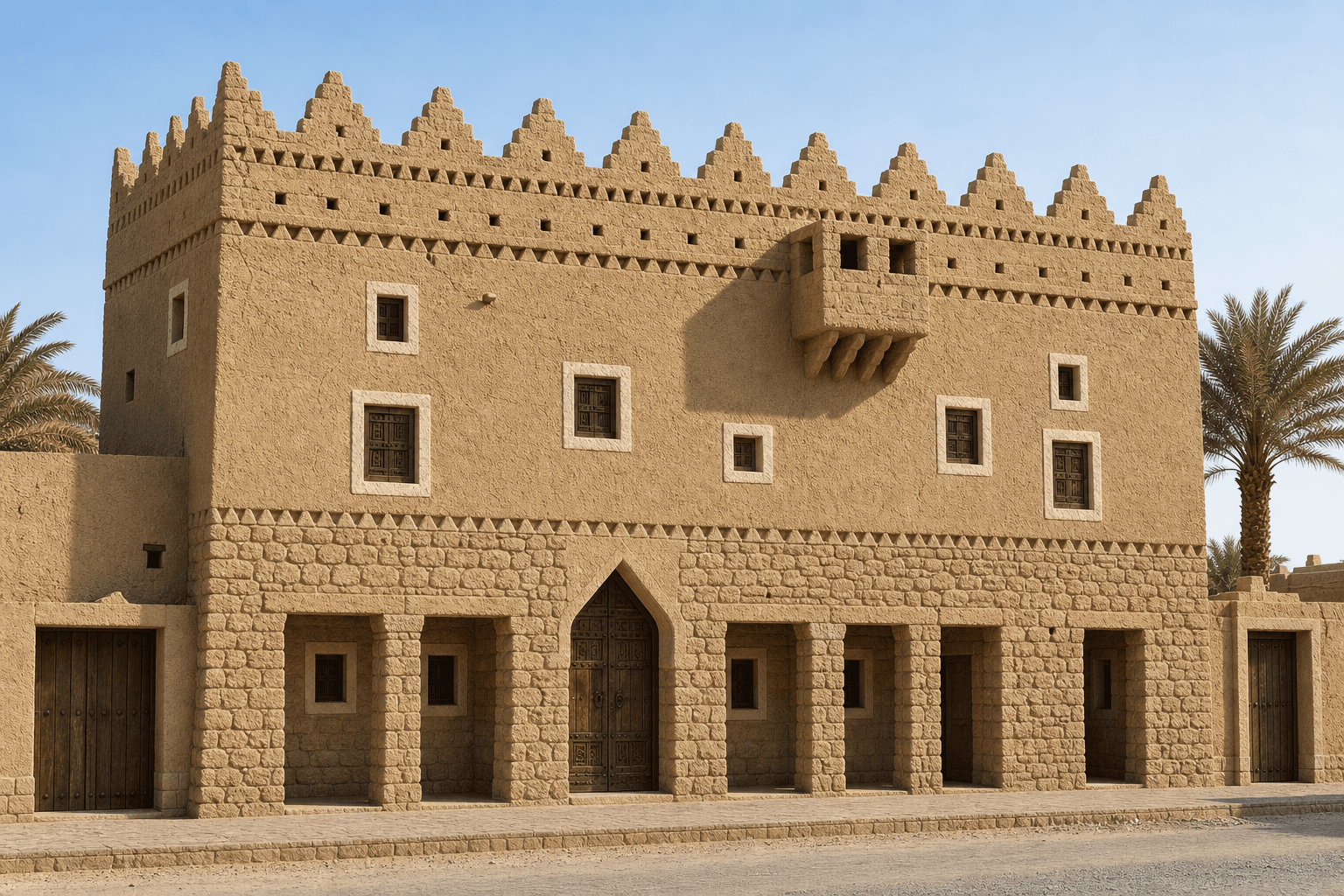
Northern Najdi Traditional
Saudi Arabia · Northern Najd
Earth-toned horizontal monolithic bearing-wall mass — rough-hewn stone base extending above ground floor — five-level triangulated crenellated parapet in SAME color as facade — raw unworked crenellation stone — prominent wide Turmah pocket-lookout element proj...
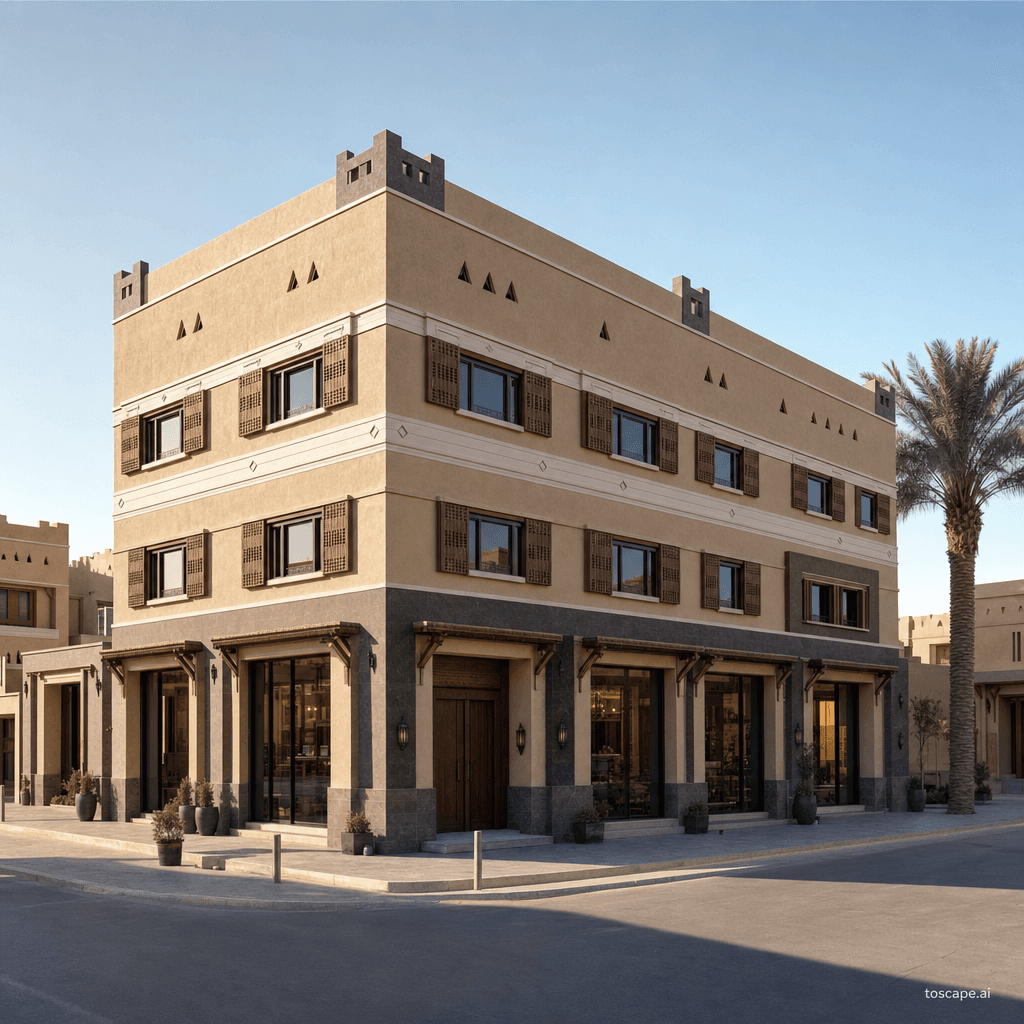
Northern Najdi Transitional
Saudi Arabia · Northern Najd
Horizontal monolithic mass with flatter cleaner aesthetic — flat parapets with CORNER CRENELLATIONS ONLY in contrasting darker color — three facade tiers separated by gypsum and fenestration bands — wider more horizontal windows (1:1 to 2:1) with timber shutte...
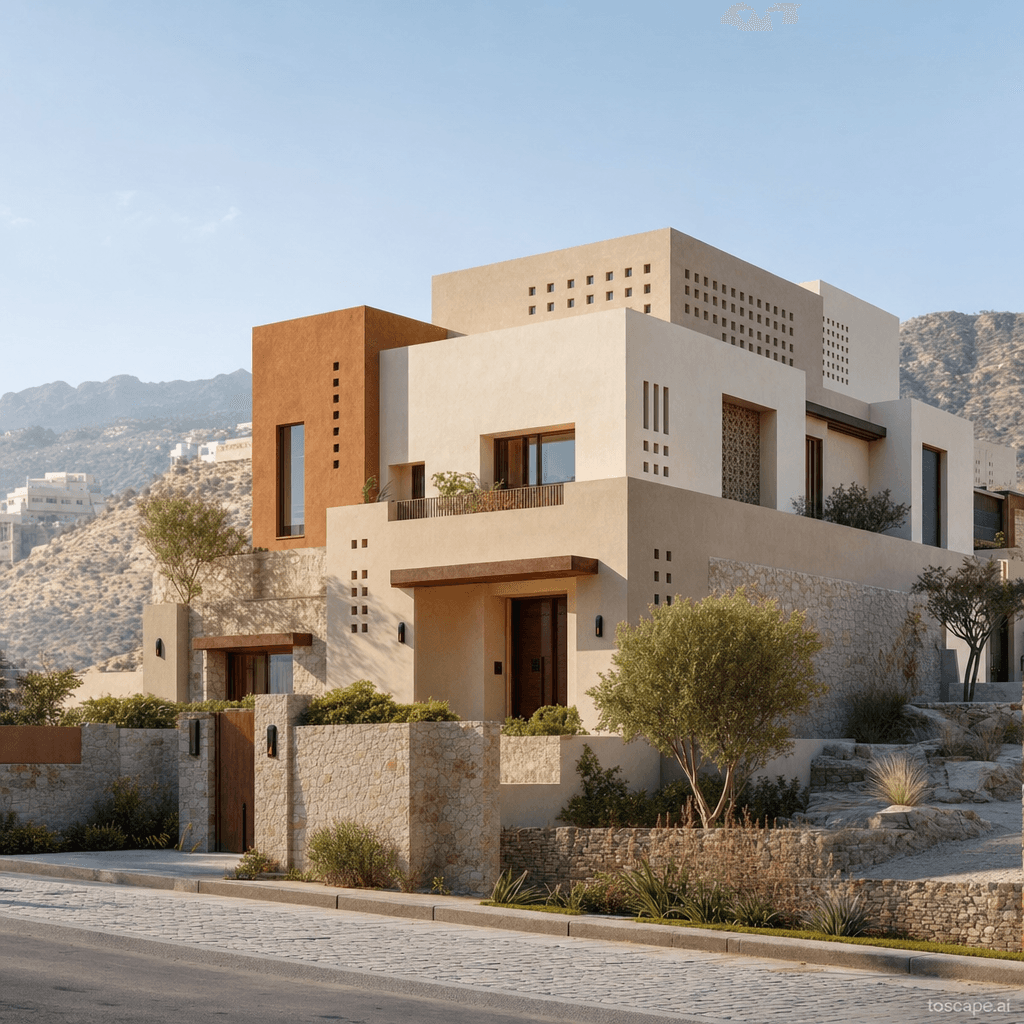
Sarawat Mountains Contemporary
Saudi Arabia · Sarawat Mountains
Abstracted geometric volumes — compact massing with flat roofs — balanced solids and voids — grounded base with stronger daylighting — perforated walls and screens — simple parapets — local stone, plaster, pigmented concrete, and limited contemporary materials...
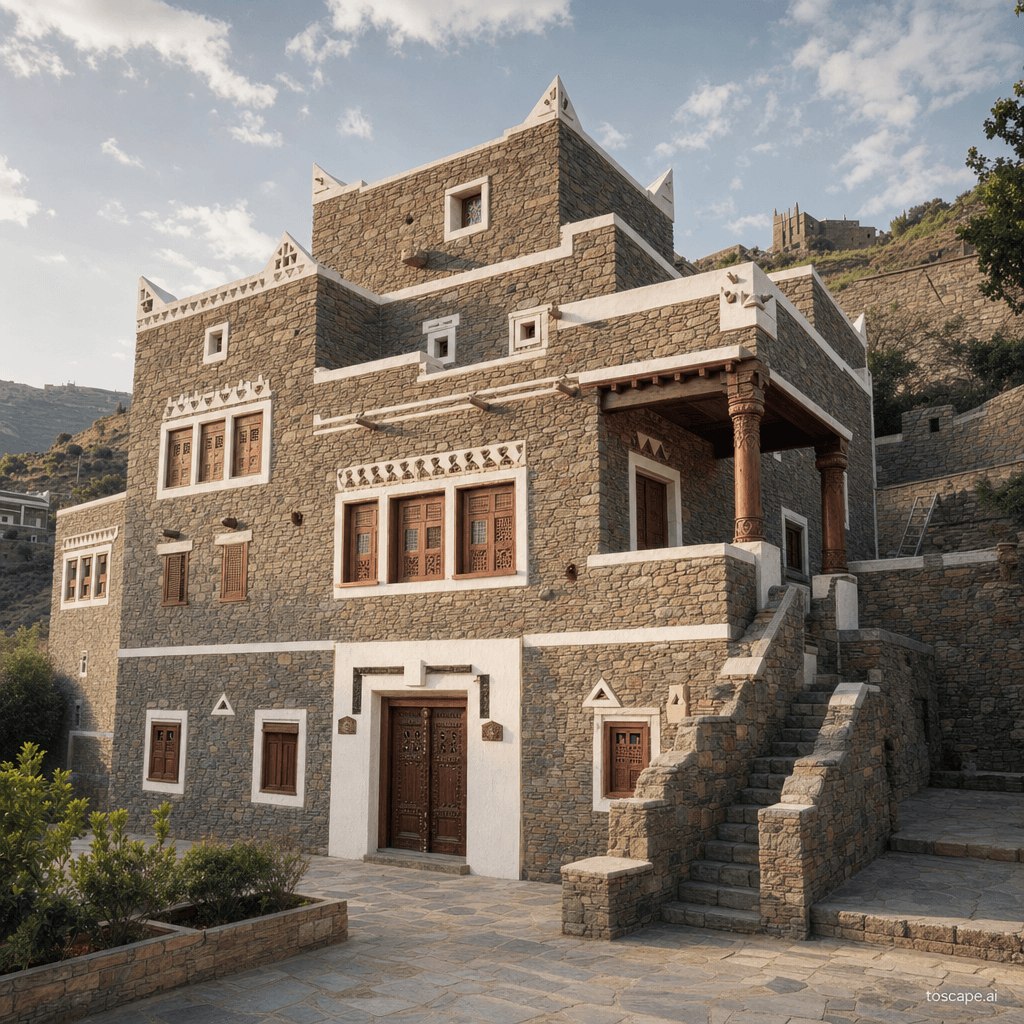
Sarawat Mountains Traditional
Saudi Arabia · Sarawat Mountains
Thick local stone walls — compact orthogonal massing — flat roofs with articulated parapets — small framed openings — projecting exterior stairs — carved timber columns and shutters — white stone highlights — courtyards and terraces shaped by steep terrain
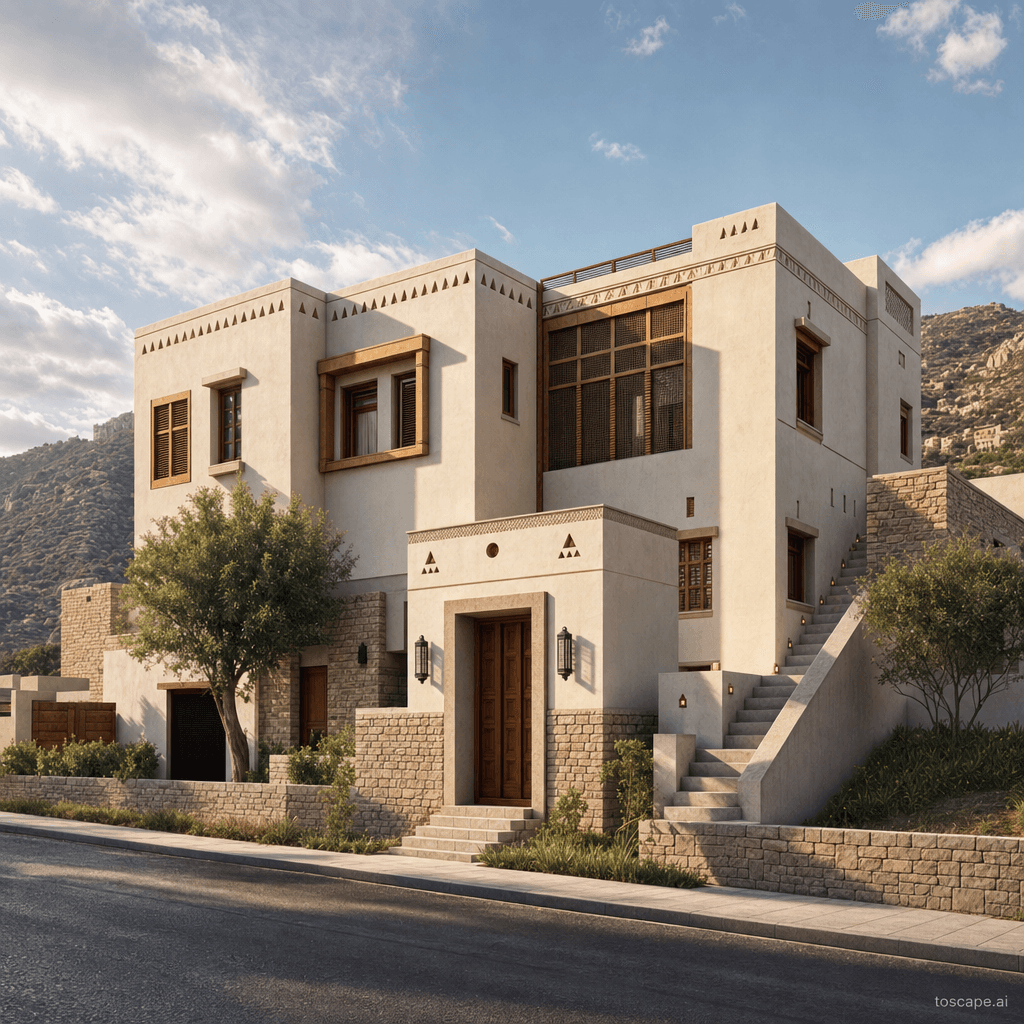
Sarawat Mountains Transitional
Saudi Arabia · Sarawat Mountains
Compact geometric massing — flat roofs with simplified parapets — balanced solids and voids — medium framed openings — interpreted exterior stairs — blended stone and plaster — timber and screen elements — light earth-tone palette — recognizable mountain DNA w...
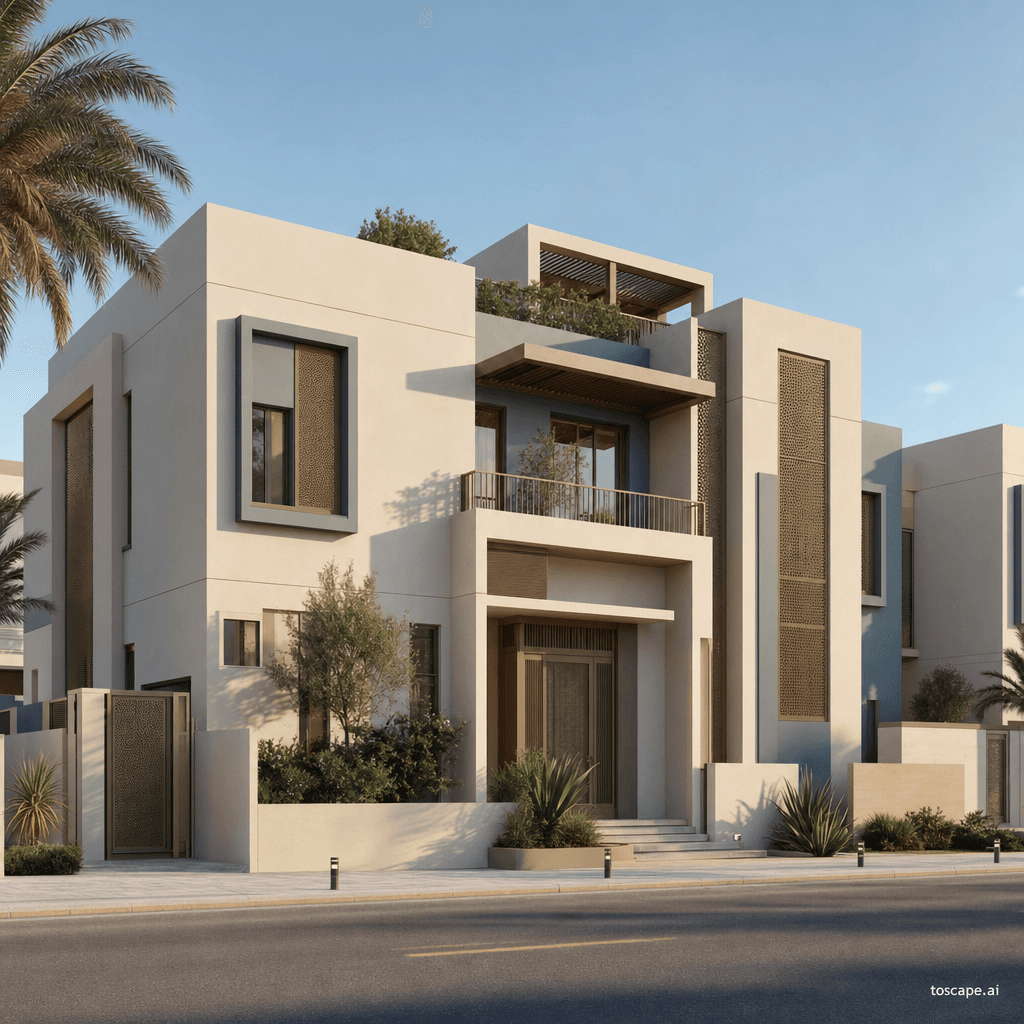
Tabuk Coast Contemporary
Saudi Arabia · Tabuk Coast
Abstraction of geometric planes within generally rectilinear forms — overall massing follows traditional proportions — perforated walls, screens, and projections for shade and comfort — wall-to-opening ratio retains original proportions with screen/panel adjus...
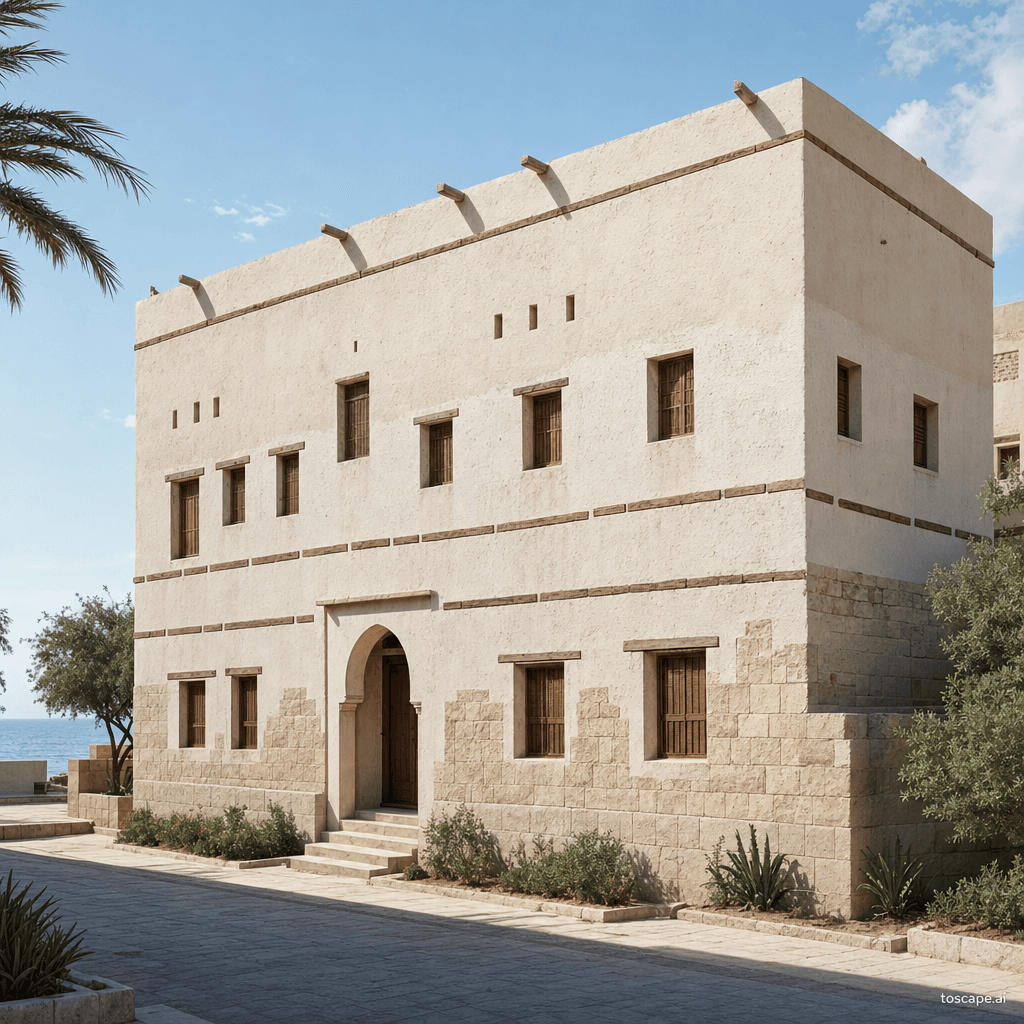
Tabuk Coast Traditional
Saudi Arabia · Tabuk Coast
Strong horizontal rectilinear massing (w:h ~2:1) — pale coral stone walls with lime-washed render — tripartite facade organization (base/middle/top) — 13–25% void with punched vertical rectangular openings — loose/misaligned window alignment with localized sym...
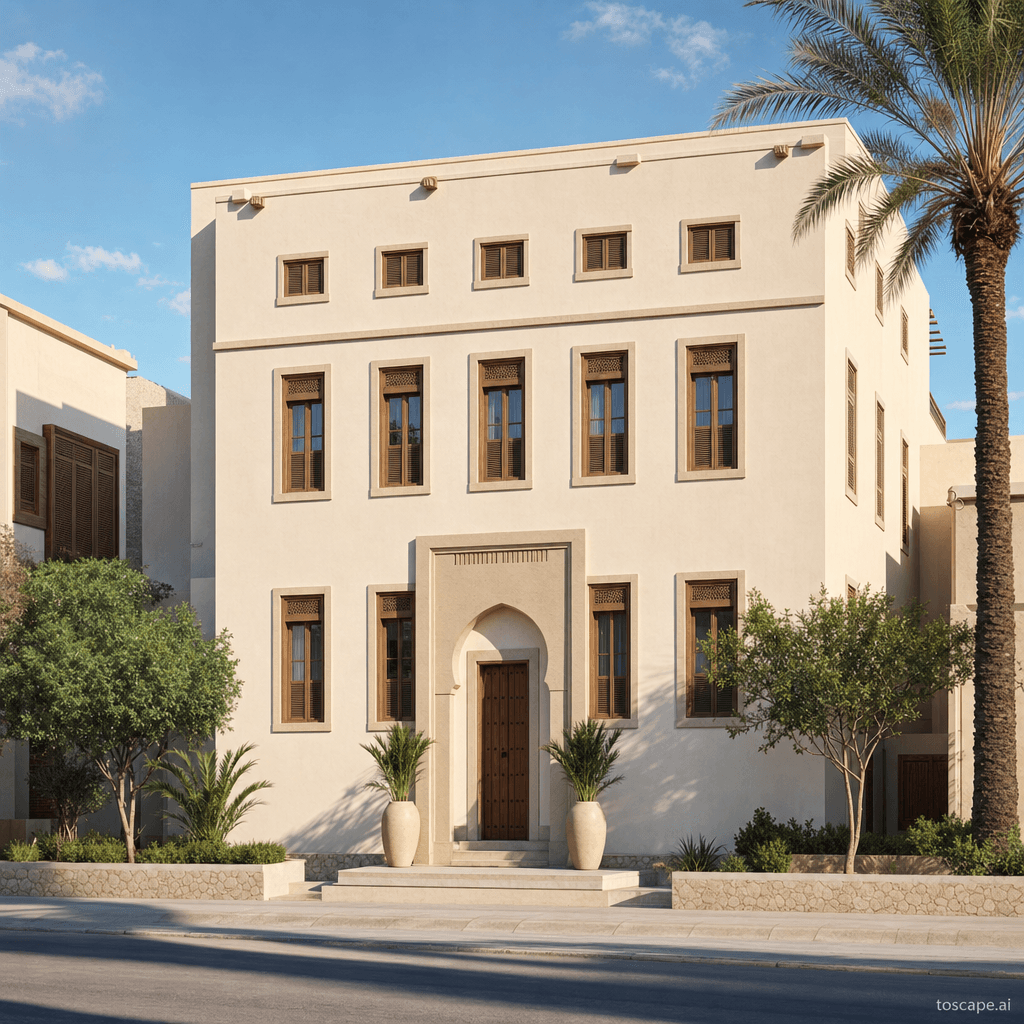
Tabuk Coast Transitional
Saudi Arabia · Tabuk Coast
Simple stone or rendered walls — rectilinear profile maintained — vertical windows aligned between floors (shift from loose alignment) — flat horizontal parapets with articulation recalling projecting elements — horizontal window alignments for layering (repla...
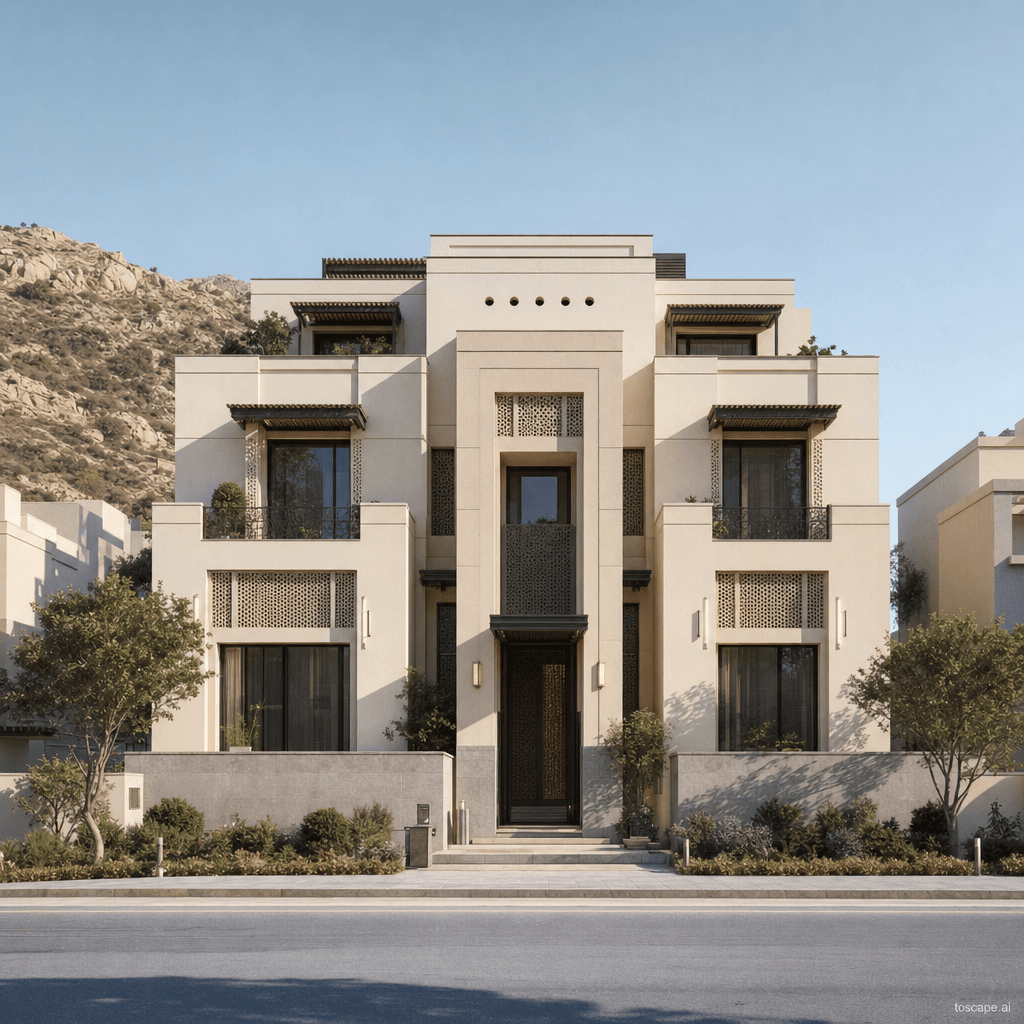
Taif Highlands Contemporary
Saudi Arabia · Taif Highlands
Light-strength regional abstraction — clear central axis or strongly ordered facade — deep recessed windows — abstracted local patterned screens — simplified cornice and canopy lines — flat parapets with restrained recesses and optional round-opening reference...
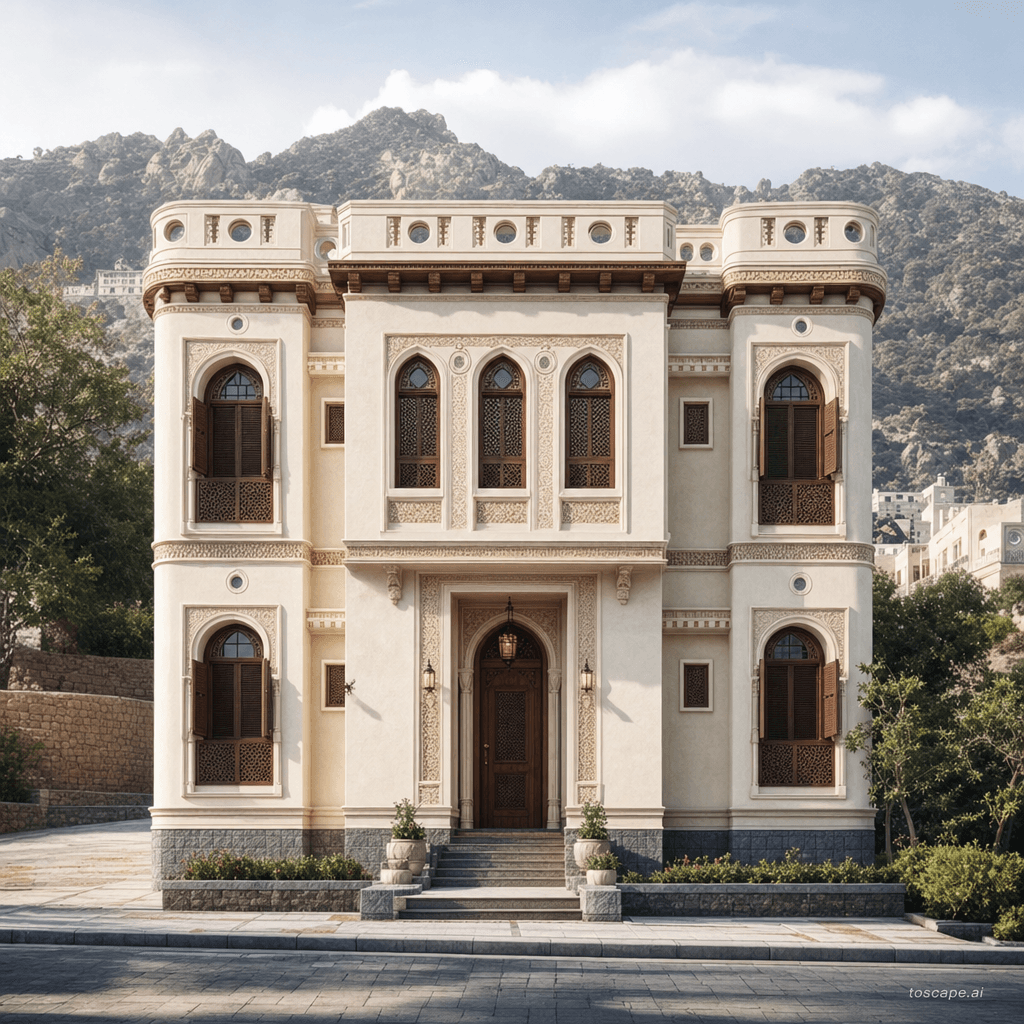
Taif Highlands Traditional
Saudi Arabia · Taif Highlands
Full-strength formal symmetry — grand villa proportions — clear central axis — rounded corners and chamfers — arched windows with upright proportions — double-recessed and ornamented entrances — heavy cornice banding — off-white rendered walls with stone and t...
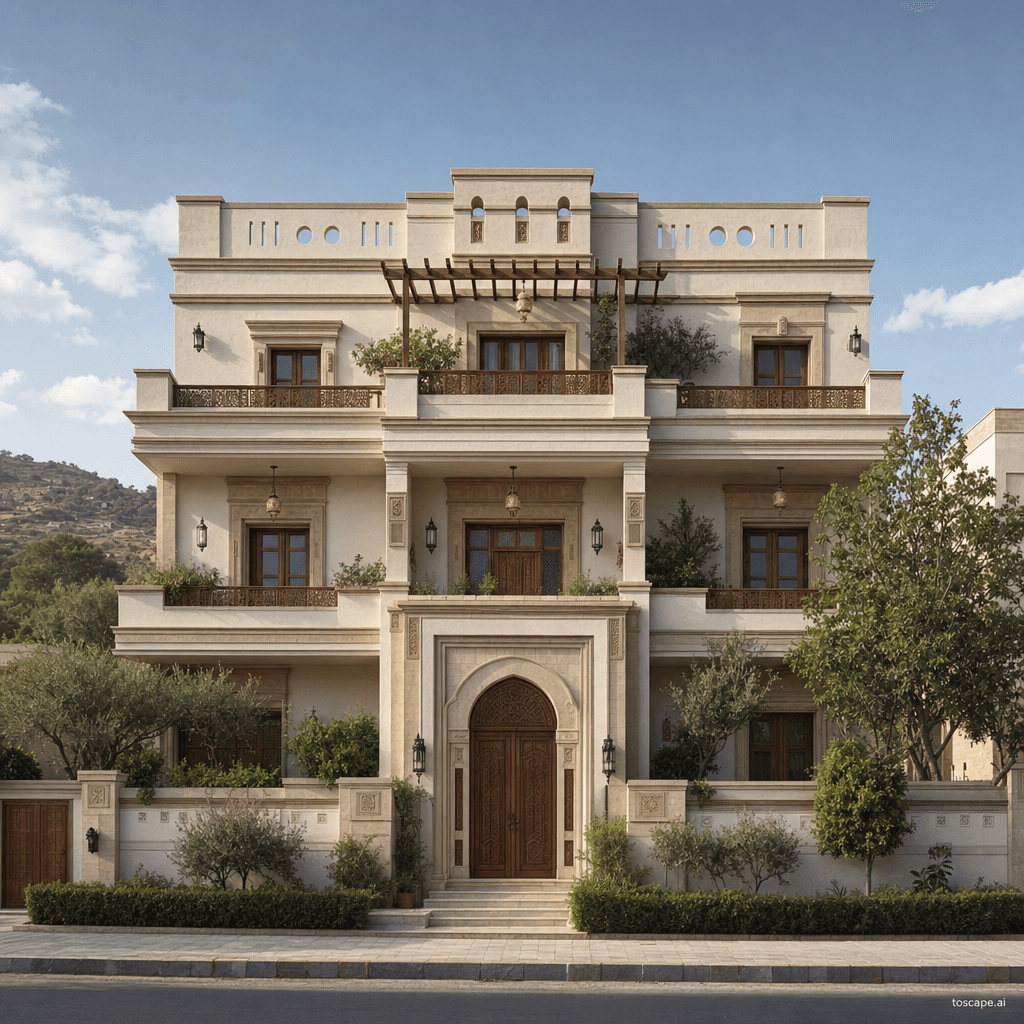
Taif Highlands Transitional
Saudi Arabia · Taif Highlands
Medium-strength traditional reference — formal central axis — simplified tripartite facade — orthogonal windows with restrained recesses — timber doors and gates inspired by Taifi craftsmanship — balconies and cornices emphasizing horizontality — flat parapets...
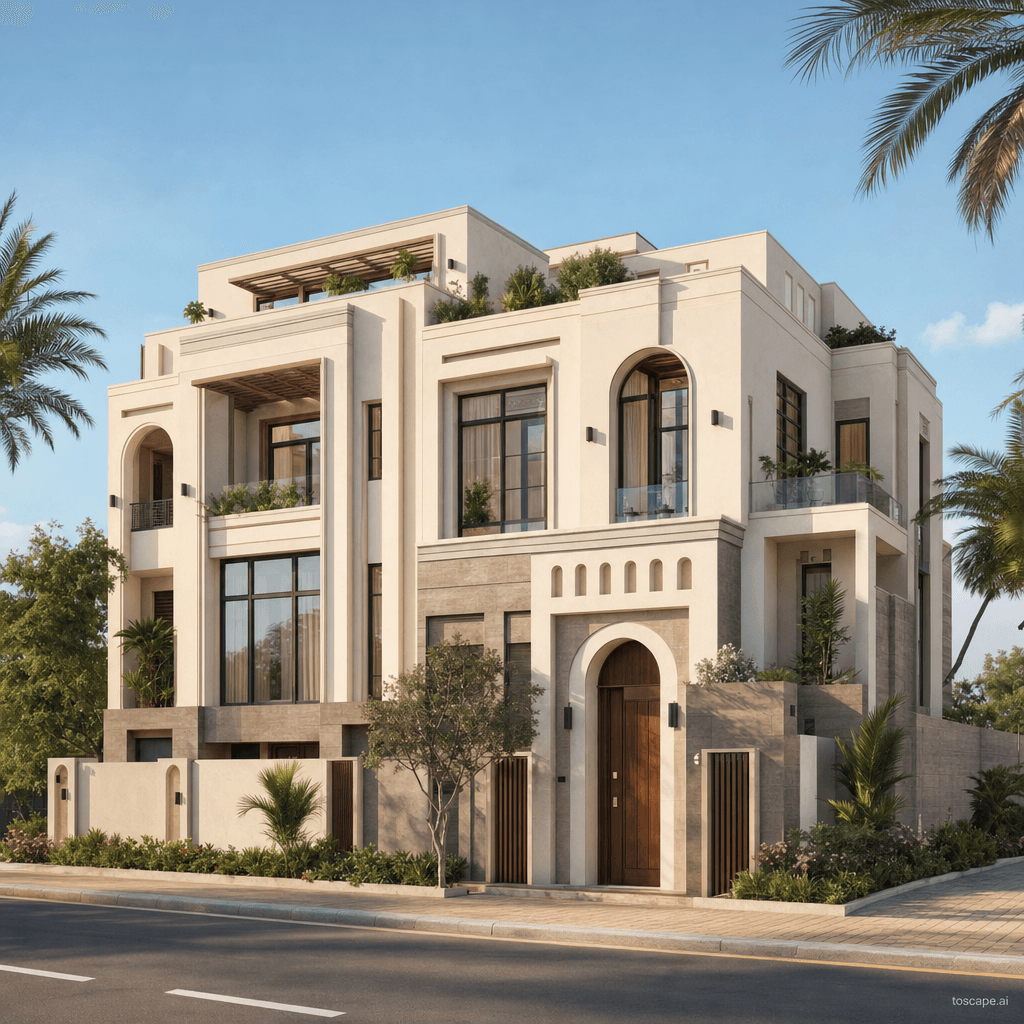
Tuhama Coast Contemporary
Saudi Arabia · Tuhama Coast
Horizontal refined mass (1:0.5 to 1:1.5 width-to-height, 1–4 storeys) — grounded base zone with hard-wearing contemporary materials — light cream/ivory primary wall (50–60% one material) — rectangular windows dominant with arch openings in balanced proportion...
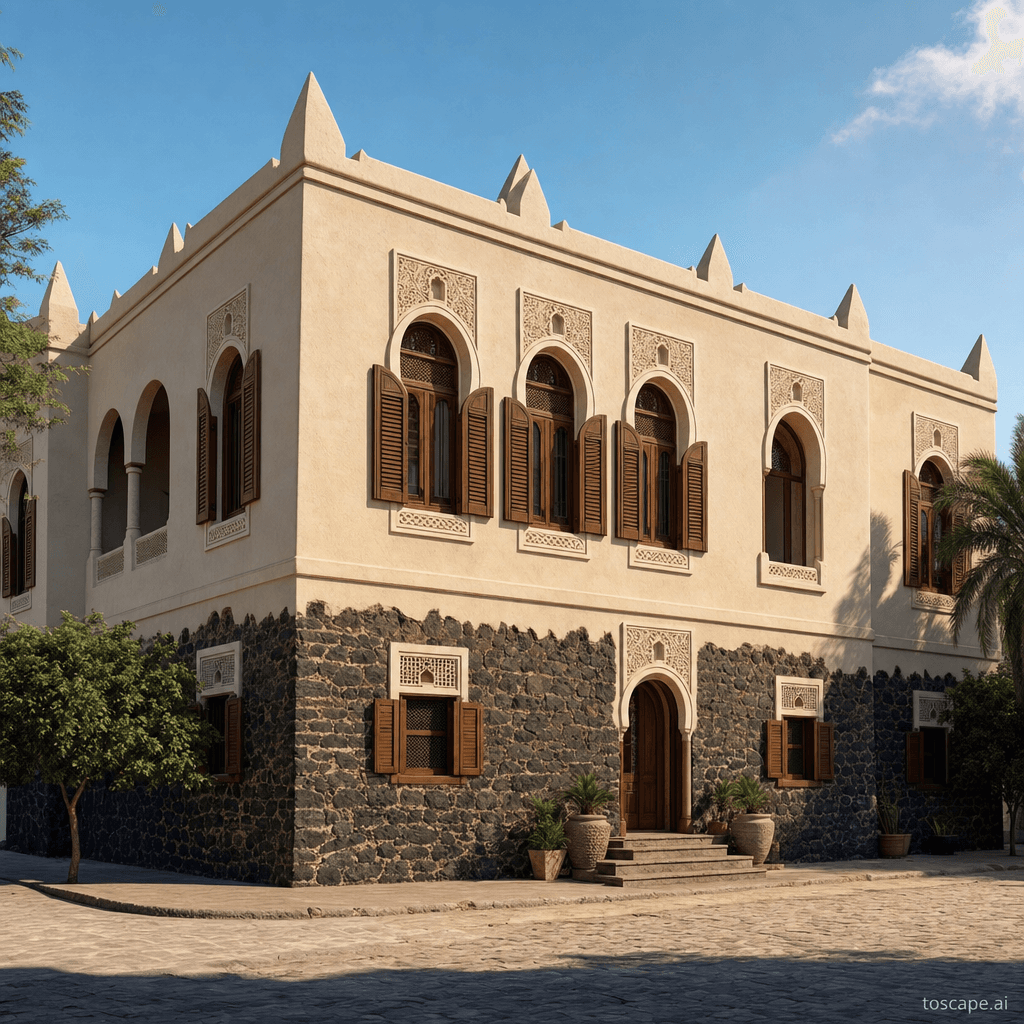
Tuhama Coast Traditional
Saudi Arabia · Tuhama Coast
Low horizontal bipartite mass (1:0.5 to 1:1.5 width-to-height) — dark volcanic stone base transitioning to warm cream coral-plaster upper wall — large horseshoe arch windows on upper floors — MANDATORY carved plaster niche overhead panel above EVERY opening —...
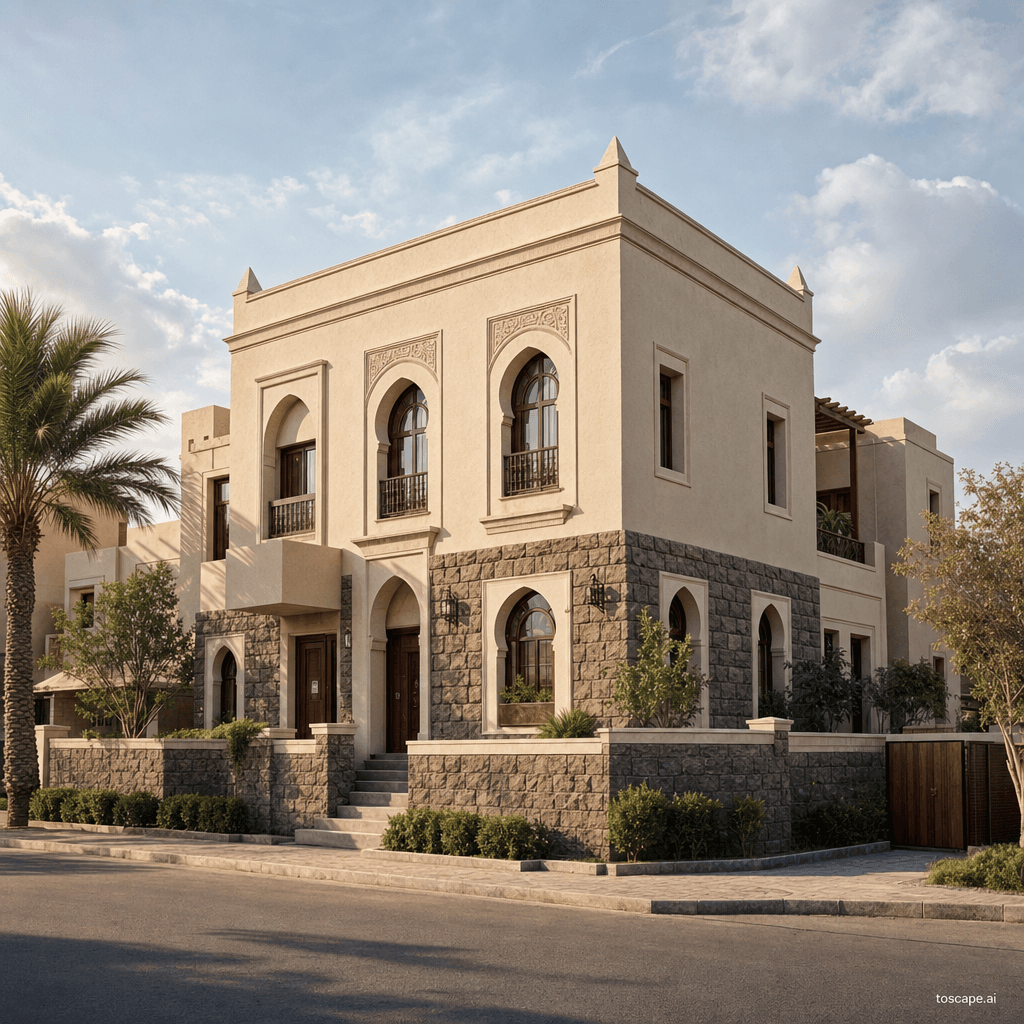
Tuhama Coast Transitional
Saudi Arabia · Tuhama Coast
Horizontal bipartite mass (1:0.5 to 1:1.5 width-to-height, 1–3 storeys) — stone or stone-equivalent base zone (min 20% facade) — warm beige/cream upper wall — arch openings dominant with interpreted carved niche over-panels on arch windows — flat or pointed co...
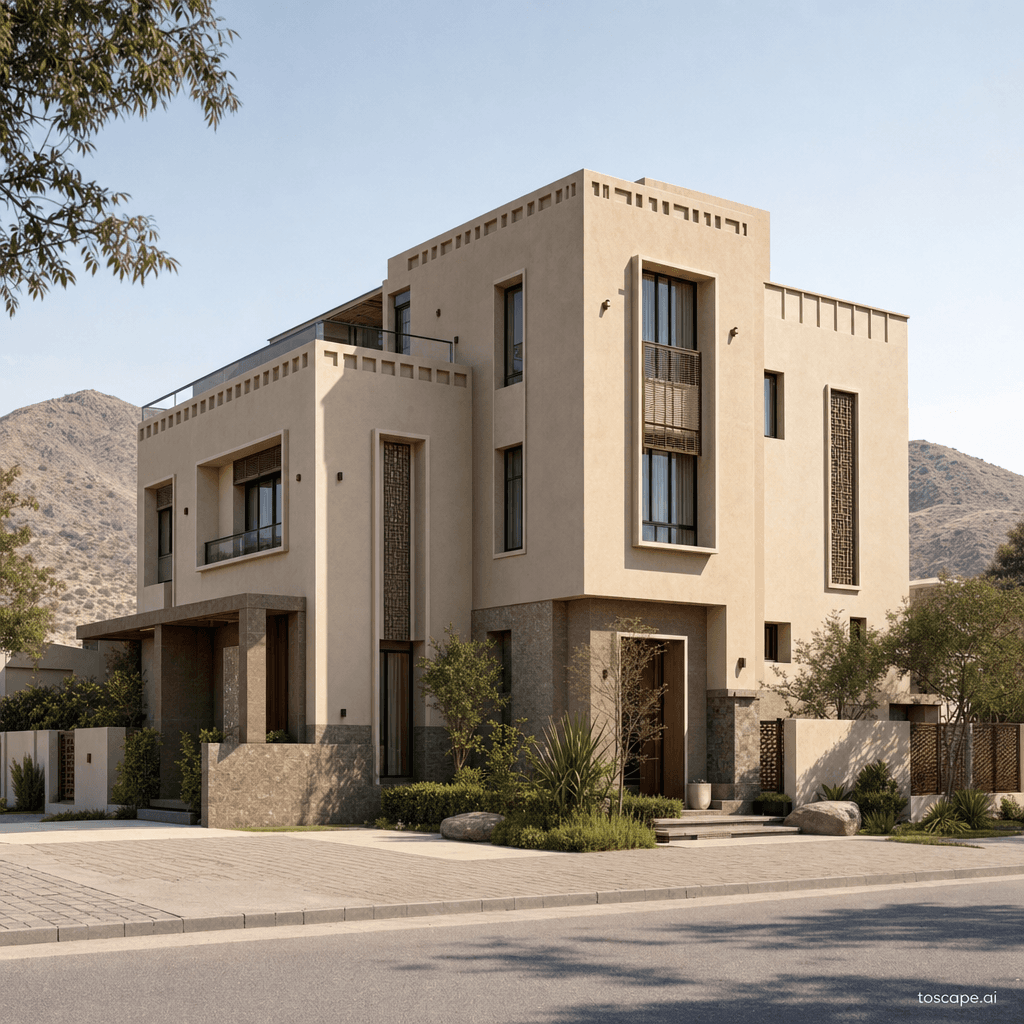
Tuhama Foothills Contemporary
Saudi Arabia · Tuhama Foothills
Balanced horizontal-and-vertical strong geometric forms — tapered walls optional (≤20% as special feature only) — flat roofs with simple recessed square-pattern parapets — window openings highlighted with simple orthogonal geometries — vertical windows 1:1.25–...
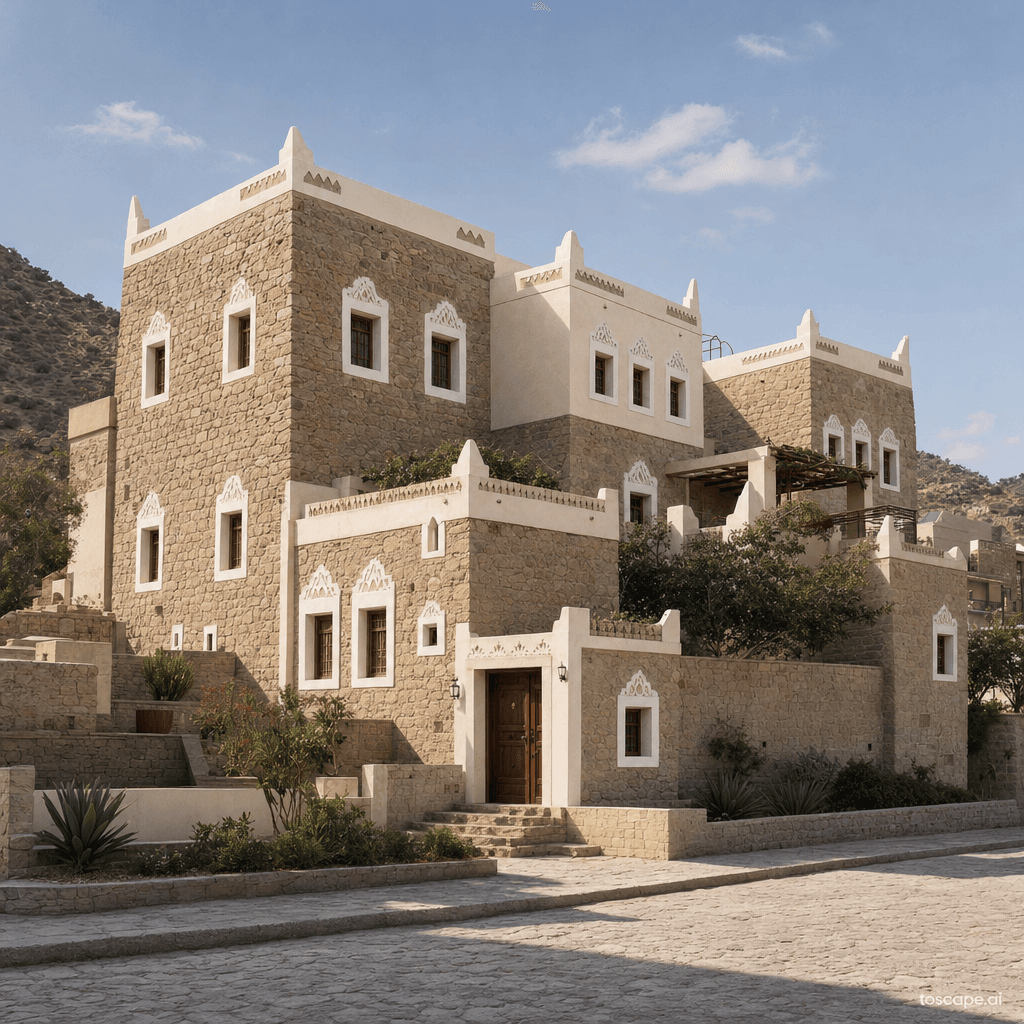
Tuhama Foothills Traditional
Saudi Arabia · Tuhama Foothills
Balanced horizontal-and-vertical clustered volumes — stone masonry combined with plastered buildings — flat roofs with pointed/stepped crenellated parapets — gently tapered walls (max 5° from vertical on ≥50% of building form) — white-painted window surrounds...
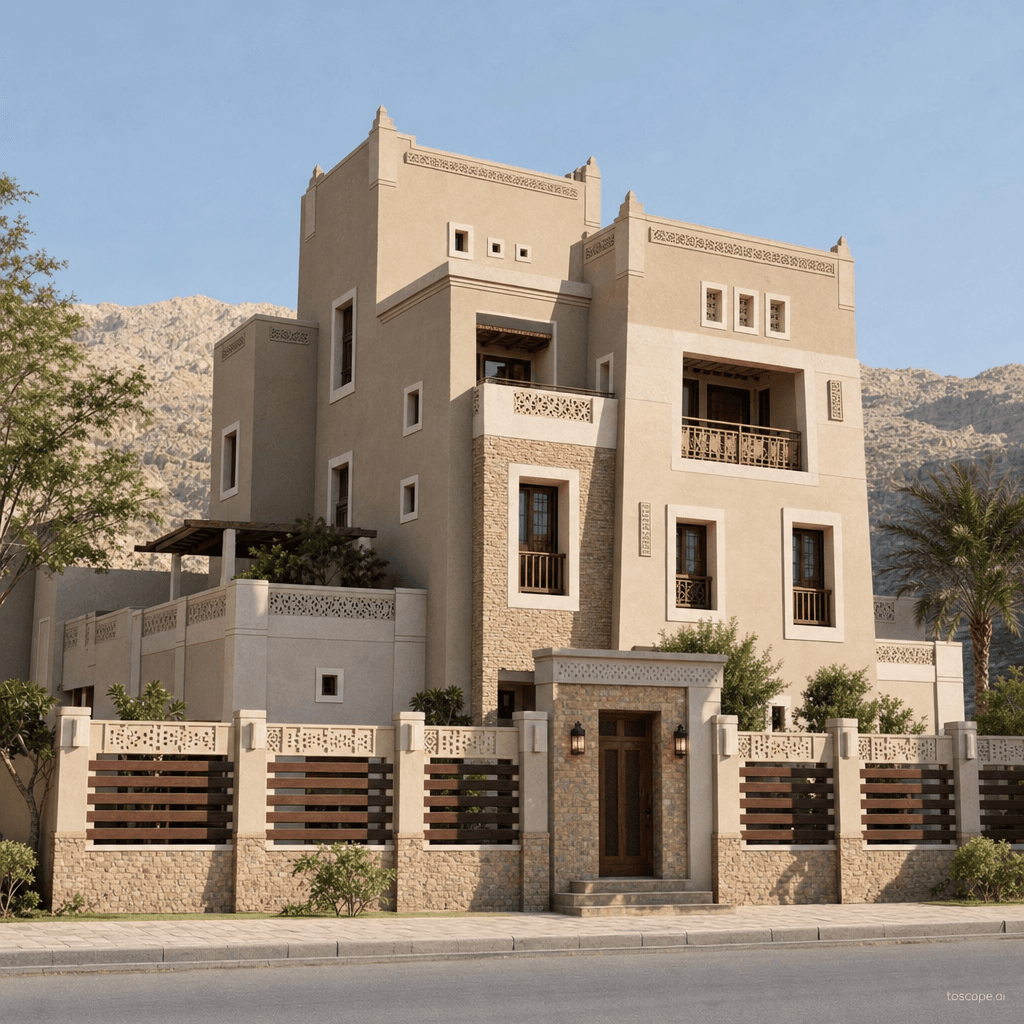
Tuhama Foothills Transitional
Saudi Arabia · Tuhama Foothills
Balanced horizontal-and-vertical compact volumes — up to 30% tapered walls (≤5°) — flat roofs with simple pointed/stepped parapets (1:1–1:2) — small-medium recessed openings with interpreted decorative motifs — loggias integrated into facades — medium-high tra...
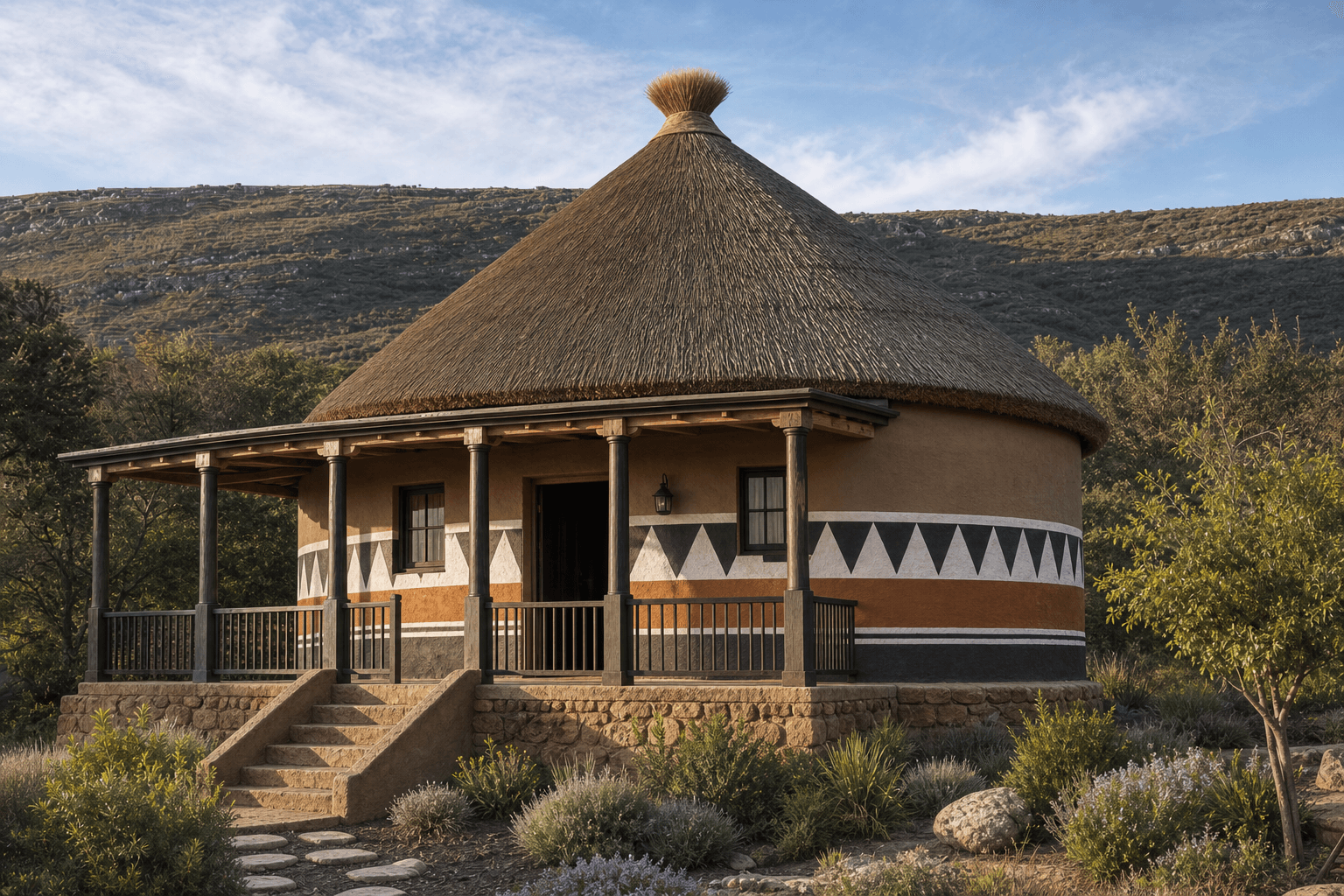
Eastern Cape
South Africa · architectural identity of the Eastern Cape
The Xhosa rondavel — a circular plan (4–7 m diameter) with a cylindrical wattle-and-daub wall (1.8–2.4 m high) and a steep conical thatch roof (45–60° pitch) terminating in a distinctive apex finial (isiduli) — walls plastered with a mixture of clay, cow dung...
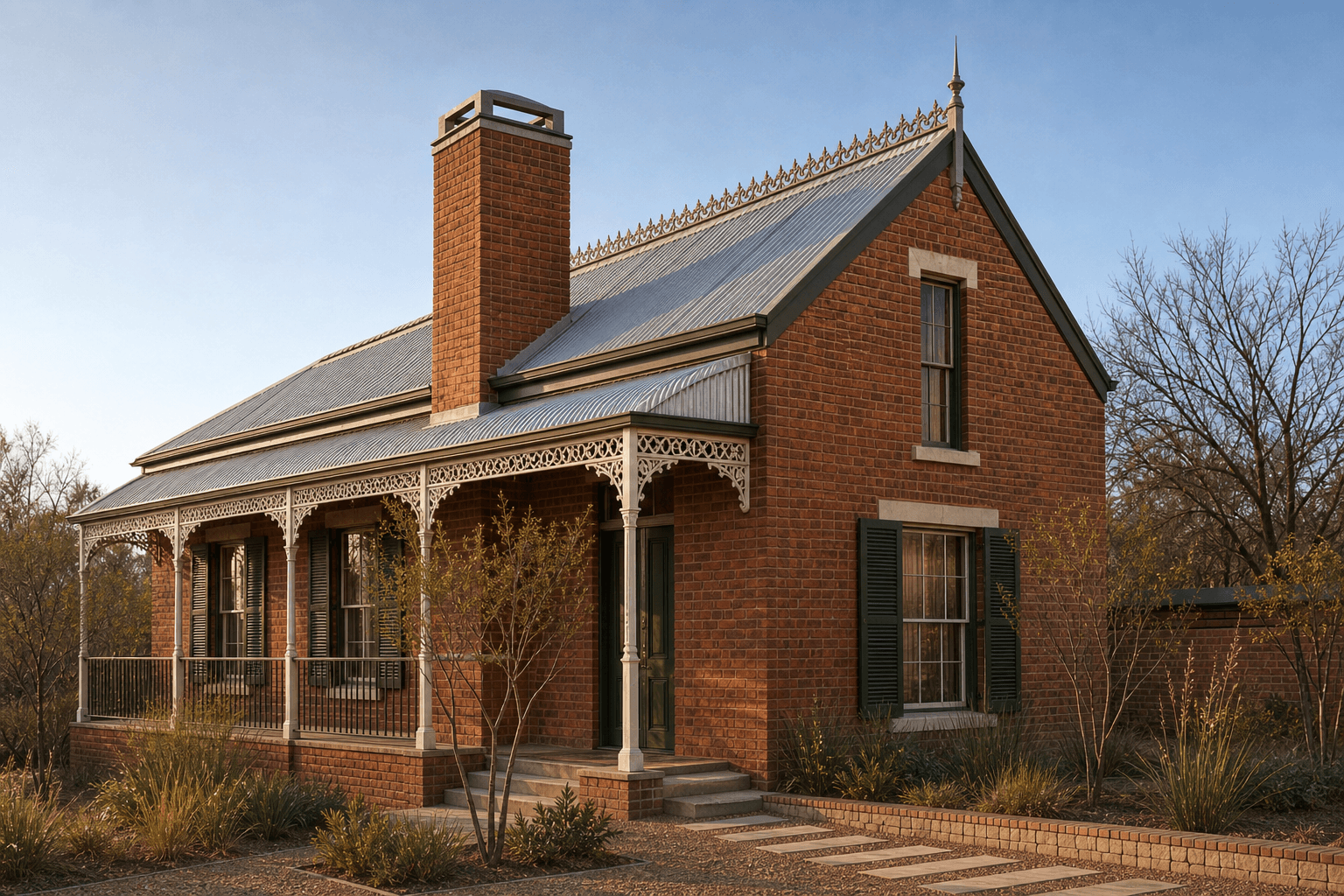
Gauteng Highveld
South Africa · architectural identity of Gauteng province and the Witwatersrand
The Highveld mining-town house — a single-storey rectangular volume (6–10 m wide × 10–16 m deep) under a corrugated iron pitched roof (30–40°) — brick walls (locally-fired from the rich Highveld clay, deep red-orange to plum-brown) — the steep (raised front ve...
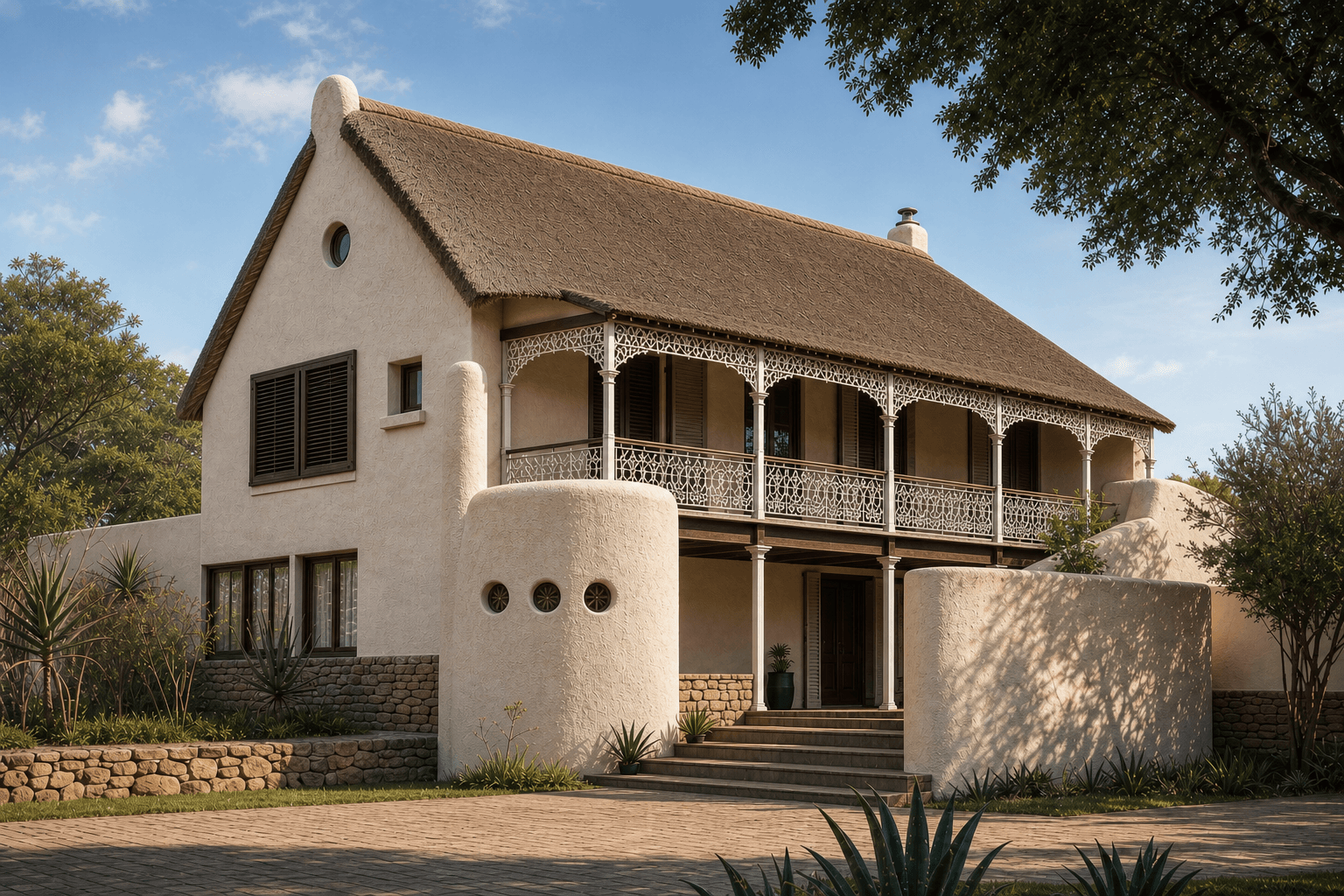
Kwazulu-Natal
South Africa · dual architectural traditions of KwaZulu-Natal
The Zulu iQhugwane — a hemispherical grass dome (3–6 m diameter, 2–4 m interior height) formed by a framework of sapling poles (izintingo) bent and lashed into a dome, thatched with layered grass (utshani) — the hut is a self-supporting tensile basket-dome — a...
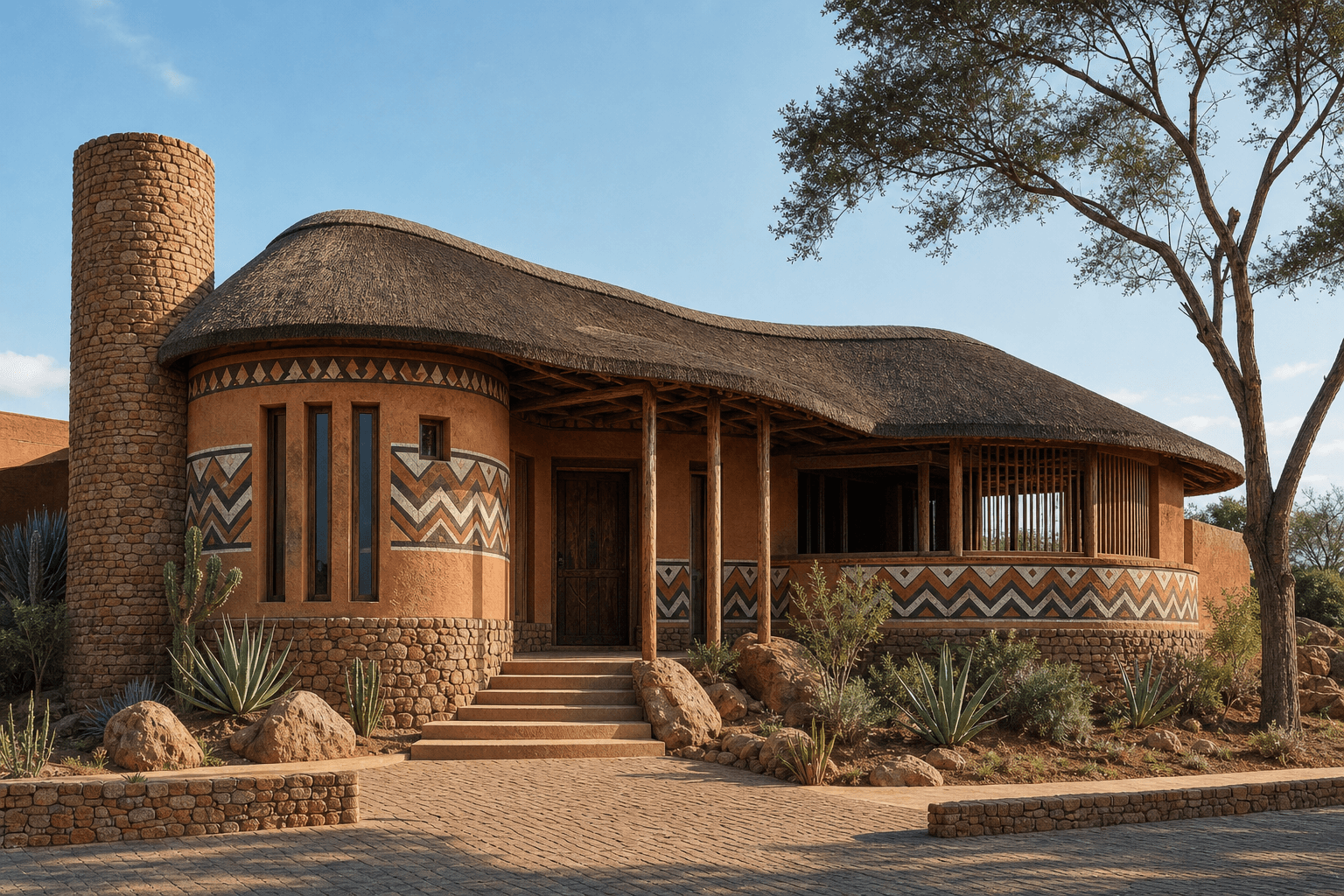
Limpopo
South Africa · architectural identity of Limpopo Province
The Venda decorated rondavel — a cylindrical wall (wattle-and-daub or coursed stone) with a conical thatch roof, distinguished by the elaborate painted and relief geometric decoration (vhulungwa) on exterior walls — patterns include the python motif (represent...
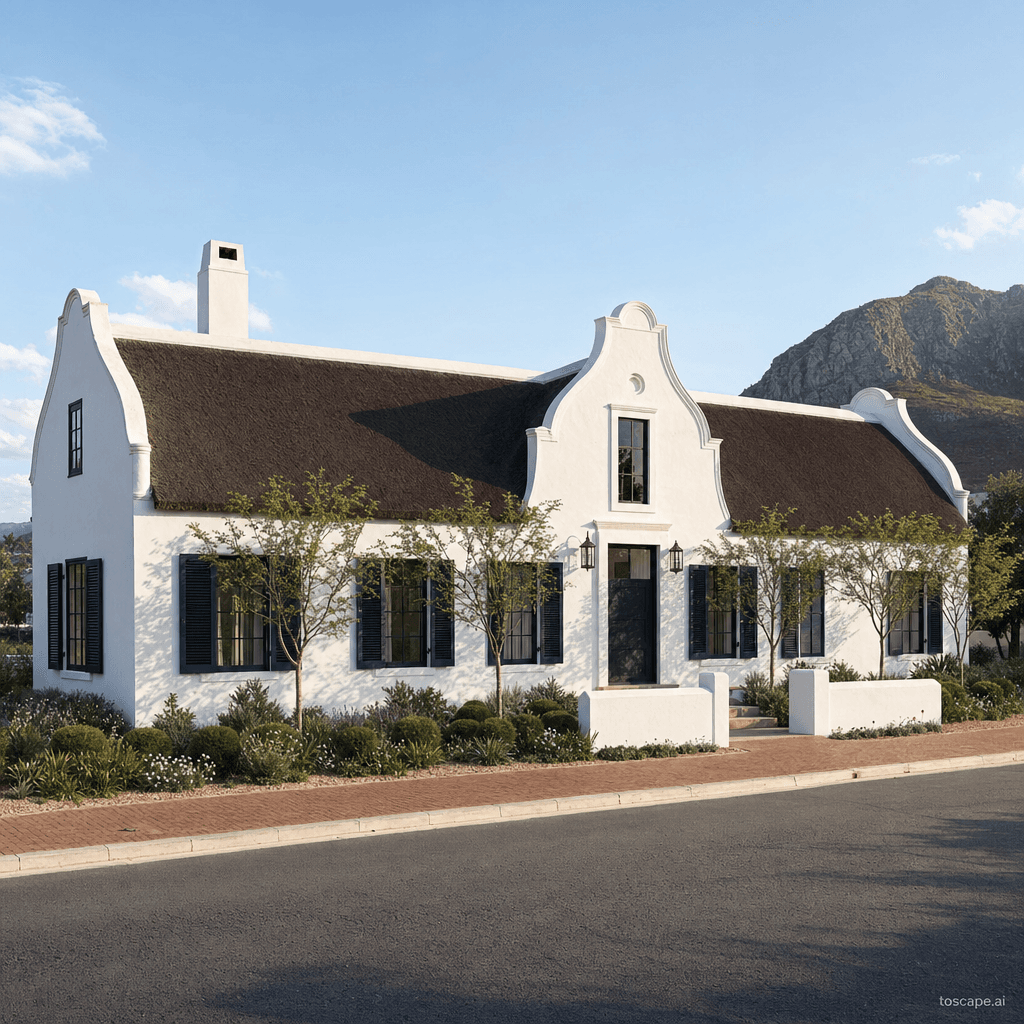
Western Cape
South Africa · Western Cape
The Cape Dutch gabled farmhouse — a long, low rectangular volume (15–35 m wide × 6–10 m deep) under a steep thatch roof (45–55° pitch) with a distinctive central gable (gewel) — the holbol gable: a Baroque silhouette with convex and concave curves, scroll work...
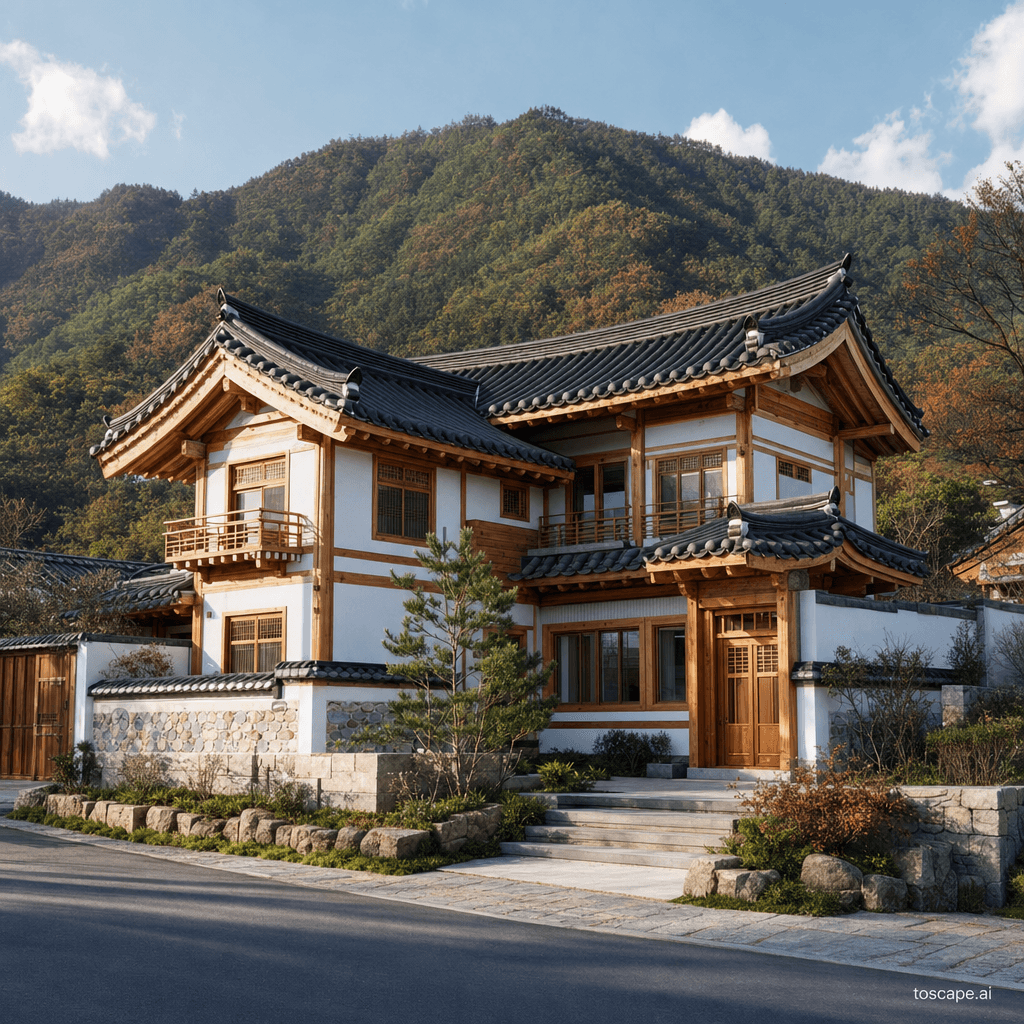
Gangwon Mountain Hanok
South Korea · Mountain-region hanok of Gangwon Province
Compact, closed-form plan with minimal madang — the most enclosed and defensive of Korean hanok typologies — thick walls (clay-straw plaster up to 200 mm) for extreme winter insulation — reduced eaves projection to minimize snow loading — steeper roof pitch (3...
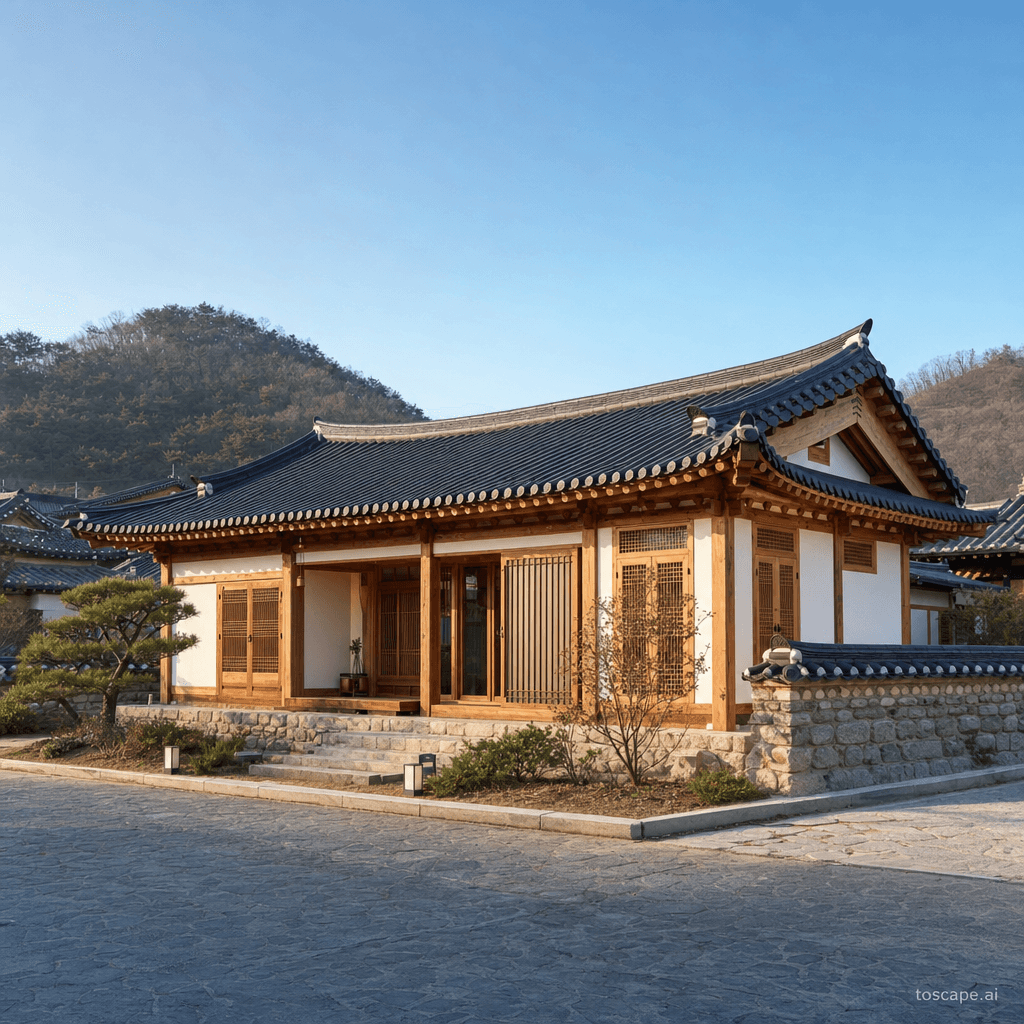
Gyeongsang Southeastern Hanok
South Korea · hanok of Gyeongsang provinces (Gyeongsangbuk-do and Gyeongsangnam-do), anchored...
Enclosed ㅁ-shaped (mieum-jip) and ㄷ-shaped (digeut-jip) courtyard plans — more formal, enclosed, and inward-looking than Jeolla — distinctive anchae-sarangchae dual-building separation (inner women's quarters vs. outer men's quarters) — strict Confucian spatia...
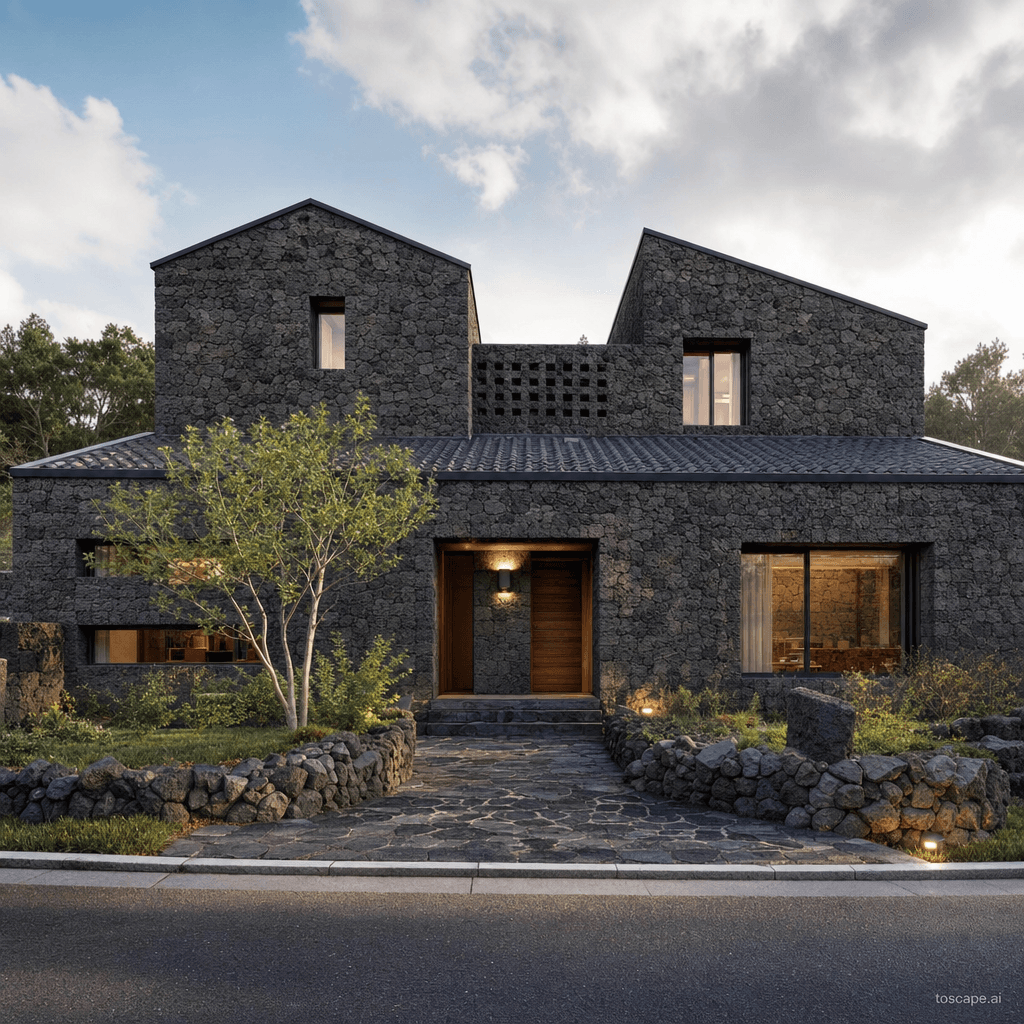
Jeju Island Volcanic Stone
South Korea · domestic architecture of Jeju Island (Jeju Special Self-Governing Province)
Basalt stone walls (black-grey porous volcanic stone) — the defining material, omnipresent in building and landscape — single-storey, low-profile, wind-resistant massing — thatched roof (choga) predominates over giwa tiles (pre-20th century, giwa was rare on J...
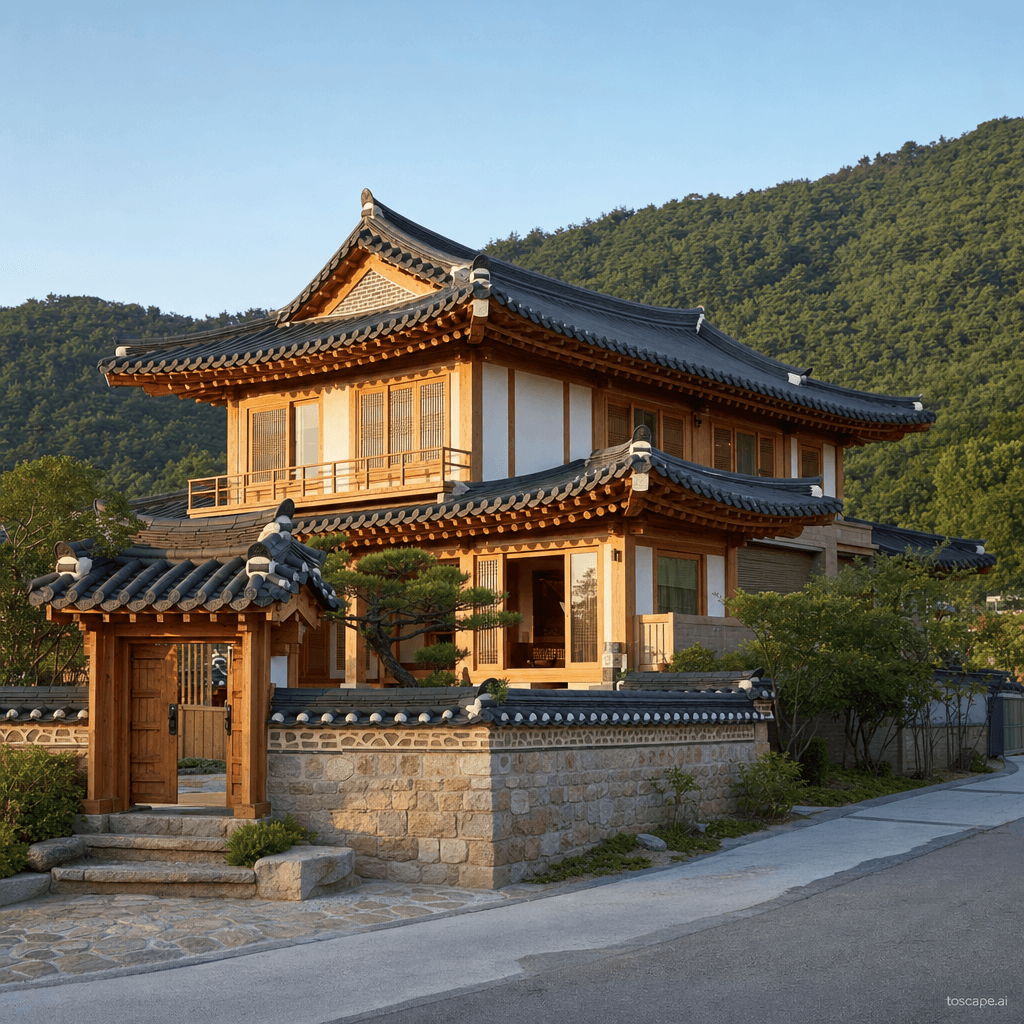
Jeolla Southwestern Hanok
South Korea · hanok domestic architecture of the Jeolla provinces (Jeollabuk-do and Jeollanam...
Single-wing linear plan (一-shaped, ilja-jip) predominating over enclosed courtyard forms — larger, more open madang — less enclosed, more outward-facing elevation — lighter, more open timber treatment — wider toenmaru verandah — single-curvature roof profile w...
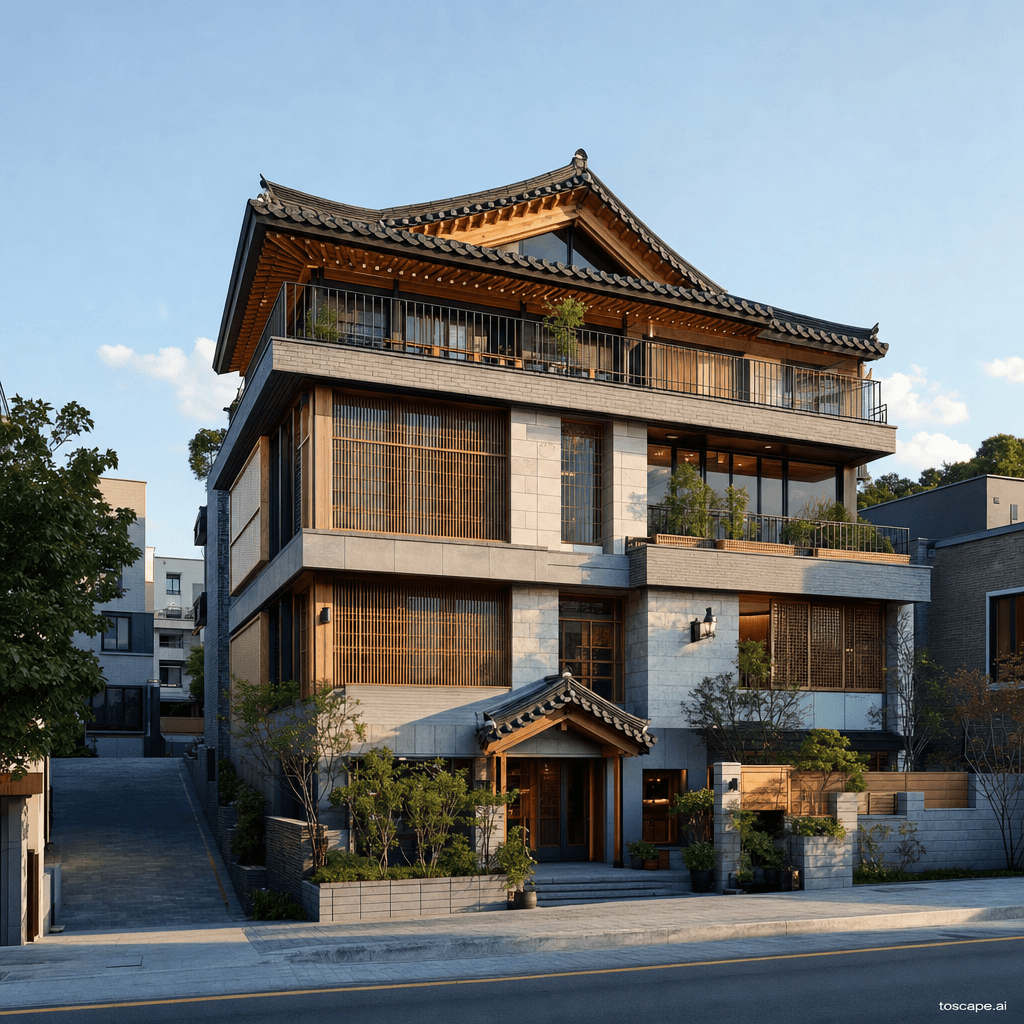
Seoul Urban Hanok
South Korea · hanok domestic architecture of Seoul and the Gyeonggi central region
Timber post-and-beam structural frame (gigong) on a raised stone platform (gidan) — curved giwa ceramic tile roof with pronounced upward-sweeping eaves (cheoma) — exposed wooden structural members stained in natural brown tones — white lime-rendered infill wal...
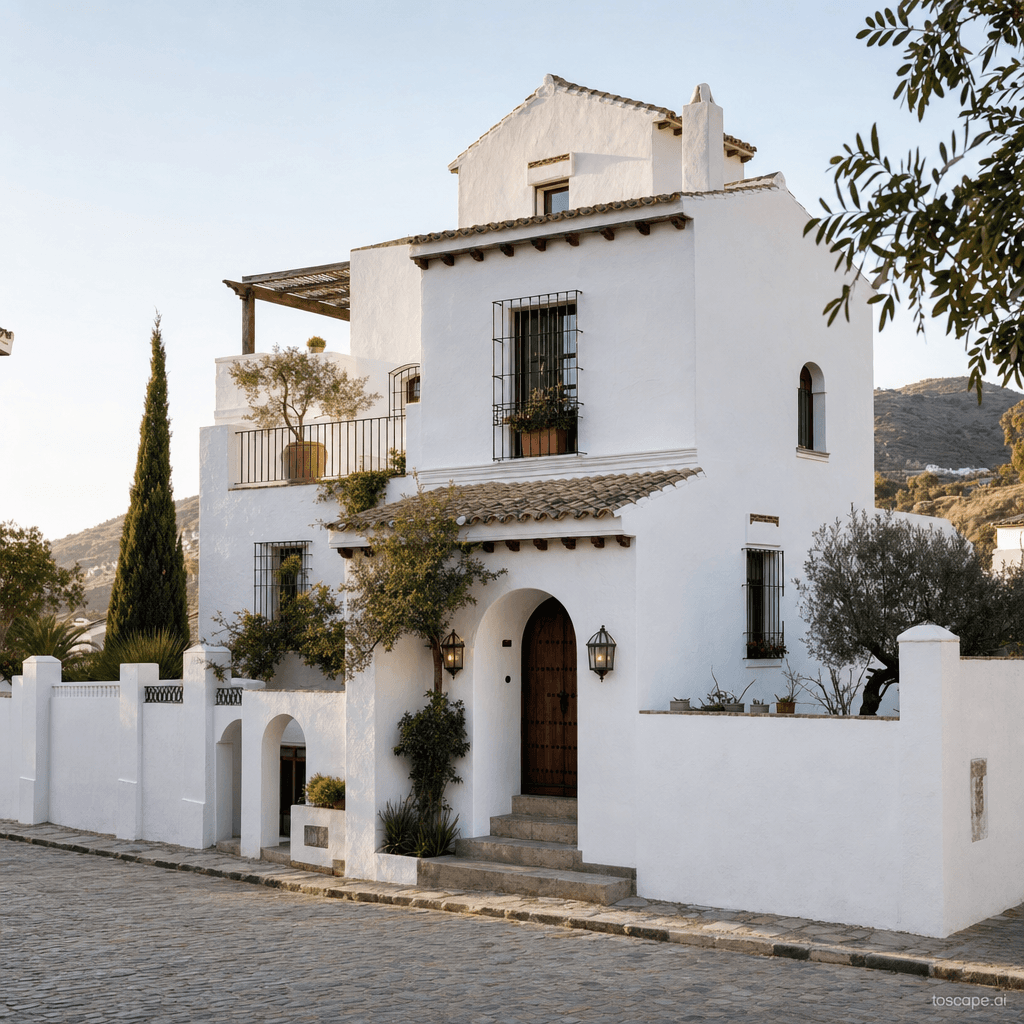
Andalusian White Village & Courtyard
Spain · white villages (pueblos blancos) of Andalusia and the courtyard house (casa-pati...
Brilliant white lime-washed walls — the defining visual identity, shared across the region — narrow, winding, shaded streets in hillside villages — internal courtyard (patio) with fountain, plants, and tilework — wrought-iron window grilles (rejas) — timber la...
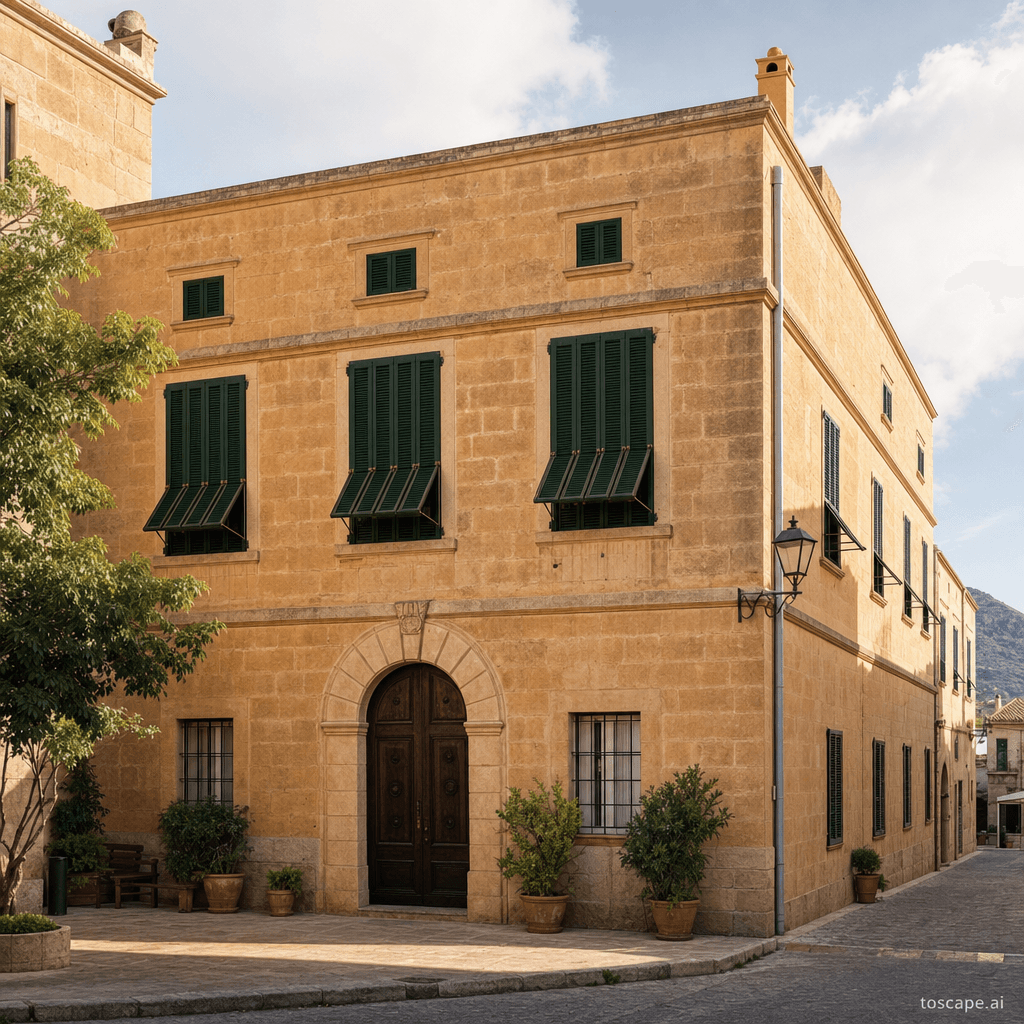
Balearic Mallorca Sandstone
Spain · Mallorca sandstone (marès)
Golden-brown marès stone unifying island palette, interior patio as climatic and social heart, green-shuttered Persian blinds (persianas mallorquinas) as defining facade element
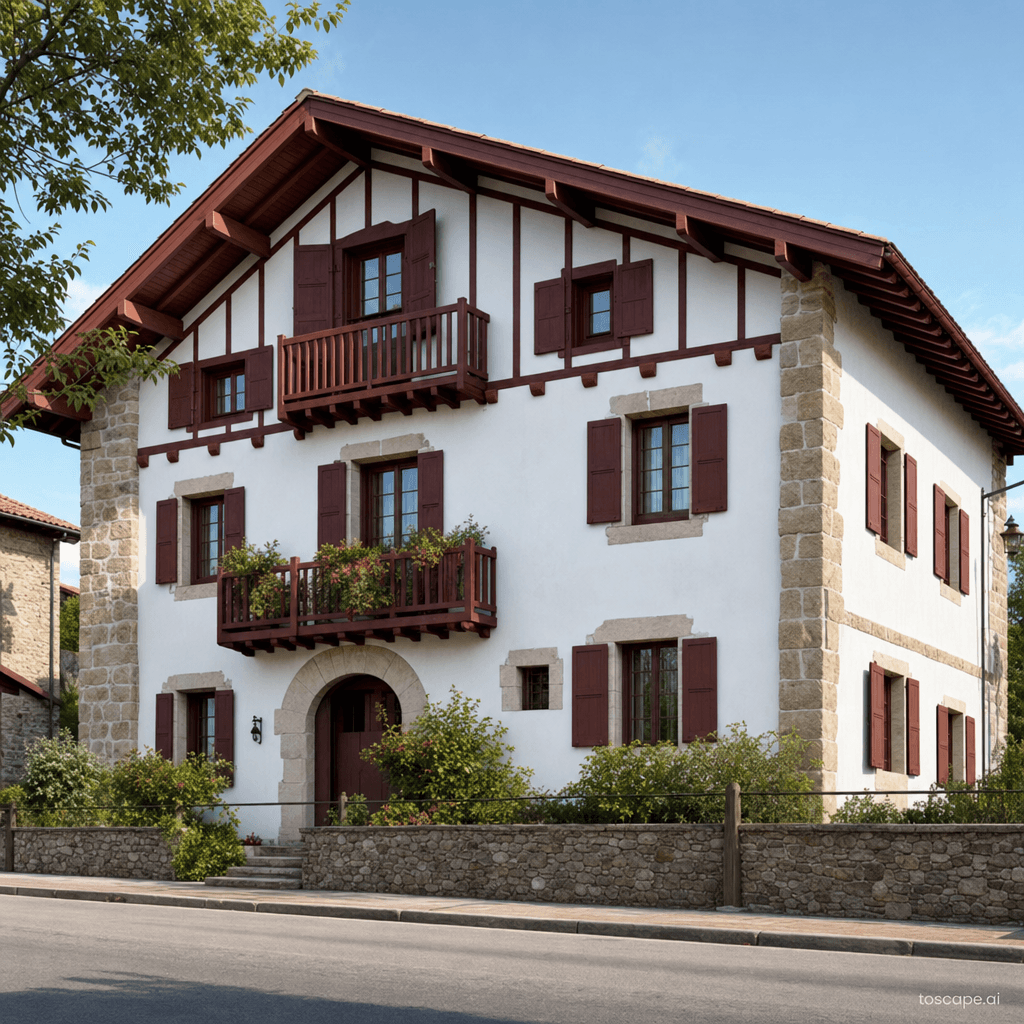
Basque Country Baserri & Urban Bayonne
Spain · baserri (Basque farmhouse)
Baserri: massive three-storey timber-framed farmhouse (half-timbered) with wide, steep-pitched terracotta tile roof and deep eaves — the ground floor in stone, upper floors in half-timber with white or ochre plaster infill — projecting timber balconies with tu...
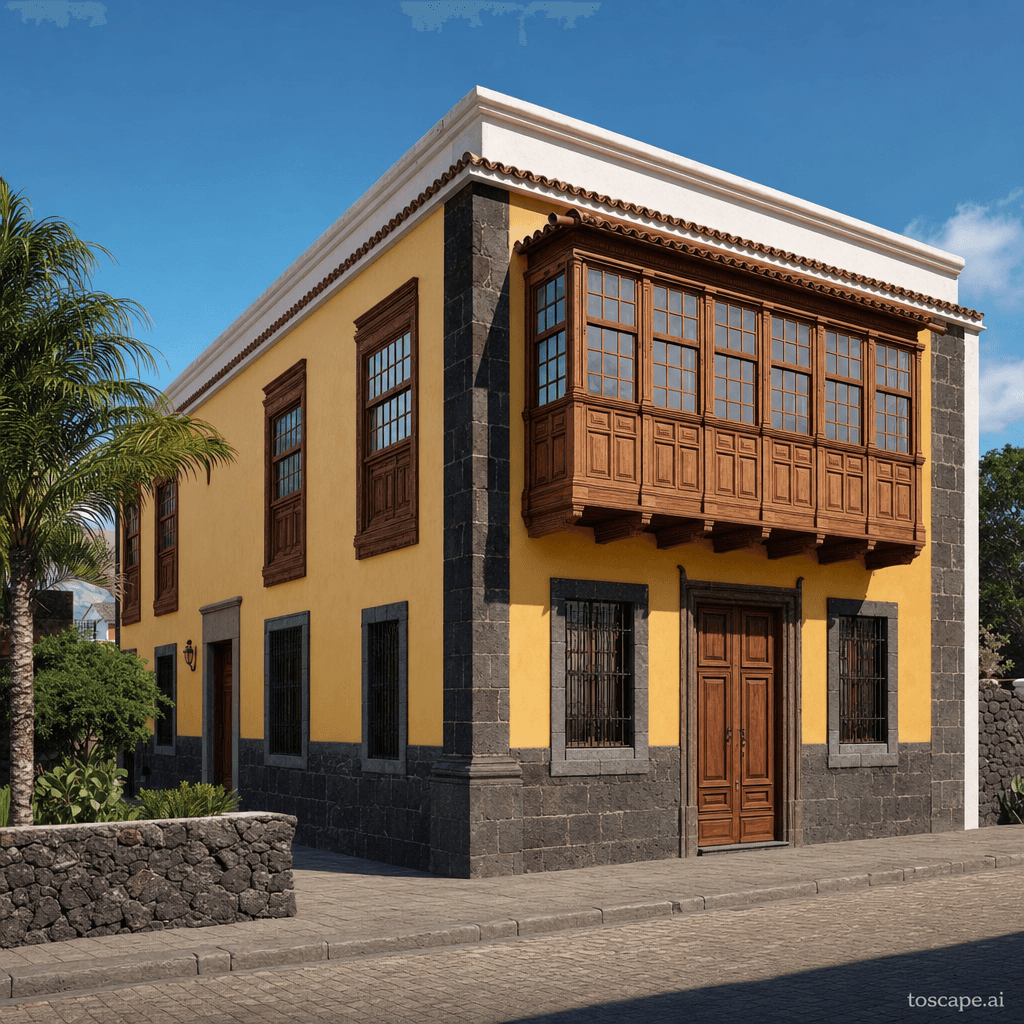
Canary Islands Volcanic
Spain · Canarian volcanic stone vernacular
Basalt stone base + colorful lime-rendered upper walls + enclosed wooden balcony galleries (balcones cerrados) as defining Atlantic island typology
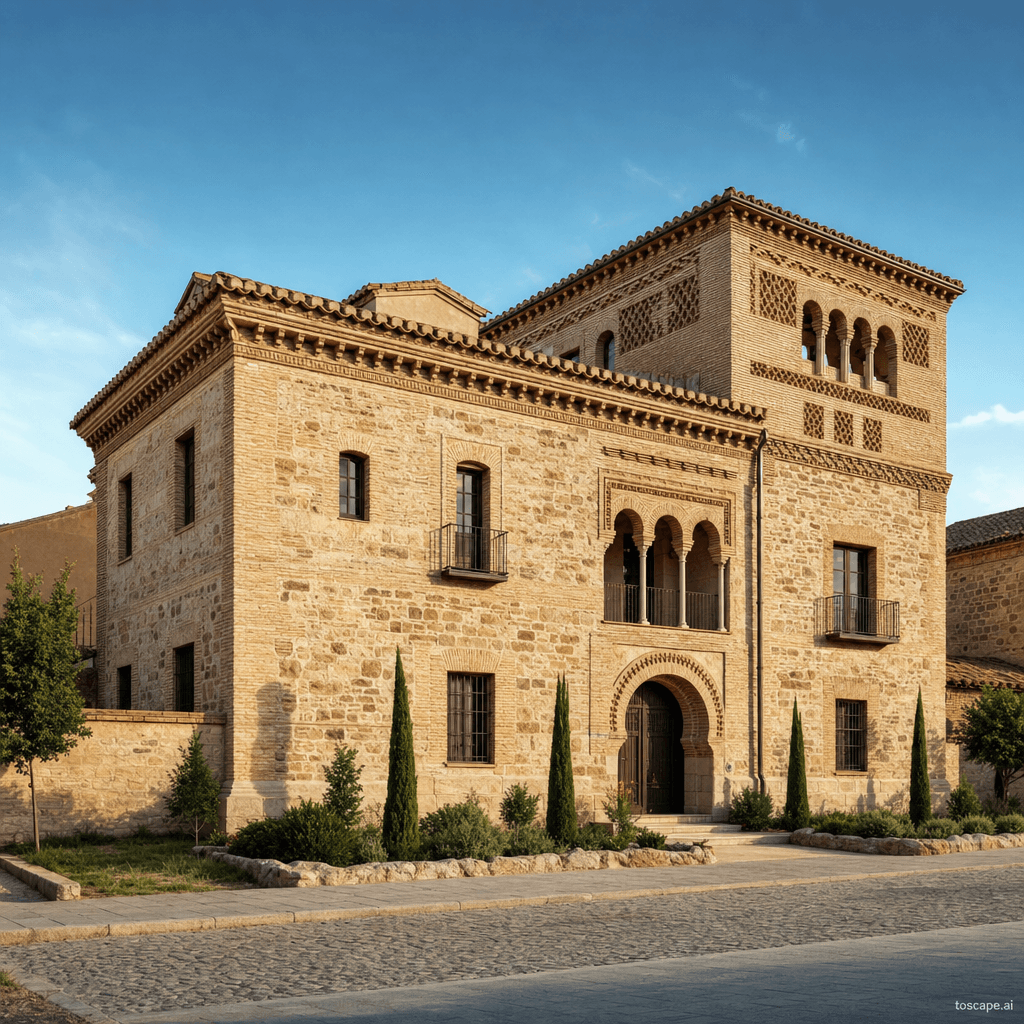
Castilian Meseta Stone & Mudéjar
Spain · Castile
Segovia's Romanesque stone arcaded streets and the Mudéjar brick towers of Aragón and Toledo — two expressions of the Castilian plateau. Mudéjar architecture: brick construction with elaborate geometric brickwork patterns (sebka — diamond net, arches, blind ar...
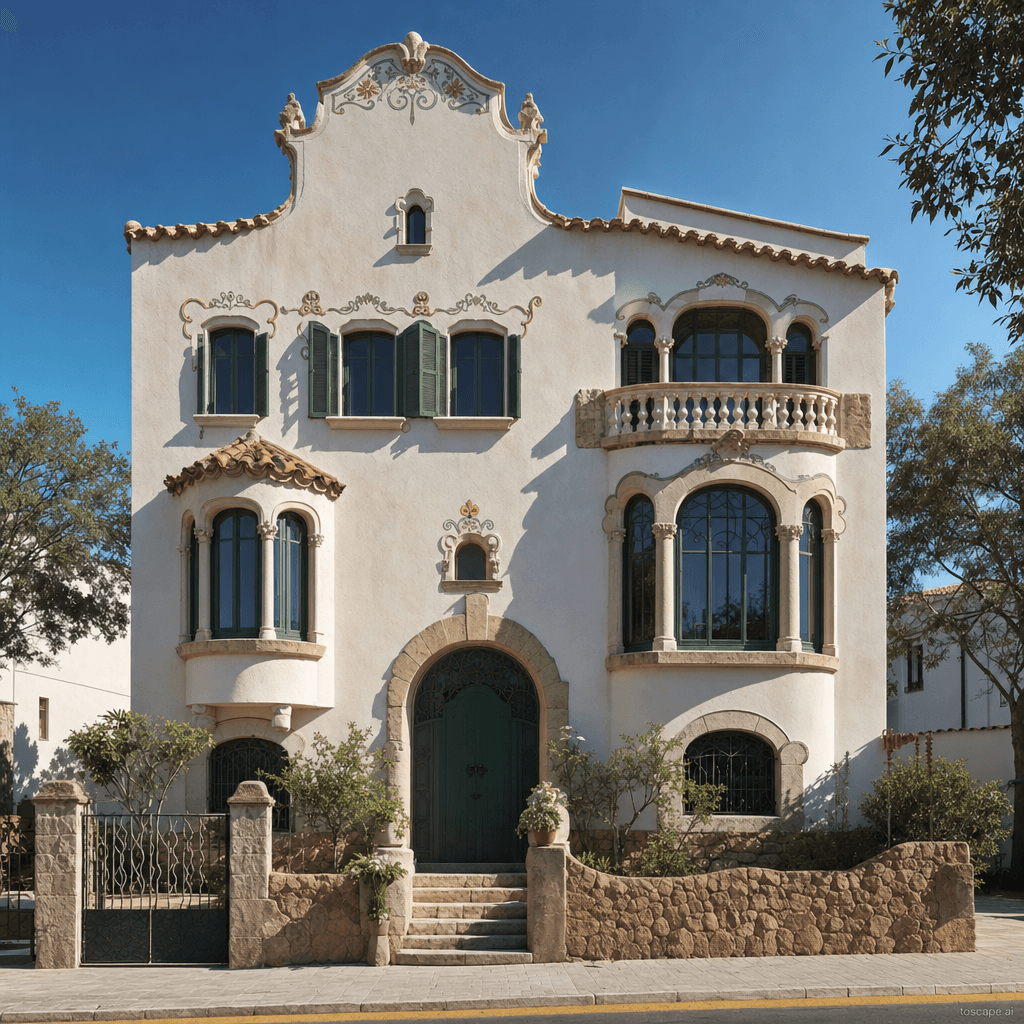
Catalan Modernista & Mediterranean Vernacular
Spain · Two distinct Catalan architectures
Barcelona Eixample: distinctive chamfered-corner city blocks (illa) with inner courtyard gardens — Modernista (Catalan Art Nouveau) facades — organic stone carving, wrought-iron balconies, trencadís mosaic, sgraffito plaster decoration — Catalan vault (volta c...
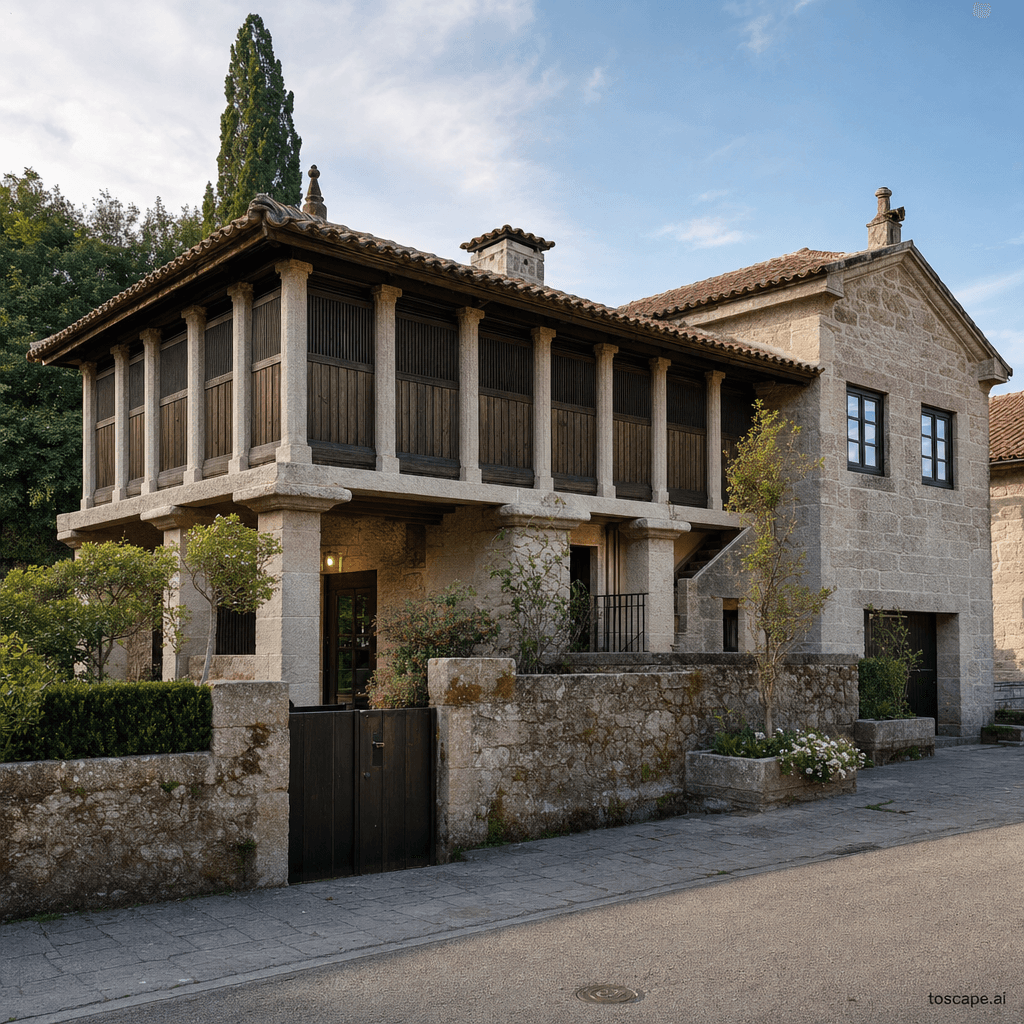
Galician Hórreo & Stone Village
Spain · distinctive vernacular architecture of Galicia
The hórreo — the iconic raised stone granary on mushroom-cap stone pillars (tornarratos) with a cross finial — the defining Galician architectural symbol, unique within Spain. Pazo (manor house): granite stone, Baroque-influenced, with a distinctive asymmetric...
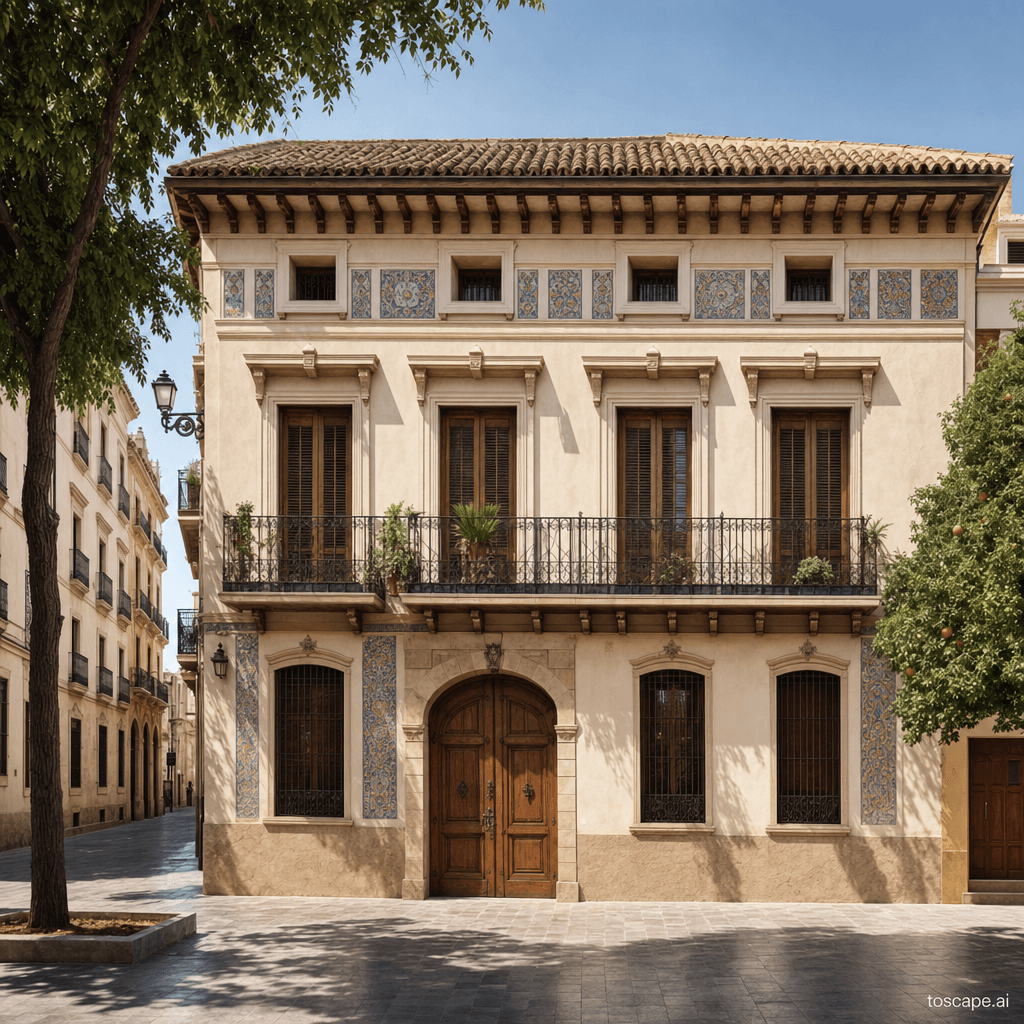
Valencia Mediterranean
Spain · Mediterranean coastal vernacular
Fertile huerta landscape shaping dispersed farmhouse typology + dense urban ceramic-ornament tradition
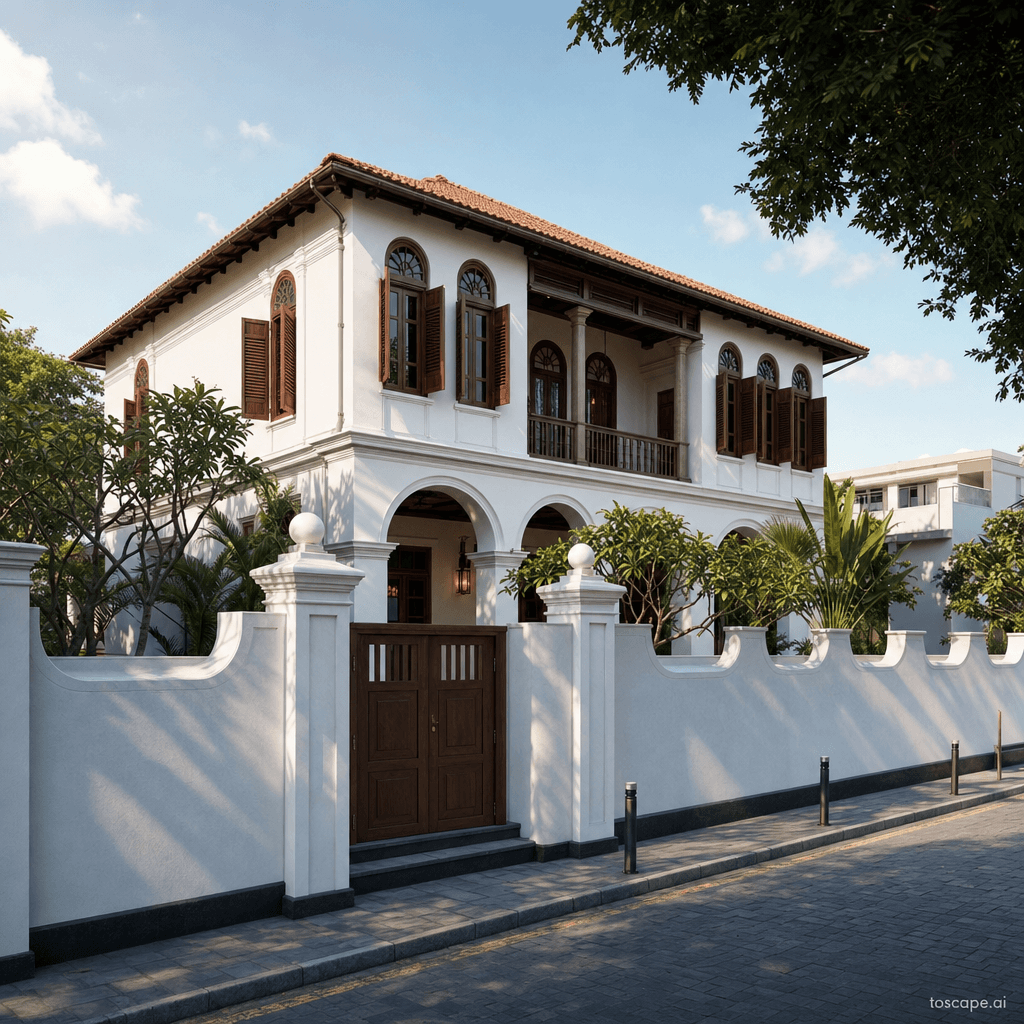
Colombo
Sri Lanka · Colombo and Western Province
Dutch-period (1640-1796) and British-period (1796-1948) colonial architecture: Dutch burgher houses with terracotta-tiled hipped roofs, deep verandas (istopuwa), louvered timber doors and fanlights, thick lime-plastered walls (kabok — laterite blocks rendered...
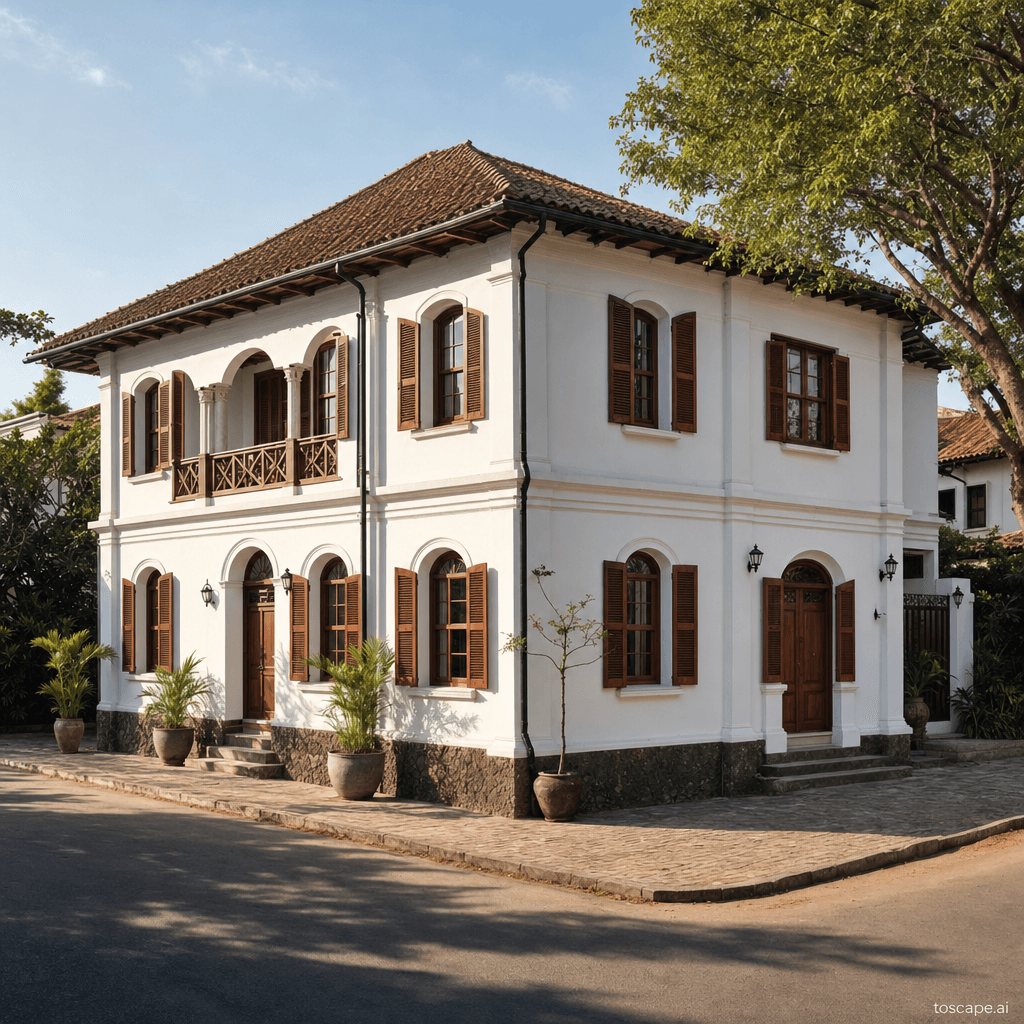
Galle Fort
Sri Lanka · Galle Fort
Galle Fort (built 1640-1796, expanded by Dutch on earlier Portuguese fort) — a complete walled colonial city on a peninsula: bastioned fortification walls of coral stone and granite, grid street plan within, Dutch-period burgher houses with distinctive archite...
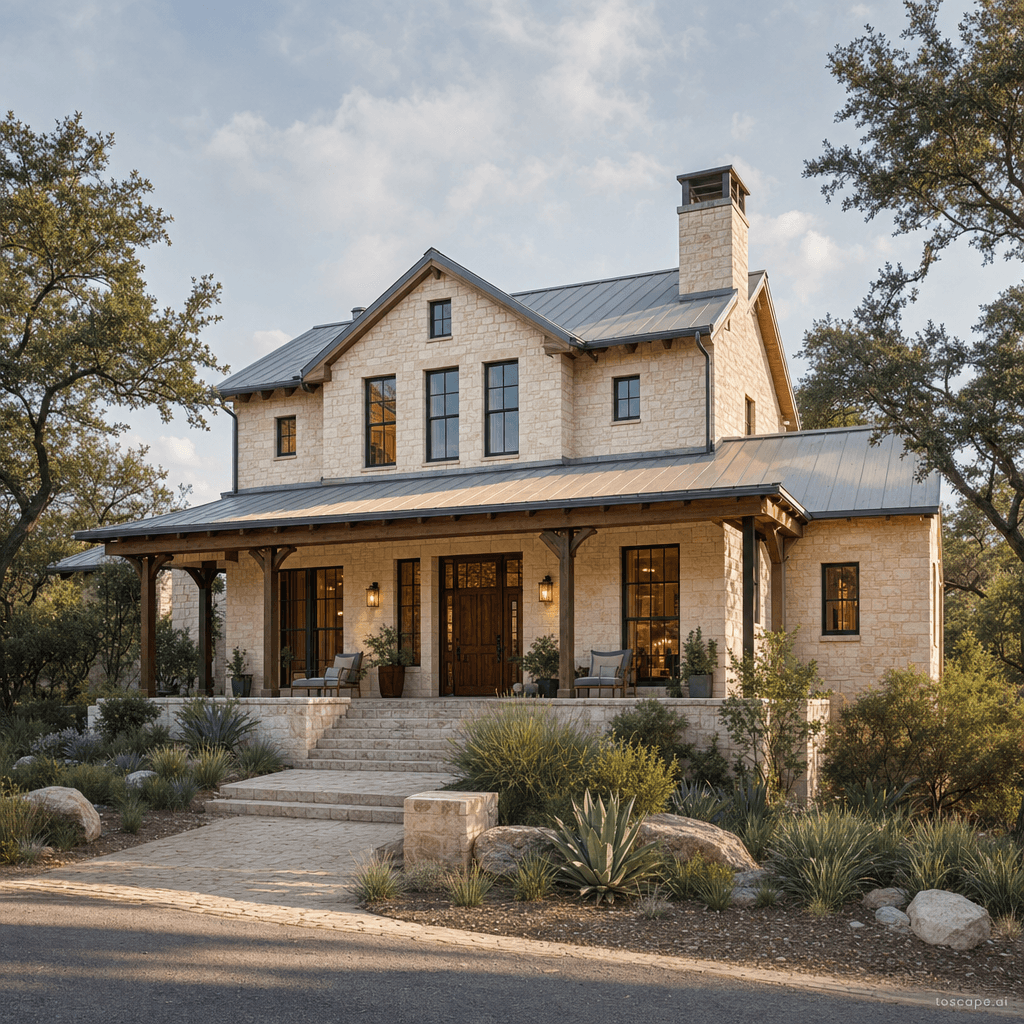
Hill Country
Sri Lanka · Sri Lankan Hill Country
British colonial tea planter's bungalow — the archetypal Hill Country dwelling: sprawling single-storey house with steep hipped or gable roof originally of corrugated iron or terracotta tiles (now largely painted green or red corrugated iron — "zinc-alume" in...
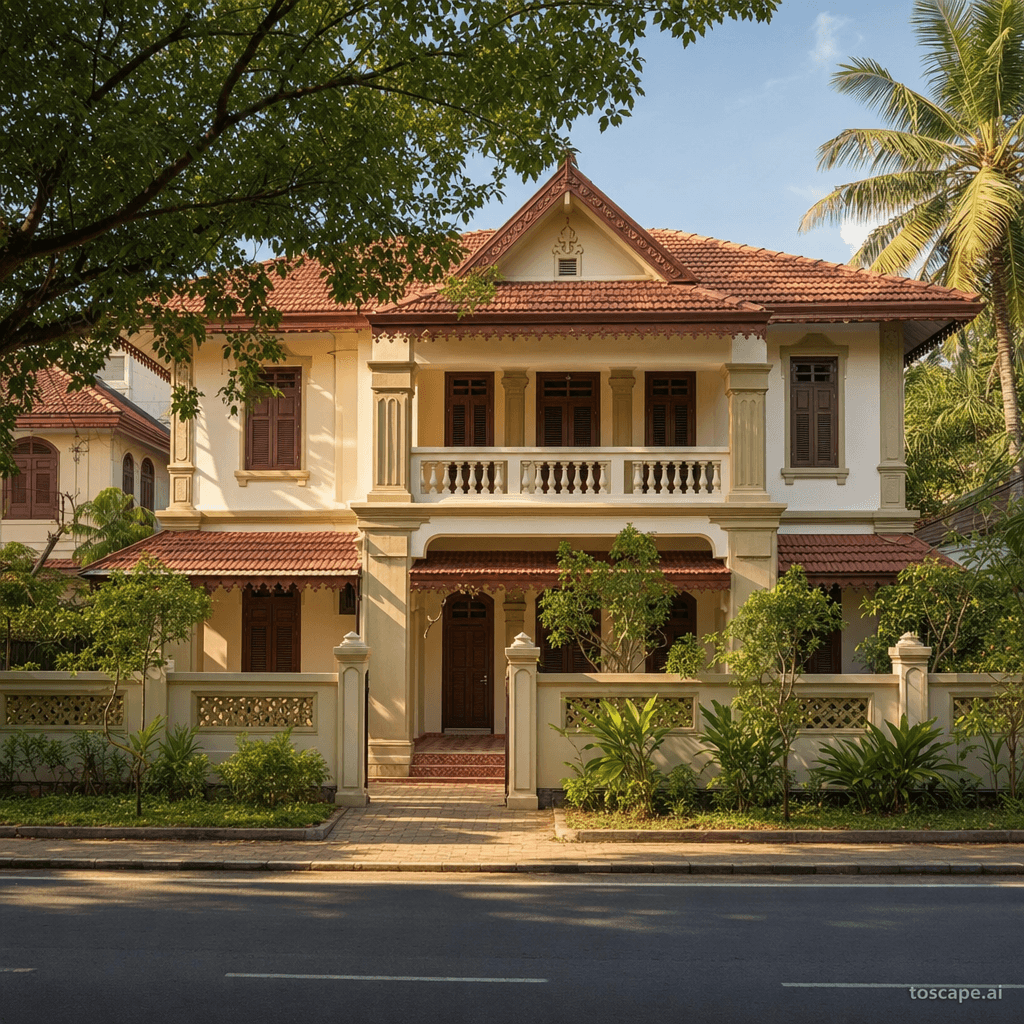
Jaffna
Sri Lanka · Jaffna Peninsula
Jaffna Tamil courtyard house (veedu) — single-storey, inward-facing courtyard dwelling, organized around an open central courtyard (mutram / thinnai) that is the climatic and social heart, thick white lime-plastered walls of coral-limestone (kangu — fossilized...
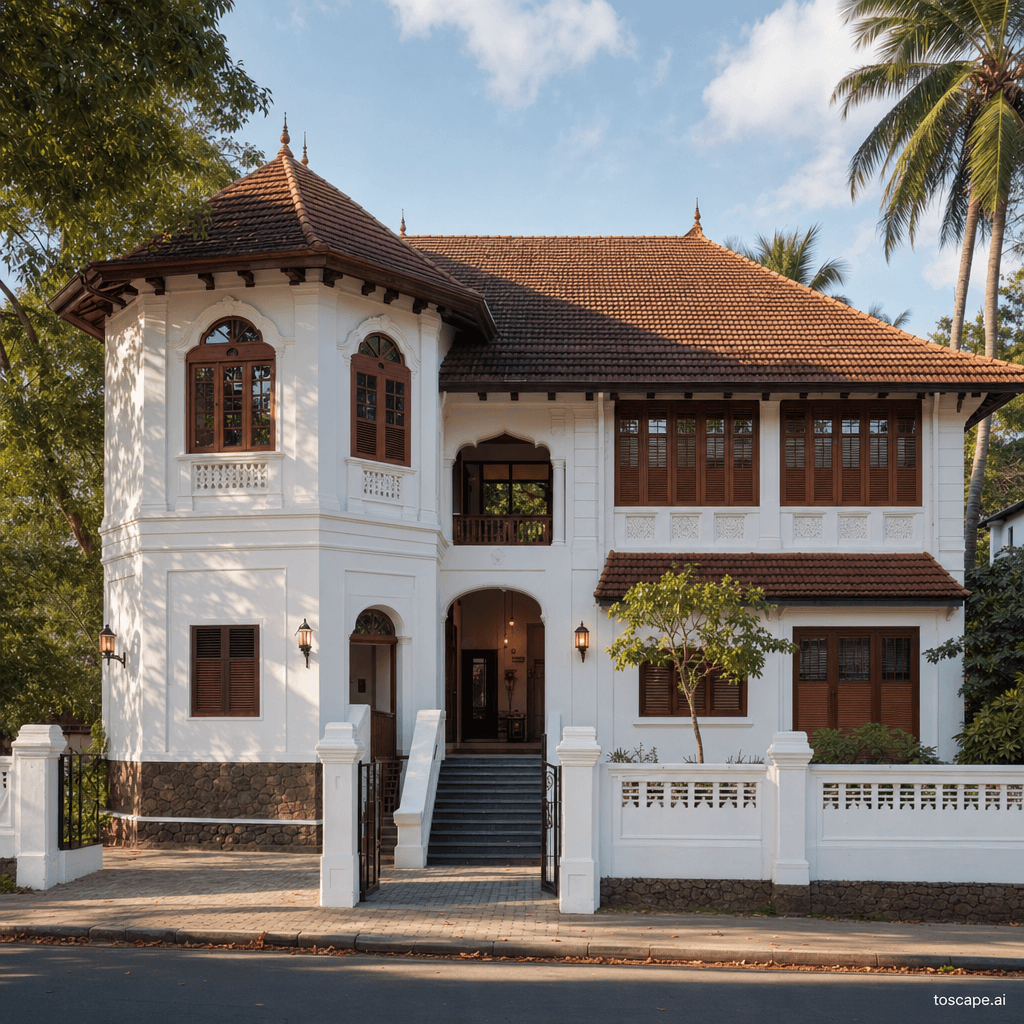
Kandy
Sri Lanka · Kandy
Kandyan walawwa (aristocratic manor house) — the refined domestic architecture of the Kandyan Kingdom: single-storey courtyard house with steep hipped roof of Sinhala ulu half-round terracotta tiles, white lime-plastered kabok laterite walls, deep colonnaded v...
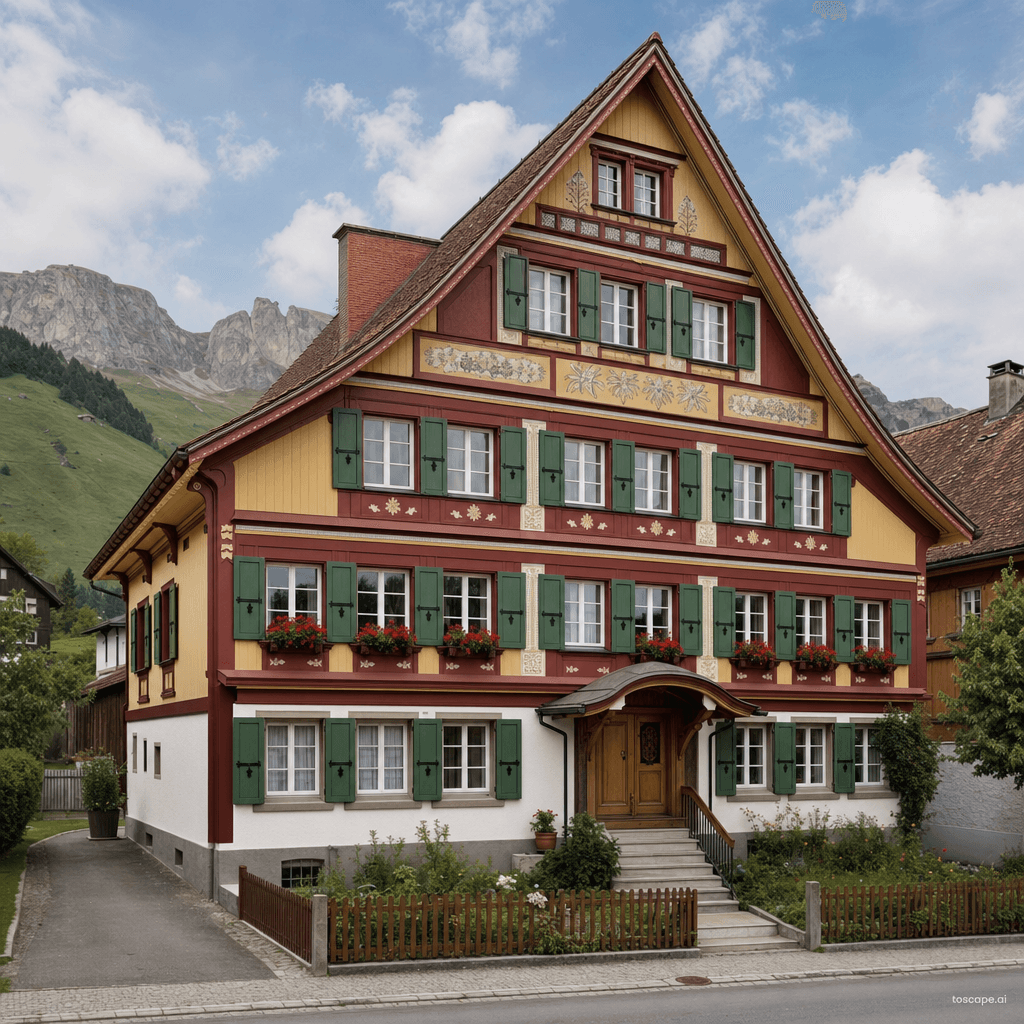
Appenzell
Switzerland · Appenzell Innerrhoden and Ausserrhoden cantons
The Appenzell farmhouse (Appenzeller Bauernhaus) — the most vividly painted timber architecture in Switzerland: white or cream-painted timber plank facades (vertical board cladding over blockbau log structure) with elaborate painted decorative ornament in rich...
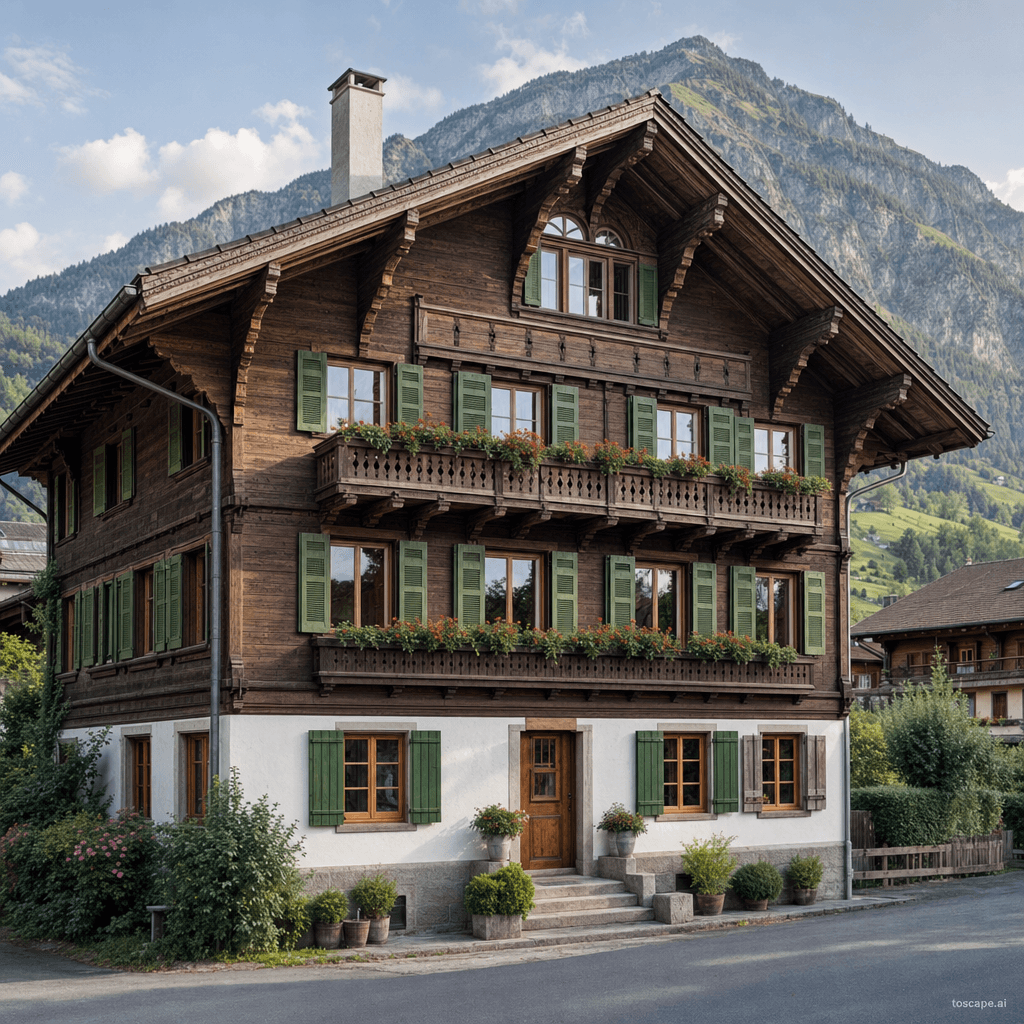
Bernese Oberland
Switzerland · Bernese Oberland
The quintessential Swiss chalet — the most recognizable Alpine architectural image globally: massive flared, low-sweeping hipped or gabled roof with very wide overhanging eaves (1.5-2.5 metres projection), deep brown-stained or naturally-weathered dark brown t...
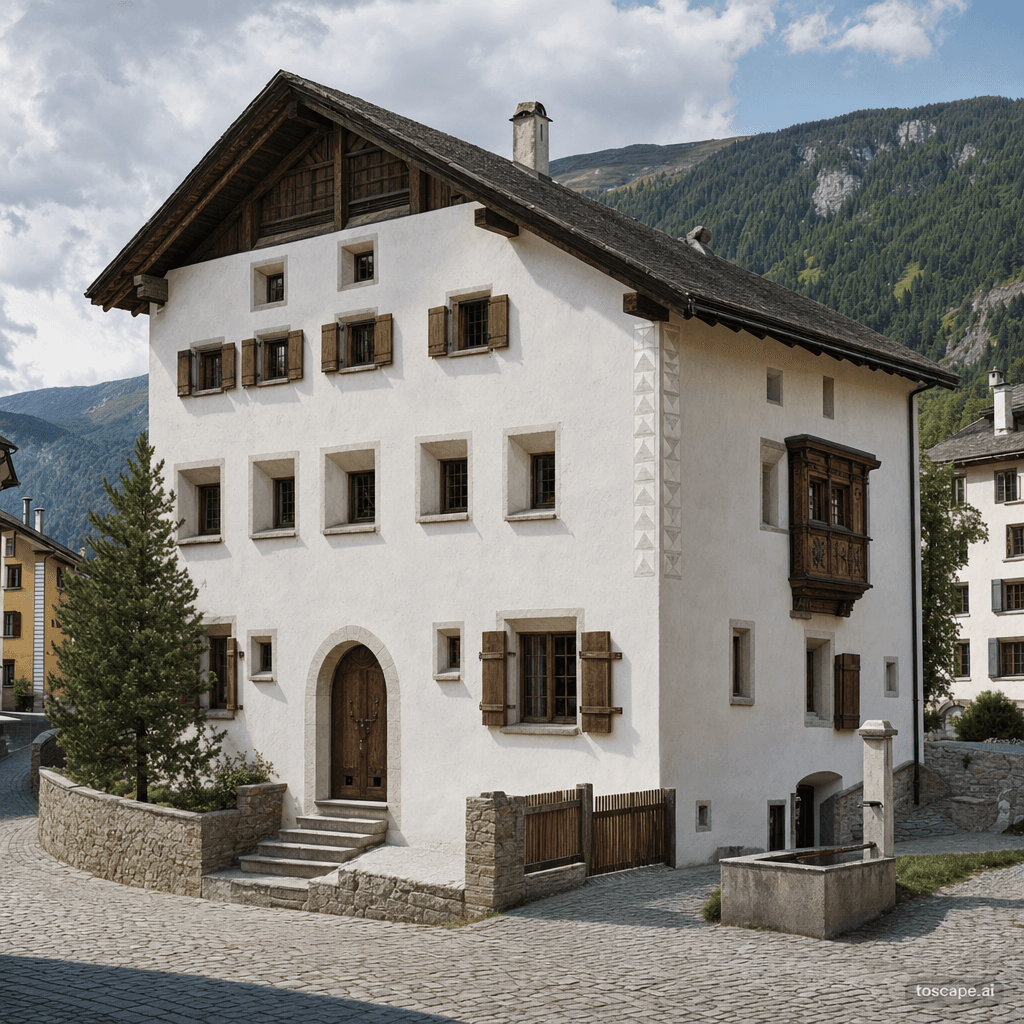
Graubünden
Switzerland · Graubünden/Grisons canton
Thick rendered stone facades (lime plaster over rubble masonry) decorated with sgraffito (sgraffito/Sgraffito) — decorative patterns incised into the wet plaster to reveal contrasting dark grey or terracotta layers beneath — the defining ornamental technique o...
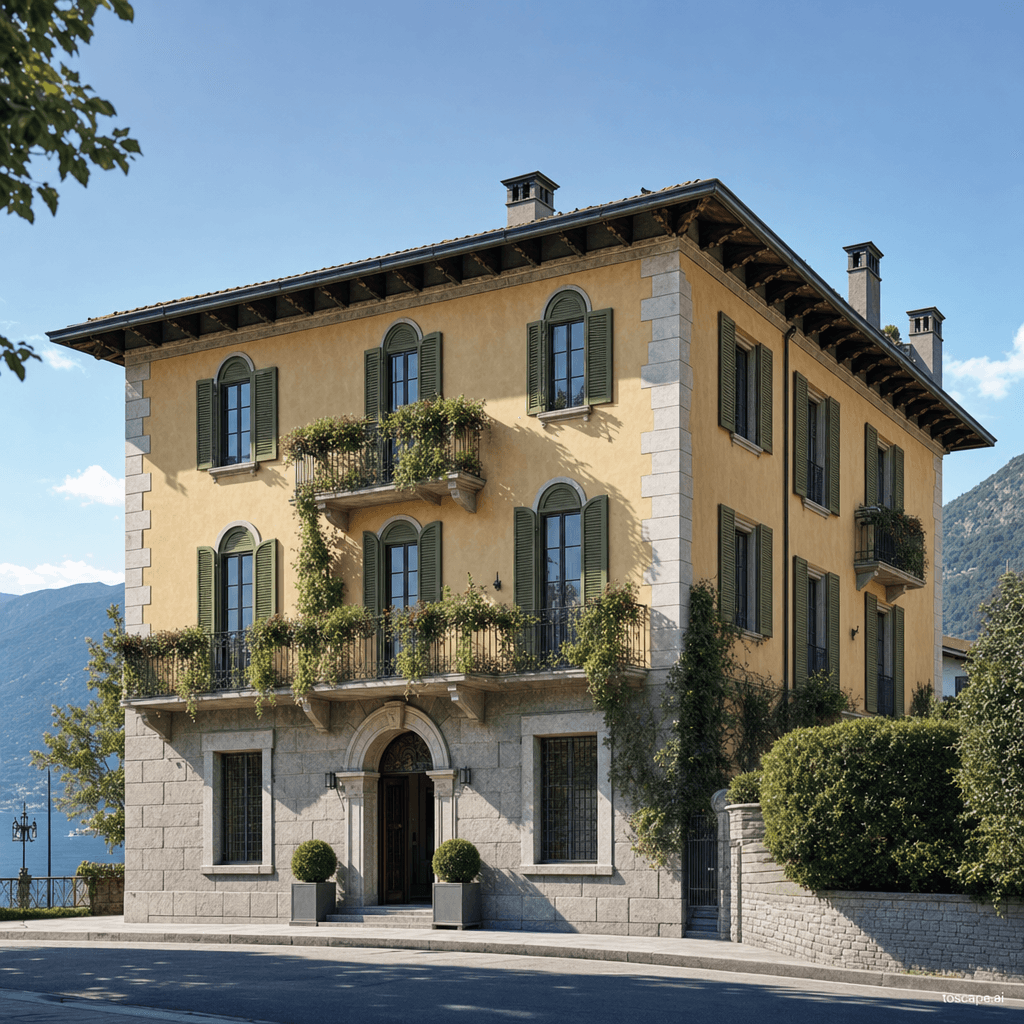
Ticino
Switzerland · Ticino canton
Massive grey gneiss or granite rubble stone walls — unrendered, exposed, with thick mortar joints — the defining Ticinese wall typology, heavy dark grey stone slab roofs (piode — local gneiss slabs, split along natural cleavage planes) laid in diminishing cour...
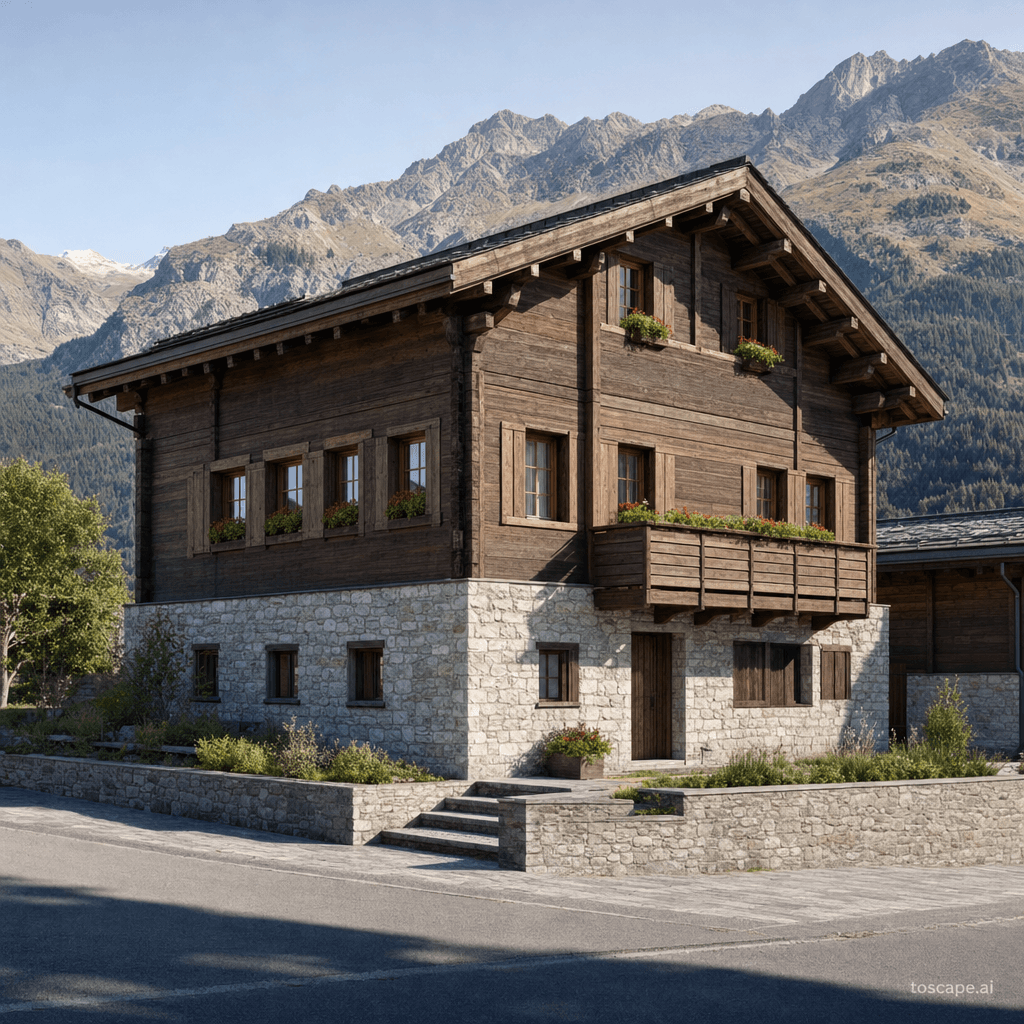
Valais
Switzerland · Valais/Wallis canton
Darkened silver-grey to near-black larch (mélèze/Lärche) timber — the defining Valais building timber, weathered to a deep charcoal-silver patina by intense alpine UV — used for solid timber blockbau (log construction) upper walls, intricately carved balconies...
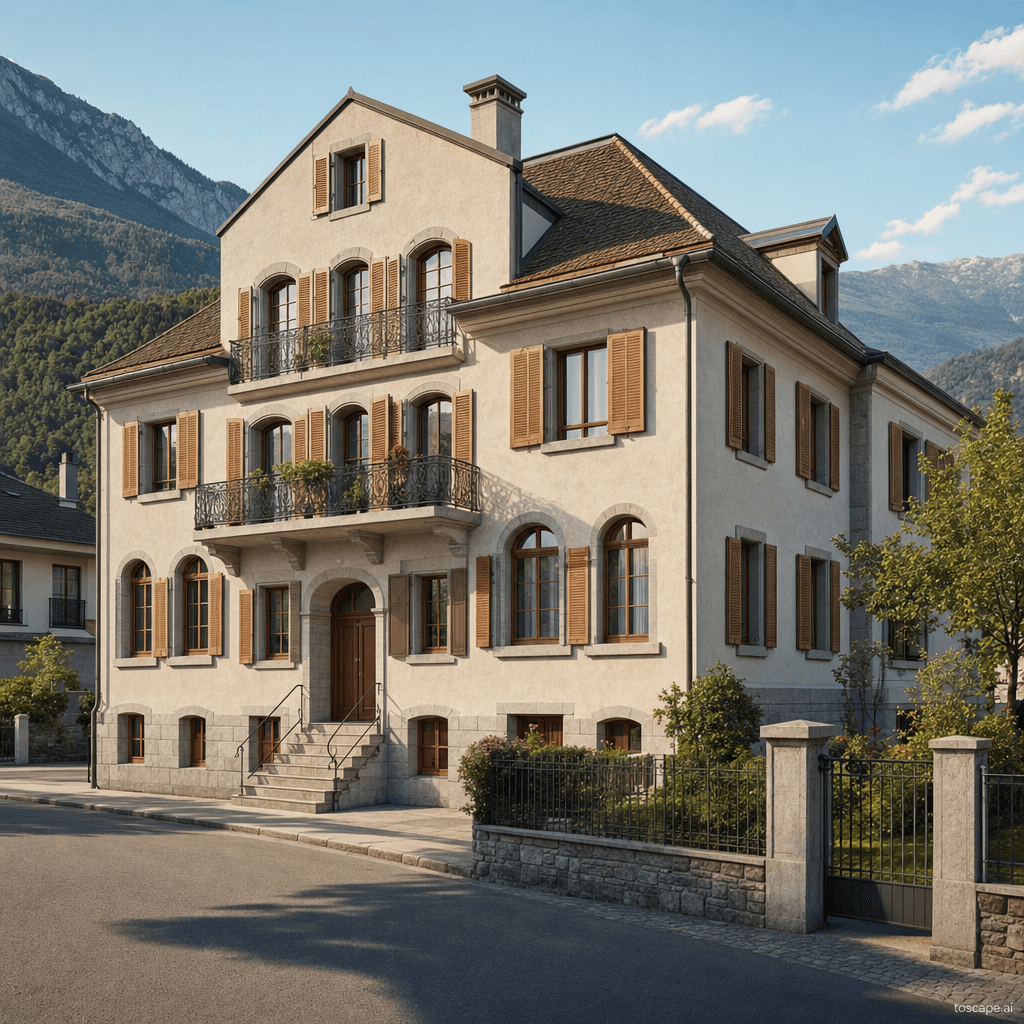
Vaud
Switzerland · Vaud canton
Pale cream-grey Jura limestone masonry walls — ashlar or coursed rubble, the warm light-coloured stone that defines the Vaudois built landscape — in contrast to the dark timber and stone of alpine Switzerland, gently pitched roofs (30-38°) with red clay pan ti...
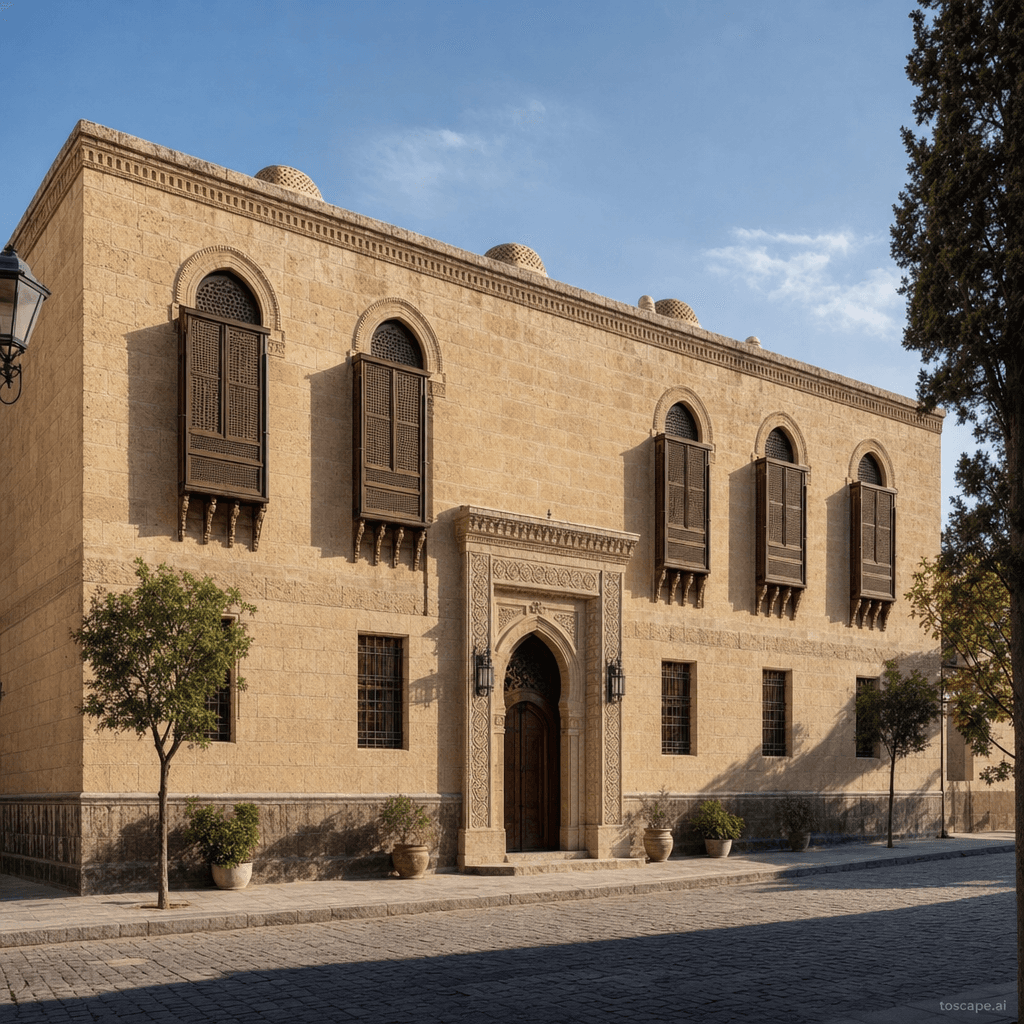
Aleppo Courtyard House
Syria · Aleppine courtyard house of the late Mamluk and Ottoman periods (15th–19th centu...
The Aleppine courtyard house — a monochrome golden stone world, its walls intricately carved in deep relief with geometric bands, muqarnas cornices, and calligraphic friezes — the stone is the color of honey (#D4C4A0 to #C8B890), its surface weathered to a sof...
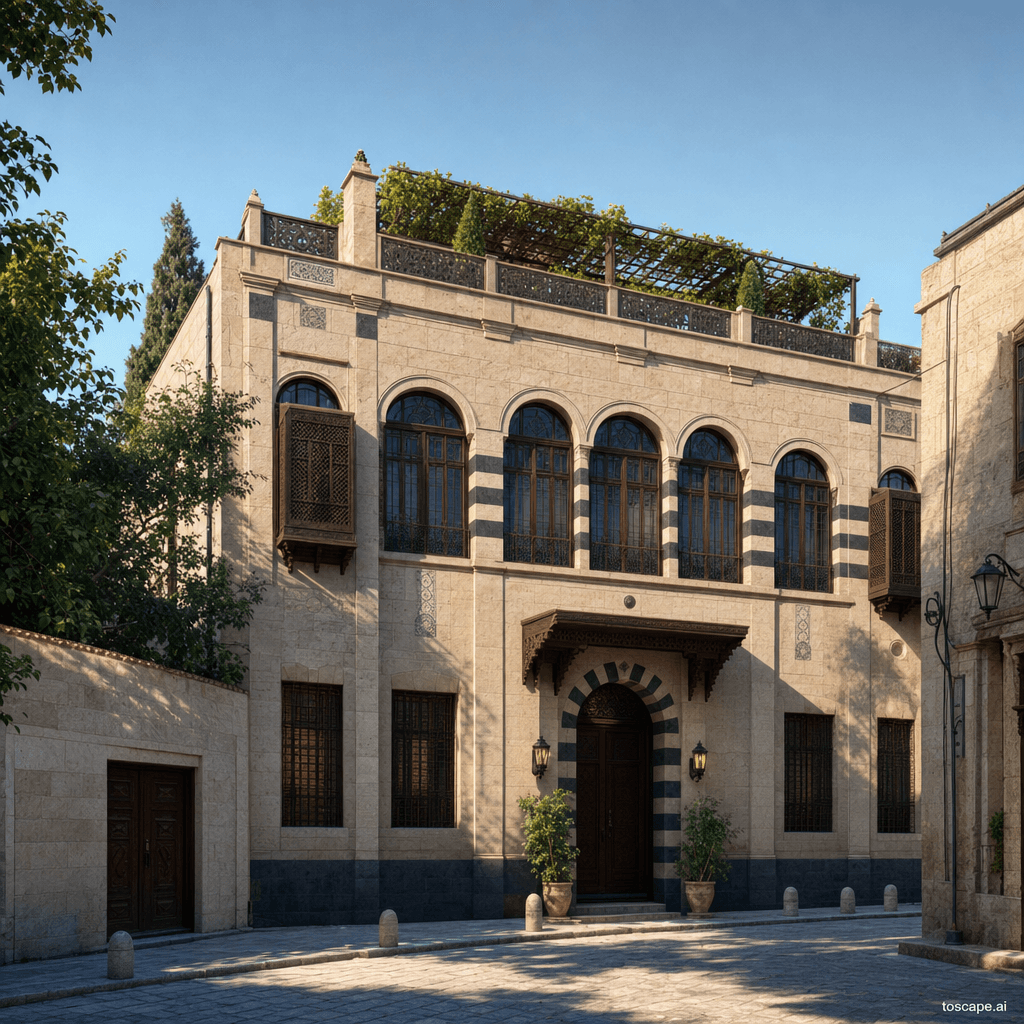
Damascus Courtyard House
Syria · Damascene courtyard house of the late Mamluk and Ottoman periods (15th–19th cent...
An introverted world of shade, water, and ornament hidden behind a plain street wall — ablāq stone patterns of pale limestone and black basalt on the courtyard floor and lower walls — the iwan rear wall decorated with ʿajamī (raised plaster and gesso, painted...
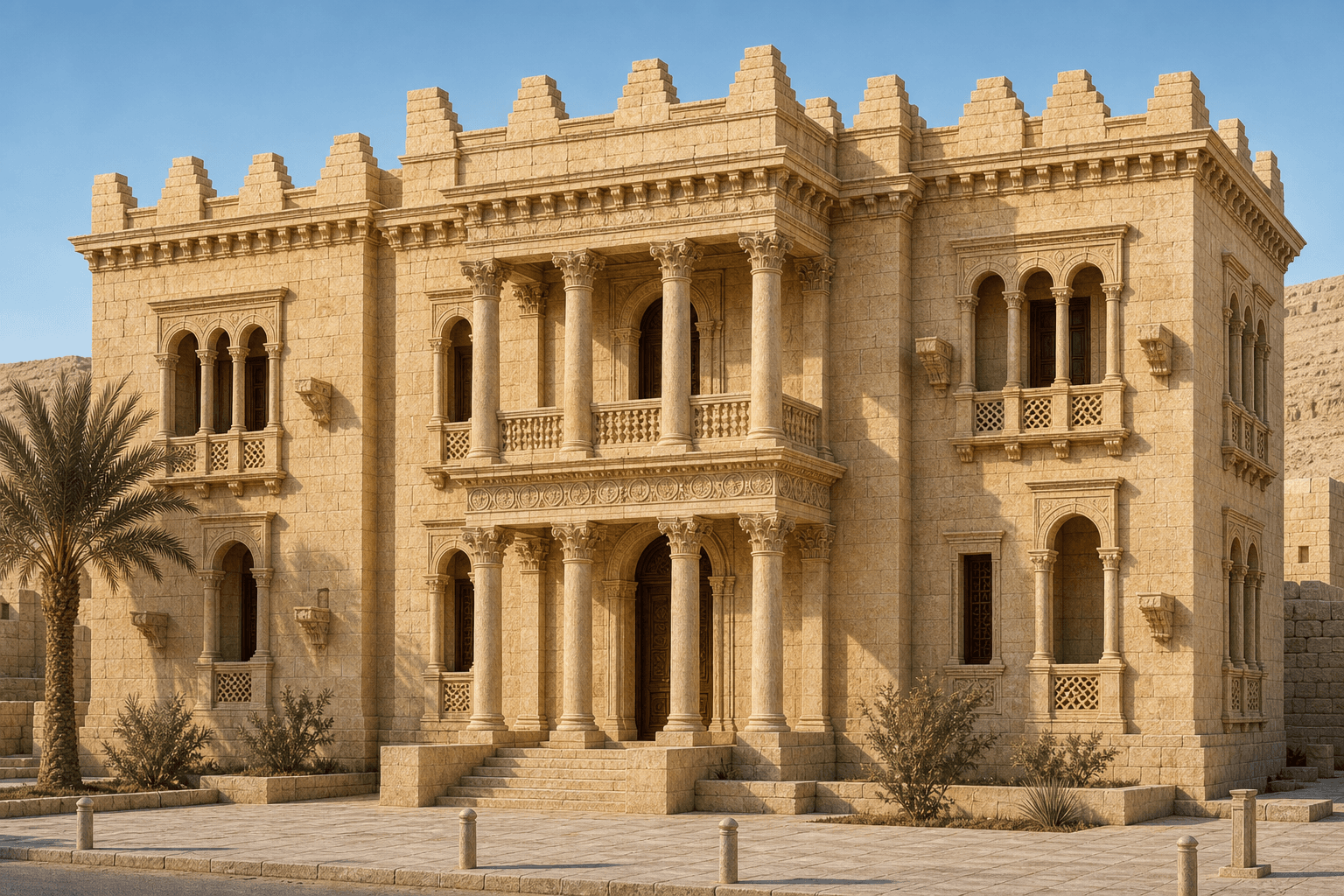
Palmyra Greco-Roman Desert
Syria · architecture of Palmyra (1st–3rd centuries CE)
Palmyrene architecture — a golden limestone classical city in the Syrian desert, where the familiar vocabulary of Roman columns, pediments, and entablatures is inflected by Eastern traditions: the stepped merlon crenellations (a Mesopotamian motif) on every wa...
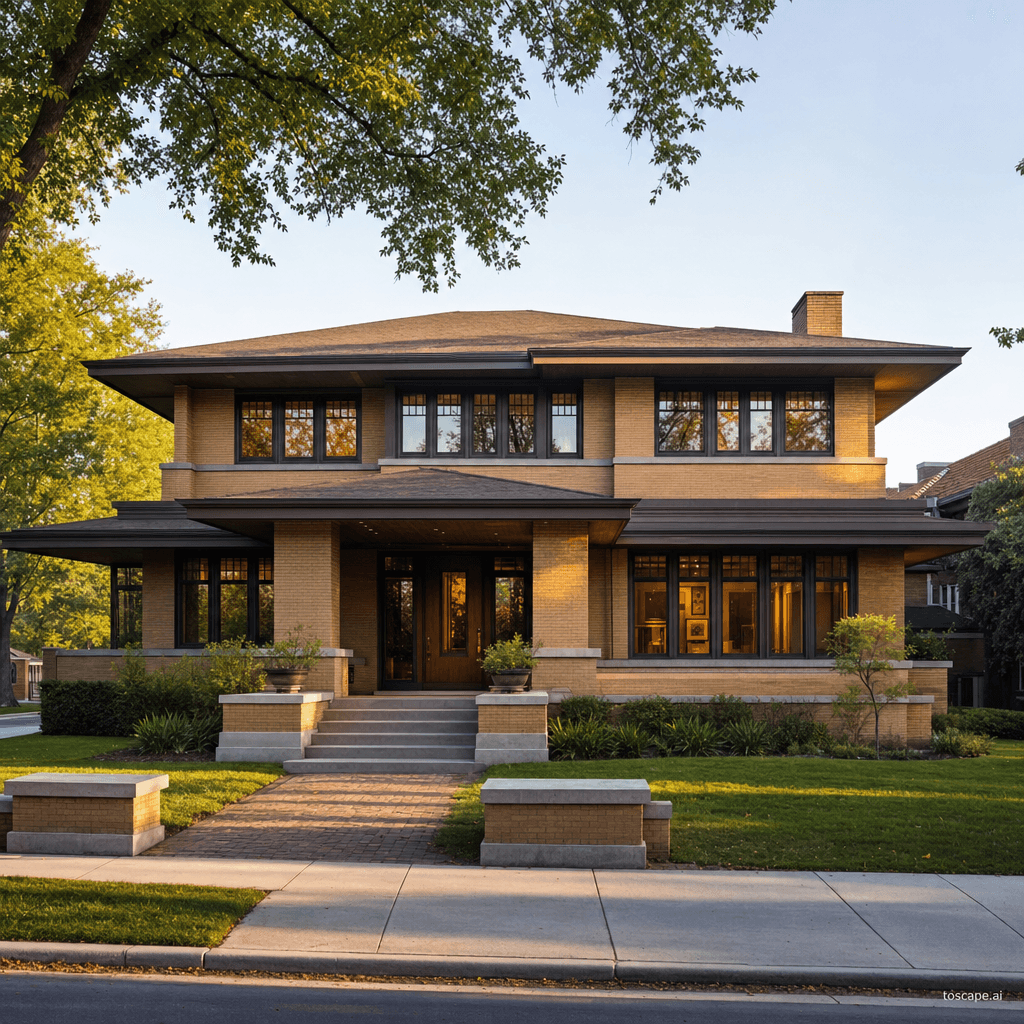
Central Plains
Thailand · Bangkok-Ayutthaya basin
Elevated timber stilt house (Ruen Khrueang Phuk / Reun Thai Doem) — steep gable roofs with distinctive curved bargeboards (pan lom / bai raka) terminating in serpentine naga finials, high-pitched (45-55°) gables with muk (hipped projections) creating complex m...
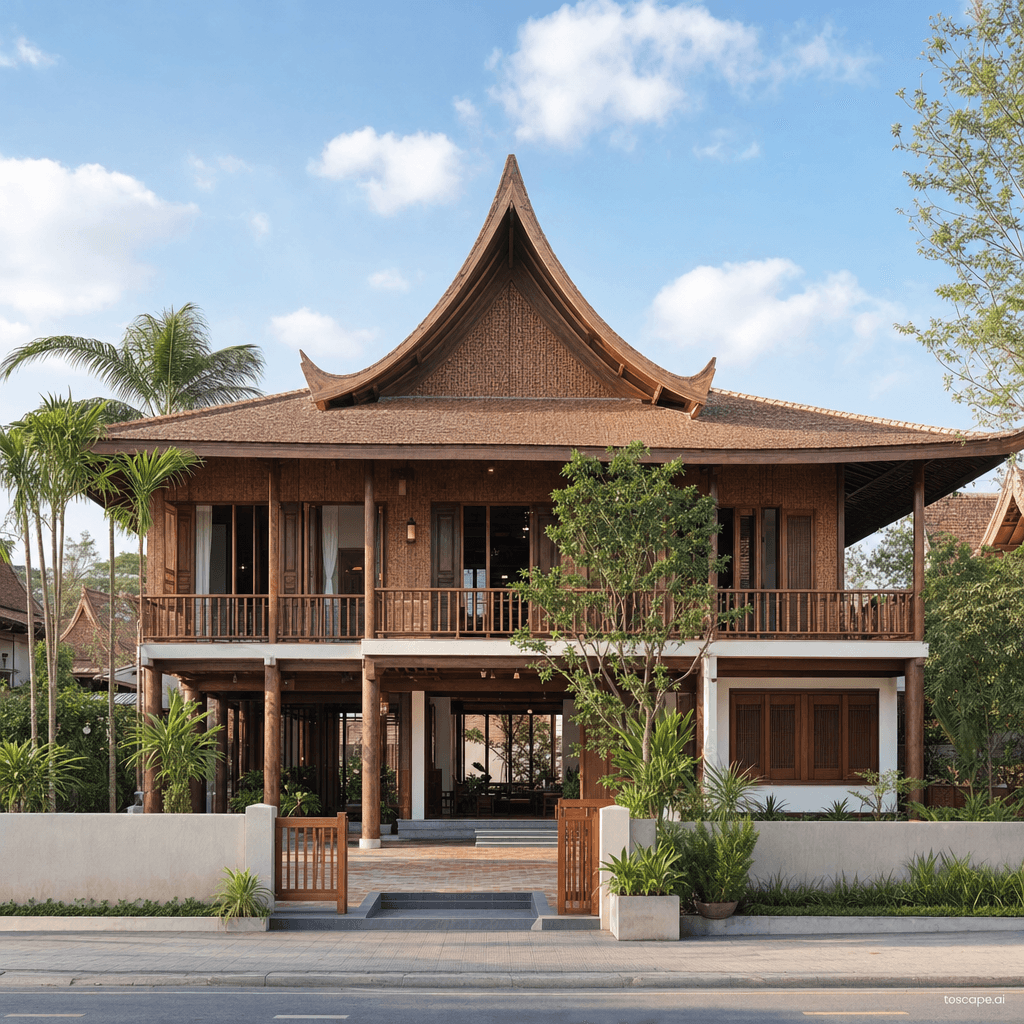
Northeastern Isan
Thailand · Northeast Thailand (Isan)
Ruen Isan — simpler, more utilitarian vernacular than Central or Northern Thai traditions, reflecting the region's economic modesty and harsh climate (flood-drought cycle). Elevated timber or bamboo stilt houses (2-3m high) with long rectangular plans, steep g...
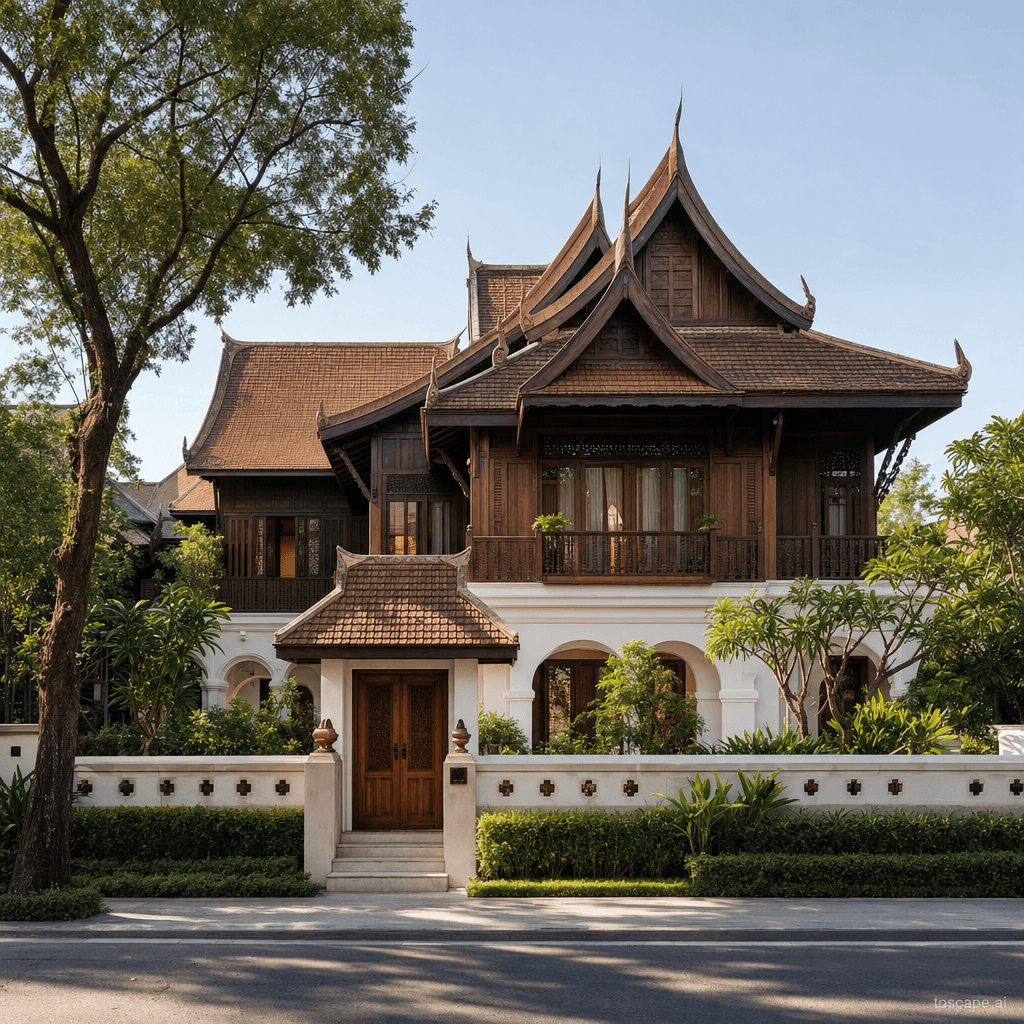
Northern Lanna
Thailand · Chiang Mai, Lamphun, Lampang, Phrae, Nan
Ruen kalae (kalae house) — steep gable roofs with distinctive V-shaped carved finials (kalae) crossing at the ridge apex — the defining architectural symbol of Lanna Thai identity, elegantly curved bargeboards (pan lom) terminating in stylized naga heads, roof...
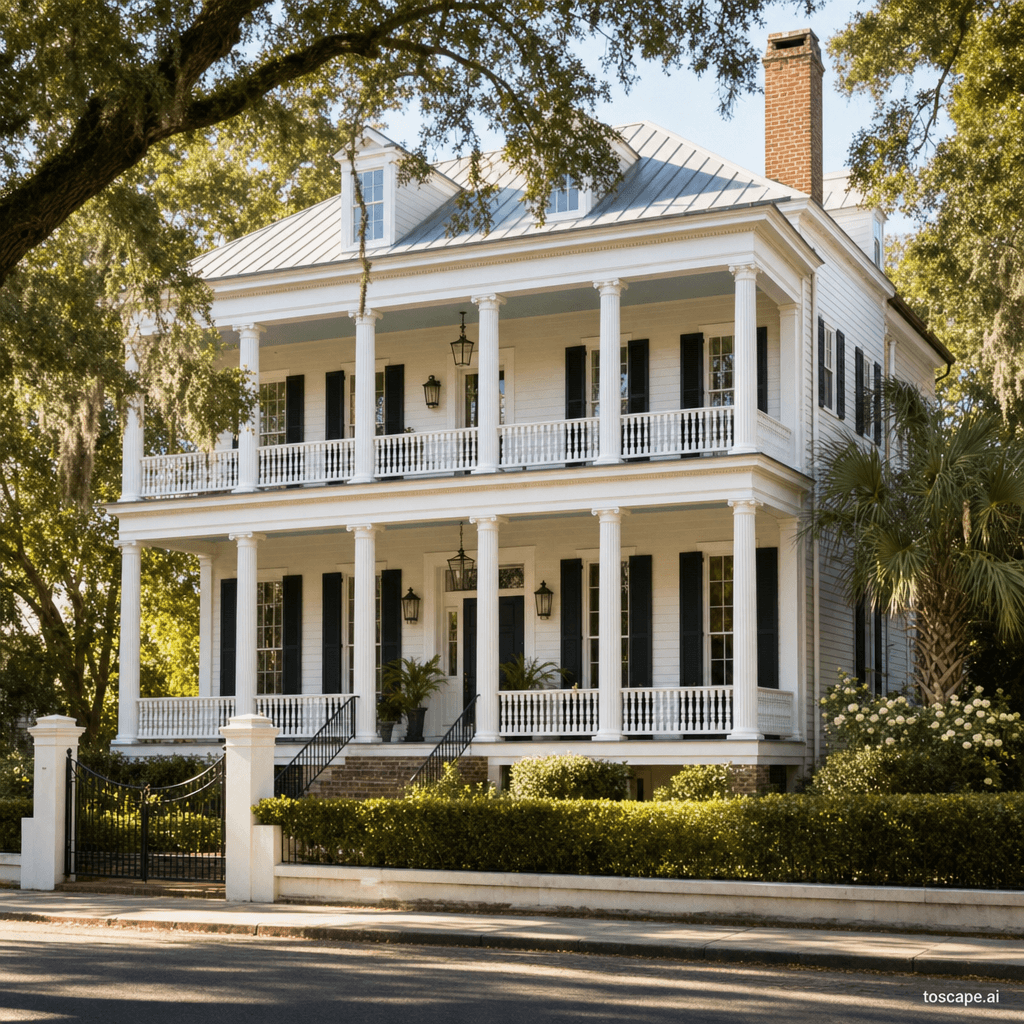
Southern
Thailand · Southern Thailand
Ruen Thai Pak Tai — Southern Thai elevated house, Malay-influenced elongated rectangular plan on high stilt posts (2-3m), long-gable roof (panya) with lower pitch (35-45°) than other Thai regions — wider span, less steep, bird's-beak gable finials (luk nok) at...
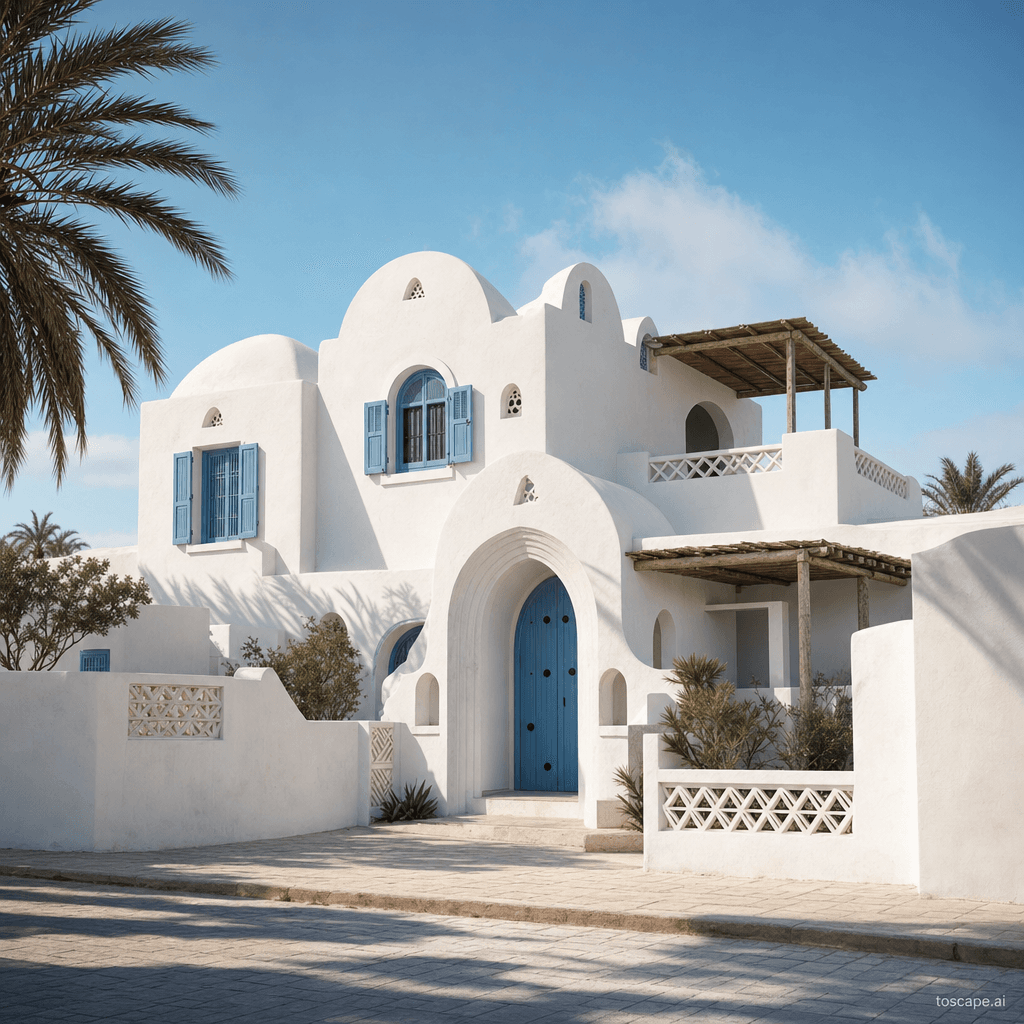
Djerba Island
Tunisia · vernacular architecture of Djerba Island (Jarba) off the southern Tunisian coast
The menzel — a dispersed farmstead typology of whitewashed cubic and domed volumes scattered across the island landscape, organized around walled courtyards (houch) — whitewashed domes (qubba) over principal rooms — flat roofs on service structures — minimal...
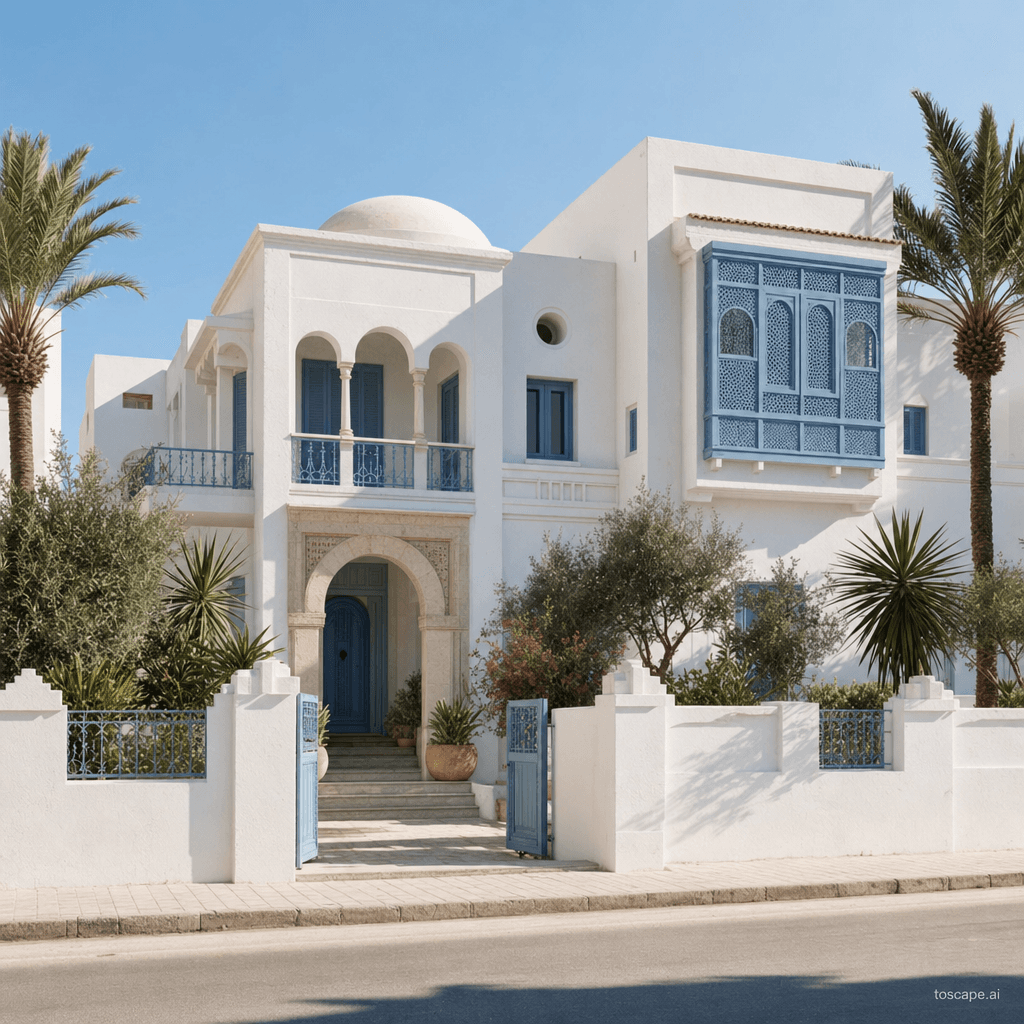
Sousse Sahel Coastal
Tunisia · coastal architecture of the Tunisian Sahel region
The ribat — a square fortified enclosure with circular corner towers and a central courtyard, combining religious, military, and maritime functions — white-rendered cubic volumes with flat roofs — coastal watchtowers (borj) — the Sousse medina with its distinc...
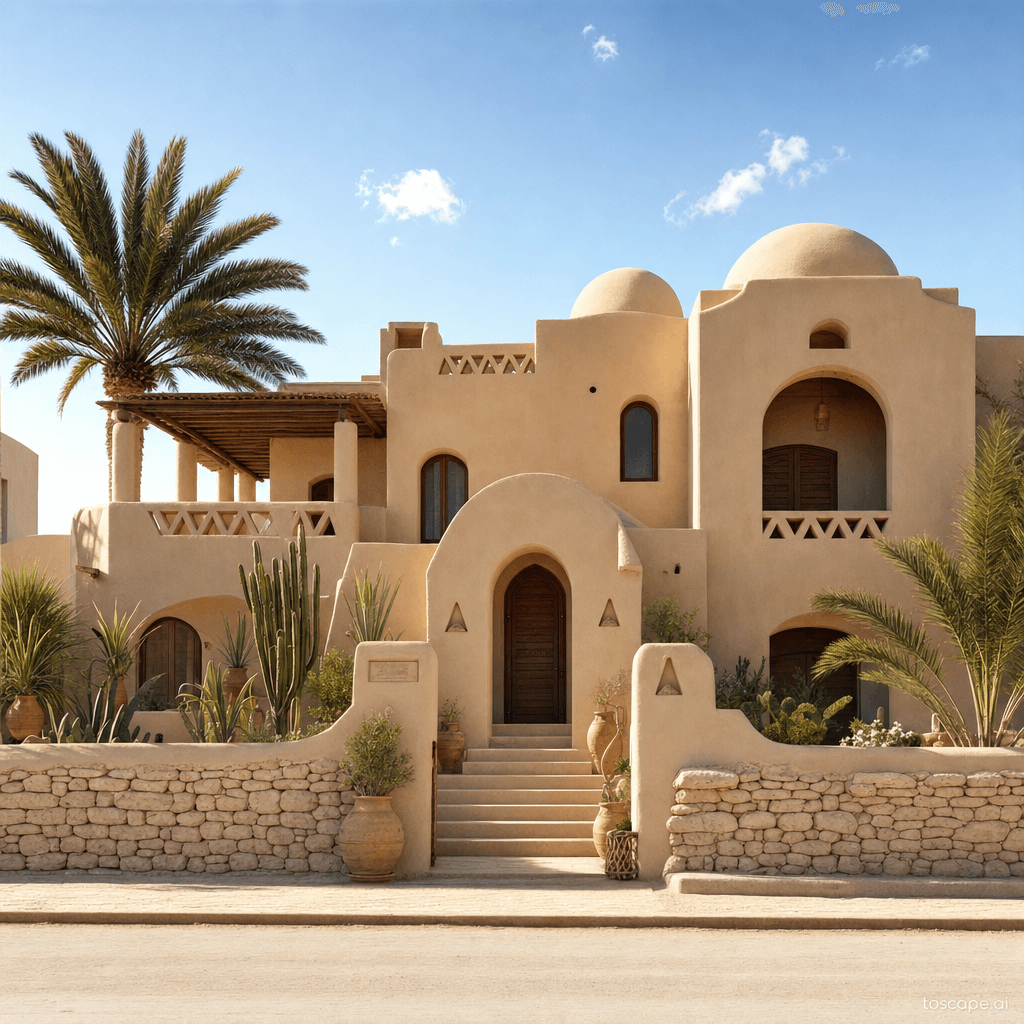
Southern Tunisia Desert
Tunisia · vernacular architecture of southern Tunisia (Gouvernorat de Tataouine, Médenine...
The ksar (pl. ksour) — a multi-storey fortified granary with stacked vaulted storage cells (ghorfa) arranged around a central courtyard — the troglodyte dwelling — a vertical shaft courtyard (houch) dug into the soft limestone, with rooms excavated radially fr...
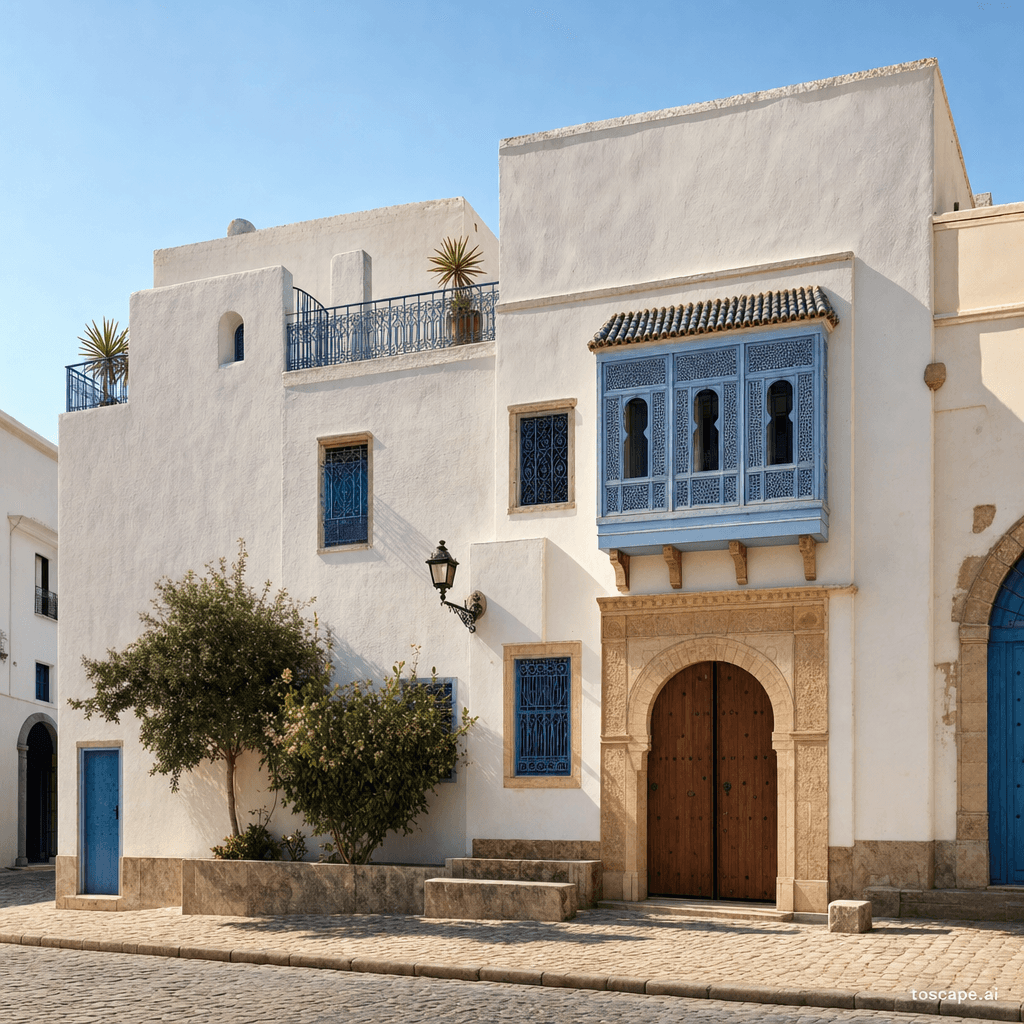
Tunis Medina
Tunisia · Medina of Tunis
Introverted courtyard house (dar) — central patio (wast al-dar) with marble fountain — white-rendered facades with blue-painted ironwork (window grilles, door studs) — horseshoe arches and multifoil arched arcades around the courtyard — polychrome ceramic tile...
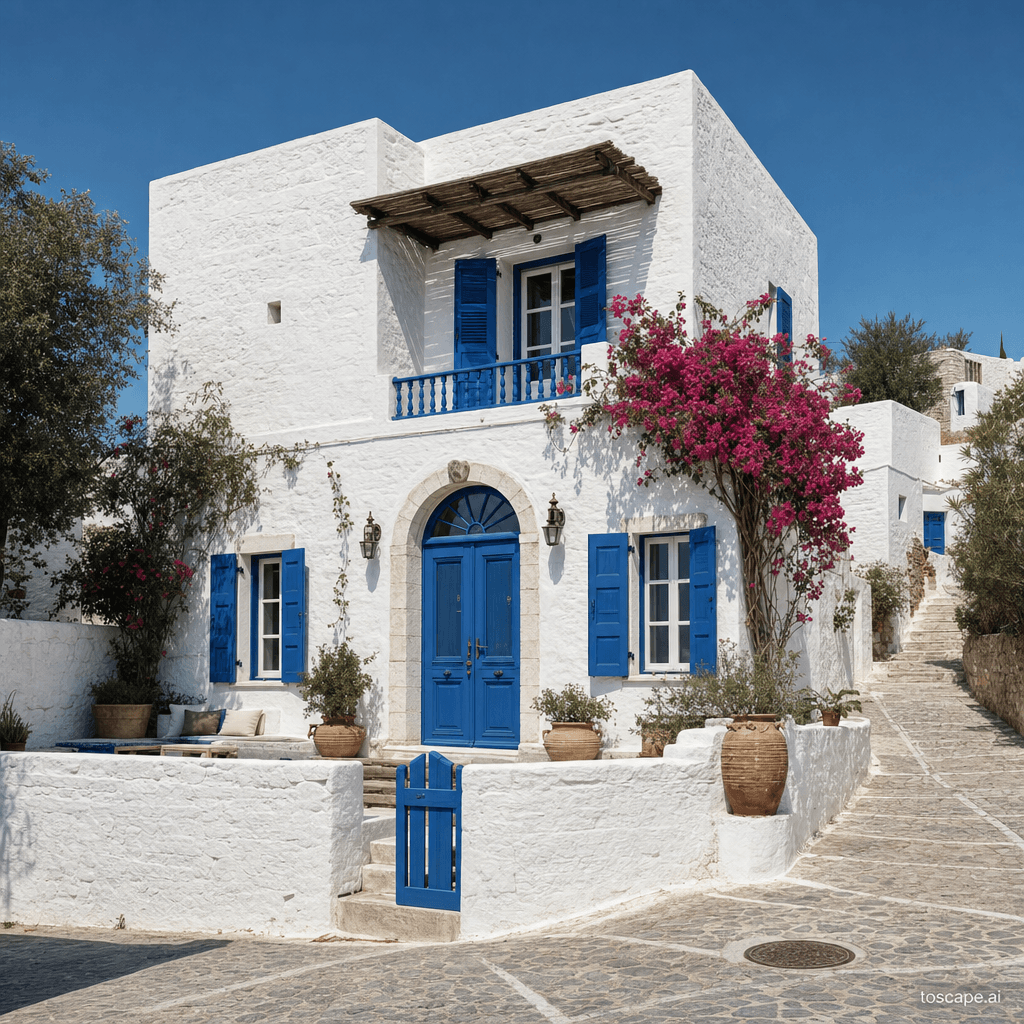
Aegean Whitewashed
Turkey · Aegean coastal region (Bodrum, Kuşadası, Alaçatı, Ayvalık)
Cubic whitewashed stone houses with flat or low-pitch roofs, blue-painted window frames and doors (mavi pencere), stone-paved courtyards (avlu), bougainvillea-draped facades, narrow stepped streets (merdivenli sokak)
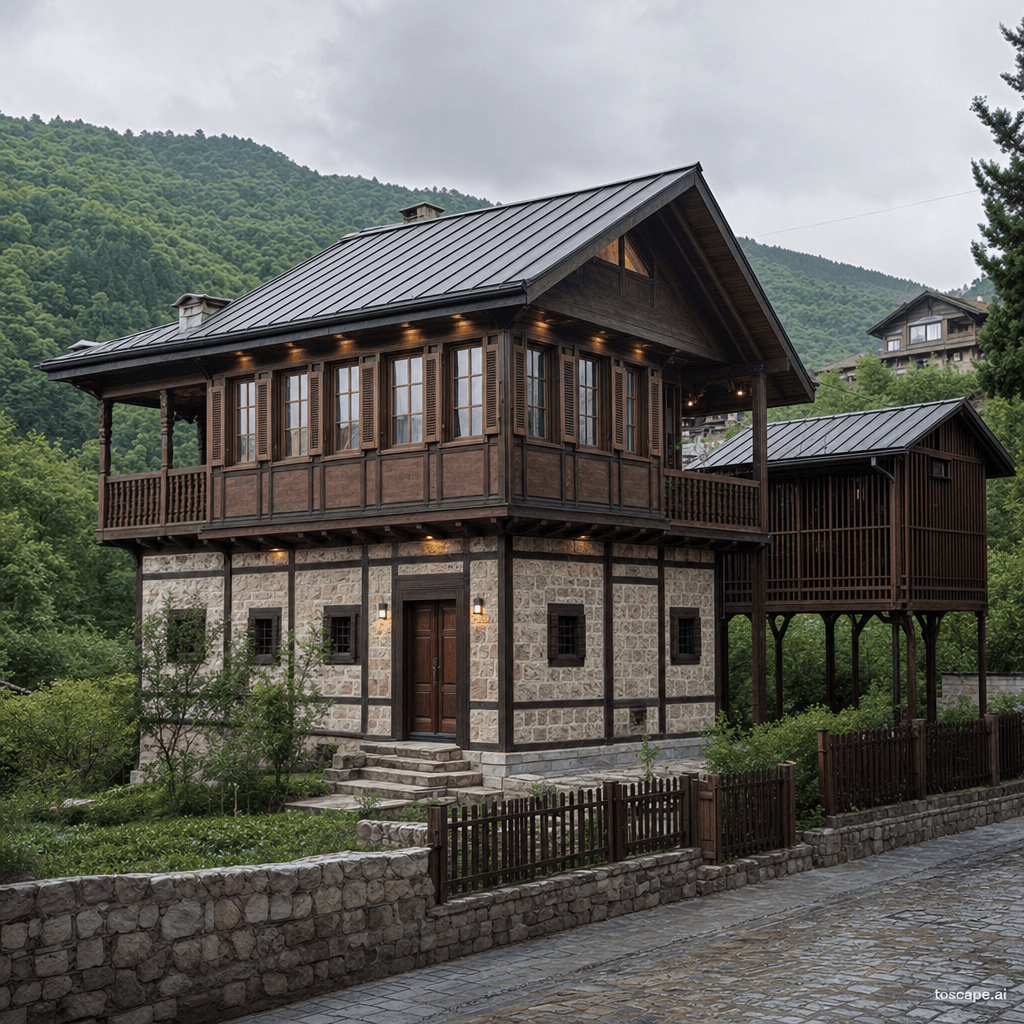
Black Sea Timber
Turkey · Eastern Black Sea region (Rize, Trabzon, Artvin)
Steeply pitched wide-eaved roofs (metal or tile), timber-frame construction with brick or stone infill (göz dolma), raised wooden granaries (serander/nailya) on stilts, linear settlement along valleys, adaptation to 2000mm+ annual rainfall
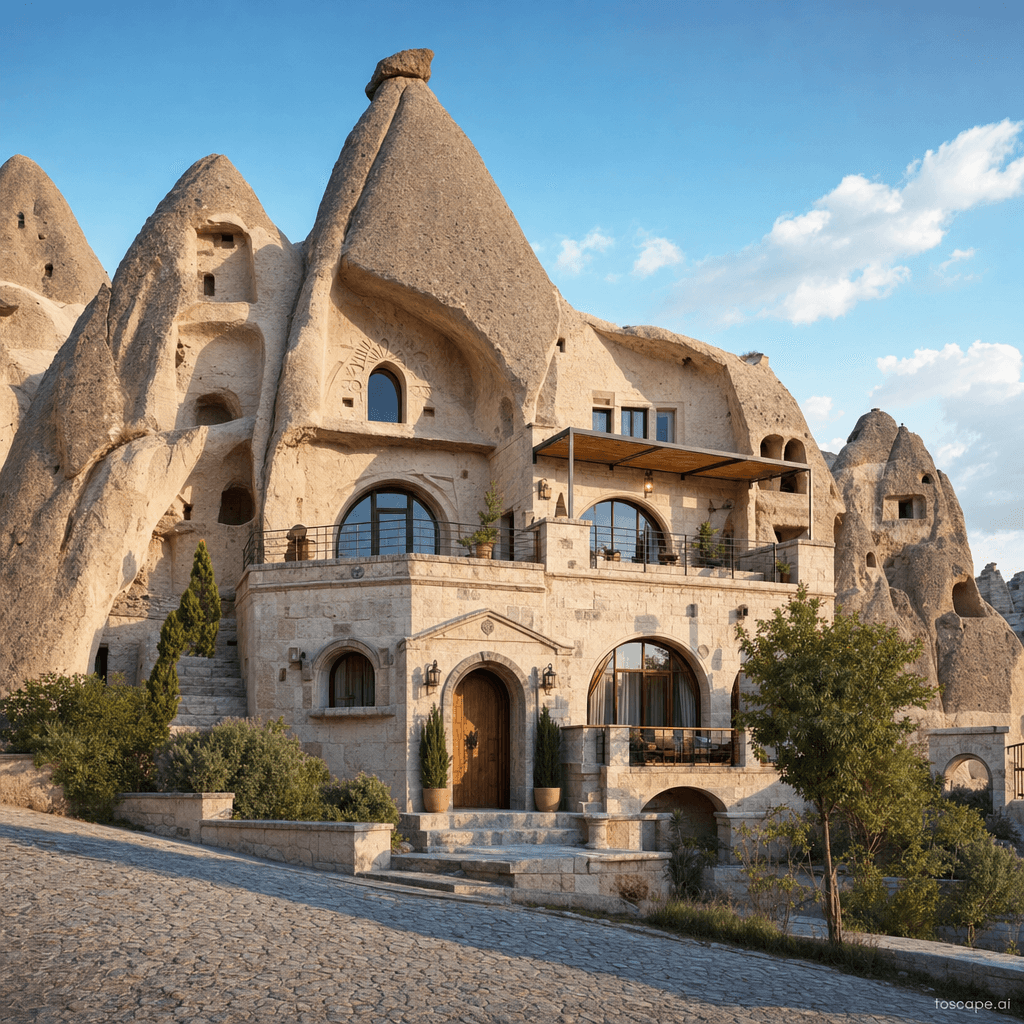
Cappadocia Cave Dwelling
Turkey · Cappadocia (Göreme, Ürgüp, Uçhisar)
Dwellings and churches carved into volcanic tuff (ignimbrite), fairy chimney rock formations (peribacası) with conical caps, underground cities (Derinkuyu, Kaymaklı), smooth sculpted interiors, carved rock facades with blind arches
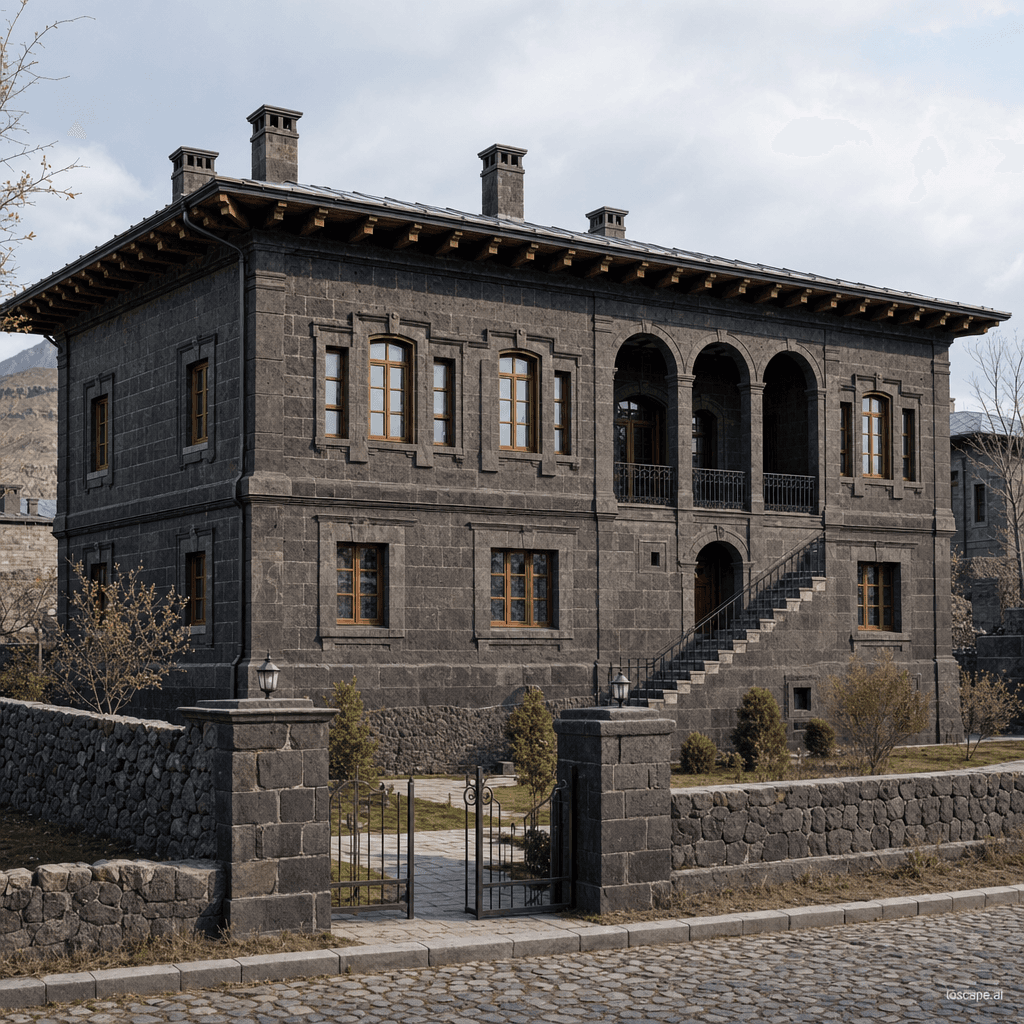
Eastern Anatolia Stone
Turkey · Eastern Anatolia (Erzurum, Kars, Van)
Dark basalt and grey volcanic stone load-bearing masonry, double-height enclosed hayat (courtyard with glass roof), wide projecting eaves for snow protection, tandır houses (earth-floored central hearth rooms), Russian Baltic-influenced stone buildings in Kars
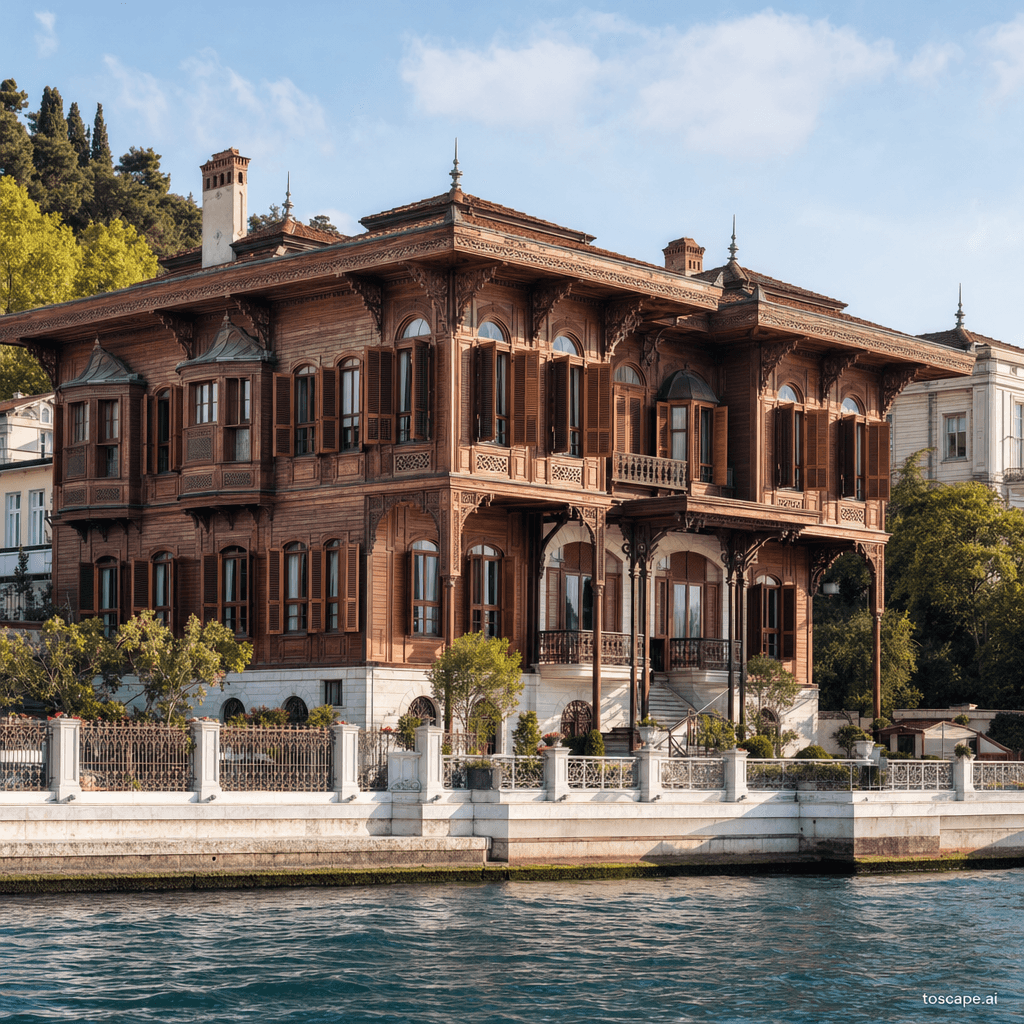
Istanbul Ottoman Imperial
Turkey · Ottoman imperial architecture of Istanbul
Central domed mosque typology with cascading semi-domes (Sinan masterwork), pencil minarets, timber yalı waterfront mansions along the Bosphorus, Iznik tile decoration, stone and brick alternating construction (almaşık)
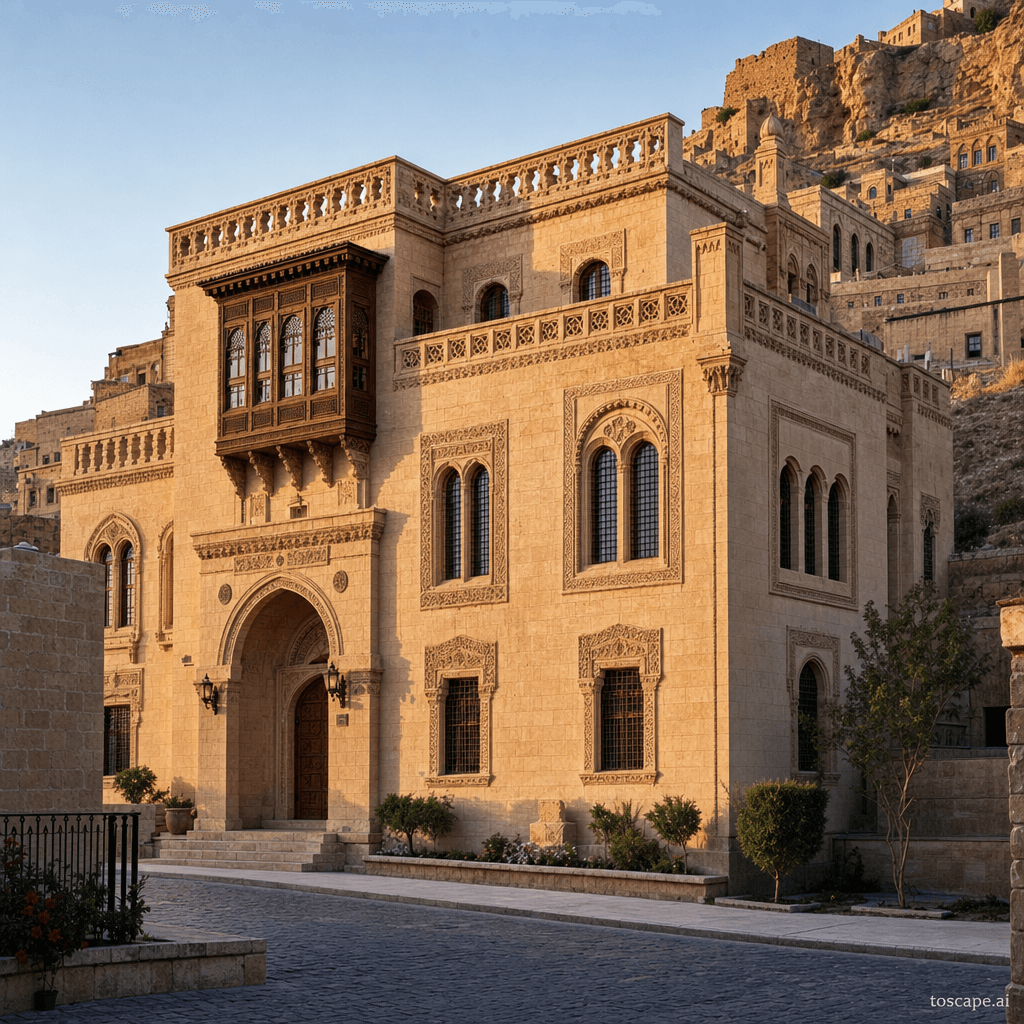
Mardin Artuqid Stone
Turkey · Mardin
Golden-honey limestone (kalker taşı) construction, elaborate carved stone ornament (taş işçiliği), cascading terraced houses stepping down the hillside, stone-vaulted bazaar (bedesten), madrasa complexes with carved portals, Syriac church and monastery archite...
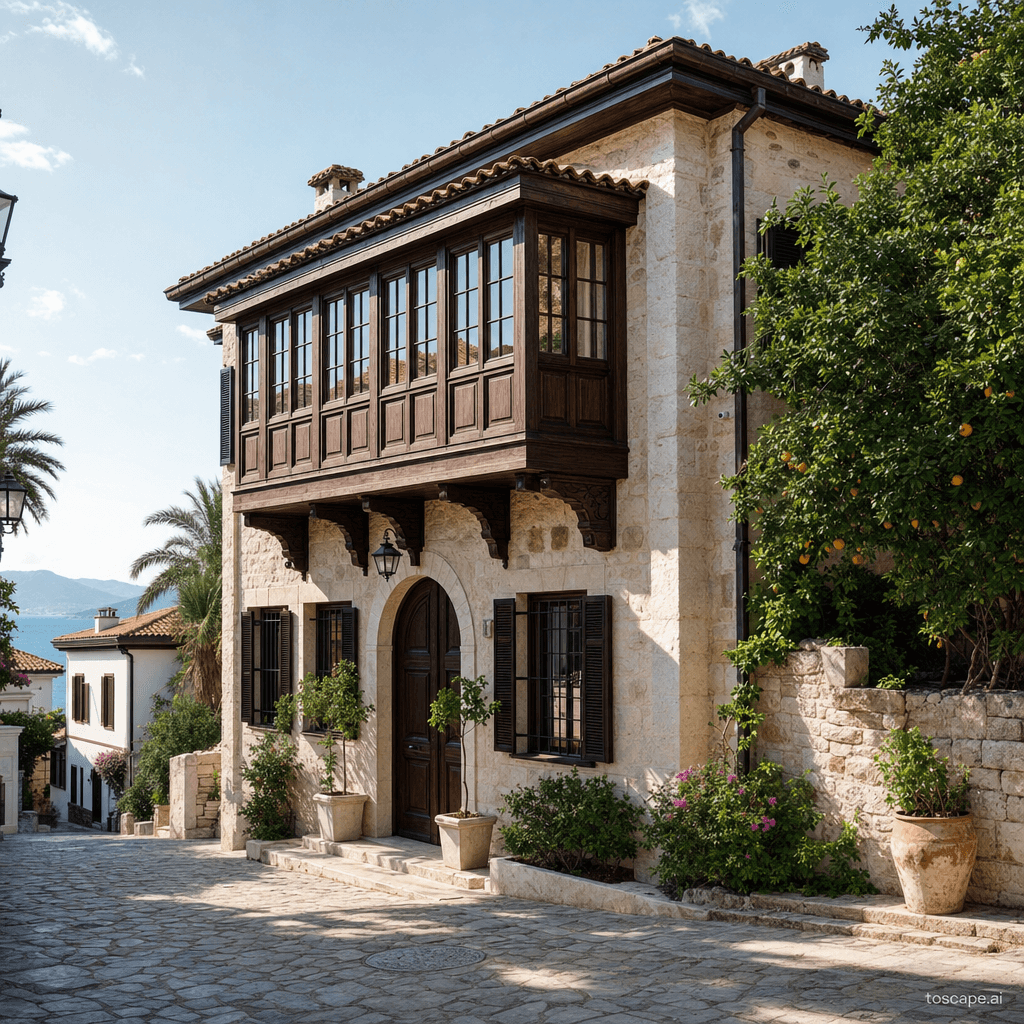
Mediterranean Coastal
Turkey · Turkish Mediterranean coast (Antalya, Kaş, Kalkan, Fethiye)
Local limestone rubble and cut stone houses, projecting timber balconies (cumba/şahnişin), tiled pitched roofs, stone-paved courtyards with citrus trees, historic Kaleiçi (Old Antalya) urban fabric, Lycian rock tombs as carved monumental heritage
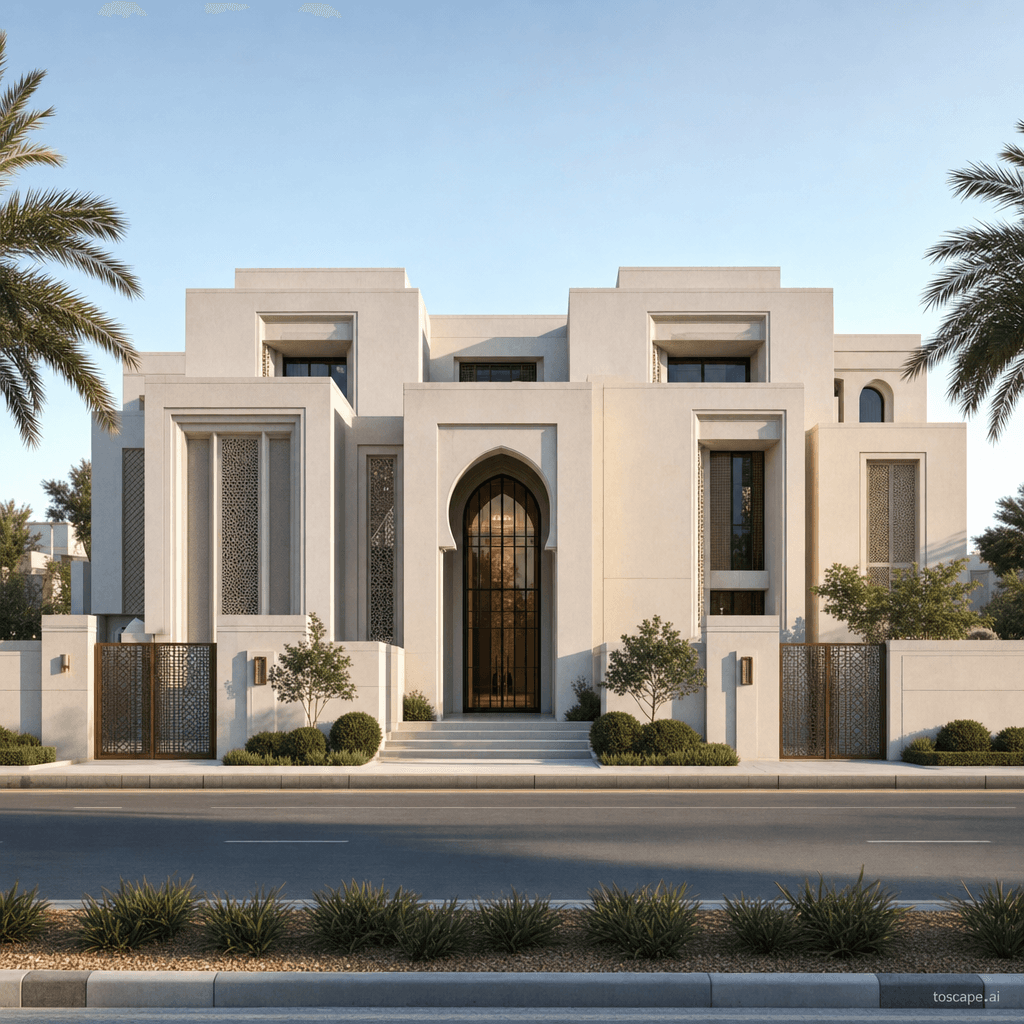
Abu Dhabi City
United Arab Emirates · architectural identity system of Abu Dhabi City as defined by the Department of...
The barjeel (wind tower) as the iconic identity marker — reinterpreted for passive cooling in contemporary form — courtyard planning (al-hosh) for privacy and climate response — mashrabiya and perforated screen facades mediating light, privacy, and heat — eart...
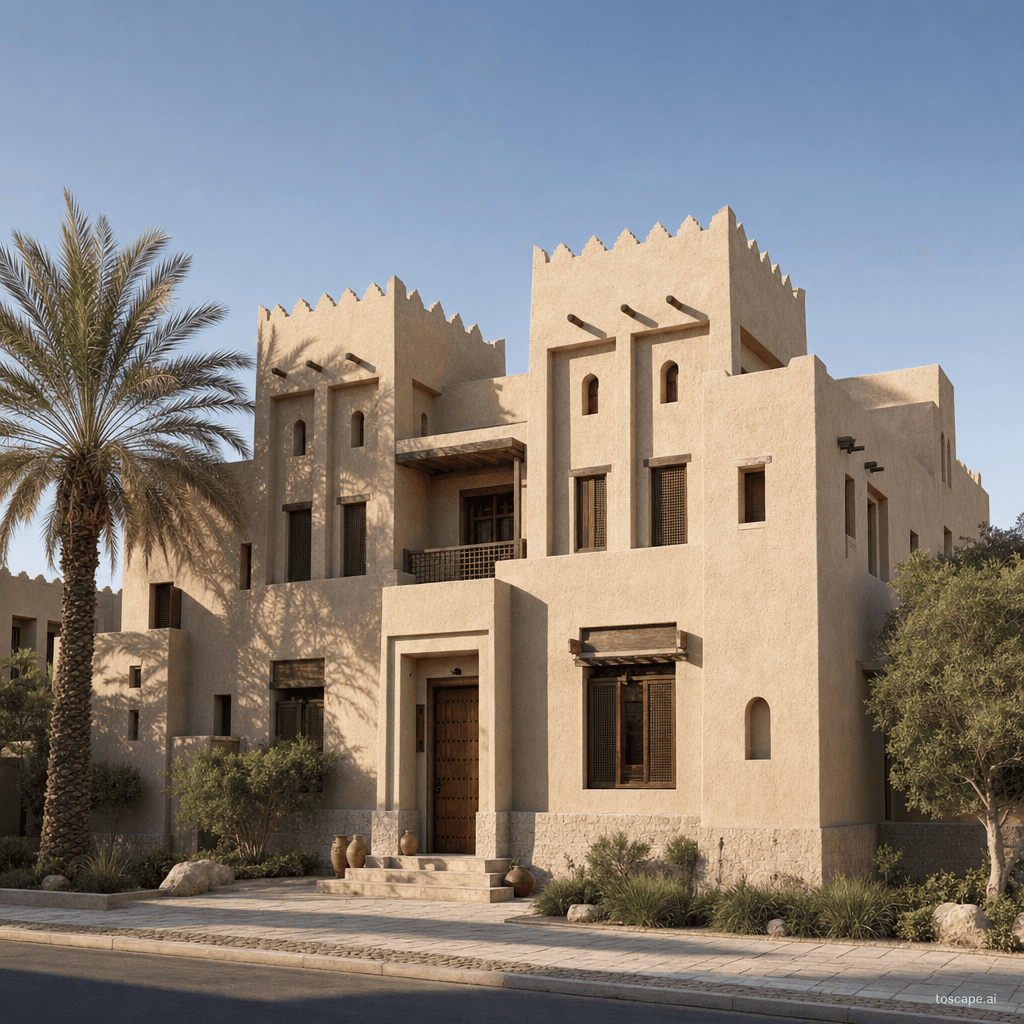
Al Ain Oasis
United Arab Emirates · Al Ain, Eastern Region, Abu Dhabi Emirate
Mud-brick forts, thick courtyard walls, falaj irrigation channels, and dense date-palm canopy define Al Ain's interior oasis identity. The architecture is earth-toned, horizontal, and embedded within cultivated gardens rather than detached from them.
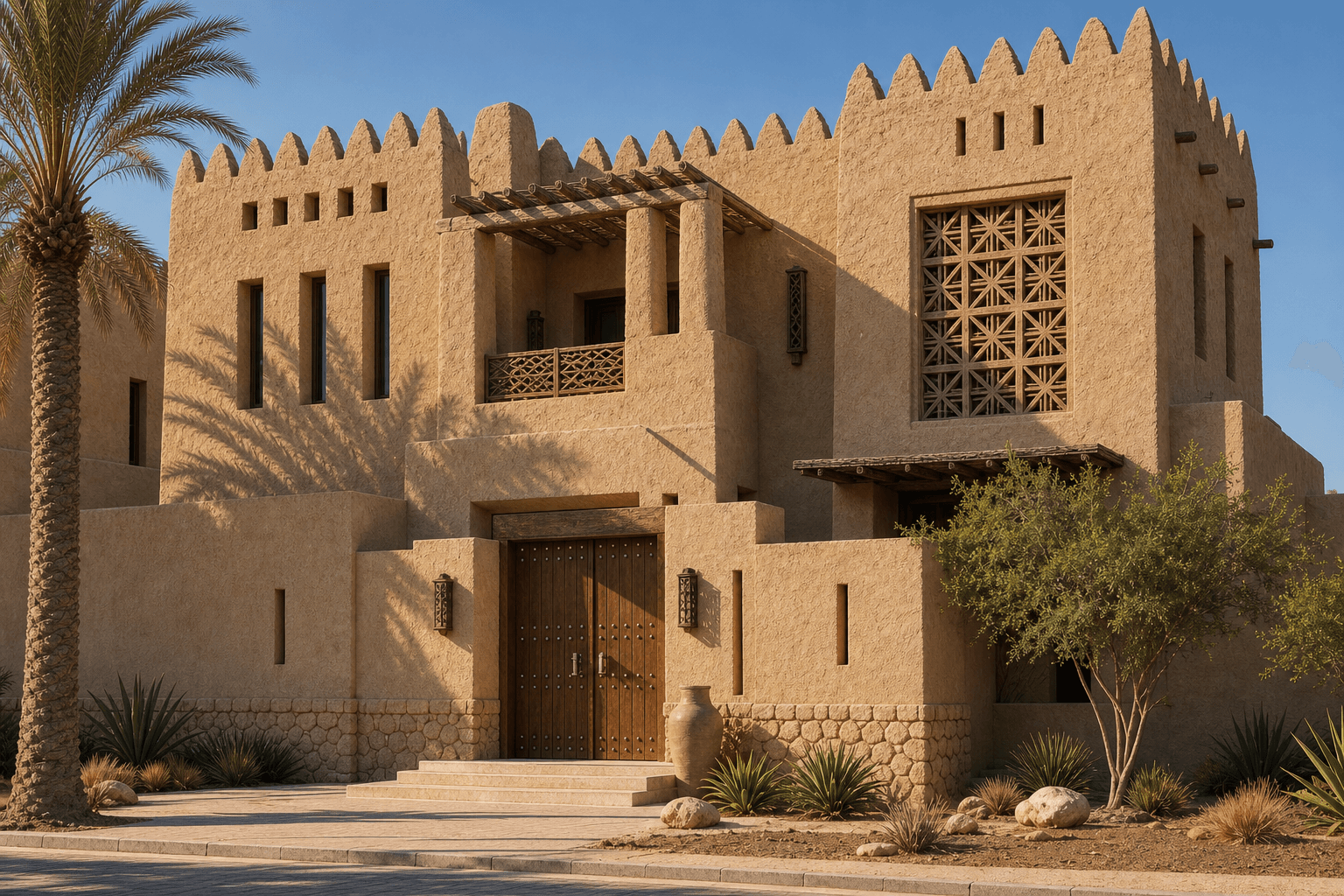
Al Dhafra Desert
United Arab Emirates · desert architecture and Bedouin heritage of the Al Dhafra Region (formerly Weste...
The Bedouin tent (bayt al-sha'r) — black goat-hair tensile structure — the arish (palm-frond house) — the transitional coastal-desert dwelling — desert forts (husn) at oasis nodes — the Liwa Oasis arc — a 100-km crescent of date palm settlements at the edge of...
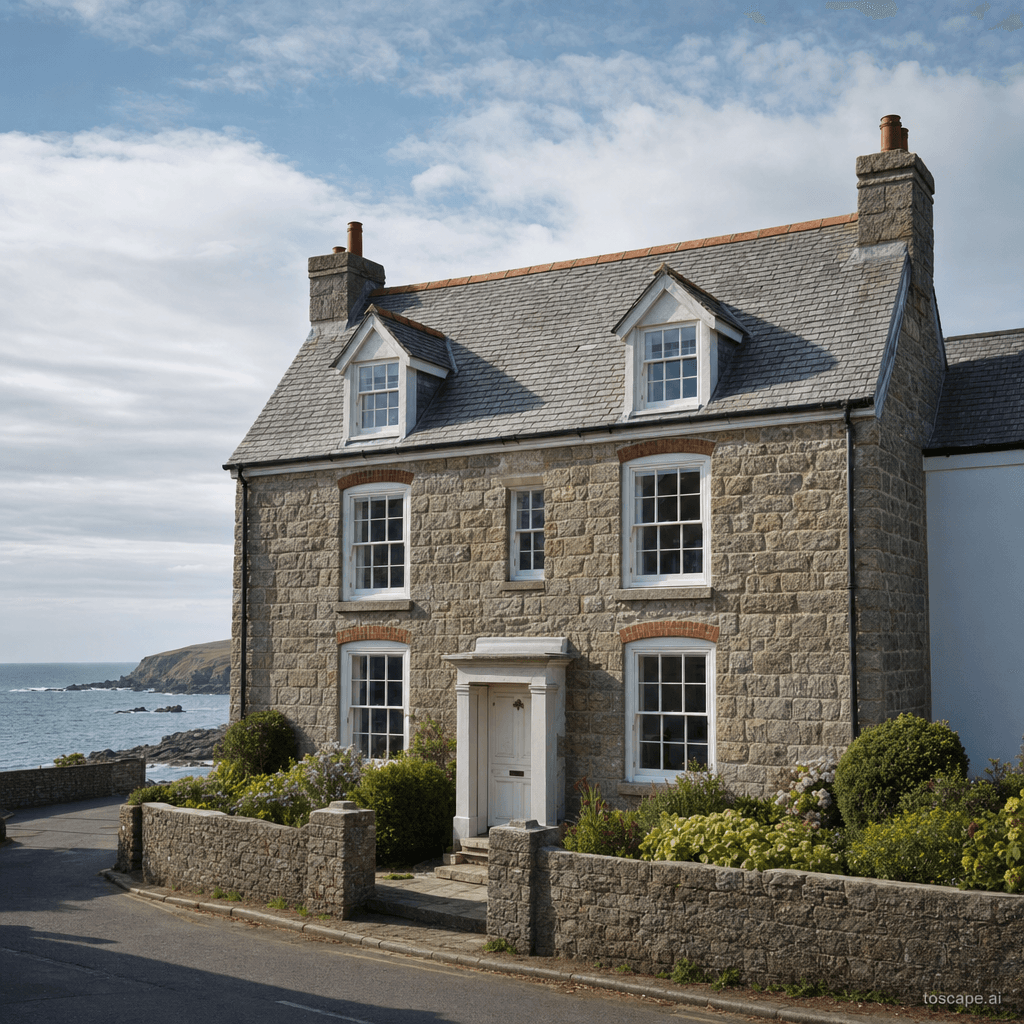
Cornwall
United Kingdom · Cornwall
Grey-silver Cornish granite rubble walls (moorstone) with massive granite quoins and lintels, steep natural slate roofs in dark grey-purple (Delabole slate) with pronounced gable verges and minimal overhang, squat cylindrical or rectangular granite chimneys wi...
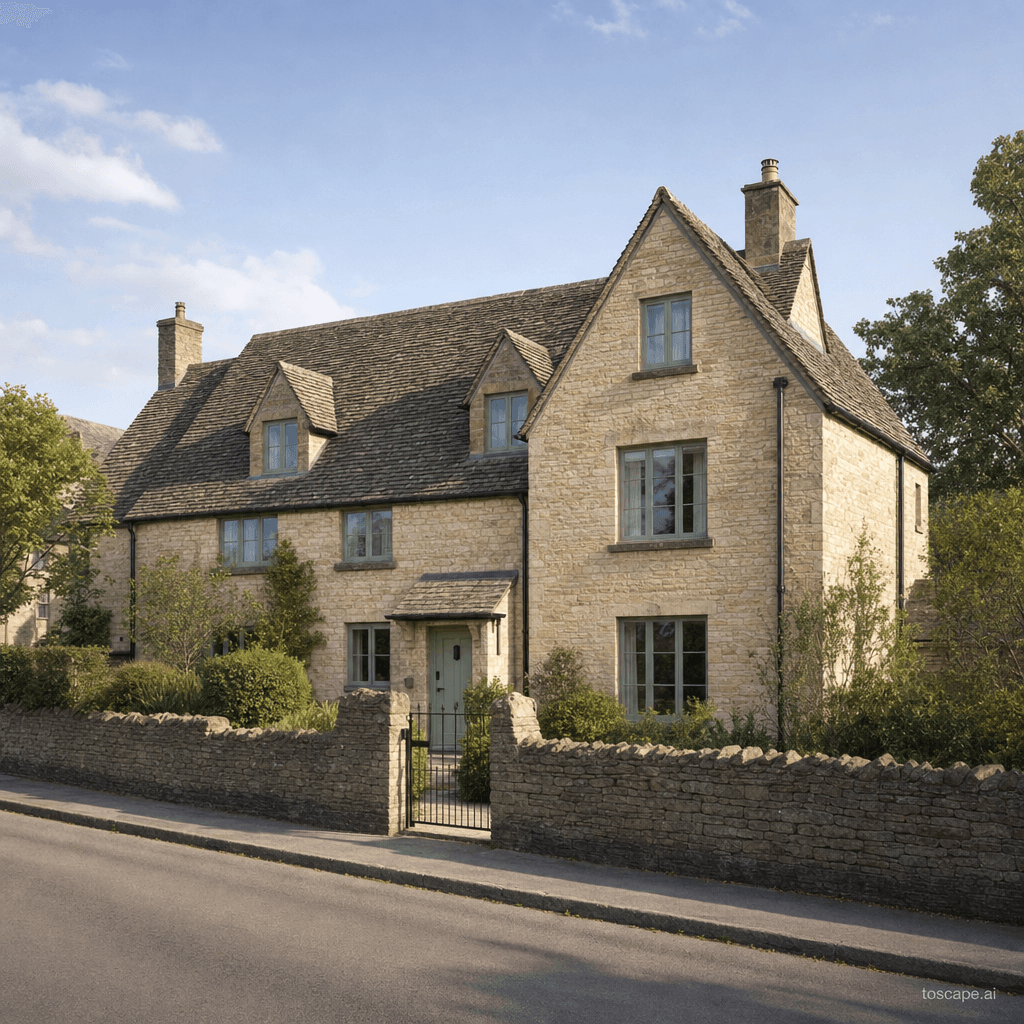
Cotswolds
United Kingdom · Cotswolds
Honey-gold oolitic Jurassic limestone ashlar and rubble walls with steep pitched grey stone slate roofs, tall gabled dormers breaking the eaves line, mullioned casement windows with leaded lights and drip-mould label stops, massive stone chimneys with molded c...
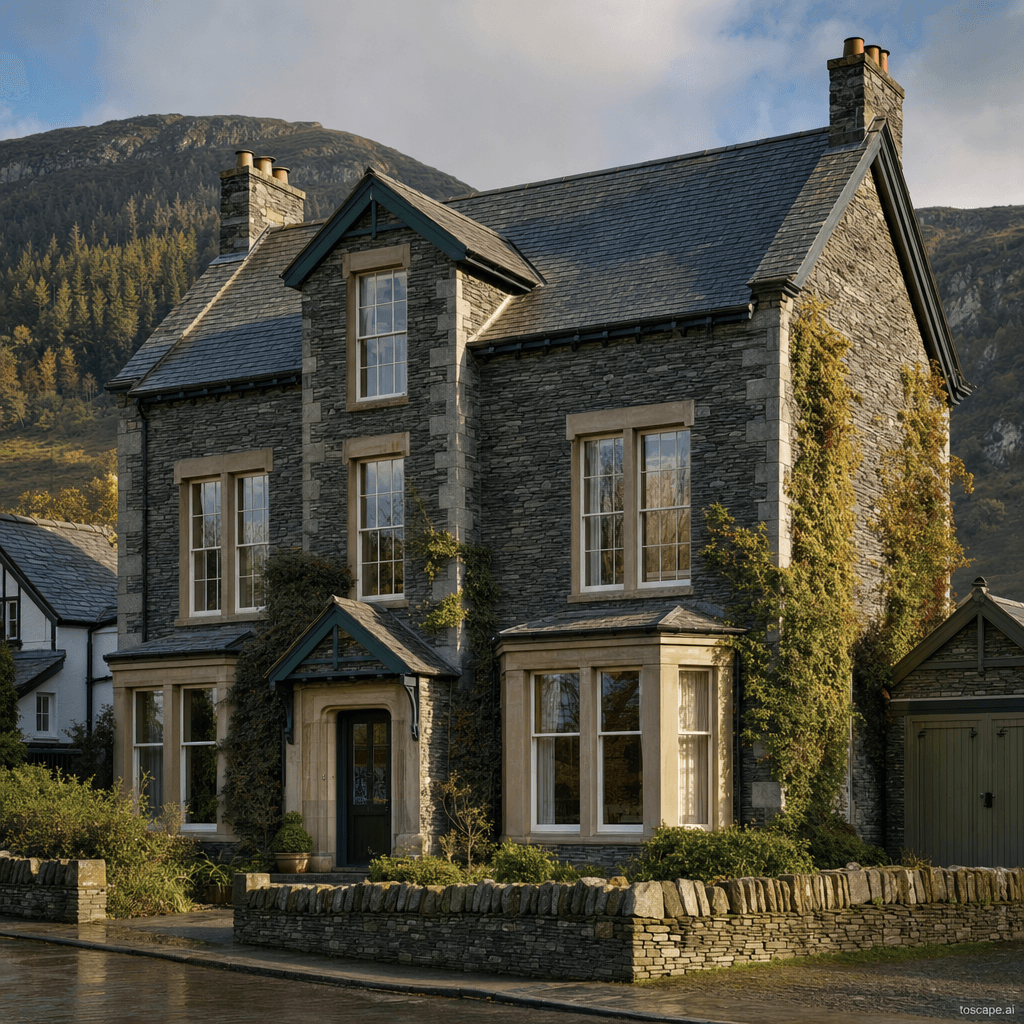
Lake District
United Kingdom · Lake District
Green-grey Westmorland and Borrowdale volcanic slate walls (local green slate — Skiddaw slate, Borrowdale volcanic greenstone) laid as random rubble or coursed with thick lime mortar joints, roughcast (wet-dash) lime harling render in cream, off-white, or soft...
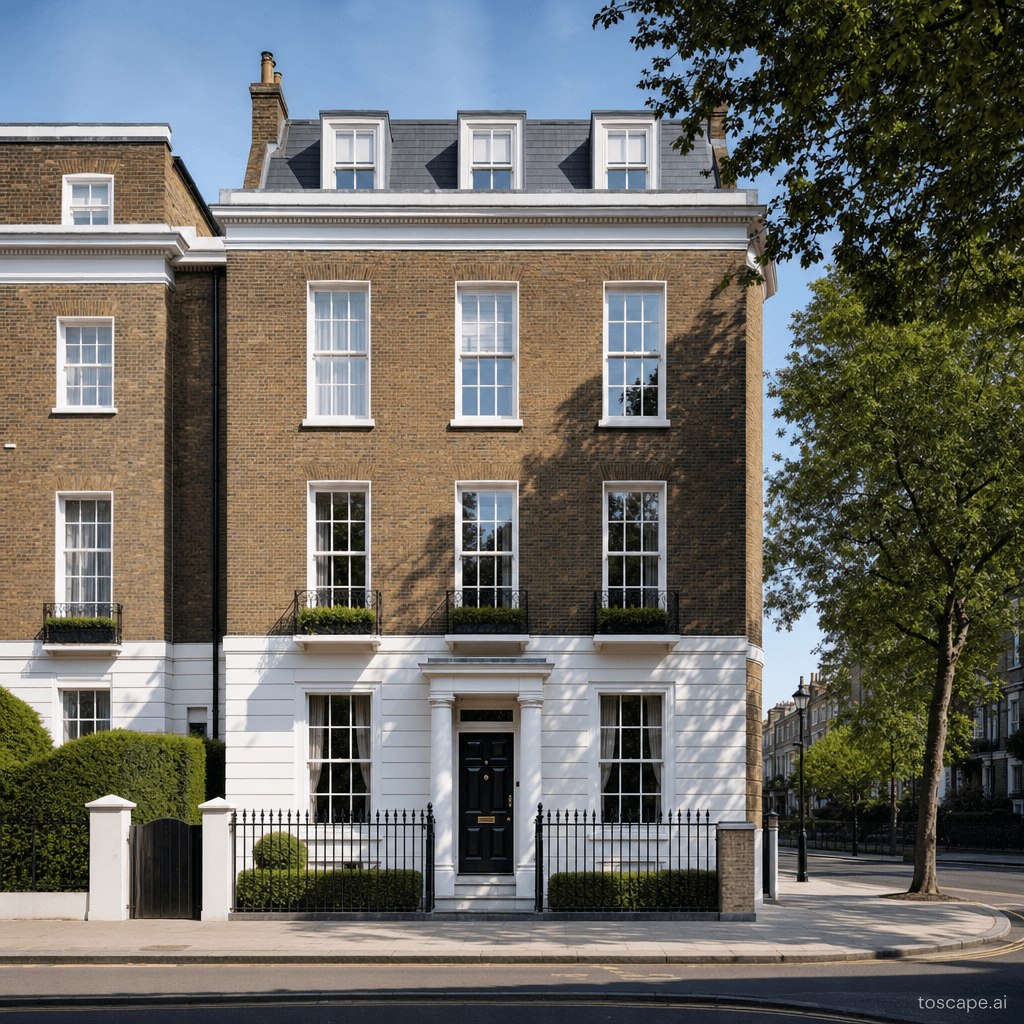
London & South East
United Kingdom · London and the South East
London stock brick — warm yellow-brown to grey-brown, the defining colour of the city, laid in Flemish bond (alternating headers and stretchers) with fine lime mortar joints, white stucco or cream-painted rendered ground floors and entire facades in Regency cr...
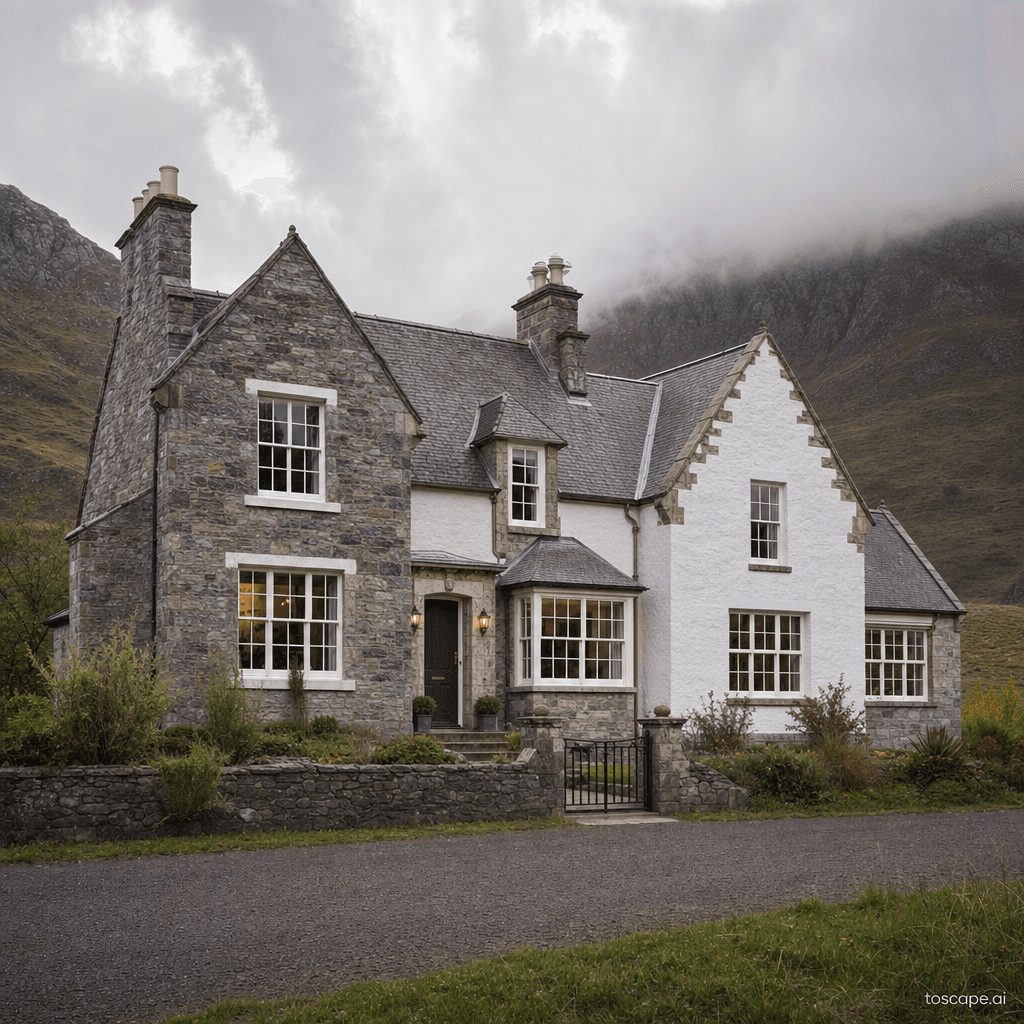
Scottish Highlands
United Kingdom · Scottish Highlands & Islands
Harled (wet-dash lime render over random rubble stone) walls in white, cream, or ochre colour-wash — the dominant Highland wall treatment unifying disparate stone types beneath a protective textured skin, steep pitched dark grey Ballachulish or Caithness slate...
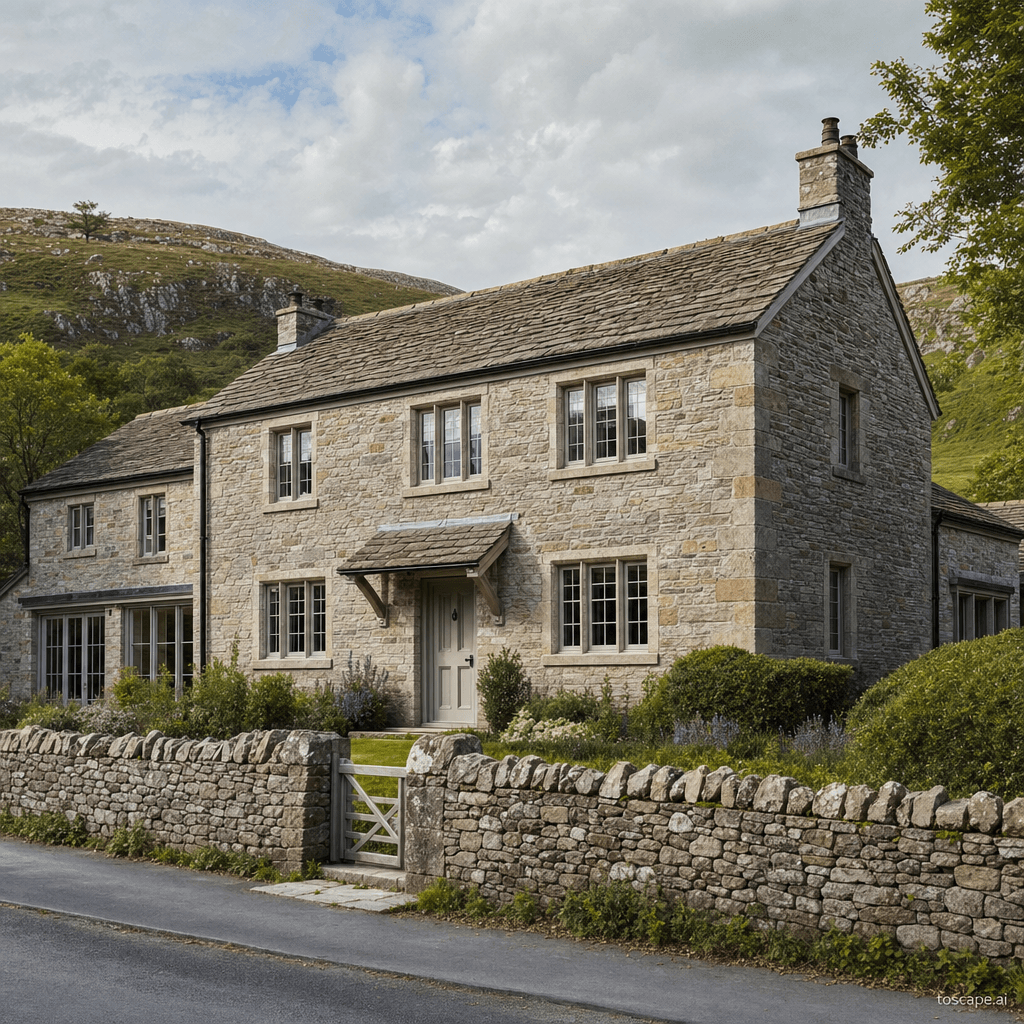
Yorkshire Dales
United Kingdom · Yorkshire Dales
Dark grey-brown Carboniferous millstone grit sandstone walls (or pale grey Carboniferous limestone in the southern Dales) laid as coursed rubble with massive irregular quoins at corners, heavy stone flag roofs — thick, massive sandstone slabs (grey-brown, "Yor...
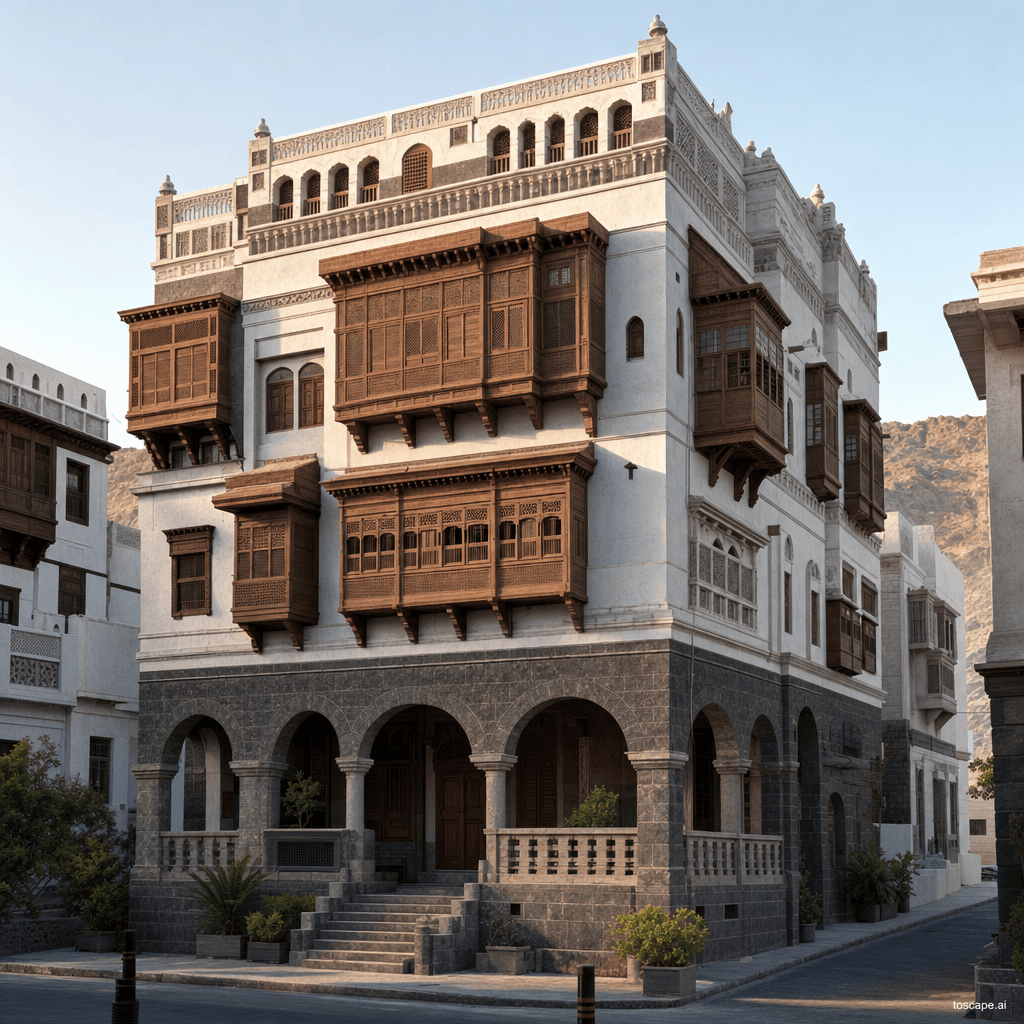
Aden Coastal Maritime
Yemen · Aden port city
Volcanic stone construction, carved wooden balconies (Indian Ocean type), mashrabiya screens, British colonial arcades, coral-stone (harash) masonry, multi-story merchants' houses in Crater district
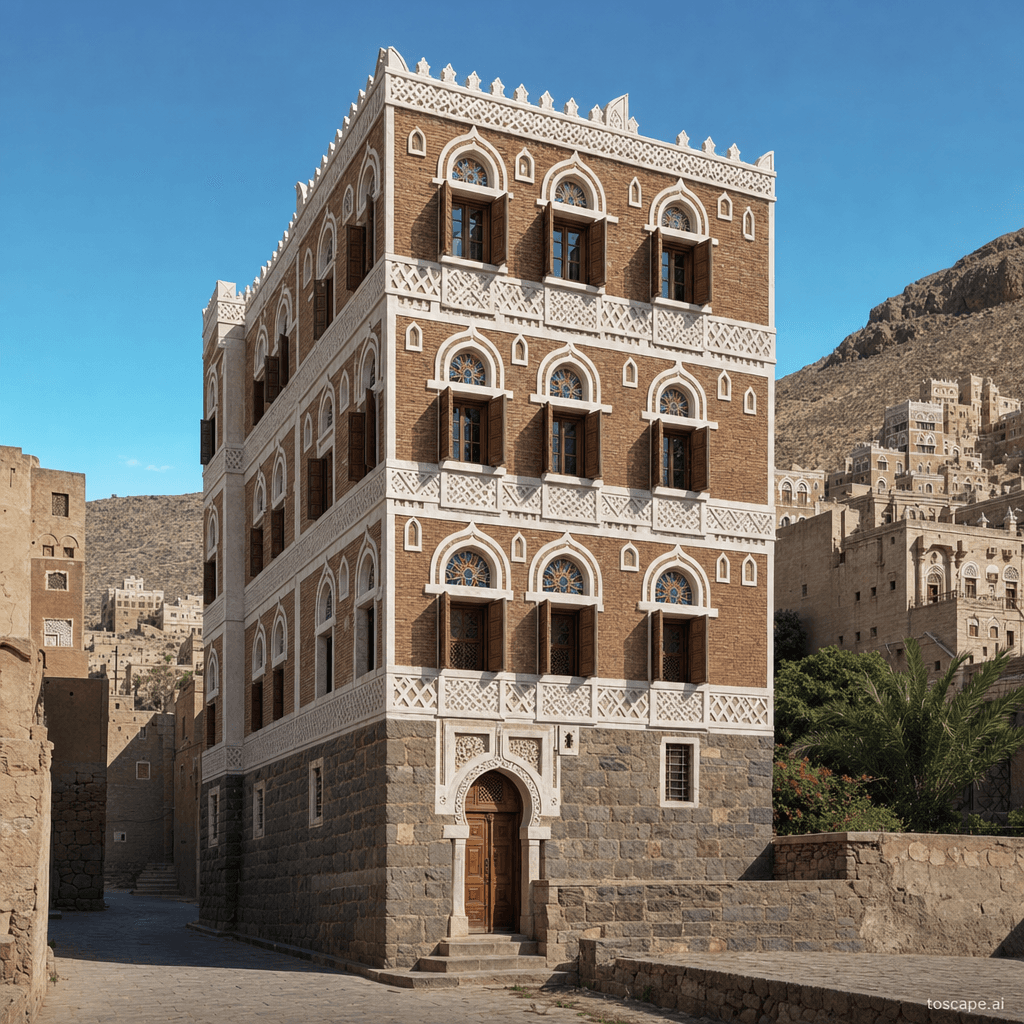
Sanaa Highland Tower
Yemen · Sanaa Old City highland tower houses
5-9 story tower houses (bara'), burnt brick and stone, white gypsum plaster (qadad), elaborate qamariya stained-glass fanlights, gingerbread-like white plaster filigree bands, vertical living
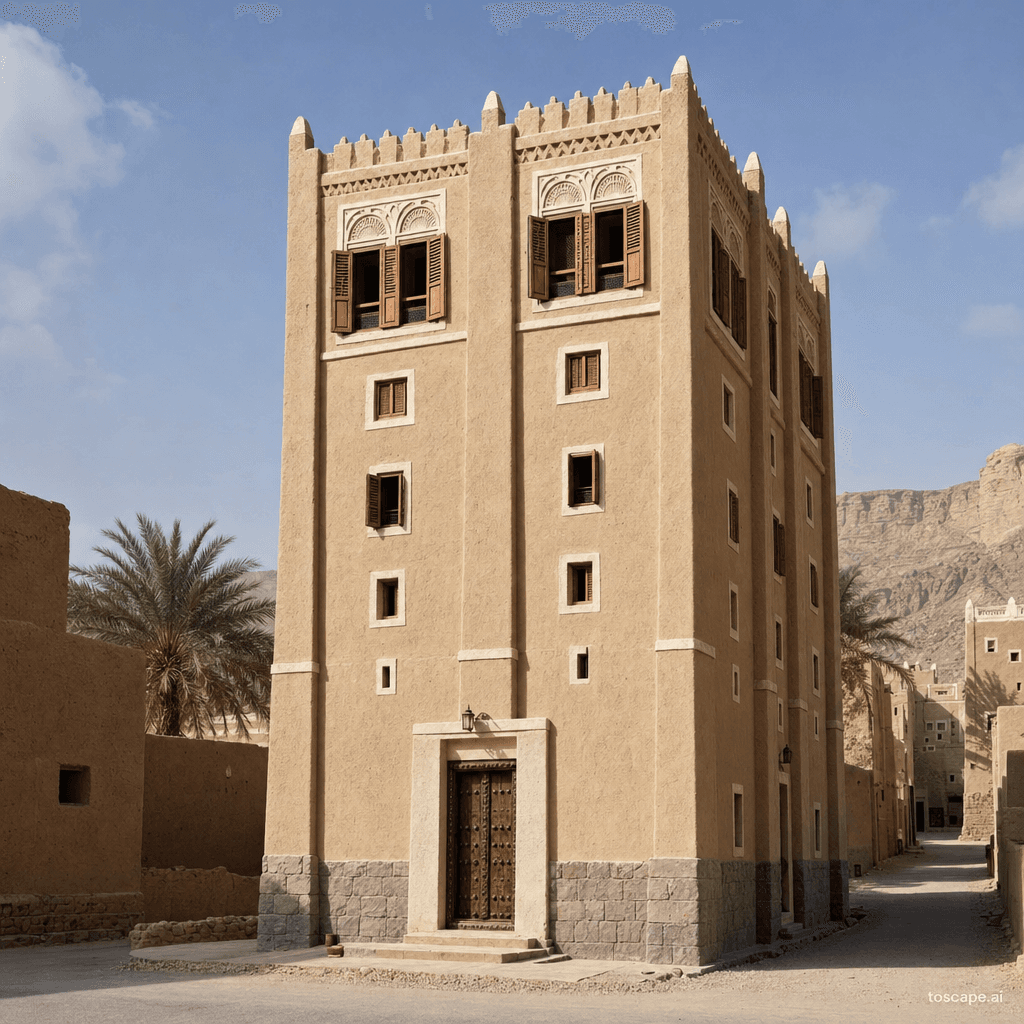
Shibam Hadhramaut Mud Tower
Yemen · Shibam Hadhramaut
Tallest mud-brick buildings on earth (up to 30m), madhar (sun-dried mud brick) construction, lime render (nurah), narrow alleyway urban fabric, compact walled city on wadi mound, defensive urban form
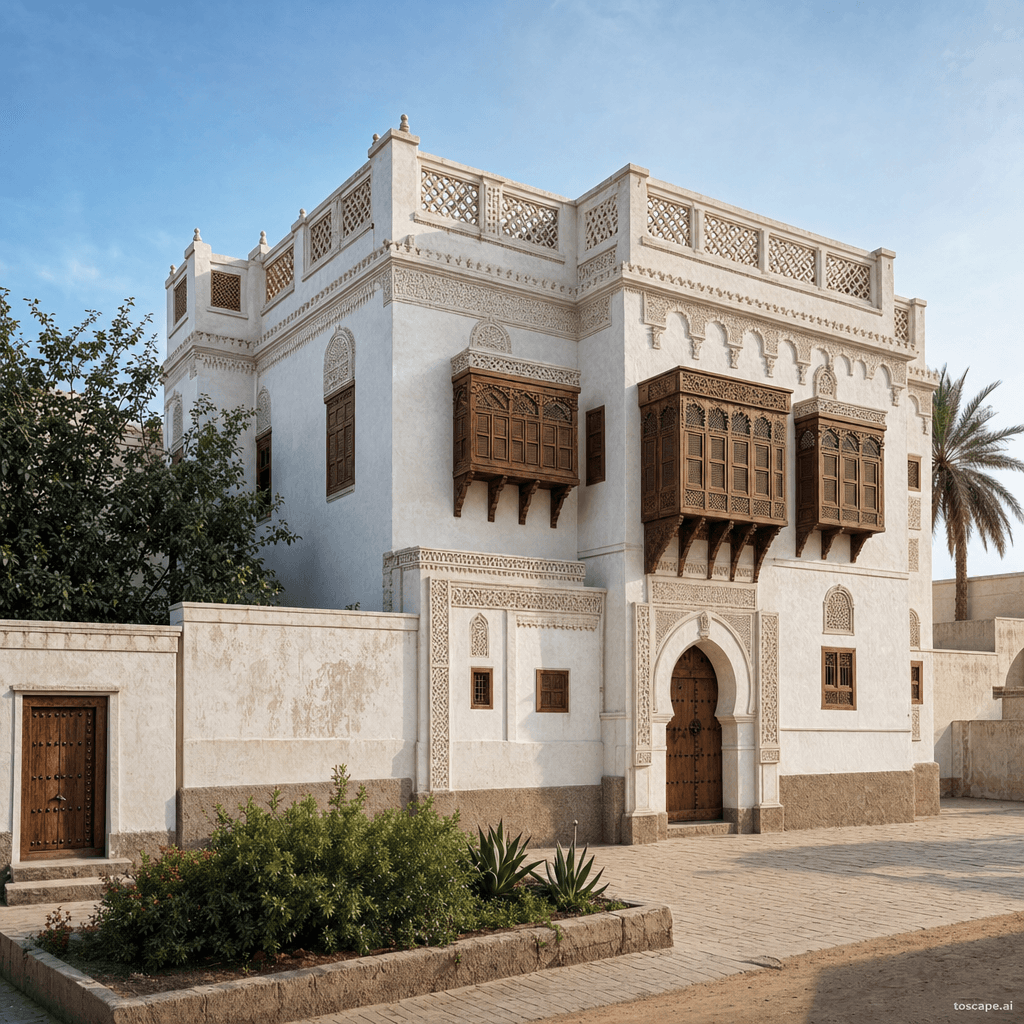
Zabid Tihama Brick
Yemen · Zabid and Tihama coastal plain
Horizontal spread on coastal plain, fired brick (yajur) houses with elaborate carved stucco (guss) ornament, mashrabiya bay windows, flat roofs, whitewashed facades, courtyard-centered domestic life
Visualize any style in Toscape
Apply architectural style directions directly inside the desktop app. Use Facade Re-Style, Interior Design, and Design Options workflows to explore style alternatives for your active projects.