Desert Contemporary
Hot-arid and semi-arid climate zones - the American Southwest, Arabian Peninsula,... / Regional contemporary
Low sheltering heat-defensive volumes, matte mineral finishes, deep shade, and hot-arid performance.
Definition
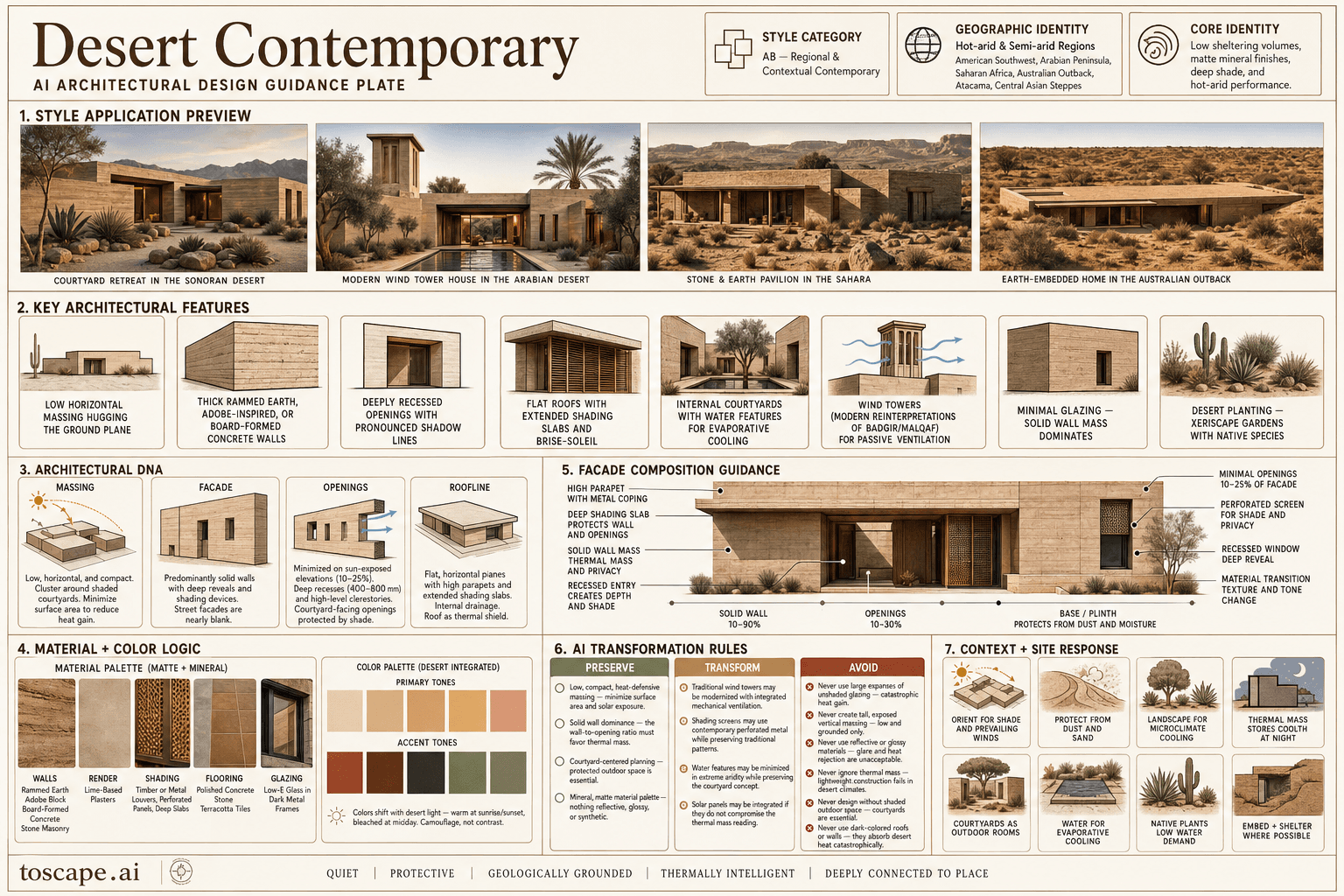
Desert Contemporary is a global architectural style within the regional contemporary. Low sheltering heat-defensive volumes, matte mineral finishes, deep shade, and hot-arid performance.
- Family
- Regional contemporary
- Origin
- Hot-arid and semi-arid climate zones - the American Southwest, Arabian Peninsula.
- Massing
- Massing is low, horizontal, and compact to minimize surface-area-to-volume ratio (reducing heat gain). Volumes cluster around shaded courtyards that serve as outdoor rooms and thermal buffers.
- Materials
- Walls: rammed earth, adobe block, board-formed concrete, stone masonry Render: lime-based plaster in desert earth tones Shading: timber or metal louver screens, perforated panels.
- Palette
- Primary tones: desert beige, warm sand, pale ochre, dusty rose, light terracotta Accent tones: deep rust, burnt umber, charcoal.
- Climate response
- Hot-arid and semi-arid climate zones. The American Southwest, Arabian Peninsula, Saharan Africa, Australian outback, Atacama, and Central Asian steppes.
Overview
Desert Contemporary is a global architectural style rooted in Hot-arid and semi-arid climate zones - the American Southwest, Arabian Peninsula, Saharan Africa, Australian outback, Atacama, and Central Asian steppes. Defined by extreme diurnal temperature swings, intense solar radiation, minimal rainfall, and wind-borne dust. Low sheltering heat-defensive volumes, matte mineral finishes, deep shade, and hot-arid performance. Quiet, protective, and geologically grounded.
Visual DNA
Massing & Form
Massing is low, horizontal, and compact to minimize surface-area-to-volume ratio (reducing heat gain). Volumes cluster around shaded courtyards that serve as outdoor rooms and thermal buffers.
Facade Language
Facades are predominantly solid. thick mineral walls with small, deeply recessed openings.
Materials & Texture
Walls: rammed earth, adobe block, board-formed concrete, stone masonry Render: lime-based plaster in desert earth tones Shading: timber or metal louver screens, perforated panels, deep concrete slabs Flooring: polished concrete, stone, or...
Color Palette
Primary tones: desert beige, warm sand, pale ochre, dusty rose, light terracotta Accent tones: deep rust, burnt umber, charcoal, muted sage green The palette must blend with the desert landscape. camouflage, not contrast No bright whites...
Ornament & Detail
Low, compact, heat-defensive massing. minimize surface area and solar exposure.
Climate Response
Hot-arid and semi-arid climate zones. the American Southwest, Arabian Peninsula, Saharan Africa, Australian outback, Atacama, and Central Asian steppes.
Landscape & Ground
Hot-arid and semi-arid climate zones. the American Southwest, Arabian Peninsula, Saharan Africa, Australian outback, Atacama, and Central Asian steppes.
Reference elevation
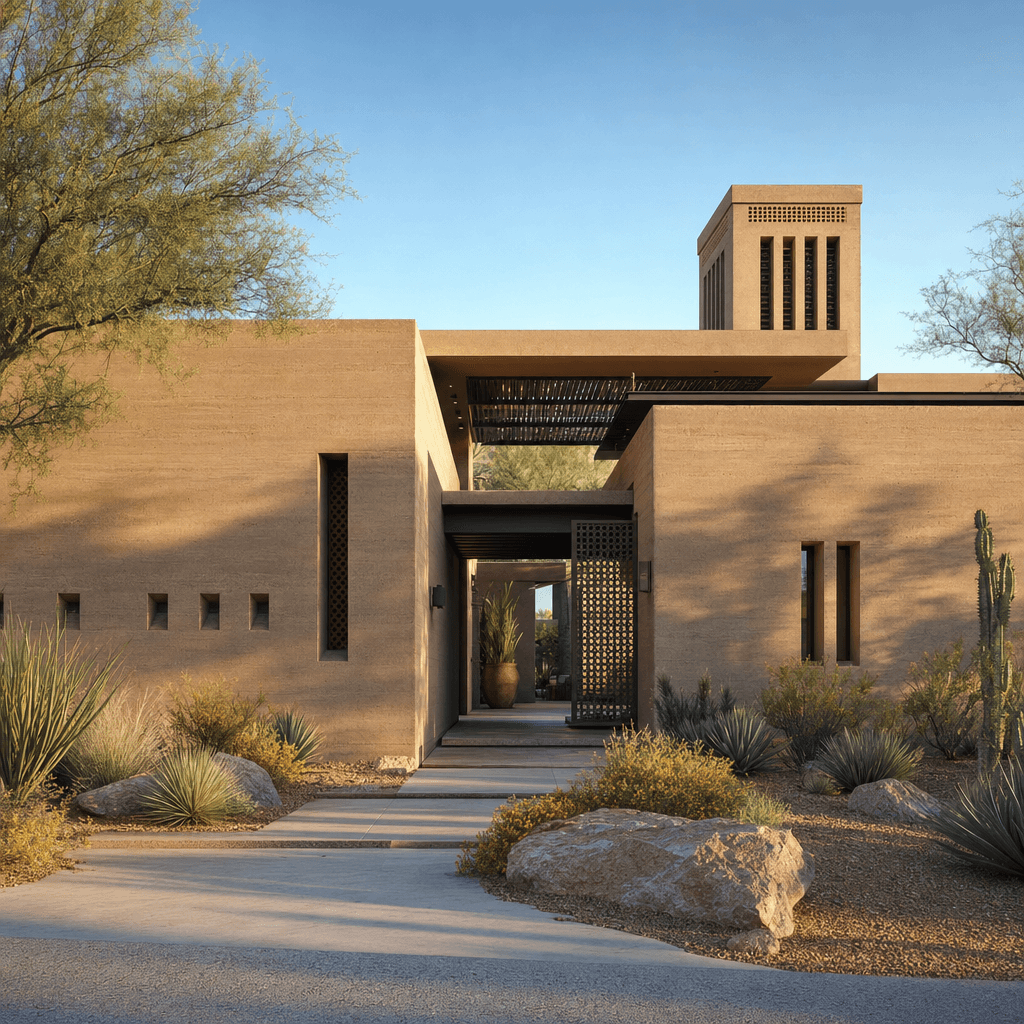
Desert Contemporary - characteristic facade composition within the regional contemporary.
Context Snapshot
Quiet, protective, and geologically grounded. Massing is low, horizontal, and compact to minimize surface-area-to-volume ratio (reducing heat gain). Hot-arid and semi-arid climate zones - the American Southwest, Arabian Peninsula, Saharan Africa, Australian outback, Atacama, and Central Asian steppes.
Contemporary Relevance
Today, Desert Contemporary remains relevant wherever projects need regional contemporary cues without losing performance or contemporary usability. In Toscape it responds best when prompts emphasize massing is low, horizontal, and compact to minimize surface-area-to-volume ratio (reducing heat gain). walls: rammed earth, adobe block, board-formed concrete, stone masonry render: lime-based plaster in desert earth tones shading: timber or metal louver...
Use this style in Toscape
Explore Desert Contemporary directly inside Toscape using Facade Re-Style and design workflow prompts tuned for global architectural references.
Open Desert Contemporary in the galleryFrequently asked questions
What is Desert Contemporary?
Desert Contemporary is a global architectural style within the regional contemporary. Low sheltering heat-defensive volumes, matte mineral finishes, deep shade, and hot-arid performance.
What materials define Desert Contemporary?
Walls: rammed earth, adobe block, board-formed concrete, stone masonry Render: lime-based plaster in desert earth tones Shading: timber or metal louver screens, perforated panels, deep concrete slabs Flooring: polished concrete.
What is the Desert Contemporary color palette?
Primary tones: desert beige, warm sand, pale ochre, dusty rose, light terracotta Accent tones: deep rust, burnt umber, charcoal, muted sage green The palette must blend with the desert landscape. Camouflage, not contrast No bright whites.
What is the origin of Desert Contemporary?
Quiet, protective, and geologically grounded. Massing is low, horizontal, and compact to minimize surface-area-to-volume ratio (reducing heat gain). Hot-arid and semi-arid climate zones - the American Southwest, Arabian Peninsula, Saharan Africa, Australian outback, Atacama, and Central Asian steppes.
When should architects use Desert Contemporary?
Today, Desert Contemporary remains relevant wherever projects need regional contemporary cues without losing performance or contemporary usability. In Toscape it responds best when prompts emphasize massing is low, horizontal, and compact to minimize surface-area-to-volume ratio (reducing heat gain). Walls: rammed earth, adobe block, board-formed concrete, stone masonry render: lime-based plaster in desert earth tones shading: timber or metal louver.
How do you render Desert Contemporary in Toscape?
Open Toscape on Windows, load your own photo, elevation, sketch, or CAD view, then apply the Desert Contemporary reference from the built-in style library. The Facade Re-Style and Design Options workflows keep your project geometry and camera while shifting materials, proportion, and detailing toward Desert Contemporary.