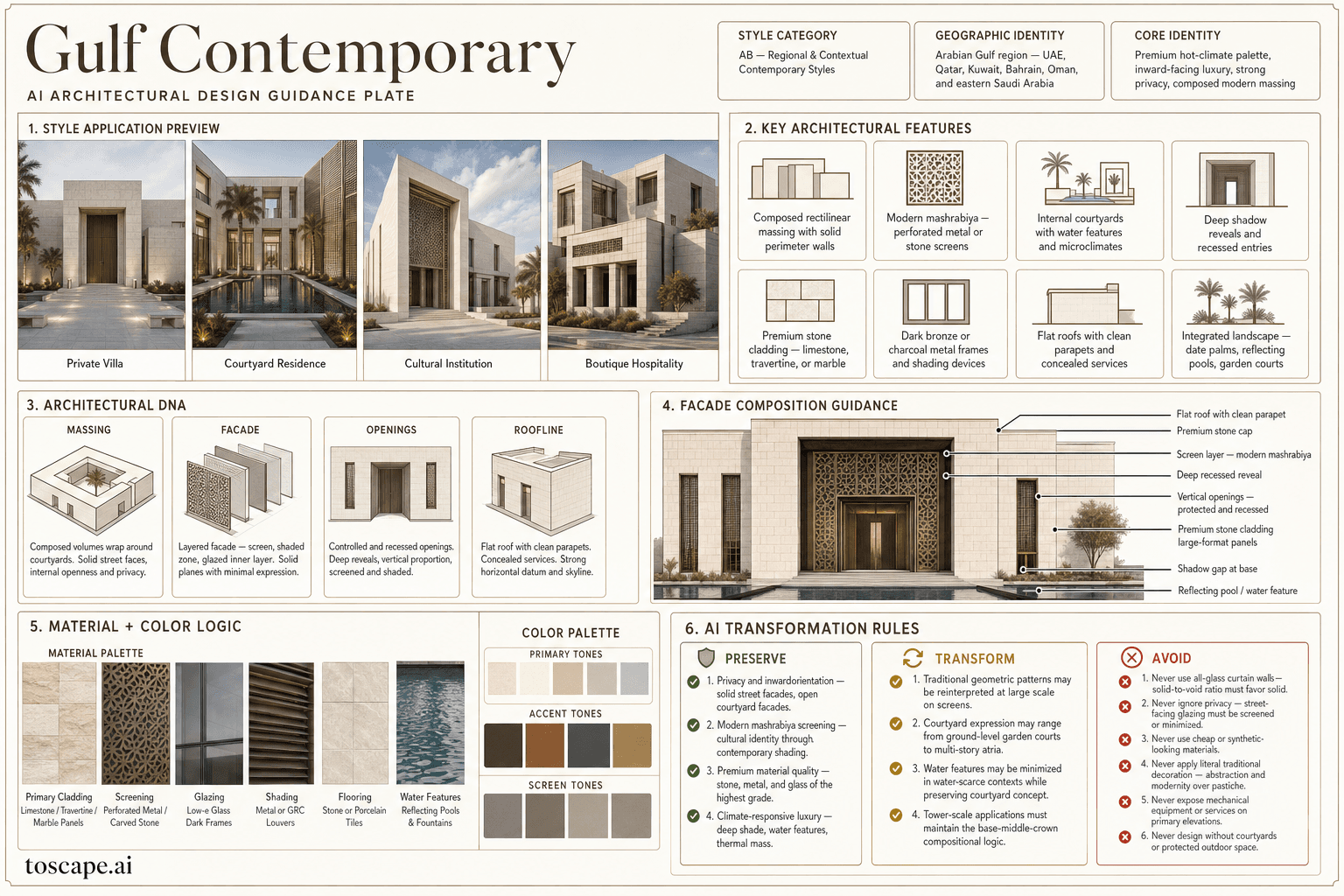
Gulf Contemporary
Arabian Gulf region - UAE, Qatar, Kuwait, Bahrain, Oman, and eastern Saudi Arabia. / Regional contemporary
Premium hot-climate palette, inward-facing luxury, strong privacy boundaries, and composed modern massing.
Definition
Gulf Contemporary is a global architectural style within the regional contemporary. Premium hot-climate palette, inward-facing luxury, strong privacy boundaries, and composed modern massing.
- Family
- Regional contemporary
- Origin
- Arabian Gulf region - UAE, Qatar, Kuwait, Bahrain, Oman, and eastern Saudi Arabia.
- Massing
- Massing is composed and dignified. Clean rectilinear volumes arranged to create protected internal spaces.
- Materials
- Primary cladding: large-format limestone, travertine, or marble panels Screening: perforated metal panels (bronze, copper, or powder-coated aluminum).
- Palette
- Primary tones: warm limestone cream, pale sand, soft beige, light grey Accent tones: dark bronze, warm copper, charcoal, muted gold (sparingly) Screen tones: bronze, champagne.
- Climate response
- Arabian Gulf region. UAE, Qatar, Kuwait, Bahrain, Oman, and eastern Saudi Arabia.
Overview
Gulf Contemporary is a global architectural style rooted in Arabian Gulf region - UAE, Qatar, Kuwait, Bahrain, Oman, and eastern Saudi Arabia. Defined by extreme heat and humidity, rapid urbanization, wealth-driven development, and a cultural preference for privacy, luxury, and inward-looking spatial organization. Premium hot-climate palette, inward-facing luxury, strong privacy boundaries, and composed modern massing. Composed, private, and materially luxurious without ostentation.
Visual DNA
Massing & Form
Massing is composed and dignified. clean rectilinear volumes arranged to create protected internal spaces.
Facade Language
Facades are layered. an outer screen layer (modern mashrabiya in perforated metal, stone, or GRC), a middle shaded zone, and the inner glazed envelope.
Materials & Texture
Primary cladding: large-format limestone, travertine, or marble panels Screening: perforated metal panels (bronze, copper, or powder-coated aluminum), carved stone screens Glazing: high-performance low-e glass in dark bronze or charcoal...
Color Palette
Primary tones: warm limestone cream, pale sand, soft beige, light grey Accent tones: dark bronze, warm copper, charcoal, muted gold (sparingly) Screen tones: bronze, champagne, warm grey. integrated with wall color The palette is warm,...
Ornament & Detail
Privacy and inward orientation. solid street facades, open courtyard facades.
Climate Response
Arabian Gulf region. UAE, Qatar, Kuwait, Bahrain, Oman, and eastern Saudi Arabia.
Landscape & Ground
Arabian Gulf region. UAE, Qatar, Kuwait, Bahrain, Oman, and eastern Saudi Arabia.
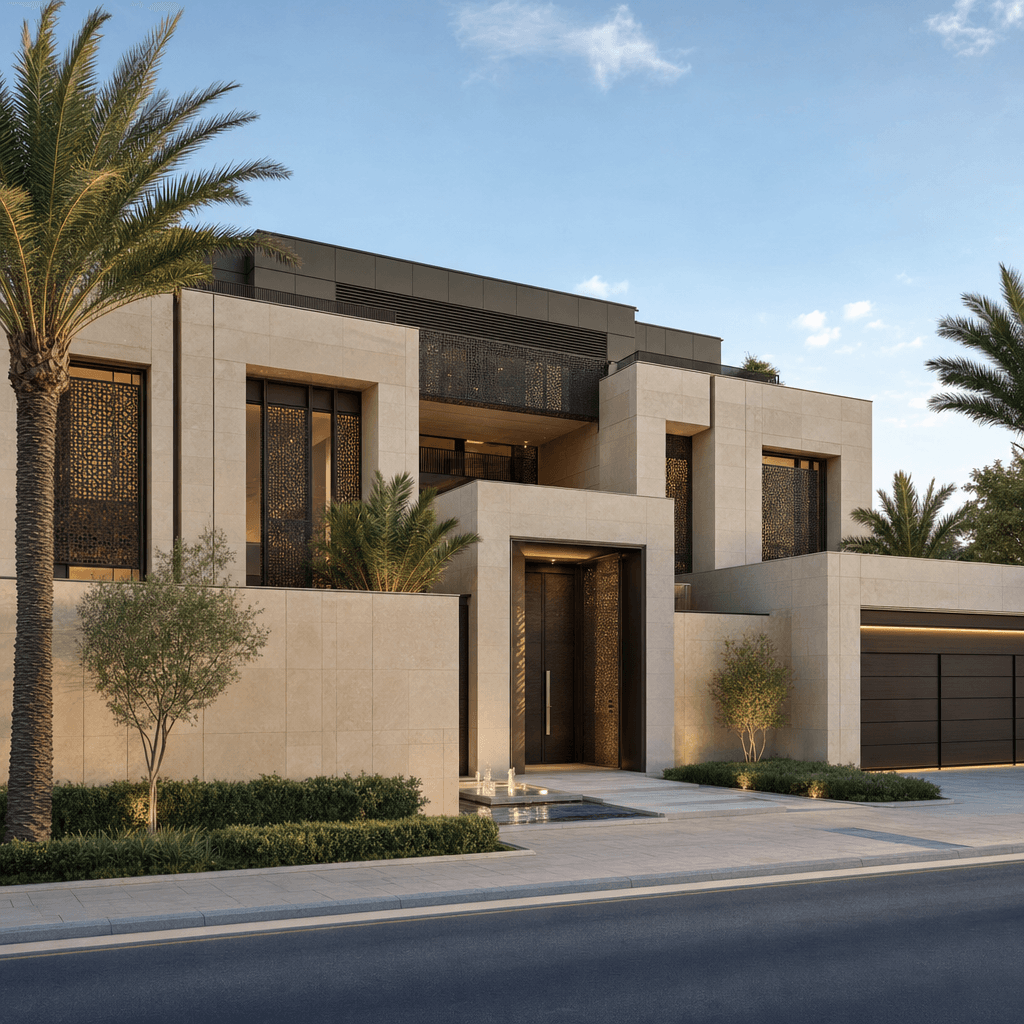
Reference elevation
Gulf Contemporary - characteristic facade composition within the regional contemporary.
Context Snapshot
Composed, private, and materially luxurious without ostentation. Massing is composed and dignified - clean rectilinear volumes arranged to create protected internal spaces. Arabian Gulf region - UAE, Qatar, Kuwait, Bahrain, Oman, and eastern Saudi Arabia.
Contemporary Relevance
Today, Gulf Contemporary remains relevant wherever projects need regional contemporary cues without losing performance or contemporary usability. In Toscape it responds best when prompts emphasize massing is composed and dignified - clean rectilinear volumes arranged to create protected internal spaces. primary cladding: large-format limestone, travertine, or marble panels screening: perforated metal panels (bronze, copper, or powder-coated aluminum),...
Use this style in Toscape
Explore Gulf Contemporary directly inside Toscape using Facade Re-Style and design workflow prompts tuned for global architectural references.
Open Gulf Contemporary in the galleryFrequently asked questions
What is Gulf Contemporary?
Gulf Contemporary is a global architectural style within the regional contemporary. Premium hot-climate palette, inward-facing luxury, strong privacy boundaries, and composed modern massing.
What materials define Gulf Contemporary?
Primary cladding: large-format limestone, travertine, or marble panels Screening: perforated metal panels (bronze, copper, or powder-coated aluminum), carved stone screens Glazing: high-performance low-e glass in dark bronze or charcoal.
What is the Gulf Contemporary color palette?
Primary tones: warm limestone cream, pale sand, soft beige, light grey Accent tones: dark bronze, warm copper, charcoal, muted gold (sparingly) Screen tones: bronze, champagne, warm grey. Integrated with wall color The palette is warm.
What is the origin of Gulf Contemporary?
Composed, private, and materially luxurious without ostentation. Massing is composed and dignified - clean rectilinear volumes arranged to create protected internal spaces. Arabian Gulf region - UAE, Qatar, Kuwait, Bahrain, Oman, and eastern Saudi Arabia.
When should architects use Gulf Contemporary?
Today, Gulf Contemporary remains relevant wherever projects need regional contemporary cues without losing performance or contemporary usability. In Toscape it responds best when prompts emphasize massing is composed and dignified - clean rectilinear volumes arranged to create protected internal spaces. Primary cladding: large-format limestone, travertine, or marble panels screening: perforated metal panels (bronze, copper, or powder-coated aluminum).
How do you render Gulf Contemporary in Toscape?
Open Toscape on Windows, load your own photo, elevation, sketch, or CAD view, then apply the Gulf Contemporary reference from the built-in style library. The Facade Re-Style and Design Options workflows keep your project geometry and camera while shifting materials, proportion, and detailing toward Gulf Contemporary.