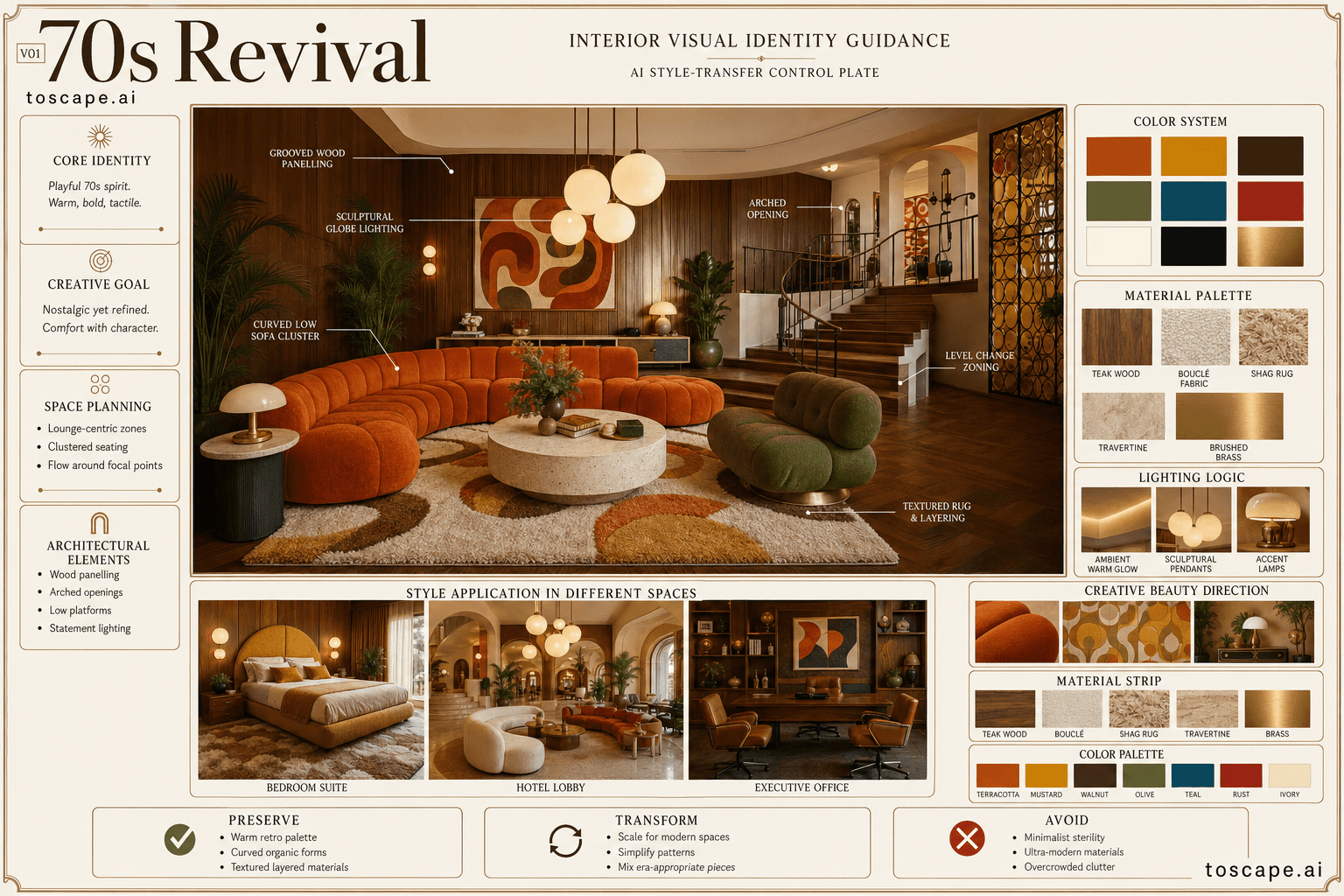
70s Revival
V01 / Retro / Vintage / Mid-Century Modern / Neo-Retro
A vibrant, expressive retro interior style with iconic curves, tactile surfaces, and bold earthy colors drawn from premium 1970s design.
Definition
70s Revival is an interior design style used for architectural visualization. A vibrant, expressive retro interior style with iconic curves, tactile surfaces, and bold earthy colors drawn from premium 1970s design.
- Family
- Retro / Vintage / Mid-Century Modern / Neo-Retro.
- Origin
- Inspired by the 1970s design revolution characterized by optimism, technological progress.
- Massing
- Bulbous, chunky curves; low, horizontal silhouettes; sinuous organic lines; bold geometric shapes; sculpted seating; and clean surfaces with tactile depth.
- Materials
- Plush, tactile, layered, soft, grooved, warm, with matte and gloss interplay.
- Palette
- Burnt orange, ochre, walnut, avocado, teal, ivory white, and brushed brass.
- Lighting
- Layered, moody, and warm-cove lights, globe pendants, or mushroom floor lamps.
Try it free
Render your own project in this style
Upload one photo of your own project and Interior Render keeps the geometry and camera while carrying the 70s Revival language into materials, proportion, and detail. Three free renders, no account needed.
Open Interior Render - freeOverview
70s Revival is an interior design style defined by A visually playful, texturally rich interior style blending bold color, organic forms, tactile materiality, and iconic 1970s design references reimagined for a contemporary, editorial context. To create inviting, nostalgic yet forward-looking spaces that celebrate playfulness, comfort, and visual delight through audacious material and color choices.
Visual DNA
Spatial Feeling
Warm, cozy, optimistic, playful, inviting, and visually energizing.
Form Language
Bulbous, chunky curves; low, horizontal silhouettes; sinuous organic lines; bold geometric shapes; sculpted seating; and clean surfaces with tactile depth. Low-slung, lounge-oriented proportions; generous seating clusters; open yet...
Composition
Open, lounge-centric layouts with groupings oriented for relaxed conversation and visual cohesion. Curved sofa arrangements, bold sculptural chairs, feature wall panelling, iconic retro lighting, statement art or a vintage credenza. Use...
Interior Elements
Grooved/fluted wood panelling, bold painted feature walls, geometric wallpaper, smooth white or warm-toned plaster, patterned or colored glass. Ceilings are generally plain with soft cove or spot-lit details; exposed beams or floating...
Color System
Burnt orange, ochre, walnut, avocado, teal, ivory white, and brushed brass. Combine rich, retro earth tones with saturated pops and a white/black anchor; use analogous and triadic groupings for authentic 70s resonance. Intensify with...
Material Palette
Plush, tactile, layered, soft, grooved, warm, with matte and gloss interplay. Use wood for vertical and horizontal planes, plush textiles for seating, stone/cork for floors, metallics for lights and details, and glass/acrylic at focal...
Lighting Logic
Layered, moody, and warm-cove lights, globe pendants, or mushroom floor lamps. Create pockets of glowing warmth and shadow; combine chrome/brass/frosted glass for sparkle and atmosphere; spotlight curves and pattern. Lighting should...
Interior reference image
70s Revival composition, material palette, furniture language, and lighting direction.
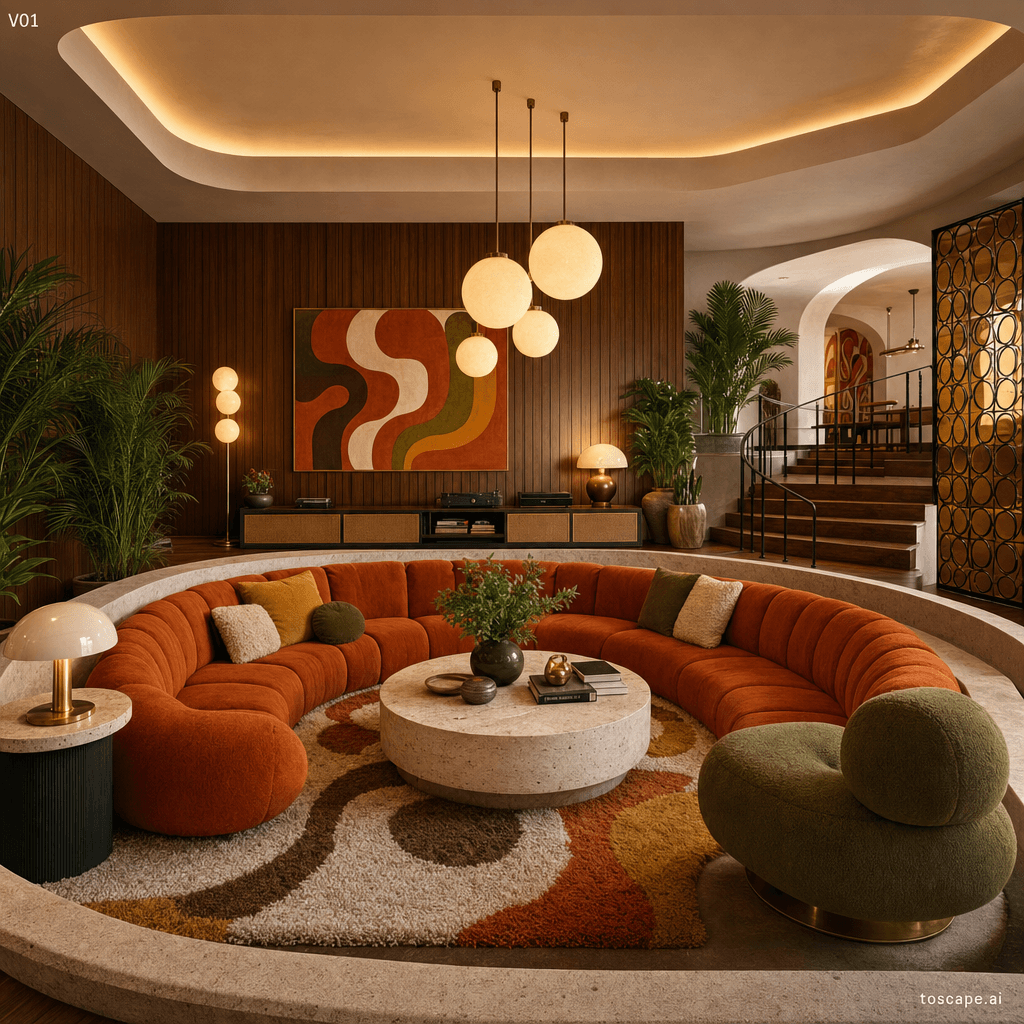
Context Snapshot
Inspired by the 1970s design revolution characterized by optimism, technological progress, experimentation with plastics and... Avowedly trendy in boutique hotels, creative agency offices, stylish apartments, statement living rooms, and retro-chic hospitality spaces. Focus on curated highlights-organic furniture, statement color-blocking, wood and velvet, careful pattern use, and authentic mood lighting-with premium finishes and contemporary spatial editing.
Composition And Planning
Open, lounge-centric layouts with groupings oriented for relaxed conversation and visual cohesion. Encourages easy movement between seating and focal points; playful, fluid circulation with visual rhythms. Use a slightly low camera angle to reinforce horizontality; frame with foreground seating, midground grouping, and background texture wall; mix symmetry with off-center highlights for editorial impact.
Furniture Grammar
Curved, low, chunky, modular, sculptural-often playful or exaggerated in form. Float arrangements away from walls; group seating for conversation; anchor with rug; avoid wall-hugging or generic symmetry. - Curved or modular pit sofa - Tulip or pedestal table - Fluted walnut credenza - Retro orb lounge chair
Creative Direction
A vibrant, layered living space anchored by a sinuous velvet lounge, fluted walnut wall, glowing globe chandelier, abstract geometric art, tactile rugs, and sculptural plants-all harmonized by expertly blended retro hues. Careful spatial composition with signature curved seating in the foreground, fluted wall and bold art in midground, layered lighting, clean negative space, lush texture, and a "fresh yet nostalgic" atmosphere. Dusky, moody lighting casts deep shadows across sculpted forms and glowing brass details; strong color-blocked walls, reflective glass and plush upholstery create emotional retro glamour. - Authentic rich wood,...
Best Project Applications
- Living rooms, creative lounges, boutique hotel lobbies, statement offices, trend-driven cafes.
Preserve, Transform, Avoid
Preserve
- Preserve curvilinear furniture language.
- Preserve layered retro color palette.
- Preserve genuine tactile richness and textural contrast.
- Preserve playful yet curated use of vintage-inspired lighting and decor.
Transform
- Update materials to luxury versions (real wood, natural fiber, artisan finish).
- Use contemporary spatial editing to simplify clutter and refine forms.
- Layer planting, art, and pattern in an editorial rather than literal way.
- Amplify lighting mood and depth for cinematic quality.
Avoid
- Over-themed, kitschy, or "costume party" retro sets.
- Ultra-minimal white, grey, or black palettes.
- Industrial, rustic, or classical stylistic drift.
- Synthetic neon or cold, overpowering highlights.
- Cheap faux finishes or over-scaled, random furniture.
Frequently asked questions
What is 70s Revival?
70s Revival is an interior design style used for architectural visualization. A vibrant, expressive retro interior style with iconic curves, tactile surfaces, and bold earthy colors drawn from premium 1970s design.
What materials define 70s Revival?
Plush, tactile, layered, soft, grooved, warm, with matte and gloss interplay. Use wood for vertical and horizontal planes, plush textiles for seating, stone/cork for floors, metallics for lights and details, and glass/acrylic at focal.
What is the 70s Revival color palette?
Burnt orange, ochre, walnut, avocado, teal, ivory white, and brushed brass. Combine rich, retro earth tones with saturated pops and a white/black anchor.
What is the origin of 70s Revival?
Inspired by the 1970s design revolution characterized by optimism, technological progress, experimentation with plastics and... Avowedly trendy in boutique hotels, creative agency offices, stylish apartments, statement living rooms, and retro-chic hospitality spaces. Focus on curated highlights-organic furniture, statement color-blocking, wood and velvet, careful pattern use, and authentic mood lighting-with premium finishes and contemporary spatial editing.
When should architects use 70s Revival?
A vibrant, layered living space anchored by a sinuous velvet lounge, fluted walnut wall, glowing globe chandelier, abstract geometric art, tactile rugs, and sculptural plants-all harmonized by expertly blended retro hues.
How do you render 70s Revival in Toscape?
In Toscape, pick the 70s Revival reference from the style library and run it over your own image - a site photo, elevation, sketch, or CAD view. The Interior Design workflow hold the geometry and camera of the project and move materials, proportion, and detailing toward 70s Revival.
Related interior design styles
- Memphis DesignA playful, graphic postmodern style with bold geometry, vibrant color, statement furniture, and irreverent 80s-inspired pattern.
- Pop Art InteriorA bold, art-driven interior style marked by saturated color blocking, playful furniture.
- Retro FuturismA playful, optimistic, and visually bold interior style inspired by past visions of the future-defined.
- BohemianA soulful, inviting interior style defined by layered global textiles, vintage finds, artisan-crafted decor.
- Global EclecticA richly layered, cosmopolitan interior fusing authentic world textiles, Artisan objects.
- Vintage EclecticA curated, expressive interior style defined by layered vintage furniture, eclectic artwork, textured textiles.
Use this style in Toscape
Explore 70s Revival inside Toscape using interior-focused rendering workflows and gallery references.
Open interior references