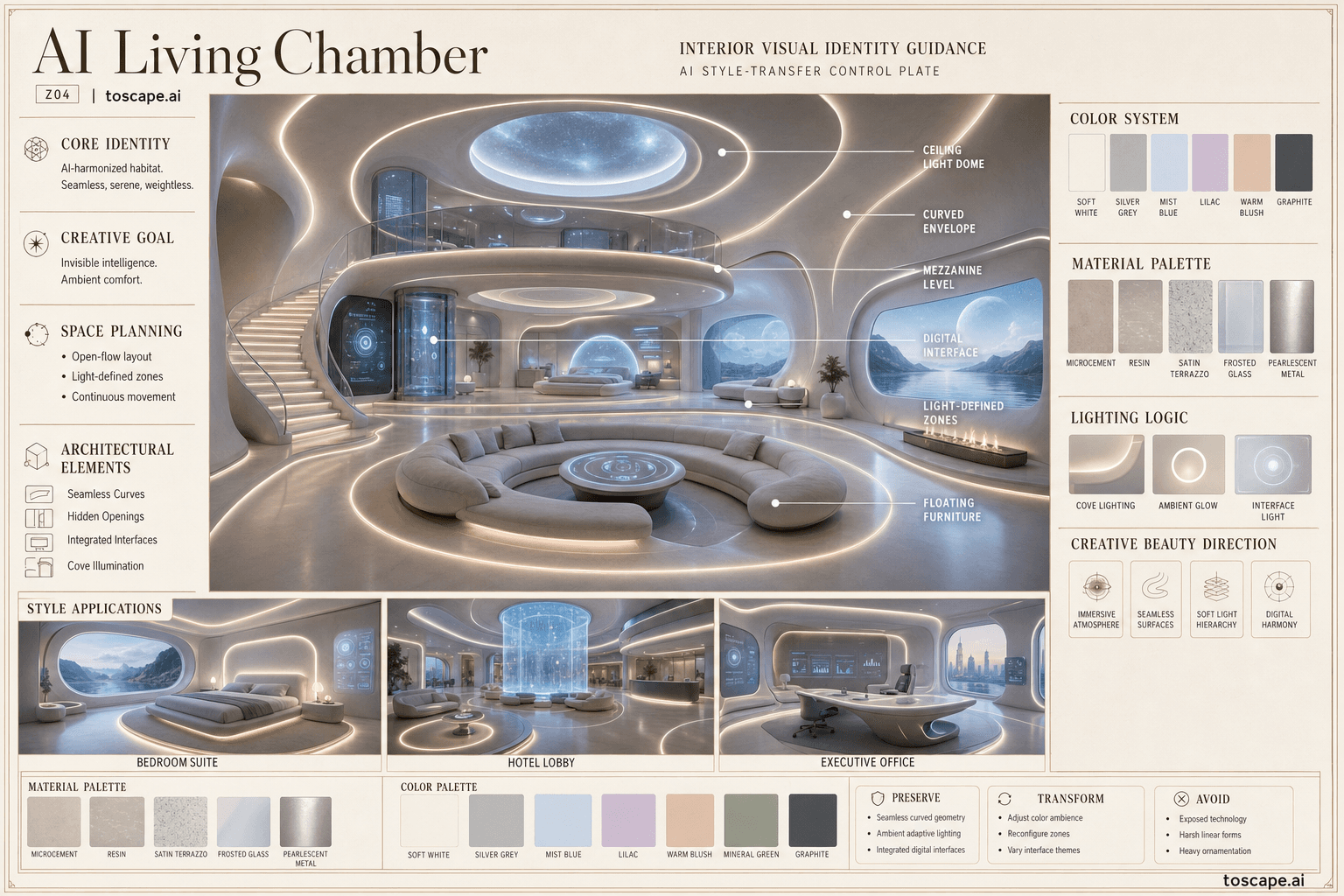
AI Living Chamber
Z04 / Futuristic / Sci-Fi / Tech Minimalism / Advanced Digital Living
A seamless, luminous, AI-driven habitat with flowing curved forms, radiant digital light, and integrated monolithic furniture.
Definition
AI Living Chamber is an interior design style used for architectural visualization. A seamless, luminous, AI-driven habitat with flowing curved forms, radiant digital light, and integrated monolithic furniture.
- Family
- Futuristic / Sci-Fi / Tech Minimalism / Advanced Digital Living.
- Origin
- Born from speculative visions of AI-shaped habitats, advanced smart home prototypes, and digital minimalism, this style.
- Massing
- Flowing curves, monolithic massing with gentle inflection, aerodynamic envelopes, organic walls blending into ceilings and floors, and embedded "portal" or "interface" forms.
- Materials
- Satin-smooth, micro-textured, zero-grain, microperforated soft panels for acoustic comfort; with digital shimmer on luminous elements.
- Palette
- Sterile whites, misty silvers, programmable digital blue gradients, pearlescent pale hues. Keep base neutral and subtle-color emerges through ambient digital light, not painted surfaces or furniture.
- Lighting
- Continuous ambient cove lighting, seamless wall washes, programmable color gradients; no visible traditional fixtures.
Overview
AI Living Chamber is an interior design style defined by A seamless, immersive spatial habitat where advanced AI systems shape serene, flowing, almost weightless interiors defined by smooth forms, soft illumination, and integrated digital interface aesthetics. To evoke a serene, contemplative, yet dazzlingly advanced living space where AI presence is felt in the atmosphere, comfort, and adaptive physicality of the environment, not through exposed gadgets or cables.
Visual DNA
Spatial Feeling
Immersive, seamless, tranquil, softly futuristic, and emotionally calm with a subtle sense of intelligence pervading the atmosphere.
Form Language
Flowing curves, monolithic massing with gentle inflection, aerodynamic envelopes, organic walls blending into ceilings and floors, and embedded "portal" or "interface" forms. Preference for open, enveloping proportions-generous ceiling...
Composition
Open-flow, minimally partitioned; boundaries dissolve, allowing for adaptive "zones" defined by light, elevation, or furniture form rather than walls. Sculptural digital interfaces, immersive luminous walls, or floating furniture...
Interior Elements
Monolithic, softly curved seamless surfaces in matte, satin, or subtle pearlescent finishes; inlaid digital "portals," translucent panels, or adaptive light wells. Softly merging with walls, cove-lit, dome, or wave-like; never flat and...
Color System
Sterile whites, misty silvers, programmable digital blue gradients, pearlescent pale hues. Keep base neutral and subtle-color emerges through ambient digital light, not painted surfaces or furniture. Stronger luminous gradients-midnight...
Material Palette
Satin-smooth, micro-textured, zero-grain, microperforated soft panels for acoustic comfort; with digital shimmer on luminous elements. Envelope (walls, floor, ceiling) is continuous; tactile elements at user touch points; luminous...
Lighting Logic
Continuous ambient cove lighting, seamless wall washes, programmable color gradients; no visible traditional fixtures. Strong luminous gradients, ambient "data glow," deep shadows along curves, soft camera flares, and controlled digital...
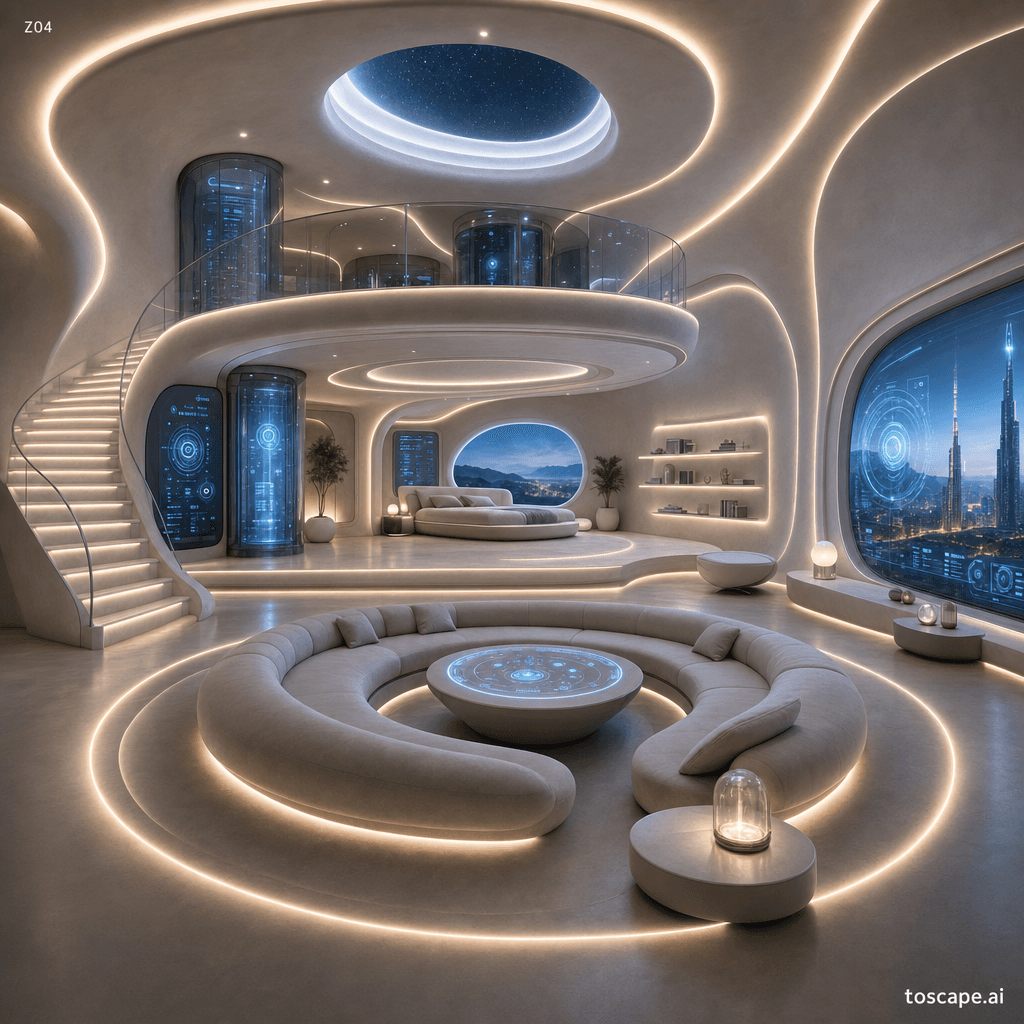
Interior reference image
AI Living Chamber composition, material palette, furniture language, and lighting direction.
Context Snapshot
Born from speculative visions of AI-shaped habitats, advanced smart home prototypes, and digital minimalism, this style... Found in luxury concept homes, sci-fi movie sets, innovation center show-units, next-gen wellness retreats, and high-tech private apartments. Employ richly tactile seamless surfaces, soft digital light, and subtle adaptive elements while editing out visual clutter and overt technological display.
Composition And Planning
Open-flow, minimally partitioned; boundaries dissolve, allowing for adaptive "zones" defined by light, elevation, or furniture form rather than walls. Movement feels continuous, effortless, and inevitable, with no abrupt threshold or collision points. Best shown with a wide lens at soft eye level, capturing a dominant flowing silhouette, an illuminated interface beyond, and a layered field of depth marked by ambient gradients.
Furniture Grammar
Monolithic, organically curved, floating or seamlessly anchored; no legs or visible joinery. Clustered but never crowded, always permitting flow of both body and gaze; rarely aligned to room corners or orthogonal axes. - Integrated sculptural living platform - Floating pod-chair with ambient halo light - Curved modular conversation bench
Creative Direction
A seamless, gently illuminated living pod where sculptural resin envelopes, silent digital panels, and floating soft furniture merge in a weightless digital landscape. Wide, tranquil, and softly glowing-with one sculptural seating zone, an arched digital portal wall, flawless material transitions, and atmosphere shaped entirely by ambient gradients. Deeper luminous color sculpting, layered midnight-cyan glows, interactive data shadows playing on surfaces, and atmospheric complexity driven by light and reflection-but always calm, never chaotic. - Authentically seamless construction with zero visible seams or joinery - Editorial-quality...
Best Project Applications
- Smart homes, concept penthouses, wellness retreats, premium hotel suites, tech brand show-units.
Preserve, Transform, Avoid
Preserve
- Preserve seamless monolithic surfaces and flowing curves.
- Preserve digital ambient lighting as a spatial organizer.
- Preserve uncluttered, floating, and integrated furniture logic.
- Preserve serene, intelligent, editorial tranquility-no gadget or pattern clutter.
Transform
- Enhance luminous gradients for cinematic or "data stream" drama within ambient calm.
- Use new soft-touch or light-reactive materials to heighten comfort and tech identity.
- Expand feature wall or portal forms into immersive interface architecture.
- Employ advanced natural light filtering techniques for peace and visual softness.
Avoid
- Clutter from decorative objects or multiple accessories.
- Mechanical, industrial, or exposed hardware.
- Retro-futurism, playful primary color pops, or overtly "techy" graphics.
- Exposed wiring, visible gadgets, or traditional device forms.
- Ornate, vintage, wood, metal, or "memorable" furniture unrelated to the AI habitat DNA.
Frequently asked questions
What is AI Living Chamber?
AI Living Chamber is an interior design style used for architectural visualization. A seamless, luminous, AI-driven habitat with flowing curved forms, radiant digital light, and integrated monolithic furniture.
What materials define AI Living Chamber?
Satin-smooth, micro-textured, zero-grain, microperforated soft panels for acoustic comfort; with digital shimmer on luminous elements. Envelope (walls, floor, ceiling) is continuous; tactile elements at user touch points; luminous.
What is the AI Living Chamber color palette?
Sterile whites, misty silvers, programmable digital blue gradients, pearlescent pale hues. Keep base neutral and subtle-color emerges through ambient digital light, not painted surfaces or furniture. Stronger luminous gradients-midnight.
What is the origin of AI Living Chamber?
Born from speculative visions of AI-shaped habitats, advanced smart home prototypes, and digital minimalism, this style... Found in luxury concept homes, sci-fi movie sets, innovation center show-units, next-gen wellness retreats, and high-tech private apartments. Employ richly tactile seamless surfaces, soft digital light, and subtle adaptive elements while editing out visual clutter and overt technological display.
When should architects use AI Living Chamber?
A seamless, gently illuminated living pod where sculptural resin envelopes, silent digital panels, and floating soft furniture merge in a weightless digital landscape. Wide, tranquil, and softly glowing-with one sculptural seating zone, an arched digital portal wall, flawless material transitions, and atmosphere shaped entirely by ambient gradients.
How do you render AI Living Chamber in Toscape?
Open Toscape on Windows, load your own photo, elevation, sketch, or CAD view, then apply the AI Living Chamber reference from the built-in style library. The Interior Design workflow keep your project geometry and camera while shifting materials, proportion, and detailing toward AI Living Chamber.
Use this style in Toscape
Explore AI Living Chamber inside Toscape using interior-focused rendering workflows and gallery references.
Open interior references