Bio-Digital Interior
Y04 / Futuristic Organic / Computational Contemporary / High-Tech Minimal / Generative Organic
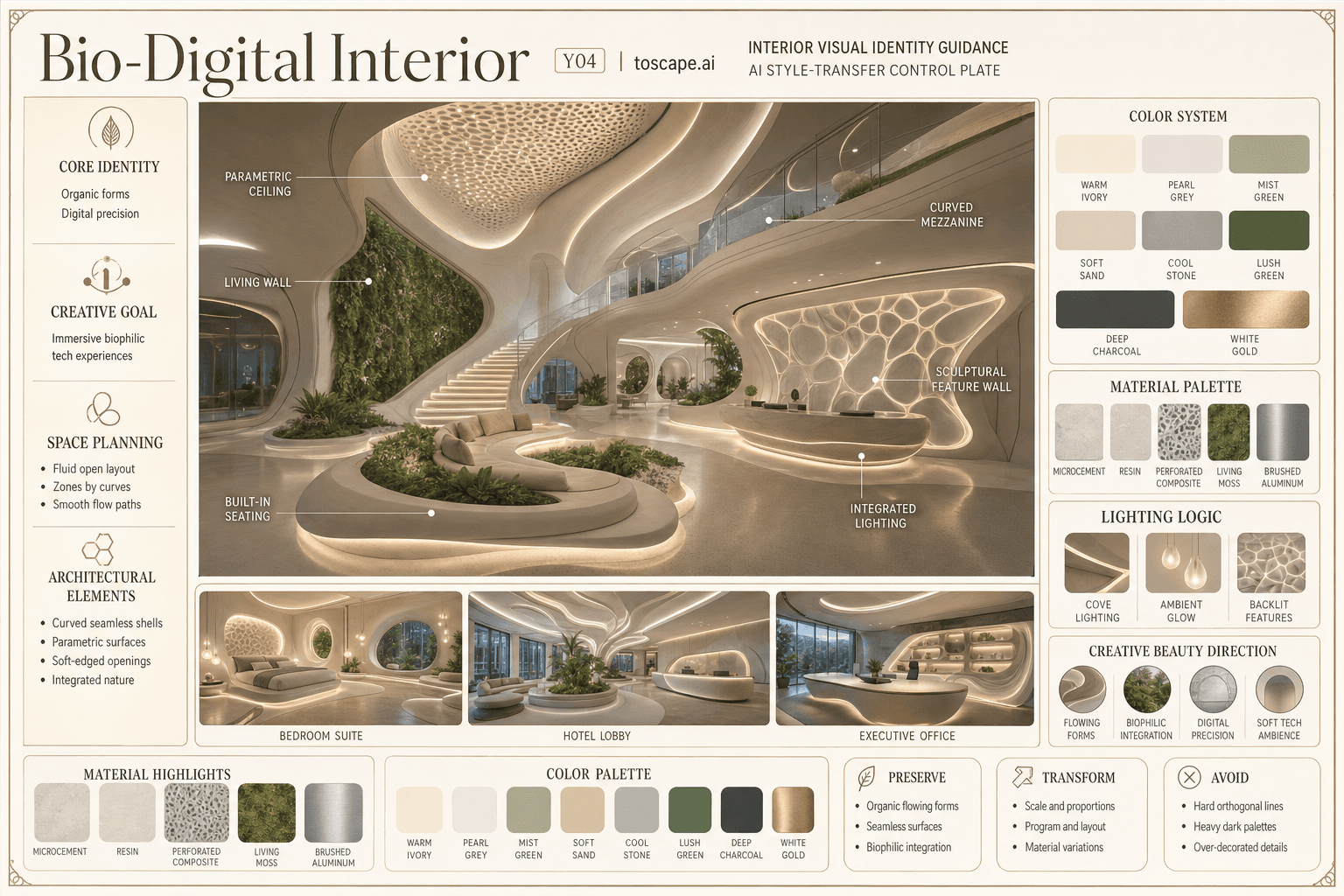
A seamless fusion of organic biophilic forms and digital fabrication, creating fluid, immersive, futuristic interiors where nature and technology...
Definition
Bio-Digital Interior is an interior design style used for architectural visualization. A seamless fusion of organic biophilic forms and digital fabrication, creating fluid, immersive, futuristic interiors where nature and technology.
- Family
- Futuristic Organic / Computational Contemporary / High-Tech Minimal / Generative Organic.
- Origin
- Emerging from parametric design, digital fabrication, and biophilic architecture.
- Massing
- Non-linear geometry, parametric curves, rippling or cellular surface reliefs, seamless enveloping shells, and gentle fluid partitions; shapes evoke natural growth or computational morphogenesis.
- Materials
- Silky smooth, softly matte, subtly tactile; transitions are seamless, with oases of mossy softness or leaf texture.
- Palette
- Ivory, pearl grey, sand, warm brushed metal, moss, clear glass, and lush green. Maintain organic continuity, using gradients and tonal overlays rather than abrupt contrast.
- Lighting
- Seamless cove lighting, hidden linear sources, softly glowing built-in illumination wrapping around curves, adaptive lighting controls.
Overview
Bio-Digital Interior is an interior design style defined by A visually seamless integration of organic biophilic geometry with precise digital fabrication, producing immersive, flowing interiors where technology and nature co-create the spatial environment. To create immersive, visually striking spaces that feel simultaneously organic and high-tech-inviting human comfort through nature-inspired geometries while demonstrating advanced digital precision.
Visual DNA
Spatial Feeling
Immersive, flowing, softly futuristic, calm, tactile, and visually unified; a sense of being enveloped by a living system.
Form Language
Non-linear geometry, parametric curves, rippling or cellular surface reliefs, seamless enveloping shells, and gentle fluid partitions; shapes evoke natural growth or computational morphogenesis. Medium-to-large scale feels best;...
Composition
Spatially open, fluid, and zoned by curvature, topographic floor levels, or organic screens rather than walls. Parametric feature walls, flowing built-in seating islands, illuminated organic installations, or living biophilic modules....
Interior Elements
Seamless curved panels, smooth microcement or synthetic composites, sculptural reliefs with bio-digital motifs, backlit gradation, and organic patterning; living wall hybrids possible. Ceilings can flow in continuous curves, incorporate...
Color System
Ivory, pearl grey, sand, warm brushed metal, moss, clear glass, and lush green. Maintain organic continuity, using gradients and tonal overlays rather than abrupt contrast. Color placement links digital forms and natural elements. Use...
Material Palette
Silky smooth, softly matte, subtly tactile; transitions are seamless, with oases of mossy softness or leaf texture. Synthetic composites dominate walls, ceilings, and built-in forms; floors remain visually continuous and soft, glass and...
Lighting Logic
Seamless cove lighting, hidden linear sources, softly glowing built-in illumination wrapping around curves, adaptive lighting controls. Use deep shadow and glowing highlights to enhance curvature and depth, with backlit bio-panels or...
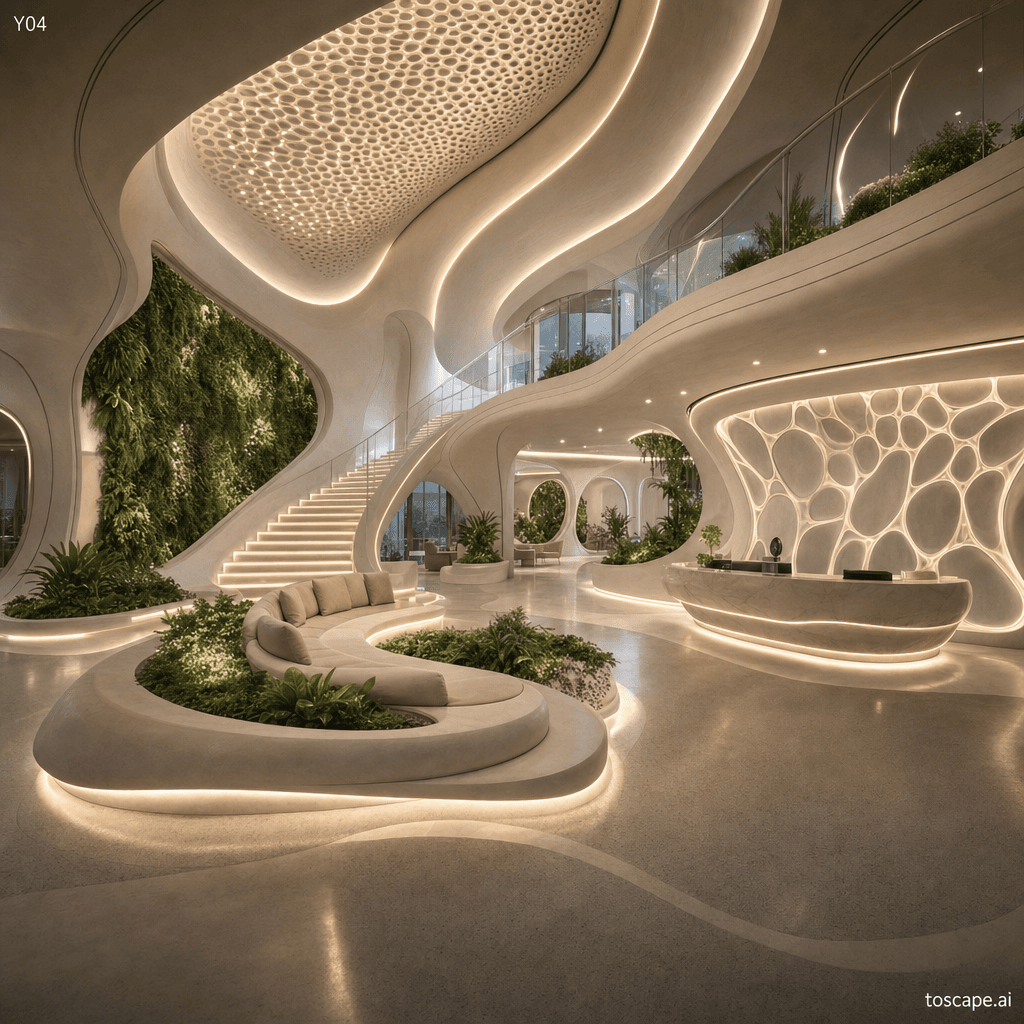
Interior reference image
Bio-Digital Interior composition, material palette, furniture language, and lighting direction.
Context Snapshot
Emerging from parametric design, digital fabrication, and biophilic architecture, Bio-Digital Interior is influenced by... Used in high-profile lobbies, creative offices, avant-garde lounges, innovative wellness spaces, visionary residential projects, and luxury retail concepts. Leverage the latest parametric fabrication, soft illumination, and minimal hardware while integrating curated biophilic inserts (such as moss walls or living partition modules) within a seamless, flowing shell.
Composition And Planning
Spatially open, fluid, and zoned by curvature, topographic floor levels, or organic screens rather than walls. Encourage smooth, meandering paths; movement is guided gently by form, with no sharp turns or hard barriers. Eye-level or slightly lowered, with deep sightlines through layered parametric forms, fluid foreground transitions, and a powerful background focal element; wide lens with immersive perspective.
Furniture Grammar
Fluid, continuous lines with no sharp corners; low-profile, gently contoured, and organically inspired forms. Clustered as islands or arcs in response to flow, never grid-like or heavily pushed to walls; prioritize social gathering, lounging, and organic circulation. - Built-in curved sofa island - Pebble bench or pod chair - Parametric ripple-edge table
Creative Direction
An immersive, visually unified interior where flowing organic shells, softly luminous backlit surfaces, sculpted biophilic modules, and premium parametric furniture dissolve the boundaries between architecture and living systems. A curated space with bold continuous curves, flawless surface transitions, a single lush moss or leafy focal wall, glowing ambient light, and tactile neutral seating-delicate objects echoing digital-organic motifs, all captured in cinematic composition. A moody, high-contrast space layered in tonal gradients, with shadows sculpting sculptural forms, softly glowing feature panels, lush green islands, and a sense...
Best Project Applications
- Luxury lounges, visionary living rooms, creative offices, wellness centers, concept hospitality spaces.
Preserve, Transform, Avoid
Preserve
- Preserve fluid, parametric geometry in walls, ceilings, and furniture.
- Preserve seamless material transitions and built-in elements.
- Preserve holistic fusion of biophilic and digital cues.
- Preserve softly integrated, immersive lighting schemes.
Transform
- Advance new materials and fabrication for improved seamlessness.
- Introduce curated living/digital art panels for fresh focal points.
- Increase lighting adaptivity for different use moods.
- Tune furniture for greater tactile and ergonomic comfort while keeping form purity.
Avoid
- Boxy or rectilinear furniture.
- Purely tech-driven, gadget-filled compositions.
- Cheap decorative green touches or fake plants.
- Industrial, exposed, or retro elements.
- Random commercial art or clutter.
Frequently asked questions
What is Bio-Digital Interior?
Bio-Digital Interior is an interior design style used for architectural visualization. A seamless fusion of organic biophilic forms and digital fabrication, creating fluid, immersive, futuristic interiors where nature and technology.
What materials define Bio-Digital Interior?
Silky smooth, softly matte, subtly tactile; transitions are seamless, with oases of mossy softness or leaf texture. Synthetic composites dominate walls, ceilings, and built-in forms; floors remain visually continuous and soft.
What is the Bio-Digital Interior color palette?
Ivory, pearl grey, sand, warm brushed metal, moss, clear glass, and lush green. Maintain organic continuity, using gradients and tonal overlays rather than abrupt contrast. Color placement links digital forms and natural elements. Use.
What is the origin of Bio-Digital Interior?
Emerging from parametric design, digital fabrication, and biophilic architecture, Bio-Digital Interior is influenced by... Used in high-profile lobbies, creative offices, avant-garde lounges, innovative wellness spaces, visionary residential projects, and luxury retail concepts. Leverage the latest parametric fabrication, soft illumination, and minimal hardware while integrating curated biophilic inserts (such as moss walls or living partition modules) within a seamless, flowing shell.
When should architects use Bio-Digital Interior?
An immersive, visually unified interior where flowing organic shells, softly luminous backlit surfaces, sculpted biophilic modules, and premium parametric furniture dissolve the boundaries between architecture and living systems.
How do you render Bio-Digital Interior in Toscape?
Open Toscape on Windows, load your own photo, elevation, sketch, or CAD view, then apply the Bio-Digital Interior reference from the built-in style library. The Interior Design workflow keep your project geometry and camera while shifting materials, proportion, and detailing toward Bio-Digital Interior.
Use this style in Toscape
Explore Bio-Digital Interior inside Toscape using interior-focused rendering workflows and gallery references.
Open interior references