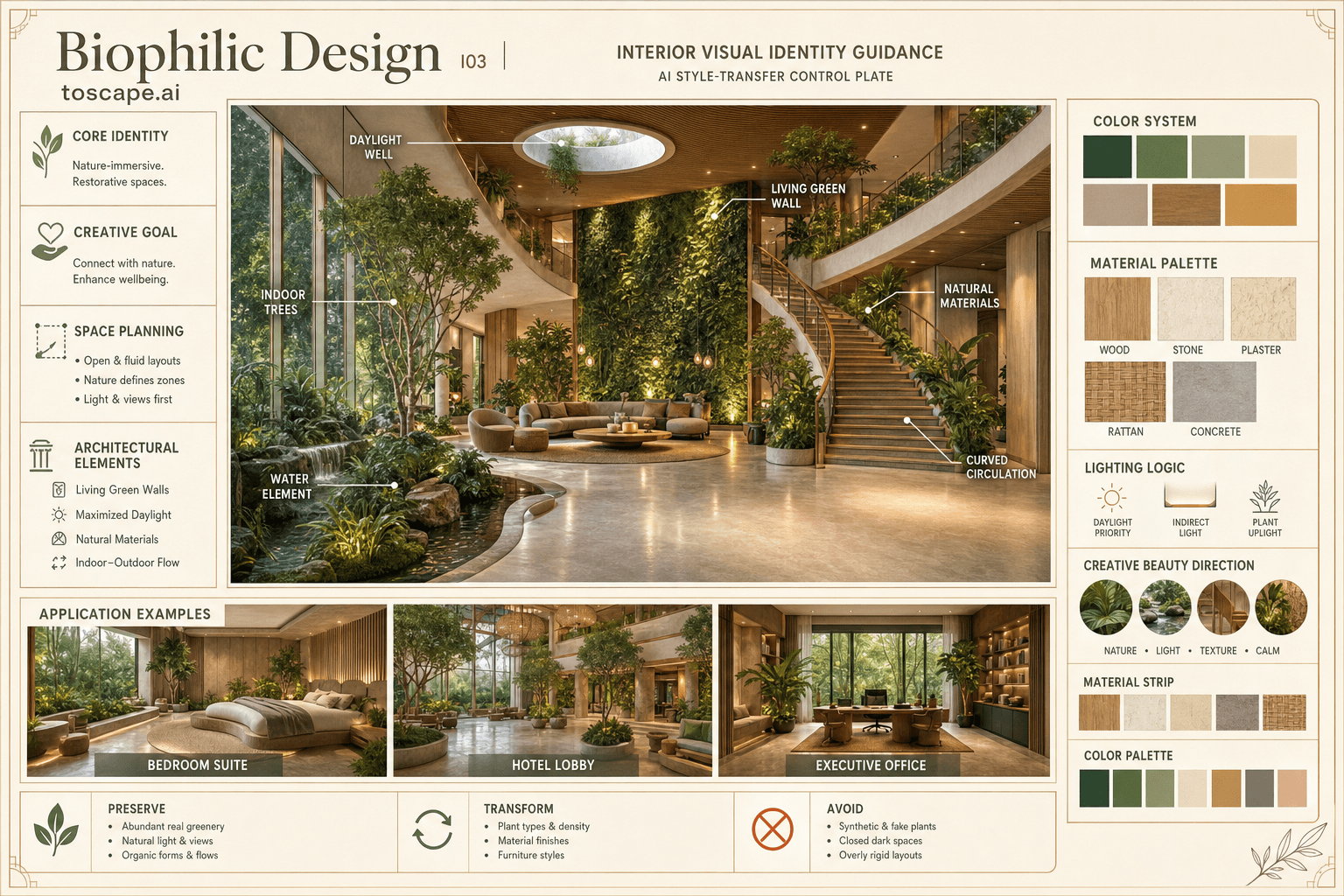
Biophilic Design
I03 / Contemporary / Organic Modern / Nature-Driven / Wellness
A contemporary interior identity centered on immersive real greenery, organic daylight, natural materials, and a health-focused connection to nature.
Definition
Biophilic Design is an interior design style used for architectural visualization. A contemporary interior identity centered on immersive real greenery, organic daylight, natural materials, and a health-focused connection to nature.
- Family
- Contemporary / Organic Modern / Nature-Driven / Wellness.
- Origin
- Rooted in biophilia theory-an innate human affinity for nature-emerging as a recognized design movement in the 21st century.
- Massing
- Curved organic shapes, flowing lines, plant-inspired motifs, soft natural edges, cascading or fractal forms, and biomorphic silhouettes.
- Materials
- Highly tactile and authentic-soft leaf, rough bark, porous stone, hand-woven fibers, water shimmer, and sunlight on organic surfaces.
- Palette
- Lush greens, warm plaster, honey or walnut wood, stone grey, soft jute, and highlights of water blue.
- Lighting
- Soft, indirect-cove lighting, wall grazing, floor washes that create a gentle glow echoing daylight.
Overview
Biophilic Design is an interior design style defined by A nature-immersive, contemporary interior style merging abundant living greenery, daylight, natural materials, organic forms, and wellness-driven atmosphere for a deeply restorative spatial experience. To deeply connect people with nature through immersive, multi-sensory design, supporting wellbeing, comfort, and inspiration.
Visual DNA
Spatial Feeling
Fresh, light-filled, alive, calming, restorative, airy, gentle, and inviting.
Form Language
Curved organic shapes, flowing lines, plant-inspired motifs, soft natural edges, cascading or fractal forms, and biomorphic silhouettes. Spaces favor openness, outdoor/indoor blurring, and flowing movement, balanced with intimate,...
Composition
Open, fluid, zoned through planting and material transitions, avoiding corridors and rigid compartmentalization. Living plant walls, light wells, indoor trees, water features, outdoor vistas, organically shaped focal seating pieces. Use...
Interior Elements
Smooth plaster, limewash, clay, or matte natural paint; active walls feature real living green walls, vertical gardens, softly integrated planters, or woven natural fiber panels. Quiet, flat, or softly sculpted; allow for skylights,...
Color System
Lush greens, warm plaster, honey or walnut wood, stone grey, soft jute, and highlights of water blue. Anchor the palette with abundant greens and earth hues, using natural off-whites and wood to keep the space fresh, balanced, and...
Material Palette
Highly tactile and authentic-soft leaf, rough bark, porous stone, hand-woven fibers, water shimmer, and sunlight on organic surfaces. Living plants across vertical and horizontal surfaces; wood on floors and joinery; stone grounding at...
Lighting Logic
Soft, indirect-cove lighting, wall grazing, floor washes that create a gentle glow echoing daylight. Highlight layered foliage, water shimmer, and authentic material texture with raking soft beams, shadow interplay, and atmospheric...
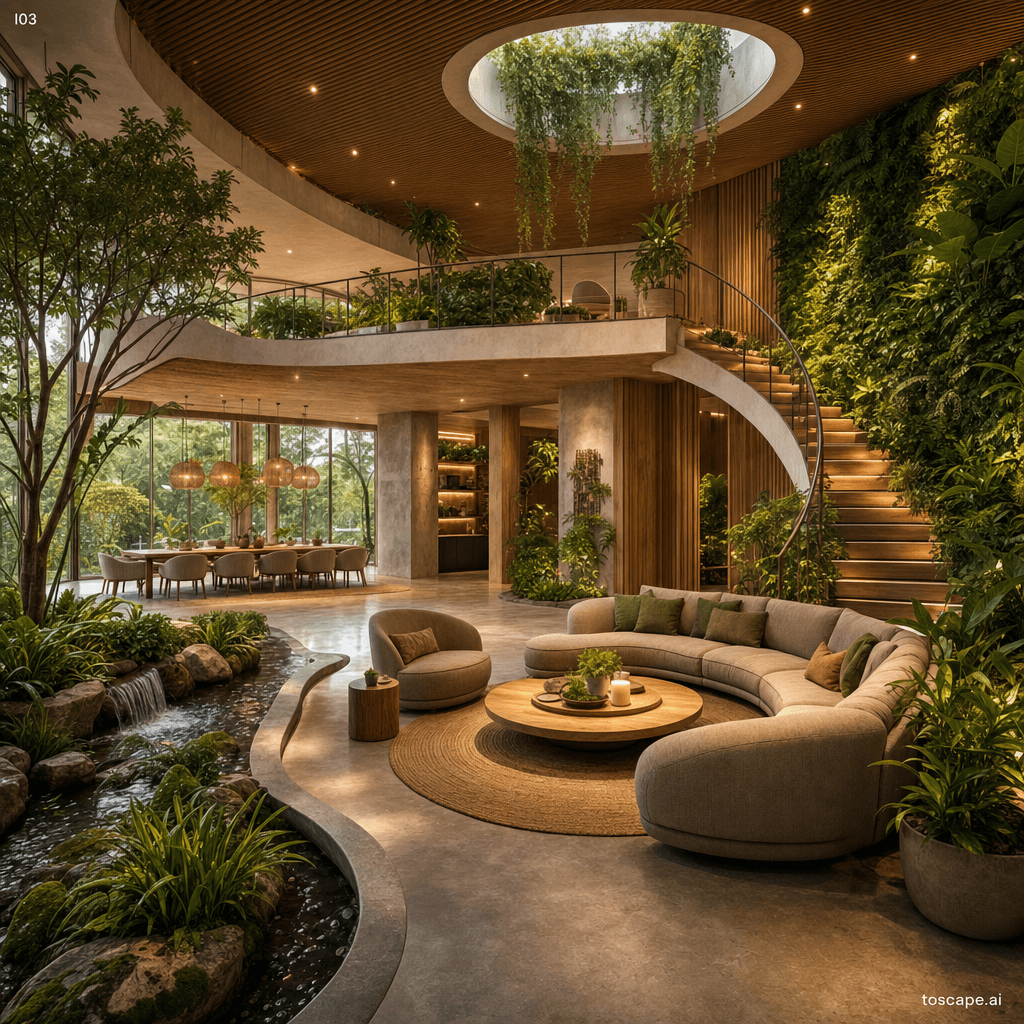
Interior reference image
Biophilic Design composition, material palette, furniture language, and lighting direction.
Context Snapshot
Rooted in biophilia theory-an innate human affinity for nature-emerging as a recognized design movement in the 21st century... Prominently used in premium homes, offices, hotels, spas, educational, and healthcare environments where wellbeing, daylight, and connection to nature are prioritized. Integrated living greenery, generous natural light, tactile raw materials, and organic architectural features-edited for clarity, calm, and premium spatial experience.
Composition And Planning
Open, fluid, zoned through planting and material transitions, avoiding corridors and rigid compartmentalization. Encourages gentle wandering, dynamic sightlines, and visual draws toward planting, light, and water-circulation is immersive, not rapid or strictly linear. Use a natural human eye height or slightly elevated view; frame the space to reveal layered greenery in foreground/midground/background, soft light, organic forms, and the transition between built and planted elements.
Furniture Grammar
Soft, curving, organic; minimal straight lines; gentle edges and ergonomic forms inspired by nature. Float key pieces toward light and plant views; avoid rigid wall alignment; keep groupings airy and circulation open. - Curved wood lounge chair with natural upholstery - Live-edge timber coffee table - Modular stone or boucle sectional - Woven rattan lounge seat
Creative Direction
A luminous contemporary salon with a living plant wall, filtered sunlight, smooth timber, river stone, serene woven textures, and minimal artisan ceramics-plant life visually flows into the architecture, flooding the space with calm and vitality. Tightly curated, visually airy, only a few strong planted features anchoring the space; daylight ripples over tactile walls and organic seating, achieving a sense of both clarity and lushness-no clutter, no distractions. Layer dense shadowed greens against soft wood, dappled light, and a sculptural water feature; emphasize indoor-outdoor blurring and a filmic mood of serene immersion in living...
Best Project Applications
- Wellness-oriented homes and offices, spa bathrooms, eco-hotels, restorative lounges, premium living rooms.
Preserve, Transform, Avoid
Preserve
- Real living greenery as a dominant visual driver.
- Soft, natural daylight and organic spatial flow.
- Honest, tactile natural materials throughout.
- Restorative, fresh, and wellness-centered spatial feeling.
Transform
- Scale greenery from planters to walls for large or dramatic spaces.
- Integrate water or natural stone for enhanced sensory effects.
- Edit clutter for more premium editorial quality; let one or two bold green features lead.
- Experiment with innovative green technology (hydroponics, green facades) as long as authenticity is clear.
Avoid
- Token or artificial plant decor.
- Cold synthetic plastics or high-gloss industrial metals.
- Fake green palette without living elements.
- Excessive decorative accessories diluting the nature focus.
- Turning the space into a chaotic urban jungle or cold minimalism.
Frequently asked questions
What is Biophilic Design?
Biophilic Design is an interior design style used for architectural visualization. A contemporary interior identity centered on immersive real greenery, organic daylight, natural materials, and a health-focused connection to nature.
What materials define Biophilic Design?
Highly tactile and authentic-soft leaf, rough bark, porous stone, hand-woven fibers, water shimmer, and sunlight on organic surfaces. Living plants across vertical and horizontal surfaces; wood on floors and joinery.
What is the Biophilic Design color palette?
Lush greens, warm plaster, honey or walnut wood, stone grey, soft jute, and highlights of water blue. Anchor the palette with abundant greens and earth hues, using natural off-whites and wood to keep the space fresh.
What is the origin of Biophilic Design?
Rooted in biophilia theory-an innate human affinity for nature-emerging as a recognized design movement in the 21st century... Prominently used in premium homes, offices, hotels, spas, educational, and healthcare environments where wellbeing, daylight, and connection to nature are prioritized. Integrated living greenery, generous natural light, tactile raw materials, and organic architectural features-edited for clarity, calm, and premium spatial experience.
When should architects use Biophilic Design?
A luminous contemporary salon with a living plant wall, filtered sunlight, smooth timber, river stone, serene woven textures, and minimal artisan ceramics-plant life visually flows into the architecture, flooding the space with calm and vitality.
How do you render Biophilic Design in Toscape?
Open Toscape on Windows, load your own photo, elevation, sketch, or CAD view, then apply the Biophilic Design reference from the built-in style library. The Interior Design workflow keep your project geometry and camera while shifting materials, proportion, and detailing toward Biophilic Design.
Use this style in Toscape
Explore Biophilic Design inside Toscape using interior-focused rendering workflows and gallery references.
Open interior references