Chinoiserie
P08 / Asian / Decorative Classic / Contemporary Heritage / Cultural Luxury
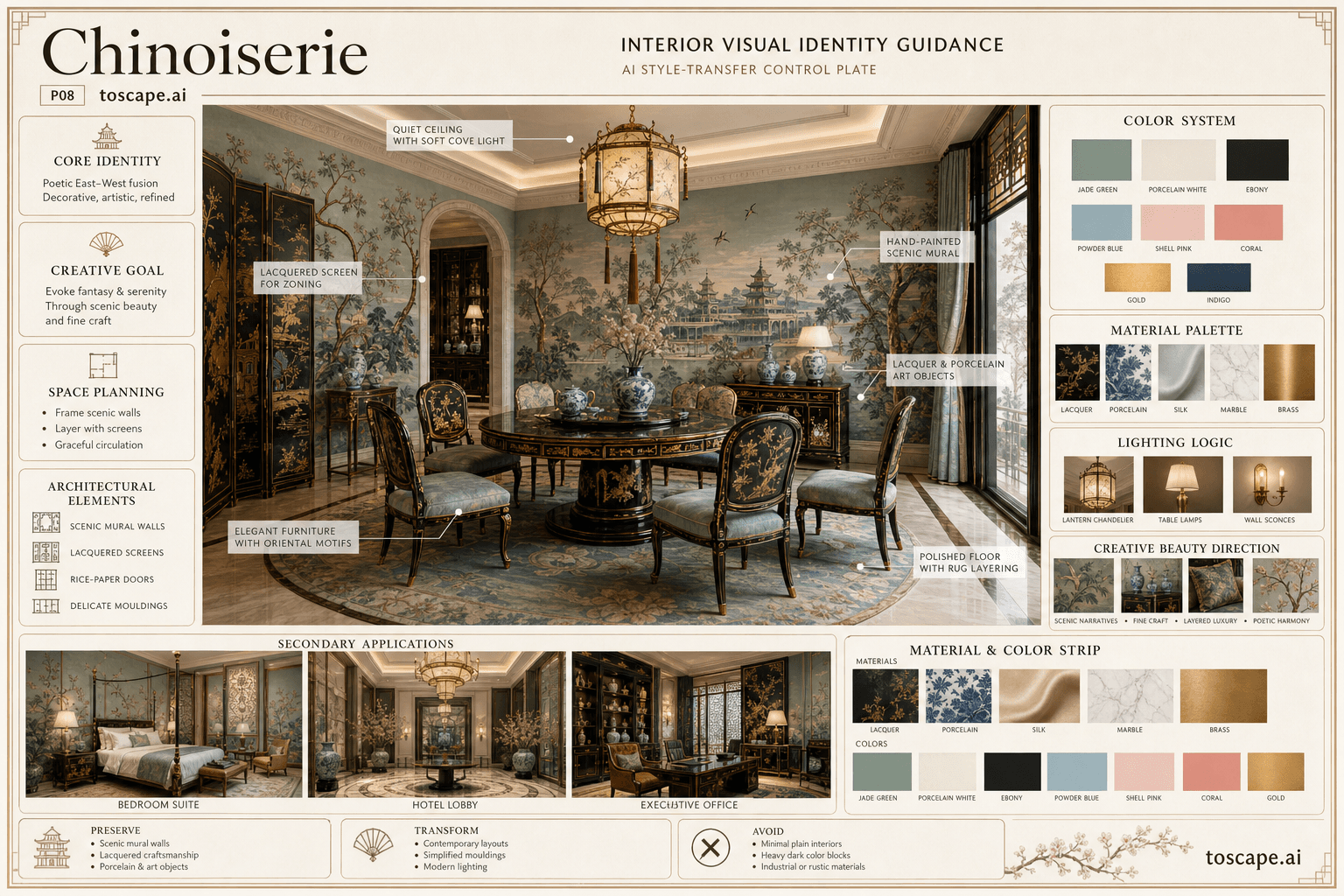
A poetic, mural-driven decorative style that fuses European elegance with dreamlike Chinese-inspired painting, lacquer, and refined Eastern objects.
Definition
Chinoiserie is an interior design style used for architectural visualization. A poetic, mural-driven decorative style that fuses European elegance with dreamlike Chinese-inspired painting, lacquer, and refined Eastern objects.
- Family
- Asian / Decorative Classic / Contemporary Heritage / Cultural Luxury.
- Origin
- Chinoiserie emerged in the 17th-18th century European fascination with Chinese art, porcelain, lacquerware, and painting.
- Massing
- Panels, graceful curves, lacquered screens, light cabriole legs, pagoda motifs, delicate moulding, asymmetrically placed art and furniture with underlying classical order.
- Materials
- Silky, smooth, lustrous, refined, often cool to the touch; visually soft through fabric, clear and reflective through lacquer and mirror.
- Palette
- Jade, soft celadon, coral, gold, porcelain, and lacquer with neutral and emerald green.
- Lighting
- Soft cove or wall-wash lighting to enhance murals, not overpower with downlights.
Overview
Chinoiserie is an interior design style defined by A poetic, decorative interior style fusing European classic structure with fantastical Chinese-inspired ornament, hand-painted murals, lacquer, elegant furniture, and exquisite craftsmanship. To evoke a sense of fantasy, sophistication, artistry, and tranquil luxury by integrating scenic narrative, delicate nature, and fine craft into an elegant architectural shell.
Visual DNA
Spatial Feeling
Dreamy, layered, serene yet ornate, artistically curated, and transportive.
Form Language
Panels, graceful curves, lacquered screens, light cabriole legs, pagoda motifs, delicate moulding, asymmetrically placed art and furniture with underlying classical order. Medium-scaled spaces feel balanced; walls are active but...
Composition
Room-based layouts framed to display murals, focal panels, or screens, allowing seating groups to engage with scenic walls. Hand-painted mural/panoramic chinoiserie wall, an artful lacquered console, signature armchair, collector's...
Interior Elements
Scenic hand-painted chinoiserie wallpaper or mural, lacquered panels, subtle classical mouldings, decorative frames, or fabric-wrapped walls. Ceilings should be quiet and supportive, finished with soft color, subtle cloud or sky...
Color System
Jade, soft celadon, coral, gold, porcelain, and lacquer with neutral and emerald green. Pair muted, nature-derived tones with porcelain whites, luminous metallics, and strong color punctuation for focused highlights. Emerald lacquer,...
Material Palette
Silky, smooth, lustrous, refined, often cool to the touch; visually soft through fabric, clear and reflective through lacquer and mirror. Feature walls and screens are mural or lacquer; furniture combines lacquer and wood; porcelain,...
Lighting Logic
Soft cove or wall-wash lighting to enhance murals, not overpower with downlights. Layer soft warm light to dramatize murals, create golden reflections in lacquer and brass, and gently fade into poetic shadow. Lighting must accentuate...
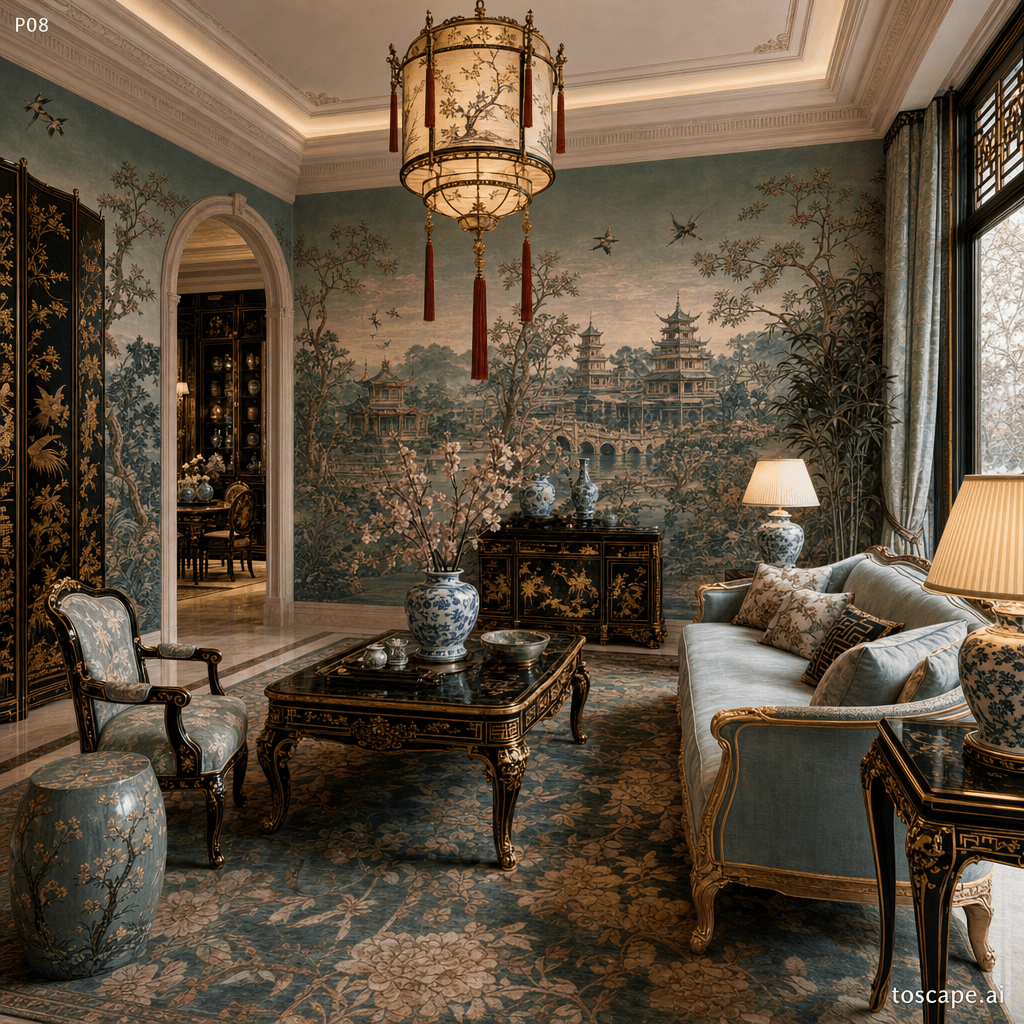
Interior reference image
Chinoiserie composition, material palette, furniture language, and lighting direction.
Context Snapshot
Chinoiserie emerged in the 17th-18th century European fascination with Chinese art, porcelain, lacquerware, and painting,... Used in luxury residences, boutique hotels, curated salons, high-end dining rooms, and as focal installations in contemporary spaces seeking artistic narrative and elegance. Preserve the hand-painted wall art, poetic composition, artisanal craft, and refined furniture, but edit clutter and balance decorative density with visual calm.
Composition And Planning
Room-based layouts framed to display murals, focal panels, or screens, allowing seating groups to engage with scenic walls. Movement feels graceful and processional, inviting the eye around hand-painted art and artful objects. Central or slightly oblique camera placing mural/art at midground, layered with elegant screens, reflective lacquer, porcelain, and curated foreground seating.
Furniture Grammar
Light, elegant, soft-curved, with classical and Asian motifs; often French-influenced but distinctly decorated. Placed poetically and lightly: often floating, sometimes paired or in small clusters, never crowding mural views. - Hand-painted or lacquered console - Ming-style horseshoe chair - French Rococo accent fauteuil with chinoiserie upholstery - Folding painted screen
Creative Direction
A luminous salon flooded with natural light, anchored by floor-to-ceiling hand-painted mural walls, reflective lacquered consoles, curated porcelain vases, French-Asian seating, and poetic, atmospheric lighting. Artful, balanced compositions with open central space, mural or scenic wall as a photographic backdrop, centered console and object curation, crisp silk, and one major floral element-fine art meets interior. Night-lit space with mural details glowing in cove light, gold and jade lacquer shimmering, porcelain casting reflections, and poetic shadow layering; atmosphere is hushed, deeply romantic, and visually dramatic. - Authentic...
Best Project Applications
- Luxury salons, boutique hotels, fine dining rooms, bedrooms, curated galleries.
Preserve, Transform, Avoid
Preserve
- Hand-painted chinoiserie murals or scenic wallpaper
- Lacquered or painted feature surfaces
- Delicate, lightly scaled furniture with Asian and European cues
- Refined curation of porcelain, art, and accessories
Transform
- Use brighter palettes or more contemporary color blocking when it highlights wall art
- Reduce decorative density in small rooms while preserving mural presence
- Combine vintage and modern chinoiserie pieces for layered authenticity
- Incorporate subtle lighting technology to enhance art surfaces
Avoid
- Standard minimal, rustic, industrial, or generic contemporary decor
- Heavy oversized Western sofas or block furniture
- Mass-produced faux-Asian accessories
- Over-use of red, black, or gold with no narrative art
- Stripping hand-painted or mural surface from primary focal walls
Frequently asked questions
What is Chinoiserie?
Chinoiserie is an interior design style used for architectural visualization. A poetic, mural-driven decorative style that fuses European elegance with dreamlike Chinese-inspired painting, lacquer, and refined Eastern objects.
What materials define Chinoiserie?
Silky, smooth, lustrous, refined, often cool to the touch; visually soft through fabric, clear and reflective through lacquer and mirror. Feature walls and screens are mural or lacquer; furniture combines lacquer and wood; porcelain.
What is the Chinoiserie color palette?
Jade, soft celadon, coral, gold, porcelain, and lacquer with neutral and emerald green. Pair muted, nature-derived tones with porcelain whites, luminous metallics, and strong color punctuation for focused highlights. Emerald lacquer.
What is the origin of Chinoiserie?
Chinoiserie emerged in the 17th-18th century European fascination with Chinese art, porcelain, lacquerware, and painting,... Used in luxury residences, boutique hotels, curated salons, high-end dining rooms, and as focal installations in contemporary spaces seeking artistic narrative and elegance. Preserve the hand-painted wall art, poetic composition, artisanal craft, and refined furniture, but edit clutter and balance decorative density with visual calm.
When should architects use Chinoiserie?
A luminous salon flooded with natural light, anchored by floor-to-ceiling hand-painted mural walls, reflective lacquered consoles, curated porcelain vases, French-Asian seating, and poetic, atmospheric lighting. Artful, balanced compositions with open central space, mural or scenic wall as a photographic backdrop, centered console and object curation, crisp silk, and one major floral element-fine art meets interior.
How do you render Chinoiserie in Toscape?
Open Toscape on Windows, load your own photo, elevation, sketch, or CAD view, then apply the Chinoiserie reference from the built-in style library. The Interior Design workflow keep your project geometry and camera while shifting materials, proportion, and detailing toward Chinoiserie.
Use this style in Toscape
Explore Chinoiserie inside Toscape using interior-focused rendering workflows and gallery references.
Open interior references