Desert Heritage
N07 / Arabian / Mediterranean / Organic / Rustic / Heritage-Modern
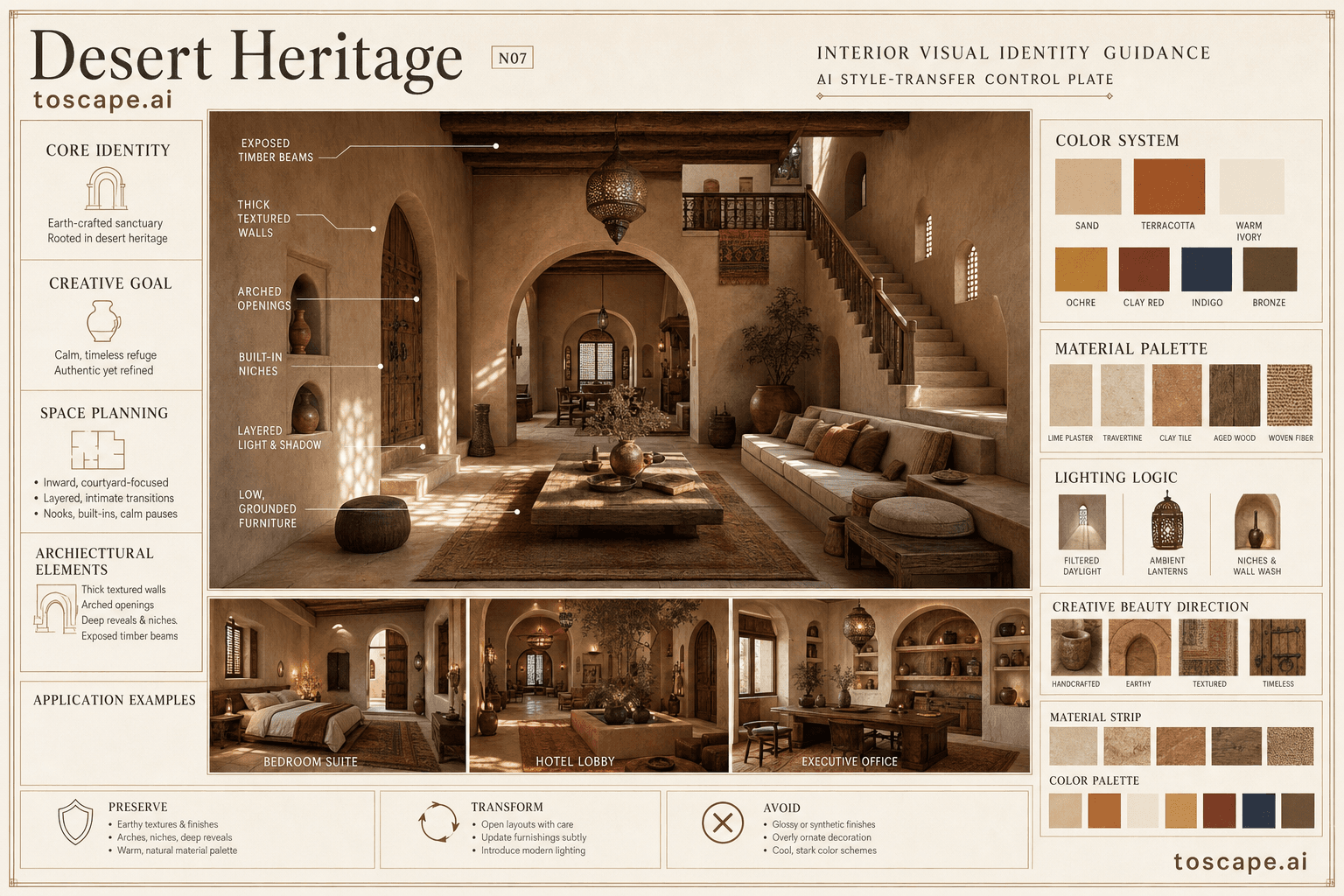
A soulful, contemporary interior rooted in desert traditions, defined by sculpted earthy walls, hand-finished textures, grounded timber,...
Definition
Desert Heritage is an interior design style used for architectural visualization. A soulful, contemporary interior rooted in desert traditions, defined by sculpted earthy walls, hand-finished textures, grounded timber.
- Family
- Arabian / Mediterranean / Organic / Rustic / Heritage-Modern.
- Origin
- Inspired by Arabian, Maghrebi, and Levantine desert settlements-traditional mudbrick kasbahs, riads, and courtyard.
- Massing
- Simple, massive volumes; softly sculpted or irregular walls; arched or horseshoe openings; deep window reveals; heavy thresholds; benches and niches carved into structure.
- Materials
- Raw, tactile, matte or low-sheen, irregular and hand-finished; visible grain, trowel marks, and surface transitions create visual interest.
- Palette
- Sandstone, terracotta, warm ivory, matte bronze, natural timber, sun-faded indigo textiles.
- Lighting
- Warm, low-level glow; indirect wall washing, up-lighting of niches, concealed lights behind beams, and integrated cove or step lighting.
Overview
Desert Heritage is an interior design style defined by A grounded, soulful interior language inspired by the sensual earthiness, natural textures, and calming ritual of traditional desert habitats, updated with refined contemporary composition. To evoke a calming, timeless sense of sanctuary connected to the land, balancing authenticity and sophisticated simplicity.
Visual DNA
Spatial Feeling
Grounded, serene, cocooning, mellow, monastic yet welcoming; an intimate retreat with quiet drama.
Form Language
Simple, massive volumes; softly sculpted or irregular walls; arched or horseshoe openings; deep window reveals; heavy thresholds; benches and niches carved into structure; organic curves and quiet geometry. Moderately high ceilings,...
Composition
Rooms are inward-facing, clustered around courtyards or intimate enclosures; layouts favor refuge, enclosure, and selective openness. Feature archway, carved niche, low fireplace, rustic wooden door, or statement artifact-never gaudy,...
Interior Elements
Textured earth-toned plaster, tadelakt, adobe, or microcement; visible hand-trowel marks; integral shelves or niches; minimal pigment wash. Ceilings are plain or carry simple native beamwork (raw wood, palm trunks, or reed matting); may...
Color System
Sandstone, terracotta, warm ivory, matte bronze, natural timber, sun-faded indigo textiles. Build from a monochromatic earth palette, accented by deep, naturally-sourced pigment, and aged metals for emotional depth. Use deep shadows,...
Material Palette
Raw, tactile, matte or low-sheen, irregular and hand-finished; visible grain, trowel marks, and surface transitions create visual interest. Walls and ceilings unified in warm, textured plaster; floors alternate between stone and clay;...
Lighting Logic
Warm, low-level glow; indirect wall washing, up-lighting of niches, concealed lights behind beams, and integrated cove or step lighting. Strong shadow-play, accentuating depth and tactility; balance direct sun with shaded ambient glow...
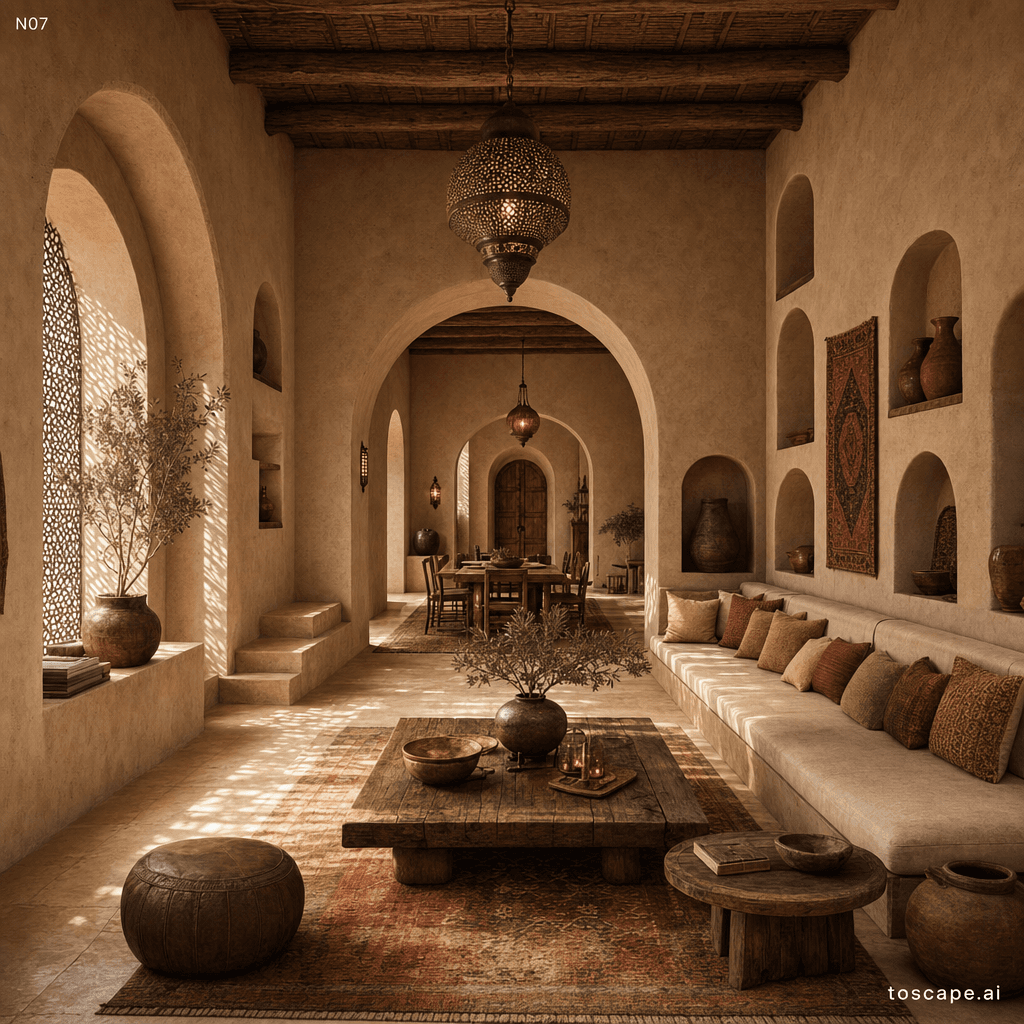
Interior reference image
Desert Heritage composition, material palette, furniture language, and lighting direction.
Context Snapshot
Inspired by Arabian, Maghrebi, and Levantine desert settlements-traditional mudbrick kasbahs, riads, and courtyard... Increasingly popular in luxury villas, eco-resorts, boutique hotels, and residential projects seeking a visceral, calming, and regionally-authentic mood. Edit ornamentation, enhance sculptural wall relief, refine earth palettes, and emphasize filtered light and tactile material depth while retaining cultural signature and comfort.
Composition And Planning
Rooms are inward-facing, clustered around courtyards or intimate enclosures; layouts favor refuge, enclosure, and selective openness. Movement is meandering, inviting exploration; sightlines are punctuated by thick arches, lattice screens, or partial walls; eye is drawn to sculptural light and shadow. Use layered depth with a strong midground (arch, niche, or built-in furniture), soft foreground focus (rug or artifact), and a luminous, shadow-rich background. Eye level or slightly lowered camera height reveals architectural mass and intimate spatial rhythm.
Furniture Grammar
Sculpted, low-slung, sturdy, with rounded corners and organic lines; hand-built, sometimes rustic or monolithic. Cluster furniture for intimacy, mostly away from walls; layer rugs, group poufs or ottomans, anchor seating zones with earth-toned blocks or benches. - Plaster or adobe built-in benches - Primitive low timber table - Handwoven poufs - Carved wooden doors
Creative Direction
A sun-washed, serene interior with thick, sculpted earth walls, layered arches, built-in benches, artisan carpets, and gently burnished bronze lighting, all brought to life by dramatic bands of sunlight and shadow. Crisp photography revealing textural tadelakt, deep shadow-lines at every opening, artfully-placed pottery, faded indigo or ochre textiles, tranquil spatial composition, and restrained, authentic artifact curation. Golden-hour sunlight pouring through a lattice, projecting intricate shadow patterns onto adobe surfaces; spiritual atmosphere; earthy scent and tactile richness palpable through imagery. - Real, hand-finished...
Best Project Applications
- Luxury regional villas, boutique desert resorts, meditation spas, artisan dining rooms, tranquil bedrooms.
Preserve, Transform, Avoid
Preserve
- Preserve tactile earth walls with rich hand-finished surface.
- Preserve sculpted archways, deep reveals, and niche elements.
- Preserve low, grounded timber and built-in furniture.
- Preserve filtered, soft, natural light with strong shadow-play.
Transform
- Abstract built-in joinery for a cleaner modern line while maintaining sculptural depth.
- Introduce select artisanal or contemporary lighting to gently increase atmosphere.
- Layer handmade textiles and vessels for curated richness.
- Edit ornamentation for restraint, focusing on pure material play and light interaction.
Avoid
- Flat, characterless beige or white walls.
- Plastic, chrome, or high-gloss finishes.
- Overly bright or blue-white lighting.
- Tall, modernist, or Scandinavian-style furniture.
- Generic hotel or social-media-driven styling.
Frequently asked questions
What is Desert Heritage?
Desert Heritage is an interior design style used for architectural visualization. A soulful, contemporary interior rooted in desert traditions, defined by sculpted earthy walls, hand-finished textures, grounded timber.
What materials define Desert Heritage?
Raw, tactile, matte or low-sheen, irregular and hand-finished; visible grain, trowel marks, and surface transitions create visual interest. Walls and ceilings unified in warm, textured plaster; floors alternate between stone and clay.
What is the Desert Heritage color palette?
Sandstone, terracotta, warm ivory, matte bronze, natural timber, sun-faded indigo textiles. Build from a monochromatic earth palette, accented by deep, naturally-sourced pigment, and aged metals for emotional depth. Use deep shadows.
What is the origin of Desert Heritage?
Inspired by Arabian, Maghrebi, and Levantine desert settlements-traditional mudbrick kasbahs, riads, and courtyard... Increasingly popular in luxury villas, eco-resorts, boutique hotels, and residential projects seeking a visceral, calming, and regionally-authentic mood. Edit ornamentation, enhance sculptural wall relief, refine earth palettes, and emphasize filtered light and tactile material depth while retaining cultural signature and comfort.
When should architects use Desert Heritage?
A sun-washed, serene interior with thick, sculpted earth walls, layered arches, built-in benches, artisan carpets, and gently burnished bronze lighting, all brought to life by dramatic bands of sunlight and shadow. Crisp photography revealing textural tadelakt, deep shadow-lines at every opening, artfully-placed pottery, faded indigo or ochre textiles, tranquil spatial composition, and restrained, authentic artifact curation.
How do you render Desert Heritage in Toscape?
Open Toscape on Windows, load your own photo, elevation, sketch, or CAD view, then apply the Desert Heritage reference from the built-in style library. The Interior Design workflow keep your project geometry and camera while shifting materials, proportion, and detailing toward Desert Heritage.
Use this style in Toscape
Explore Desert Heritage inside Toscape using interior-focused rendering workflows and gallery references.
Open interior references