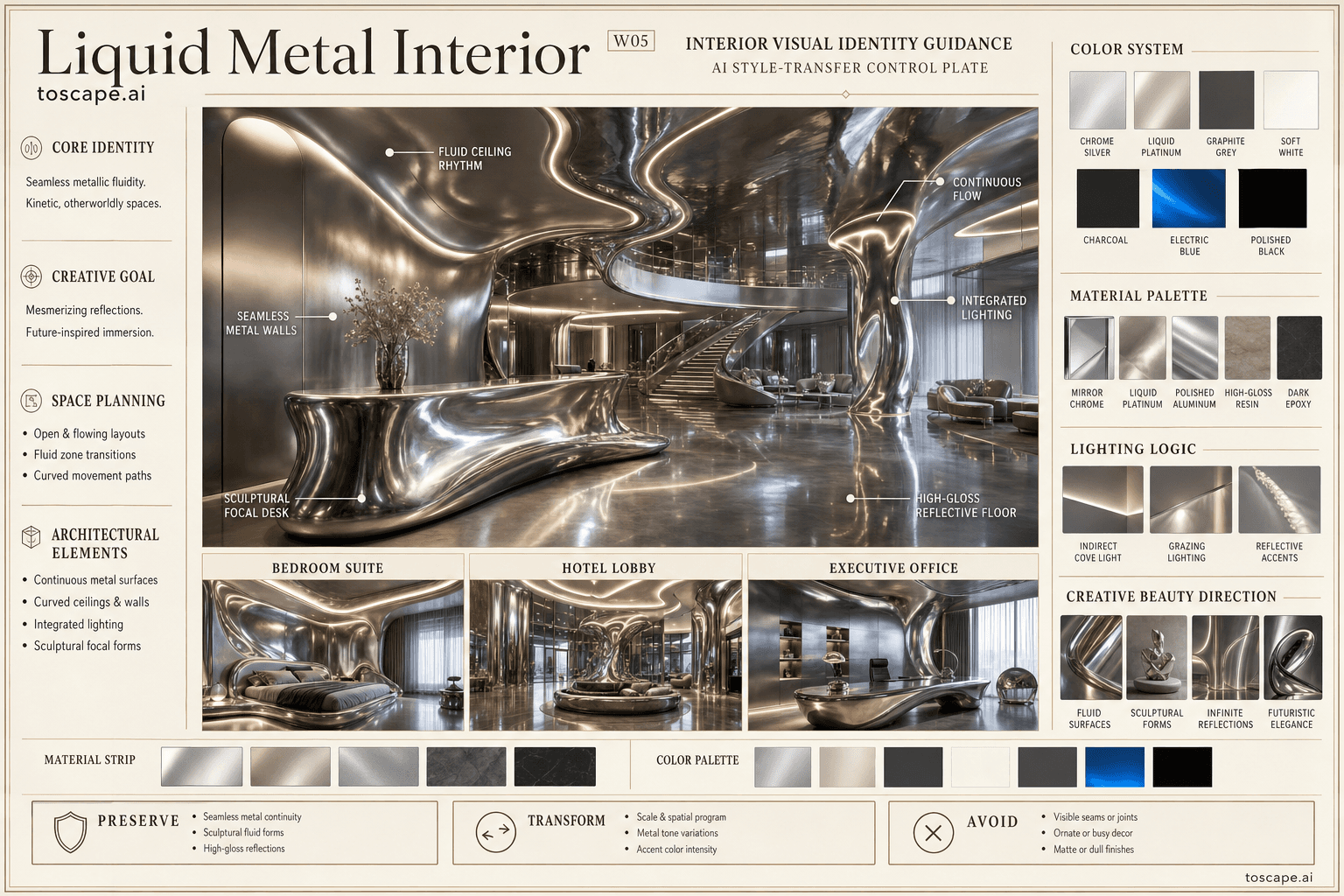
Liquid Metal Interior
W05 / Futuristic / High-Gloss Contemporary / Sculptural Modern / Avant-Garde
A futuristic interior style defined by seamless liquid-metal surfaces, sculptural curves, kinetic reflections, and immersive flowing space.
Definition
Liquid Metal Interior is an interior design style used for architectural visualization. A futuristic interior style defined by seamless liquid-metal surfaces, sculptural curves, kinetic reflections, and immersive flowing space.
- Family
- Futuristic / High-Gloss Contemporary / Sculptural Modern / Avant-Garde.
- Origin
- Emerging from advances in material technology, CGI-inspired environments, and high-concept parametric architecture, the style.
- Massing
- Organic curves, fluid undulations, seamless joints, continuous waves, amorphous masses, and sculpted voids.
- Materials
- Liquid-smooth, mirror-reflective, ultra-polished, with occasional contrast from subtly brushed or satin metal.
- Palette
- Seamless mirror-silver surfaces, fluid platinum, shadow-cast graphite, illuminated blue or white highlight lines. Restrict to a nearly-monochrome metallic palette; add subtle accent lights for visual tension.
- Lighting
- Integrated cove, linear LED, and concealed light washes; avoid exposed downlights except as pinpoint accents.
Overview
Liquid Metal Interior is an interior design style defined by A futuristic interior identity defined by seamless, high-gloss metallic surfaces, sculptural fluid forms, kinetic reflections, and an immersive, otherworldly atmosphere. To mesmerize and envelop users in a future-inspired, visually fluid world that feels both kinetic and emotionally transformative.
Visual DNA
Spatial Feeling
Otherworldly, enveloping, coolly dramatic, smooth yet dynamic, with a sense of infinite reflection and kinetic movement.
Form Language
Organic curves, fluid undulations, seamless joints, continuous waves, amorphous masses, and sculpted voids. Medium to monumental scale; open layouts with bold forms that command space but avoid overfilling; spaces flow with continuous...
Composition
Open, flowing, and immersive; spaces are designed to feel seamless, with minimal partitions and maximum continuity. Heroic fluid metal installations (walls, reception desks, bars, staircases), dramatic reflective ceilings, key...
Interior Elements
Continuous high-gloss metal panels (chrome, polished aluminum, platinum), curved or undulating feature walls, seamless metallic skin, or integrated lighting reveals-avoid visible panel joins wherever possible. A major expressive driver...
Color System
Seamless mirror-silver surfaces, fluid platinum, shadow-cast graphite, illuminated blue or white highlight lines. Restrict to a nearly-monochrome metallic palette; add subtle accent lights for visual tension. Predominantly deep...
Material Palette
Liquid-smooth, mirror-reflective, ultra-polished, with occasional contrast from subtly brushed or satin metal. Metals flow across primary surfaces; resin/glass used for transitions or partitions; accents integrated in fine lines or...
Lighting Logic
Integrated cove, linear LED, and concealed light washes; avoid exposed downlights except as pinpoint accents. Maximize sculptural shadow, brilliant highlights, symmetric or asymmetric washes of light and dark, glowing edges along...
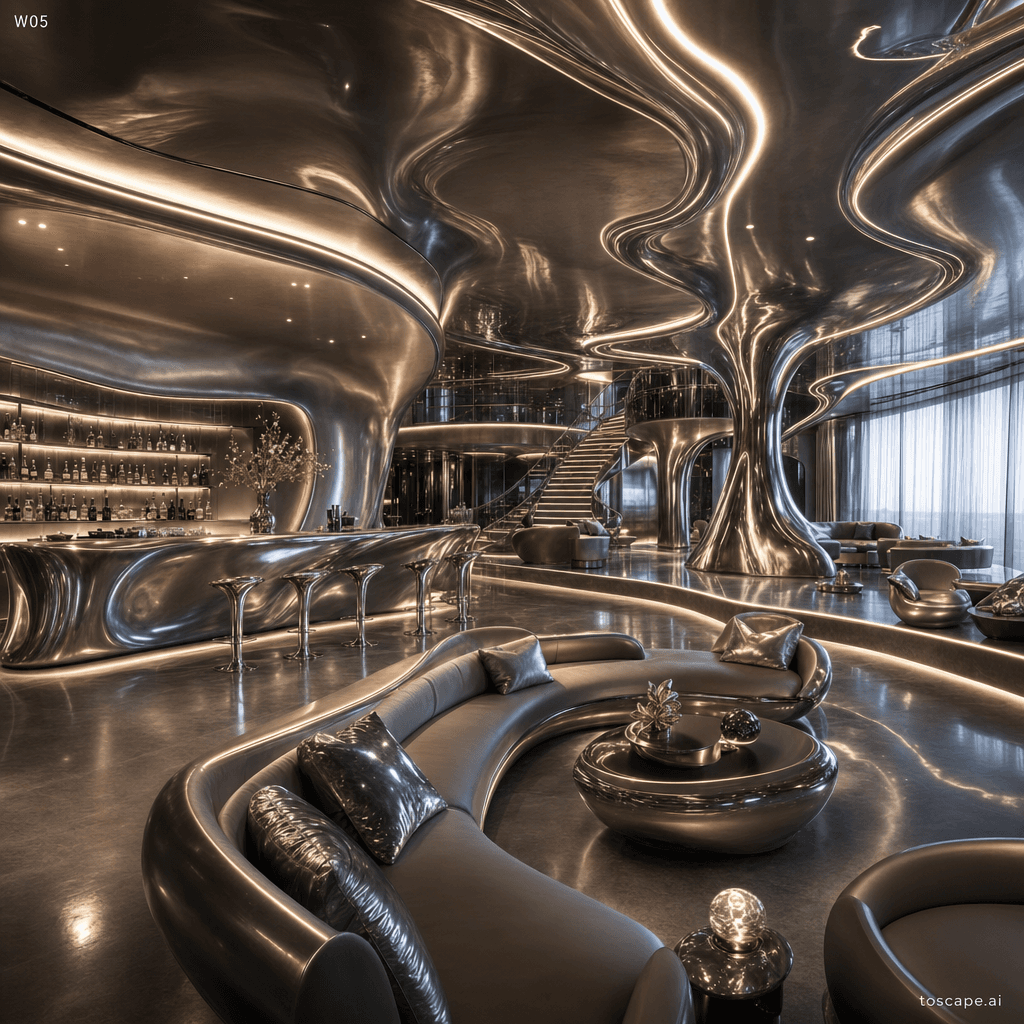
Interior reference image
Liquid Metal Interior composition, material palette, furniture language, and lighting direction.
Context Snapshot
Emerging from advances in material technology, CGI-inspired environments, and high-concept parametric architecture, the style... Applied in avant-garde lounges, premium tech-enabled spaces, digital art galleries, flagship stores, hotel lobbies, and select high-end residences seeking strong signature identity. Prioritize seamless, continuous metallic surfaces, integrated sculptural furniture, controlled lighting, and the emotional impact of movement, avoiding over-clutter or literal science fiction themes.
Composition And Planning
Open, flowing, and immersive; spaces are designed to feel seamless, with minimal partitions and maximum continuity. Movement is guided by curves, pathways, and visual leads created by the reflective surfaces and sculptural elements; encourages continuous circulation and discovery. Mid-height or low-angle shots to accentuate curve, light, and reflection; strong foreground element, layered reflective midground, and seamless receding background; maximize immersive sense.
Furniture Grammar
Sculptural, curved, organic, fluid, and minimal in number; often appears as if carved or poured as a single piece. Anchor main pieces as focal points or curves, keep clear circulation, float select forms in open space, and maintain unobstructed reflection lines. - Liquid-metal sculptural lounge chair - Seamless reflective banquette - Mirror-platinum coffee table - Floating curvilinear metallic console
Creative Direction
A luminous, seamless environment of mirrored curves and kinetic shadows, where stunning fluid forms float across polished surfaces, highlighted by ethereal, integrated lighting and dramatic visual depth. Impeccably executed, with flawless continuous metal surfaces, few iconic sculptural furniture pieces, crisp reflections, and artful use of light to carve out stunning contours; gallery-like visual silence accentuates every curve. Bold contrasts, pools of blue-white light slicing across liquid metal, exaggerated reflections creating an endless, otherworldly depth, and dramatic shadow amplifying the sense of spatial mystery. - Flawless,...
Best Project Applications
- Flagship lounges, digital art galleries, high-concept residential, visionary retail, tech suites.
Preserve, Transform, Avoid
Preserve
- Preserve seamless, uninterrupted, reflective metallic surfaces.
- Preserve fluid, organic, sculptural geometry throughout.
- Preserve visually immersive, kinetic play of light and reflection.
- Preserve minimalism in decor and focal sculptural furniture.
Transform
- Experiment with dynamic lighting to enhance reflection and ambiance.
- Scale fluid geometry toward monumental art pieces in larger spaces.
- Integrate digital art or kinetic installations for extra drama.
- Use subtle matte, smoked, or tinted glass accents to break monotony, but always in harmony with liquid metal.
Avoid
- Introducing industrial bolts or visible fasteners.
- Overcrowding with excessive furniture or decor.
- Using wood, heavy textiles, or rustic finishes as dominant materials.
- Applying "liquid metal" as just a color or coating to generic forms.
- Allowing clutter, ornamentation, or traditional motifs to erode the signature look.
Frequently asked questions
What is Liquid Metal Interior?
Liquid Metal Interior is an interior design style used for architectural visualization. A futuristic interior style defined by seamless liquid-metal surfaces, sculptural curves, kinetic reflections, and immersive flowing space.
What materials define Liquid Metal Interior?
Liquid-smooth, mirror-reflective, ultra-polished, with occasional contrast from subtly brushed or satin metal. Metals flow across primary surfaces; resin/glass used for transitions or partitions.
What is the Liquid Metal Interior color palette?
Seamless mirror-silver surfaces, fluid platinum, shadow-cast graphite, illuminated blue or white highlight lines. Restrict to a nearly-monochrome metallic palette; add subtle accent lights for visual tension. Predominantly deep.
What is the origin of Liquid Metal Interior?
Emerging from advances in material technology, CGI-inspired environments, and high-concept parametric architecture, the style... Applied in avant-garde lounges, premium tech-enabled spaces, digital art galleries, flagship stores, hotel lobbies, and select high-end residences seeking strong signature identity. Prioritize seamless, continuous metallic surfaces, integrated sculptural furniture, controlled lighting, and the emotional impact of movement, avoiding over-clutter or literal science fiction themes.
When should architects use Liquid Metal Interior?
A luminous, seamless environment of mirrored curves and kinetic shadows, where stunning fluid forms float across polished surfaces, highlighted by ethereal, integrated lighting and dramatic visual depth. Impeccably executed, with flawless continuous metal surfaces, few iconic sculptural furniture pieces, crisp reflections, and artful use of light to carve out stunning contours; gallery-like visual silence accentuates every curve.
How do you render Liquid Metal Interior in Toscape?
Open Toscape on Windows, load your own photo, elevation, sketch, or CAD view, then apply the Liquid Metal Interior reference from the built-in style library. The Interior Design workflow keep your project geometry and camera while shifting materials, proportion, and detailing toward Liquid Metal Interior.
Use this style in Toscape
Explore Liquid Metal Interior inside Toscape using interior-focused rendering workflows and gallery references.
Open interior references