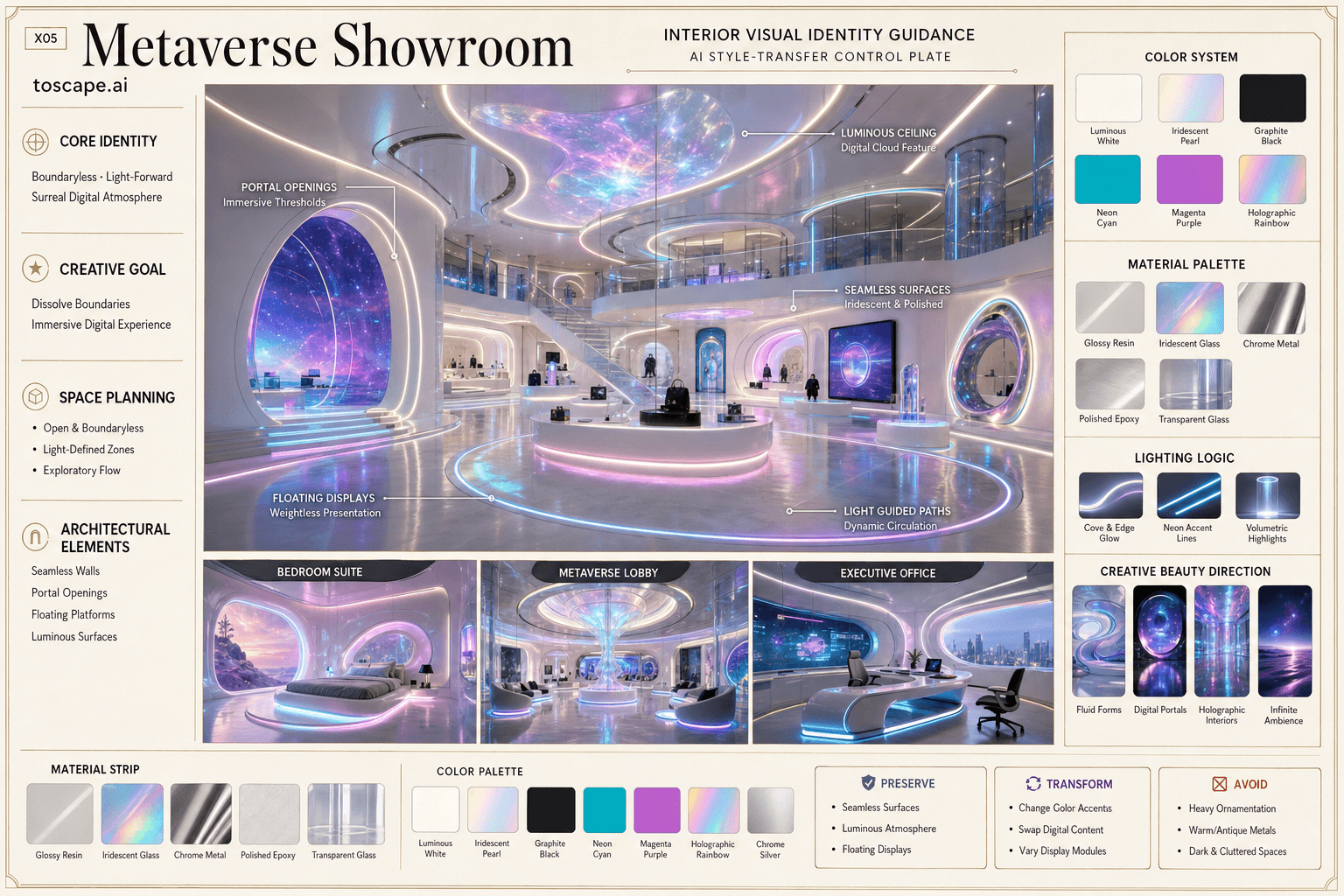
Metaverse Showroom
X05 / Futuristic / Hyper-Contemporary / Digital-Native / Immersive Retail / Media Space
An immersive, fluid, and luminous digital-native interior defined by seamless geometry, iridescent highlights, and futuristic spatial infinity.
Definition
Metaverse Showroom is an interior design style used for architectural visualization. An immersive, fluid, and luminous digital-native interior defined by seamless geometry, iridescent highlights, and futuristic spatial infinity.
- Family
- Futuristic / Hyper-Contemporary / Digital-Native / Immersive Retail / Media Space.
- Origin
- Born from digital design, virtual environments, and the metaverse revolution in gaming, art, and future commerce, this style.
- Massing
- Fluid curves, seamless geometry, organic loops, torus and arch modules, soft-edged extrusions, gently morphing surfaces, and bold visual portals.
- Materials
- Ultra-smooth, high-gloss, mirror-like, luminous, refractive, and virtual; not tactile or coarse.
- Palette
- Clean luminous white, seamless iridescent gradients, neon cyan/magenta accents, and reflective chrome for an elevated, digital-forward harmony.
- Lighting
- Integrated coves, glowing ceiling/floor edges, full-wall LED backdrops, or lit panels; uniform, boundary-erasing glow.
Overview
Metaverse Showroom is an interior design style defined by A boundaryless, light-forward interior defined by surreal digital geometry, seamless material transitions, iridescent and luminous finishes, modular display elements, and an immersive, hyper-polished virtual atmosphere that blurs physical and digital boundaries. To dissolve physical constraints, invite exploration, and present objects or experiences in an immersive, future-native environment that feels fluid, hyper-clean, and visually limitless.
Visual DNA
Spatial Feeling
Expansive, boundless, ultra-clean, immersive, and hyper-polished.
Form Language
Fluid curves, seamless geometry, organic loops, torus and arch modules, soft-edged extrusions, gently morphing surfaces, and bold visual portals. Wide, open, and generous; vertical compression or boundary walls dissolve into luminous...
Composition
Open and boundaryless with flowing circulation; central or modular display platforms anchor focal points without visible partitions. Floating product displays, immersive digital installations, feature arches, volumetric screens, or...
Interior Elements
Smooth, seamless, ultra-polished surfaces in glossy white, iridescent gradients, or softly glowing finishes; walls may dissolve into virtual projections or gradient light fields. Not a decorative driver in the classical sense; use...
Color System
Clean luminous white, seamless iridescent gradients, neon cyan/magenta accents, and reflective chrome for an elevated, digital-forward harmony. Use high-contrast neutrals with bold digital color accents and iridescent blends; gradients...
Material Palette
Ultra-smooth, high-gloss, mirror-like, luminous, refractive, and virtual; not tactile or coarse. Use seamless white on floors/walls/ceilings, iridescent or translucent panels on displays and focal points, and chrome/holographic for...
Lighting Logic
Integrated coves, glowing ceiling/floor edges, full-wall LED backdrops, or lit panels; uniform, boundary-erasing glow. Amplify visual drama with layered glows, sharp color shifts, deep shadow/light contrast, and luminous object halos....
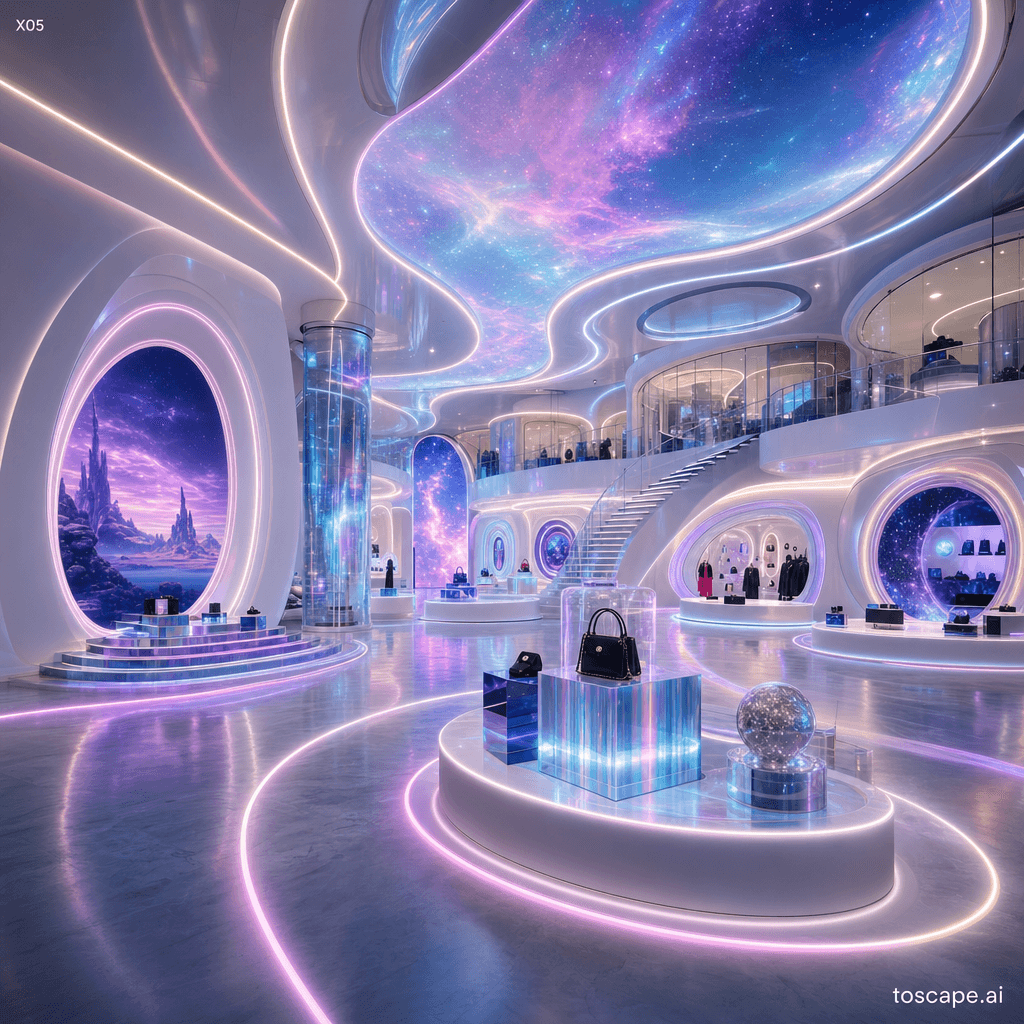
Interior reference image
Metaverse Showroom composition, material palette, furniture language, and lighting direction.
Context Snapshot
Born from digital design, virtual environments, and the metaverse revolution in gaming, art, and future commerce, this style... Applied to flagship tech retail, virtual flagship stores, immersive pop-ups, high-end gaming lounges, digital art galleries, luxury product launches, and brand experiences in both physical and virtual realms. Blend real architectural elements with digitally-inspired geometry, advanced lighting, augmented reality placements, and immaterial visual effects for a hybrid physical/virtual experience.
Composition And Planning
Open and boundaryless with flowing circulation; central or modular display platforms anchor focal points without visible partitions. Dynamic and exploratory; users/visitors are gently guided by visual cues, glowing paths, and spatial highlights rather than doors or corridors. Wide-angled, slightly elevated or floating perspectives; sense of vanishing point or receding light; strong midground feature with layered glowing background and clean foreground.
Furniture Grammar
Futuristic, low-profile, rounded and sculptural; often modular or abstract; seamless joins and floating forms. Arrange to encourage flow and spatial curiosity-never block visual lines; use floating or modular clusters for editorial scenes. - Iridescent sculptural plinth - Floating pod lounge seat - Chromed display disk - Transparent LED console
Creative Direction
A luminous, boundaryless digital space with floating iridescent platforms, chromed display objects, seamless radiant walls, and visually infinite, editorially composed light layers. Sculpted negative space, glowing digital art, immersive perspective, seamless chromatic reflections, and strong display hierarchy-all captured in cinematic clarity. Deep, glowing gradients, strong luminous contrasts, floating holographic platforms, iridescent edge highlights, and a sense of virtual infinity. - Flawless seamless surfaces - Editorial, clean digital lighting with sharp gradients - Limited, highly-curated showpieces on glowing sculptural plinths
Best Project Applications
- Virtual showrooms, digital art galleries, brand experience suites, product launches, tech hubs.
Preserve, Transform, Avoid
Preserve
- Preserve seamless, fluid digital geometry and spatial openness.
- Preserve luminous and iridescent surfaces with editorial clarity.
- Preserve the sense of digital infinity and floating negative space.
- Preserve integrated digital art/display as core to the experience.
Transform
- Evolve display logic with curated floating objects or immersive virtual content.
- Intensify lighting drama with controlled gradients or chromatic LED effects.
- Offer layered compositions with foreground/midground/background digital depth cues.
- Experiment with virtual plant forms or interactive digital "nature" only as abstract sculpture.
Avoid
- Introducing wood, stone, brick, or any rustic/natural material.
- Using classic sofa/chair typologies or domestic layouts.
- Filling space with random decor or non-digital art.
- Adding traditional pendant lighting, chandeliers, or sconces.
- Complicating form with unnecessary ornament or trim.
Frequently asked questions
What is Metaverse Showroom?
Metaverse Showroom is an interior design style used for architectural visualization. An immersive, fluid, and luminous digital-native interior defined by seamless geometry, iridescent highlights, and futuristic spatial infinity.
What materials define Metaverse Showroom?
Ultra-smooth, high-gloss, mirror-like, luminous, refractive, and virtual; not tactile or coarse. Use seamless white on floors/walls/ceilings, iridescent or translucent panels on displays and focal points.
What is the Metaverse Showroom color palette?
Clean luminous white, seamless iridescent gradients, neon cyan/magenta accents, and reflective chrome for an elevated, digital-forward harmony. Use high-contrast neutrals with bold digital color accents and iridescent blends; gradients.
What is the origin of Metaverse Showroom?
Born from digital design, virtual environments, and the metaverse revolution in gaming, art, and future commerce, this style... Applied to flagship tech retail, virtual flagship stores, immersive pop-ups, high-end gaming lounges, digital art galleries, luxury product launches, and brand experiences in both physical and virtual realms.
When should architects use Metaverse Showroom?
A luminous, boundaryless digital space with floating iridescent platforms, chromed display objects, seamless radiant walls, and visually infinite, editorially composed light layers. Sculpted negative space, glowing digital art, immersive perspective, seamless chromatic reflections, and strong display hierarchy-all captured in cinematic clarity. Deep, glowing gradients, strong luminous contrasts, floating holographic platforms, iridescent edge highlights, and a sense of virtual infinity.
How do you render Metaverse Showroom in Toscape?
Open Toscape on Windows, load your own photo, elevation, sketch, or CAD view, then apply the Metaverse Showroom reference from the built-in style library. The Interior Design workflow keep your project geometry and camera while shifting materials, proportion, and detailing toward Metaverse Showroom.
Use this style in Toscape
Explore Metaverse Showroom inside Toscape using interior-focused rendering workflows and gallery references.
Open interior references