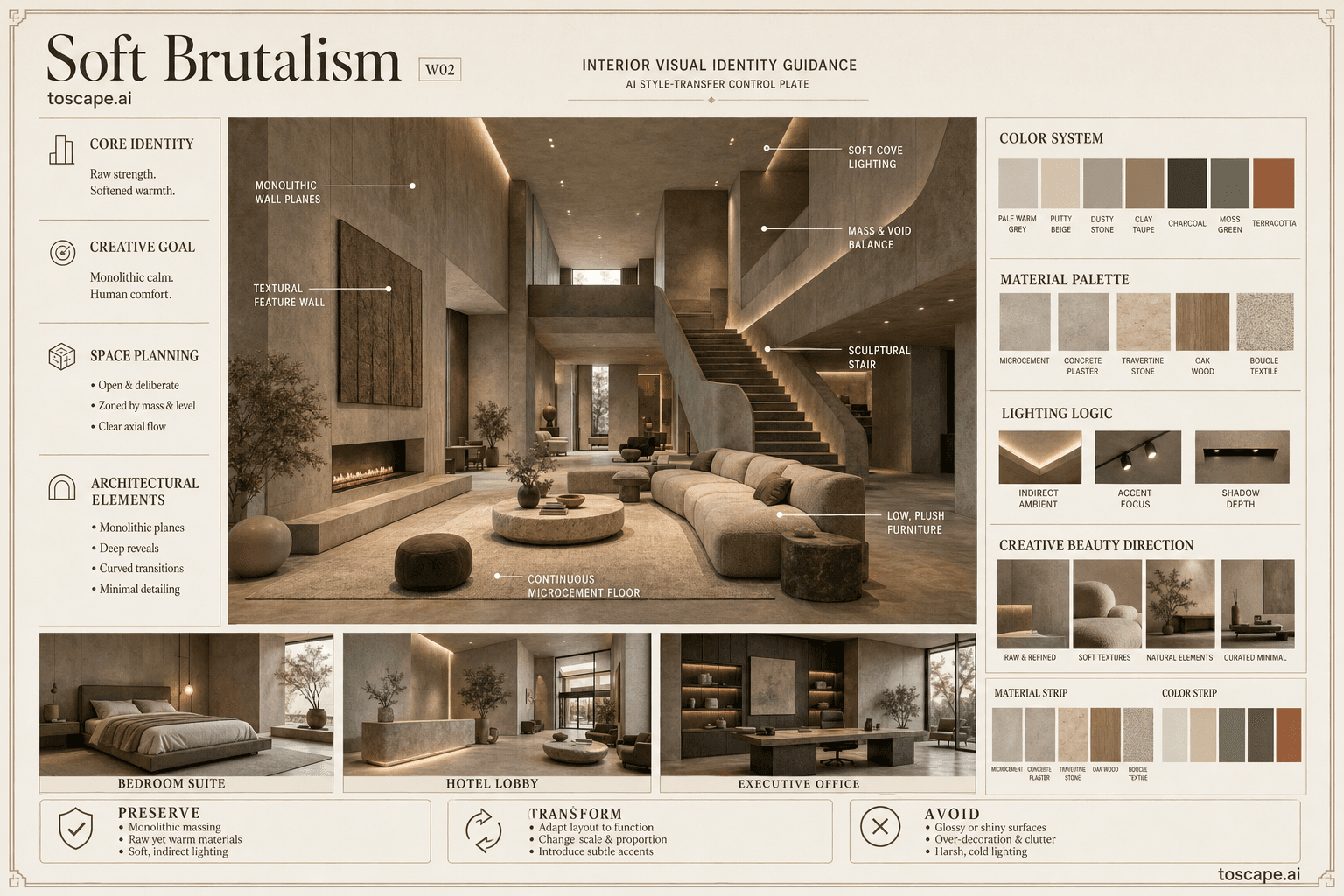
Soft Brutalism
W02 / Modern / Minimal / Monolithic / Gentle Industrial
A monolithic yet warm architectural interior style balancing structural rawness, smooth tactile finishes, and inviting visual softness.
Definition
Soft Brutalism is an interior design style used for architectural visualization. A monolithic yet warm architectural interior style balancing structural rawness, smooth tactile finishes, and inviting visual softness.
- Family
- Modern / Minimal / Monolithic / Gentle Industrial.
- Origin
- Inspired by mid-20th-century Brutalism, reimagined for 21st-century interiors that crave both visual weight and psychological.
- Massing
- Rectilinear and geometric with select curves, blocky masses, deep reveals, thick planes, smooth transitions, and simplified detailing.
- Materials
- Subtly tactile-grainy, smooth stone; soft matte wood; thick plush textiles; never slick or glossy.
- Palette
- Warm pale greys, putty beiges, moss accents, blackened steel, tactile stone; layered, tonally rich but not busy.
- Lighting
- Concealed linear LEDs, low cove lighting, or wall-washers that produce broad, indirect illumination.
Overview
Soft Brutalism is an interior design style defined by A streamlined, monolithic interior style balancing raw structural presence and strong forms with tactile softness, warmth, and serene, habitable atmosphere. To evoke a sense of grounded monumentality softened by comfort and tactility, making raw architecture feel human, elegant, and emotionally warm.
Visual DNA
Spatial Feeling
Calm, monumental, grounded, sheltering, and softly luminous.
Form Language
Rectilinear and geometric with select curves, blocky masses, deep reveals, thick planes, smooth transitions, and simplified detailing. Generously scaled but never cavernous; perceived height and volume balanced by mass-thick walls, deep...
Composition
Open but deliberate; rooms read as "carved" from monolithic volumes, with sightlines and zones shaped by architectural mass. Custom sculptural feature walls, a monolithic fireplace, textural panels, deeply set windows, or a single...
Interior Elements
Smooth microcement, sanded concrete, finely rendered plaster, or large-format solid surface-textural but refined. Quiet and flat, with sharp shadow reveals or exposed soffits; occasional recessed lighting or subtle cove-lit edges....
Color System
Warm pale greys, putty beiges, moss accents, blackened steel, tactile stone; layered, tonally rich but not busy. Keep tones muted, earthy, and harmonious; blocks of soft neutrals punctuated by gentle, unsaturated color moments. Deep...
Material Palette
Subtly tactile-grainy, smooth stone; soft matte wood; thick plush textiles; never slick or glossy. Dominant monolithic materials for architecture; natural woods and linens for softening furniture and accents; metals used highly...
Lighting Logic
Concealed linear LEDs, low cove lighting, or wall-washers that produce broad, indirect illumination. Use directional beams, strong shadow-casting, and accent lighting for volume; encourage interplay of darkness and light to enhance the...
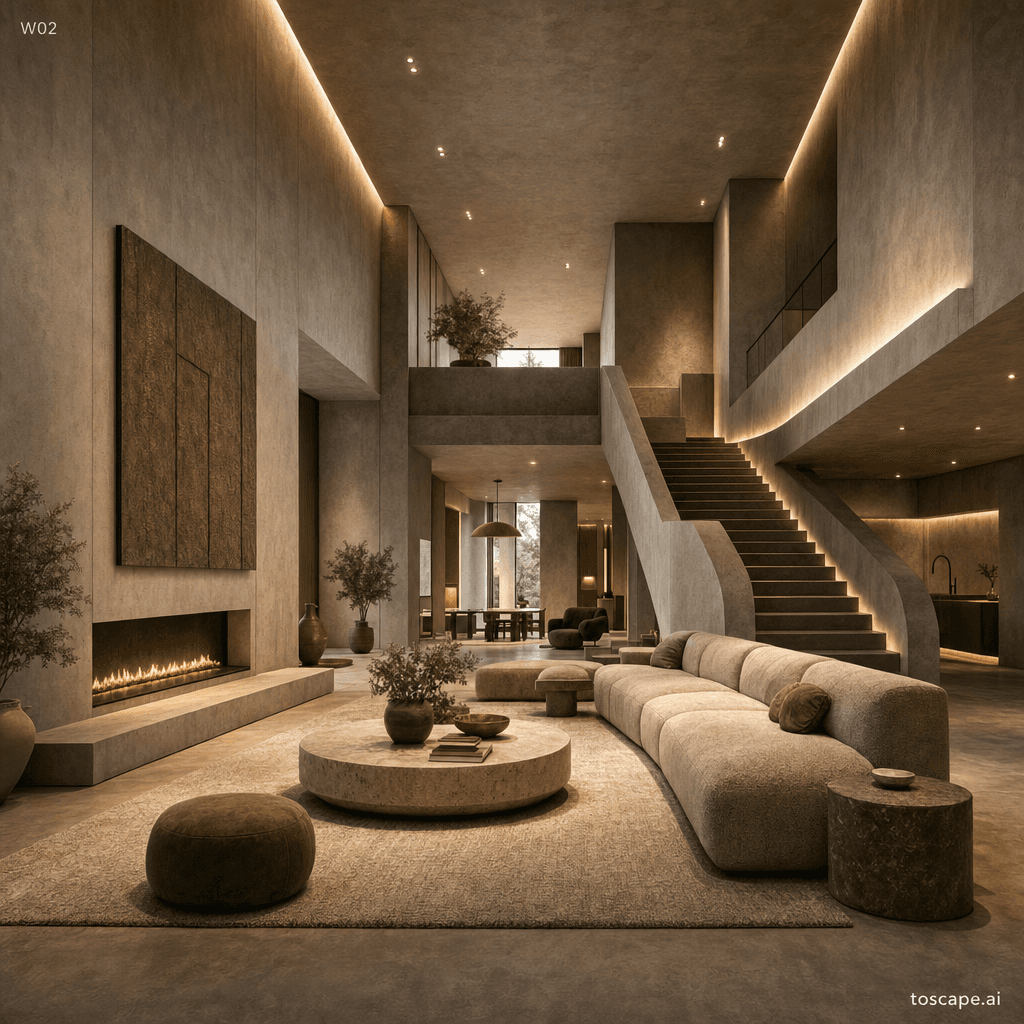
Interior reference image
Soft Brutalism composition, material palette, furniture language, and lighting direction.
Context Snapshot
Inspired by mid-20th-century Brutalism, reimagined for 21st-century interiors that crave both visual weight and psychological... Seen in high-end residences, hotels, galleries, lounges, showrooms, and creative workspaces emphasizing serene monumentality and livable softness. Edit out harshness-use raw, monolithic elements but pair them with natural textiles, refined furniture, rounded corners, ambient lighting, and a muted, warm palette.
Composition And Planning
Open but deliberate; rooms read as "carved" from monolithic volumes, with sightlines and zones shaped by architectural mass. Movement feels calm and processional-fluid transitions, long axial views, and seamless movement between zones. Best visualized from a low to mid-level camera, with strong foreground/midground relationships, leading lines from forms or shadows, and a focal background wall-emphasizing depth and scale.
Furniture Grammar
Chunky, block-like, softly geometric, with rounded corners and deep seats; simple, elemental, and low-lying. Furniture floats in the space, anchored by a large rug; avoid pushing all pieces to the walls; keep the room uncluttered and focused on grouping. - Modular block sofa with soft curves - Monolithic microcement or stone coffee table - Low daybed in textured off-white linen
Creative Direction
A gallery-like living environment with soft daylight skimming across pale microcement planes, plush linen seating blocks, a sculpted stone coffee table, and thick shadow lines, all floating in calm, warm emptiness. A single grand focal wall with smooth block surfaces, low modular furniture, neutral heavy fabrics, framed by an oversized pale rug and a single curated art object-styled with absolute restraint and visual confidence. Monumental forms emerge from shadow with directional light-blocky furniture catches the glow, while deep set reveals interplay with darkness to build haunting, elegant contrast. - Flawless wall and floor finishing...
Best Project Applications
- Luxury residential, design-led hotels, gallery lounges, premium showrooms, creative studios.
Preserve, Transform, Avoid
Preserve
- Preserve monolithic block forms and massing.
- Preserve honest tactile materials-microcement, stone, wool, linen.
- Preserve a low, muted, warm/neutral palette.
- Preserve calm, controlled negative space and deep shadow lines.
Transform
- Introduce gentle curves and radiused corners to soften massing.
- Add plush tactile textiles to improve comfort and warmth.
- Use sculptural minimalist lighting to create visual interest.
- Integrate large-scale art or a single bold sculpture for select focus.
Avoid
- Styling the space as harsh or cold, with no softness or comfort.
- Overdecorating with accessories, colors, or small trinkets.
- Adding ornate, classical, traditional, or overly rustic elements.
- Using cheap glossy finishes, laminate, or plastic.
- Placing all furniture against the walls or cluttering the space.
Frequently asked questions
What is Soft Brutalism?
Soft Brutalism is an interior design style used for architectural visualization. A monolithic yet warm architectural interior style balancing structural rawness, smooth tactile finishes, and inviting visual softness.
What materials define Soft Brutalism?
Subtly tactile-grainy, smooth stone; soft matte wood; thick plush textiles; never slick or glossy. Dominant monolithic materials for architecture; natural woods and linens for softening furniture and accents; metals used highly.
What is the Soft Brutalism color palette?
Warm pale greys, putty beiges, moss accents, blackened steel, tactile stone; layered, tonally rich but not busy. Keep tones muted, earthy, and harmonious; blocks of soft neutrals punctuated by gentle, unsaturated color moments. Deep.
What is the origin of Soft Brutalism?
Inspired by mid-20th-century Brutalism, reimagined for 21st-century interiors that crave both visual weight and psychological... Seen in high-end residences, hotels, galleries, lounges, showrooms, and creative workspaces emphasizing serene monumentality and livable softness. Edit out harshness-use raw, monolithic elements but pair them with natural textiles, refined furniture, rounded corners, ambient lighting, and a muted, warm palette.
When should architects use Soft Brutalism?
A gallery-like living environment with soft daylight skimming across pale microcement planes, plush linen seating blocks, a sculpted stone coffee table, and thick shadow lines, all floating in calm, warm emptiness.
How do you render Soft Brutalism in Toscape?
Open Toscape on Windows, load your own photo, elevation, sketch, or CAD view, then apply the Soft Brutalism reference from the built-in style library. The Interior Design workflow keep your project geometry and camera while shifting materials, proportion, and detailing toward Soft Brutalism.
Use this style in Toscape
Explore Soft Brutalism inside Toscape using interior-focused rendering workflows and gallery references.
Open interior references