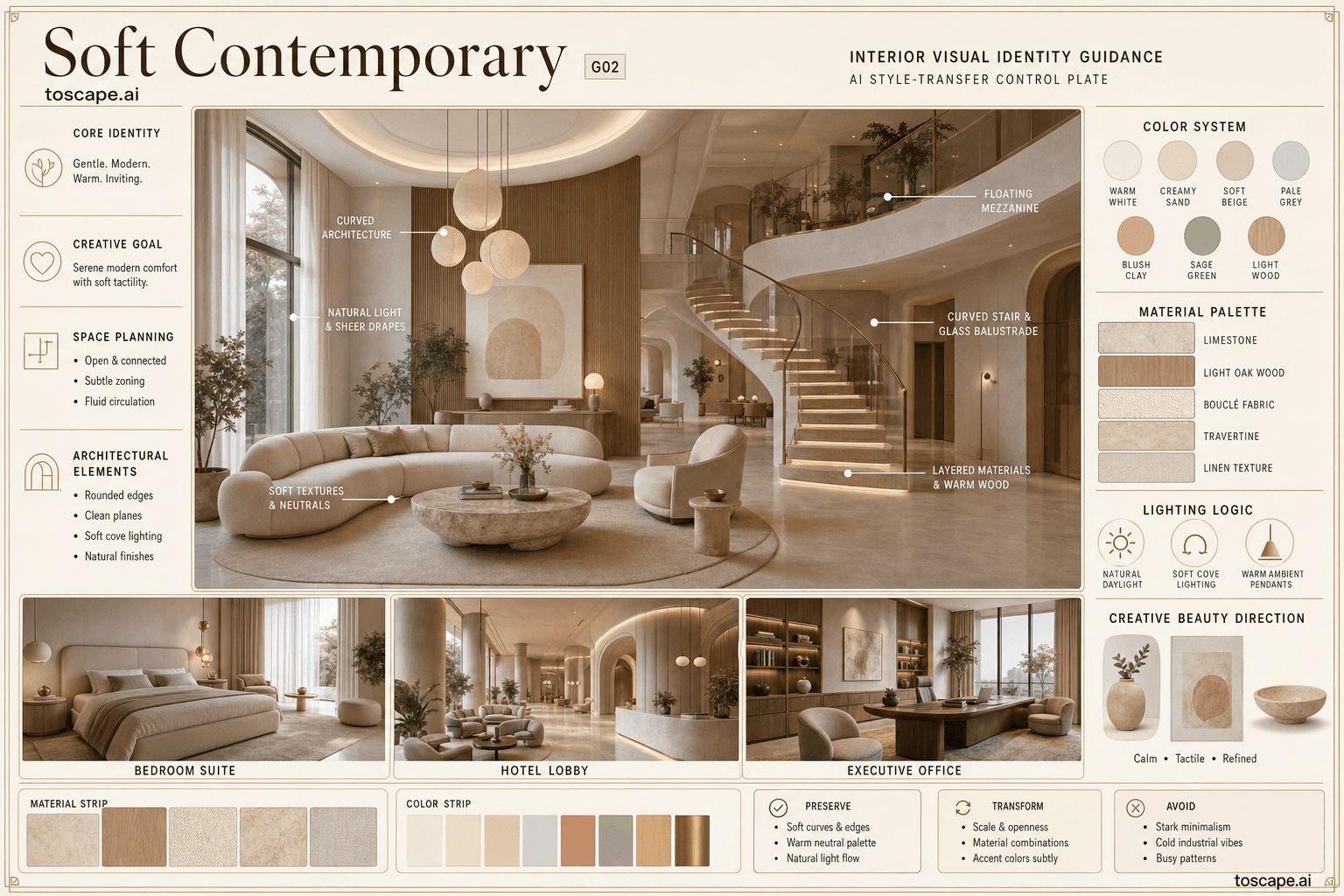
Soft Contemporary
G02 / Contemporary, Warm Contemporary, Modern Organic, Minimal, Urban Contemporary
A welcoming contemporary interior style defined by soft curves, warm neutrals, tactile textures, and calm, uncluttered composition.
Definition
Soft Contemporary is an interior design style used for architectural visualization. A welcoming contemporary interior style defined by soft curves, warm neutrals, tactile textures, and calm, uncluttered composition.
- Family
- Contemporary, Warm Contemporary, Modern Organic, Minimal, Urban Contemporary.
- Origin
- Evolved from the late-20th and early-21st-century contemporary movement, responding to the need for humanizing modern.
- Massing
- Predominantly clean lines softened by gentle curves, rounded edges, low-relief shapes, pillowed forms, floating planes, and subtle arching elements.
- Materials
- Tactile, touchable, subtly layered-soft textile weaves, smooth stone, gentle wood grain, and matte or suede-like surfaces.
- Palette
- Warm white, soft sand, light taupe, pale wood, creamy textiles, blush or brushed brass accent for a tranquil, luminous feel.
- Lighting
- Diffuse, indirect sources: soft perimeter coves, shallow ceiling-wash LEDs, uplighting, hidden strips, and gentle pendant glow for an even mood.
Overview
Soft Contemporary is an interior design style defined by A gentle, fluid, and approachable contemporary interior style defined by soft silhouettes, warm neutral palettes, natural light, tactile textures, and restrained composition. The intent is to create spaces that feel soothing, approachable, and quietly refined, prioritizing livable beauty and soft tactility.
Visual DNA
Spatial Feeling
Open, airy, gentle, welcoming, serene, and subtly sophisticated.
Form Language
Predominantly clean lines softened by gentle curves, rounded edges, low-relief shapes, pillowed forms, floating planes, and subtle arching elements. Balanced horizontal-vertical articulation; medium-to-large scale for furniture with...
Composition
Open plan or semi-open spaces with gentle transitions; spaces feel connected but not empty. Feature furniture (e.g., curved sofa), sculptural stone coffee table, textured wall, large piece of art, or a softly lit joinery wall. Elevated...
Interior Elements
Smooth painted walls in soft matte finishes, gentle stone or wood cladding, micro-cement, subtle wall paneling, or low-relief curved architectural details. Ceilings are kept quiet and clean-flat or subtly coved, with gentle perimeter...
Color System
Warm white, soft sand, light taupe, pale wood, creamy textiles, blush or brushed brass accent for a tranquil, luminous feel. Build the palette from harmonious, close-toned neutrals; accents add barely-there warmth or gentle muted color...
Material Palette
Tactile, touchable, subtly layered-soft textile weaves, smooth stone, gentle wood grain, and matte or suede-like surfaces. Walls and ceilings remain matte and seamless; floors marry soft wood or stone with plush area rugs; joinery uses...
Lighting Logic
Diffuse, indirect sources: soft perimeter coves, shallow ceiling-wash LEDs, uplighting, hidden strips, and gentle pendant glow for an even mood. Highlight layered soft surfaces and gentle curves with side illumination; avoid harsh...
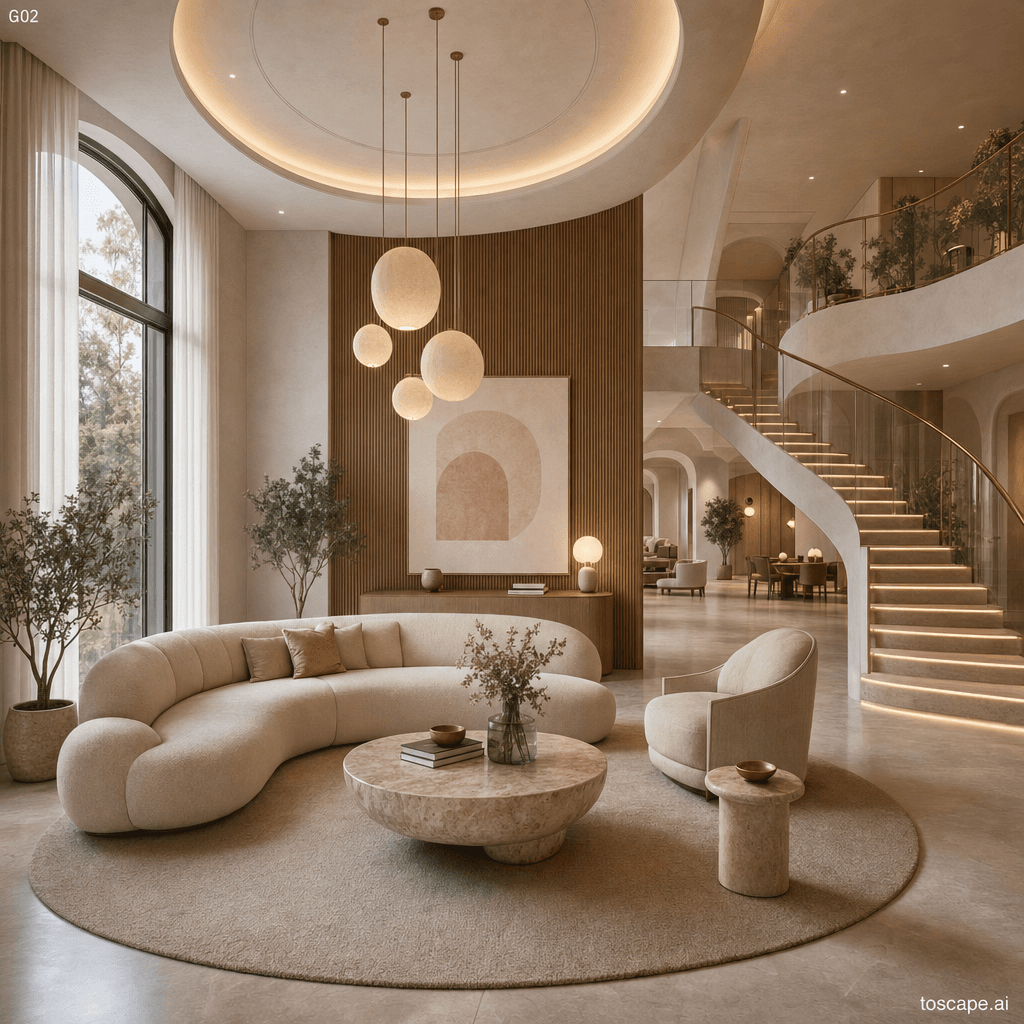
Interior reference image
Soft Contemporary composition, material palette, furniture language, and lighting direction.
Context Snapshot
Evolved from the late-20th and early-21st-century contemporary movement, responding to the need for humanizing modern... Widely used in high-end homes, lounges, modern hotels, upscale offices, wellness spaces, and design-led apartments-desirable for its universal appeal and comfort. Use sculptural but restrained soft lines, premium natural materials, and luminous neutral palettes with layered textures, keeping clutter minimal and forms elegant.
Composition And Planning
Open plan or semi-open spaces with gentle transitions; spaces feel connected but not empty. Fluid movement encouraged by unobstructed circulation; soft transitions with visual and physical comfort. Elevated eye-level or low perspective works best, with a strong foreground anchor (e.g., soft sofa curve), gentle leading lines, and deep luminous layers; use asymmetrical compositions with a soft visual anchor.
Furniture Grammar
Curved, low-profile, generously upholstered with pillowy gestures; rounded corners, softly monolithic shapes, and floating bases. Loose conversational groupings, off-wall placement, plenty of breathing space between items; furniture often anchors visual zones but never crowds. - Curved modular sofa in textured fabric - Sculptural soft-sided armchair - Rounded stone or wood plinth coffee table
Creative Direction
A luminous, tranquil living space with a gentle curved sofa in creamy boucle, seamless matte walls, a floating low table in light stone, layered plush rugs, minimalist sculptural lighting, subtle brushed brass touches, airy curtains, and balanced negative space. Cleverly styled with one or two statement curves, light diffusion across textured surfaces, oversized, elegant art, and minimal yet precise object placement-immaculately tactile and soothing. Soft shadows, diffuse golden-hour light, visible plush textiles, glowing perimeters, and quiet stillness; gently reflective surfaces highlight tactile warmth and shapes. - Real, quality...
Best Project Applications
- Luxury living rooms, tranquil bedrooms, boutique hotels, serene lounges.
Preserve, Transform, Avoid
Preserve
- Preserve gentle curves and rounded edges in key furnishings and built-ins.
- Preserve tactile, layered textile and upholstery language.
- Preserve warm, soft-neutral color palettes and harmonious material restraint.
- Preserve uncluttered, welcoming compositions with open negative space.
Transform
- Allow creative use of sculptural lighting or statement curved joinery for additional warmth and editorial quality.
- Introduce subtle biophilic gestures (single plant or artful greenery) for softness.
- Upgrade material quality: real wood, plush textiles, honed stone.
- Refine spatial flow and zone transitions with custom floating furniture or low feature walls.
Avoid
- Harsh geometric lines without softening.
- Cold or clinical color palettes (greys, blues, clinical whites).
- Heavy ornament, intricate moulding, or historical references.
- Industrial, exposed structure, or distressed finishes.
- Cheap plastic, high-gloss or mirrored synthetic surfaces.
Frequently asked questions
What is Soft Contemporary?
Soft Contemporary is an interior design style used for architectural visualization. A welcoming contemporary interior style defined by soft curves, warm neutrals, tactile textures, and calm, uncluttered composition.
What materials define Soft Contemporary?
Tactile, touchable, subtly layered-soft textile weaves, smooth stone, gentle wood grain, and matte or suede-like surfaces. Walls and ceilings remain matte and seamless; floors marry soft wood or stone with plush area rugs; joinery uses.
What is the Soft Contemporary color palette?
Warm white, soft sand, light taupe, pale wood, creamy textiles, blush or brushed brass accent for a tranquil, luminous feel. Build the palette from harmonious, close-toned neutrals; accents add barely-there warmth or gentle muted color.
What is the origin of Soft Contemporary?
Evolved from the late-20th and early-21st-century contemporary movement, responding to the need for humanizing modern... Widely used in high-end homes, lounges, modern hotels, upscale offices, wellness spaces, and design-led apartments-desirable for its universal appeal and comfort. Use sculptural but restrained soft lines, premium natural materials, and luminous neutral palettes with layered textures, keeping clutter minimal and forms elegant.
When should architects use Soft Contemporary?
A luminous, tranquil living space with a gentle curved sofa in creamy boucle, seamless matte walls, a floating low table in light stone, layered plush rugs, minimalist sculptural lighting, subtle brushed brass touches, airy curtains, and balanced negative space.
How do you render Soft Contemporary in Toscape?
Open Toscape on Windows, load your own photo, elevation, sketch, or CAD view, then apply the Soft Contemporary reference from the built-in style library. The Interior Design workflow keep your project geometry and camera while shifting materials, proportion, and detailing toward Soft Contemporary.
Use this style in Toscape
Explore Soft Contemporary inside Toscape using interior-focused rendering workflows and gallery references.
Open interior references