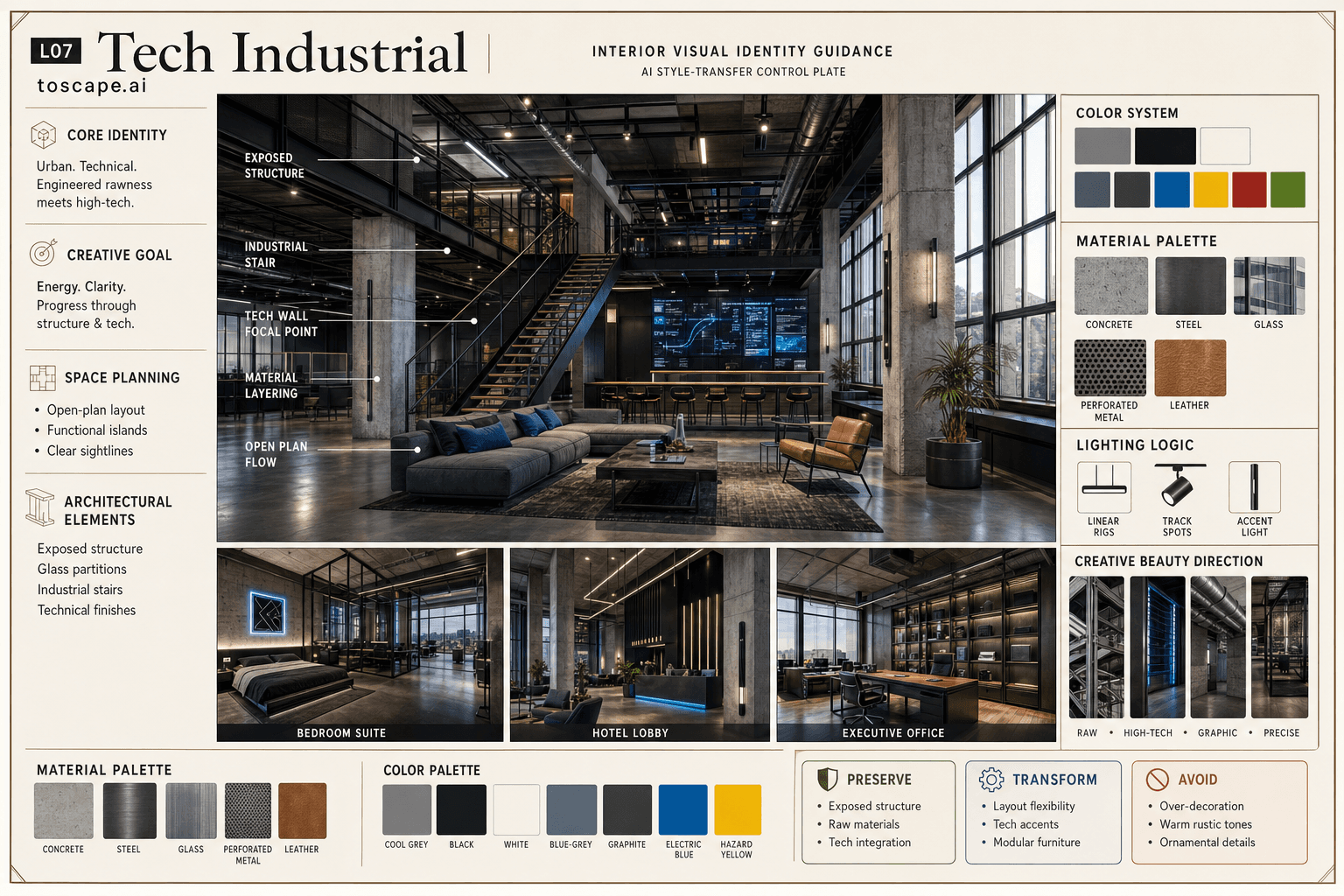
Tech Industrial
L07 / Industrial / Urban Contemporary / High-Tech / Minimal
A bold, high-tech industrial interior with exposed structure, engineered materials, visible technical systems, and striking urban clarity.
Definition
Tech Industrial is an interior design style used for architectural visualization. A bold, high-tech industrial interior with exposed structure, engineered materials, visible technical systems, and striking urban clarity.
- Family
- Industrial / Urban Contemporary / High-Tech / Minimal.
- Origin
- Roots in the adaptive reuse of factories and lofts (late 20th century) updated with a technology-forward mindset.
- Massing
- Bold geometry, exposed beams and columns, graphic lines, grids, frameworks, modular layouts, crisp rectangular forms, and floating or cantilevered elements.
- Materials
- Smooth, matte, raw, crisp-edged, technical, machine-precise, with tactile contrast between cold (metal/concrete/glass) and rare warm (timber).
- Palette
- Matte concrete, crisp white, black steel, brushed aluminum, glass, and an electric blue or yellow highlight.
- Lighting
- Linear LED strips, indirect coves, high bay fixtures, grid lighting, or suspended technical panels.
Overview
Tech Industrial is an interior design style defined by An urban, innovative industrial interior style defined by exposed structure, technical detailing, advanced materials, graphic lines, and a seamless integration of technology and modern design. To evoke energy, clarity, and progress through a balance of engineered rawness and state-of-the-art technical sophistication.
Visual DNA
Spatial Feeling
Open, urban, high-impact, energetic, and raw yet controlled; a mood of technical confidence and creative potential.
Form Language
Bold geometry, exposed beams and columns, graphic lines, grids, frameworks, modular layouts, crisp rectangular forms, and floating or cantilevered elements. Tall ceilings, wide-open spaces, volumetric clarity, and a sense of air and...
Composition
Open-plan with functional islands, clearly zoned work/play/social areas, and sightlines that celebrate structural elements. Large-scale engineered details (stairs, bridges, lighting rigs, industrial columns), a signature tech wall, or a...
Interior Elements
Exposed concrete, architectural glass, painted structural steel, technical panels (e.g., black/grey metal, engineered composite), with minimal applied detail. Exposed mechanical ceilings: visible ducts, beams, cable trays, acoustic...
Color System
Matte concrete, crisp white, black steel, brushed aluminum, glass, and an electric blue or yellow highlight. Use cool/neutral base; add strong dark/light contrast and occasional saturated tech accent for graphic vitality. Dial up the...
Material Palette
Smooth, matte, raw, crisp-edged, technical, machine-precise, with tactile contrast between cold (metal/concrete/glass) and rare warm (timber). Reserve concrete for structure and envelope, steel for framework and partition, glass for...
Lighting Logic
Linear LED strips, indirect coves, high bay fixtures, grid lighting, or suspended technical panels. Use deep directional shadows, strong side or top-lit contrast, dramatic spot highlights on structure or metal, and focused accent color...
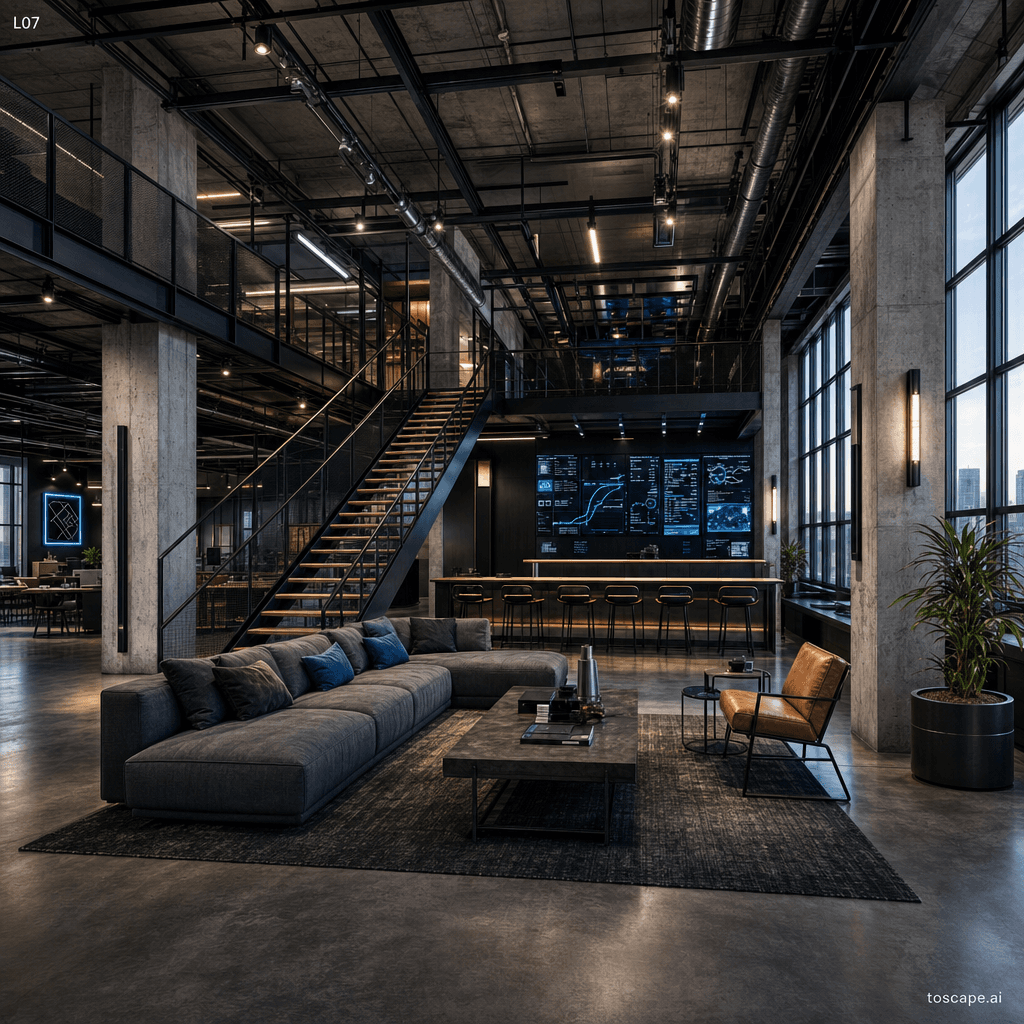
Interior reference image
Tech Industrial composition, material palette, furniture language, and lighting direction.
Context Snapshot
Roots in the adaptive reuse of factories and lofts (late 20th century) updated with a technology-forward mindset, drawing on... Used in tech office interiors, high-end creative studios, premium urban lofts, innovation centers, and destination hospitality concepts wanting a future-forward industrial edge. Elevate structure as design; integrate technical systems visibly and aesthetically; favor clean lines, engineered glass, precision metals, vanguard lighting, and minimal visual clutter.
Composition And Planning
Open-plan with functional islands, clearly zoned work/play/social areas, and sightlines that celebrate structural elements. Direct, dynamic, unhindered paths; circulation benefits from sightlines along beams, tracks, windows, or exposed conduits. Use wide-angle views, elevated eye level, clear structural foreground, deep linear perspective, bold diagonal or grid lines, and layered zones for depth.
Furniture Grammar
Crisp-edged, blocky or modular, technically detailed, low profile or cantilevered; industrial-precision over homey comfort. Clustered for use, floated in space to reinforce openness, rarely hugging the walls; keep circulation fluid and structure visible. - Black steel and glass shelving unit - Low-profile modular sectional in neutral textile - Industrial trestle table - Mesh tech desk chair
Creative Direction
A dramatic, light-filled urban loft featuring a rhythmic ceiling grid, black steel columns, crystalline glass partitions, sleek modular furnishings, and a kinetic pattern of light and shadow playing across industrial surfaces. Impeccably finished with razor-sharp lines, bold structure, precision joinery, isolated color accents, and signature sculptural lighting highlighted in photographic broad daylight or focused spot contrast. Deep, directional shadows; selective accent lighting picks out steel, glass, and technical elements; urban night outside windows; a strong, moody, future-forward energy. - Flawless technical detailing - Custom...
Best Project Applications
- Creative offices, urban loft apartments, innovation labs, design studios.
Preserve, Transform, Avoid
Preserve
- Exposed structural elements (beams, columns, ceiling)
- Raw, engineered industrial materials (concrete, steel, glass)
- High-contrast composition with powerful light/shadow interplay
- Visible tech infrastructure-lighting, cabling, integrated controls
Transform
- Innovate technical joinery and engineered details for new visual drama
- Integrate smart systems and lighting for elevated tech experience
- Use color pops (electric blue/yellow) for bold graphic punch
- Refine and float modular furniture for greater spatial clarity
Avoid
- Faux-vintage, distressed, or rustic finishes
- Decor-heavy, homey or boho accessories or upholstery
- Ornate or soft classical/traditional features
- Hiding technical features behind drywall or panels
- Overfilling space and losing structure/negative space
Frequently asked questions
What is Tech Industrial?
Tech Industrial is an interior design style used for architectural visualization. A bold, high-tech industrial interior with exposed structure, engineered materials, visible technical systems, and striking urban clarity.
What materials define Tech Industrial?
Smooth, matte, raw, crisp-edged, technical, machine-precise, with tactile contrast between cold (metal/concrete/glass) and rare warm (timber). Reserve concrete for structure and envelope, steel for framework and partition.
What is the Tech Industrial color palette?
Matte concrete, crisp white, black steel, brushed aluminum, glass, and an electric blue or yellow highlight. Use cool/neutral base.
What is the origin of Tech Industrial?
Roots in the adaptive reuse of factories and lofts (late 20th century) updated with a technology-forward mindset, drawing on... Used in tech office interiors, high-end creative studios, premium urban lofts, innovation centers, and destination hospitality concepts wanting a future-forward industrial edge.
When should architects use Tech Industrial?
A dramatic, light-filled urban loft featuring a rhythmic ceiling grid, black steel columns, crystalline glass partitions, sleek modular furnishings, and a kinetic pattern of light and shadow playing across industrial surfaces. Impeccably finished with razor-sharp lines, bold structure, precision joinery, isolated color accents, and signature sculptural lighting highlighted in photographic broad daylight or focused spot contrast.
How do you render Tech Industrial in Toscape?
Open Toscape on Windows, load your own photo, elevation, sketch, or CAD view, then apply the Tech Industrial reference from the built-in style library. The Interior Design workflow keep your project geometry and camera while shifting materials, proportion, and detailing toward Tech Industrial.
Use this style in Toscape
Explore Tech Industrial inside Toscape using interior-focused rendering workflows and gallery references.
Open interior references