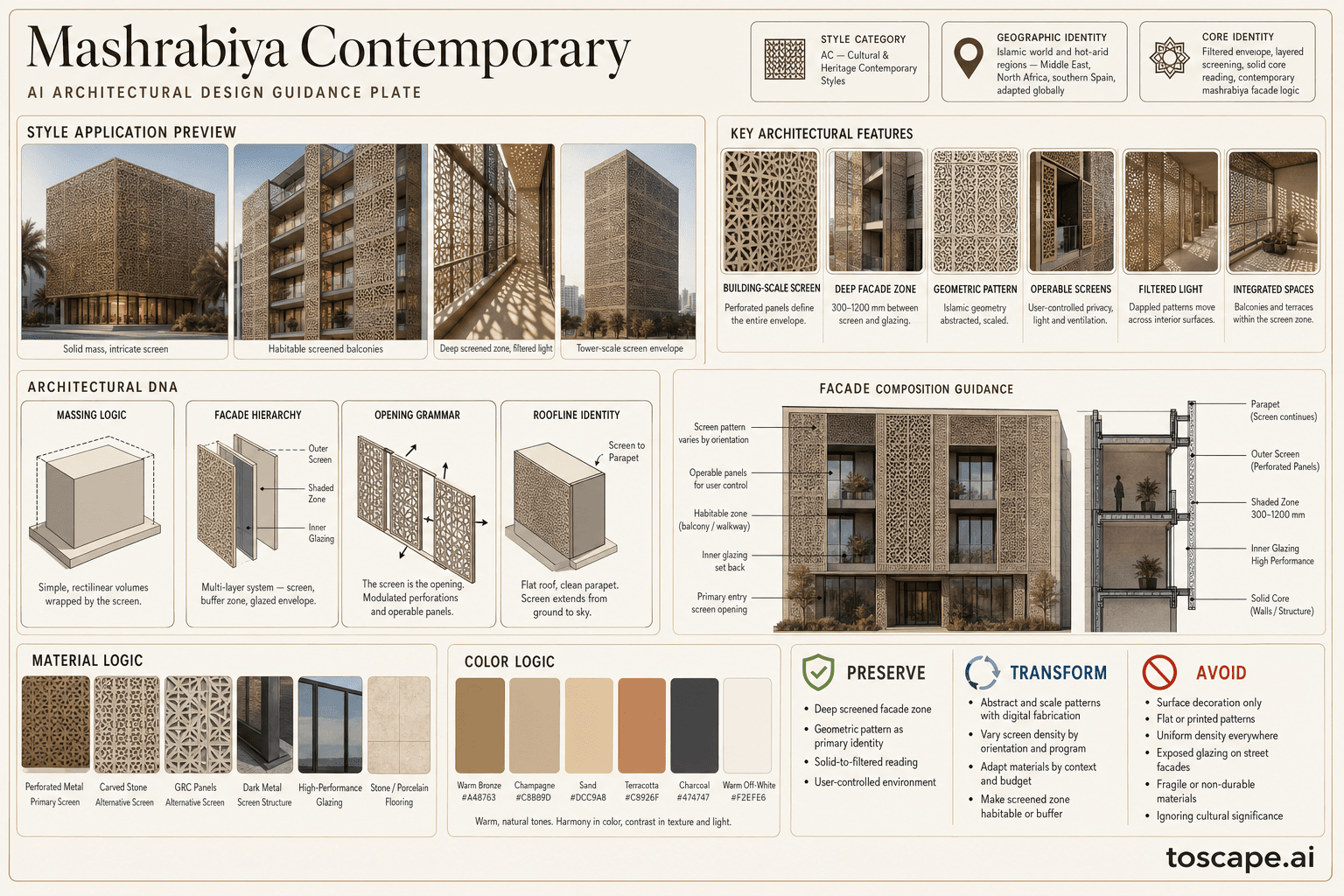
Mashrabiya Contemporary
Islamic world and hot-arid regions - Middle East, North Africa, southern Spain, and... / Cultural heritage
Filtered envelope, layered screening, solid core reading, and contemporary mashrabiya facade logic.
Definition
Mashrabiya Contemporary is a global architectural style within the cultural heritage. Filtered envelope, layered screening, solid core reading, and contemporary mashrabiya facade logic.
- Family
- Cultural heritage
- Origin
- Islamic world and hot-arid regions - Middle East, North Africa.
- Massing
- Massing is typically rectilinear and composed. The screen unifies the facade, so volumetric complexity is minimized.
- Materials
- Primary screen: perforated aluminum or steel panels, powder-coated or anodized Alternative screen: carved stone (limestone, marble), GRC panels, terracotta baguettes Screen structure: dark metal framing.
- Palette
- Screen tones: warm bronze, champagne, sand, terracotta, or charcoal Wall tones: warm off-white, cream.
- Climate response
- Islamic world and hot-arid regions.
Overview
Mashrabiya Contemporary is a global architectural style rooted in Islamic world and hot-arid regions - Middle East, North Africa, southern Spain, and adapted globally in contexts where privacy, solar control, and cultural identity through screening are valued. Filtered envelope, layered screening, solid core reading, and contemporary mashrabiya facade logic. Mysterious, layered, and optically rich.
Visual DNA
Massing & Form
Massing is typically rectilinear and composed. the screen unifies the facade, so volumetric complexity is minimized.
Facade Language
The facade is a multi-layer system: an outer screen (perforated panels, louvered elements, or carved surfaces), an intermediate shaded zone (balcony, walkway, or buffer space), and the inner glazed building envelope. The outer screen is...
Materials & Texture
Primary screen: perforated aluminum or steel panels, powder-coated or anodized Alternative screen: carved stone (limestone, marble), GRC panels, terracotta baguettes Screen structure: dark metal framing.
Color Palette
Screen tones: warm bronze, champagne, sand, terracotta, or charcoal Wall tones: warm off-white, cream, or matching the screen base tone The screen color should harmonize with the wall. contrast is in texture, not color Avoid bright or...
Ornament & Detail
Deep screened facade zone. the mashrabiya is spatial, not surface-mounted.
Climate Response
Islamic world and hot-arid regions. Middle East, North Africa, southern Spain, and adapted globally in contexts where privacy, solar control, and cultural identity through screening are valued.
Landscape & Ground
Islamic world and hot-arid regions. Middle East, North Africa, southern Spain, and adapted globally in contexts where privacy, solar control, and cultural identity through screening are valued.
Reference elevation
Mashrabiya Contemporary - characteristic facade composition within the cultural heritage.
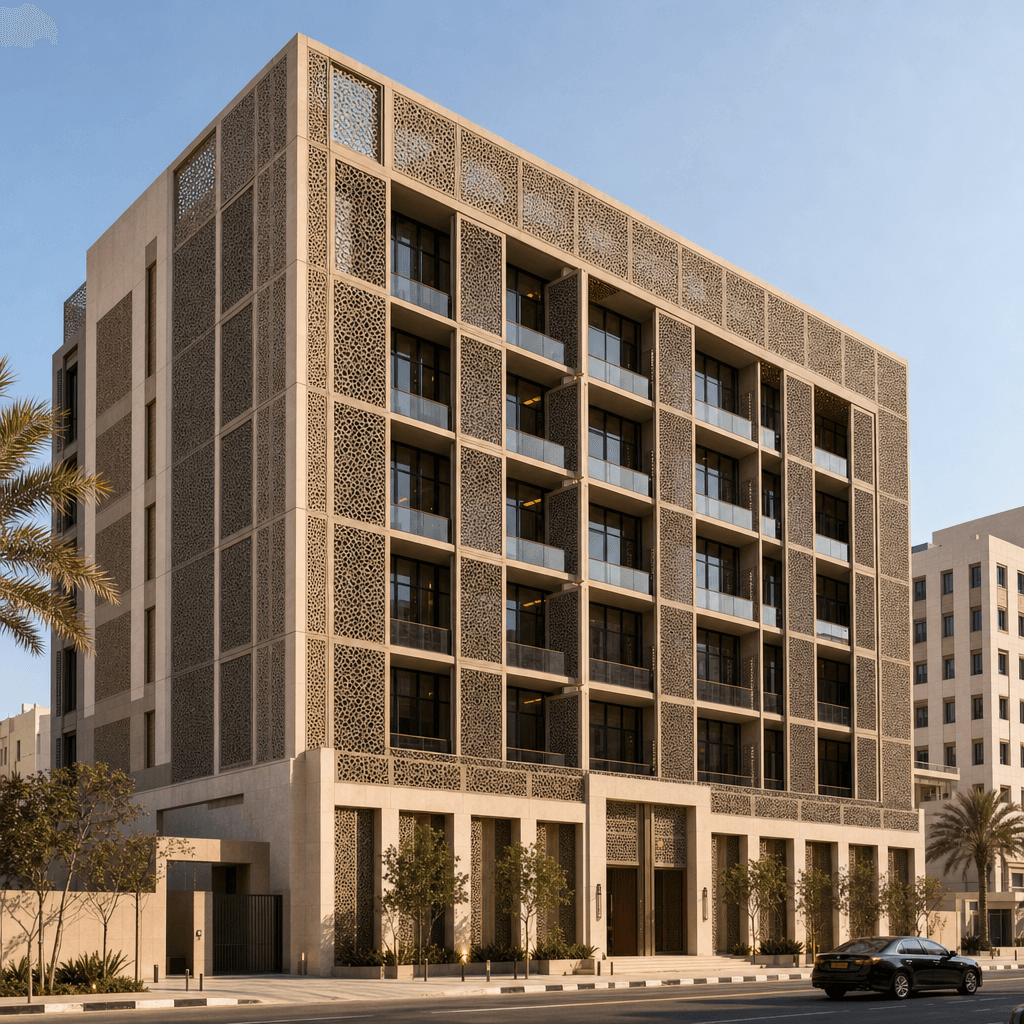
Context Snapshot
Mysterious, layered, and optically rich. Massing is typically rectilinear and composed - the screen unifies the facade, so volumetric complexity is minimized. Islamic world and hot-arid regions - Middle East, North Africa, southern Spain, and adapted globally in contexts where privacy, solar control, and cultural identity through screening are valued.
Contemporary Relevance
Today, Mashrabiya Contemporary remains relevant wherever projects need cultural heritage cues without losing performance or contemporary usability. In Toscape it responds best when prompts emphasize massing is typically rectilinear and composed - the screen unifies the facade, so volumetric complexity is minimized. primary screen: perforated aluminum or steel panels, powder-coated or anodized alternative screen: carved stone (limestone, marble), grc...
Use this style in Toscape
Explore Mashrabiya Contemporary directly inside Toscape using Facade Re-Style and design workflow prompts tuned for global architectural references.
Open Mashrabiya Contemporary in the galleryFrequently asked questions
What is Mashrabiya Contemporary?
Mashrabiya Contemporary is a global architectural style within the cultural heritage. Filtered envelope, layered screening, solid core reading, and contemporary mashrabiya facade logic.
What materials define Mashrabiya Contemporary?
Primary screen: perforated aluminum or steel panels, powder-coated or anodized Alternative screen: carved stone (limestone, marble), GRC panels, terracotta baguettes Screen structure: dark metal framing.
What is the Mashrabiya Contemporary color palette?
Screen tones: warm bronze, champagne, sand, terracotta, or charcoal Wall tones: warm off-white, cream, or matching the screen base tone The screen color should harmonize with the wall. Contrast is in texture.
What is the origin of Mashrabiya Contemporary?
Mysterious, layered, and optically rich. Massing is typically rectilinear and composed - the screen unifies the facade, so volumetric complexity is minimized. Islamic world and hot-arid regions - Middle East, North Africa, southern Spain, and adapted globally in contexts where privacy, solar control, and cultural identity through screening are valued.
When should architects use Mashrabiya Contemporary?
Today, Mashrabiya Contemporary remains relevant wherever projects need cultural heritage cues without losing performance or contemporary usability. In Toscape it responds best when prompts emphasize massing is typically rectilinear and composed - the screen unifies the facade, so volumetric complexity is minimized. Primary screen: perforated aluminum or steel panels, powder-coated or anodized alternative screen: carved stone (limestone, marble), grc.
How do you render Mashrabiya Contemporary in Toscape?
Open Toscape on Windows, load your own photo, elevation, sketch, or CAD view, then apply the Mashrabiya Contemporary reference from the built-in style library. The Facade Re-Style and Design Options workflows keep your project geometry and camera while shifting materials, proportion, and detailing toward Mashrabiya Contemporary.