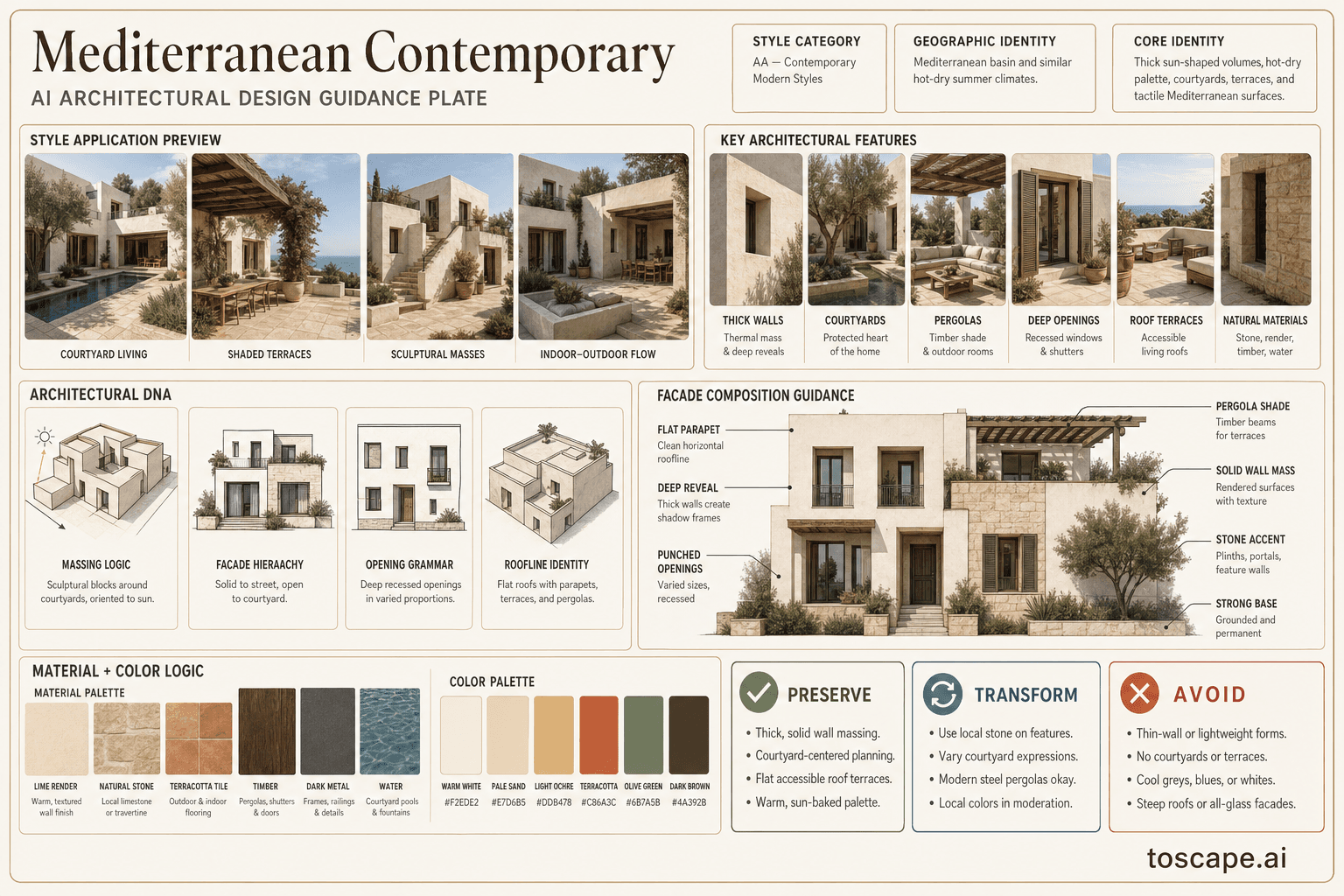
Mediterranean Contemporary
Mediterranean basin and similar hot-dry summer climates - southern Europe, North Africa,... / Contemporary modern
Thick sun-shaped volumes, hot-dry palette, courtyards, terraces, and tactile Mediterranean surfaces.
Definition
Mediterranean Contemporary is a global architectural style within the contemporary modern. Thick sun-shaped volumes, hot-dry palette, courtyards, terraces, and tactile Mediterranean surfaces.
- Family
- Contemporary modern
- Origin
- Mediterranean basin and similar hot-dry summer climates - southern Europe, North Africa.
- Massing
- Volumes are composed as sculptural blocks arranged around courtyards and terraces. The massing prioritizes solar orientation.
- Materials
- Walls: lime-based render (warm off-white, cream, or pale earth tones) Stone accents: local limestone, travertine, sandstone, or marble Flooring: large-format terracotta, limestone.
- Palette
- Primary tones: warm white, cream, pale limestone, soft sand, light ochre Earth accents: terracotta, warm clay, rust, burnt sienna (used sparingly) Timber tones: dark brown.
- Climate response
- Mediterranean basin and similar hot-dry summer climates. Southern Europe, North Africa, the Levant, coastal California, central Chile, South Australia, and South Africa's Western Cape.
Overview
Mediterranean Contemporary is a global architectural style rooted in Mediterranean basin and similar hot-dry summer climates - southern Europe, North Africa, the Levant, coastal California, central Chile, South Australia, and South Africa's Western Cape. Thick sun-shaped volumes, hot-dry palette, courtyards, terraces, and tactile Mediterranean surfaces. Grounded, sun-wise, and materially rich.
Visual DNA
Massing & Form
Volumes are composed as sculptural blocks arranged around courtyards and terraces. The massing prioritizes solar orientation.
Facade Language
Facades express the thickness and solidity of walls through deep recesses and shadow lines. Rendered surfaces are smooth but not perfect.
Materials & Texture
Walls: lime-based render (warm off-white, cream, or pale earth tones) Stone accents: local limestone, travertine, sandstone, or marble Flooring: large-format terracotta, limestone, or porcelain tiles Timber: dark-stained hardwood for...
Color Palette
Primary tones: warm white, cream, pale limestone, soft sand, light ochre Earth accents: terracotta, warm clay, rust, burnt sienna (used sparingly) Timber tones: dark brown, weathered grey, charcoal-stained Metal tones: dark bronze, matte...
Ornament & Detail
Thick, solid wall massing. maintain the thermal and visual weight of Mediterranean walls.
Climate Response
Mediterranean basin and similar hot-dry summer climates. southern Europe, North Africa, the Levant, coastal California, central Chile, South Australia, and South Africa's Western Cape.
Landscape & Ground
Mediterranean basin and similar hot-dry summer climates. southern Europe, North Africa, the Levant, coastal California, central Chile, South Australia, and South Africa's Western Cape.
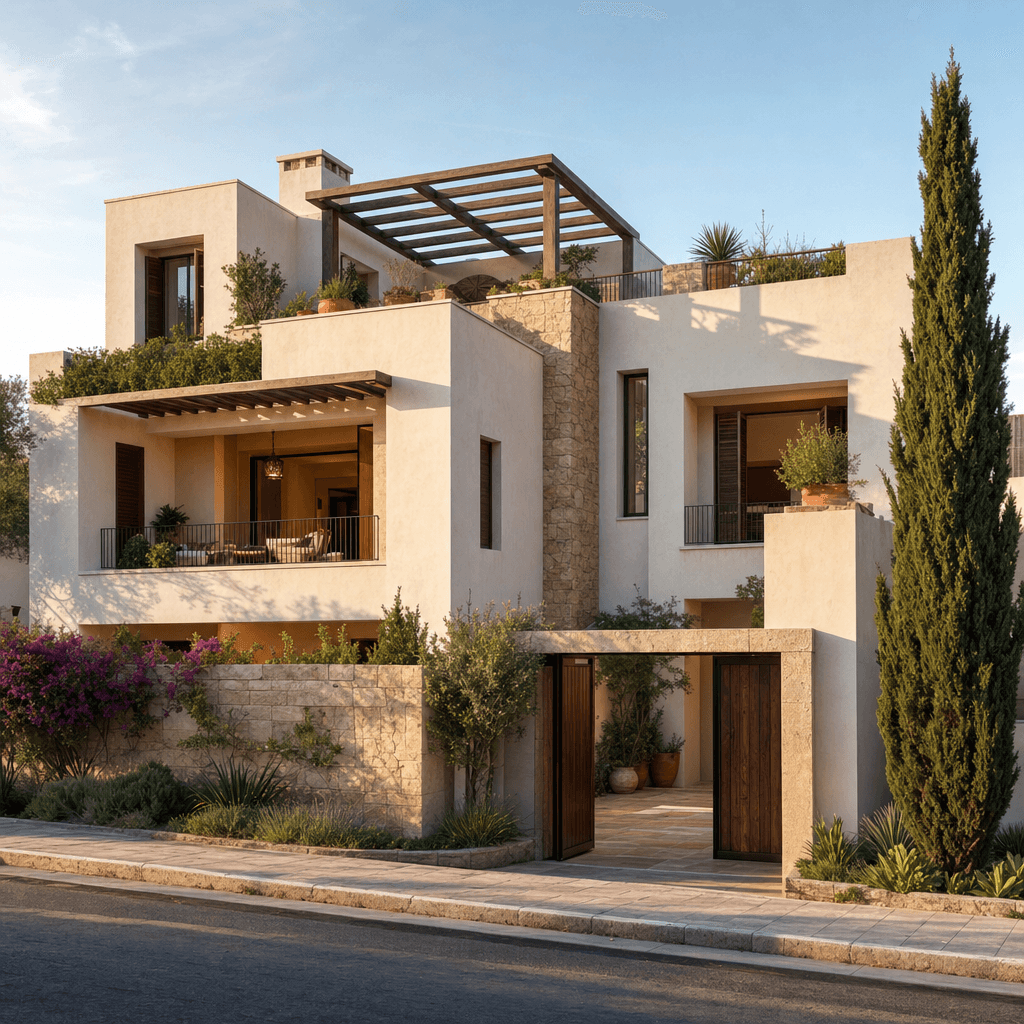
Reference elevation
Mediterranean Contemporary - characteristic facade composition within the contemporary modern.
Context Snapshot
Grounded, sun-wise, and materially rich. Volumes are composed as sculptural blocks arranged around courtyards and terraces. Mediterranean basin and similar hot-dry summer climates - southern Europe, North Africa, the Levant, coastal California, central Chile, South Australia, and South Africa's Western Cape.
Contemporary Relevance
Today, Mediterranean Contemporary remains relevant wherever projects need contemporary modern cues without losing performance or contemporary usability. In Toscape it responds best when prompts emphasize volumes are composed as sculptural blocks arranged around courtyards and terraces. walls: lime-based render (warm off-white, cream, or pale earth tones) stone accents: local limestone, travertine, sandstone, or marble flooring: large-format terracotta,...
Use this style in Toscape
Explore Mediterranean Contemporary directly inside Toscape using Facade Re-Style and design workflow prompts tuned for global architectural references.
Open Mediterranean Contemporary in the galleryFrequently asked questions
What is Mediterranean Contemporary?
Mediterranean Contemporary is a global architectural style within the contemporary modern. Thick sun-shaped volumes, hot-dry palette, courtyards, terraces, and tactile Mediterranean surfaces.
What materials define Mediterranean Contemporary?
Walls: lime-based render (warm off-white, cream, or pale earth tones) Stone accents: local limestone, travertine, sandstone, or marble Flooring: large-format terracotta, limestone.
What is the Mediterranean Contemporary color palette?
Primary tones: warm white, cream, pale limestone, soft sand, light ochre Earth accents: terracotta, warm clay, rust, burnt sienna (used sparingly) Timber tones: dark brown, weathered grey, charcoal-stained Metal tones: dark bronze, matte.
What is the origin of Mediterranean Contemporary?
Grounded, sun-wise, and materially rich. Volumes are composed as sculptural blocks arranged around courtyards and terraces. Mediterranean basin and similar hot-dry summer climates - southern Europe, North Africa, the Levant, coastal California, central Chile, South Australia, and South Africa's Western Cape.
When should architects use Mediterranean Contemporary?
Today, Mediterranean Contemporary remains relevant wherever projects need contemporary modern cues without losing performance or contemporary usability. In Toscape it responds best when prompts emphasize volumes are composed as sculptural blocks arranged around courtyards and terraces. Walls: lime-based render (warm off-white, cream, or pale earth tones) stone accents: local limestone, travertine, sandstone, or marble flooring: large-format terracotta.
How do you render Mediterranean Contemporary in Toscape?
Open Toscape on Windows, load your own photo, elevation, sketch, or CAD view, then apply the Mediterranean Contemporary reference from the built-in style library. The Facade Re-Style and Design Options workflows keep your project geometry and camera while shifting materials, proportion, and detailing toward Mediterranean Contemporary.