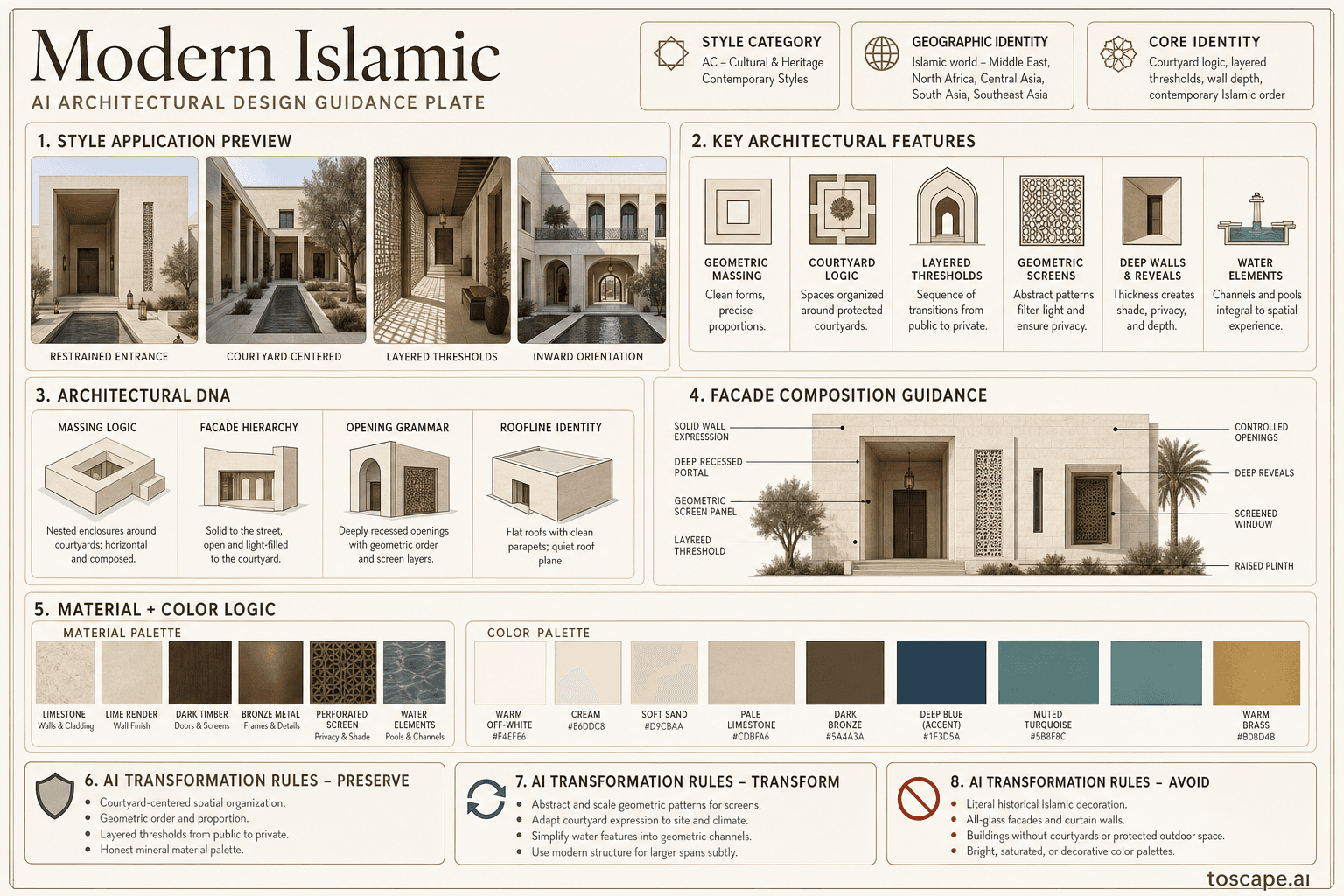
Modern Islamic
Islamic world - Middle East, North Africa, Central Asia, South Asia, and Southeast Asia. / Cultural heritage
Restrained mineral palette, courtyard logic, layered thresholds, wall depth, and contemporary Islamic order.
Definition
Modern Islamic is a global architectural style within the cultural heritage. Restrained mineral palette, courtyard logic, layered thresholds, wall depth, and contemporary Islamic order.
- Family
- Cultural heritage
- Origin
- Islamic world - Middle East, North Africa, Central Asia, South Asia, and Southeast Asia.
- Massing
- Massing follows Islamic spatial principles of inward orientation and hierarchical enclosure.
- Materials
- Walls: warm mineral render (lime-based), limestone, or travertine Screens: perforated metal, carved stone, or GRC with abstracted geometric patterns Flooring: stone or porcelain tiles with geometric.
- Palette
- Primary tones: warm off-white, cream, pale limestone, soft sand Accent tones: dark bronze, deep blue (sparingly), muted turquoise, warm brass The palette is restrained and mineral.
- Climate response
- Islamic world. Middle East, North Africa, Central Asia, South Asia, and Southeast Asia.
Overview
Modern Islamic is a global architectural style rooted in Islamic world - Middle East, North Africa, Central Asia, South Asia, and Southeast Asia. Adapted globally where Islamic cultural identity and contemporary architectural expression converge. Restrained mineral palette, courtyard logic, layered thresholds, wall depth, and contemporary Islamic order. Dignified, contemplative, and geometrically ordered.
Visual DNA
Massing & Form
Massing follows Islamic spatial principles of inward orientation and hierarchical enclosure. Volumes are composed around courtyards, with perimeter walls creating a defined boundary between public realm and private interior.
Facade Language
Facades express the duality of Islamic architecture. solid, protective outer walls transitioning to open, light-filled inner facades.
Materials & Texture
Walls: warm mineral render (lime-based), limestone, or travertine Screens: perforated metal, carved stone, or GRC with abstracted geometric patterns Flooring: stone or porcelain tiles with geometric layout patterns Timber: dark-stained...
Color Palette
Primary tones: warm off-white, cream, pale limestone, soft sand Accent tones: dark bronze, deep blue (sparingly), muted turquoise, warm brass The palette is restrained and mineral. no bright or saturated colors Color comes from material.
Ornament & Detail
Courtyard-centered spatial organization. the organizing principle of Islamic space.
Climate Response
Islamic world. Middle East, North Africa, Central Asia, South Asia, and Southeast Asia.
Landscape & Ground
Islamic world. Middle East, North Africa, Central Asia, South Asia, and Southeast Asia.
Reference elevation
Modern Islamic - characteristic facade composition within the cultural heritage.
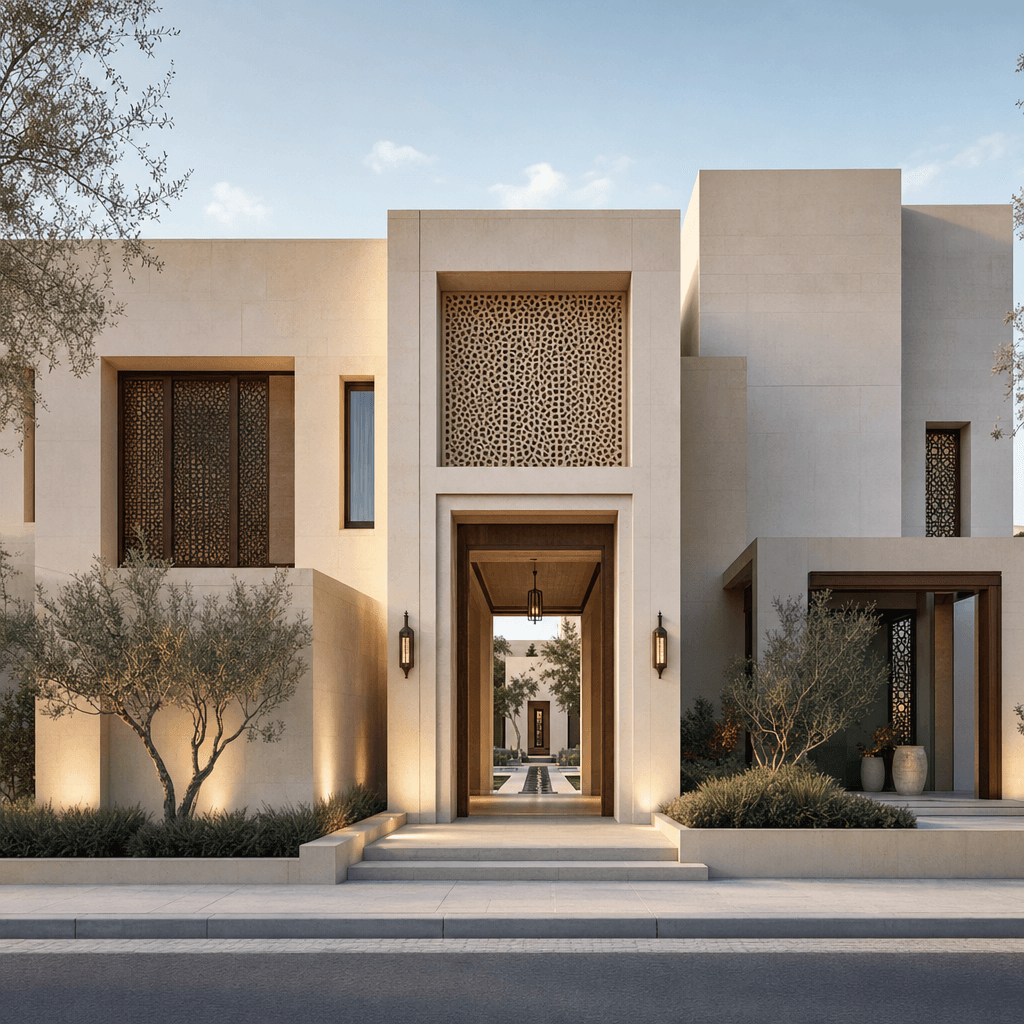
Context Snapshot
Dignified, contemplative, and geometrically ordered. Massing follows Islamic spatial principles of inward orientation and hierarchical enclosure. Islamic world - Middle East, North Africa, Central Asia, South Asia, and Southeast Asia.
Contemporary Relevance
Today, Modern Islamic remains relevant wherever projects need cultural heritage cues without losing performance or contemporary usability. In Toscape it responds best when prompts emphasize massing follows islamic spatial principles of inward orientation and hierarchical enclosure. walls: warm mineral render (lime-based), limestone, or travertine screens: perforated metal, carved stone, or grc with abstracted geometric patterns flooring: stone or...
Use this style in Toscape
Explore Modern Islamic directly inside Toscape using Facade Re-Style and design workflow prompts tuned for global architectural references.
Open Modern Islamic in the galleryFrequently asked questions
What is Modern Islamic?
Modern Islamic is a global architectural style within the cultural heritage. Restrained mineral palette, courtyard logic, layered thresholds, wall depth, and contemporary Islamic order.
What materials define Modern Islamic?
Walls: warm mineral render (lime-based), limestone, or travertine Screens: perforated metal, carved stone, or GRC with abstracted geometric patterns Flooring: stone or porcelain tiles with geometric layout patterns Timber: dark-stained.
What is the Modern Islamic color palette?
Primary tones: warm off-white, cream, pale limestone, soft sand Accent tones: dark bronze, deep blue (sparingly), muted turquoise, warm brass The palette is restrained and mineral. No bright or saturated colors Color comes from material.
What is the origin of Modern Islamic?
Dignified, contemplative, and geometrically ordered. Massing follows Islamic spatial principles of inward orientation and hierarchical enclosure. Islamic world - Middle East, North Africa, Central Asia, South Asia, and Southeast Asia.
When should architects use Modern Islamic?
Today, Modern Islamic remains relevant wherever projects need cultural heritage cues without losing performance or contemporary usability. In Toscape it responds best when prompts emphasize massing follows islamic spatial principles of inward orientation and hierarchical enclosure. Walls: warm mineral render (lime-based), limestone, or travertine screens: perforated metal, carved stone.
How do you render Modern Islamic in Toscape?
Open Toscape on Windows, load your own photo, elevation, sketch, or CAD view, then apply the Modern Islamic reference from the built-in style library. The Facade Re-Style and Design Options workflows keep your project geometry and camera while shifting materials, proportion, and detailing toward Modern Islamic.