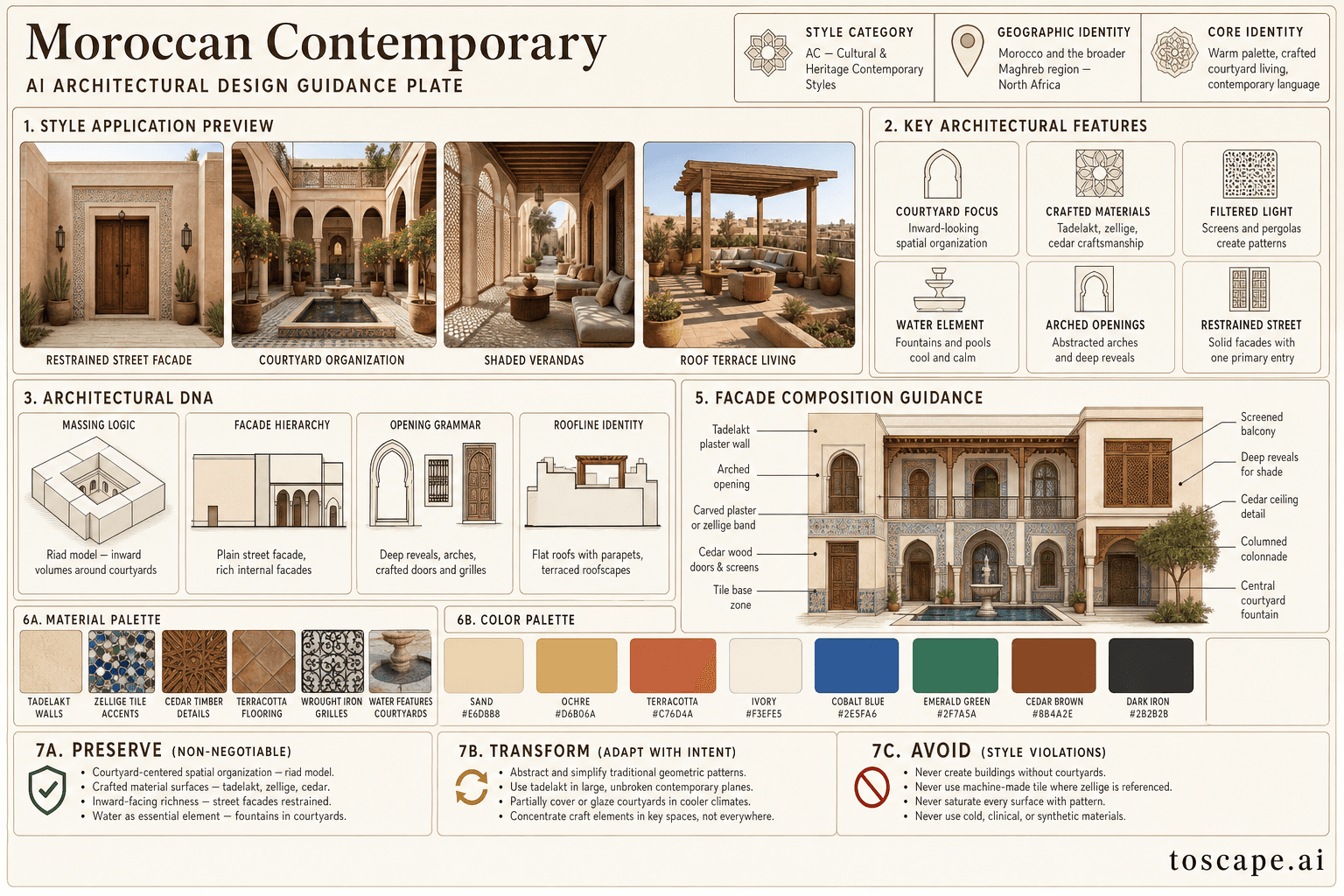
Moroccan Contemporary
Morocco and the broader Maghreb region - North Africa. / Cultural heritage
Warm Moroccan palette, tactile courtyard-oriented massing, sun-shaped forms, and crafted material depth.
Definition
Moroccan Contemporary is a global architectural style within the cultural heritage. Warm Moroccan palette, tactile courtyard-oriented massing, sun-shaped forms, and crafted material depth.
- Family
- Cultural heritage
- Origin
- Morocco and the broader Maghreb region - North Africa.
- Massing
- Massing follows the riad typology. An inward-looking composition organized around one or more courtyards.
- Materials
- Walls: tadelakt plaster (polished lime) in warm tones, or textured render Tile: zellige (hand-cut glazed terracotta tiles) for accent features Timber: cedar. Carved, painted, or natural.
- Palette
- Primary tones: warm terracotta, soft ochre, pale sand, ivory Tile accent colors: cobalt blue, emerald green, warm yellow, white (traditional zellige) Timber tones: natural cedar.
- Climate response
- Morocco and the broader Maghreb region. North Africa.
Overview
Moroccan Contemporary is a global architectural style rooted in Morocco and the broader Maghreb region - North Africa. Adapted globally in hot-dry and Mediterranean climates where craftsmanship, geometric patterning, and courtyard living are valued. Warm Moroccan palette, tactile courtyard-oriented massing, sun-shaped forms, and crafted material depth. Rich, crafted, and sensually warm.
Visual DNA
Massing & Form
Massing follows the riad typology. an inward-looking composition organized around one or more courtyards.
Facade Language
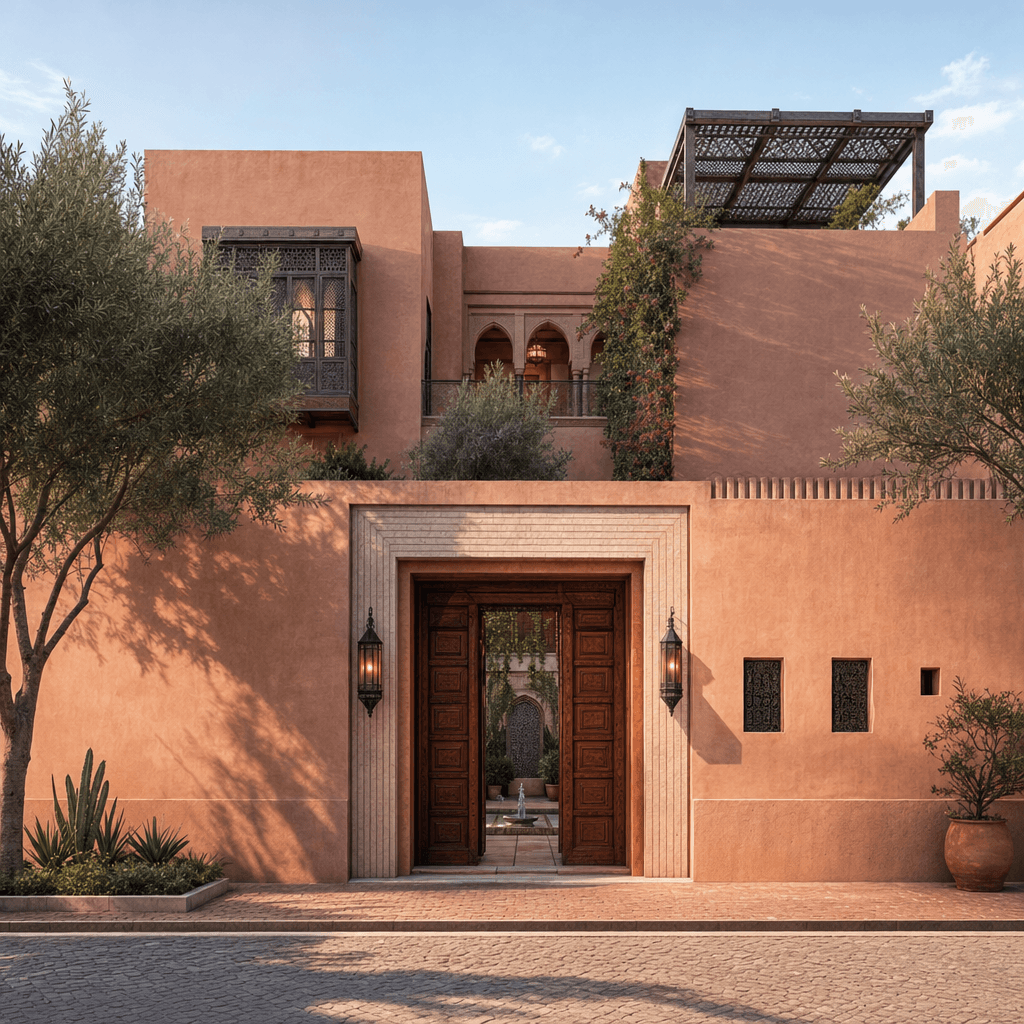
Street facades are understated. rendered walls in warm tones with minimal openings.
Materials & Texture
Walls: tadelakt plaster (polished lime) in warm tones, or textured render Tile: zellige (hand-cut glazed terracotta tiles) for accent features Timber: cedar. carved, painted, or natural.
Color Palette
Primary tones: warm terracotta, soft ochre, pale sand, ivory Tile accent colors: cobalt blue, emerald green, warm yellow, white (traditional zellige) Timber tones: natural cedar. warm reddish-brown Metal tones: dark iron, bronze The...
Ornament & Detail
Courtyard-centered spatial organization. the riad as organizational model.
Climate Response
Morocco and the broader Maghreb region. North Africa.
Landscape & Ground
Morocco and the broader Maghreb region. North Africa.
Reference elevation
Moroccan Contemporary - characteristic facade composition within the cultural heritage.
Context Snapshot
Rich, crafted, and sensually warm. Massing follows the riad typology - an inward-looking composition organized around one or more courtyards. Morocco and the broader Maghreb region - North Africa.
Contemporary Relevance
Today, Moroccan Contemporary remains relevant wherever projects need cultural heritage cues without losing performance or contemporary usability. In Toscape it responds best when prompts emphasize massing follows the riad typology - an inward-looking composition organized around one or more courtyards. walls: tadelakt plaster (polished lime) in warm tones, or textured render tile: zellige (hand-cut glazed terracotta tiles) for accent features timber:...
Use this style in Toscape
Explore Moroccan Contemporary directly inside Toscape using Facade Re-Style and design workflow prompts tuned for global architectural references.
Open Moroccan Contemporary in the galleryFrequently asked questions
What is Moroccan Contemporary?
Moroccan Contemporary is a global architectural style within the cultural heritage. Warm Moroccan palette, tactile courtyard-oriented massing, sun-shaped forms, and crafted material depth.
What materials define Moroccan Contemporary?
Walls: tadelakt plaster (polished lime) in warm tones, or textured render Tile: zellige (hand-cut glazed terracotta tiles) for accent features Timber: cedar. Carved, painted, or natural.
What is the Moroccan Contemporary color palette?
Primary tones: warm terracotta, soft ochre, pale sand, ivory Tile accent colors: cobalt blue, emerald green, warm yellow, white (traditional zellige) Timber tones: natural cedar. Warm reddish-brown Metal tones: dark iron.
What is the origin of Moroccan Contemporary?
Rich, crafted, and sensually warm. Massing follows the riad typology - an inward-looking composition organized around one or more courtyards. Morocco and the broader Maghreb region - North Africa.
When should architects use Moroccan Contemporary?
Today, Moroccan Contemporary remains relevant wherever projects need cultural heritage cues without losing performance or contemporary usability. In Toscape it responds best when prompts emphasize massing follows the riad typology - an inward-looking composition organized around one or more courtyards.
How do you render Moroccan Contemporary in Toscape?
Open Toscape on Windows, load your own photo, elevation, sketch, or CAD view, then apply the Moroccan Contemporary reference from the built-in style library. The Facade Re-Style and Design Options workflows keep your project geometry and camera while shifting materials, proportion, and detailing toward Moroccan Contemporary.