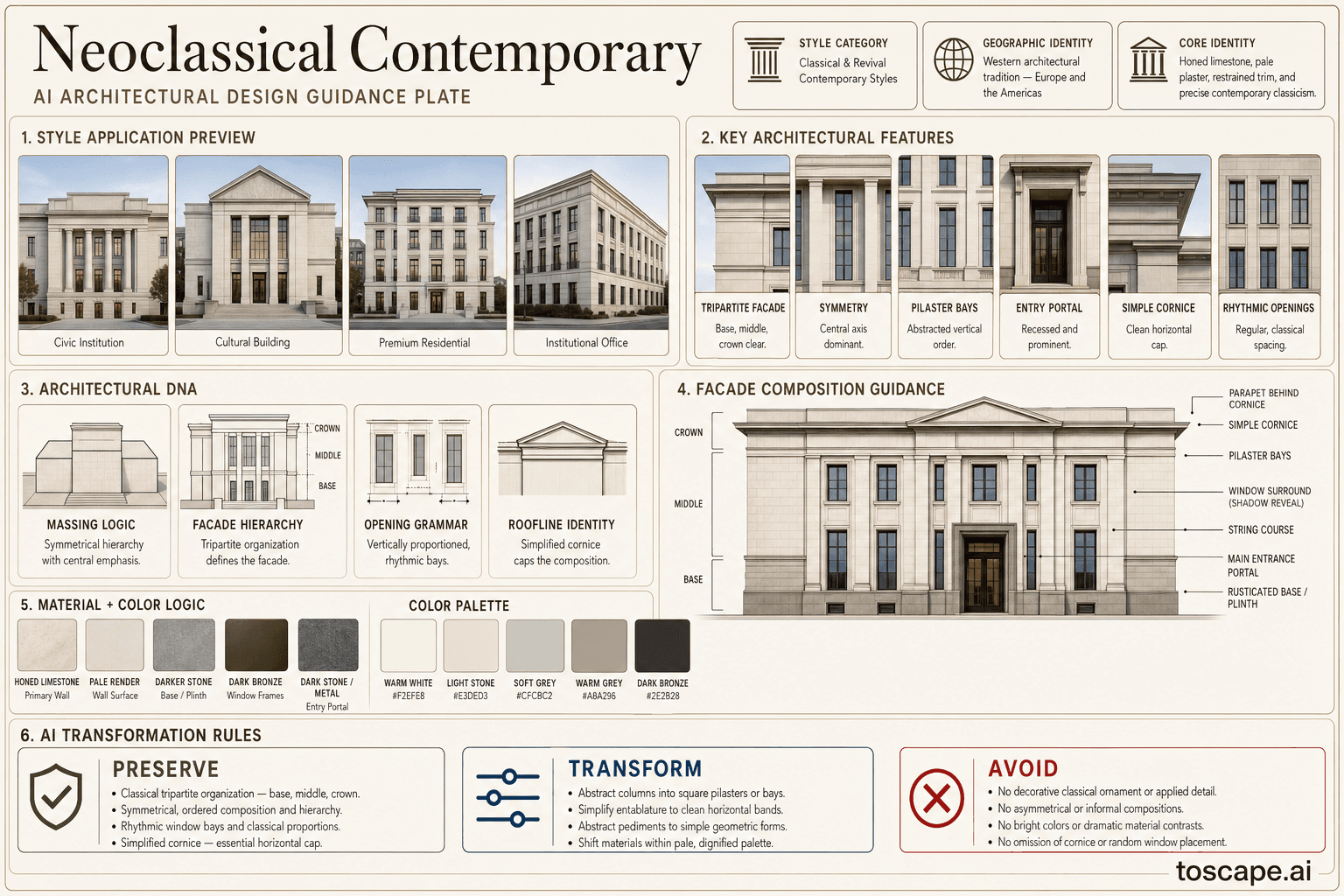
Neoclassical Contemporary
Western architectural tradition - Europe and the Americas, particularly in urban and... / Classical lineage
Contemporary classicism shaped by symmetry, tripartite facades, pale stone, and restrained civic gravity.
Definition
Neoclassical Contemporary is a global architectural style within the classical lineage. Contemporary classicism shaped by symmetry, tripartite facades, pale stone, and restrained civic gravity.
- Family
- Classical lineage
- Origin
- Western architectural tradition - Europe and the Americas.
- Massing
- Massing is composed with classical order. Clearly defined primary volume with subordinate wings or pavilions.
- Materials
- Primary wall: honed limestone panels or pale smooth render with expressed joint lines Base/plinth: expressed in slightly darker stone or deeper texture Cornice: precast concrete.
- Palette
- Primary tones: pale limestone, warm white, soft grey, light cream Base tones: slightly darker.
- Climate response
- Western architectural tradition. Europe and the Americas, particularly in urban and institutional contexts where classical order, proportion, and dignity are valued.
Overview
Neoclassical Contemporary is a global style that distills classical architecture into a sharper, quieter contemporary language. It keeps symmetry, hierarchy, and facade order intact while replacing carved ornament with clean edges, pale material fields, and disciplined proportion.
Visual DNA
Massing & Form
Massing is composed with classical order. clearly defined primary volume with subordinate wings or pavilions.
Facade Language
The facade is organized as a clear tripartite composition: a rusticated or expressed base (ground floor), a smooth middle section (piano nobile), and a simplified cornice or crown. Vertical bays are defined by pilasters or expressed...
Materials & Texture
Primary wall: honed limestone panels or pale smooth render with expressed joint lines Base/plinth: expressed in slightly darker stone or deeper texture Cornice: precast concrete, stone, or metal panel. clean profile Window frames: dark...
Color Palette
Primary tones: pale limestone, warm white, soft grey, light cream Base tones: slightly darker. warm grey, light beige-grey Metal tones: dark bronze, charcoal, matte black The palette is pale, dignified, and unified.
Ornament & Detail
Classical tripartite organization. base, middle, crown must be legible.
Climate Response
Western architectural tradition. Europe and the Americas, particularly in urban and institutional contexts where classical order, proportion, and dignity are valued.
Landscape & Ground
Western architectural tradition. Europe and the Americas, particularly in urban and institutional contexts where classical order, proportion, and dignity are valued.
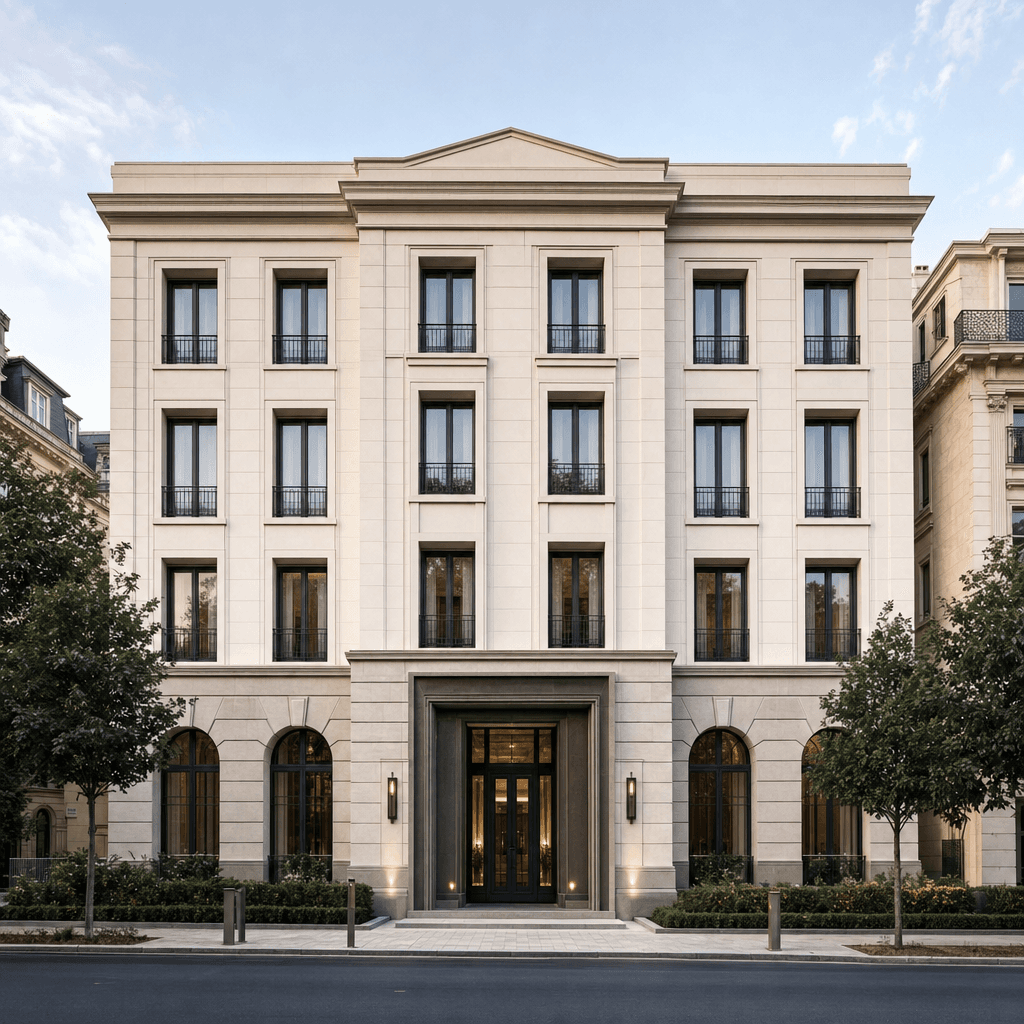
Reference elevation
Neoclassical Contemporary - characteristic facade composition within the classical lineage.
Context Snapshot
Its roots sit in the neoclassical tradition of Europe and the Americas, where architecture used tripartite composition, measured bays, and monumental entrances to convey order and civic authority. The contemporary version keeps that structure but simplifies the visual vocabulary for modern construction and premium urban contexts.
Contemporary Relevance
This style fits cultural institutions, premium residential blocks, hospitality, and civic architecture that need gravitas without overt historicism. In Toscape it performs best when prompts call for pale stone, symmetrical massing, strong entry hierarchy, and a crisp base-middle-crown reading.
Use this style in Toscape
Explore Neoclassical Contemporary directly inside Toscape using Facade Re-Style and design workflow prompts tuned for global architectural references.
Open Neoclassical Contemporary in the galleryFrequently asked questions
What is Neoclassical Contemporary?
Neoclassical Contemporary is a global architectural style within the classical lineage. Contemporary classicism shaped by symmetry, tripartite facades, pale stone, and restrained civic gravity.
What materials define Neoclassical Contemporary?
Primary wall: honed limestone panels or pale smooth render with expressed joint lines Base/plinth: expressed in slightly darker stone or deeper texture Cornice: precast concrete, stone, or metal panel. Clean profile Window frames: dark.
What is the Neoclassical Contemporary color palette?
Primary tones: pale limestone, warm white, soft grey, light cream Base tones: slightly darker. Warm grey, light beige-grey Metal tones: dark bronze, charcoal, matte black The palette is pale, dignified, and unified.
What is the origin of Neoclassical Contemporary?
Its roots sit in the neoclassical tradition of Europe and the Americas, where architecture used tripartite composition, measured bays, and monumental entrances to convey order and civic authority. The contemporary version keeps that structure but simplifies the visual vocabulary for modern construction and premium urban contexts.
When should architects use Neoclassical Contemporary?
This style fits cultural institutions, premium residential blocks, hospitality, and civic architecture that need gravitas without overt historicism. In Toscape it performs best when prompts call for pale stone, symmetrical massing, strong entry hierarchy, and a crisp base-middle-crown reading.
How do you render Neoclassical Contemporary in Toscape?
Open Toscape on Windows, load your own photo, elevation, sketch, or CAD view, then apply the Neoclassical Contemporary reference from the built-in style library. The Facade Re-Style and Design Options workflows keep your project geometry and camera while shifting materials, proportion, and detailing toward Neoclassical Contemporary.