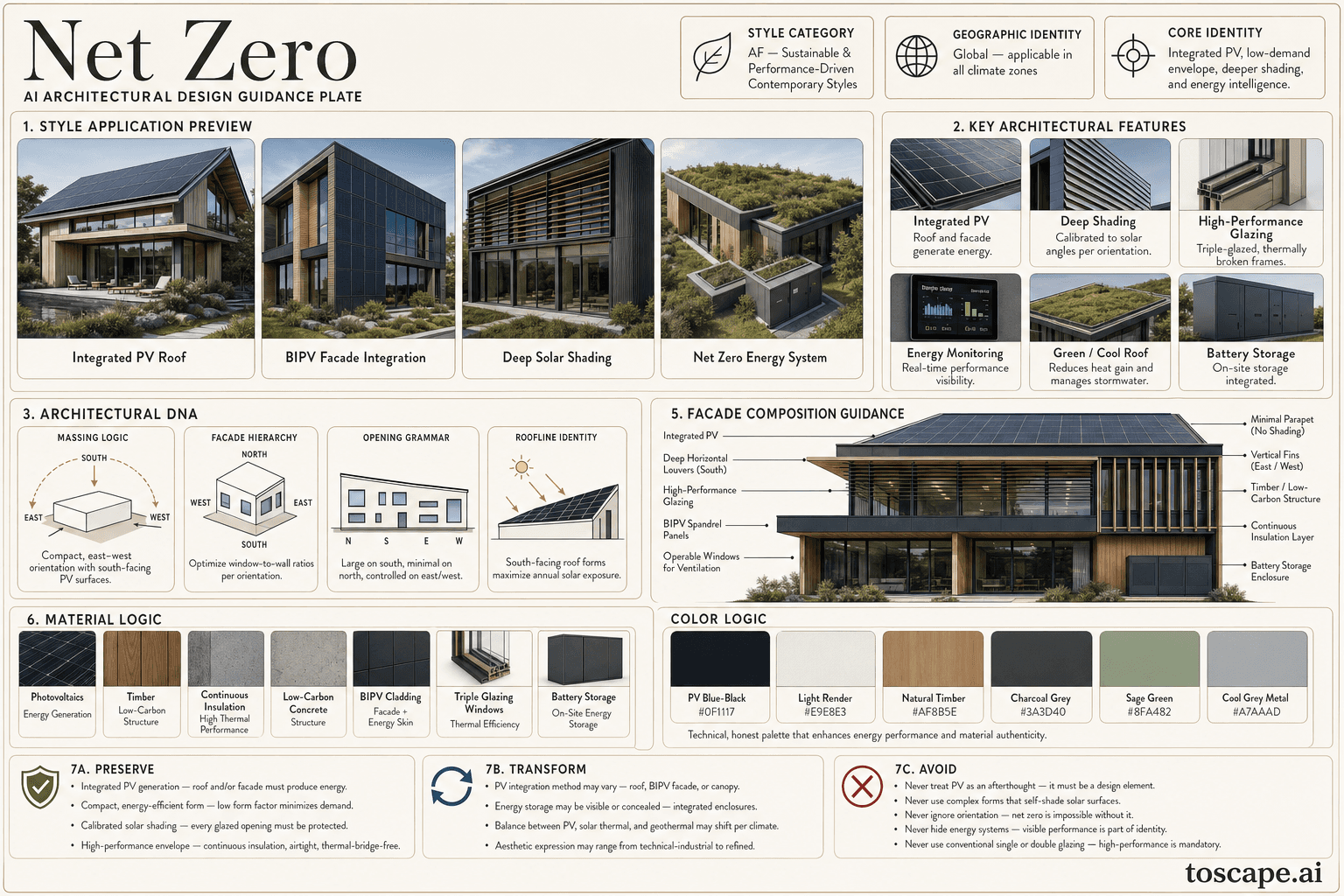
Net Zero
Global - applicable in all climate zones. / Sustainable performance
Integrated PV roof surfaces, low-demand envelope, deeper shading, and technically credible energy harvesting.
Definition
Net Zero is a global architectural style within the sustainable performance. Integrated PV roof surfaces, low-demand envelope, deeper shading, and technically credible energy harvesting.
- Family
- Sustainable performance
- Origin
- Global - applicable in all climate zones.
- Massing
- Massing is energy-driven. Compact forms with the long axis oriented east-west to maximize south-facing surface area for PV and passive solar gain.
- Materials
- Photovoltaics: monocrystalline or thin-film PV panels. Integrated into roof and facade Structure: low-embodied-carbon materials.
- Palette
- Primary tones: dark blue-black of PV surfaces, natural render, timber, or metal PV arrays create a characteristic dark.
- Climate response
- Global. Applicable in all climate zones.
Overview
Net Zero is a global architectural style rooted in Global - applicable in all climate zones. Defined by the operational target of net-zero energy consumption - a building that produces as much energy as it consumes on an annual basis through on-site or nearby renewable energy generation. The standard is enforced through certification programs such as ILFI Zero Energy, Passive House Plus, and national building codes worldwide. Integrated PV roof surfaces, low-demand envelope, deeper shading, and technically credible energy...
Visual DNA
Massing & Form
Massing is energy-driven. compact forms with the long axis oriented east-west to maximize south-facing surface area for PV and passive solar gain.
Facade Language
The facade is a calibrated climate filter. window-to-wall ratios are optimized per orientation (largest on south for solar gain and daylight, minimal on north for heat retention, controlled on east/west to manage overheating).
Materials & Texture
Photovoltaics: monocrystalline or thin-film PV panels. integrated into roof and facade Structure: low-embodied-carbon materials.
Color Palette
Primary tones: dark blue-black of PV surfaces, natural render, timber, or metal PV arrays create a characteristic dark, glassy roof surface Lighter facade tones reflect solar radiation and reduce cooling loads Window frames typically...
Ornament & Detail
Integrated PV generation. the roof and/or facade must actively produce energy.
Climate Response
Global. applicable in all climate zones.
Landscape & Ground
Global. applicable in all climate zones.
Reference elevation
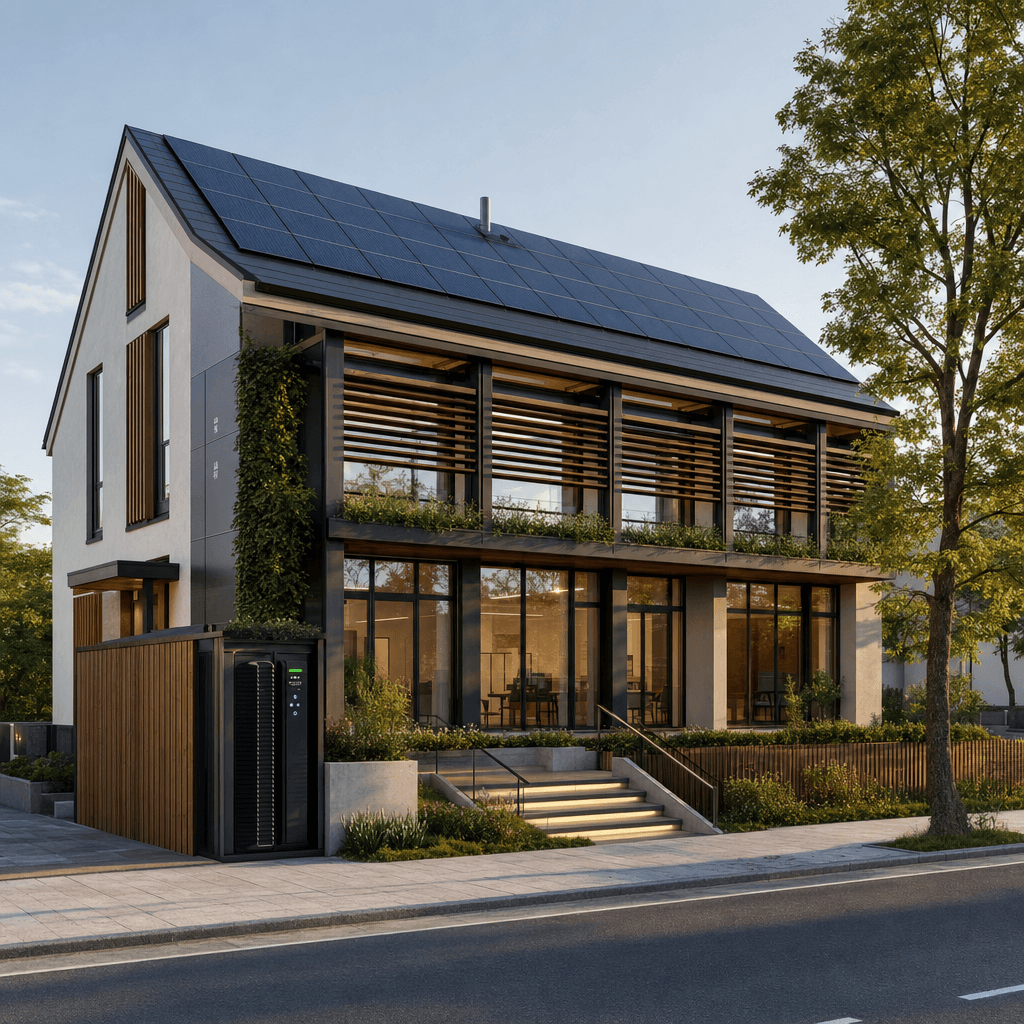
Net Zero - characteristic facade composition within the sustainable performance.
Context Snapshot
Energy-literate, rational, and technologically confident. Massing is energy-driven - compact forms with the long axis oriented east-west to maximize south-facing surface area for PV and passive solar gain. Global - applicable in all climate zones.
Contemporary Relevance
Today, Net Zero remains relevant wherever projects need sustainable performance cues without losing performance or contemporary usability. In Toscape it responds best when prompts emphasize massing is energy-driven - compact forms with the long axis oriented east-west to maximize south-facing surface area for pv and passive solar gain. photovoltaics: monocrystalline or thin-film pv panels - integrated into roof and facade structure: low-embodied-carbon...
Use this style in Toscape
Explore Net Zero directly inside Toscape using Facade Re-Style and design workflow prompts tuned for global architectural references.
Open Net Zero in the galleryFrequently asked questions
What is Net Zero?
Net Zero is a global architectural style within the sustainable performance. Integrated PV roof surfaces, low-demand envelope, deeper shading, and technically credible energy harvesting.
What materials define Net Zero?
Photovoltaics: monocrystalline or thin-film PV panels. Integrated into roof and facade Structure: low-embodied-carbon materials.
What is the Net Zero color palette?
Primary tones: dark blue-black of PV surfaces, natural render, timber, or metal PV arrays create a characteristic dark, glassy roof surface Lighter facade tones reflect solar radiation and reduce cooling loads Window frames typically.
What is the origin of Net Zero?
Energy-literate, rational, and technologically confident. Massing is energy-driven - compact forms with the long axis oriented east-west to maximize south-facing surface area for PV and passive solar gain. Global - applicable in all climate zones.
When should architects use Net Zero?
Today, Net Zero remains relevant wherever projects need sustainable performance cues without losing performance or contemporary usability. In Toscape it responds best when prompts emphasize massing is energy-driven - compact forms with the long axis oriented east-west to maximize south-facing surface area for pv and passive solar gain.
How do you render Net Zero in Toscape?
Open Toscape on Windows, load your own photo, elevation, sketch, or CAD view, then apply the Net Zero reference from the built-in style library. The Facade Re-Style and Design Options workflows keep your project geometry and camera while shifting materials, proportion, and detailing toward Net Zero.