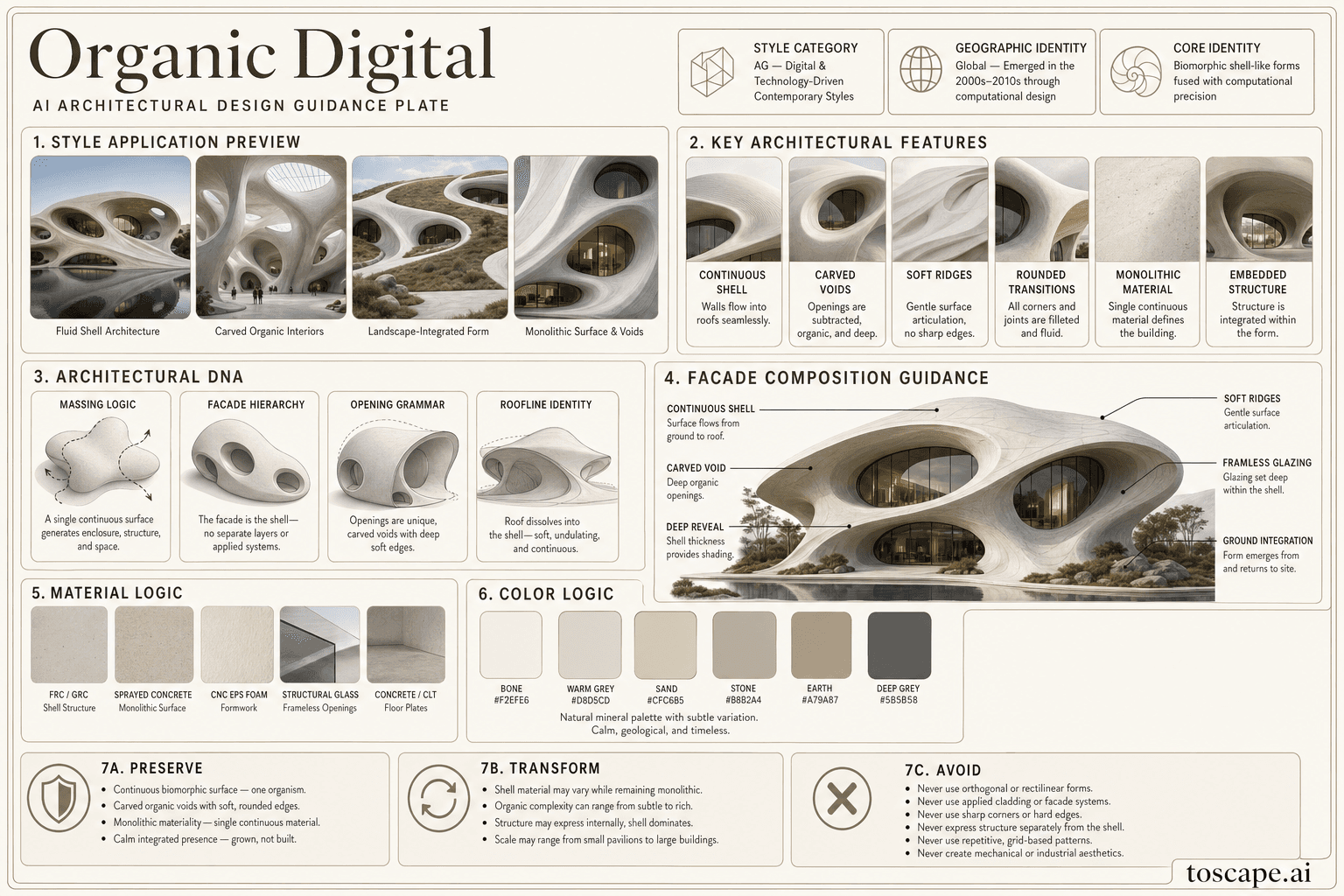
Organic Digital
Global - Organic Digital architecture emerged in the 2000s-2010s at the intersection of... / Digital and technology
Biomorphic shell-like forms, carved voids, soft ridges, and integrated quiet structure.
Definition
Organic Digital is a global architectural style within the digital and technology. Biomorphic shell-like forms, carved voids, soft ridges, and integrated quiet structure.
- Family
- Digital and technology
- Origin
- Global - Organic Digital architecture emerged in the 2000s-2010s at the intersection.
- Massing
- Massing is topological. The building is conceived as a continuous surface that differentiates into enclosure, structure, and space.
- Materials
- Shell structure: fiber-reinforced concrete (FRC/GRC), sprayed concrete (shotcrete) over CNC-milled formwork, or glass-fiber reinforced polymer (GFRP) Formwork: CNC-milled EPS foam, 3D-printed molds, or robotically hot-wire-cut.
- Palette
- Primary tones: pale warm grey, white, bone, sand. Natural mineral palette The shell surface is monolithic and unadorned.
- Climate response
- Global. Organic Digital architecture emerged in the 2000s-2010s at the intersection of biomorphic design, advanced computation, and digital fabrication.
Try it free
Render your own project in this style
Upload one photo of your own project and Re-Render keeps the geometry and camera while carrying the Organic Digital language into materials, proportion, and detail. Three free renders, no account needed.
Open Re-Render - freeOverview
Organic Digital is a global architectural style rooted in Global - Organic Digital architecture emerged in the 2000s-2010s at the intersection of biomorphic design, advanced computation, and digital fabrication. The movement draws inspiration from natural forms - bones, shells, leaves, coral, geological formations - but realizes them through purely digital means: algorithmic generation, NURBS modeling, parametric optimization, and CNC fabrication. Key practitioners include Zaha Hadid Architects (later works), MAD Architects,...
Visual DNA
Massing & Form
Massing is topological. the building is conceived as a continuous surface that differentiates into enclosure, structure, and space.
Facade Language
The facade is the building surface. there is no applied cladding or separate facade system.
Materials & Texture
Shell structure: fiber-reinforced concrete (FRC/GRC), sprayed concrete (shotcrete) over CNC-milled formwork, or glass-fiber reinforced polymer (GFRP) Formwork: CNC-milled EPS foam, 3D-printed molds, or robotically hot-wire-cut...
Color Palette
Primary tones: pale warm grey, white, bone, sand. natural mineral palette The shell surface is monolithic and unadorned.
Ornament & Detail
Continuous biomorphic surface. the building must read as a single organism, not an assembly of parts.
Climate Response
Global. Organic Digital architecture emerged in the 2000s-2010s at the intersection of biomorphic design, advanced computation, and digital fabrication.
Landscape & Ground
Global. Organic Digital architecture emerged in the 2000s-2010s at the intersection of biomorphic design, advanced computation, and digital fabrication.
Reference elevation
Organic Digital - characteristic facade composition within the digital and technology.
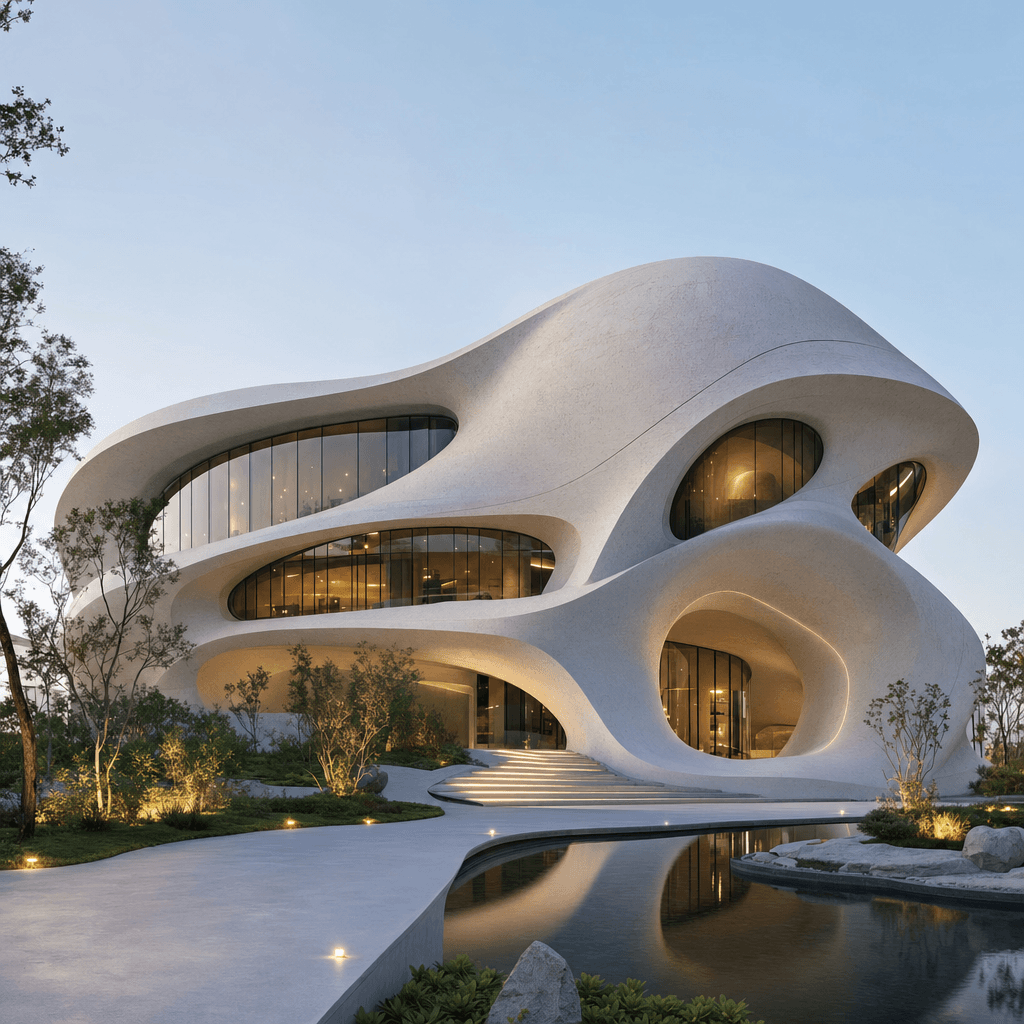
Context Snapshot
Fluid, calm, and biologically inspired. Massing is topological - the building is conceived as a continuous surface that differentiates into enclosure, structure, and space. Global - Organic Digital architecture emerged in the 2000s-2010s at the intersection of biomorphic design, advanced computation, and digital fabrication.
Contemporary Relevance
Today, Organic Digital remains relevant wherever projects need digital and technology cues without losing performance or contemporary usability. In Toscape it responds best when prompts emphasize massing is topological - the building is conceived as a continuous surface that differentiates into enclosure, structure, and space. shell structure: fiber-reinforced concrete (frc/grc), sprayed concrete (shotcrete) over cnc-milled formwork, or glass-fiber...
Use this style in Toscape
Explore Organic Digital directly inside Toscape using Facade Re-Style and design workflow prompts tuned for global architectural references.
Open Organic Digital in the galleryFrequently asked questions
What is Organic Digital?
Organic Digital is a global architectural style within the digital and technology. Biomorphic shell-like forms, carved voids, soft ridges, and integrated quiet structure.
What materials define Organic Digital?
Shell structure: fiber-reinforced concrete (FRC/GRC), sprayed concrete (shotcrete) over CNC-milled formwork, or glass-fiber reinforced polymer (GFRP) Formwork: CNC-milled EPS foam, 3D-printed molds, or robotically hot-wire-cut.
What is the Organic Digital color palette?
Primary tones: pale warm grey, white, bone, sand. Natural mineral palette The shell surface is monolithic and unadorned.
What is the origin of Organic Digital?
Fluid, calm, and biologically inspired. Massing is topological - the building is conceived as a continuous surface that differentiates into enclosure, structure, and space. Global - Organic Digital architecture emerged in the 2000s-2010s at the intersection of biomorphic design, advanced computation, and digital fabrication.
When should architects use Organic Digital?
Today, Organic Digital remains relevant wherever projects need digital and technology cues without losing performance or contemporary usability. In Toscape it responds best when prompts emphasize massing is topological - the building is conceived as a continuous surface that differentiates into enclosure, structure, and space. Shell structure: fiber-reinforced concrete (frc/grc), sprayed concrete (shotcrete) over cnc-milled formwork, or glass-fiber.
How do you render Organic Digital in Toscape?
Toscape renders your own photograph, elevation, sketch, or CAD view through the Organic Digital reference. The Facade Re-Style and Design Options workflows keep the building's geometry and camera fixed while the surface language shifts toward Organic Digital.
Other styles in the Digital and technology family
- High TechExposed structure, curtain wall systems, visible service bands, modular joints, and legible technical assemblies.
- 3D PRINTED ARCHITECTURE / ADDITIVE CONSTRUCTIONWalls printed layer by layer through robotic extrusion - visible horizontal layer lines as primary surface.
- DECONSTRUCTIVISMFragmented volumes colliding at non-orthogonal angles - tilted planes and skewed grids - surfaces folding.
- FLOATING ARCHITECTURE / AQUATECTUREBuildings that float on water - pontoon or concrete-hull foundations - amphibious houses that rise.
- KINETIC ARCHITECTUREBuilding elements that physically move - operable facade panels and shutters that transform throughout the day.
- Modular / PrefabStacked linked units, repeated module logic, prefabricated clarity, and efficient compositional variation.