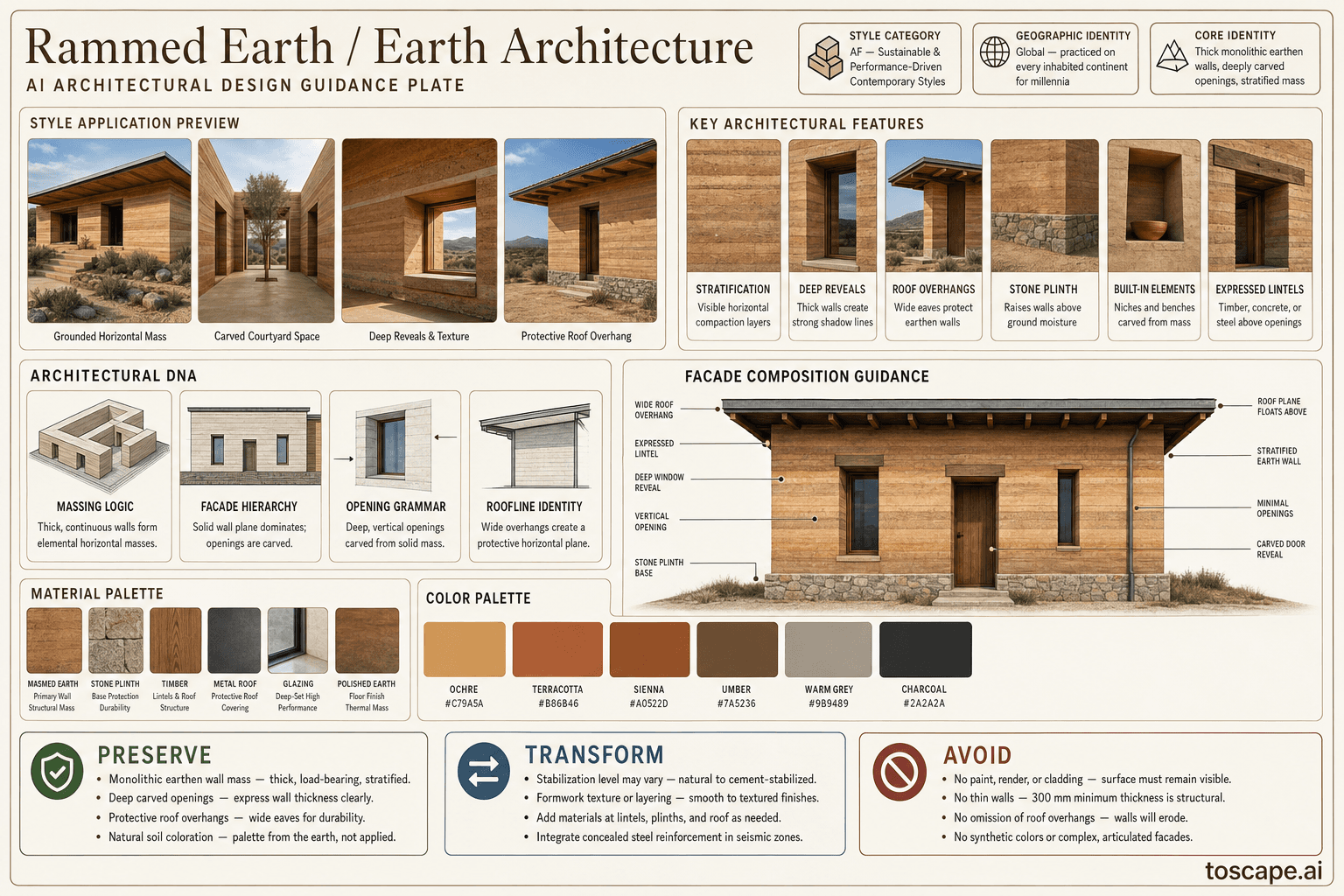
Rammed Earth / Earth Architecture
Global - practiced on every inhabited continent for millennia. / Sustainable performance
Thick monolithic earthen walls, deeply carved openings, stratified rammed earth, and tactile mineral mass.
Definition
Rammed Earth / Earth Architecture is a global architectural style within the sustainable performance. Thick monolithic earthen walls, deeply carved openings, stratified rammed earth, and tactile mineral mass.
- Family
- Sustainable performance
- Origin
- Global - practiced on every inhabited continent for millennia.
- Massing
- Massing is governed by the structural logic of rammed earth. Walls are thick, load-bearing, and continuous.
- Materials
- Primary walls: rammed earth.
- Palette
- Primary tones: warm natural earth. Ochre, terracotta, sienna, umber, warm grey Color is determined by local soil composition.
- Climate response
- Global. Practiced on every inhabited continent for millennia.
Overview
Rammed Earth / Earth Architecture is a global architectural style rooted in Global - practiced on every inhabited continent for millennia. Modern rammed earth construction is found from Australia (Pritzker Prize-winning projects by Glenn Murcutt and others) to Morocco, China, India, the American Southwest, and across Europe. The technique uses locally sourced subsoil compacted into formwork to create monolithic load-bearing walls with extraordinary thermal mass and minimal embodied carbon. Thick monolithic earthen walls, deeply...
Visual DNA
Massing & Form
Massing is governed by the structural logic of rammed earth. walls are thick, load-bearing, and continuous.
Facade Language
The facade is a continuous monolithic earth surface. uninterrupted wall planes are the defining feature.
Materials & Texture
Primary walls: rammed earth. locally sourced subsoil, stabilized with 5-10% cement or lime, or unstabilized for full recyclability Wall protection: roof overhangs, stone or concrete plinths, vapor-permeable sealers Structure: load-bearing...
Color Palette
Primary tones: warm natural earth. ochre, terracotta, sienna, umber, warm grey Color is determined by local soil composition.
Ornament & Detail
Monolithic earthen wall mass. thick, load-bearing, and visibly stratified.
Climate Response
Global. practiced on every inhabited continent for millennia.
Landscape & Ground
Global. practiced on every inhabited continent for millennia.
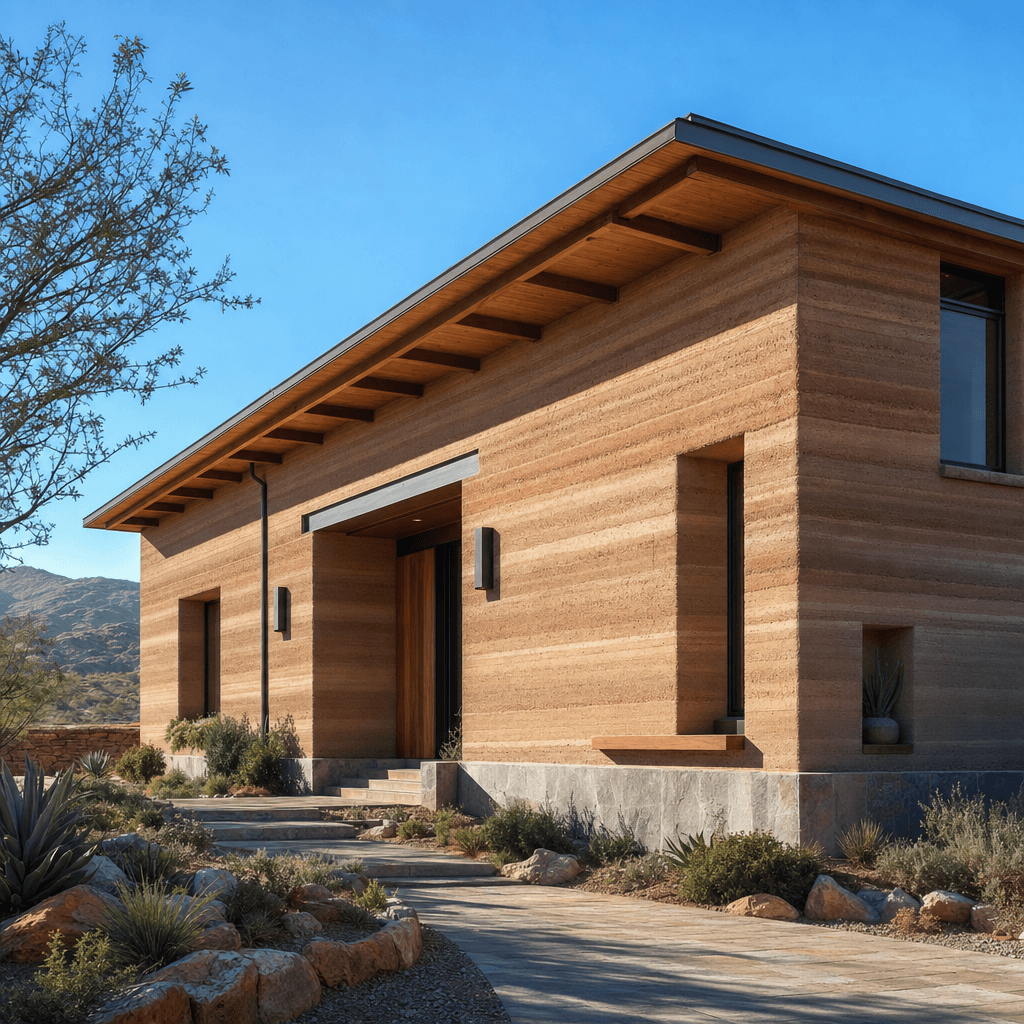
Reference elevation
Rammed Earth / Earth Architecture - characteristic facade composition within the sustainable performance.
Context Snapshot
Elemental, grounded, and tectonically honest. Massing is governed by the structural logic of rammed earth - walls are thick, load-bearing, and continuous. Global - practiced on every inhabited continent for millennia.
Contemporary Relevance
Today, Rammed Earth / Earth Architecture remains relevant wherever projects need sustainable performance cues without losing performance or contemporary usability. In Toscape it responds best when prompts emphasize massing is governed by the structural logic of rammed earth - walls are thick, load-bearing, and continuous. primary walls: rammed earth - locally sourced subsoil, stabilized with 5-10% cement or lime, or unstabilized for full recyclability...
Use this style in Toscape
Explore Rammed Earth / Earth Architecture directly inside Toscape using Facade Re-Style and design workflow prompts tuned for global architectural references.
Open Rammed Earth / Earth Architecture in the galleryFrequently asked questions
What is Rammed Earth / Earth Architecture?
Rammed Earth / Earth Architecture is a global architectural style within the sustainable performance. Thick monolithic earthen walls, deeply carved openings, stratified rammed earth, and tactile mineral mass.
What materials define Rammed Earth / Earth Architecture?
Primary walls: rammed earth. Locally sourced subsoil, stabilized with 5-10% cement or lime, or unstabilized for full recyclability Wall protection: roof overhangs, stone or concrete plinths, vapor-permeable sealers Structure: load-bearing.
What is the Rammed Earth / Earth Architecture color palette?
Primary tones: warm natural earth. Ochre, terracotta, sienna, umber, warm grey Color is determined by local soil composition.
What is the origin of Rammed Earth / Earth Architecture?
Elemental, grounded, and tectonically honest. Massing is governed by the structural logic of rammed earth - walls are thick, load-bearing, and continuous. Global - practiced on every inhabited continent for millennia.
When should architects use Rammed Earth / Earth Architecture?
Today, Rammed Earth / Earth Architecture remains relevant wherever projects need sustainable performance cues without losing performance or contemporary usability. In Toscape it responds best when prompts emphasize massing is governed by the structural logic of rammed earth - walls are thick, load-bearing, and continuous.
How do you render Rammed Earth / Earth Architecture in Toscape?
Open Toscape on Windows, load your own photo, elevation, sketch, or CAD view, then apply the Rammed Earth / Earth Architecture reference from the built-in style library. The Facade Re-Style and Design Options workflows keep your project geometry and camera while shifting materials, proportion, and detailing toward Rammed Earth / Earth Architecture.