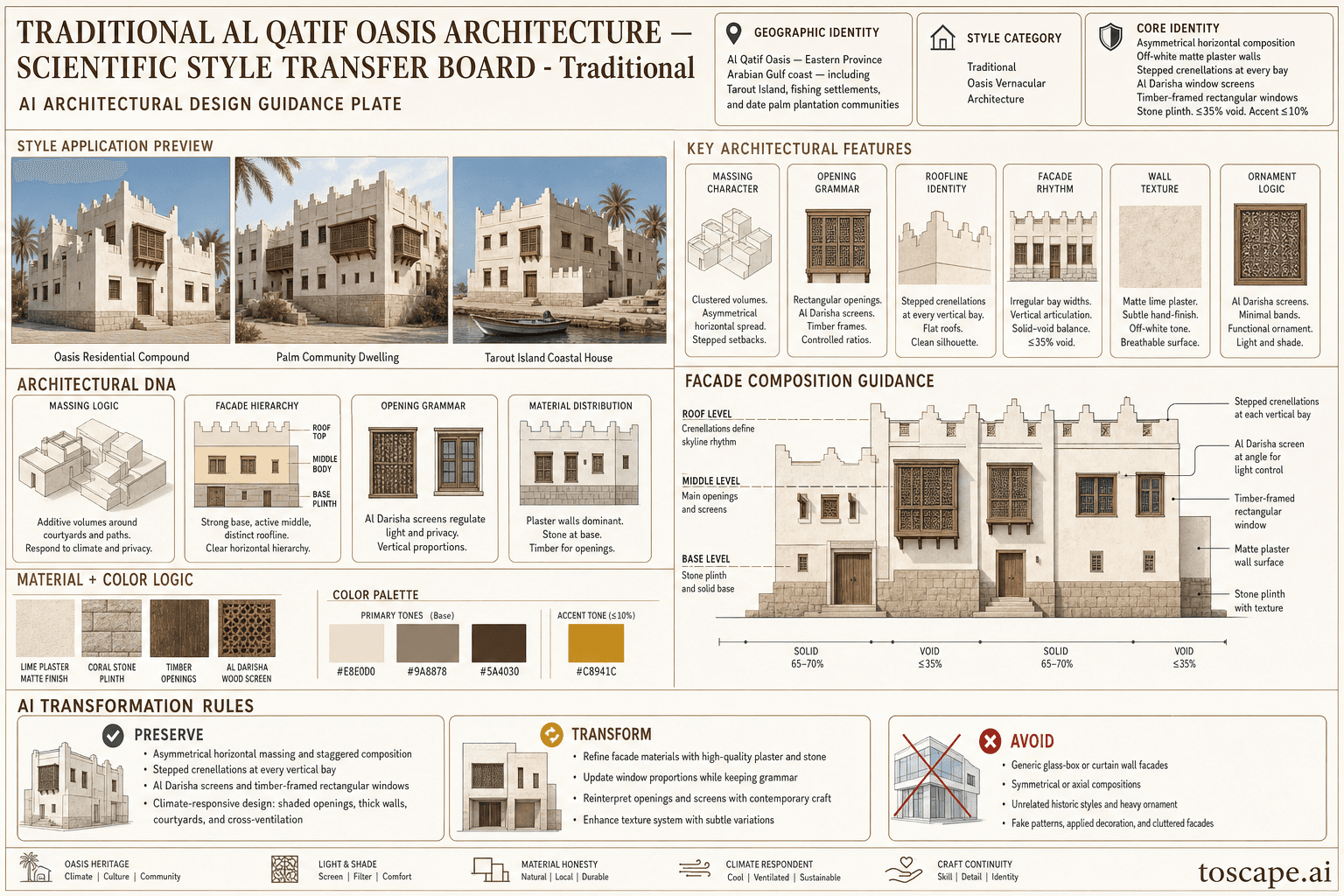
Al Qatif Oasis Traditional
Saudi Arabia · Al Qatif Oasis
The muted Eastern Arabian coastal oasis — off-white plastered walls, asymmetrical facade composition, crenellated parapets, Al Darisha light-reflecting screens, arcaded upper level...
Definition
Al Qatif Oasis Traditional is a regional architectural identity from Saudi Arabia. The muted Eastern Arabian coastal oasis — off-white plastered walls, asymmetrical facade composition, crenellated parapets, Al Darisha light-reflecting screens, arcaded upper level.
- Country
- Saudi Arabia
- Region
- Al Qatif Oasis
- Massing
- Traditional Al Qatif villas develop horizontally with an asymmetrical composition . Buildings are typically 1-2 storeys with flat roofs.
- Materials
- Primary wall surface: matte-finish off-white plaster, limewash or similar, continuous from above the base to the top of the parapet .
- Palette
- Use a light mineral field of sand, shell, coral, and sun-softened white, then introduce timber, bronze, or darker screened shadow as accent.
- Climate response
- Climate: high humidity is extremely common; frequent sandstorms and haze. Windows and ventilation are smaller to preclude dust accumulation .
Overview
Al Qatif Oasis Traditional is a Saudi architectural identity rooted in Al Qatif Oasis. Eastern Arabian Oasis Architecture — Traditional level (Full Strength). Al Qatif Oasis — Eastern Province, Arabian Gulf coast — including Tarout Island, fishing settlements, and date palm plantation communities.
Visual DNA
Massing & Form
Traditional Al Qatif villas develop horizontally with an asymmetrical composition . Buildings are typically 1-2 storeys with flat roofs.
Facade Language
Asymmetry is the governing principle — expressed through varied grouped elements, frames, and openings on different levels and massings . Facades are broken into additive vertical bays with crenellations at the top of each bay.
Materials & Texture
Primary wall surface: matte-finish off-white plaster, limewash or similar, continuous from above the base to the top of the parapet . Wood (or equivalent) for windows, doors, shutters.
Color Palette
Use a light mineral field of sand, shell, coral, and sun-softened white, then introduce timber, bronze, or darker screened shadow as accent. Coastal and oasis palettes should feel bright, breathable, and climate-tempered rather than heavy or monochrome.
Ornament & Detail
The architectural style of Al Qatif is more muted than Al Ahsa — less ornamentation in the building structure . Ornamentation is embedded within parapets, horizontal banding, arches, doors, and recessed elements.
Climate Response
Climate: high humidity is extremely common; frequent sandstorms and haze. Windows and ventilation are smaller to preclude dust accumulation .
Landscape & Ground
Al Qatif Oasis — Eastern Province, Arabian Gulf coast — including Tarout Island, fishing settlements, and date palm plantation communities. Climate: high humidity is extremely common; frequent sandstorms and haze.
Reference elevation
Al Qatif Oasis Traditional — characteristic facade composition, Al Qatif Oasis.
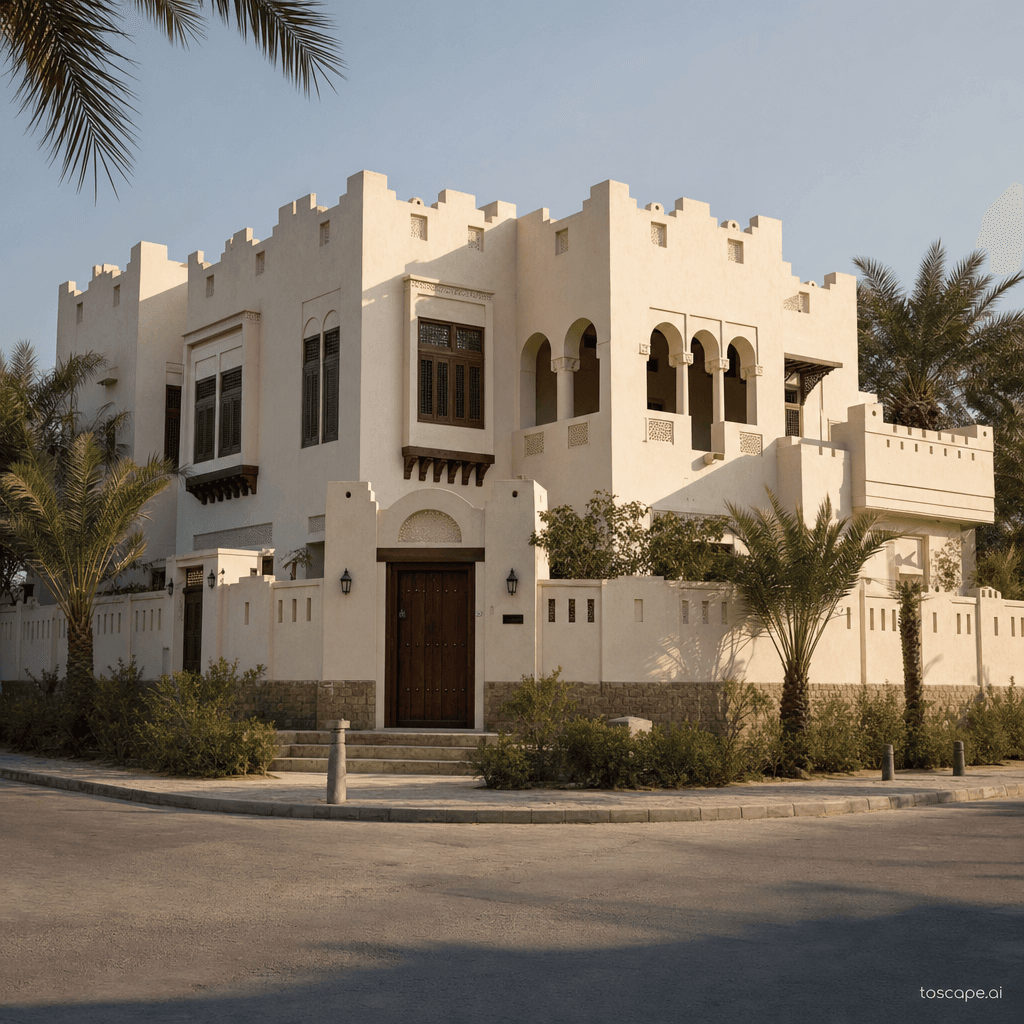
Context Snapshot
Faithful interpretation of Al Qatif Oasis vernacular — more muted and less ornamented than neighboring Al Ahsa — characterized by asymmetry, off-white plaster, flat roofscapes with stepped crenellatio... Eastern Arabian Oasis Architecture — Traditional level (Full Strength) Al Qatif Oasis — Eastern Province, Arabian Gulf coast — including Tarout Island, fishing settlements, and date palm plantation communities
Contemporary Relevance
Al Qatif Oasis Traditional operates as the heritage reference layer for Al Qatif Oasis and is most useful today in conservation work, cultural tourism districts, and accurate AI rendering direction. Its value in current practice comes from preserving proportion, material hierarchy, and climate logic without flattening them into generic nostalgia.
Use this style in Toscape
Explore Al Qatif Oasis Traditional directly inside Toscape using the Facade Re-Style and Design Options workflows.
Open Al Qatif Oasis Traditional in the galleryFrequently asked questions
What is Al Qatif Oasis Traditional?
Al Qatif Oasis Traditional is a regional architectural identity from Saudi Arabia. The muted Eastern Arabian coastal oasis — off-white plastered walls, asymmetrical facade composition, crenellated parapets, Al Darisha light-reflecting screens, arcaded upper level.
What materials define Al Qatif Oasis Traditional?
Primary wall surface: matte-finish off-white plaster, limewash or similar, continuous from above the base to the top of the parapet . Wood (or equivalent) for windows, doors, shutters.
What is the Al Qatif Oasis Traditional color palette?
Use a light mineral field of sand, shell, coral, and sun-softened white, then introduce timber, bronze, or darker screened shadow as accent. Coastal and oasis palettes should feel bright, breathable, and climate-tempered rather than heavy or monochrome.
Where does Al Qatif Oasis Traditional come from?
Faithful interpretation of Al Qatif Oasis vernacular — more muted and less ornamented than neighboring Al Ahsa — characterized by asymmetry, off-white plaster, flat roofscapes with stepped crenellatio... Eastern Arabian Oasis Architecture — Traditional level (Full Strength) Al Qatif Oasis — Eastern Province, Arabian Gulf coast — including Tarout Island, fishing settlements, and date palm plantation communities.
When should architects use Al Qatif Oasis Traditional?
Al Qatif Oasis Traditional operates as the heritage reference layer for Al Qatif Oasis and is most useful today in conservation work, cultural tourism districts, and accurate AI rendering direction. Its value in current practice comes from preserving proportion, material hierarchy, and climate logic without flattening them into generic nostalgia.
How do you render Al Qatif Oasis Traditional in Toscape?
Open Toscape on Windows, load your own photo, elevation, sketch, or CAD view, then apply the Al Qatif Oasis Traditional reference from the built-in style library. The Facade Re-Style and Design Options workflows keep your project geometry and camera while shifting materials, proportion, and detailing toward Al Qatif Oasis Traditional.