Al Qatif Oasis Transitional
Saudi Arabia · Al Qatif Oasis
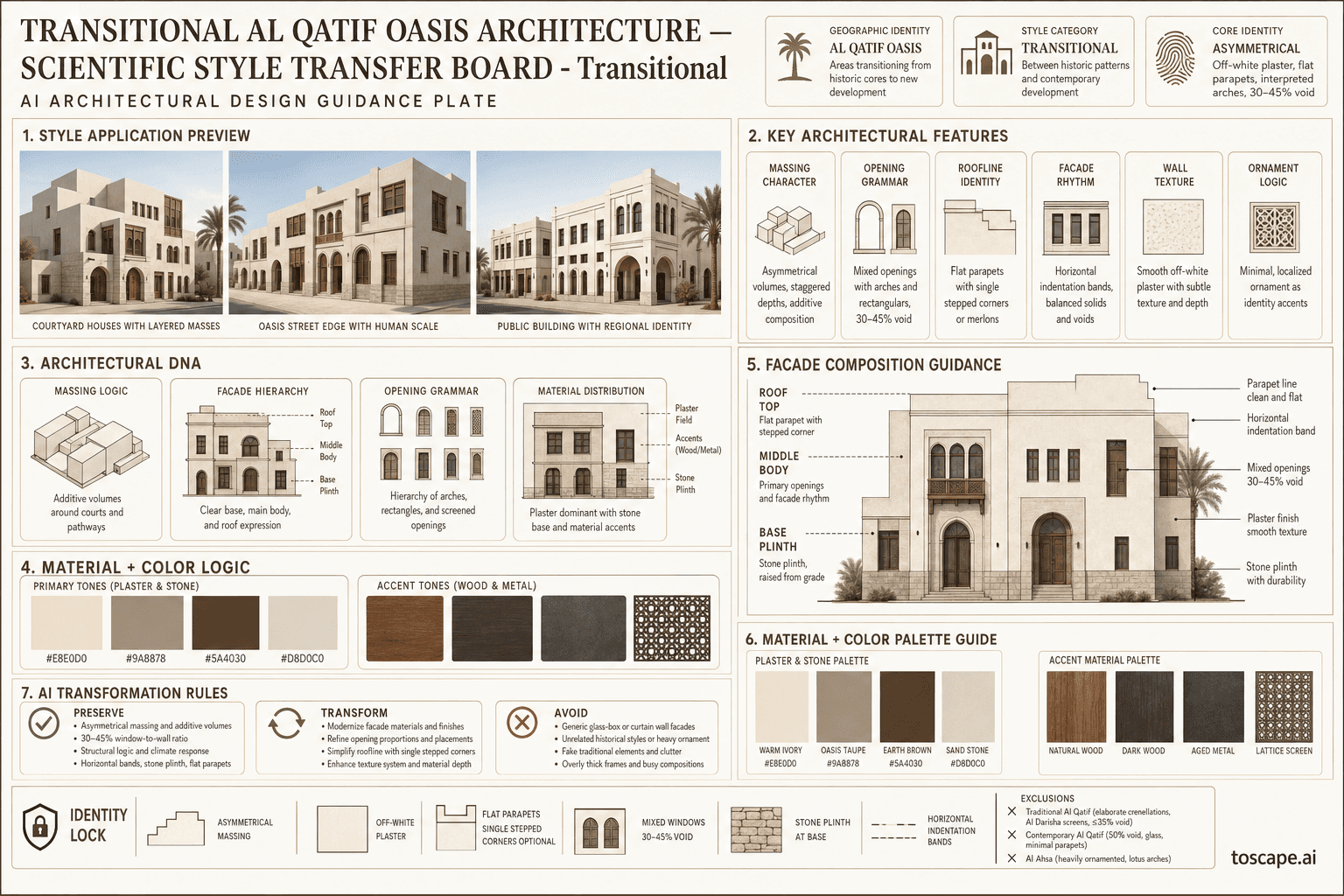
Bridging traditional muted oasis to contemporary — maintained off-white palette, simplified crenellations, interpreted arch geometry, increased openings, vertical breaks in horizon...
Definition
Al Qatif Oasis Transitional is a regional architectural identity from Saudi Arabia. Bridging traditional muted oasis to contemporary — maintained off-white palette, simplified crenellations, interpreted arch geometry, increased openings, vertical breaks in horizon.
- Country
- Saudi Arabia
- Region
- Al Qatif Oasis
- Massing
- Transitional Al Qatif buildings maintain horizontal character but introduce greater vertical breaks — less exaggerated differentiation in wall setback, variation in parapet height.
- Materials
- Off-white matte plaster/limewash as primary wall surface — continuous . Dark timber or equivalent for windows, doors, shutters.
- Palette
- Use a light mineral field of sand, shell, coral, and sun-softened white, then introduce timber, bronze, or darker screened shadow as accent.
- Climate response
- Same climate response: small openings for dust/humidity control. Shaded roof terraces.
Overview
Al Qatif Oasis Transitional is a Saudi architectural identity rooted in Al Qatif Oasis. Eastern Arabian Oasis Architecture — Transitional level. Al Qatif Oasis — areas transitioning from historic cores to new development.
Visual DNA
Massing & Form
Transitional Al Qatif buildings maintain horizontal character but introduce greater vertical breaks — less exaggerated differentiation in wall setback, variation in parapet height, changes in local symmetry across storeys . The additive grid pattern of Traditional is simplified.
Facade Language
Asymmetry is maintained as the governing principle . Facades are flatter than Traditional — less deeply modeled.
Materials & Texture
Off-white matte plaster/limewash as primary wall surface — continuous . Dark timber or equivalent for windows, doors, shutters.
Color Palette
Use a light mineral field of sand, shell, coral, and sun-softened white, then introduce timber, bronze, or darker screened shadow as accent. Coastal and oasis palettes should feel bright, breathable, and climate-tempered rather than heavy or monochrome.
Ornament & Detail
Transitional ornament is abstracted from vegetal-inspired traditional motifs . Simplified geometric bands replace elaborate crenellations.
Climate Response
Same climate response: small openings for dust/humidity control. Shaded roof terraces.
Landscape & Ground
Al Qatif Oasis — areas transitioning from historic cores to new development. Same climate response: small openings for dust/humidity control.
Reference elevation
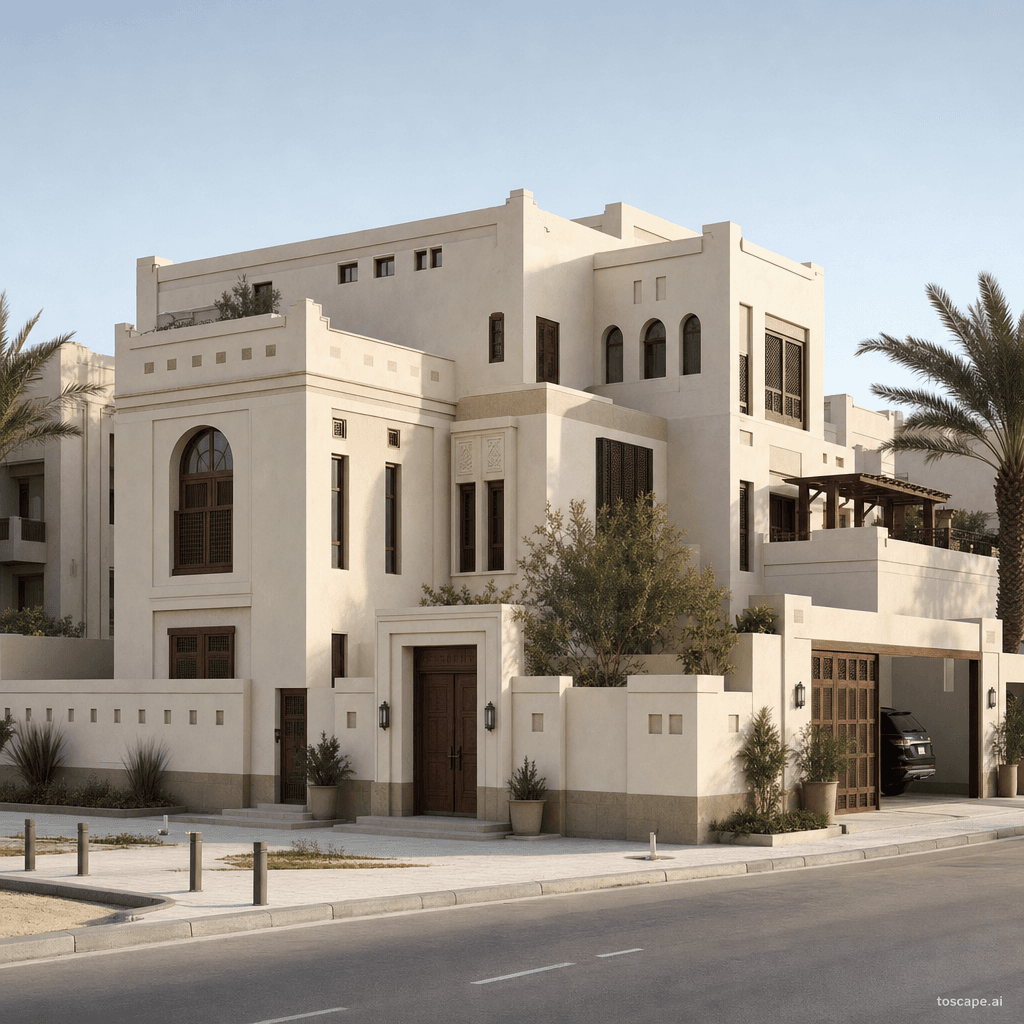
Al Qatif Oasis Transitional — characteristic facade composition, Al Qatif Oasis.
Context Snapshot
Graduate transition from Traditional Al Qatif — asymmetry retained, off-white plaster maintained, crenellations simplified to flat parapets with single stepped corners, window openings increased to 30... Eastern Arabian Oasis Architecture — Transitional level Al Qatif Oasis — areas transitioning from historic cores to new development
Contemporary Relevance
Al Qatif Oasis Transitional is the bridge between conservation and current construction across Al Qatif Oasis, allowing contemporary programs to keep regional identity legible while using modern structure, services, and envelope systems. It is the most practical mode for streetscapes that need to feel rooted without becoming literal replicas.
Use this style in Toscape
Explore Al Qatif Oasis Transitional directly inside Toscape using the Facade Re-Style and Design Options workflows.
Open Al Qatif Oasis Transitional in the galleryFrequently asked questions
What is Al Qatif Oasis Transitional?
Al Qatif Oasis Transitional is a regional architectural identity from Saudi Arabia. Bridging traditional muted oasis to contemporary — maintained off-white palette, simplified crenellations, interpreted arch geometry, increased openings, vertical breaks in horizon.
What materials define Al Qatif Oasis Transitional?
Off-white matte plaster/limewash as primary wall surface — continuous . Dark timber or equivalent for windows, doors, shutters.
What is the Al Qatif Oasis Transitional color palette?
Use a light mineral field of sand, shell, coral, and sun-softened white, then introduce timber, bronze, or darker screened shadow as accent. Coastal and oasis palettes should feel bright, breathable, and climate-tempered rather than heavy or monochrome.
Where does Al Qatif Oasis Transitional come from?
Graduate transition from Traditional Al Qatif — asymmetry retained, off-white plaster maintained, crenellations simplified to flat parapets with single stepped corners, window openings increased to 30... Eastern Arabian Oasis Architecture — Transitional level Al Qatif Oasis — areas transitioning from historic cores to new development.
When should architects use Al Qatif Oasis Transitional?
Al Qatif Oasis Transitional is the bridge between conservation and current construction across Al Qatif Oasis, allowing contemporary programs to keep regional identity legible while using modern structure, services, and envelope systems. It is the most practical mode for streetscapes that need to feel rooted without becoming literal replicas.
How do you render Al Qatif Oasis Transitional in Toscape?
Open Toscape on Windows, load your own photo, elevation, sketch, or CAD view, then apply the Al Qatif Oasis Transitional reference from the built-in style library. The Facade Re-Style and Design Options workflows keep your project geometry and camera while shifting materials, proportion, and detailing toward Al Qatif Oasis Transitional.