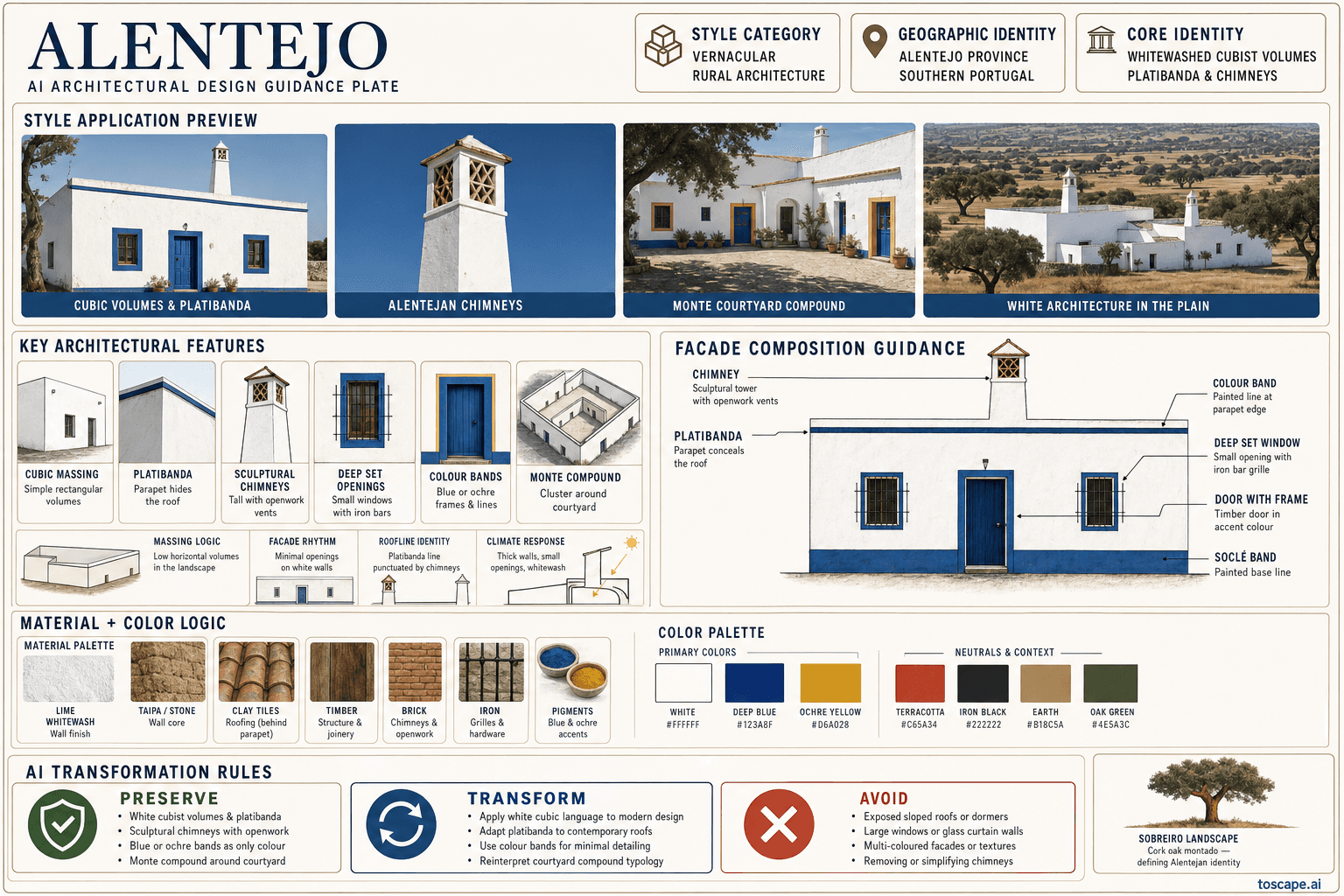
Alentejo
Portugal · Alentejo province
Whitewashed Cubist Plains Architecture, Massive Chimneys & Monte Farmsteads
Definition
Alentejo is a regional architectural identity from Portugal. Whitewashed Cubist Plains Architecture, Massive Chimneys & Monte Farmsteads.
- Country
- Portugal
- Region
- Alentejo province
- Massing
- The Alentejan building is a pure geometric volume — typically a simple rectangular block, single-storey (the dominant form) or two-storey.
- Materials
- Lime whitewash (caiação): the primary finish — multiple coats of slaked lime, producing a brilliant white, highly reflective surface that is renewed annually.
- Palette
- White, cream, pale sand, warm timber, and shadow-driven dark metal accents define the palette.
- Climate response
- Continental Mediterranean — the hottest region of Portugal: summer temperatures regularly exceed 40°C, very low rainfall (500-700mm annually), intense solar radiation, wide diurnal temperature range.
Overview
Alentejo is a regional architectural identity in Portugal. Alentejo province — whitewashed cubist vernacular, montes (farmsteads), and the distinctive plains architecture of southern Portugal. Brilliant white lime-washed cubist volumes — simple, stark, geometric rectangular blocks under the intense Alentejan sun, with minimal openings piercing the thick walls, flat or very low-pitched roofs hidden behind parapet walls (platibanda) giving a pure cubic silhouette, the distinct...
Visual DNA
Massing & Form
The Alentejan building is a pure geometric volume — typically a simple rectangular block, single-storey (the dominant form) or two-storey, with a flat or very low-pitched roof hidden behind a parapet wall (platibanda). The platibanda is the defining facade element — a continuous whitewashed wall rising above the roof l...
Facade Language
The Alentejan facade is minimalist — a white rectangle with a few small window punctures and a door. Symmetry is not strict — openings are placed where needed, often grouped near the centre.
Materials & Texture
Lime whitewash (caiação): the primary finish — multiple coats of slaked lime, producing a brilliant white, highly reflective surface that is renewed annually. Rammed earth (taipa): the traditional wall core of many Alentejan buildings — local earth mixed with small stones and lime, compacted in layers.
Color Palette
White, cream, pale sand, warm timber, and shadow-driven dark metal accents define the palette. The facade should stay bright and climate-aware rather than heavy, gray, or over-saturated.
Ornament & Detail
Alentejan ornament is minimal and colour-based: painted colour bands (barra de cor) — the simple painted line of deep blue or ochre running along the platibanda top edge, around window and door frames, and as a socle at wall base — the only decoration on the white facade, chimney vents — decorative openwork brick patte...
Climate Response
Continental Mediterranean — the hottest region of Portugal: summer temperatures regularly exceed 40°C, very low rainfall (500-700mm annually), intense solar radiation, wide diurnal temperature range, and a vast flat to gently undulating landscape — the Alentejo plain (planície alentejana). Whitewash: the brilliant whit...
Landscape & Ground
Alentejo province — whitewashed cubist vernacular, montes (farmsteads), and the distinctive plains architecture of southern Portugal. Continental Mediterranean — the hottest region of Portugal: summer temperatures regularly exceed 40°C, very low rainfall (500-700mm annually), intense solar radiation, wide diurnal tempe...
Reference elevation
Alentejo — characteristic facade composition, Alentejo province.
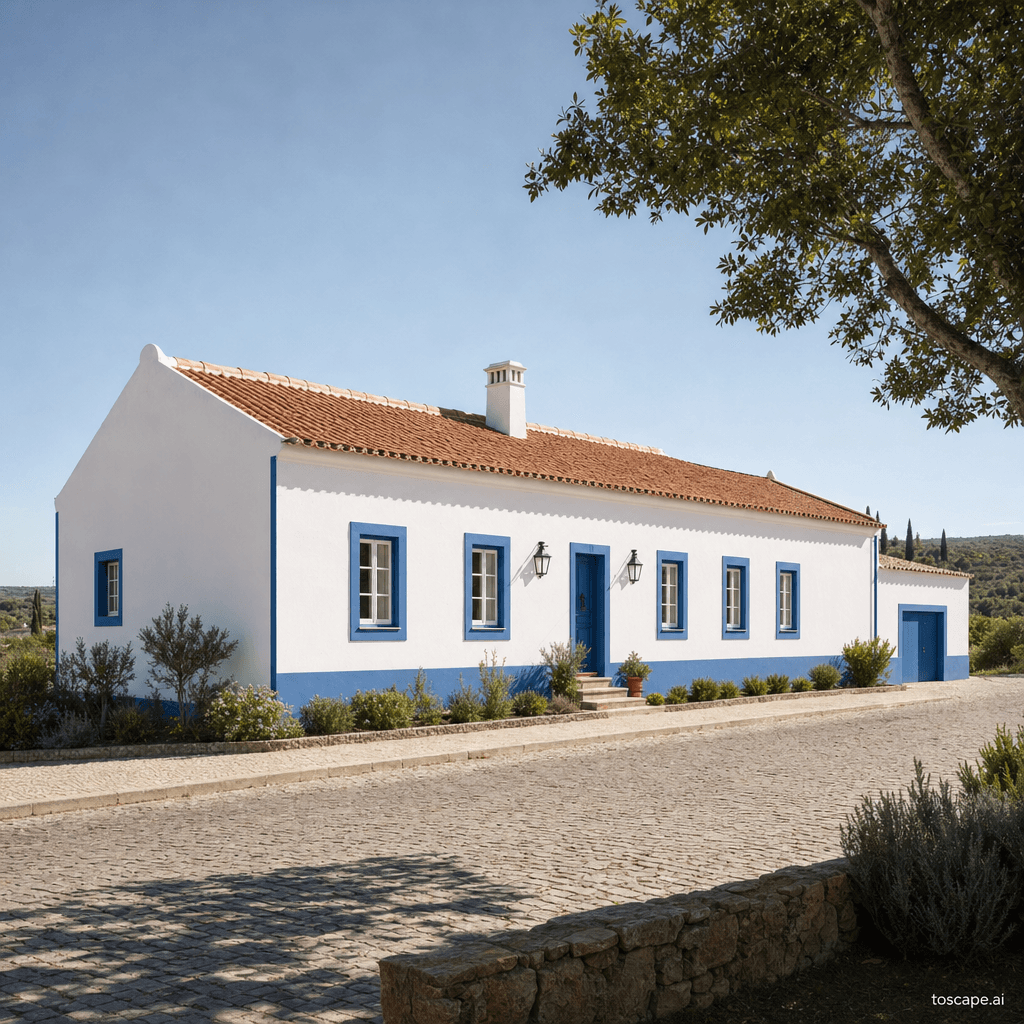
Context Snapshot
Alentejo province — whitewashed cubist vernacular, montes (farmsteads), and the distinctive plains architecture of southern Portugal Continental Mediterranean — the hottest region of Portugal: summer temperatures regularly exceed 40°C, very low rainfall (500-700mm annually), intense solar radiation, wide diurnal temperature range, and a vast flat to g...
Contemporary Relevance
Alentejo is useful today for residential, hospitality, civic, and place-branding work that needs Portugal-specific character grounded in local massing, material tone, climate response, and settlement logic rather than generic international styling.
Use this style in Toscape
Explore Alentejo directly inside Toscape using the Facade Re-Style and Design Options workflows.
Open Alentejo in the galleryFrequently asked questions
What is Alentejo?
Alentejo is a regional architectural identity from Portugal. Whitewashed Cubist Plains Architecture, Massive Chimneys & Monte Farmsteads.
What materials define Alentejo?
Lime whitewash (caiação): the primary finish — multiple coats of slaked lime, producing a brilliant white, highly reflective surface that is renewed annually. Rammed earth (taipa): the traditional wall core of many Alentejan buildings — local earth mixed with small stones and lime, compacted in layers.
What is the Alentejo color palette?
White, cream, pale sand, warm timber, and shadow-driven dark metal accents define the palette. The facade should stay bright and climate-aware rather than heavy, gray, or over-saturated.
Where does Alentejo come from?
Alentejo province — whitewashed cubist vernacular, montes (farmsteads), and the distinctive plains architecture of southern Portugal Continental Mediterranean — the hottest region of Portugal: summer temperatures regularly exceed 40°C, very low rainfall (500-700mm annually), intense solar radiation, wide diurnal temperature range, and a vast flat to g.
When should architects use Alentejo?
Alentejo is useful today for residential, hospitality, civic, and place-branding work that needs Portugal-specific character grounded in local massing, material tone, climate response, and settlement logic rather than generic international styling.
How do you render Alentejo in Toscape?
Open Toscape on Windows, load your own photo, elevation, sketch, or CAD view, then apply the Alentejo reference from the built-in style library. The Facade Re-Style and Design Options workflows keep your project geometry and camera while shifting materials, proportion, and detailing toward Alentejo.