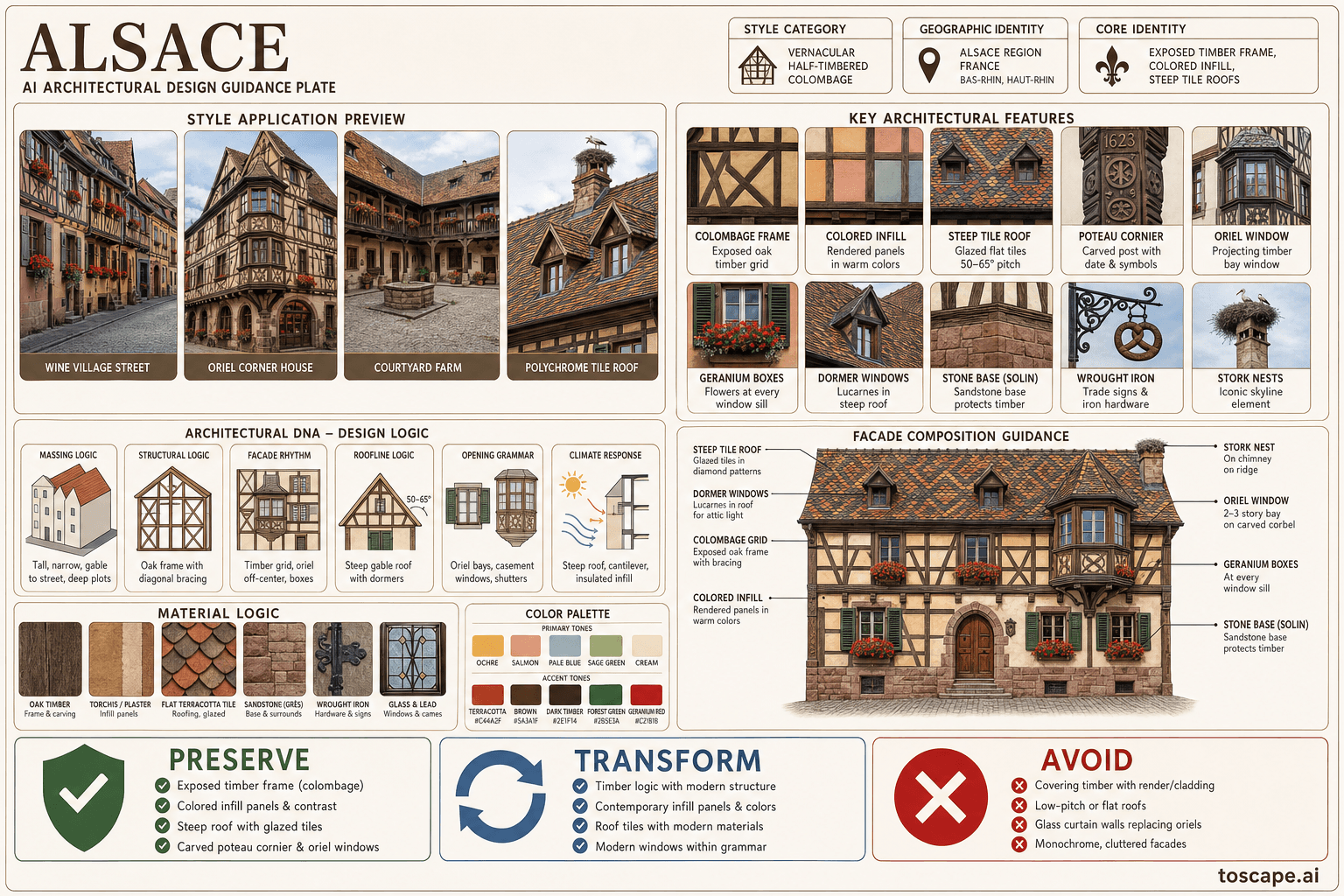
Alsace
France · Alsace region (Bas-Rhin, Haut-Rhin)
Half-Timbered Colombage, Steep Tile Roofs & Rhine Valley Polychrome Vernacular
Definition
Alsace is a regional architectural identity from France. Half-Timbered Colombage, Steep Tile Roofs & Rhine Valley Polychrome Vernacular.
- Country
- France
- Region
- Alsace region (Bas-Rhin, Haut-Rhin).
- Massing
- Urban: tall narrow houses (3-4 stories + attic) on deep narrow plots, gable to street, with rear courtyard.
- Materials
- Chêne (oak): frame, carved posts, bracing, beams — stained dark brown or naturally aged to silver-grey.
- Palette
- White, cream, pale sand, warm timber, and shadow-driven dark metal accents define the palette.
- Climate response
- Continental with Rhine influence: cold snowy winters, warm summers, moderate rainfall. Steep roof: essential for snow shedding — 50-65° pitch eliminates snow load.
Overview
Alsace is a regional architectural identity in France. Alsace region (Bas-Rhin, Haut-Rhin) — pan de bois half-timbered architecture. Exposed timber-frame (colombage/pan de bois) with colored infill panels — ochre, salmon, pale blue, cream rendered between dark timber members, steep pitched (50-60°) terracotta tile roofs (tuile plate alsacienne) often in coloured glazed fish-scale patterns, oriel windows (oriel/erker), window boxes with red geraniums, carved timber posts...
Visual DNA
Massing & Form
Urban: tall narrow houses (3-4 stories + attic) on deep narrow plots, gable to street, with rear courtyard. Rural: ferme à cour carrée — square courtyard farm with dwelling, barn, and stable forming enclosed quadrangle.
Facade Language
Exposed timber grid: dark brown/black timber members (walnut-stained or painted) defining rectangular and triangular infill panels in contrasting light colors (cream, ochre, salmon pink, pale blue, sage green). Oriel window (oriel erker): projecting 2-3 story bay window on carved stone or timber corbel, with glazed pan...
Materials & Texture
Chêne (oak): frame, carved posts, bracing, beams — stained dark brown or naturally aged to silver-grey. Torchis (cob): clay-straw mix on timber lath — infill, plastered and painted with lime.
Color Palette
White, cream, pale sand, warm timber, and shadow-driven dark metal accents define the palette. The facade should stay bright and climate-aware rather than heavy, gray, or over-saturated.
Ornament & Detail
Carved timber: poteau cornier (corner post) — the most important ornamental surface, carved with date of construction, initials of owner/spouse, guild emblems (tools for carpenters, pretzel for bakers), religious symbols (cross, Sacred Heart), geometric patterns (diamond, spiral, rope), and sometimes human figures (Ada...
Climate Response
Continental with Rhine influence: cold snowy winters, warm summers, moderate rainfall. Steep roof: essential for snow shedding — 50-65° pitch eliminates snow load.
Landscape & Ground
Alsace region (Bas-Rhin, Haut-Rhin) — pan de bois half-timbered architecture. Continental with Rhine influence: cold snowy winters, warm summers, moderate rainfall.
Reference elevation
Alsace — characteristic facade composition, Alsace region (Bas-Rhin, Haut-Rhin).
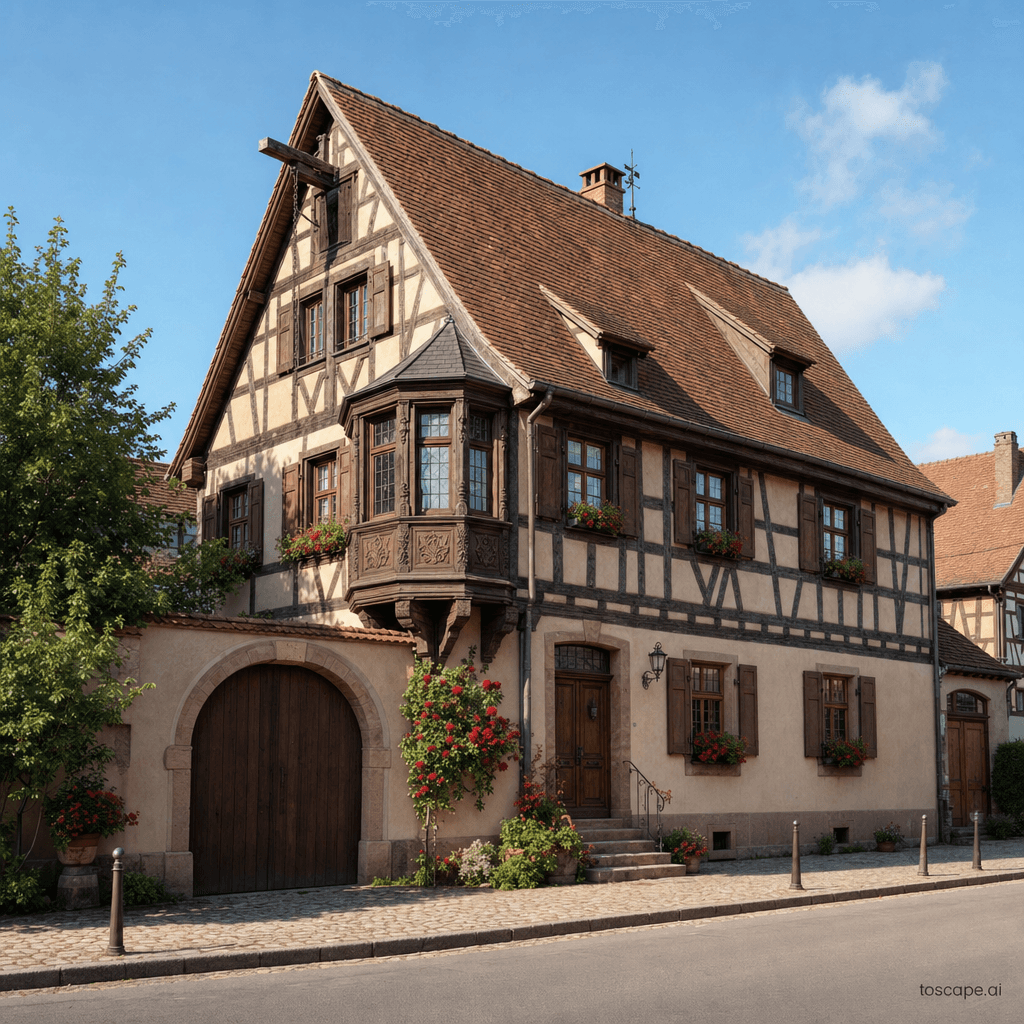
Context Snapshot
Alsace region (Bas-Rhin, Haut-Rhin) — pan de bois half-timbered architecture Continental with Rhine influence: cold snowy winters, warm summers, moderate rainfall.
Contemporary Relevance
Alsace is useful today for residential, hospitality, civic, and place-branding work that needs France-specific character grounded in local massing, material tone, climate response, and settlement logic rather than generic international styling.
Use this style in Toscape
Explore Alsace directly inside Toscape using the Facade Re-Style and Design Options workflows.
Open Alsace in the galleryFrequently asked questions
What is Alsace?
Alsace is a regional architectural identity from France. Half-Timbered Colombage, Steep Tile Roofs & Rhine Valley Polychrome Vernacular.
What materials define Alsace?
Chêne (oak): frame, carved posts, bracing, beams — stained dark brown or naturally aged to silver-grey. Torchis (cob): clay-straw mix on timber lath — infill, plastered and painted with lime.
What is the Alsace color palette?
White, cream, pale sand, warm timber, and shadow-driven dark metal accents define the palette. The facade should stay bright and climate-aware rather than heavy, gray, or over-saturated.
Where does Alsace come from?
Alsace region (Bas-Rhin, Haut-Rhin) — pan de bois half-timbered architecture Continental with Rhine influence: cold snowy winters, warm summers, moderate rainfall.
When should architects use Alsace?
Alsace is useful today for residential, hospitality, civic, and place-branding work that needs France-specific character grounded in local massing, material tone, climate response, and settlement logic rather than generic international styling.
How do you render Alsace in Toscape?
Open Toscape on Windows, load your own photo, elevation, sketch, or CAD view, then apply the Alsace reference from the built-in style library. The Facade Re-Style and Design Options workflows keep your project geometry and camera while shifting materials, proportion, and detailing toward Alsace.