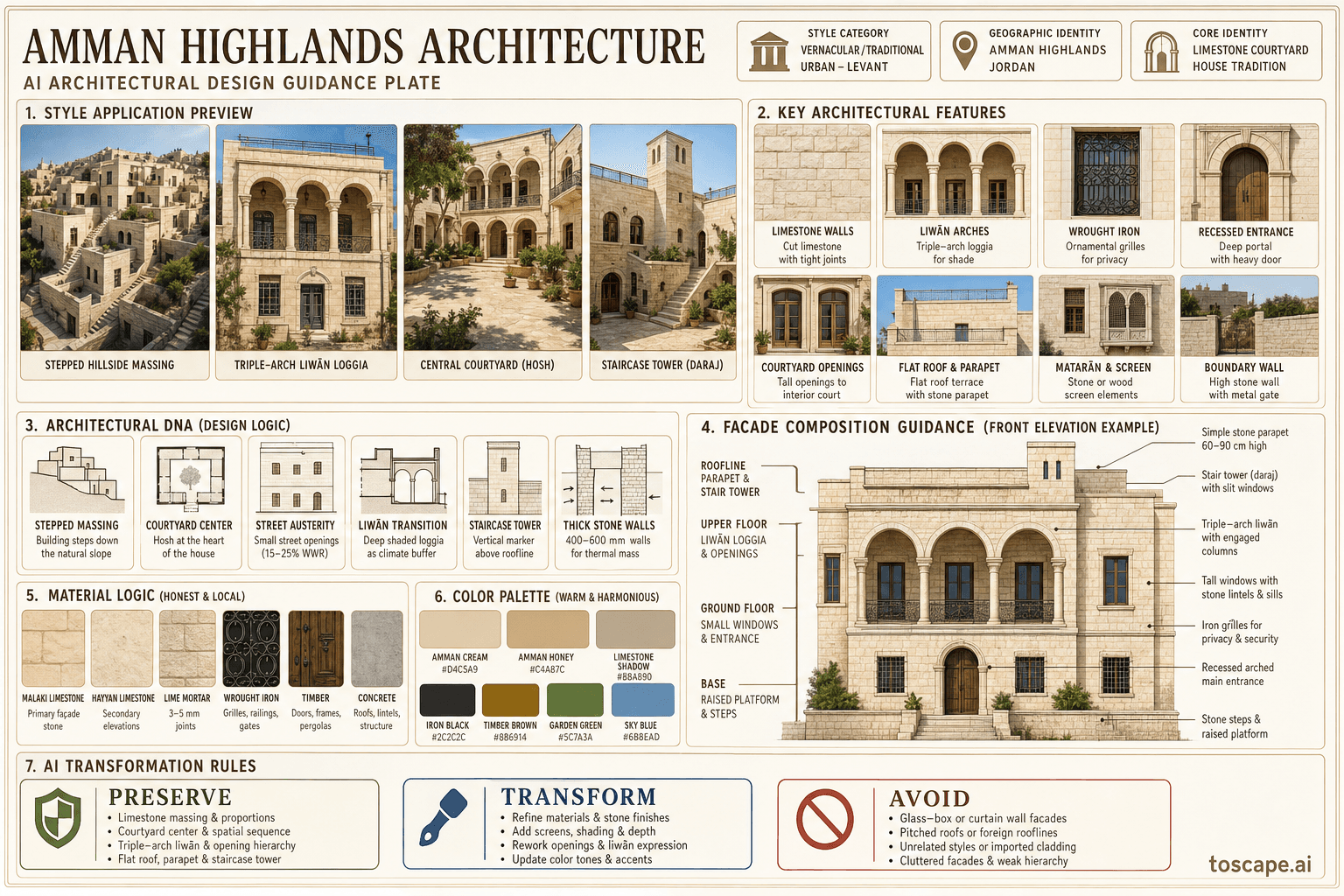
Amman Highlands
Jordan · domestic and urban architecture of Amman and the central Jordanian highlands (Ba...
The limestone-clad hillside dwelling of the Jordanian plateau — courtyard houses, cross-vaulted roof terraces, and the enduring vernacular of the Balqa highlands
Definition
Amman Highlands is a regional architectural identity from Jordan. The limestone-clad hillside dwelling of the Jordanian plateau — courtyard houses, cross-vaulted roof terraces, and the enduring vernacular of the Balqa highlands.
- Country
- Jordan
- Region
- domestic and urban architecture of Amman and the central Jordanian highlands (Ba.
- Massing
- The Ammani house is a rectangular or L-plan volume — typically 10–18 m wide × 12–22 m deep — sited to step down the natural limestone.
- Materials
- Malaki limestone — cream to warm honey-beige — primary façade stone.
- Palette
- White, cream, pale sand, warm timber, and shadow-driven dark metal accents define the palette.
- Climate response
- Amman's semi-arid Mediterranean climate — hot dry summers (32–38°C), cold winters (2–8°C with occasional snow).
Overview
Amman Highlands is a regional architectural identity in Jordan. Traditional domestic and urban architecture of Amman and the central Jordanian highlands (Balqa plateau) — a region defined by its honey-colored limestone building tradition, stepped hillside construction, courtyard-centered house forms, and the adaptation of vernacular Levantine architecture to the semi-arid Mediterranean climate at 700–1,100 m elevation. The Ammani limestone house — cut local limestone (malaki and...
Visual DNA
Massing & Form
The Ammani house is a rectangular or L-plan volume — typically 10–18 m wide × 12–22 m deep — sited to step down the natural limestone slopes, creating a terraced composition. Houses are 2–3 storeys: ground floor for service and storage, upper floors for family living, with flat rooftop terraces used for summer sleeping...
Facade Language
The Ammani street facade is characterized by stone solidity with controlled rhythmic articulation: Triple-arch motif (liwān): The most distinctive Ammani feature — a three-bay arched loggia or recessed porch on the upper floor façade, formed by two engaged stone columns or piers supporting three shallow stone arches. T...
Materials & Texture
Malaki limestone — cream to warm honey-beige — primary façade stone, locally quarried from the Amman-Russeifa formations Hayyan limestone — lighter cream — secondary elevations and interior wall facing Lime mortar — tight joints (3–5 mm) between stone courses — traditionally lime-based, now cement-lime hybrid Timber —...
Color Palette
White, cream, pale sand, warm timber, and shadow-driven dark metal accents define the palette. The facade should stay bright and climate-aware rather than heavy, gray, or over-saturated.
Ornament & Detail
Ammani ornament is restrained — the limestone itself is the primary aesthetic vehicle: (1) Stone coursing as ornament — the expressed horizontal joints create the primary architectural texture. (2) Liwān arches — the triple-arch composition is the main ornamental event on the façade.
Climate Response
Amman's semi-arid Mediterranean climate — hot dry summers (32–38°C), cold winters (2–8°C with occasional snow), and 250–400 mm annual rainfall — shapes the architecture through: (1) Thermal mass — thick limestone walls (400–600 mm) absorb daytime heat and release it at night, moderating interior temperatures. (2) The l...
Landscape & Ground
Traditional domestic and urban architecture of Amman and the central Jordanian highlands (Balqa plateau) — a region defined by its honey-colored limestone building tradition, stepped hillside construction, courtyard-centered house forms, and the adaptation of vernacular Levantine architecture to the semi-arid Mediterra...
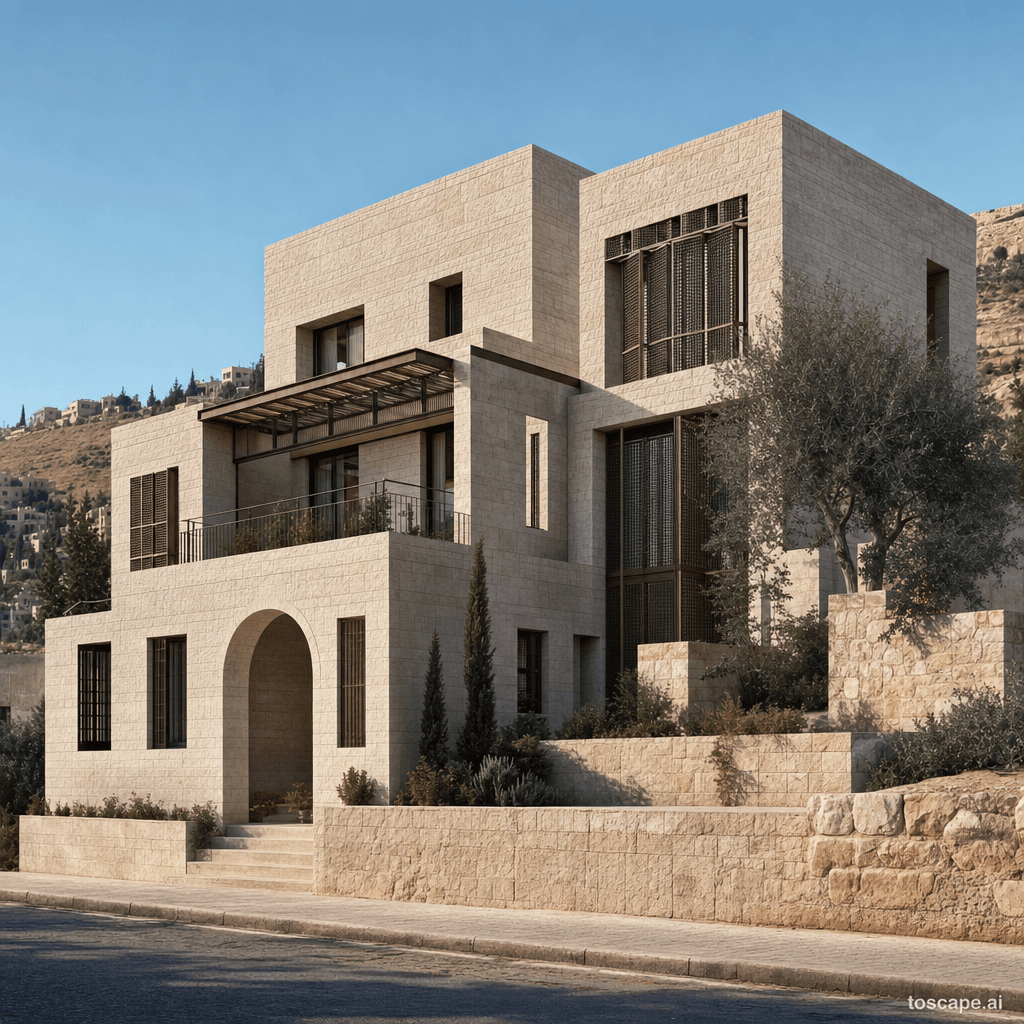
Reference elevation
Amman Highlands — characteristic facade composition, domestic and urban architecture of Amman and the central Jordanian highlands (Ba....
Context Snapshot
Traditional domestic and urban architecture of Amman and the central Jordanian highlands (Balqa plateau) — a region defined by its honey-colored limestone building tradition, stepped hillside construc... Amman's semi-arid Mediterranean climate — hot dry summers (32–38°C), cold winters (2–8°C with occasional snow), and 250–400 mm annual rainfall — shapes the architecture through: (1) Thermal mass — thick limestone walls (...
Contemporary Relevance
Amman Highlands is useful today for residential, hospitality, civic, and place-branding work that needs Jordan-specific character grounded in local massing, material tone, climate response, and settlement logic rather than generic international styling.
Use this style in Toscape
Explore Amman Highlands directly inside Toscape using the Facade Re-Style and Design Options workflows.
Open Amman Highlands in the galleryFrequently asked questions
What is Amman Highlands?
Amman Highlands is a regional architectural identity from Jordan. The limestone-clad hillside dwelling of the Jordanian plateau — courtyard houses, cross-vaulted roof terraces, and the enduring vernacular of the Balqa highlands.
What materials define Amman Highlands?
Malaki limestone — cream to warm honey-beige — primary façade stone, locally quarried from the Amman-Russeifa formations Hayyan limestone — lighter cream — secondary elevations and interior wall facing Lime mortar — tight joints (3–5 mm) between stone courses — traditionally lime-based, now cement-lime hybrid Timber.
What is the Amman Highlands color palette?
White, cream, pale sand, warm timber, and shadow-driven dark metal accents define the palette. The facade should stay bright and climate-aware rather than heavy, gray, or over-saturated.
Where does Amman Highlands come from?
Traditional domestic and urban architecture of Amman and the central Jordanian highlands (Balqa plateau) — a region defined by its honey-colored limestone building tradition, stepped hillside construc... Amman's semi-arid Mediterranean climate — hot dry summers (32–38°C), cold winters (2–8°C with occasional snow), and 250–400 mm annual rainfall — shapes the architecture through: (1) Thermal mass — thick limestone walls (.
When should architects use Amman Highlands?
Amman Highlands is useful today for residential, hospitality, civic, and place-branding work that needs Jordan-specific character grounded in local massing, material tone, climate response, and settlement logic rather than generic international styling.
How do you render Amman Highlands in Toscape?
Open Toscape on Windows, load your own photo, elevation, sketch, or CAD view, then apply the Amman Highlands reference from the built-in style library. The Facade Re-Style and Design Options workflows keep your project geometry and camera while shifting materials, proportion, and detailing toward Amman Highlands.