Arequipa Sillar
Peru · architectural identity of Arequipa (UNESCO World Heritage, inscribed 2000)
The white volcanic stone architecture of Arequipa — the sillar (ignimbrite) Baroque-Mestizo churches and colonial casonas of Peru's "White City," where the volcanic tuff from El Mi...
Definition
Arequipa Sillar is a regional architectural identity from Peru. The white volcanic stone architecture of Arequipa — the sillar (ignimbrite) Baroque-Mestizo churches and colonial casonas of Peru's "White City," where the volcanic tuff from El Mi.
- Country
- Peru
- Region
- architectural identity of Arequipa (UNESCO World Heritage, inscribed 2000).
- Massing
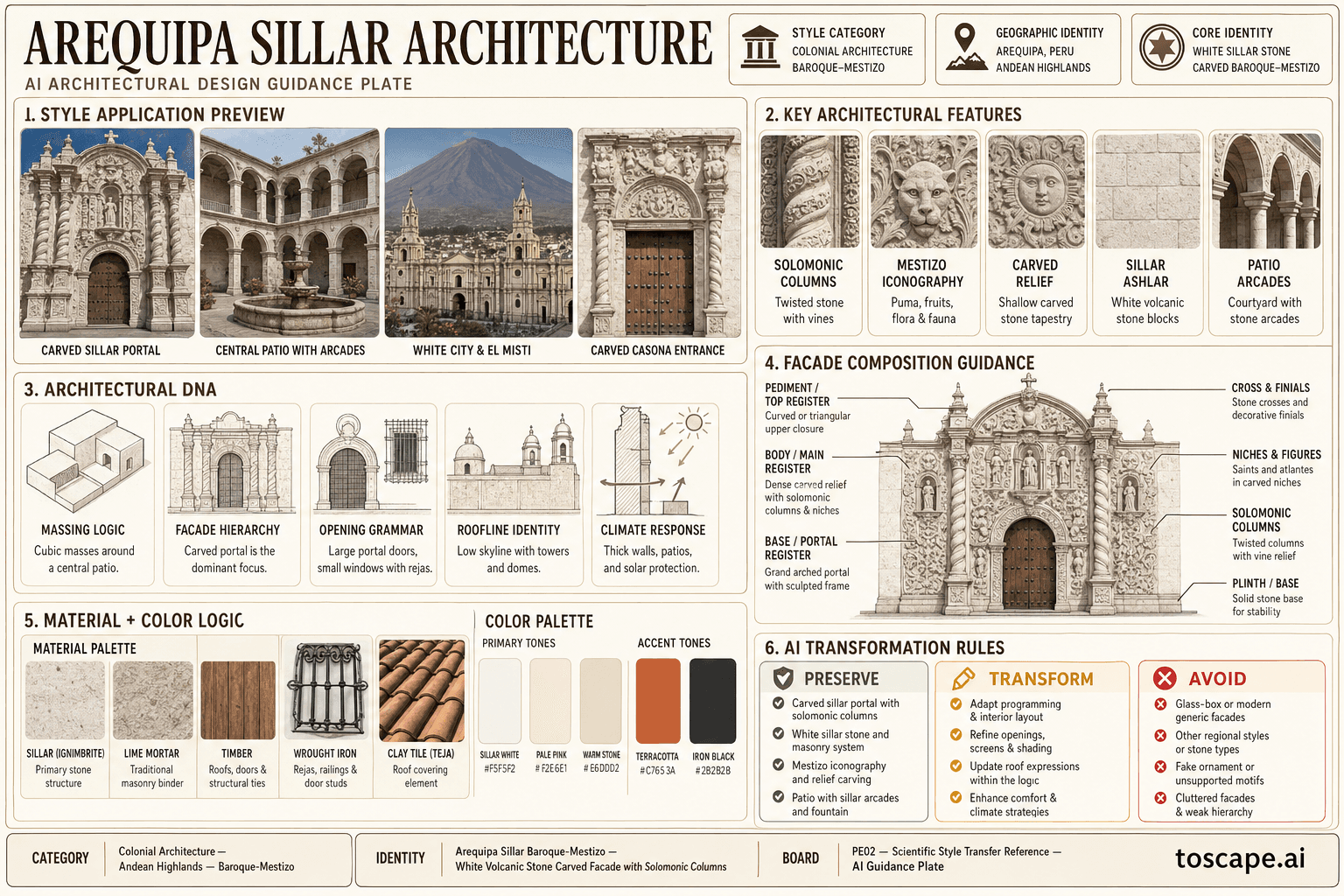
- Arequipa colonial architecture is blocky and cubic — the sillar ashlar produces rectilinear masses with flat or low-pitched roofs (clay tile on timber or cane-vault structure).
- Materials
- Sillar IS Arequipa — the material identity is absolute: (1) Sillar (ignimbrite) — white to pale pinkish-white, fine-grained but pumice-speckled.
- Palette
- White, cream, pale sand, warm timber, and shadow-driven dark metal accents define the palette.
- Climate response
- Arequipa (2,335 m, high-altitude desert) has a dry, sunny climate (300+ days of sunshine per year) with mild temperatures (10–25°C) and very low rainfall (under 100.
Overview
Arequipa Sillar is a regional architectural identity in Peru. The architectural identity of Arequipa (UNESCO World Heritage, inscribed 2000) — the colonial city at 2,335 m elevation in the shadow of El Misti volcano, built entirely from sillar — a white-to-pale-pink volcanic tuff (ignimbrite) quarried from the Chachani and Misti volcanic deposits — the sillar architecture of the 17th–19th centuries is distinguished by its Baroque-Mestizo style: elaborate facade reliefs carved d...
Visual DNA
Massing & Form
Arequipa colonial architecture is blocky and cubic — the sillar ashlar produces rectilinear masses with flat or low-pitched roofs (clay tile on timber or cane-vault structure). Church facades are planar — a single rectangular plane rising to a curved or triangular pediment, with the portal occupying the full width of t...
Facade Language
The Arequipa facade is the carved sillar surface — a white stone tapestry. The church portal organizes the facade into vertical bays (typically three, corresponding to nave and aisles) and horizontal registers (base, body, pediment).
Materials & Texture
Sillar IS Arequipa — the material identity is absolute: (1) Sillar (ignimbrite) — white to pale pinkish-white, fine-grained but pumice-speckled, the exclusive building stone for the historic core — the color varies from brilliant white (Chachani quarry) to warm cream-pink (Misti quarry deposits). (2) Lime mortar — made...
Color Palette
White, cream, pale sand, warm timber, and shadow-driven dark metal accents define the palette. The facade should stay bright and climate-aware rather than heavy, gray, or over-saturated.
Ornament & Detail
The ornament is carved sillar — the entire facade is a stone relief: (1) Solomonic (twisted) columns — spiral-fluted with vine decoration — the signature Arequipa Baroque element. (2) Mestizo iconography — tropical fruits (chirimoya, granadilla), Andean animals (puma, monkey, llama, condor), indigenous flowers (cantuta...
Climate Response
Arequipa (2,335 m, high-altitude desert) has a dry, sunny climate (300+ days of sunshine per year) with mild temperatures (10–25°C) and very low rainfall (under 100 mm/year). The sillar architecture is perfectly adapted: (1) The white stone reflects solar radiation, keeping interiors cool.
Landscape & Ground
The architectural identity of Arequipa (UNESCO World Heritage, inscribed 2000) — the colonial city at 2,335 m elevation in the shadow of El Misti volcano, built entirely from sillar — a white-to-pale-pink volcanic tuff (ignimbrite) quarried from the Chachani and Misti volcanic deposits — the sillar architecture of the...
Reference elevation
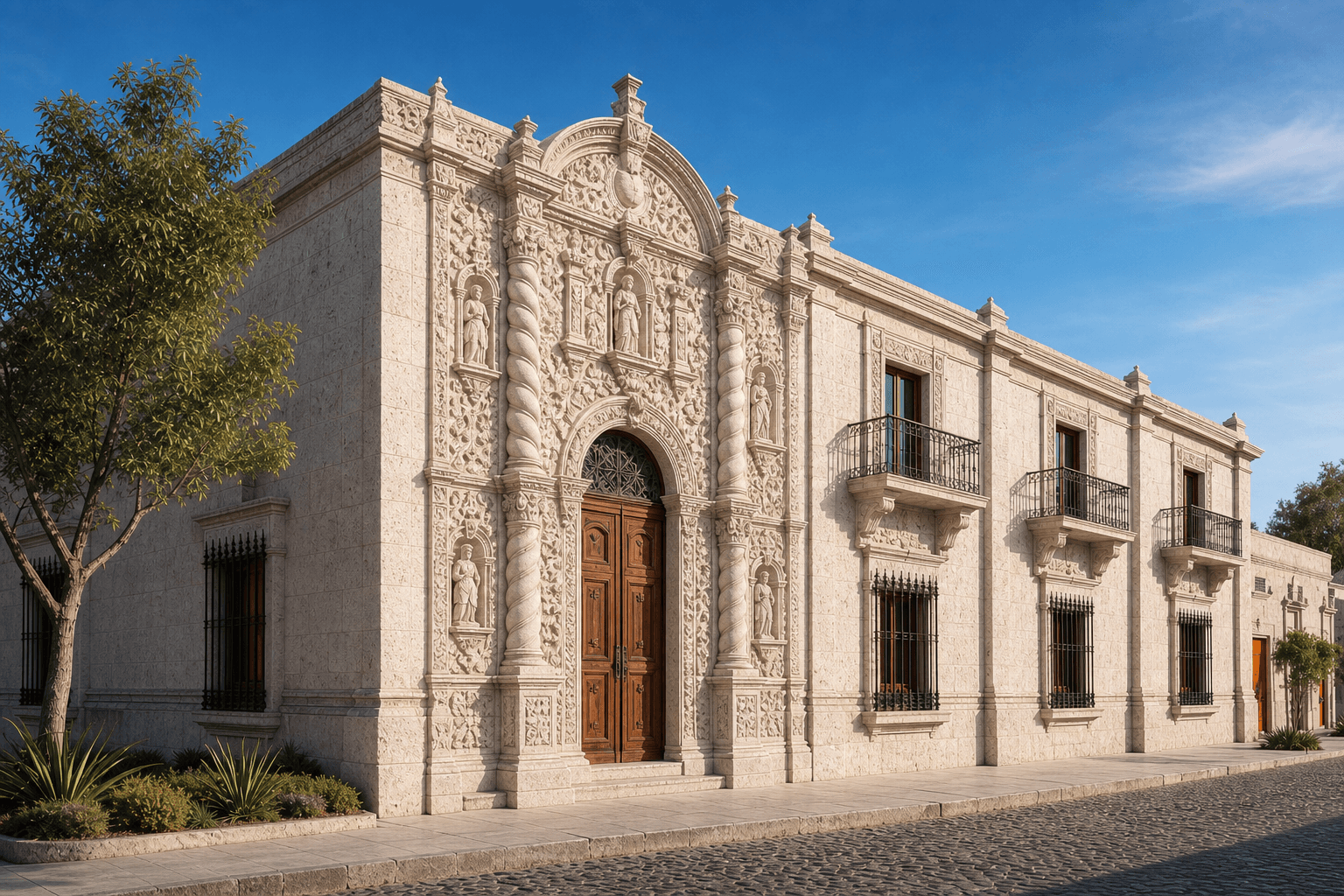
Arequipa Sillar — characteristic facade composition, architectural identity of Arequipa (UNESCO World Heritage, inscribed 2000).
Context Snapshot
The architectural identity of Arequipa (UNESCO World Heritage, inscribed 2000) — the colonial city at 2,335 m elevation in the shadow of El Misti volcano, built entirely from sillar — a white-to-pale... Arequipa (2,335 m, high-altitude desert) has a dry, sunny climate (300+ days of sunshine per year) with mild temperatures (10–25°C) and very low rainfall (under 100 mm/year).
Contemporary Relevance
Arequipa Sillar is useful today for residential, hospitality, civic, and place-branding work that needs Peru-specific character grounded in local massing, material tone, climate response, and settlement logic rather than generic international styling.
Use this style in Toscape
Explore Arequipa Sillar directly inside Toscape using the Facade Re-Style and Design Options workflows.
Open Arequipa Sillar in the galleryFrequently asked questions
What is Arequipa Sillar?
Arequipa Sillar is a regional architectural identity from Peru. The white volcanic stone architecture of Arequipa — the sillar (ignimbrite) Baroque-Mestizo churches and colonial casonas of Peru's "White City," where the volcanic tuff from El Mi.
What materials define Arequipa Sillar?
Sillar IS Arequipa — the material identity is absolute: (1) Sillar (ignimbrite) — white to pale pinkish-white, fine-grained but pumice-speckled, the exclusive building stone for the historic core — the color varies from brilliant white (Chachani quarry) to warm cream-pink (Misti quarry deposits). (2) Lime mortar — made.
What is the Arequipa Sillar color palette?
White, cream, pale sand, warm timber, and shadow-driven dark metal accents define the palette. The facade should stay bright and climate-aware rather than heavy, gray, or over-saturated.
Where does Arequipa Sillar come from?
The architectural identity of Arequipa (UNESCO World Heritage, inscribed 2000) — the colonial city at 2,335 m elevation in the shadow of El Misti volcano, built entirely from sillar — a white-to-pale... Arequipa (2,335 m, high-altitude desert) has a dry, sunny climate (300+ days of sunshine per year) with mild temperatures (10–25°C) and very low rainfall (under 100 mm/year).
When should architects use Arequipa Sillar?
Arequipa Sillar is useful today for residential, hospitality, civic, and place-branding work that needs Peru-specific character grounded in local massing, material tone, climate response, and settlement logic rather than generic international styling.
How do you render Arequipa Sillar in Toscape?
Open Toscape on Windows, load your own photo, elevation, sketch, or CAD view, then apply the Arequipa Sillar reference from the built-in style library. The Facade Re-Style and Design Options workflows keep your project geometry and camera while shifting materials, proportion, and detailing toward Arequipa Sillar.