Atacama Desert
Chile · architectural identity of the Atacama Desert oasis settlements
The adobe-and-cactus-wood architecture of the Atacama Desert oases — the San Pedro de Atacama vernacular where Licanantay (Atacameño) traditions meet Spanish colonial adobe constru...
Definition
Atacama Desert is a regional architectural identity from Chile. The adobe-and-cactus-wood architecture of the Atacama Desert oases — the San Pedro de Atacama vernacular where Licanantay (Atacameño) traditions meet Spanish colonial adobe constru.
- Country
- Chile
- Region
- architectural identity of the Atacama Desert oasis settlements.
- Massing
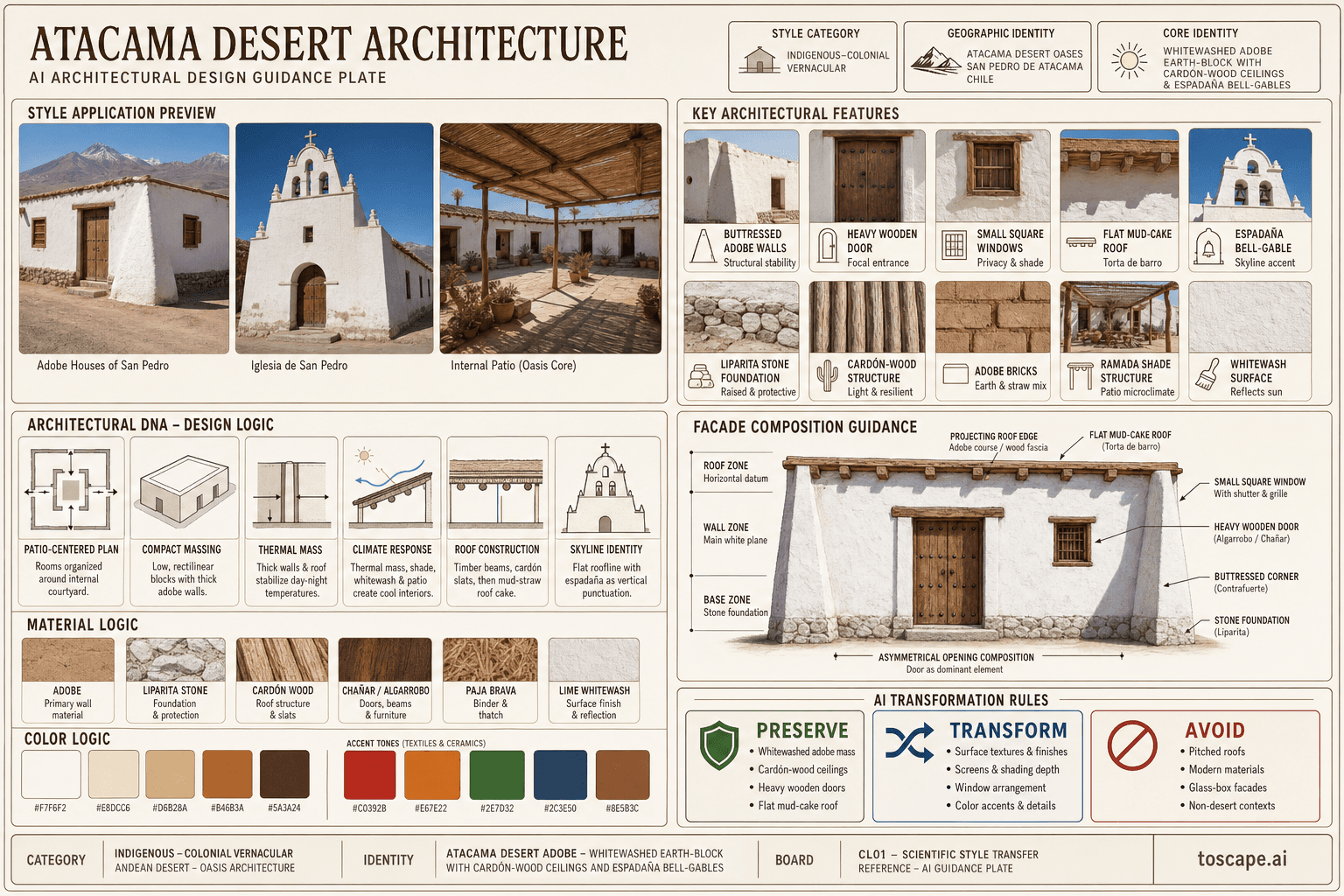
- The Atacameño house is a low, compact rectilinear block — typically 6–12 m × 4–8 m, single-story, with flat or very low-pitched roofs.
- Materials
- The palette is entirely local and desert-derived: (1) Adobe — clay-rich desert soil mixed with paja brava (high-altitude straw).
- Palette
- White, cream, pale sand, warm timber, and shadow-driven dark metal accents define the palette.
- Climate response
- The Atacama Desert is the driest non-polar desert on Earth — some weather stations have never recorded rainfall.
Overview
Atacama Desert is a regional architectural identity in Chile. The architectural identity of the Atacama Desert oasis settlements — San Pedro de Atacama and the surrounding ayllus (indigenous communities) at 2,400 m elevation in Chile's Antofagasta Region — the Atacameño colonial adobe house, a single-story rectangular structure with thick adobe walls (50–80 cm), flat torta de barro roofs (a layered mud-and-straw cake over chañar or algarrobo timber beams), small windows with wo...
Visual DNA
Massing & Form
The Atacameño house is a low, compact rectilinear block — typically 6–12 m × 4–8 m, single-story, with flat or very low-pitched roofs. The mass is heavy and earthbound — thick adobe walls dominate the visual reading.
Facade Language
The facade is a whitewashed adobe plane — smooth but slightly irregular, the hand of the builder visible in the surface. The single heavy wooden door (2–2.5 m high) is the dominant compositional element, framed by a slightly projecting adobe architrave.
Materials & Texture
The palette is entirely local and desert-derived: (1) Adobe — clay-rich desert soil mixed with paja brava (high-altitude straw), sun-dried into bricks — color: warm ochre to pale brown under the whitewash. (2) Piedra liparita — white volcanic tuff, the foundation stone, quarried from the Cordillera de la Sal.
Color Palette
White, cream, pale sand, warm timber, and shadow-driven dark metal accents define the palette. The facade should stay bright and climate-aware rather than heavy, gray, or over-saturated.
Ornament & Detail
Ornament is minimal and material-honest: (1) The cardón-wood ceiling — exposed cactus-rib rafters (tijerales de cardón) with their distinctive parallel-ribbed texture, tied with leather thongs — the ceiling IS the ornamental surface of the interior. (2) Wooden door carving — simple geometric patterns on algarrobo doors...
Climate Response
The Atacama Desert is the driest non-polar desert on Earth — some weather stations have never recorded rainfall. San Pedro de Atacama (2,400 m) receives under 35 mm of annual precipitation, with diurnal temperature swings of 25–30°C (near-freezing at night to 25°C by day) and intense solar radiation.
Landscape & Ground
The architectural identity of the Atacama Desert oasis settlements — San Pedro de Atacama and the surrounding ayllus (indigenous communities) at 2,400 m elevation in Chile's Antofagasta Region — the Atacameño colonial adobe house, a single-story rectangular structure with thick adobe walls (50–80 cm), flat torta de bar...
Reference elevation
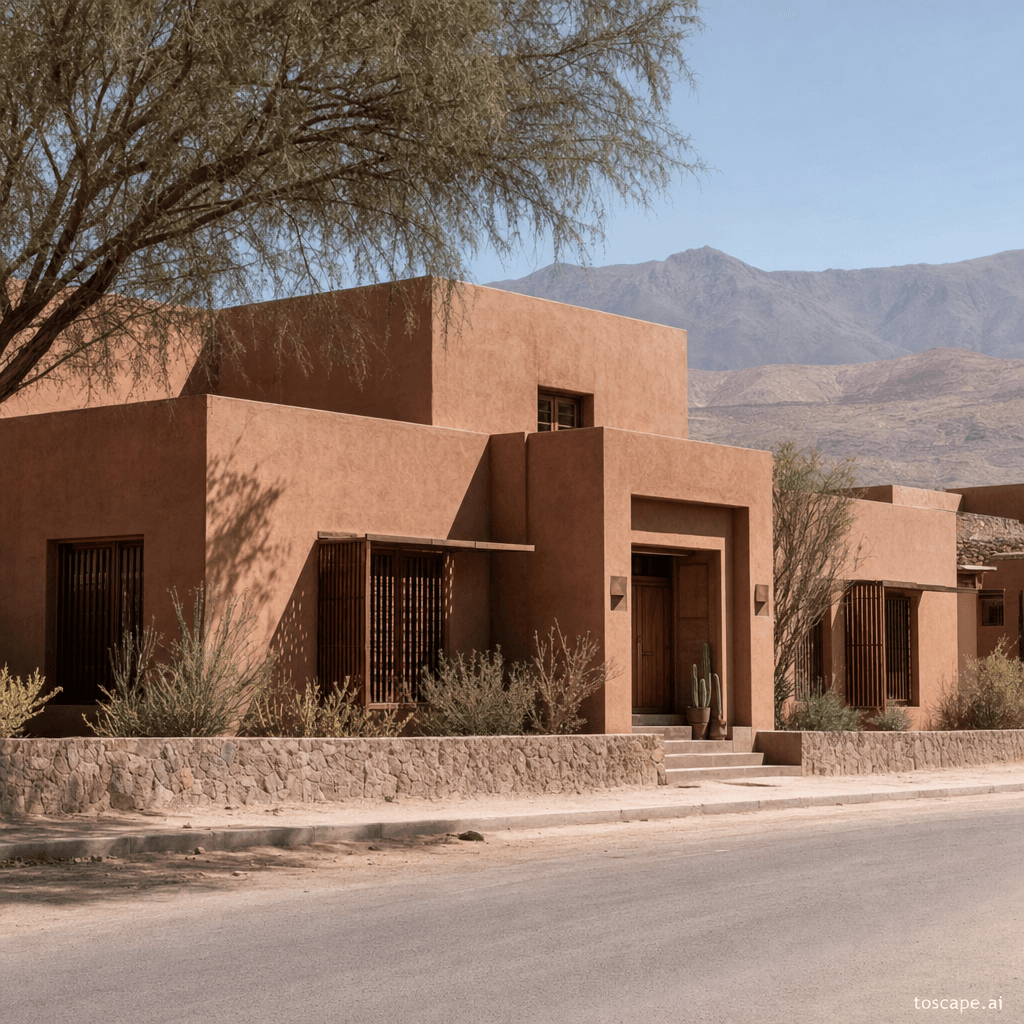
Atacama Desert — characteristic facade composition, architectural identity of the Atacama Desert oasis settlements.
Context Snapshot
The architectural identity of the Atacama Desert oasis settlements — San Pedro de Atacama and the surrounding ayllus (indigenous communities) at 2,400 m elevation in Chile's Antofagasta Region — the A... The Atacama Desert is the driest non-polar desert on Earth — some weather stations have never recorded rainfall.
Contemporary Relevance
Atacama Desert is useful today for residential, hospitality, civic, and place-branding work that needs Chile-specific character grounded in local massing, material tone, climate response, and settlement logic rather than generic international styling.
Use this style in Toscape
Explore Atacama Desert directly inside Toscape using the Facade Re-Style and Design Options workflows.
Open Atacama Desert in the galleryFrequently asked questions
What is Atacama Desert?
Atacama Desert is a regional architectural identity from Chile. The adobe-and-cactus-wood architecture of the Atacama Desert oases — the San Pedro de Atacama vernacular where Licanantay (Atacameño) traditions meet Spanish colonial adobe constru.
What materials define Atacama Desert?
The palette is entirely local and desert-derived: (1) Adobe — clay-rich desert soil mixed with paja brava (high-altitude straw), sun-dried into bricks — color: warm ochre to pale brown under the whitewash. (2) Piedra liparita — white volcanic tuff, the foundation stone, quarried from the Cordillera de la Sal.
What is the Atacama Desert color palette?
White, cream, pale sand, warm timber, and shadow-driven dark metal accents define the palette. The facade should stay bright and climate-aware rather than heavy, gray, or over-saturated.
Where does Atacama Desert come from?
The architectural identity of the Atacama Desert oasis settlements — San Pedro de Atacama and the surrounding ayllus (indigenous communities) at 2,400 m elevation in Chile's Antofagasta Region — the A... The Atacama Desert is the driest non-polar desert on Earth — some weather stations have never recorded rainfall.
When should architects use Atacama Desert?
Atacama Desert is useful today for residential, hospitality, civic, and place-branding work that needs Chile-specific character grounded in local massing, material tone, climate response, and settlement logic rather than generic international styling.
How do you render Atacama Desert in Toscape?
Open Toscape on Windows, load your own photo, elevation, sketch, or CAD view, then apply the Atacama Desert reference from the built-in style library. The Facade Re-Style and Design Options workflows keep your project geometry and camera while shifting materials, proportion, and detailing toward Atacama Desert.