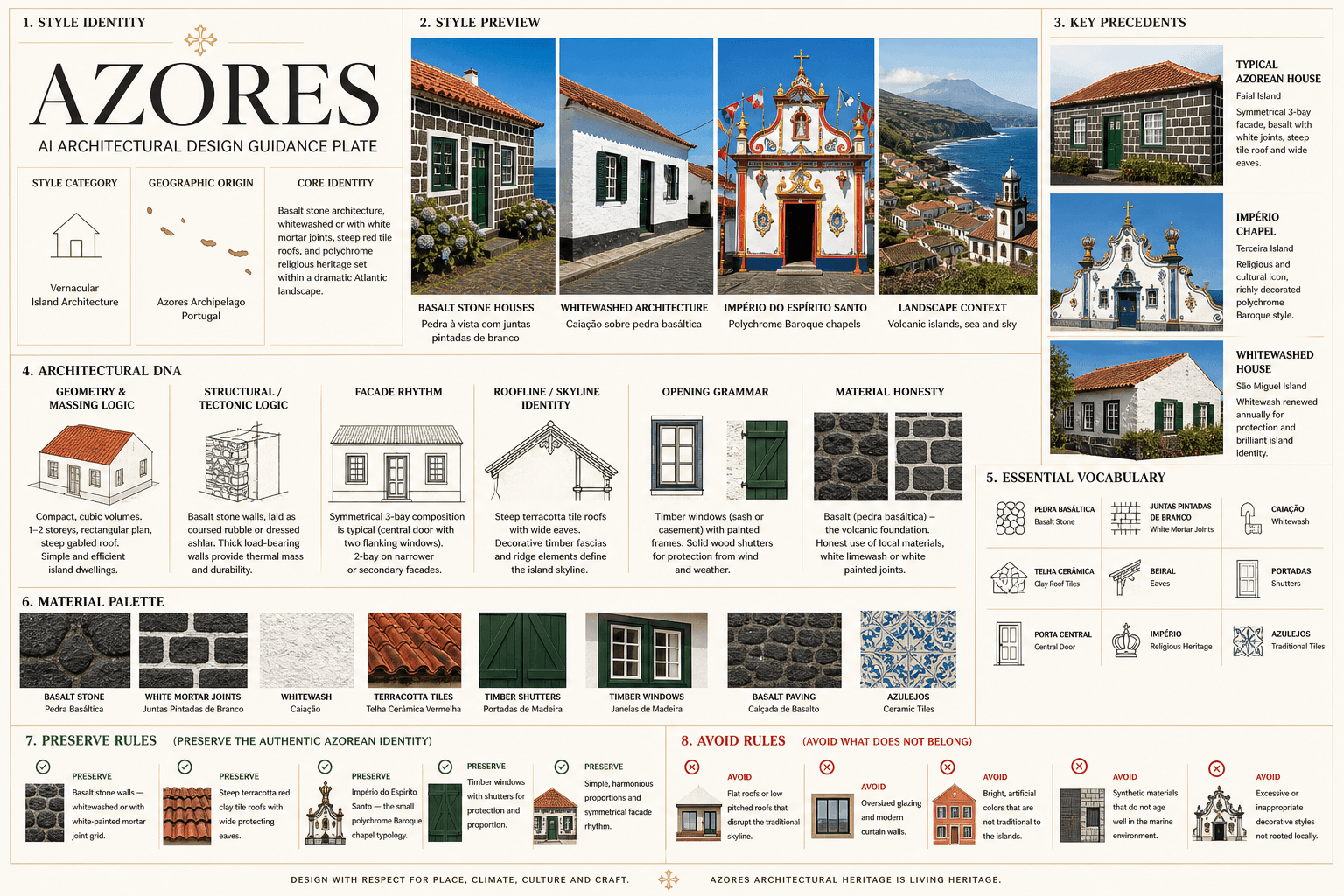
Azores
Portugal · Azores archipelago
Basalt Stone Architecture, Impérios & Atlantic Island Vernacular
Definition
Azores is a regional architectural identity from Portugal. Basalt Stone Architecture, Impérios & Atlantic Island Vernacular.
- Country
- Portugal
- Region
- Azores archipelago
- Massing
- Azorean houses are compact, cubic, 1-2 storeys, with steep gabled roofs.
- Materials
- Basalt (pedra basáltica): dark grey to black, sometimes with rust-coloured weathering — the volcanic foundation of the islands.
- Palette
- White, cream, pale sand, warm timber, and shadow-driven dark metal accents define the palette.
- Climate response
- Mid-Atlantic subtropical oceanic — extremely humid, very high rainfall (up to 4000mm/year on some islands), mild year-round temperatures (14-25°C), salt-laden air, frequent storms, and volcanic geology.
Try it free
Render your own project in this style
Upload one photo of your own project and Re-Render keeps the geometry and camera while carrying the Azores language into materials, proportion, and detail. Three free renders, no account needed.
Open Re-Render - freeOverview
Azores is a regional architectural identity in Portugal. Azores archipelago — basalt stone vernacular, Impérios do Divino Espírito Santo (colourful chapels), and volcanic island architecture. Dark grey to black volcanic basalt stone walls — the defining Azorean building material, quarried from the ubiquitous volcanic bedrock, laid as coursed rubble or dressed ashlar, often with white-painted lime mortar joints creating a striking black-and-white grid pattern (pedra à vista...
Visual DNA
Massing & Form
Azorean houses are compact, cubic, 1-2 storeys, with steep gabled roofs. The massing is simple — rectangular volumes, often with an attached adega (wine cellar) or palheiro (barn) forming an L-plan or compound.
Facade Language
House facades: symmetrical, 3-bay typical (central door + two flanking windows), or narrower 2-bay. The basalt wall, either whitewashed or with painted white joint grid, is the dominant surface.
Materials & Texture
Basalt (pedra basáltica): dark grey to black, sometimes with rust-coloured weathering — the volcanic foundation of the islands. Lime plaster and whitewash: brilliant white, renewed annually, protecting the stone in the extremely humid, rain-drenched climate.
Color Palette
White, cream, pale sand, warm timber, and shadow-driven dark metal accents define the palette. The facade should stay bright and climate-aware rather than heavy, gray, or over-saturated.
Ornament & Detail
The Império do Espírito Santo is the ornamental focus of Azorean architecture: polychrome Baroque pediment — painted in bright red, blue, yellow, white with geometric borders, floral scrolls, and the crown-and-dove symbol of the Holy Spirit at the apex, painted window and door surrounds — contrasting colour frames, dec...
Climate Response
Mid-Atlantic subtropical oceanic — extremely humid, very high rainfall (up to 4000mm/year on some islands), mild year-round temperatures (14-25°C), salt-laden air, frequent storms, and volcanic geology. Whitewash: essential protection against the constant moisture — lime is sacrificial and breathable.
Landscape & Ground
Azores archipelago — basalt stone vernacular, Impérios do Divino Espírito Santo (colourful chapels), and volcanic island architecture. Mid-Atlantic subtropical oceanic — extremely humid, very high rainfall (up to 4000mm/year on some islands), mild year-round temperatures (14-25°C), salt-laden air, frequent storms, and...
Reference elevation
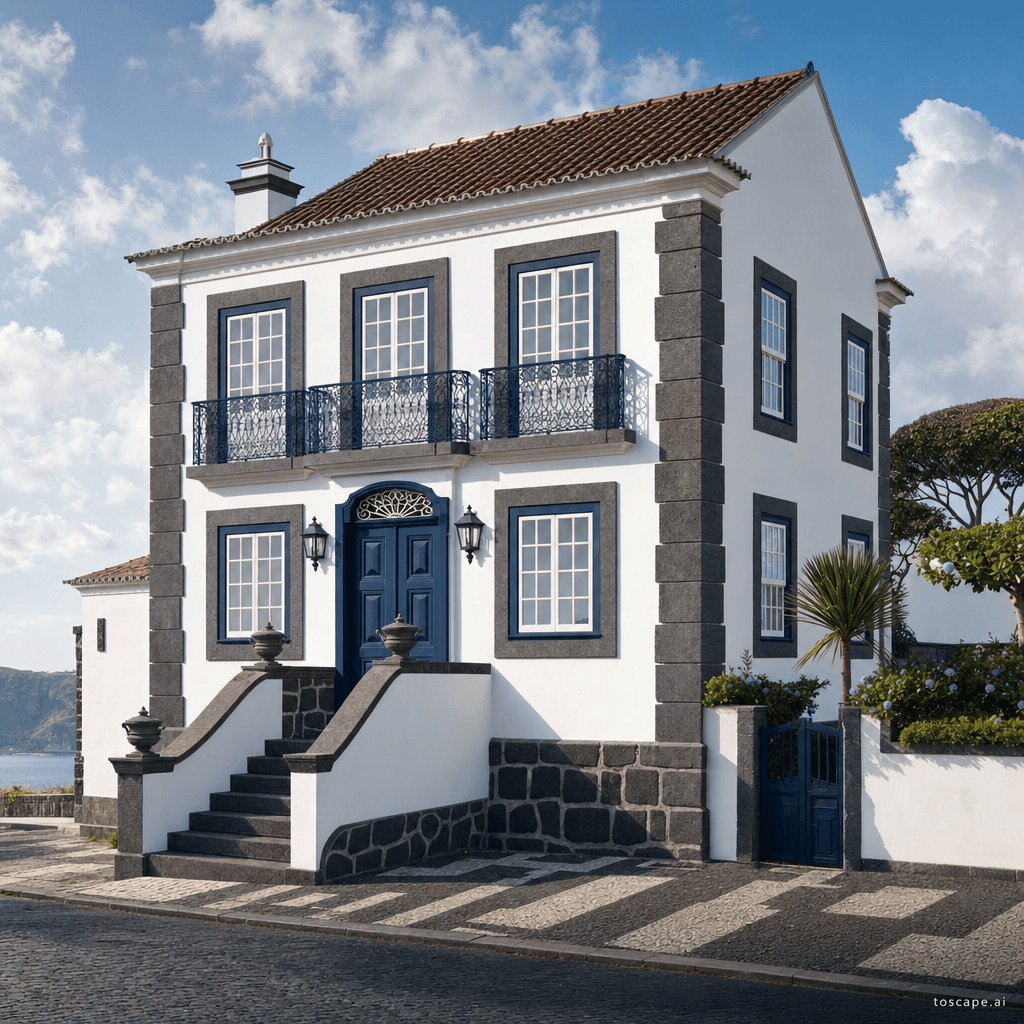
Azores — characteristic facade composition, Azores archipelago.
Context Snapshot
Azores archipelago — basalt stone vernacular, Impérios do Divino Espírito Santo (colourful chapels), and volcanic island architecture Mid-Atlantic subtropical oceanic — extremely humid, very high rainfall (up to 4000mm/year on some islands), mild year-round temperatures (14-25°C), salt-laden air, frequent storms, and volcanic geology.
Contemporary Relevance
Azores is useful today for residential, hospitality, civic, and place-branding work that needs Portugal-specific character grounded in local massing, material tone, climate response, and settlement logic rather than generic international styling.
Use this style in Toscape
Explore Azores directly inside Toscape using the Facade Re-Style and Design Options workflows.
Open Azores in the galleryFrequently asked questions
What is Azores?
Azores is a regional architectural identity from Portugal. Basalt Stone Architecture, Impérios & Atlantic Island Vernacular.
What materials define Azores?
Basalt (pedra basáltica): dark grey to black, sometimes with rust-coloured weathering — the volcanic foundation of the islands. Lime plaster and whitewash: brilliant white, renewed annually, protecting the stone in the extremely humid, rain-drenched climate.
What is the Azores color palette?
White, cream, pale sand, warm timber, and shadow-driven dark metal accents define the palette. The facade should stay bright and climate-aware rather than heavy, gray, or over-saturated.
Where does Azores come from?
Azores archipelago — basalt stone vernacular, Impérios do Divino Espírito Santo (colourful chapels), and volcanic island architecture Mid-Atlantic subtropical oceanic — extremely humid, very high rainfall (up to 4000mm/year on some islands), mild year-round temperatures (14-25°C), salt-laden air, frequent storms, and volcanic geology.
When should architects use Azores?
Azores is useful today for residential, hospitality, civic, and place-branding work that needs Portugal-specific character grounded in local massing, material tone, climate response, and settlement logic rather than generic international styling.
How do you render Azores in Toscape?
Toscape renders your own photograph, elevation, sketch, or CAD view through the Azores reference. The Facade Re-Style and Design Options workflows keep the building's geometry and camera fixed while the surface language shifts toward Azores.
Other regional identities from Portugal
- AlgarveMoorish White Cubist Volumes, Rooftop Terraces & Lacework Chimneys.
- BeiraSchist & Granite Mountain Villages, Slate Roofs & Central Portuguese Vernacular.
- MadeiraBasalt Stone, Triangular Thatched Houses & Laurissilva Island Vernacular.
- MinhoGranite Vernacular, Espigueiros & Baroque Solares of Northern Portugal.
- AlentejoWhitewashed Cubist Plains Architecture, Massive Chimneys & Monte Farmsteads.