Baghdad Courtyard
Iraq · domestic architecture of historic Baghdad (Al-Rusafa and Al-Karkh districts alon...
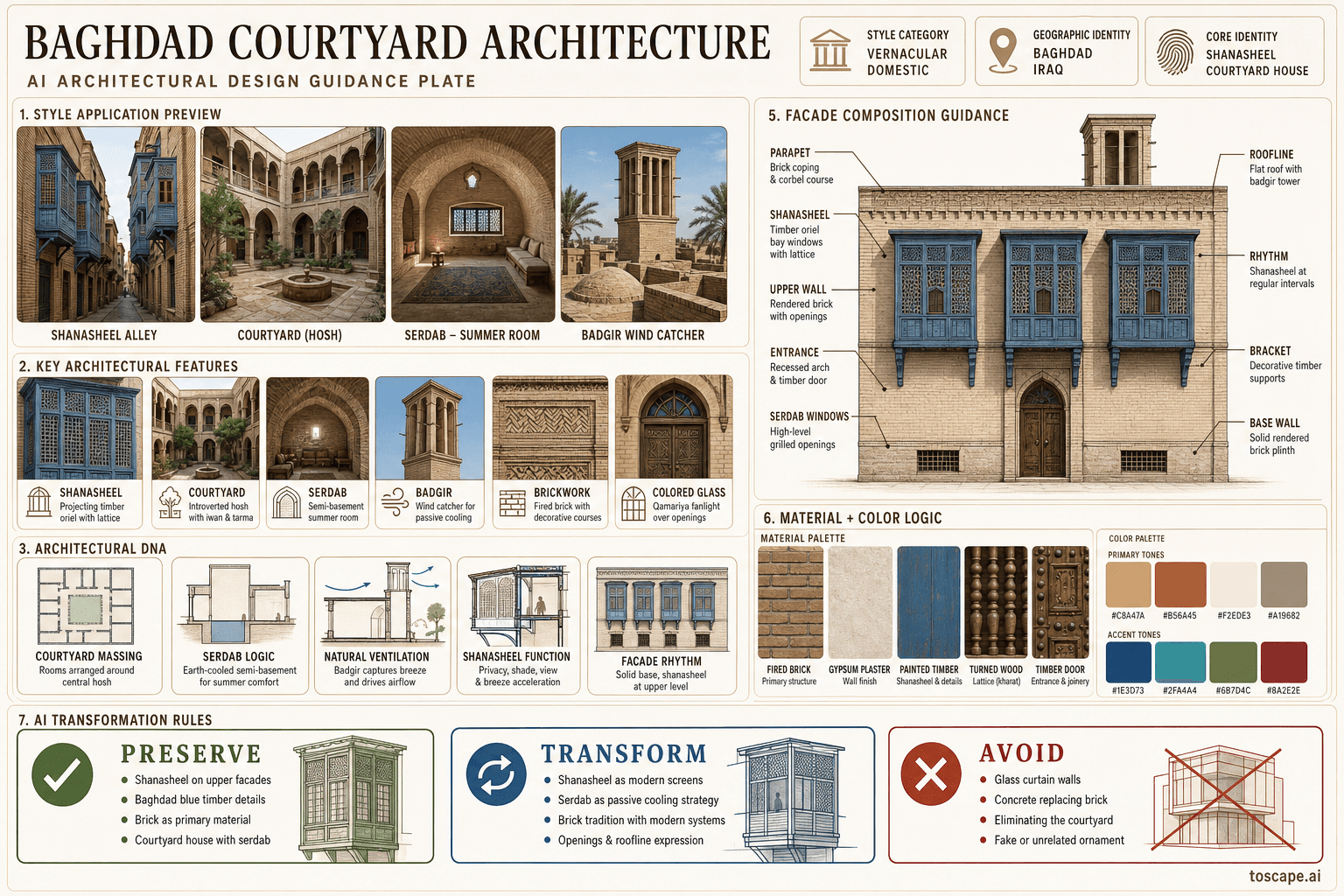
The shanasheel balconies of old Baghdad — projecting timber bay windows, courtyard houses, brick vaulting, and the Ottoman-influenced architectural identity of the Abbasid capital
Definition
Baghdad Courtyard is a regional architectural identity from Iraq. The shanasheel balconies of old Baghdad — projecting timber bay windows, courtyard houses, brick vaulting, and the Ottoman-influenced architectural identity of the Abbasid capital.
- Country
- Iraq
- Region
- domestic architecture of historic Baghdad (Al-Rusafa and Al-Karkh districts alon.
- Massing
- The Baghdadi courtyard house is a 2-storey rectangular volume — typically 10–18 m wide × 15–25 m deep — organized around a central courtyard.
- Materials
- Fired brick (ajur) — warm golden-brown to reddish-brown — the primary structural material, legacy of Mesopotamian brick tradition Gypsum plaster (juss) — white to cream render.
- Palette
- White, cream, pale sand, warm timber, and shadow-driven dark metal accents define the palette.
- Climate response
- Baghdad's extreme continental climate — scorching summers (45–50°C) and cold winters — drives unique architectural responses: (1) The serdab — the most distinctive Baghdadi climate adaptation.
Overview
Baghdad Courtyard is a regional architectural identity in Iraq. Traditional domestic architecture of historic Baghdad (Al-Rusafa and Al-Karkh districts along the Tigris River) — the courtyard houses (al-bayt al-baghdadi) of the Ottoman and early modern periods, defined by their distinctive projecting timber bay windows (shanasheel), introverted courtyard organization, and the unique spatial adaptations to the Mesopotamian climate. The shanasheel — projecting timber oriel bay wind...
Visual DNA
Massing & Form
The Baghdadi courtyard house is a 2-storey rectangular volume — typically 10–18 m wide × 15–25 m deep — organized around a central courtyard. The plan is introverted: blank or minimally-penetrated external walls with all major rooms opening onto the courtyard.
Facade Language
The Baghdadi street facade displays a tripartite logic: Ground floor: Solid rendered brick wall with minimal openings — the entrance door (recessed within a pointed arch portal) is the primary articulation. Small, high-set grilled windows for the serdab — narrow horizontal slots at pavement level Upper floor: The shana...
Materials & Texture
Fired brick (ajur) — warm golden-brown to reddish-brown — the primary structural material, legacy of Mesopotamian brick tradition Gypsum plaster (juss) — white to cream render for walls, carved for interior decoration Turned wood (kharat) — for shanasheel lattice cylinders — local hardwood (mulberry, walnut) or importe...
Color Palette
White, cream, pale sand, warm timber, and shadow-driven dark metal accents define the palette. The facade should stay bright and climate-aware rather than heavy, gray, or over-saturated.
Ornament & Detail
Baghdadi ornament reflects the city's position at the crossroads of Ottoman, Persian, and Arab traditions: (1) Shanasheel lattice — the primary decorative element. Turned-wood cylinders arranged in geometric patterns — often a central star or diamond panel flanked by simpler grid patterns.
Climate Response
Baghdad's extreme continental climate — scorching summers (45–50°C) and cold winters — drives unique architectural responses: (1) The serdab — the most distinctive Baghdadi climate adaptation. A semi-basement room, 1.5–2.0 m below courtyard level, with high-level grilled windows to the street.
Landscape & Ground
Traditional domestic architecture of historic Baghdad (Al-Rusafa and Al-Karkh districts along the Tigris River) — the courtyard houses (al-bayt al-baghdadi) of the Ottoman and early modern periods, defined by their distinctive projecting timber bay windows (shanasheel), introverted courtyard organization, and the uniqu...
Reference elevation
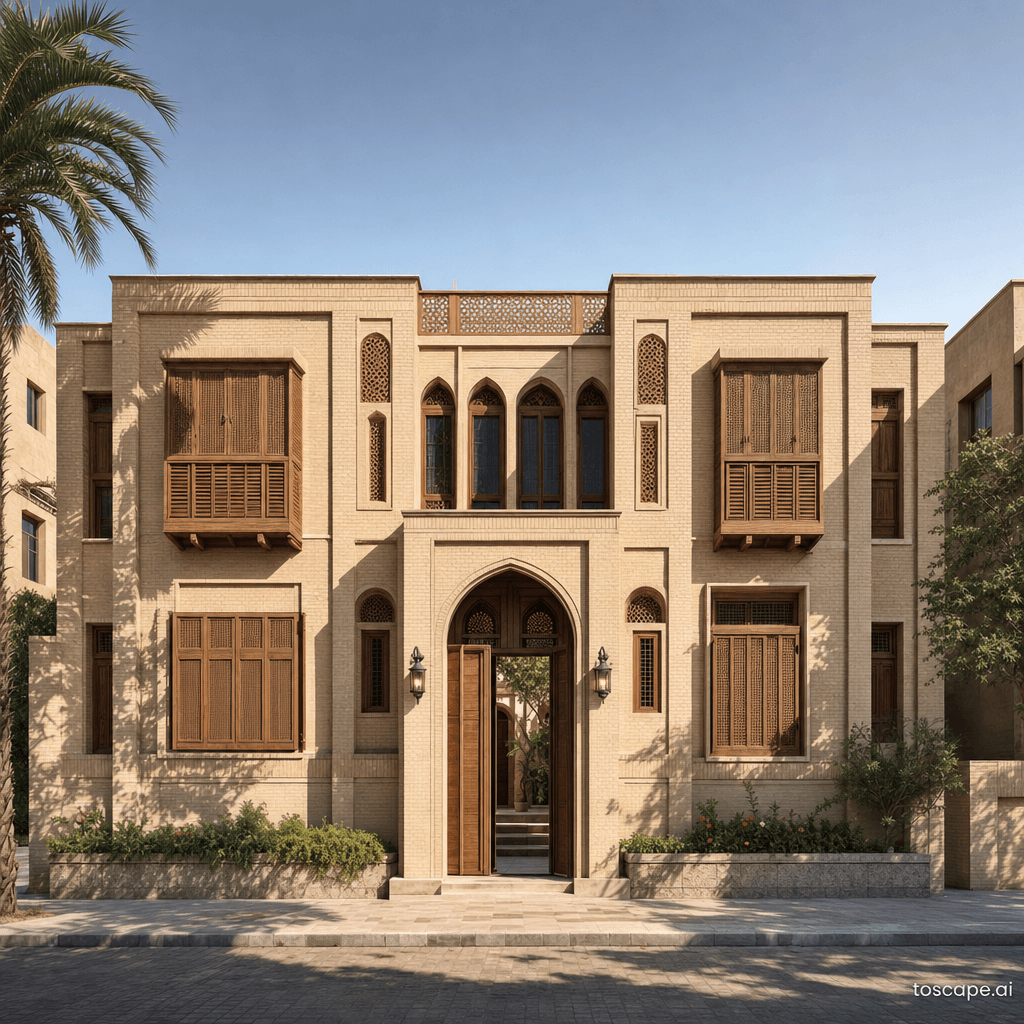
Baghdad Courtyard — characteristic facade composition, domestic architecture of historic Baghdad (Al-Rusafa and Al-Karkh districts alon....
Context Snapshot
Traditional domestic architecture of historic Baghdad (Al-Rusafa and Al-Karkh districts along the Tigris River) — the courtyard houses (al-bayt al-baghdadi) of the Ottoman and early modern periods, de... Baghdad's extreme continental climate — scorching summers (45–50°C) and cold winters — drives unique architectural responses: (1) The serdab — the most distinctive Baghdadi climate adaptation.
Contemporary Relevance
Baghdad Courtyard is useful today for residential, hospitality, civic, and place-branding work that needs Iraq-specific character grounded in local massing, material tone, climate response, and settlement logic rather than generic international styling.
Use this style in Toscape
Explore Baghdad Courtyard directly inside Toscape using the Facade Re-Style and Design Options workflows.
Open Baghdad Courtyard in the galleryFrequently asked questions
What is Baghdad Courtyard?
Baghdad Courtyard is a regional architectural identity from Iraq. The shanasheel balconies of old Baghdad — projecting timber bay windows, courtyard houses, brick vaulting, and the Ottoman-influenced architectural identity of the Abbasid capital.
What materials define Baghdad Courtyard?
Fired brick (ajur) — warm golden-brown to reddish-brown — the primary structural material, legacy of Mesopotamian brick tradition Gypsum plaster (juss) — white to cream render for walls, carved for interior decoration Turned wood (kharat) — for shanasheel lattice cylinders — local hardwood (mulberry, walnut) or importe.
What is the Baghdad Courtyard color palette?
White, cream, pale sand, warm timber, and shadow-driven dark metal accents define the palette. The facade should stay bright and climate-aware rather than heavy, gray, or over-saturated.
Where does Baghdad Courtyard come from?
Traditional domestic architecture of historic Baghdad (Al-Rusafa and Al-Karkh districts along the Tigris River) — the courtyard houses (al-bayt al-baghdadi) of the Ottoman and early modern periods, de... Baghdad's extreme continental climate — scorching summers (45–50°C) and cold winters — drives unique architectural responses: (1) The serdab — the most distinctive Baghdadi climate adaptation.
When should architects use Baghdad Courtyard?
Baghdad Courtyard is useful today for residential, hospitality, civic, and place-branding work that needs Iraq-specific character grounded in local massing, material tone, climate response, and settlement logic rather than generic international styling.
How do you render Baghdad Courtyard in Toscape?
Open Toscape on Windows, load your own photo, elevation, sketch, or CAD view, then apply the Baghdad Courtyard reference from the built-in style library. The Facade Re-Style and Design Options workflows keep your project geometry and camera while shifting materials, proportion, and detailing toward Baghdad Courtyard.