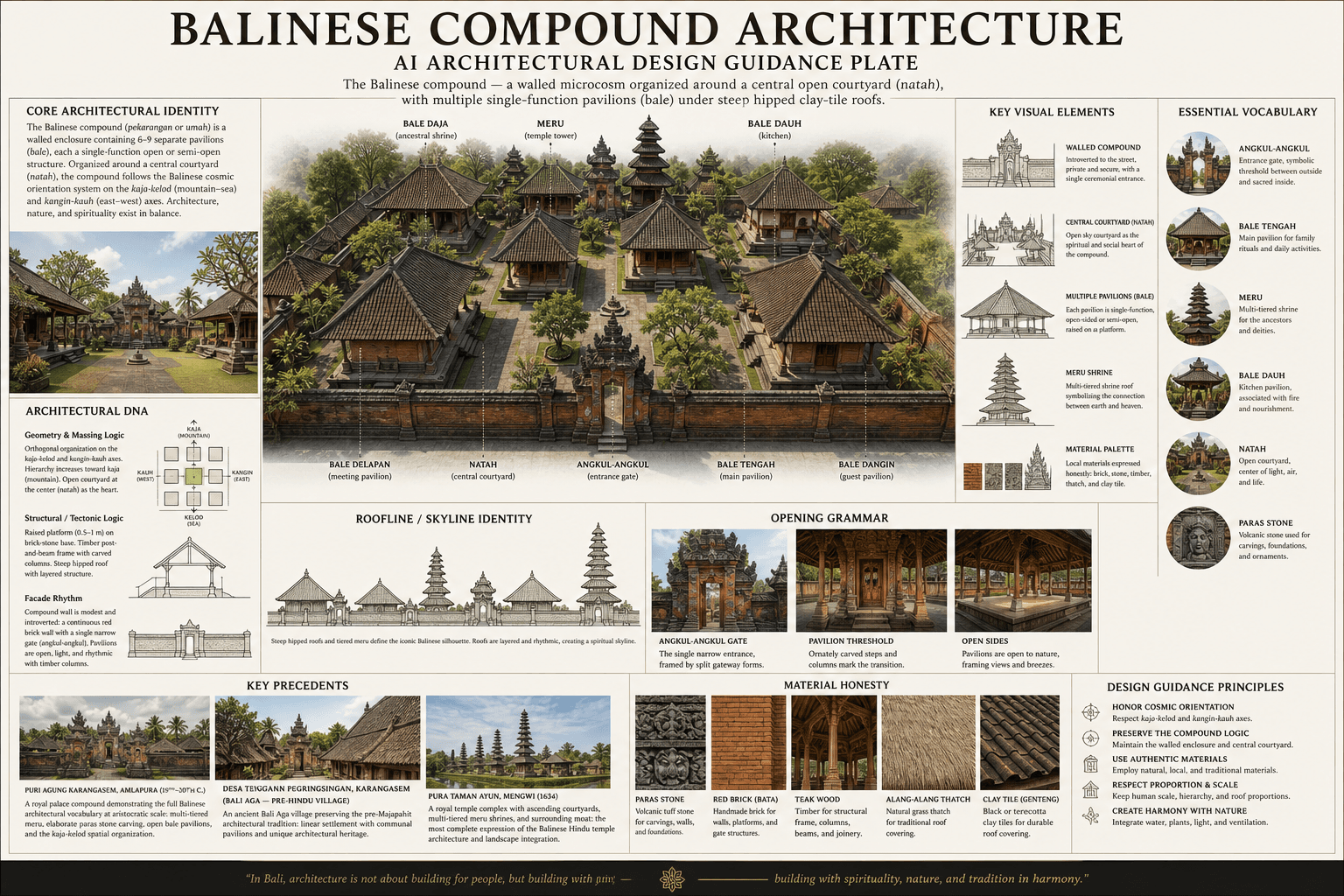
Balinese Compound
Indonesia · traditional Balinese house compound (pekarangan or umah)
The walled family temple-compound of Bali — where every house is a microcosm of the Hindu-Balinese cosmos, organized around a central courtyard with the family shrine (sanggah/mera...
Definition
Balinese Compound is a regional architectural identity from Indonesia. The walled family temple-compound of Bali — where every house is a microcosm of the Hindu-Balinese cosmos, organized around a central courtyard with the family shrine (sanggah/mera.
- Country
- Indonesia
- Region
- traditional Balinese house compound (pekarangan or umah).
- Massing
- The Balinese compound is orthogonally organized on the kaja-kelod (mountain-sea) and kangin-kauh (east-west) axes. The enclosing wall is a defining element — a 2–2.
- Materials
- Balinese materials are the island's geology expressed in architecture: (1) Paras (volcanic tuff) — a soft grey stone from the island's volcanoes.
- Palette
- Warm earth, sandy beige, ochre, clay brown, and sun-softened mineral tones should dominate, with palm green or weathered timber as secondary accents.
- Climate response
- Bali's tropical monsoon climate and volcanic geography shape everything: (1) The kaja-kelok axis: kaja ("toward the mountain," toward Gunung Agung.
Overview
Balinese Compound is a regional architectural identity in Indonesia. The traditional Balinese house compound (pekarangan or umah) — a walled enclosure (15–25 m × 20–35 m) containing 6–9 separate pavilions (bale), each a single-room open-sided or semi-open structure with a specific function, arranged according to the Balinese cosmic orientation system — the compound is entered through a narrow gate (angkul-angkul) into a transitional courtyard, then into the main compound where the fam...
Visual DNA
Massing & Form
The Balinese compound is orthogonally organized on the kaja-kelod (mountain-sea) and kangin-kauh (east-west) axes. The enclosing wall is a defining element — a 2–2.5 m high red brick wall with carved stone coping, creating a rectangular enclosure.
Facade Language
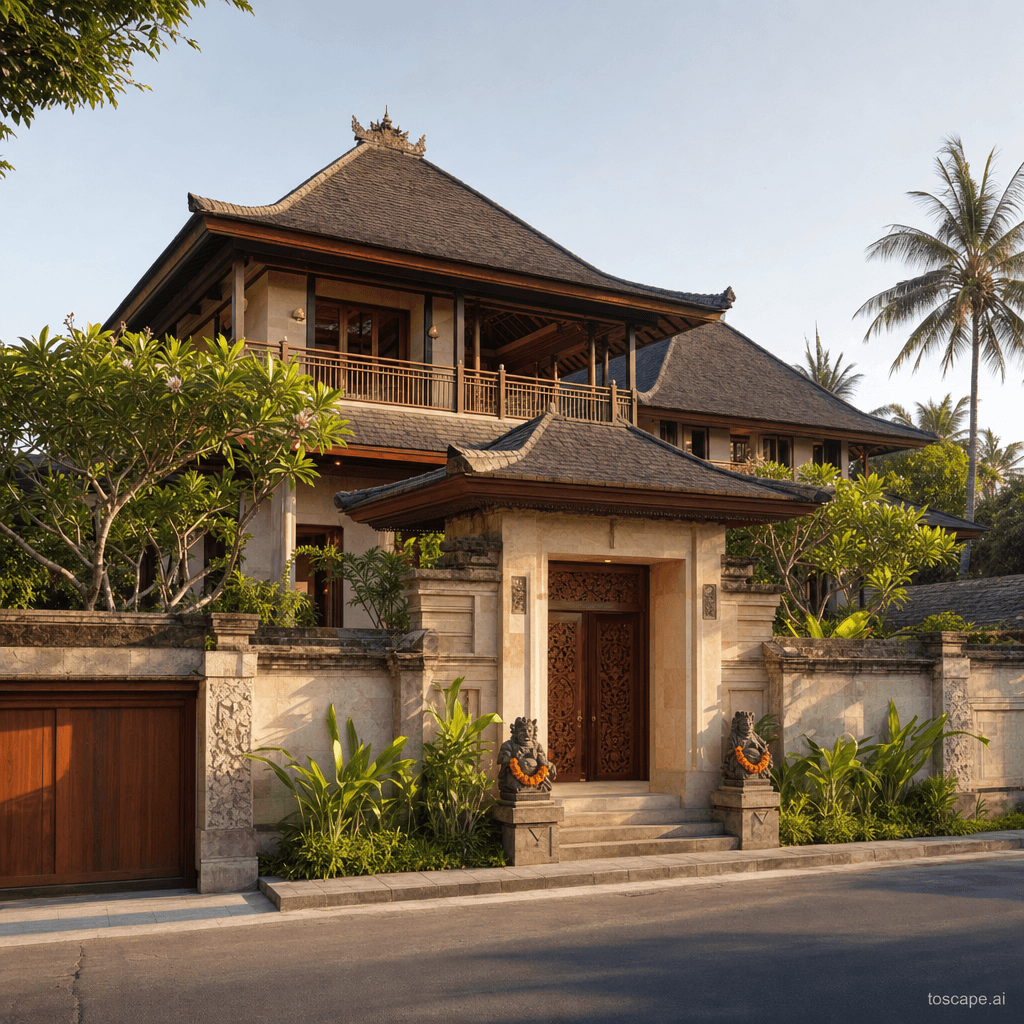
The compound wall facade to the street is modest — a blank red brick wall with a single narrow gate (angkul-angkul). The gate is the only decorated street element: two massive brick piers (1–1.5 m wide) with carved stone panels and a roof canopy — the gate is deliberately narrow, requiring single-file passage, and step...
Materials & Texture
Balinese materials are the island's geology expressed in architecture: (1) Paras (volcanic tuff) — a soft grey stone from the island's volcanoes, easily carved when freshly quarried, hardening with exposure — the primary ornamental material for gate panels, column bases, wall coping, and shrine bodies — the distinctive...
Color Palette
Warm earth, sandy beige, ochre, clay brown, and sun-softened mineral tones should dominate, with palm green or weathered timber as secondary accents. The palette should read as land-derived rather than polished or urban-generic.
Ornament & Detail
Balinese ornament is pervasive, symbolic, and carved in stone: (1) Karang boma — the protective guardian face carved on stone column bases and above doorways — a fierce face with bulging eyes, fangs, and floral headdress — derived from the Hindu-Buddhist kala-makara. (2) Karang asti — the elephant-face ornament.
Climate Response
Bali's tropical monsoon climate and volcanic geography shape everything: (1) The kaja-kelok axis: kaja ("toward the mountain," toward Gunung Agung, the sacred volcano) is the sacred direction; kelod ("toward the sea") is the profane direction — every compound orients its temple to the mountain. (2) The compound wall cr...
Landscape & Ground
The traditional Balinese house compound (pekarangan or umah) — a walled enclosure (15–25 m × 20–35 m) containing 6–9 separate pavilions (bale), each a single-room open-sided or semi-open structure with a specific function, arranged according to the Balinese cosmic orientation system — the compound is entered through a...
Reference elevation
Balinese Compound — characteristic facade composition, traditional Balinese house compound (pekarangan or umah).
Context Snapshot
The traditional Balinese house compound (pekarangan or umah) — a walled enclosure (15–25 m × 20–35 m) containing 6–9 separate pavilions (bale), each a single-room open-sided or semi-open structure wit... Bali's tropical monsoon climate and volcanic geography shape everything: (1) The kaja-kelok axis: kaja ("toward the mountain," toward Gunung Agung, the sacred volcano) is the sacred direction; kelod ("toward the sea") is...
Contemporary Relevance
Balinese Compound is useful today for residential, hospitality, civic, and place-branding work that needs Indonesia-specific character grounded in local massing, material tone, climate response, and settlement logic rather than generic international styling.
Use this style in Toscape
Explore Balinese Compound directly inside Toscape using the Facade Re-Style and Design Options workflows.
Open Balinese Compound in the galleryFrequently asked questions
What is Balinese Compound?
Balinese Compound is a regional architectural identity from Indonesia. The walled family temple-compound of Bali — where every house is a microcosm of the Hindu-Balinese cosmos, organized around a central courtyard with the family shrine (sanggah/mera.
What materials define Balinese Compound?
Balinese materials are the island's geology expressed in architecture: (1) Paras (volcanic tuff) — a soft grey stone from the island's volcanoes, easily carved when freshly quarried, hardening with exposure — the primary ornamental material for gate panels, column bases, wall coping, and shrine bodies — the distinctive.
What is the Balinese Compound color palette?
Warm earth, sandy beige, ochre, clay brown, and sun-softened mineral tones should dominate, with palm green or weathered timber as secondary accents. The palette should read as land-derived rather than polished or urban-generic.
Where does Balinese Compound come from?
The traditional Balinese house compound (pekarangan or umah) — a walled enclosure (15–25 m × 20–35 m) containing 6–9 separate pavilions (bale), each a single-room open-sided or semi-open structure wit.
When should architects use Balinese Compound?
Balinese Compound is useful today for residential, hospitality, civic, and place-branding work that needs Indonesia-specific character grounded in local massing, material tone, climate response, and settlement logic rather than generic international styling.
How do you render Balinese Compound in Toscape?
Open Toscape on Windows, load your own photo, elevation, sketch, or CAD view, then apply the Balinese Compound reference from the built-in style library. The Facade Re-Style and Design Options workflows keep your project geometry and camera while shifting materials, proportion, and detailing toward Balinese Compound.