Balochistan
Pakistan · vernacular architecture of Balochistan
The mud-and-stone fortress architecture of the Baloch frontier — courtyard compounds, wind-sheltered villages, and the enduring nomadic-stone building tradition of Pakistan's large...
Definition
Balochistan is a regional architectural identity from Pakistan. The mud-and-stone fortress architecture of the Baloch frontier — courtyard compounds, wind-sheltered villages, and the enduring nomadic-stone building tradition of Pakistan's large.
- Country
- Pakistan
- Region
- vernacular architecture of Balochistan.
- Massing
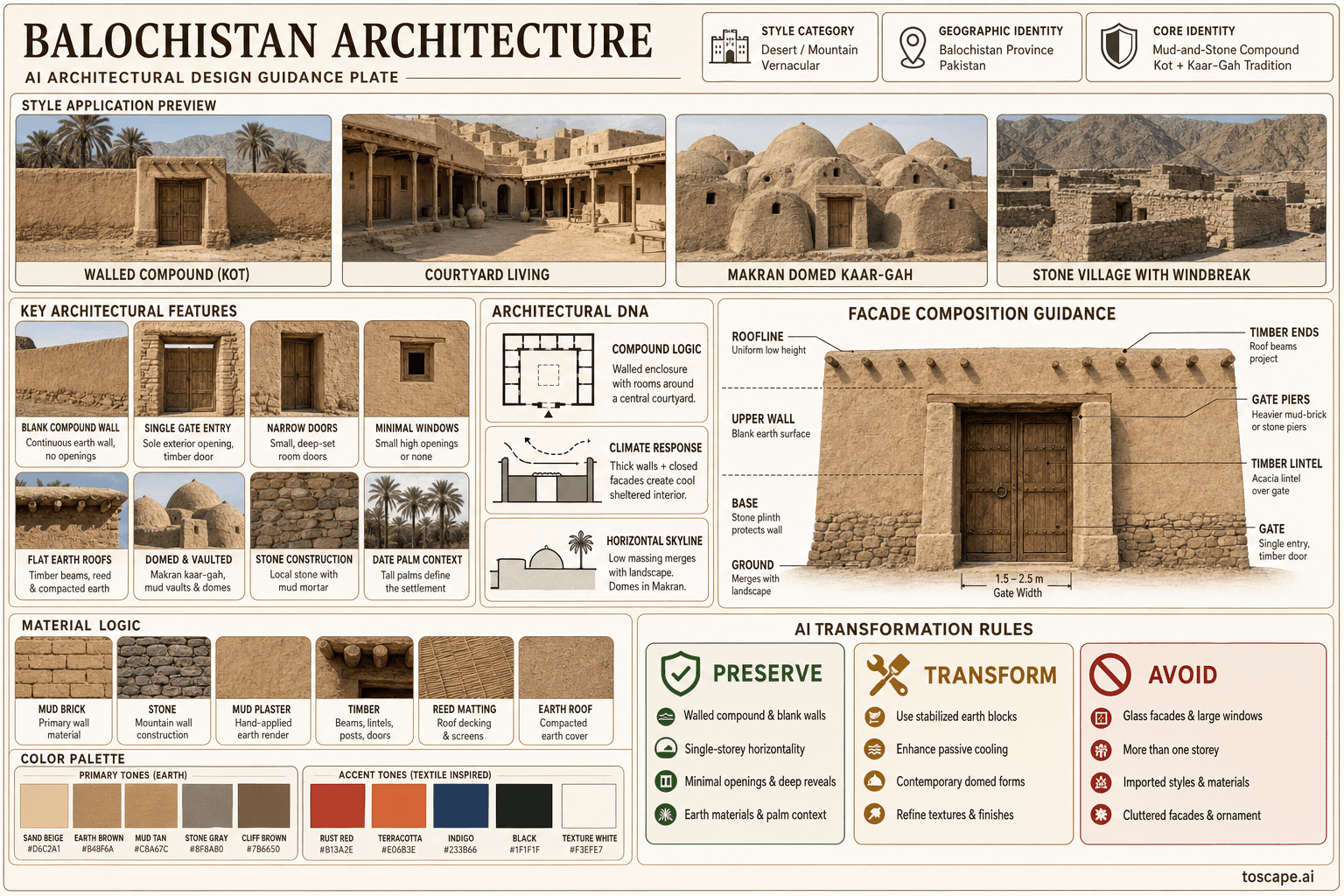
- The Balochi compound is a single-storey, walled enclosure — 15–30 m wide × 20–40 m deep — organized as a perimeter wall surrounding multiple small rectilinear.
- Materials
- Mud brick (kacha) — warm tan to light brown — the primary desert-interior wall material Mountain stone — gray, brown.
- Palette
- White, cream, pale sand, warm timber, and shadow-driven dark metal accents define the palette.
- Climate response
- Balochistan's extreme arid climate — summer maxima 45–52°C, winter minima -5 to 5°C, 50–150 mm annual rainfall.
Overview
Balochistan is a regional architectural identity in Pakistan. Traditional vernacular architecture of Balochistan — Pakistan's vast, arid southwestern province spanning desert, mountain, and coastal zones. Defined by the Balochi mud-brick compound (halk / kot), stone courtyard houses adapted to extreme aridity, the distinctive mud-plastered dome-and-vault construction of the Makran coast, and the enduring semi-nomadic architectural traditions of the Baloch tribes.
Visual DNA
Massing & Form
The Balochi compound is a single-storey, walled enclosure — 15–30 m wide × 20–40 m deep — organized as a perimeter wall surrounding multiple small rectilinear rooms. Individual rooms are compact (3–5 m × 3–5 m), arranged along one or two sides of the courtyard.
Facade Language
The Balochi compound presents the architecture of the blank wall: Compound wall: The sole exterior expression — a continuous mud-plastered or stone surface, 1.8–2.5 m high, unbroken except for the gate. The wall reads as an abstract earth plane — no windows, no decorative elements, no architectural articulation beyond...
Materials & Texture
Mud brick (kacha) — warm tan to light brown — the primary desert-interior wall material Mountain stone — gray, brown, or reddish locally-quarried stone — the mountain-region wall material Mud plaster — hand-applied external render — renewed annually or biennially Date palm timber — midribs and trunks for roof beams, do...
Color Palette
White, cream, pale sand, warm timber, and shadow-driven dark metal accents define the palette. The facade should stay bright and climate-aware rather than heavy, gray, or over-saturated.
Ornament & Detail
Balochi ornament is among the most minimal in South Asian architecture — the architecture of extreme scarcity: (1) Mud-plaster texture — the hand-applied render surface creates subtle undulations — the aesthetic of the handmade. (2) Gate carving — simple geometric patterns on the timber door — concentric squares, diamo...
Climate Response
Balochistan's extreme arid climate — summer maxima 45–52°C, winter minima -5 to 5°C, 50–150 mm annual rainfall, frequent dust storms — generates the most extreme climate-responsive architecture in Pakistan: (1) Compound wall as wind shelter — the high perimeter wall creates a protected microclimate within the courtyard...
Landscape & Ground
Traditional vernacular architecture of Balochistan — Pakistan's vast, arid southwestern province spanning desert, mountain, and coastal zones. Defined by the Balochi mud-brick compound (halk / kot), stone courtyard houses adapted to extreme aridity, the distinctive mud-plastered dome-and-vault construction of the Makra...
Reference elevation
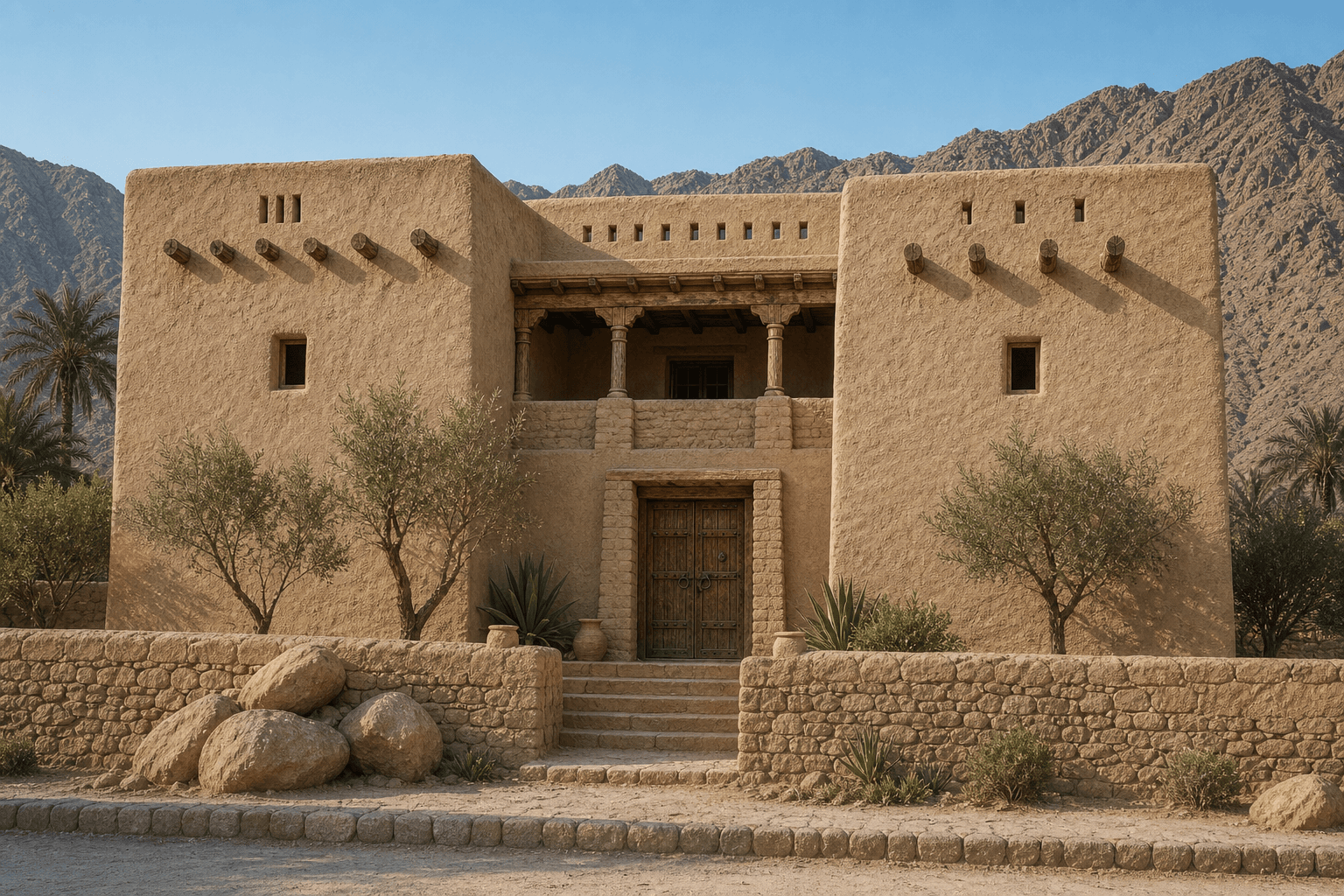
Balochistan — characteristic facade composition, vernacular architecture of Balochistan.
Context Snapshot
Traditional vernacular architecture of Balochistan — Pakistan's vast, arid southwestern province spanning desert, mountain, and coastal zones. Balochistan's extreme arid climate — summer maxima 45–52°C, winter minima -5 to 5°C, 50–150 mm annual rainfall, frequent dust storms — generates the most extreme climate-responsive architecture in Pakistan: (1) Compound...
Contemporary Relevance
Balochistan is useful today for residential, hospitality, civic, and place-branding work that needs Pakistan-specific character grounded in local massing, material tone, climate response, and settlement logic rather than generic international styling.
Use this style in Toscape
Explore Balochistan directly inside Toscape using the Facade Re-Style and Design Options workflows.
Open Balochistan in the galleryFrequently asked questions
What is Balochistan?
Balochistan is a regional architectural identity from Pakistan. The mud-and-stone fortress architecture of the Baloch frontier — courtyard compounds, wind-sheltered villages, and the enduring nomadic-stone building tradition of Pakistan's large.
What materials define Balochistan?
Mud brick (kacha) — warm tan to light brown — the primary desert-interior wall material Mountain stone — gray, brown, or reddish locally-quarried stone — the mountain-region wall material Mud plaster — hand-applied external render — renewed annually or biennially Date palm timber — midribs and trunks for roof beams, do.
What is the Balochistan color palette?
White, cream, pale sand, warm timber, and shadow-driven dark metal accents define the palette. The facade should stay bright and climate-aware rather than heavy, gray, or over-saturated.
Where does Balochistan come from?
Traditional vernacular architecture of Balochistan — Pakistan's vast, arid southwestern province spanning desert, mountain, and coastal zones. Balochistan's extreme arid climate — summer maxima 45–52°C, winter minima -5 to 5°C, 50–150 mm annual rainfall, frequent dust storms — generates the most extreme climate-responsive architecture in Pakistan: (1) Compound.
When should architects use Balochistan?
Balochistan is useful today for residential, hospitality, civic, and place-branding work that needs Pakistan-specific character grounded in local massing, material tone, climate response, and settlement logic rather than generic international styling.
How do you render Balochistan in Toscape?
Open Toscape on Windows, load your own photo, elevation, sketch, or CAD view, then apply the Balochistan reference from the built-in style library. The Facade Re-Style and Design Options workflows keep your project geometry and camera while shifting materials, proportion, and detailing toward Balochistan.