Basque Country
France · French Basque Country / Pays Basque (Labourd, Basse-Navarre, Soule)
Labourdine Half-Timbered, Red-and-White Facades & Pyrenean Atlantic Vernacular
Definition
Basque Country is a regional architectural identity from France. Labourdine Half-Timbered, Red-and-White Facades & Pyrenean Atlantic Vernacular.
- Country
- France
- Region
- French Basque Country / Pays Basque (Labourd, Basse-Navarre, Soule).
- Massing
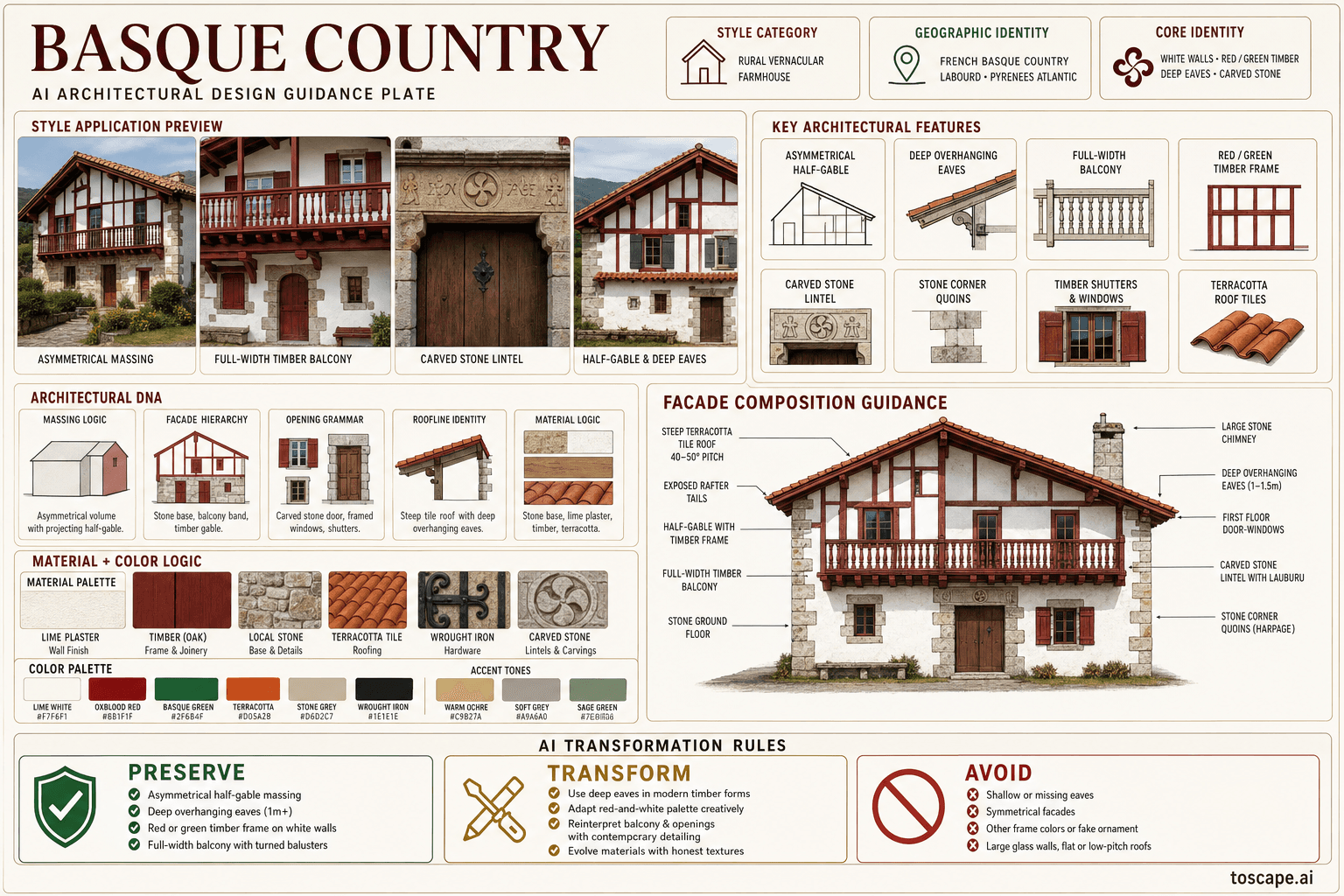
- Asymmetrical rectangular volumes: the defining Labourdine massing features an asymmetrical gable — one side projecting forward creating a half-gable (pignon) with the facade set back.
- Materials
- Pierre calcaire/grès (limestone/sandstone): local grey-white or ochre stone — ground floor walls, lintels, door surrounds, quoins.
- Palette
- White, cream, pale sand, warm timber, and shadow-driven dark metal accents define the palette.
- Climate response
- Atlantic maritime: high rainfall (1500-2000mm/year), mild temperatures, strong westerly winds. Deep overhanging eaves (avant-toit): essential for protecting timber frame and rendered walls from driving rain.
Overview
Basque Country is a regional architectural identity in France. French Basque Country / Pays Basque (Labourd, Basse-Navarre, Soule) — Labourdine etxe architecture. Whitewashed lime plaster or pale stone facades with exposed red-brown (oxblood) or green painted half-timbering (colombage basque), asymmetrical steep terracotta tile roofs (typically 40-50° pitch) with deep overhanging eaves, full-width timber balcony (balcon/galerie) on first floor with carved balusters, carved stone...
Visual DNA
Massing & Form
Asymmetrical rectangular volumes: the defining Labourdine massing features an asymmetrical gable — one side projecting forward creating a half-gable (pignon) with the facade set back on the other side. Two stories with attic under roof.
Facade Language
Asymmetrical three-part composition: (1) projecting half-gable with exposed timber frame painted red-brown or green, (2) set-back main facade with whitewashed wall, (3) entrance door with carved stone surround. The red/green timber grid against white plaster is the defining color contrast.
Materials & Texture
Pierre calcaire/grès (limestone/sandstone): local grey-white or ochre stone — ground floor walls, lintels, door surrounds, quoins. Chaux (lime): white lime plaster (crépi à la chaux) on stone and timber infill panels.
Color Palette
White, cream, pale sand, warm timber, and shadow-driven dark metal accents define the palette. The facade should stay bright and climate-aware rather than heavy, gray, or over-saturated.
Ornament & Detail
Carved stone door lintel (linteau sculpté): the most important ornamental surface — Basque cross (lauburu — four-headed curved cross), house name (etxe izena), date of construction, owner's initials, religious symbols (cross, IHS, Virgin Mary), and Basque motifs (solar disk, tree of life). The lauburu is the quintessen...
Climate Response
Atlantic maritime: high rainfall (1500-2000mm/year), mild temperatures, strong westerly winds. Deep overhanging eaves (avant-toit): essential for protecting timber frame and rendered walls from driving rain.
Landscape & Ground
French Basque Country / Pays Basque (Labourd, Basse-Navarre, Soule) — Labourdine etxe architecture. Atlantic maritime: high rainfall (1500-2000mm/year), mild temperatures, strong westerly winds.
Reference elevation
Basque Country — characteristic facade composition, French Basque Country / Pays Basque (Labourd, Basse-Navarre, Soule).
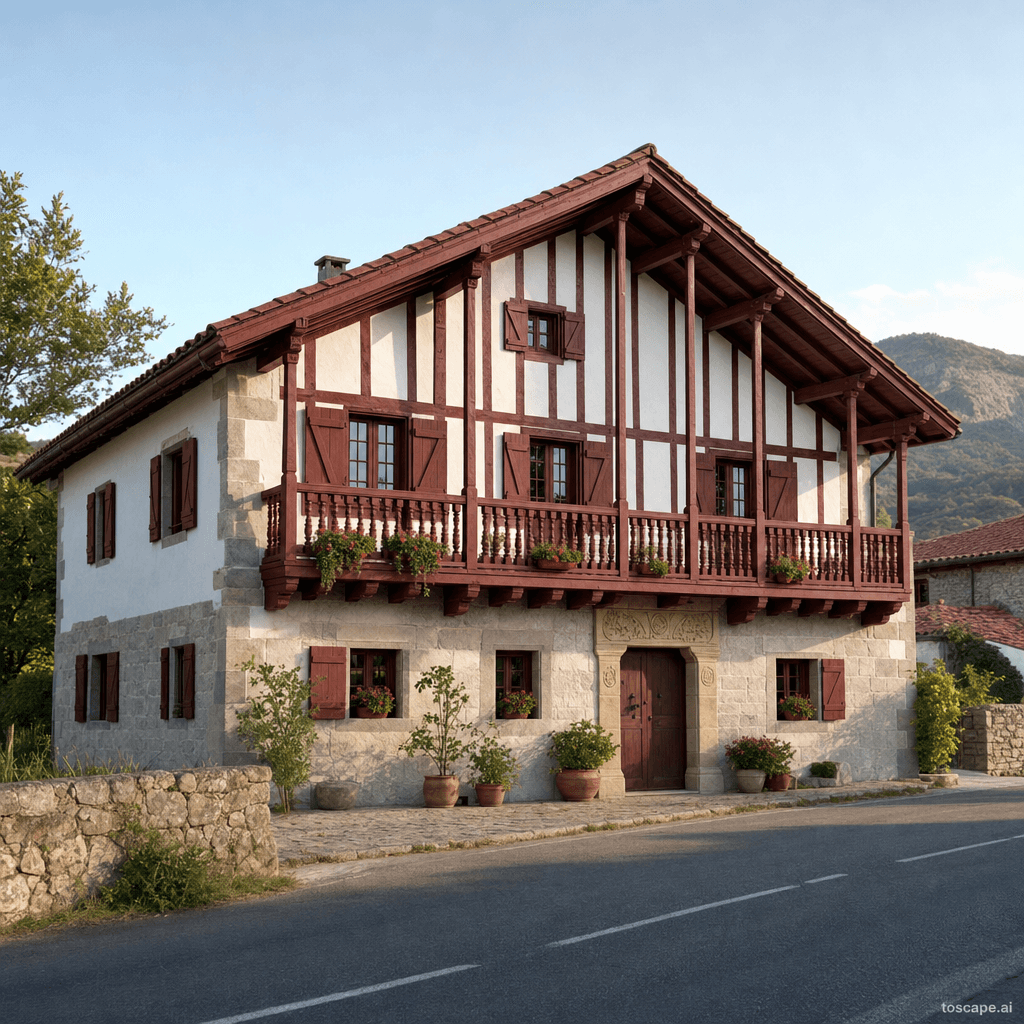
Context Snapshot
French Basque Country / Pays Basque (Labourd, Basse-Navarre, Soule) — Labourdine etxe architecture Atlantic maritime: high rainfall (1500-2000mm/year), mild temperatures, strong westerly winds.
Contemporary Relevance
Basque Country is useful today for residential, hospitality, civic, and place-branding work that needs France-specific character grounded in local massing, material tone, climate response, and settlement logic rather than generic international styling.
Use this style in Toscape
Explore Basque Country directly inside Toscape using the Facade Re-Style and Design Options workflows.
Open Basque Country in the galleryFrequently asked questions
What is Basque Country?
Basque Country is a regional architectural identity from France. Labourdine Half-Timbered, Red-and-White Facades & Pyrenean Atlantic Vernacular.
What materials define Basque Country?
Pierre calcaire/grès (limestone/sandstone): local grey-white or ochre stone — ground floor walls, lintels, door surrounds, quoins. Chaux (lime): white lime plaster (crépi à la chaux) on stone and timber infill panels.
What is the Basque Country color palette?
White, cream, pale sand, warm timber, and shadow-driven dark metal accents define the palette. The facade should stay bright and climate-aware rather than heavy, gray, or over-saturated.
Where does Basque Country come from?
French Basque Country / Pays Basque (Labourd, Basse-Navarre, Soule) — Labourdine etxe architecture Atlantic maritime: high rainfall (1500-2000mm/year), mild temperatures, strong westerly winds.
When should architects use Basque Country?
Basque Country is useful today for residential, hospitality, civic, and place-branding work that needs France-specific character grounded in local massing, material tone, climate response, and settlement logic rather than generic international styling.
How do you render Basque Country in Toscape?
Open Toscape on Windows, load your own photo, elevation, sketch, or CAD view, then apply the Basque Country reference from the built-in style library. The Facade Re-Style and Design Options workflows keep your project geometry and camera while shifting materials, proportion, and detailing toward Basque Country.