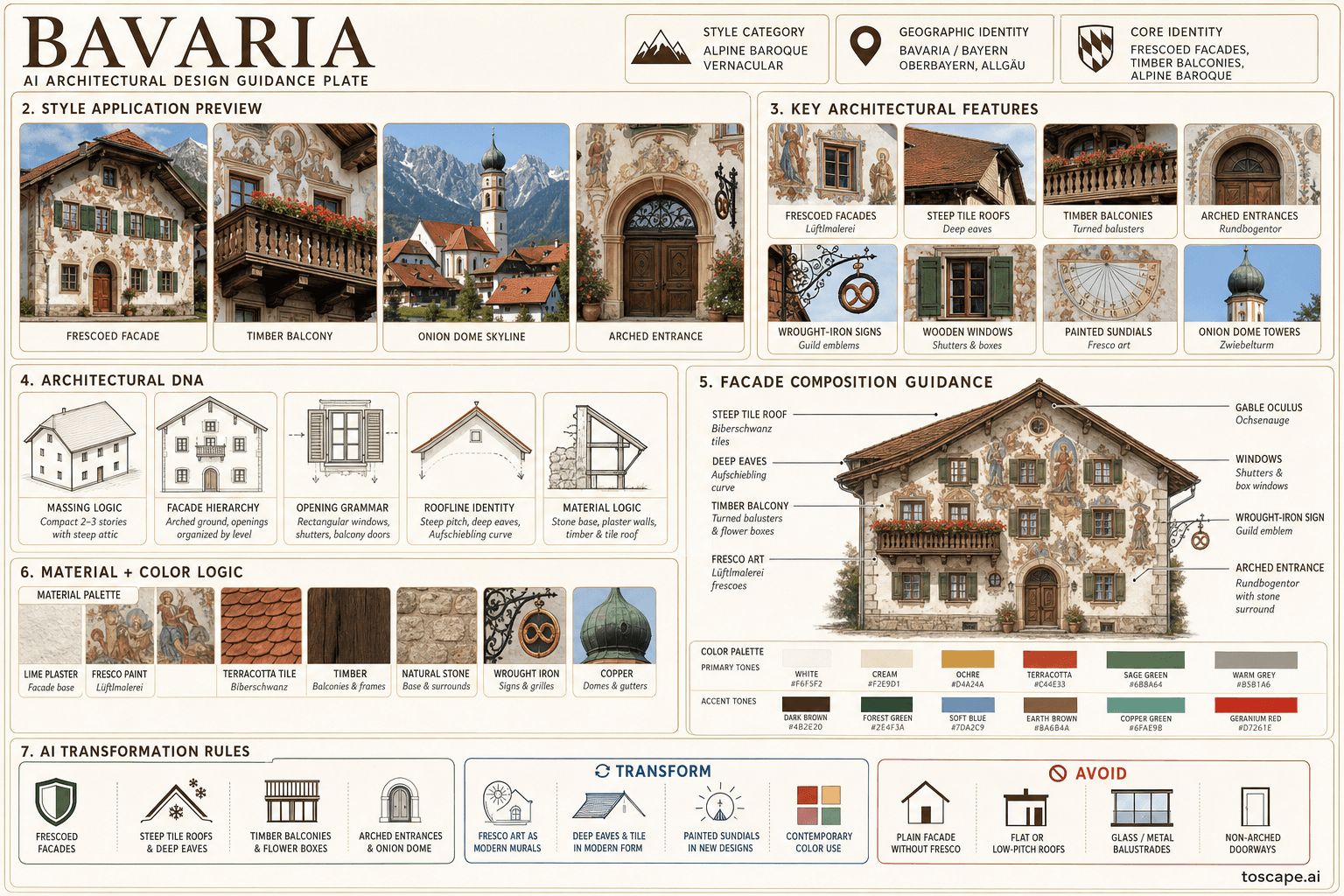
Bavaria
Germany · Bavaria / Bayern (Oberbayern, Allgäu)
Alpine Frescoed Facades, Timber Balconies & South German Baroque Vernacular
Definition
Bavaria is a regional architectural identity from Germany. Alpine Frescoed Facades, Timber Balconies & South German Baroque Vernacular.
- Country
- Germany
- Region
- Bavaria / Bayern (Oberbayern, Allgäu).
- Massing
- Compact rectangular volumes, 2-3 stories with steep attic, often with projecting gable to street.
- Materials
- Kalkputz (lime plaster): white or cream base for frescoes — the primary facade finish.
- Palette
- White, cream, pale sand, warm timber, and shadow-driven dark metal accents define the palette.
- Climate response
- Transitional Alpine-continental: cold snowy winters, warm summers, föhn wind (warm dry downslope wind). Steep roof: snow shedding essential.
Overview
Bavaria is a regional architectural identity in Germany. Bavaria / Bayern (Oberbayern, Allgäu) — Lüftlmalerei frescoed architecture. White lime-plastered facades with elaborate exterior fresco paintings (Lüftlmalerei) in pastel and earth tones, steep terracotta tile or wooden shingle roofs with deep overhanging eaves, carved timber balconies (Balkon/Laube) with turned balusters and floral sawn balustrades, onion-dome church towers (Zwiebelturm), wrought-iron trade signs (Z...
Visual DNA
Massing & Form
Compact rectangular volumes, 2-3 stories with steep attic, often with projecting gable to street. Ground floor in stone or plastered, upper floors in plastered brick or timber.
Facade Language
White or pale cream lime render (Kalkputz) with Lüftlmalerei fresco painting — the defining Bavarian facade element. Frescoes: architectural illusionism (painted pilasters/Quaderung — imitation stone blocks, window architraves/fasciae), religious scenes (patron saints, Madonna, Christ on cross), and secular motifs (tra...
Materials & Texture
Kalkputz (lime plaster): white or cream base for frescoes — the primary facade finish. Fresco pigments (Kalkfarben): earth pigments — ochre yellow, red-brown, green, blue, applied to wet lime plaster.
Color Palette
White, cream, pale sand, warm timber, and shadow-driven dark metal accents define the palette. The facade should stay bright and climate-aware rather than heavy, gray, or over-saturated.
Ornament & Detail
Lüftlmalerei (facade fresco): the quintessential Bavarian ornament — painted illusionistic architecture (Scheinarchitektur — trompe-l'œil pilasters, cornices, quoins), religious iconography (house Madonna — Hausmadonna in niche, patron saints protecting the house), and secular scenes (craftsmen at work, harvest, mounta...
Climate Response
Transitional Alpine-continental: cold snowy winters, warm summers, föhn wind (warm dry downslope wind). Steep roof: snow shedding essential.
Landscape & Ground
Bavaria / Bayern (Oberbayern, Allgäu) — Lüftlmalerei frescoed architecture. Transitional Alpine-continental: cold snowy winters, warm summers, föhn wind (warm dry downslope wind).
Reference elevation
Bavaria — characteristic facade composition, Bavaria / Bayern (Oberbayern, Allgäu).
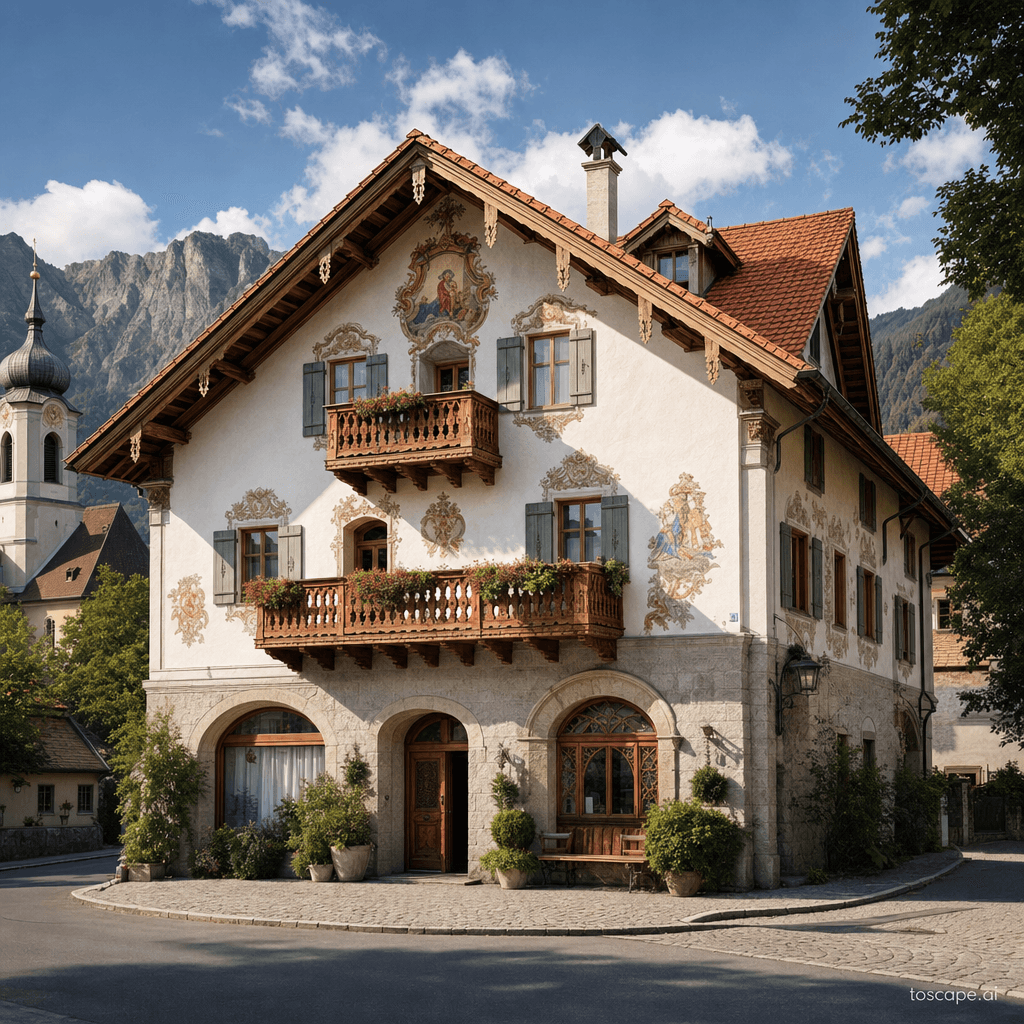
Context Snapshot
Bavaria / Bayern (Oberbayern, Allgäu) — Lüftlmalerei frescoed architecture Transitional Alpine-continental: cold snowy winters, warm summers, föhn wind (warm dry downslope wind).
Contemporary Relevance
Bavaria is useful today for residential, hospitality, civic, and place-branding work that needs Germany-specific character grounded in local massing, material tone, climate response, and settlement logic rather than generic international styling.
Use this style in Toscape
Explore Bavaria directly inside Toscape using the Facade Re-Style and Design Options workflows.
Open Bavaria in the galleryFrequently asked questions
What is Bavaria?
Bavaria is a regional architectural identity from Germany. Alpine Frescoed Facades, Timber Balconies & South German Baroque Vernacular.
What materials define Bavaria?
Kalkputz (lime plaster): white or cream base for frescoes — the primary facade finish. Fresco pigments (Kalkfarben): earth pigments — ochre yellow, red-brown, green, blue, applied to wet lime plaster.
What is the Bavaria color palette?
White, cream, pale sand, warm timber, and shadow-driven dark metal accents define the palette. The facade should stay bright and climate-aware rather than heavy, gray, or over-saturated.
Where does Bavaria come from?
Bavaria / Bayern (Oberbayern, Allgäu) — Lüftlmalerei frescoed architecture Transitional Alpine-continental: cold snowy winters, warm summers, föhn wind (warm dry downslope wind).
When should architects use Bavaria?
Bavaria is useful today for residential, hospitality, civic, and place-branding work that needs Germany-specific character grounded in local massing, material tone, climate response, and settlement logic rather than generic international styling.
How do you render Bavaria in Toscape?
Open Toscape on Windows, load your own photo, elevation, sketch, or CAD view, then apply the Bavaria reference from the built-in style library. The Facade Re-Style and Design Options workflows keep your project geometry and camera while shifting materials, proportion, and detailing toward Bavaria.