Beira
Portugal · Beira region (Beira Alta and Beira Baixa)
Schist & Granite Mountain Villages, Slate Roofs & Central Portuguese Vernacular
Definition
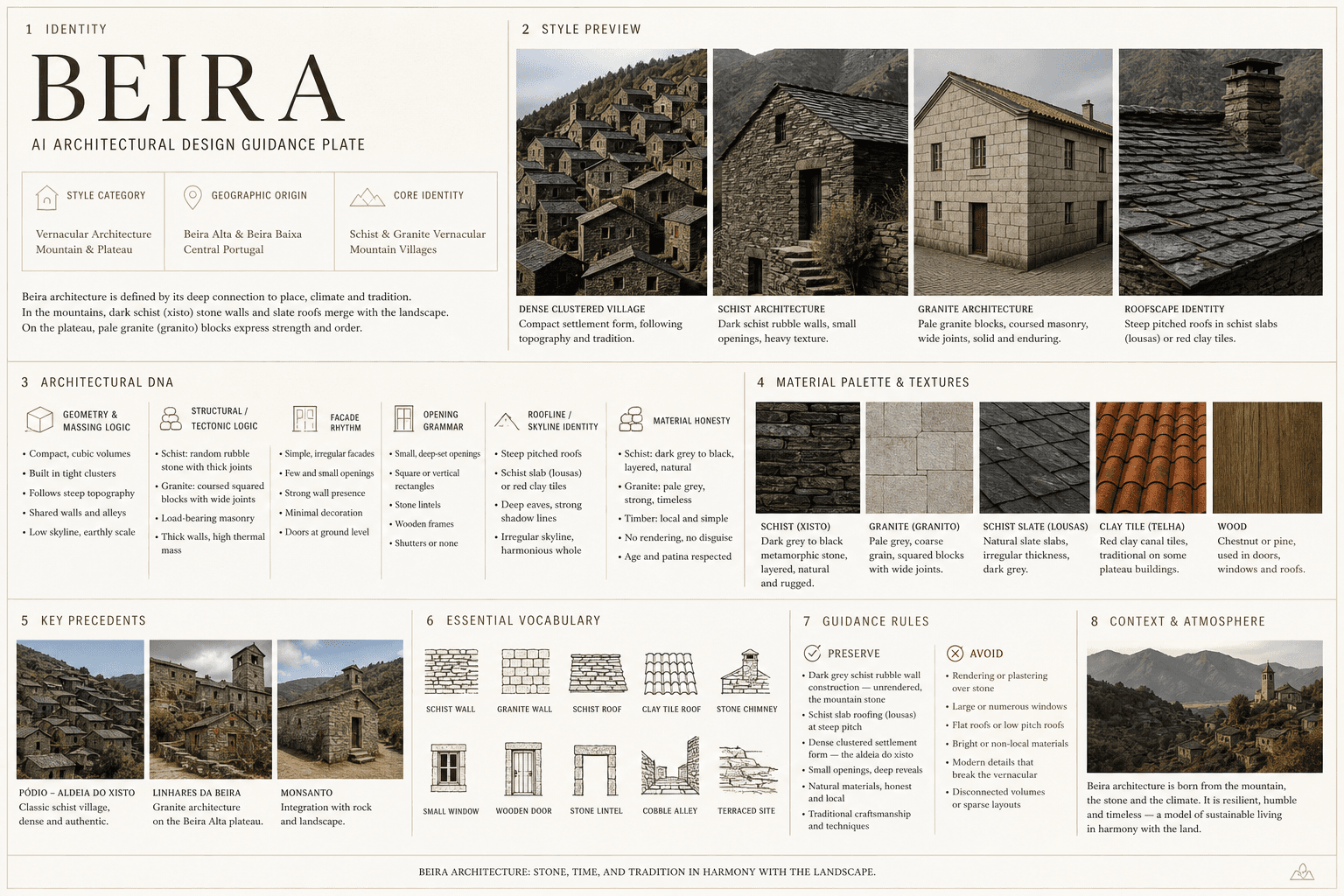
Beira is a regional architectural identity from Portugal. Schist & Granite Mountain Villages, Slate Roofs & Central Portuguese Vernacular.
- Country
- Portugal
- Region
- Beira region (Beira Alta and Beira Baixa).
- Massing
- Beira houses are compact, cubic, and tightly clustered — the mountain villages (aldeias do xisto) are among the densest settlement forms in Portugal.
- Materials
- Schist (xisto): dark grey, charcoal, sometimes with rust-coloured iron staining — the defining mountain stone. Granite (granito): pale grey to warm grey — the plateau stone.
- Palette
- White, cream, pale sand, warm timber, and shadow-driven dark metal accents define the palette.
- Climate response
- Inland mountain — cool, wet (rainfall 1000-1500mm annually), hot summers in valleys, cold winters at altitude.
Overview
Beira is a regional architectural identity in Portugal. Beira region (Beira Alta and Beira Baixa) — schist and granite stone vernacular, mountain villages, and the architecture of central Portugal. Dark grey schist (xisto) stone walls — the defining material of Beira mountain villages (Aldeias do Xisto), laid as random rubble with thick mortar joints, often left unrendered, creating a dark, monolithic architecture that blends into the grey mountain landscape, or pale grey...
Visual DNA
Massing & Form
Beira houses are compact, cubic, and tightly clustered — the mountain villages (aldeias do xisto) are among the densest settlement forms in Portugal. Houses are typically 2 storeys, rectangular plan, built on steep terraced slopes — the ground floor is often partially embedded in the hillside.
Facade Language
Schist village houses: simple, irregular — the facade is a dark stone wall with a door and perhaps 1-2 small windows. No symmetry, no applied ornament — the beauty is in the stone itself, the play of dark schist blocks, and the integration with surrounding rock.
Materials & Texture
Schist (xisto): dark grey, charcoal, sometimes with rust-coloured iron staining — the defining mountain stone. Granite (granito): pale grey to warm grey — the plateau stone.
Color Palette
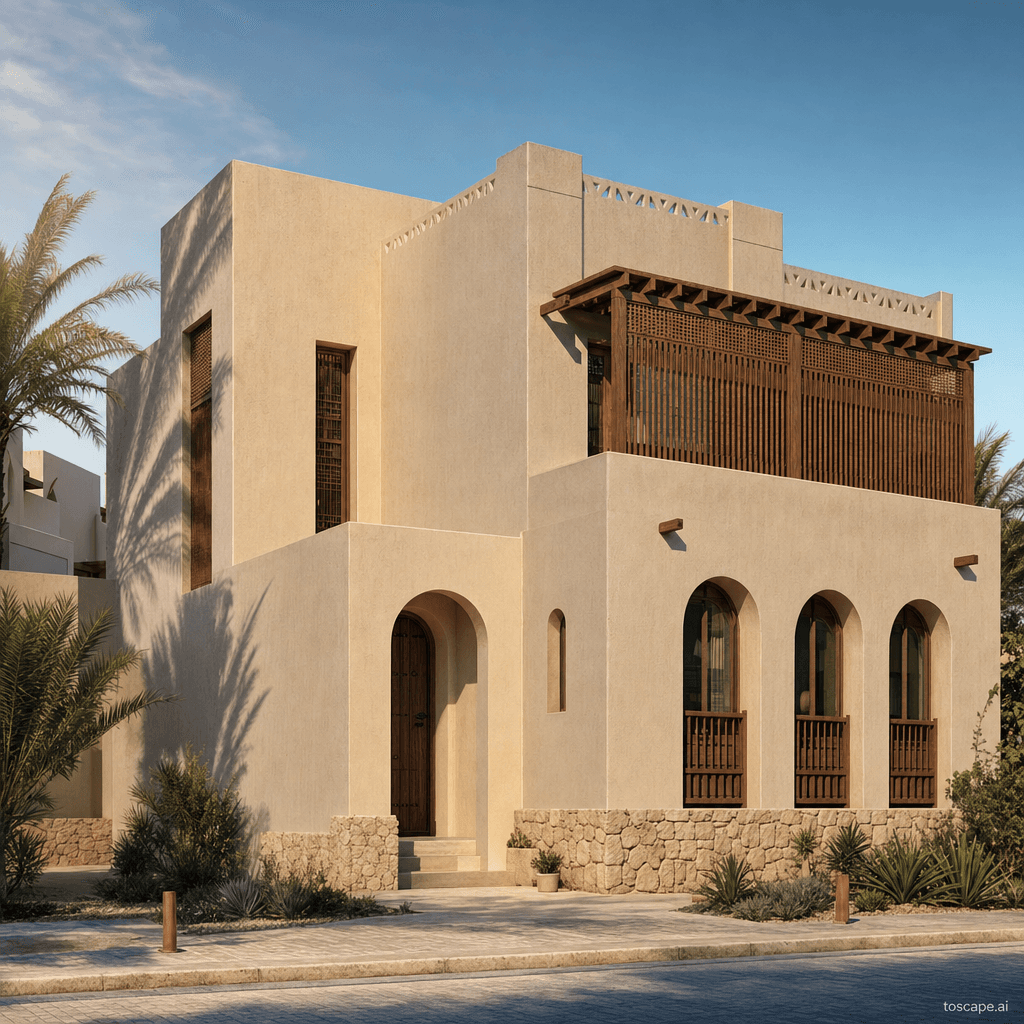
White, cream, pale sand, warm timber, and shadow-driven dark metal accents define the palette. The facade should stay bright and climate-aware rather than heavy, gray, or over-saturated.
Ornament & Detail
Beira ornament is tectonic and minimal: stone lintels and door surrounds — simple chamfered edges, sometimes a carved date-stone or initials, balcony timber railing — simple turned or square balusters, ironwork — simple scroll hinges and door handles, chimney cap courses — simple stone projections, the schist wall itse...
Climate Response
Inland mountain — cool, wet (rainfall 1000-1500mm annually), hot summers in valleys, cold winters at altitude. Schist villages: built on steep terraced slopes — the schist bedrock is everywhere, and villages are built from excavated stone.
Landscape & Ground
Beira region (Beira Alta and Beira Baixa) — schist and granite stone vernacular, mountain villages, and the architecture of central Portugal. Inland mountain — cool, wet (rainfall 1000-1500mm annually), hot summers in valleys, cold winters at altitude.
Reference elevation
Beira — characteristic facade composition, Beira region (Beira Alta and Beira Baixa).
Context Snapshot
Beira region (Beira Alta and Beira Baixa) — schist and granite stone vernacular, mountain villages, and the architecture of central Portugal Inland mountain — cool, wet (rainfall 1000-1500mm annually), hot summers in valleys, cold winters at altitude.
Contemporary Relevance
Beira is useful today for residential, hospitality, civic, and place-branding work that needs Portugal-specific character grounded in local massing, material tone, climate response, and settlement logic rather than generic international styling.
Use this style in Toscape
Explore Beira directly inside Toscape using the Facade Re-Style and Design Options workflows.
Open Beira in the galleryFrequently asked questions
What is Beira?
Beira is a regional architectural identity from Portugal. Schist & Granite Mountain Villages, Slate Roofs & Central Portuguese Vernacular.
What materials define Beira?
Schist (xisto): dark grey, charcoal, sometimes with rust-coloured iron staining — the defining mountain stone. Granite (granito): pale grey to warm grey — the plateau stone.
What is the Beira color palette?
White, cream, pale sand, warm timber, and shadow-driven dark metal accents define the palette. The facade should stay bright and climate-aware rather than heavy, gray, or over-saturated.
Where does Beira come from?
Beira region (Beira Alta and Beira Baixa) — schist and granite stone vernacular, mountain villages, and the architecture of central Portugal Inland mountain — cool, wet (rainfall 1000-1500mm annually), hot summers in valleys, cold winters at altitude.
When should architects use Beira?
Beira is useful today for residential, hospitality, civic, and place-branding work that needs Portugal-specific character grounded in local massing, material tone, climate response, and settlement logic rather than generic international styling.
How do you render Beira in Toscape?
Open Toscape on Windows, load your own photo, elevation, sketch, or CAD view, then apply the Beira reference from the built-in style library. The Facade Re-Style and Design Options workflows keep your project geometry and camera while shifting materials, proportion, and detailing toward Beira.