Bekaa Valley
Lebanon · domestic and agricultural architecture of the Bekaa Valley
The earth-brick and stone agricultural architecture of Lebanon's fertile plateau — courtyard farmhouses, mud-brick village compounds, and the unique Roman-Umayyad architectural her...
Definition
Bekaa Valley is a regional architectural identity from Lebanon. The earth-brick and stone agricultural architecture of Lebanon's fertile plateau — courtyard farmhouses, mud-brick village compounds, and the unique Roman-Umayyad architectural her.
- Country
- Lebanon
- Region
- domestic and agricultural architecture of the Bekaa Valley.
- Massing
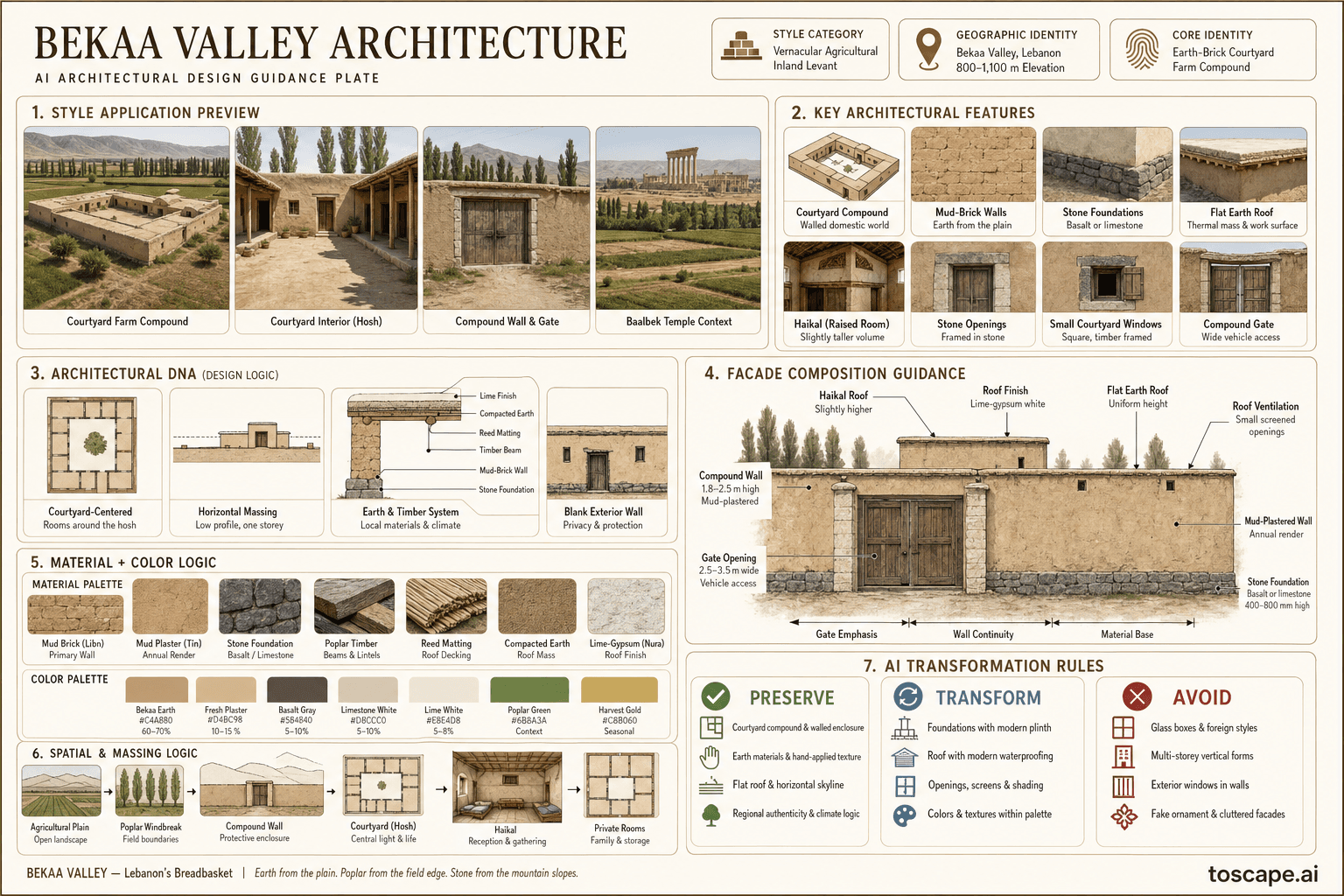
- The Bekaa farmhouse compound is a single-storey, horizontally-extended enclosure — typically 20–40 m wide × 25–50 m deep — organized as a walled compound containing multiple.
- Materials
- Mud brick (libn) — warm tan to light brown — the primary wall material of the Bekaa plain Mud plaster (tîn) — hand-applied annual render.
- Palette
- White, cream, pale sand, warm timber, and shadow-driven dark metal accents define the palette.
- Climate response
- The Bekaa Valley's semi-arid continental climate — hot dry summers (32–38°C), cold winters (0–5°C, occasional snow).
Overview
Bekaa Valley is a regional architectural identity in Lebanon. Traditional domestic and agricultural architecture of the Bekaa Valley — Lebanon's fertile high plateau (800–1,100 m elevation) between the Mount Lebanon and Anti-Lebanon ranges. A distinct architectural ecology defined by adobe/mud-brick (libn) construction on stone foundations, flat-earth roofs, courtyard farm compounds, and the monumental Umayyad-Roman stone architecture at Baalbek and Anjar — a region where earth...
Visual DNA
Massing & Form
The Bekaa farmhouse compound is a single-storey, horizontally-extended enclosure — typically 20–40 m wide × 25–50 m deep — organized as a walled compound containing multiple rectilinear volumes around a central courtyard. Individual rooms are rectangular (3–5 m × 4–8 m), arranged around the courtyard perimeter.
Facade Language
The Bekaa compound presents the architecture of the blank wall: Compound wall: Continuous earth-rendered surface, 1.8–2.5 m high — the dominant exterior expression. The wall is mud-plastered (tîn), reapplied annually after the rainy season.
Materials & Texture
Mud brick (libn) — warm tan to light brown — the primary wall material of the Bekaa plain Mud plaster (tîn) — hand-applied annual render — the living surface of the architecture Basalt rubble — dark gray to black — foundation courses in the northern Bekaa (volcanic geology) Limestone rubble — white to pale gray — found...
Color Palette
White, cream, pale sand, warm timber, and shadow-driven dark metal accents define the palette. The facade should stay bright and climate-aware rather than heavy, gray, or over-saturated.
Ornament & Detail
Bekaa ornament is minimal — the aesthetic of the agricultural compound is fundamentally functional: (1) Mud-plaster texture — the hand-applied annual render creates subtle surface variation — an anonymous, collective aesthetic. (2) Stone door and window surrounds — where stone is available, openings are framed in dress...
Climate Response
The Bekaa Valley's semi-arid continental climate — hot dry summers (32–38°C), cold winters (0–5°C, occasional snow), 400–600 mm annual rainfall concentrated in winter — dictates the architecture: (1) Thermal mass — thick mud-brick walls (400–700 mm) and earth roofs moderate the extreme diurnal temperature range (up to...
Landscape & Ground
Traditional domestic and agricultural architecture of the Bekaa Valley — Lebanon's fertile high plateau (800–1,100 m elevation) between the Mount Lebanon and Anti-Lebanon ranges. A distinct architectural ecology defined by adobe/mud-brick (libn) construction on stone foundations, flat-earth roofs, courtyard farm compou...
Reference elevation
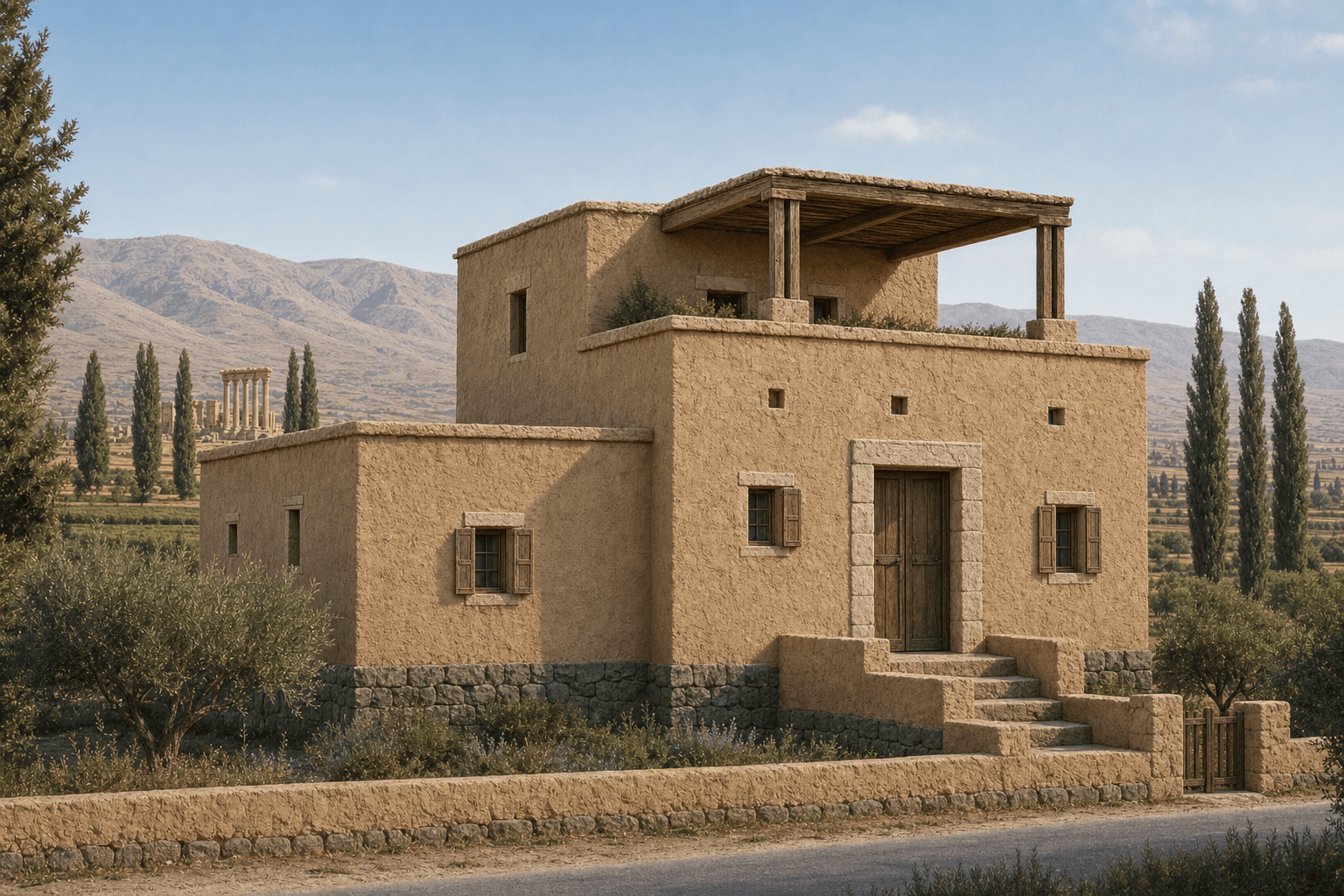
Bekaa Valley — characteristic facade composition, domestic and agricultural architecture of the Bekaa Valley.
Context Snapshot
Traditional domestic and agricultural architecture of the Bekaa Valley — Lebanon's fertile high plateau (800–1,100 m elevation) between the Mount Lebanon and Anti-Lebanon ranges. The Bekaa Valley's semi-arid continental climate — hot dry summers (32–38°C), cold winters (0–5°C, occasional snow), 400–600 mm annual rainfall concentrated in winter — dictates the architecture: (1) Thermal mass — thick...
Contemporary Relevance
Bekaa Valley is useful today for residential, hospitality, civic, and place-branding work that needs Lebanon-specific character grounded in local massing, material tone, climate response, and settlement logic rather than generic international styling.
Use this style in Toscape
Explore Bekaa Valley directly inside Toscape using the Facade Re-Style and Design Options workflows.
Open Bekaa Valley in the galleryFrequently asked questions
What is Bekaa Valley?
Bekaa Valley is a regional architectural identity from Lebanon. The earth-brick and stone agricultural architecture of Lebanon's fertile plateau — courtyard farmhouses, mud-brick village compounds, and the unique Roman-Umayyad architectural her.
What materials define Bekaa Valley?
Mud brick (libn) — warm tan to light brown — the primary wall material of the Bekaa plain Mud plaster (tîn) — hand-applied annual render — the living surface of the architecture Basalt rubble — dark gray to black — foundation courses in the northern Bekaa (volcanic geology) Limestone rubble — white to pale gray — found.
What is the Bekaa Valley color palette?
White, cream, pale sand, warm timber, and shadow-driven dark metal accents define the palette. The facade should stay bright and climate-aware rather than heavy, gray, or over-saturated.
Where does Bekaa Valley come from?
Traditional domestic and agricultural architecture of the Bekaa Valley — Lebanon's fertile high plateau (800–1,100 m elevation) between the Mount Lebanon and Anti-Lebanon ranges. The Bekaa Valley's semi-arid continental climate — hot dry summers (32–38°C), cold winters (0–5°C, occasional snow), 400–600 mm annual rainfall concentrated in winter — dictates the architecture: (1) Thermal mass — thick.
When should architects use Bekaa Valley?
Bekaa Valley is useful today for residential, hospitality, civic, and place-branding work that needs Lebanon-specific character grounded in local massing, material tone, climate response, and settlement logic rather than generic international styling.
How do you render Bekaa Valley in Toscape?
Open Toscape on Windows, load your own photo, elevation, sketch, or CAD view, then apply the Bekaa Valley reference from the built-in style library. The Facade Re-Style and Design Options workflows keep your project geometry and camera while shifting materials, proportion, and detailing toward Bekaa Valley.