Berlin-Brandenburg
Germany · Berlin and Brandenburg region
Prussian Classicism, Plastered Facades & Berliner Mietskaserne Urbanism
Definition
Berlin-Brandenburg is a regional architectural identity from Germany. Prussian Classicism, Plastered Facades & Berliner Mietskaserne Urbanism.
- Country
- Germany
- Region
- Berlin and Brandenburg region.
- Massing
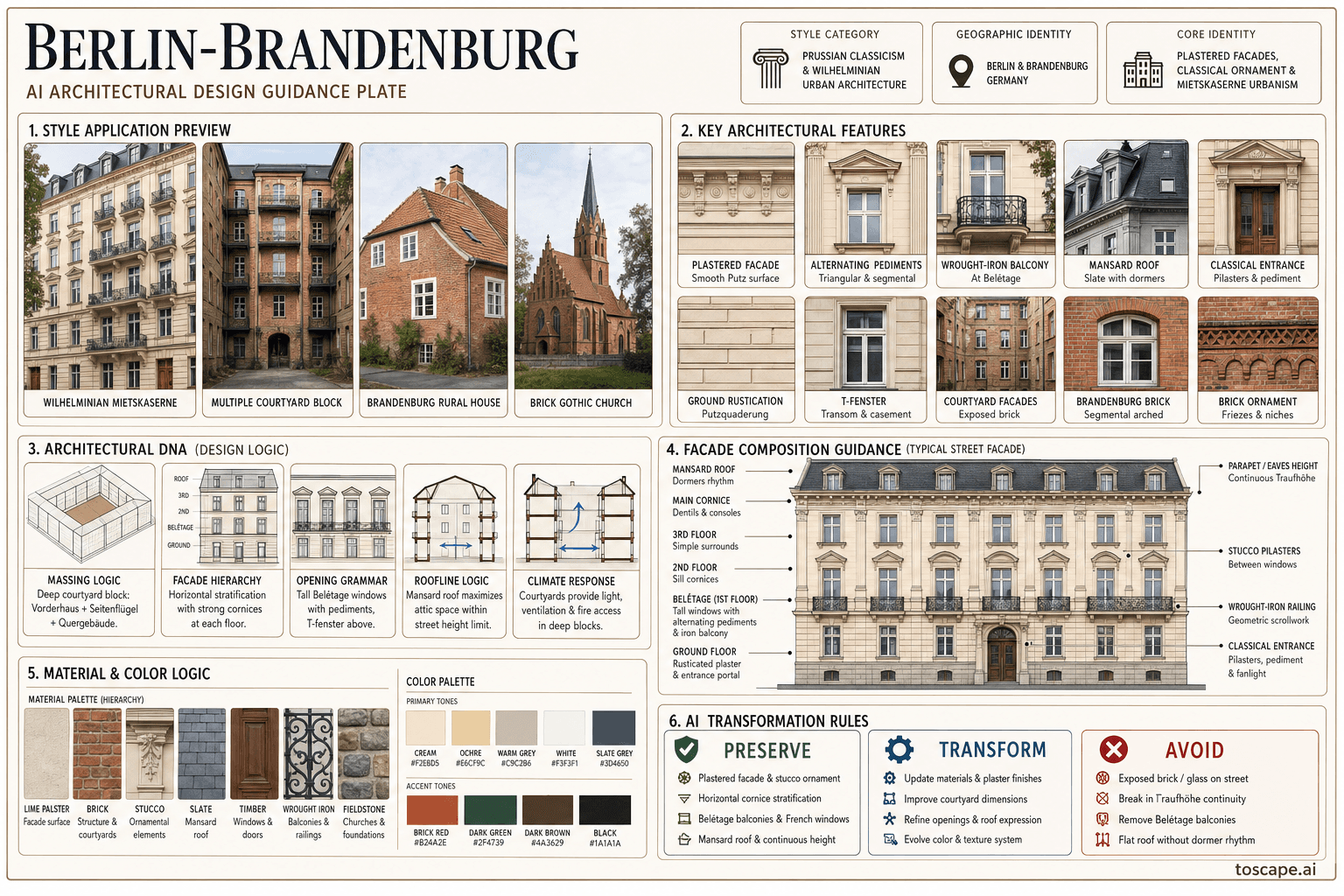
- Berliner Mietskaserne (tenement barracks): deep rectangular block, 5-6 stories, with front building (Vorderhaus), side wings (Seitenflügel), and rear buildings (Quergebäude) arranged around multiple narrow courtyards.
- Materials
- Putz (plaster/render): smooth lime-cement render in pale ochre, cream, or grey — the defining Berlin facade surface, scored to imitate stone blocks (Quaderputz) at ground.
- Palette
- White, cream, pale sand, warm timber, and shadow-driven dark metal accents define the palette.
- Climate response
- Continental: cold winters, warm summers, moderate rainfall. Plastered brick: good thermal mass, durable in freeze-thaw with quality render.
Overview
Berlin-Brandenburg is a regional architectural identity in Germany. Berlin and Brandenburg region — Prussian classical and Wilhelminian urban architecture. Smooth plastered facades (Putzfassade) in pale ochre, cream, or grey with classical stucco ornament — cornices (Gesimse), pilasters (Pilaster), window pediments (Fensterverdachungen) alternating triangular and segmental, deep building volumes with multiple rear courtyards (Hinterhöfe) in Berliner Mietskaserne typology, grey slate...
Visual DNA
Massing & Form
Berliner Mietskaserne (tenement barracks): deep rectangular block, 5-6 stories, with front building (Vorderhaus), side wings (Seitenflügel), and rear buildings (Quergebäude) arranged around multiple narrow courtyards. Street facade: 18-22m wide, repeated identically along block.
Facade Language
Prussian classical street facade: smooth plaster surface (Putz) in pale cream, ochre, warm grey, or white. Horizontal stratification with continuous cornices at each floor.
Materials & Texture
Putz (plaster/render): smooth lime-cement render in pale ochre, cream, or grey — the defining Berlin facade surface, scored to imitate stone blocks (Quaderputz) at ground. Stuck (stucco): gypsum-based ornamental elements — cornices, pediments, architraves, medallions, console brackets.
Color Palette
White, cream, pale sand, warm timber, and shadow-driven dark metal accents define the palette. The facade should stay bright and climate-aware rather than heavy, gray, or over-saturated.
Ornament & Detail
Stuck (stucco ornament): the primary Berlin decorative medium — prefabricated or site-molded gypsum elements applied to plastered brick facades. Motifs: acanthus consoles under main cornice, garlands (Festons) between windows, medallions with classical busts (Medaillonköpfe), egg-and-dart (Eierstab), dentils (Zahnschni...
Climate Response
Continental: cold winters, warm summers, moderate rainfall. Plastered brick: good thermal mass, durable in freeze-thaw with quality render.
Landscape & Ground
Berlin and Brandenburg region — Prussian classical and Wilhelminian urban architecture. Continental: cold winters, warm summers, moderate rainfall.
Reference elevation
Berlin-Brandenburg — characteristic facade composition, Berlin and Brandenburg region.
Context Snapshot
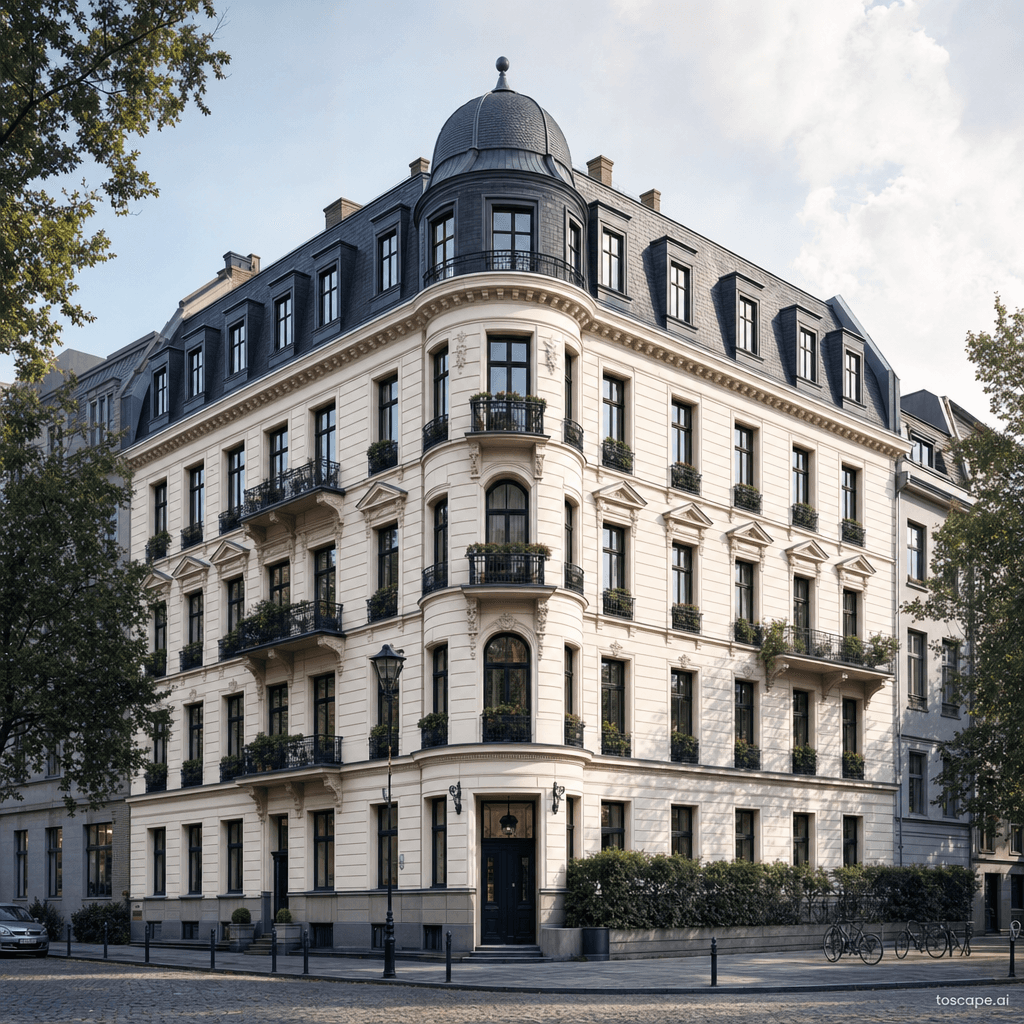
Berlin and Brandenburg region — Prussian classical and Wilhelminian urban architecture Continental: cold winters, warm summers, moderate rainfall.
Contemporary Relevance
Berlin-Brandenburg is useful today for residential, hospitality, civic, and place-branding work that needs Germany-specific character grounded in local massing, material tone, climate response, and settlement logic rather than generic international styling.
Use this style in Toscape
Explore Berlin-Brandenburg directly inside Toscape using the Facade Re-Style and Design Options workflows.
Open Berlin-Brandenburg in the galleryFrequently asked questions
What is Berlin-Brandenburg?
Berlin-Brandenburg is a regional architectural identity from Germany. Prussian Classicism, Plastered Facades & Berliner Mietskaserne Urbanism.
What materials define Berlin-Brandenburg?
Putz (plaster/render): smooth lime-cement render in pale ochre, cream, or grey — the defining Berlin facade surface, scored to imitate stone blocks (Quaderputz) at ground. Stuck (stucco): gypsum-based ornamental elements — cornices, pediments, architraves, medallions, console brackets.
What is the Berlin-Brandenburg color palette?
White, cream, pale sand, warm timber, and shadow-driven dark metal accents define the palette. The facade should stay bright and climate-aware rather than heavy, gray, or over-saturated.
Where does Berlin-Brandenburg come from?
Berlin and Brandenburg region — Prussian classical and Wilhelminian urban architecture Continental: cold winters, warm summers, moderate rainfall.
When should architects use Berlin-Brandenburg?
Berlin-Brandenburg is useful today for residential, hospitality, civic, and place-branding work that needs Germany-specific character grounded in local massing, material tone, climate response, and settlement logic rather than generic international styling.
How do you render Berlin-Brandenburg in Toscape?
Open Toscape on Windows, load your own photo, elevation, sketch, or CAD view, then apply the Berlin-Brandenburg reference from the built-in style library. The Facade Re-Style and Design Options workflows keep your project geometry and camera while shifting materials, proportion, and detailing toward Berlin-Brandenburg.