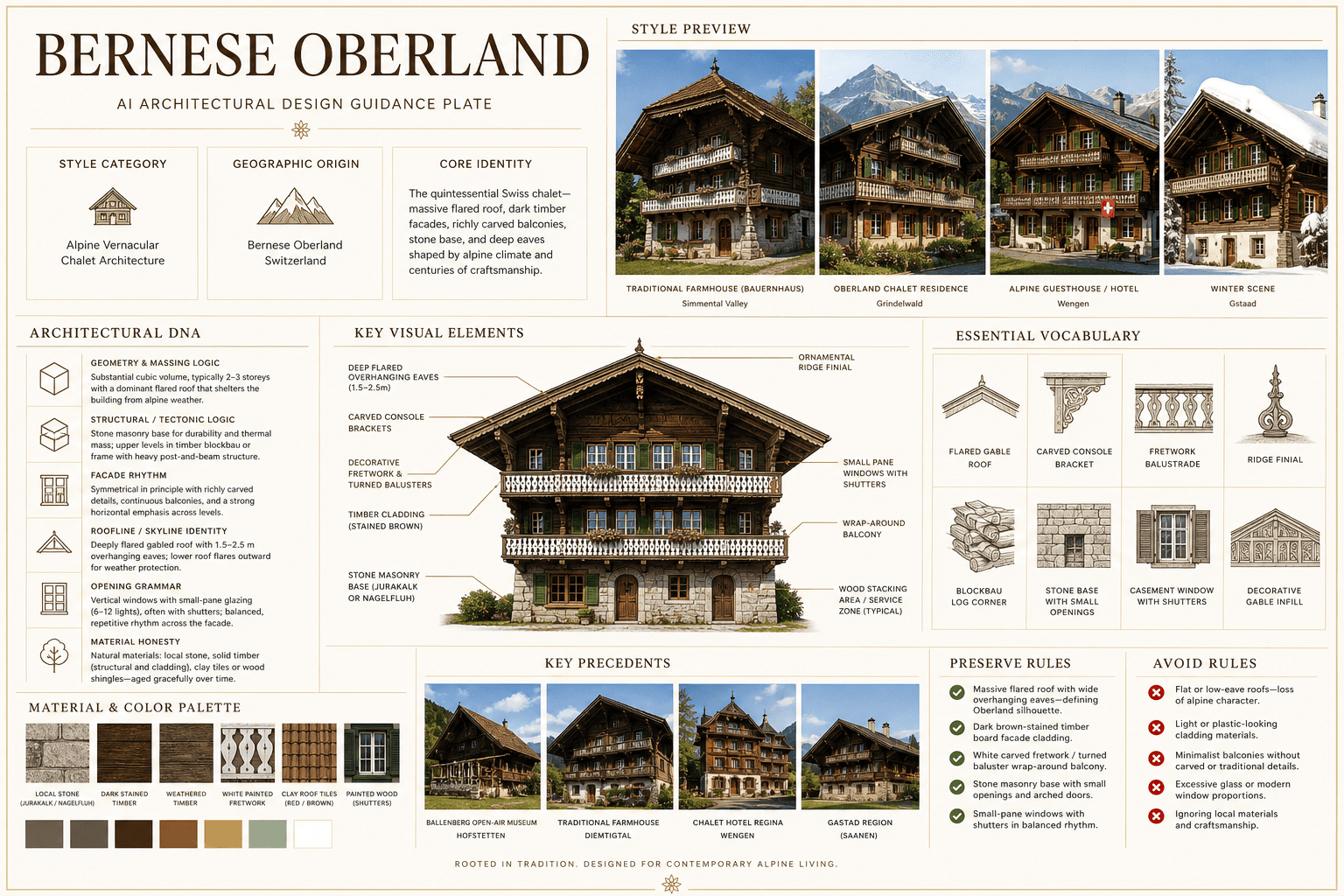
Bernese Oberland
Switzerland · Bernese Oberland
Classic Swiss Chalet, Carved Timber Facades & Flared Alpine Roof Architecture
Definition
Bernese Oberland is a regional architectural identity from Switzerland. Classic Swiss Chalet, Carved Timber Facades & Flared Alpine Roof Architecture.
- Country
- Switzerland
- Region
- Bernese Oberland
- Massing
- The Bernese Oberland farmhouse (Bauernhaus) is a substantial cubic volume — typically 2-3 storeys with a dominant roof.
- Materials
- Spruce/fir timber (Fichte/Tanne): the primary structural and cladding timber — light-coloured, painted dark brown or weathered naturally.
- Palette
- White, cream, pale sand, warm timber, and shadow-driven dark metal accents define the palette.
- Climate response
- Alpine valley — moderate altitude (800-1500m), heavy winter snowfall (often 2-4 metres accumulation), significant rainfall in summer, strong föhn winds (warm dry downslope wind).
Overview
Bernese Oberland is a regional architectural identity in Switzerland. Bernese Oberland — the archetypal Swiss chalet tradition, Simmental and Oberland farmhouses, and alpine tourism architecture. The quintessential Swiss chalet — the most recognizable Alpine architectural image globally: massive flared, low-sweeping hipped or gabled roof with very wide overhanging eaves (1.5-2.5 metres projection), deep brown-stained or naturally-weathered dark brown timber plank facade (vertical or ho...
Visual DNA
Massing & Form
The Bernese Oberland farmhouse (Bauernhaus) is a substantial cubic volume — typically 2-3 storeys with a dominant roof, square to rectangular plan (often nearly square — 10-15 metres per side). The massing is defined by the flared roof: the roof flares outward at the eaves, creating an almost bell-shaped silhouette — t...
Facade Language
The Oberland chalet facade is highly decorative and symmetrical in principle but enriched asymmetrically with carved details. The principal (south or southeast-facing) elevation: continuous wrap-around balcony at upper-floor level, richly carved balustrade — turned spindle balusters (Drechslerarbeit), fretwork panels w...
Materials & Texture
Spruce/fir timber (Fichte/Tanne): the primary structural and cladding timber — light-coloured, painted dark brown or weathered naturally. Larch (Lärche): used for shingles, balcony elements, and in higher-altitude buildings — naturally durable.
Color Palette
White, cream, pale sand, warm timber, and shadow-driven dark metal accents define the palette. The facade should stay bright and climate-aware rather than heavy, gray, or over-saturated.
Ornament & Detail
The Oberland chalet is the most ornate of Swiss vernacular architectures: fretwork balcony balusters — heart motifs, diamond lattice, teardrop, cross, and tulip patterns cut from boards — often painted white against the dark balcony, console brackets under the eaves — deeply carved scrolls, volutes, acanthus leaves, an...
Climate Response
Alpine valley — moderate altitude (800-1500m), heavy winter snowfall (often 2-4 metres accumulation), significant rainfall in summer, strong föhn winds (warm dry downslope wind). Flared roof with deep eaves: the bell-shaped roof profile facilitates snow shedding while the deep overhang protects the timber walls from ra...
Landscape & Ground
Bernese Oberland — the archetypal Swiss chalet tradition, Simmental and Oberland farmhouses, and alpine tourism architecture. Alpine valley — moderate altitude (800-1500m), heavy winter snowfall (often 2-4 metres accumulation), significant rainfall in summer, strong föhn winds (warm dry downslope wind).
Reference elevation
Bernese Oberland — characteristic facade composition, Bernese Oberland.
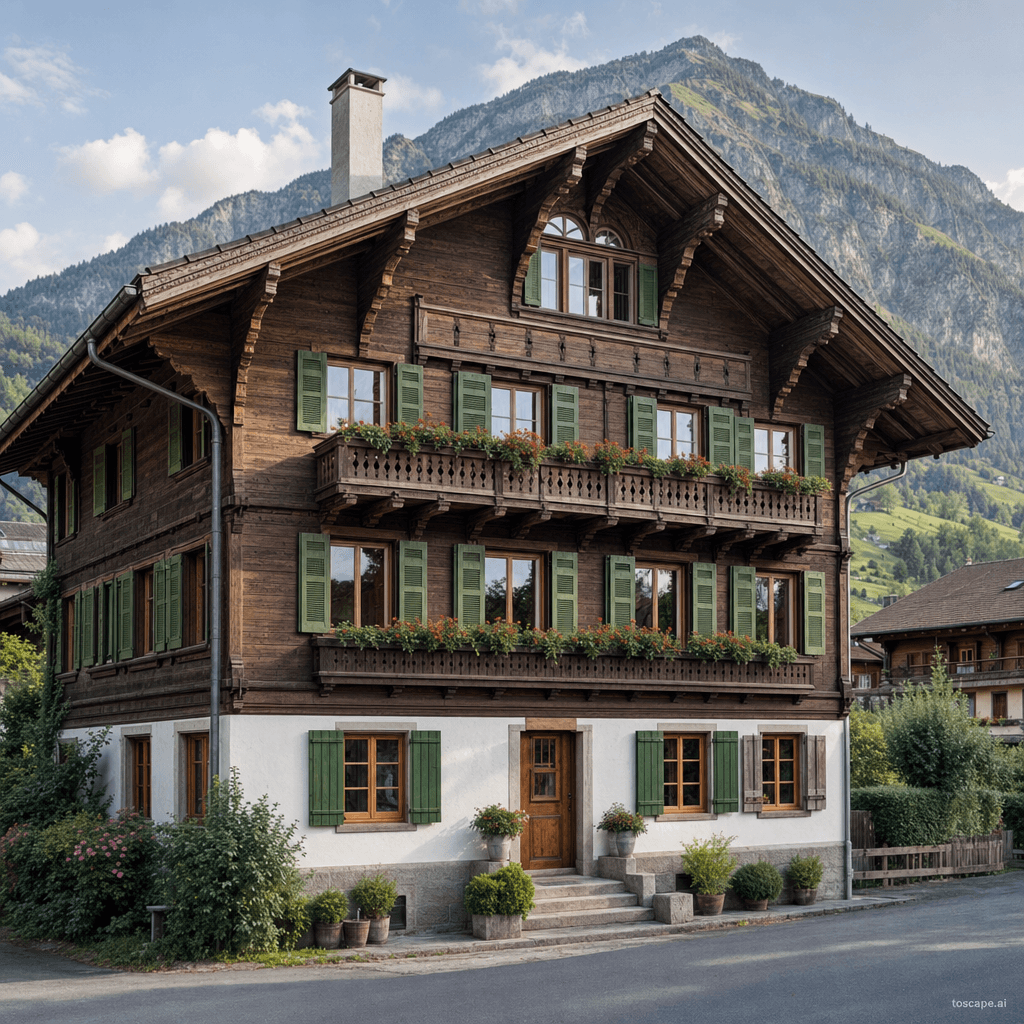
Context Snapshot
Bernese Oberland — the archetypal Swiss chalet tradition, Simmental and Oberland farmhouses, and alpine tourism architecture Alpine valley — moderate altitude (800-1500m), heavy winter snowfall (often 2-4 metres accumulation), significant rainfall in summer, strong föhn winds (warm dry downslope wind).
Contemporary Relevance
Bernese Oberland is useful today for residential, hospitality, civic, and place-branding work that needs Switzerland-specific character grounded in local massing, material tone, climate response, and settlement logic rather than generic international styling.
Use this style in Toscape
Explore Bernese Oberland directly inside Toscape using the Facade Re-Style and Design Options workflows.
Open Bernese Oberland in the galleryFrequently asked questions
What is Bernese Oberland?
Bernese Oberland is a regional architectural identity from Switzerland. Classic Swiss Chalet, Carved Timber Facades & Flared Alpine Roof Architecture.
What materials define Bernese Oberland?
Spruce/fir timber (Fichte/Tanne): the primary structural and cladding timber — light-coloured, painted dark brown or weathered naturally. Larch (Lärche): used for shingles, balcony elements, and in higher-altitude buildings — naturally durable.
What is the Bernese Oberland color palette?
White, cream, pale sand, warm timber, and shadow-driven dark metal accents define the palette. The facade should stay bright and climate-aware rather than heavy, gray, or over-saturated.
Where does Bernese Oberland come from?
Bernese Oberland — the archetypal Swiss chalet tradition, Simmental and Oberland farmhouses, and alpine tourism architecture Alpine valley — moderate altitude (800-1500m), heavy winter snowfall (often 2-4 metres accumulation), significant rainfall in summer, strong föhn winds (warm dry downslope wind).
When should architects use Bernese Oberland?
Bernese Oberland is useful today for residential, hospitality, civic, and place-branding work that needs Switzerland-specific character grounded in local massing, material tone, climate response, and settlement logic rather than generic international styling.
How do you render Bernese Oberland in Toscape?
Open Toscape on Windows, load your own photo, elevation, sketch, or CAD view, then apply the Bernese Oberland reference from the built-in style library. The Facade Re-Style and Design Options workflows keep your project geometry and camera while shifting materials, proportion, and detailing toward Bernese Oberland.