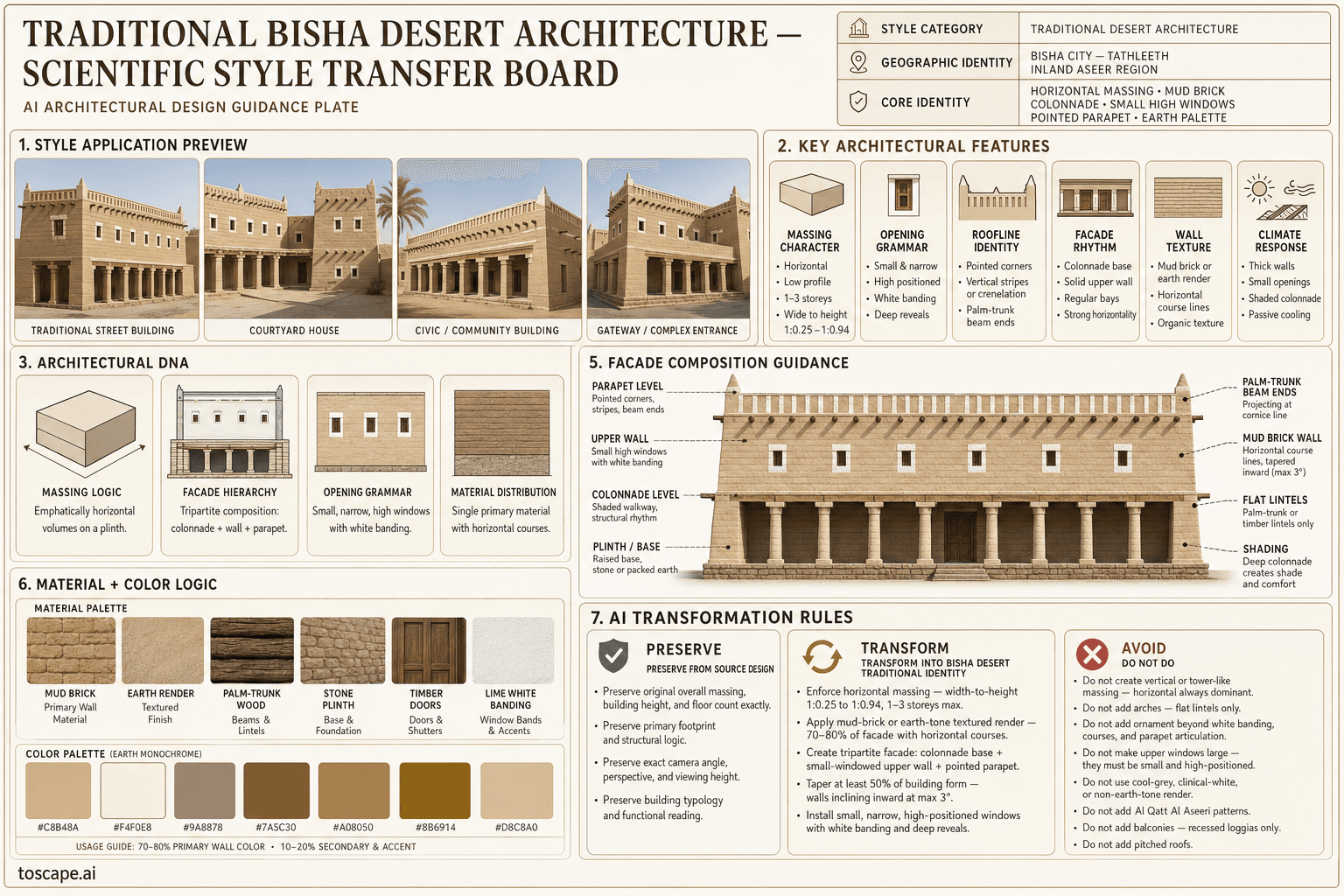
Bisha Desert Traditional
Saudi Arabia · Bisha Desert
The stark horizontal mud-brick courtyard vernacular of the Bisha-Tathleeth desert plain, pre-20th century CE
Definition
Bisha Desert Traditional is a regional architectural identity from Saudi Arabia. The stark horizontal mud-brick courtyard vernacular of the Bisha-Tathleeth desert plain, pre-20th century CE.
- Country
- Saudi Arabia
- Region
- Bisha Desert
- Massing
- Traditional Bisha Desert buildings are emphatically horizontal — the most horizontally-proportioned of all Saudi character areas. Documented width-to-height ratio: 1:0. 25 to 1:0.
- Materials
- Primary wall: sun-dried mud brick with mud plaster surface — 70–80% of facade as one consistent material.
- Palette
- Earth-toned wall masses, gypsum white accents, and warm timber details define the palette.
- Climate response
- The Bisha Desert climate is hot arid continental with intense solar radiation on flat desert plains and wadi corridors .
Overview
Bisha Desert Traditional is a Saudi architectural identity rooted in Bisha Desert. Bisha Desert Architecture — inland Aseer desert settlements, historic mud-brick patio houses of Bisha and Tathleeth. Bisha city — Tathleeth — the flat desert wadi corridors of the inland Aseer region.
Visual DNA
Massing & Form
Traditional Bisha Desert buildings are emphatically horizontal — the most horizontally-proportioned of all Saudi character areas. Documented width-to-height ratio: 1:0.25 to 1:0.94 — the building must read as wider than it is tall .
Facade Language
Facade rhythm follows a strict tripartite system: colonnade/large-opening ground floor → near-solid upper wall with small high-positioned windows → articulated parapet crown . Upper-floor windows are small, narrow, and positioned high on the wall — leaving large expanses of unbroken mud-brick surface.
Materials & Texture
Primary wall: sun-dried mud brick with mud plaster surface — 70–80% of facade as one consistent material. The surface must show organic, slightly grainy adobe texture of hand-applied mud plaster .
Color Palette
Earth-toned wall masses, gypsum white accents, and warm timber details define the palette. The building should read as desert mineral first, with ornament or painted detail working as a controlled secondary layer rather than a competing facade field.
Ornament & Detail
This is the most restrained ornamental system in the Saudi Characters Map. Ornament derives from construction logic, not applied decoration: (a) horizontal mud-brick coursing lines — the continuous surface texture across the entire facade; (b) pointed corner parapet — the articulated skyline element; (c) white window b...
Climate Response
The Bisha Desert climate is hot arid continental with intense solar radiation on flat desert plains and wadi corridors . Traditional architecture responds through: (a) thick mud-brick walls providing thermal mass; (b) introverted courtyard organization; (c) very low upper-floor window-to-wall ratio (max 30%) minimizing...
Landscape & Ground
Bisha city — Tathleeth — the flat desert wadi corridors of the inland Aseer region. The Bisha Desert climate is hot arid continental with intense solar radiation on flat desert plains and wadi corridors .
Reference elevation
Bisha Desert Traditional — characteristic facade composition, Bisha Desert.
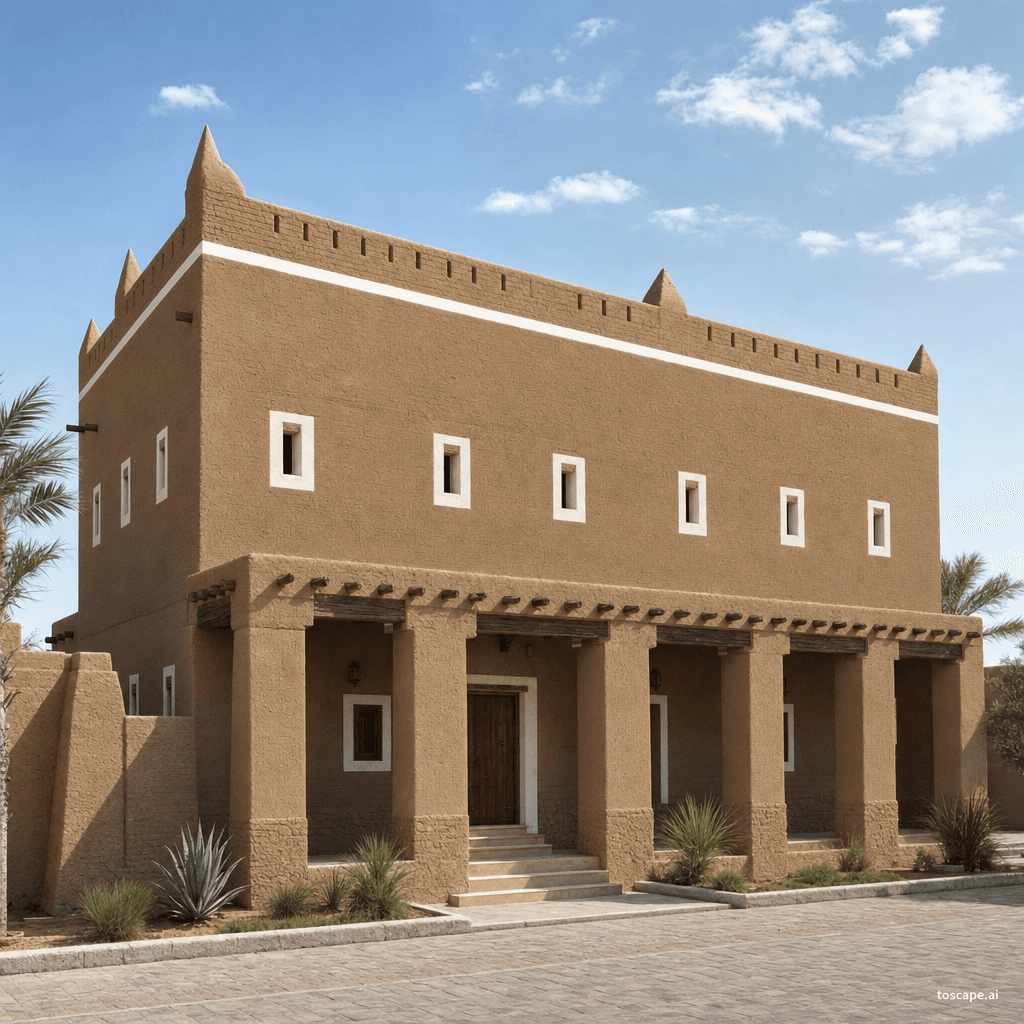
Context Snapshot
Maximum-fidelity translation of Bisha Desert mud-brick vernacular — the most restrained, sober, earth-monochrome character in the Saudi Architecture Characters Map Bisha Desert Architecture — inland Aseer desert settlements, historic mud-brick patio houses of Bisha and Tathleeth Bisha city — Tathleeth — the flat desert wadi corridors of the inland Aseer region
Contemporary Relevance
Bisha Desert Traditional operates as the heritage reference layer for Bisha Desert and is most useful today in conservation work, cultural tourism districts, and accurate AI rendering direction. Its value in current practice comes from preserving proportion, material hierarchy, and climate logic without flattening them into generic nostalgia.
Use this style in Toscape
Explore Bisha Desert Traditional directly inside Toscape using the Facade Re-Style and Design Options workflows.
Open Bisha Desert Traditional in the galleryFrequently asked questions
What is Bisha Desert Traditional?
Bisha Desert Traditional is a regional architectural identity from Saudi Arabia. The stark horizontal mud-brick courtyard vernacular of the Bisha-Tathleeth desert plain, pre-20th century CE.
What materials define Bisha Desert Traditional?
Primary wall: sun-dried mud brick with mud plaster surface — 70–80% of facade as one consistent material. The surface must show organic, slightly grainy adobe texture of hand-applied mud plaster .
What is the Bisha Desert Traditional color palette?
Earth-toned wall masses, gypsum white accents, and warm timber details define the palette. The building should read as desert mineral first, with ornament or painted detail working as a controlled secondary layer rather than a competing facade field.
Where does Bisha Desert Traditional come from?
Maximum-fidelity translation of Bisha Desert mud-brick vernacular — the most restrained, sober, earth-monochrome character in the Saudi Architecture Characters Map Bisha Desert Architecture — inland Aseer desert settlements, historic mud-brick patio houses of Bisha and Tathleeth Bisha city — Tathleeth — the flat desert wadi corridors of the inland Aseer region.
When should architects use Bisha Desert Traditional?
Bisha Desert Traditional operates as the heritage reference layer for Bisha Desert and is most useful today in conservation work, cultural tourism districts, and accurate AI rendering direction. Its value in current practice comes from preserving proportion, material hierarchy, and climate logic without flattening them into generic nostalgia.
How do you render Bisha Desert Traditional in Toscape?
Open Toscape on Windows, load your own photo, elevation, sketch, or CAD view, then apply the Bisha Desert Traditional reference from the built-in style library. The Facade Re-Style and Design Options workflows keep your project geometry and camera while shifting materials, proportion, and detailing toward Bisha Desert Traditional.