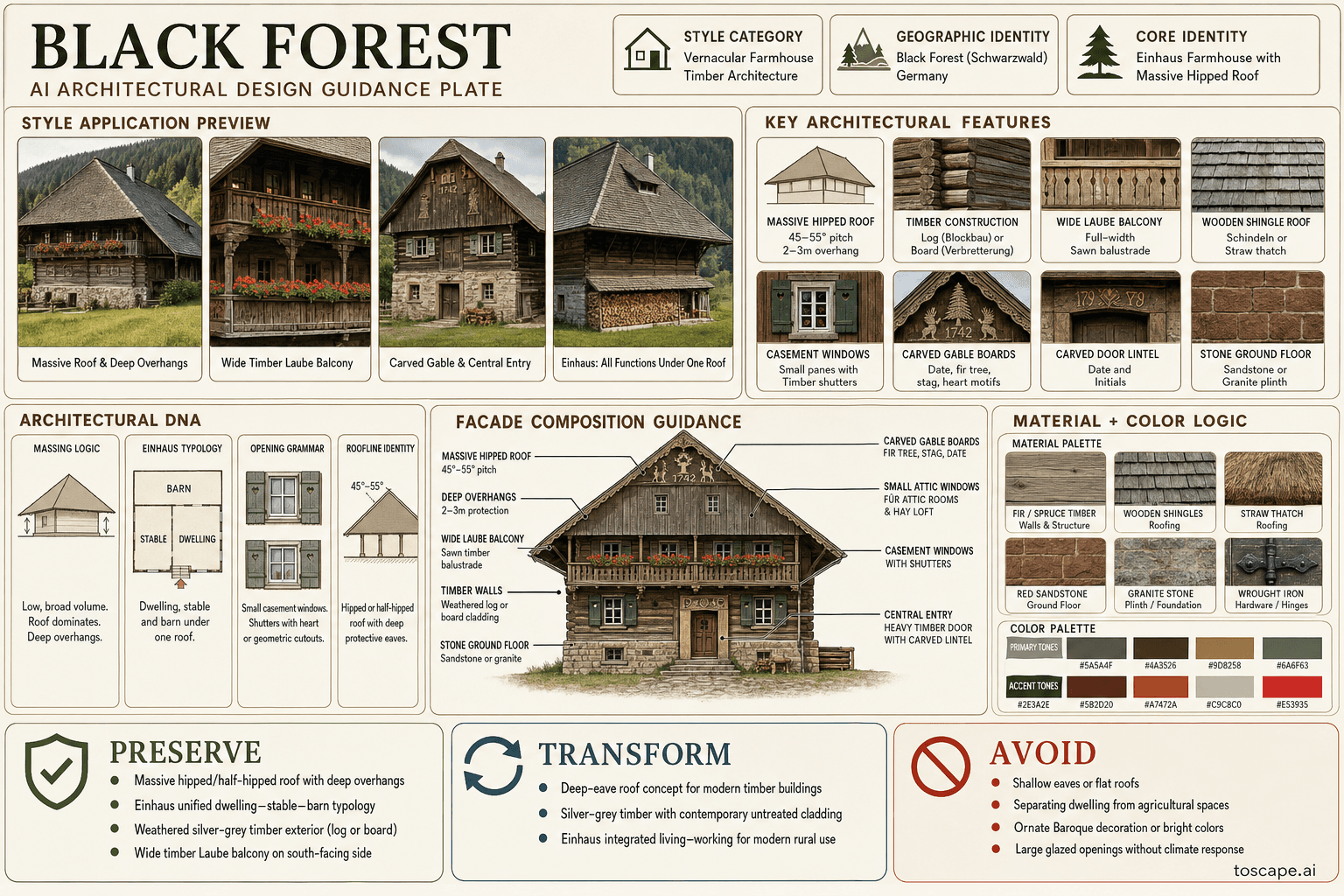
Black Forest
Germany · Black Forest / Schwarzwald
Schwarzwaldhaus Timber Farmhouse, Massive Hipped Roof & High Forest Vernacular
Definition
Black Forest is a regional architectural identity from Germany. Schwarzwaldhaus Timber Farmhouse, Massive Hipped Roof & High Forest Vernacular.
- Country
- Germany
- Region
- Black Forest / Schwarzwald.
- Massing
- Schwarzwaldhaus: the defining type — a massive single-volume Einhaus (unitary house) containing dwelling, stable, and barn under one enormous roof. Rectangular plan elongated along slope contour.
- Materials
- Tanne/Fichte (silver fir/spruce): primary construction timber — weathered to silver-grey when untreated, the characteristic Black Forest color. Eiche (oak): used for sills, corner posts, structural joints.
- Palette
- White, cream, pale sand, warm timber, and shadow-driven dark metal accents define the palette.
- Climate response
- High forest-subalpine: cold snowy winters (1-2m snow typical), cool wet summers, high rainfall, strong winds on exposed slopes.
Overview
Black Forest is a regional architectural identity in Germany. Black Forest / Schwarzwald — iconic Schwarzwaldhaus farmhouse architecture. Massive broad-hipped or half-hipped roof (Walmdach/Krüppelwalmdach) dominating the volume with deep overhangs sheltering all sides, timber construction — either log (Blockbau) or post-and-beam with timber cladding (Verbretterung) in weathered silver-grey, stone or rendered ground floor, wide timber balconies (Laube) with sawn balustrades on s...
Visual DNA
Massing & Form
Schwarzwaldhaus: the defining type — a massive single-volume Einhaus (unitary house) containing dwelling, stable, and barn under one enormous roof. Rectangular plan elongated along slope contour.
Facade Language
Low, broad, horizontally dominated facade — the roof is visually equal or greater than the walls. Timber walls: horizontal logs in Blockbau type creating continuous horizontal line rhythm; or vertical board cladding (Verbretterung) in frame type creating vertical rhythm.
Materials & Texture
Tanne/Fichte (silver fir/spruce): primary construction timber — weathered to silver-grey when untreated, the characteristic Black Forest color. Eiche (oak): used for sills, corner posts, structural joints.
Color Palette
White, cream, pale sand, warm timber, and shadow-driven dark metal accents define the palette. The facade should stay bright and climate-aware rather than heavy, gray, or over-saturated.
Ornament & Detail
Restrained, tectonic ornament — the Black Forest aesthetic is not Baroque like Bavaria but honest and structural. Sawn balcony balustrade: vertical boards with simple geometric cutouts — diamonds, hearts (Herz), circles (Kreis), or cross motifs.
Climate Response
High forest-subalpine: cold snowy winters (1-2m snow typical), cool wet summers, high rainfall, strong winds on exposed slopes. The massive roof with deep overhangs is the primary climate response: snow slides off steep pitch rather than accumulating, deep eaves protect timber walls and foundation from rain and snow, o...
Landscape & Ground
Black Forest / Schwarzwald — iconic Schwarzwaldhaus farmhouse architecture. High forest-subalpine: cold snowy winters (1-2m snow typical), cool wet summers, high rainfall, strong winds on exposed slopes.
Reference elevation
Black Forest — characteristic facade composition, Black Forest / Schwarzwald.
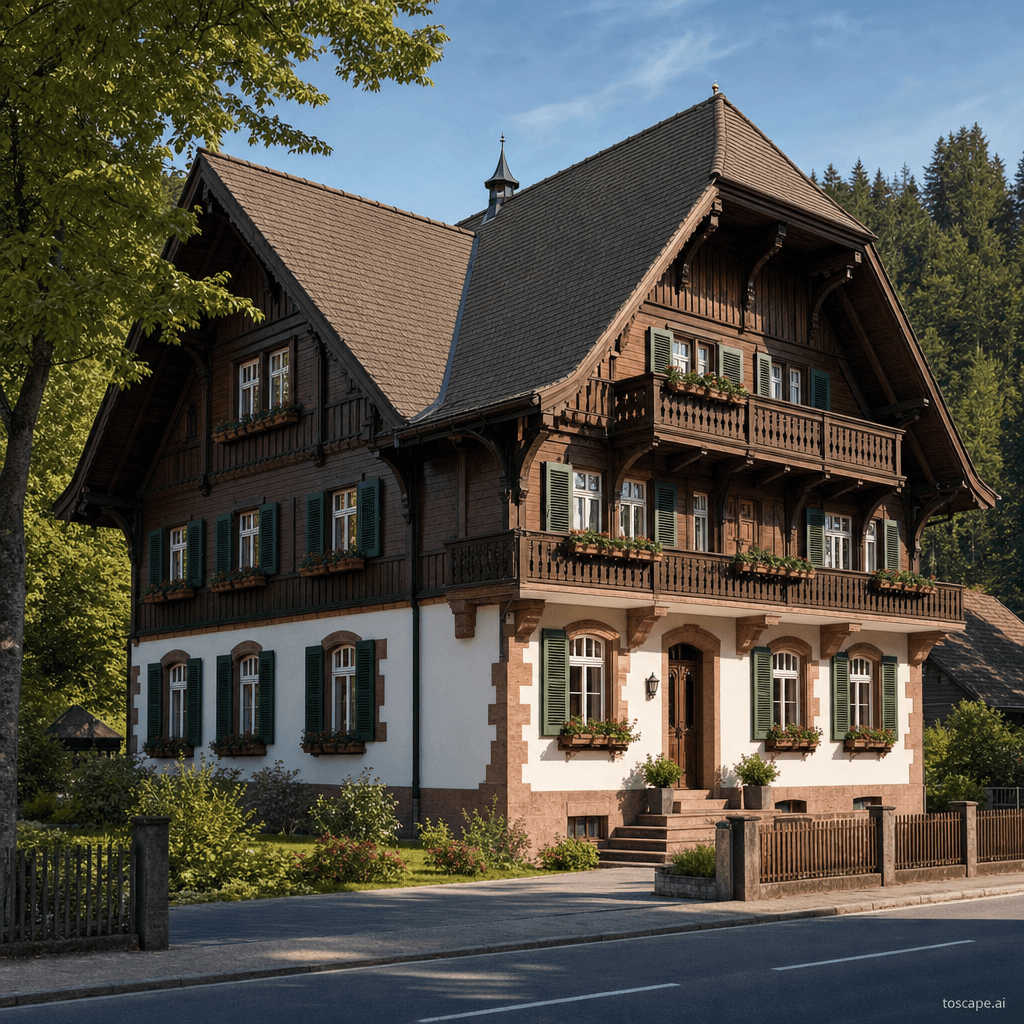
Context Snapshot
Black Forest / Schwarzwald — iconic Schwarzwaldhaus farmhouse architecture High forest-subalpine: cold snowy winters (1-2m snow typical), cool wet summers, high rainfall, strong winds on exposed slopes.
Contemporary Relevance
Black Forest is useful today for residential, hospitality, civic, and place-branding work that needs Germany-specific character grounded in local massing, material tone, climate response, and settlement logic rather than generic international styling.
Use this style in Toscape
Explore Black Forest directly inside Toscape using the Facade Re-Style and Design Options workflows.
Open Black Forest in the galleryFrequently asked questions
What is Black Forest?
Black Forest is a regional architectural identity from Germany. Schwarzwaldhaus Timber Farmhouse, Massive Hipped Roof & High Forest Vernacular.
What materials define Black Forest?
Tanne/Fichte (silver fir/spruce): primary construction timber — weathered to silver-grey when untreated, the characteristic Black Forest color. Eiche (oak): used for sills, corner posts, structural joints.
What is the Black Forest color palette?
White, cream, pale sand, warm timber, and shadow-driven dark metal accents define the palette. The facade should stay bright and climate-aware rather than heavy, gray, or over-saturated.
Where does Black Forest come from?
Black Forest / Schwarzwald — iconic Schwarzwaldhaus farmhouse architecture High forest-subalpine: cold snowy winters (1-2m snow typical), cool wet summers, high rainfall, strong winds on exposed slopes.
When should architects use Black Forest?
Black Forest is useful today for residential, hospitality, civic, and place-branding work that needs Germany-specific character grounded in local massing, material tone, climate response, and settlement logic rather than generic international styling.
How do you render Black Forest in Toscape?
Open Toscape on Windows, load your own photo, elevation, sketch, or CAD view, then apply the Black Forest reference from the built-in style library. The Facade Re-Style and Design Options workflows keep your project geometry and camera while shifting materials, proportion, and detailing toward Black Forest.