Brittany
France · Brittany peninsula (Finistère, Côtes-d'Armor, Morbihan, Ille-et-Vilaine)
Breton Granite, Slate Roofs & Celtic Maritime Vernacular
Definition
Brittany is a regional architectural identity from France. Breton Granite, Slate Roofs & Celtic Maritime Vernacular.
- Country
- France
- Region
- Brittany peninsula (Finistère, Côtes-d'Armor, Morbihan, Ille-et-Vilaine).
- Massing
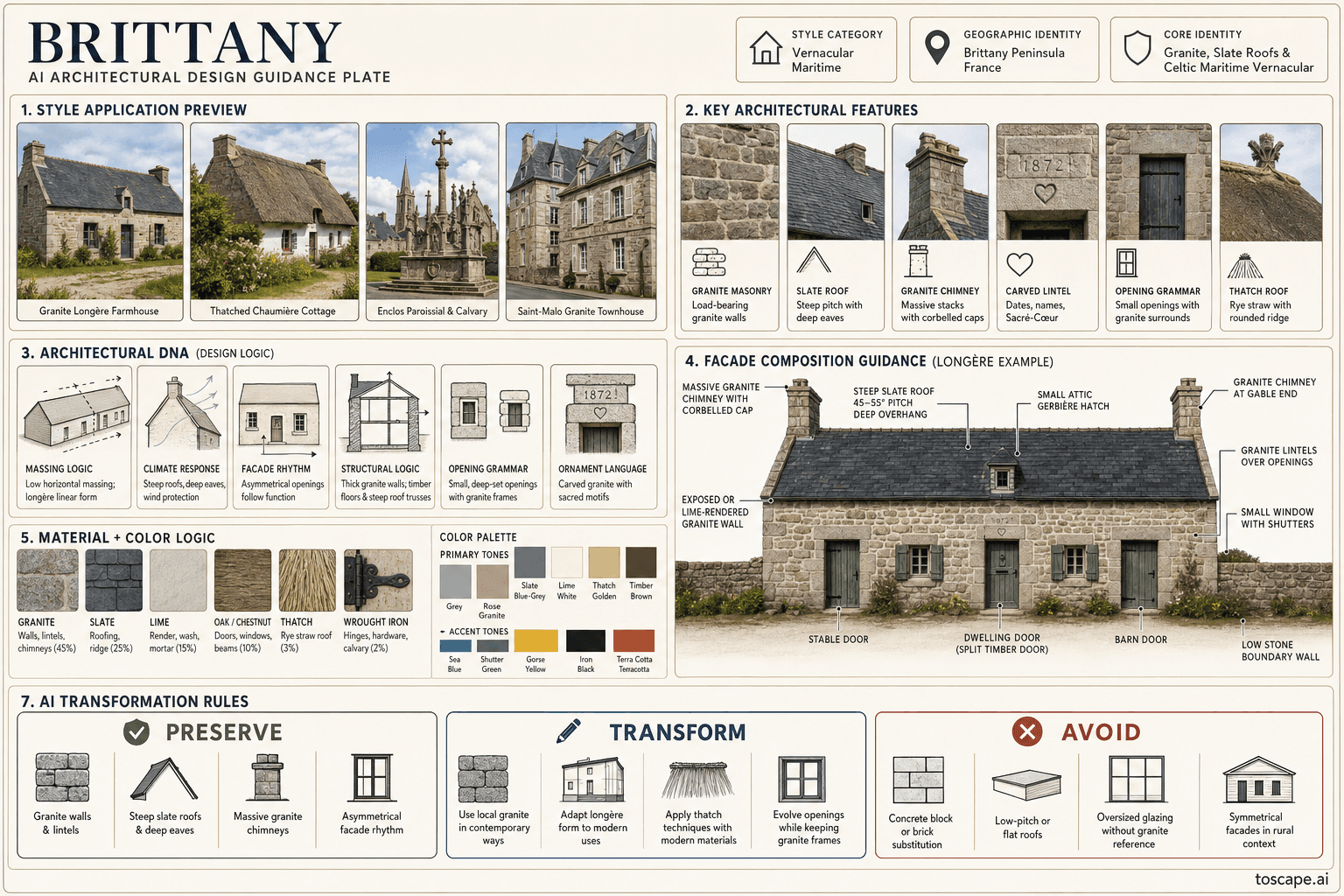
- Low horizontal massing in countryside: single-story with attic, 2-3 bay width, rectangular plan elongated east-west for sun. Taller urban forms in Saint-Malo: 3-4 story granite townhouses.
- Materials
- Granit (granite): grey (gris — predominant), rose/pink (rose — Côtes-d'Armor coast), blue-grey (bleu de Lanhélin) — walls, lintels, chimneys, calvaries, paving.
- Palette
- White, cream, pale sand, warm timber, and shadow-driven dark metal accents define the palette.
- Climate response
- Oceanic maritime: mild wet winters, cool summers, strong Atlantic winds (suroît — southwesterly), high rainfall, salt spray. Granite: near-indestructible in wet maritime climate, resists salt erosion.
Try it free
Render your own project in this style
Upload one photo of your own project and Re-Render keeps the geometry and camera while carrying the Brittany language into materials, proportion, and detail. Three free renders, no account needed.
Open Re-Render - freeOverview
Brittany is a regional architectural identity in France. Brittany peninsula (Finistère, Côtes-d'Armor, Morbihan, Ille-et-Vilaine) — granite maritime architecture. Grey and rose granite (granit gris/rose) load-bearing masonry, steep dark blue-grey slate roofs (ardoise d'Angers), massive granite chimney stacks with decorated caps, white-lime-rendered or exposed granite facades, thatched cottage (chaumière) in interior, enclosed parish architecture (enclos paroissial) with ca...
Visual DNA
Massing & Form
Low horizontal massing in countryside: single-story with attic, 2-3 bay width, rectangular plan elongated east-west for sun. Taller urban forms in Saint-Malo: 3-4 story granite townhouses.
Facade Language
Asymmetrical facade organization: door offset from center, windows irregularly spaced to reflect internal function. Granite lintels and jambs framing white-lime rendered wall panels, or entire facade in exposed granite (pierre apparente).
Materials & Texture
Granit (granite): grey (gris — predominant), rose/pink (rose — Côtes-d'Armor coast), blue-grey (bleu de Lanhélin) — walls, lintels, chimneys, calvaries, paving. Ardoise (slate): dark blue-grey, split — roofing, sometimes wall cladding.
Color Palette
White, cream, pale sand, warm timber, and shadow-driven dark metal accents define the palette. The facade should stay bright and climate-aware rather than heavy, gray, or over-saturated.
Ornament & Detail
Carved granite: the primary ornament — door lintels with date, name, sacred heart (Sacré-Cœur), IHS monogram, or Celtic motifs; calvary sculptures with detailed Passion scenes; church porch (porche) with carved apostles. Chimney cap corbelling: stepped granite projections creating architectural termination.
Climate Response
Oceanic maritime: mild wet winters, cool summers, strong Atlantic winds (suroît — southwesterly), high rainfall, salt spray. Granite: near-indestructible in wet maritime climate, resists salt erosion.
Landscape & Ground
Brittany peninsula (Finistère, Côtes-d'Armor, Morbihan, Ille-et-Vilaine) — granite maritime architecture. Oceanic maritime: mild wet winters, cool summers, strong Atlantic winds (suroît — southwesterly), high rainfall, salt spray.
Reference elevation
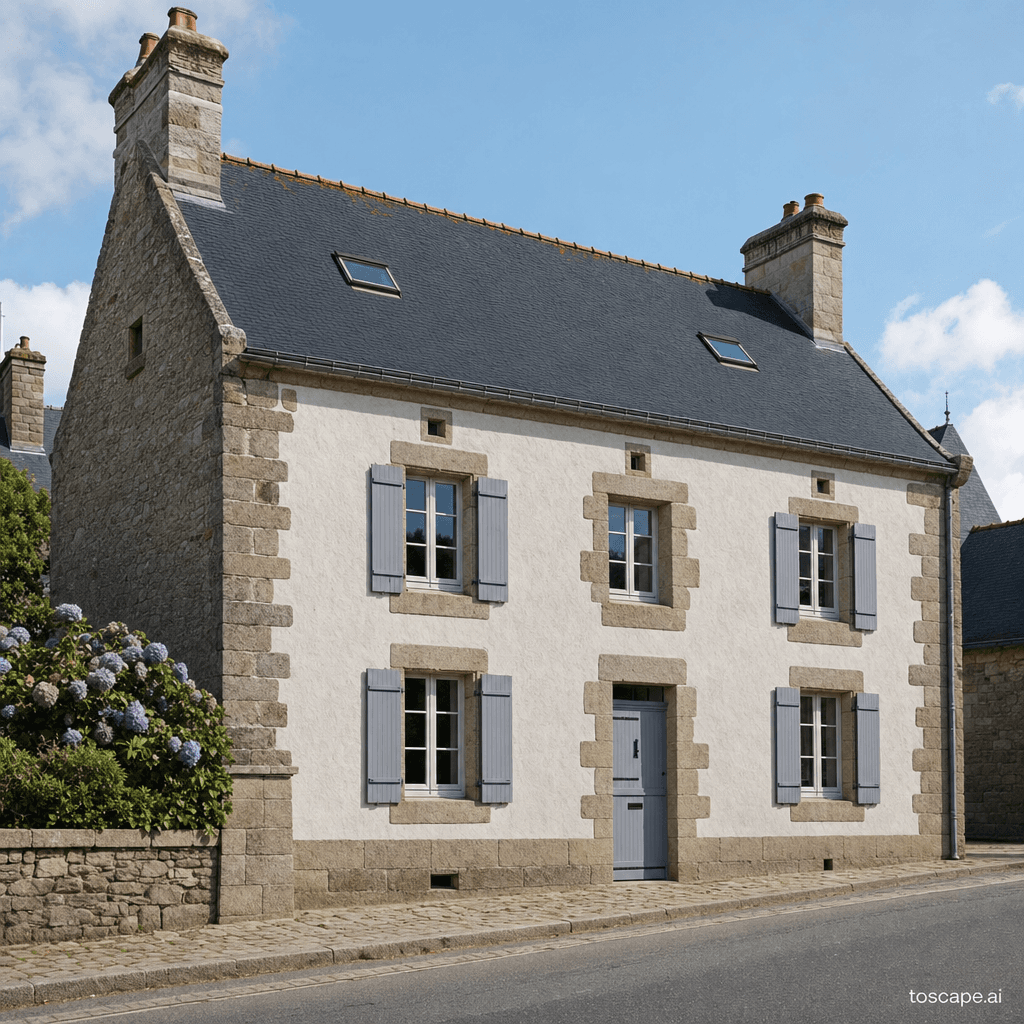
Brittany — characteristic facade composition, Brittany peninsula (Finistère, Côtes-d'Armor, Morbihan, Ille-et-Vilaine).
Context Snapshot
Brittany peninsula (Finistère, Côtes-d'Armor, Morbihan, Ille-et-Vilaine) — granite maritime architecture Oceanic maritime: mild wet winters, cool summers, strong Atlantic winds (suroît — southwesterly), high rainfall, salt spray.
Contemporary Relevance
Brittany is useful today for residential, hospitality, civic, and place-branding work that needs France-specific character grounded in local massing, material tone, climate response, and settlement logic rather than generic international styling.
Use this style in Toscape
Explore Brittany directly inside Toscape using the Facade Re-Style and Design Options workflows.
Open Brittany in the galleryFrequently asked questions
What is Brittany?
Brittany is a regional architectural identity from France. Breton Granite, Slate Roofs & Celtic Maritime Vernacular.
What materials define Brittany?
Granit (granite): grey (gris — predominant), rose/pink (rose — Côtes-d'Armor coast), blue-grey (bleu de Lanhélin) — walls, lintels, chimneys, calvaries, paving. Ardoise (slate): dark blue-grey, split — roofing, sometimes wall cladding.
What is the Brittany color palette?
White, cream, pale sand, warm timber, and shadow-driven dark metal accents define the palette. The facade should stay bright and climate-aware rather than heavy, gray, or over-saturated.
Where does Brittany come from?
Brittany peninsula (Finistère, Côtes-d'Armor, Morbihan, Ille-et-Vilaine) — granite maritime architecture Oceanic maritime: mild wet winters, cool summers, strong Atlantic winds (suroît — southwesterly), high rainfall, salt spray.
When should architects use Brittany?
Brittany is useful today for residential, hospitality, civic, and place-branding work that needs France-specific character grounded in local massing, material tone, climate response, and settlement logic rather than generic international styling.
How do you render Brittany in Toscape?
Load your project image in Toscape, select the Brittany reference, and process the run. The Facade Re-Style and Design Options workflows preserve the existing geometry and viewpoint while redirecting materials, proportion, and detail toward Brittany.
Other regional identities from France
- NormandyNorman Half-Timbered, Thatch & Slate Roofs & Pays d'Auge Vernacular.
- ProvenceProvençal Mas, Roman Tile & Limestone-Ochre Mediterranean Identity.
- Savoy AlpsSavoyard Chalet, Stone-Base Timber & Alpine Snow-Country Vernacular.
- AlsaceHalf-Timbered Colombage, Steep Tile Roofs & Rhine Valley Polychrome Vernacular.
- Basque CountryLabourdine Half-Timbered, Red-and-White Facades & Pyrenean Atlantic Vernacular.