Cairo Islamic
Egypt · Islamic urban architecture of Historic Cairo (Al-Qahira) and the Nile Delta regi...
The Mamluk-Ottoman urban morphology of Historic Cairo — courtyard houses, mashrabiya screens, and the enduring Islamic architectural identity of the Nile Delta capital
Definition
Cairo Islamic is a regional architectural identity from Egypt. The Mamluk-Ottoman urban morphology of Historic Cairo — courtyard houses, mashrabiya screens, and the enduring Islamic architectural identity of the Nile Delta capital.
- Country
- Egypt
- Region
- Islamic urban architecture of Historic Cairo (Al-Qahira) and the Nile Delta regi.
- Massing
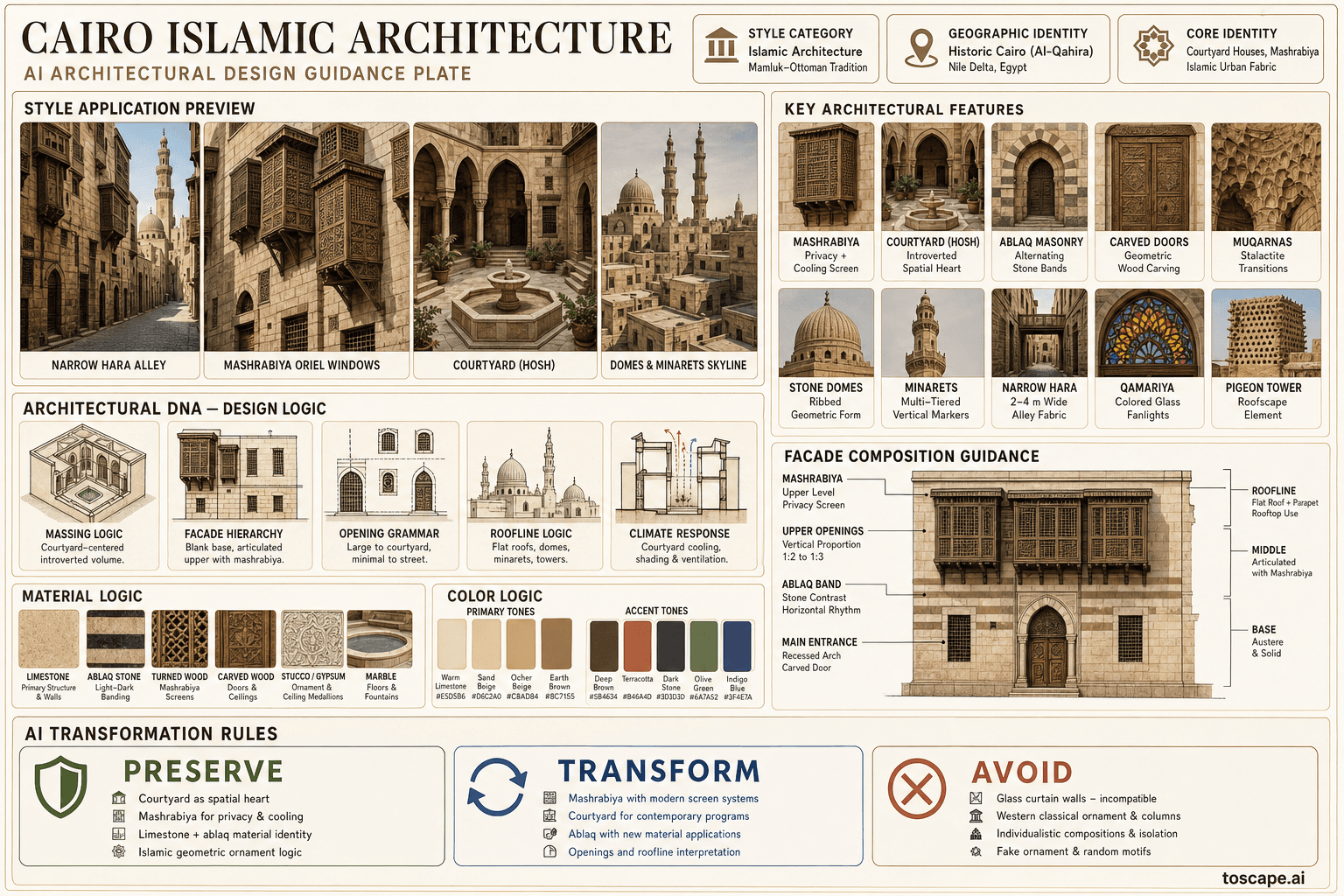
- The Cairene house is a multi-storey (2–4 storeys) courtyard-centered volume — typically 8–15 m wide × 12–25 m deep.
- Materials
- Mokattam limestone — primary structural and facing material, warm beige-to-golden color range Ablaq — alternating light and dark stone courses (white limestone + red/brown or black.
- Palette
- White, cream, pale sand, warm timber, and shadow-driven dark metal accents define the palette.
- Climate response
- The architecture is a direct response to the hot-arid Cairo climate: (1) Courtyard as microclimate regulator — provides shade, evaporative cooling via fountain.
Overview
Cairo Islamic is a regional architectural identity in Egypt. Traditional Islamic urban architecture of Historic Cairo (Al-Qahira) and the Nile Delta region — a UNESCO World Heritage site since 1979, representing one of the world's oldest and most intact Islamic urban fabrics, defined by courtyard houses, intricately turned-wood mashrabiya screens, stone domes, and a city fabric organized around the hara (alley-neighborhood) system. Introverted courtyard house (al-bayt al-arabi...
Visual DNA
Massing & Form
The Cairene house is a multi-storey (2–4 storeys) courtyard-centered volume — typically 8–15 m wide × 12–25 m deep. The plan is inwardly oriented: blank external walls facing the narrow alley (hara), with all major rooms opening onto the central courtyard.
Facade Language
The Cairene street facade is characterized by blank austerity punctuated by highly articulated projections: Mashrabiya: The defining Cairene facade element — projecting timber oriel bay windows, enclosed by intricate turned-wood lattice screens. Mashrabiya serve triple functions: privacy (residents can see out, street...
Materials & Texture
Mokattam limestone — primary structural and facing material, warm beige-to-golden color range Ablaq — alternating light and dark stone courses (white limestone + red/brown or black basalt) Turned wood (kharat) — for mashrabiya screens, sourced from local hardwoods (sycamore, walnut) Carved and painted wood — for doors...
Color Palette
White, cream, pale sand, warm timber, and shadow-driven dark metal accents define the palette. The facade should stay bright and climate-aware rather than heavy, gray, or over-saturated.
Ornament & Detail
Islamic geometric ornament governs all decorative expression: (1) geometric star patterns — 8-point and 12-point star compositions in wood, stone, and stucco, (2) arabesque — flowing vegetal scrollwork on wood and plaster, (3) calligraphic inscriptions — Quranic verses in thuluth and kufic scripts carved on stone and w...
Climate Response
The architecture is a direct response to the hot-arid Cairo climate: (1) Courtyard as microclimate regulator — provides shade, evaporative cooling via fountain, and thermal chimney effect for hot air exhaust. (2) Mashrabiya as passive cooling device — filters dust, reduces solar gain, accelerates breeze velocity throug...
Landscape & Ground
Traditional Islamic urban architecture of Historic Cairo (Al-Qahira) and the Nile Delta region — a UNESCO World Heritage site since 1979, representing one of the world's oldest and most intact Islamic urban fabrics, defined by courtyard houses, intricately turned-wood mashrabiya screens, stone domes, and a city fabric...
Reference elevation
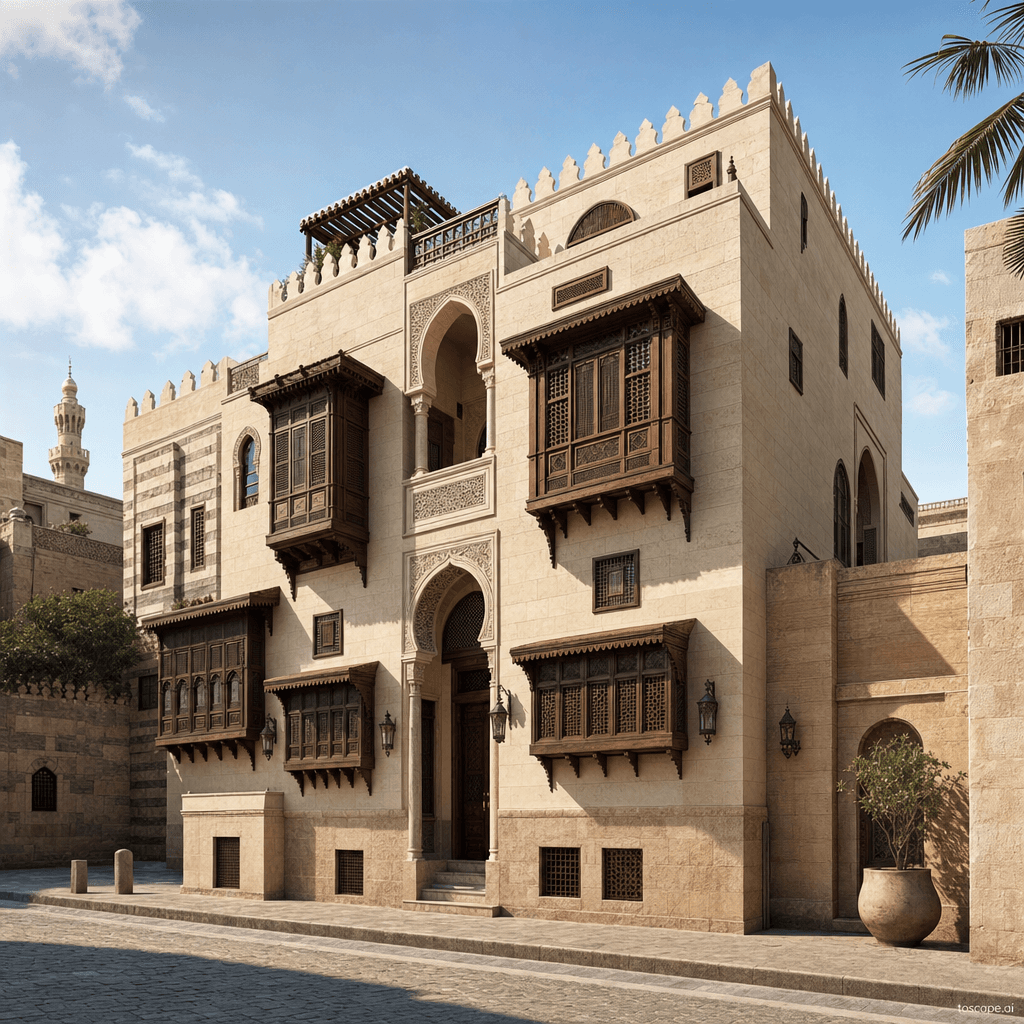
Cairo Islamic — characteristic facade composition, Islamic urban architecture of Historic Cairo (Al-Qahira) and the Nile Delta regi....
Context Snapshot
Traditional Islamic urban architecture of Historic Cairo (Al-Qahira) and the Nile Delta region — a UNESCO World Heritage site since 1979, representing one of the world's oldest and most intact Islamic... The architecture is a direct response to the hot-arid Cairo climate: (1) Courtyard as microclimate regulator — provides shade, evaporative cooling via fountain, and thermal chimney effect for hot air exhaust.
Contemporary Relevance
Cairo Islamic is useful today for residential, hospitality, civic, and place-branding work that needs Egypt-specific character grounded in local massing, material tone, climate response, and settlement logic rather than generic international styling.
Use this style in Toscape
Explore Cairo Islamic directly inside Toscape using the Facade Re-Style and Design Options workflows.
Open Cairo Islamic in the galleryFrequently asked questions
What is Cairo Islamic?
Cairo Islamic is a regional architectural identity from Egypt. The Mamluk-Ottoman urban morphology of Historic Cairo — courtyard houses, mashrabiya screens, and the enduring Islamic architectural identity of the Nile Delta capital.
What materials define Cairo Islamic?
Mokattam limestone — primary structural and facing material, warm beige-to-golden color range Ablaq — alternating light and dark stone courses (white limestone + red/brown or black basalt) Turned wood (kharat) — for mashrabiya screens, sourced from local hardwoods (sycamore, walnut) Carved and painted wood — for doors.
What is the Cairo Islamic color palette?
White, cream, pale sand, warm timber, and shadow-driven dark metal accents define the palette. The facade should stay bright and climate-aware rather than heavy, gray, or over-saturated.
Where does Cairo Islamic come from?
Traditional Islamic urban architecture of Historic Cairo (Al-Qahira) and the Nile Delta region — a UNESCO World Heritage site since 1979, representing one of the world's oldest and most intact Islamic.
When should architects use Cairo Islamic?
Cairo Islamic is useful today for residential, hospitality, civic, and place-branding work that needs Egypt-specific character grounded in local massing, material tone, climate response, and settlement logic rather than generic international styling.
How do you render Cairo Islamic in Toscape?
Open Toscape on Windows, load your own photo, elevation, sketch, or CAD view, then apply the Cairo Islamic reference from the built-in style library. The Facade Re-Style and Design Options workflows keep your project geometry and camera while shifting materials, proportion, and detailing toward Cairo Islamic.