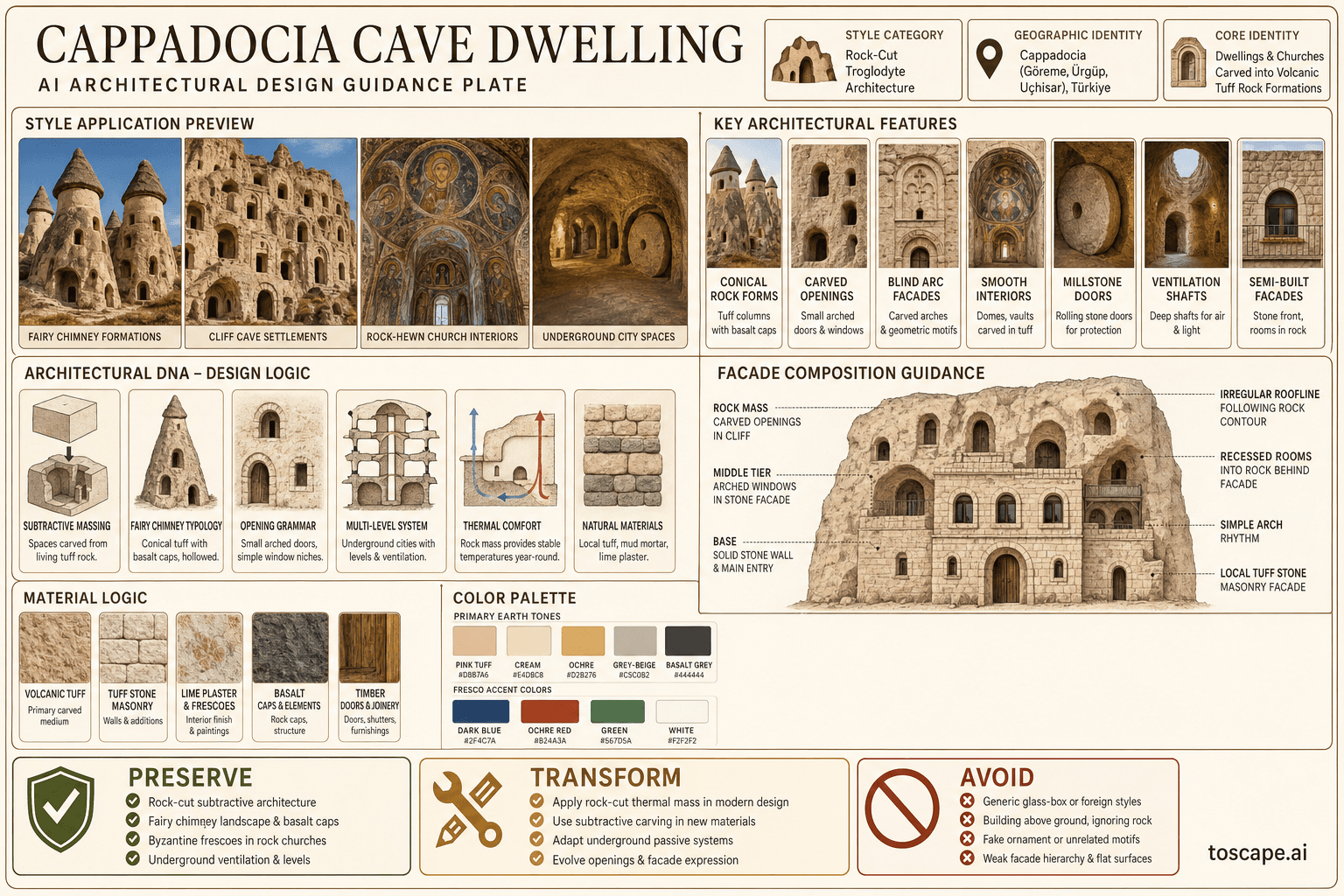
Cappadocia Cave Dwelling
Turkey · Cappadocia (Göreme, Ürgüp, Uçhisar)
Rock-Cut Architecture, Fairy Chimney Cones & Volcanic Tuff Troglodyte Settlements
Definition
Cappadocia Cave Dwelling is a regional architectural identity from Turkey. Rock-Cut Architecture, Fairy Chimney Cones & Volcanic Tuff Troglodyte Settlements.
- Country
- Turkey
- Region
- Cappadocia (Göreme, Ürgüp, Uçhisar).
- Massing
- Carved (subtractive) rather than built (additive) architecture — interiors carved from monolithic tuff formations. Fairy chimneys: conical rock formations with harder basalt caps, hollowed for dwellings.
- Materials
- Volcanic tuff (ignimbrite) — the primary medium: pink, cream, ochre, and grey-beige tones. Basalt — caps on fairy chimneys, structural elements.
- Palette
- White, cream, pale sand, warm timber, and shadow-driven dark metal accents define the palette.
- Climate response
- Continental semi-arid plateau (1000-1200m): hot summers, cold winters with snow. Rock-cut dwellings provide natural thermal insulation — stable interior temperatures year-round (15-18°C).
Overview
Cappadocia Cave Dwelling is a regional architectural identity in Turkey. Cappadocia (Göreme, Ürgüp, Uçhisar) — world's most extensive rock-cut architecture in soft volcanic tuff. Dwellings and churches carved into volcanic tuff (ignimbrite), fairy chimney rock formations (peribacası) with conical caps, underground cities (Derinkuyu, Kaymaklı), smooth sculpted interiors, carved rock facades with blind arches
Visual DNA
Massing & Form
Carved (subtractive) rather than built (additive) architecture — interiors carved from monolithic tuff formations. Fairy chimneys: conical rock formations with harder basalt caps, hollowed for dwellings.
Facade Language
Rock-cut church/monastery: carved blind arcades, niches, and geometric patterns directly on cliff face — facade as sculpture. Tokalı and Karanlık churches: rhythmic blind arches and pilasters carved into tuff.
Materials & Texture
Volcanic tuff (ignimbrite) — the primary medium: pink, cream, ochre, and grey-beige tones. Basalt — caps on fairy chimneys, structural elements.
Color Palette
White, cream, pale sand, warm timber, and shadow-driven dark metal accents define the palette. The facade should stay bright and climate-aware rather than heavy, gray, or over-saturated.
Ornament & Detail
Carved rock facades: blind arches, pilasters, geometric patterns, cross-in-square motifs — all carved from living rock. Frescoes: Byzantine-style wall paintings in rock churches (Karanlık, Tokalı, Elmalı) — Christ Pantocrator in dome, biblical scenes, saints in niches.
Climate Response
Continental semi-arid plateau (1000-1200m): hot summers, cold winters with snow. Rock-cut dwellings provide natural thermal insulation — stable interior temperatures year-round (15-18°C).
Landscape & Ground
Cappadocia (Göreme, Ürgüp, Uçhisar) — world's most extensive rock-cut architecture in soft volcanic tuff. Continental semi-arid plateau (1000-1200m): hot summers, cold winters with snow.
Reference elevation
Cappadocia Cave Dwelling — characteristic facade composition, Cappadocia (Göreme, Ürgüp, Uçhisar).
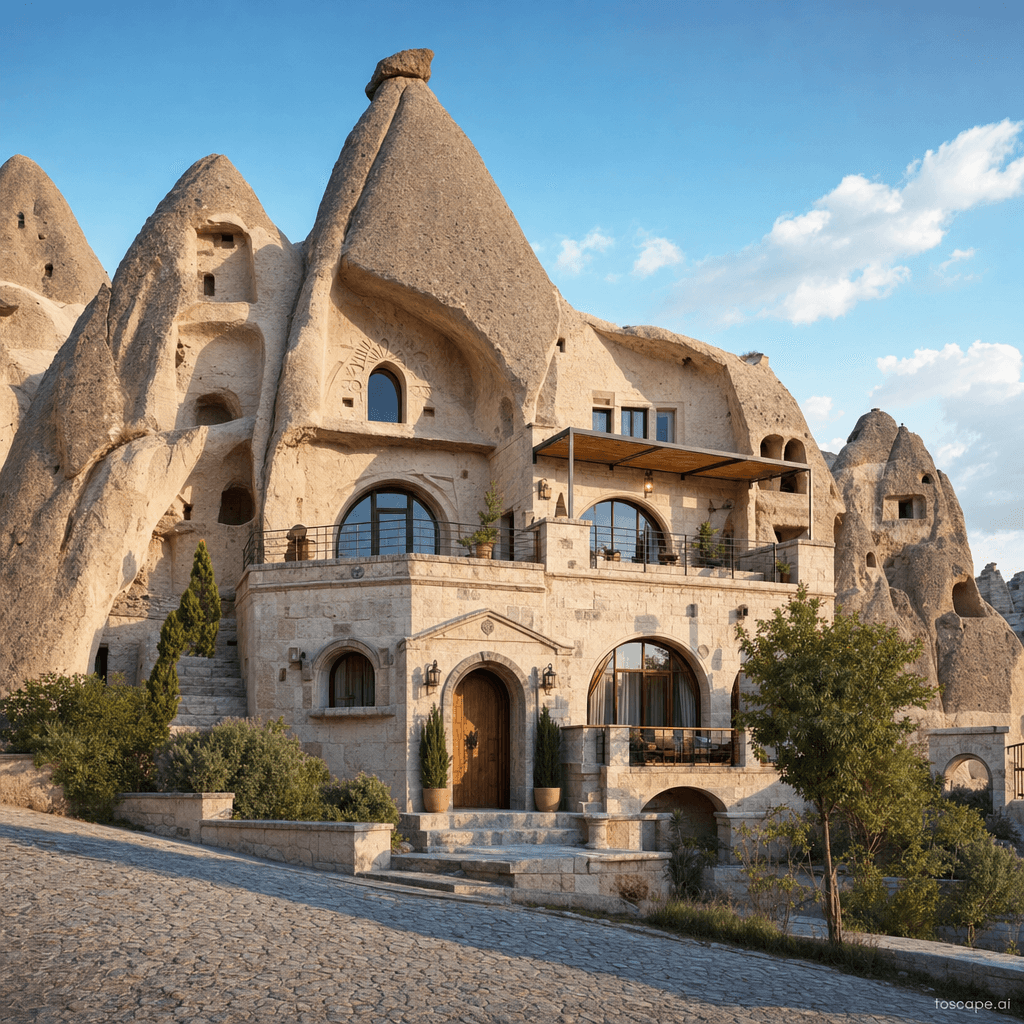
Context Snapshot
Cappadocia (Göreme, Ürgüp, Uçhisar) — world's most extensive rock-cut architecture in soft volcanic tuff Continental semi-arid plateau (1000-1200m): hot summers, cold winters with snow.
Contemporary Relevance
Cappadocia Cave Dwelling is useful today for residential, hospitality, civic, and place-branding work that needs Turkey-specific character grounded in local massing, material tone, climate response, and settlement logic rather than generic international styling.
Use this style in Toscape
Explore Cappadocia Cave Dwelling directly inside Toscape using the Facade Re-Style and Design Options workflows.
Open Cappadocia Cave Dwelling in the galleryFrequently asked questions
What is Cappadocia Cave Dwelling?
Cappadocia Cave Dwelling is a regional architectural identity from Turkey. Rock-Cut Architecture, Fairy Chimney Cones & Volcanic Tuff Troglodyte Settlements.
What materials define Cappadocia Cave Dwelling?
Volcanic tuff (ignimbrite) — the primary medium: pink, cream, ochre, and grey-beige tones. Basalt — caps on fairy chimneys, structural elements.
What is the Cappadocia Cave Dwelling color palette?
White, cream, pale sand, warm timber, and shadow-driven dark metal accents define the palette. The facade should stay bright and climate-aware rather than heavy, gray, or over-saturated.
Where does Cappadocia Cave Dwelling come from?
Cappadocia (Göreme, Ürgüp, Uçhisar) — world's most extensive rock-cut architecture in soft volcanic tuff Continental semi-arid plateau (1000-1200m): hot summers, cold winters with snow.
When should architects use Cappadocia Cave Dwelling?
Cappadocia Cave Dwelling is useful today for residential, hospitality, civic, and place-branding work that needs Turkey-specific character grounded in local massing, material tone, climate response, and settlement logic rather than generic international styling.
How do you render Cappadocia Cave Dwelling in Toscape?
Open Toscape on Windows, load your own photo, elevation, sketch, or CAD view, then apply the Cappadocia Cave Dwelling reference from the built-in style library. The Facade Re-Style and Design Options workflows keep your project geometry and camera while shifting materials, proportion, and detailing toward Cappadocia Cave Dwelling.