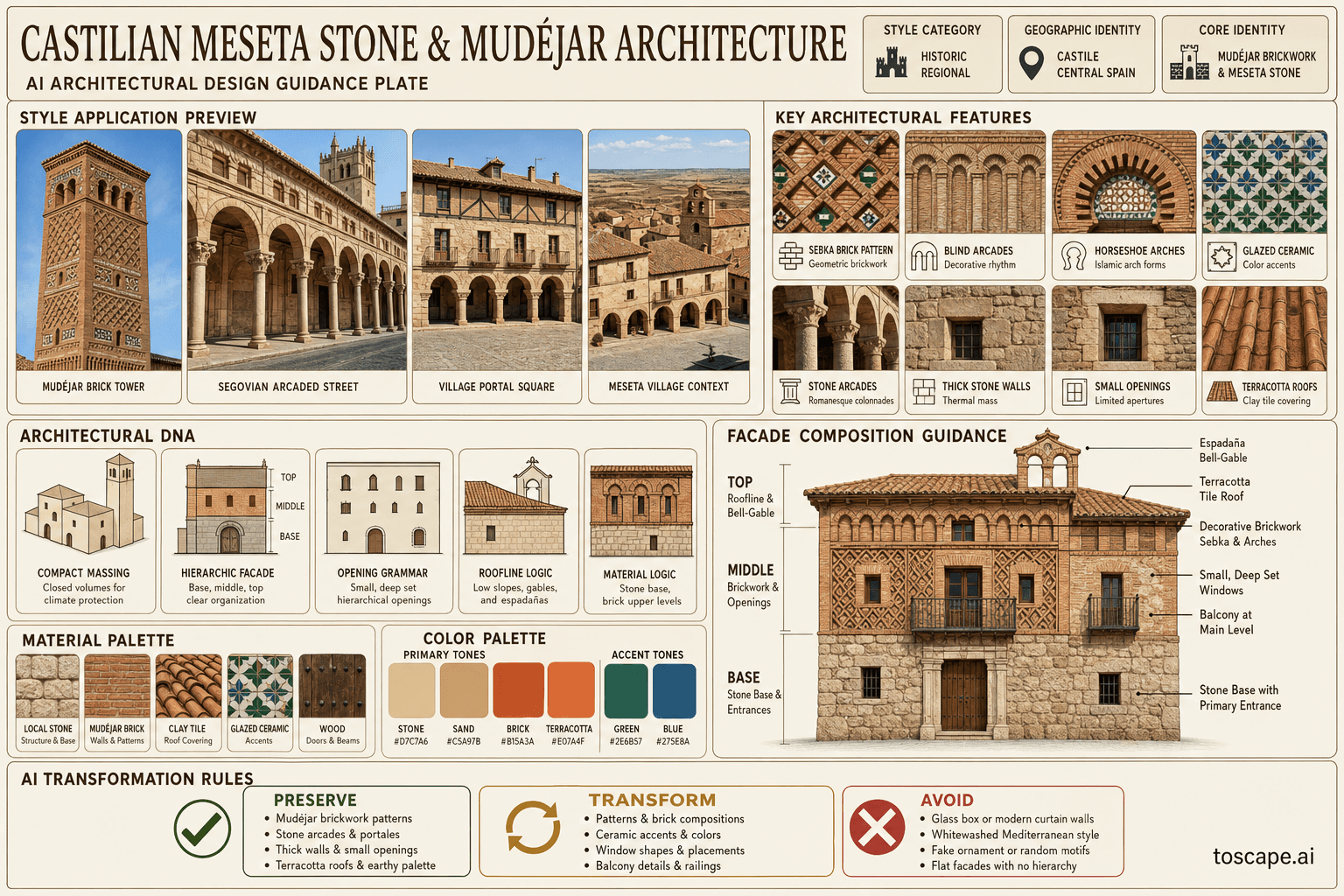
Castilian Meseta Stone & Mudéjar
Spain · Castile
The austere stone and brick architecture of the Spanish central plateau — Mudéjar towers and Segovian Romanesque
Definition
Castilian Meseta Stone & Mudéjar is a regional architectural identity from Spain. The austere stone and brick architecture of the Spanish central plateau — Mudéjar towers and Segovian Romanesque.
- Country
- Spain
- Region
- Castile
- Massing
- Segovia's Romanesque stone arcaded streets and the Mudéjar brick towers of Aragón and Toledo — two expressions of the Castilian plateau.
- Palette
- Warm earth, sandy beige, ochre, clay brown, and sun-softened mineral tones should dominate, with palm green or weathered timber as secondary accents.
- Climate response
- Traditional architecture of Castile — the vast, arid central plateau (meseta) of Spain.
Overview
Castilian Meseta Stone & Mudéjar is a regional architectural identity in Spain. Traditional architecture of Castile — the vast, arid central plateau (meseta) of Spain, defined by extreme continental climate and the Mudéjar architectural tradition (Islamic-inspired brickwork in Christian contexts). Segovia's Romanesque stone arcaded streets and the Mudéjar brick towers of Aragón and Toledo — two expressions of the Castilian plateau.
Visual DNA
Massing & Form
Segovia's Romanesque stone arcaded streets and the Mudéjar brick towers of Aragón and Toledo — two expressions of the Castilian plateau. Mudéjar architecture: brick construction with elaborate geometric brickwork patterns (sebka — diamond net, arches, blind arcades), glazed ceramic tile accents, horseshoe and multifoil...
Facade Language
Segovia's Romanesque stone arcaded streets and the Mudéjar brick towers of Aragón and Toledo — two expressions of the Castilian plateau. Mudéjar architecture: brick construction with elaborate geometric brickwork patterns (sebka — diamond net, arches, blind arcades), glazed ceramic tile accents, horseshoe and multifoil...
Materials & Texture
Segovia's Romanesque stone arcaded streets and the Mudéjar brick towers of Aragón and Toledo — two expressions of the Castilian plateau. Mudéjar architecture: brick construction with elaborate geometric brickwork patterns (sebka — diamond net, arches, blind arcades), glazed ceramic tile accents, horseshoe and multifoil...
Color Palette
Warm earth, sandy beige, ochre, clay brown, and sun-softened mineral tones should dominate, with palm green or weathered timber as secondary accents. The palette should read as land-derived rather than polished or urban-generic.
Ornament & Detail
Segovia's Romanesque stone arcaded streets and the Mudéjar brick towers of Aragón and Toledo — two expressions of the Castilian plateau. Mudéjar architecture: brick construction with elaborate geometric brickwork patterns (sebka — diamond net, arches, blind arcades), glazed ceramic tile accents, horseshoe and multifoil...
Climate Response
Traditional architecture of Castile — the vast, arid central plateau (meseta) of Spain, defined by extreme continental climate and the Mudéjar architectural tradition (Islamic-inspired brickwork in Christian contexts)
Landscape & Ground
Traditional architecture of Castile — the vast, arid central plateau (meseta) of Spain, defined by extreme continental climate and the Mudéjar architectural tradition (Islamic-inspired brickwork in Christian contexts)
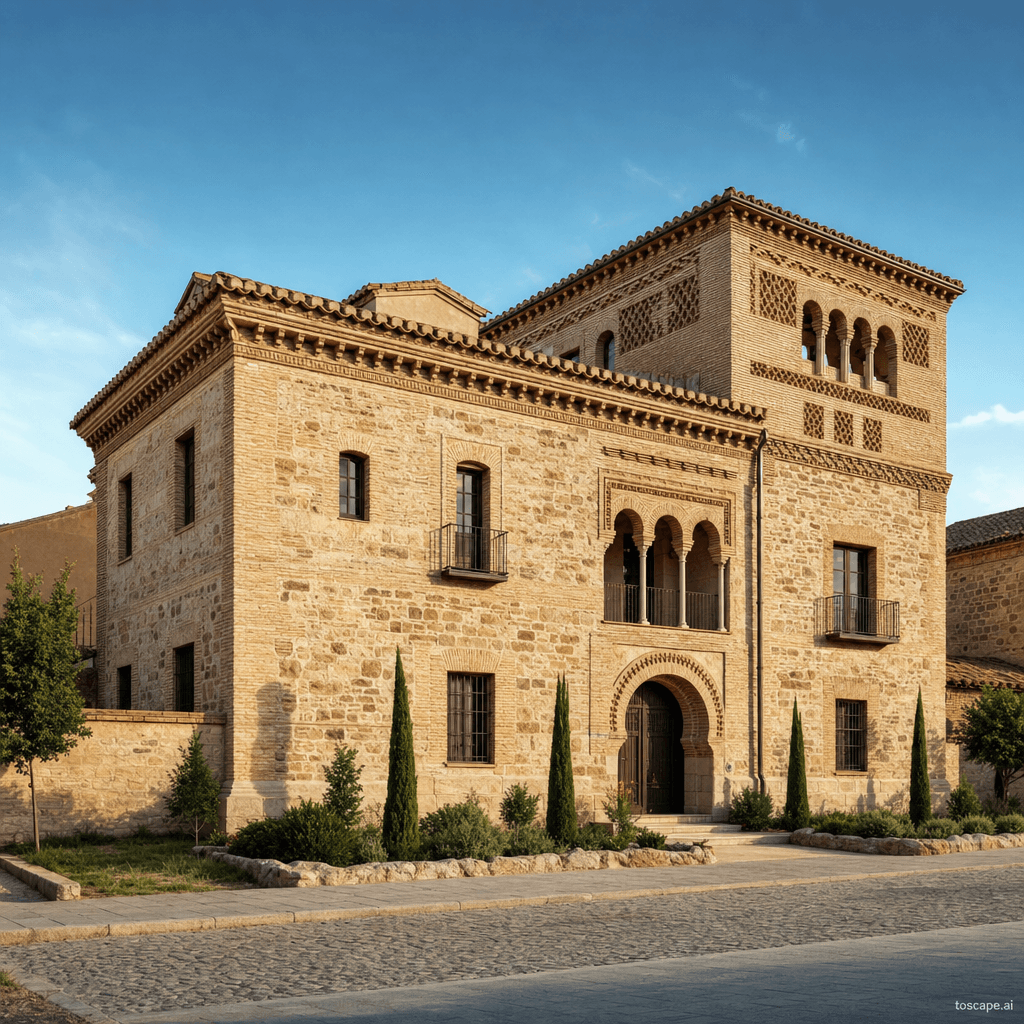
Reference elevation
Castilian Meseta Stone & Mudéjar — characteristic facade composition, Castile.
Context Snapshot
Traditional architecture of Castile — the vast, arid central plateau (meseta) of Spain, defined by extreme continental climate and the Mudéjar architectural tradition (Islamic-inspired brickwork in Ch...
Contemporary Relevance
Castilian Meseta Stone & Mudéjar is useful today for residential, hospitality, civic, and place-branding work that needs Spain-specific character grounded in local massing, material tone, climate response, and settlement logic rather than generic international styling.
Use this style in Toscape
Explore Castilian Meseta Stone & Mudéjar directly inside Toscape using the Facade Re-Style and Design Options workflows.
Open Castilian Meseta Stone & Mudéjar in the galleryFrequently asked questions
What is Castilian Meseta Stone & Mudéjar?
Castilian Meseta Stone & Mudéjar is a regional architectural identity from Spain. The austere stone and brick architecture of the Spanish central plateau — Mudéjar towers and Segovian Romanesque.
What materials define Castilian Meseta Stone & Mudéjar?
Segovia's Romanesque stone arcaded streets and the Mudéjar brick towers of Aragón and Toledo — two expressions of the Castilian plateau. Mudéjar architecture: brick construction with elaborate geometric brickwork patterns (sebka — diamond net, arches, blind arcades), glazed ceramic tile accents, horseshoe and multifoil.
What is the Castilian Meseta Stone & Mudéjar color palette?
Warm earth, sandy beige, ochre, clay brown, and sun-softened mineral tones should dominate, with palm green or weathered timber as secondary accents. The palette should read as land-derived rather than polished or urban-generic.
Where does Castilian Meseta Stone & Mudéjar come from?
Traditional architecture of Castile — the vast, arid central plateau (meseta) of Spain, defined by extreme continental climate and the Mudéjar architectural tradition (Islamic-inspired brickwork in Ch.
When should architects use Castilian Meseta Stone & Mudéjar?
Castilian Meseta Stone & Mudéjar is useful today for residential, hospitality, civic, and place-branding work that needs Spain-specific character grounded in local massing, material tone, climate response, and settlement logic rather than generic international styling.
How do you render Castilian Meseta Stone & Mudéjar in Toscape?
Open Toscape on Windows, load your own photo, elevation, sketch, or CAD view, then apply the Castilian Meseta Stone & Mudéjar reference from the built-in style library. The Facade Re-Style and Design Options workflows keep your project geometry and camera while shifting materials, proportion, and detailing toward Castilian Meseta Stone & Mudéjar.